
- Home
- »
- Communications Infrastructure
- »
-
Network Switches Market Size And Share Report, 2026-2033GVR Report cover
![Network Switches Market (2026 - 2033)Report]()
Network Switches Market (2026 - 2033)
Size, Share & Trends Analysis Report By Type (Fixed Configuration Switches), By Port Speed (100 Mbps & 1 Gbps, 2.5 Gbps & 5 Gbps, 10 Gbps, 25 Gbps & 50 Gbps, 100 Gbps), By End Use, By Region, And Segment Forecasts
Market Size, 2025
$37.5BMarket Estimate, 2026
$39.5BMarket Forecast, 2033
$63.1BCAGR, 2026–2033
6.9%Network Switches Market Summary
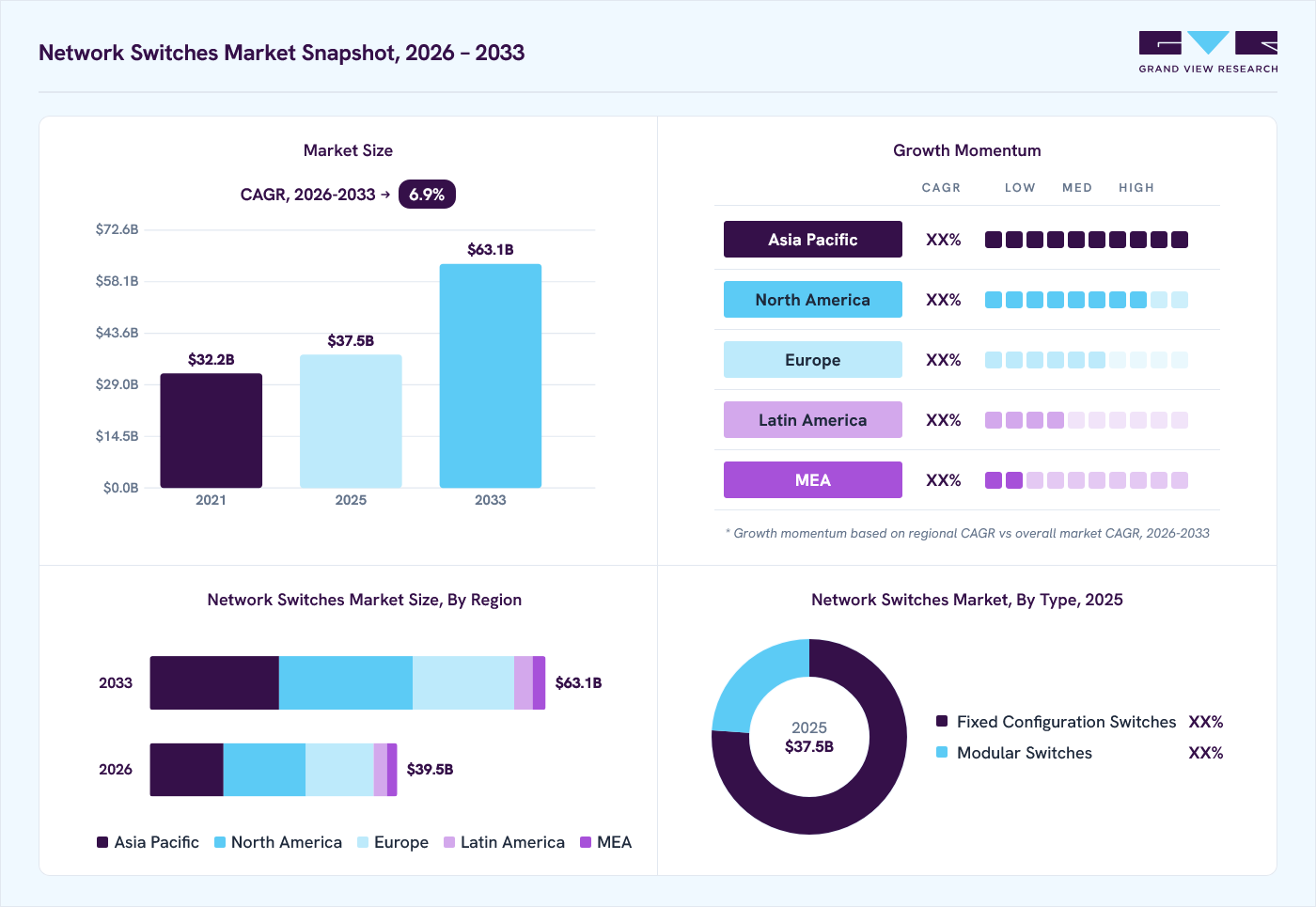
The global network switches market size was valued at USD 37.5 billion in 2025 and is projected to grow from USD 39.5 billion in 2026 to USD 63.1 billion by 2033, at a CAGR of 6.9% from 2026 to 2033. North America dominated the market, accounting for a revenue share of 33.2% in 2025. The increasing demand for data center and cloud infrastructure is driving the growth of the network switches market.
Key Market Trends & Insights
- By type: The fixed configuration switches segment dominated the market, accounting for a 76.0% share of global revenue in 2025.
- By port speed: The 100 Mbps & 1 Gbps segment held the largest market share of 42.2% in 2025.
- By end use: The telecom operators / ISPs segment accounted for the largest share of 27.1% in 2025.
Regional Highlights
- Largest regional market: North America (33.2% revenue share, 2025)
- Fastest-growing regional market: Asia Pacific (highest CAGR, 2026-2033)
- By country: The U.S. held the largest market share in 2025.
Market Size & Forecast
- Market size in 2025: USD 37.5 Billion
- Estimated market size in 2026: USD 39.5 Billion
- Projected market size by 2033: USD 63.1 Billion
- CAGR (2026-2033): 6.9%
The expansion of data center infrastructure is driving demand for network switches. Increasing adoption of cloud computing, AI, and data-intensive applications is generating higher volumes of data traffic within data centers. This is encouraging data center operators to upgrade their networking infrastructure to support faster and more reliable data transmission. The growing need for efficient connections between servers, storage systems, and other equipment is further supporting switch adoption. As data center capacity continues to expand, demand for high-performance network switches is expected to increase.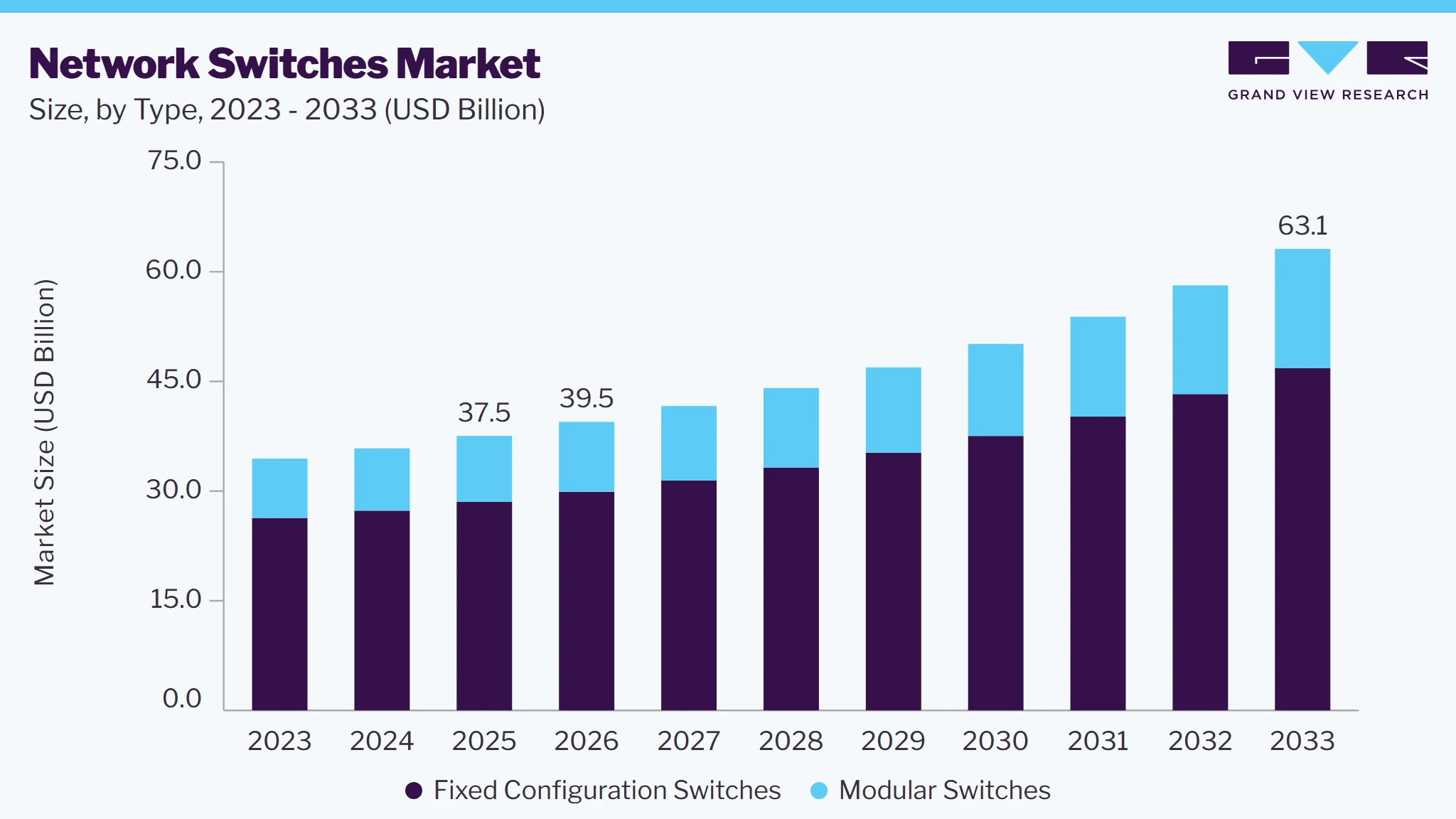
Higher-speed Ethernet is emerging as a technology trend in the network switch market. Manufacturers are developing switches that can handle growing data volumes across data centers and business networks. The increasing use of cloud services, AI applications, and other data-intensive operations is creating demand for faster network connections. This is encouraging improvements in the speed, capacity, and performance of network switches. As data traffic grows, higher-speed Ethernet is driving the development of advanced network switches.
Increasing regulatory focus on product safety is influencing the network switches market in the U.S. According to the FCC, Part 15 applies to electronic equipment, including Ethernet switches, to limit interference with other devices. Compliance requirements encourage manufacturers to ensure that network switches meet required standards before entering the U.S. market. This supports the availability of compliant products and increases customer confidence in network equipment. As businesses seek reliable and compliant networking solutions, regulatory requirements are supporting the adoption of network switches in the U.S.
High initial investment poses a restraint in the network switches market. The high cost of new switches and related equipment can limit adoption, particularly among small and medium-sized businesses. Upgrading network infrastructure may also require additional spending on installation and maintenance. These costs can lead businesses to delay network upgrades and continue using existing systems.
Market Dynamics
The network switches market is being shaped by the continued expansion of enterprise networks, cloud infrastructure, data centers, IoT deployments, and AI workloads. Increasing data traffic is raising the need for higher bandwidth, lower latency, and more scalable network infrastructure. The technology landscape is also shifting toward managed, programmable, cloud-managed, and high-speed Ethernet switches. AI and data-center applications are accelerating the transition toward 100G, 200G, 400G, 800G, and emerging 1.6T connectivity. The Ethernet Alliance identifies 800G and 1.6T as key speeds for cloud-scale and AI infrastructure, highlighting the shift toward higher-capacity networking.
The increasing volume of data generated by cloud applications, AI workloads, video services, connected devices, and enterprise applications is creating greater pressure on existing network infrastructure. Traditional network equipment may not provide sufficient bandwidth and scalability for environments handling large amounts of data simultaneously. AI infrastructure is particularly increasing network requirements because large numbers of computing accelerators need to exchange data at high speeds. This is increasing the need for network switches capable of supporting higher port speeds, greater port density, and efficient traffic management.
Network switches address this requirement by providing high-speed connectivity between servers, storage systems, computing devices, and other network equipment. Vendors are expanding their portfolios toward higher-speed Ethernet, with solutions supporting 100G, 200G, 400G, 800G, and beyond. The availability of higher-speed switching solutions enables organizations to handle increasing data volumes and improve network capacity. This transition toward high-capacity switching is supporting replacement demand and increasing revenue opportunities for advanced network switches.
Increasing network security risks are constraining the Network Switches Market. Network switches form a critical part of enterprise and data-center infrastructure, making them important components of overall network security. Increasing cyber threats and unauthorized access attempts are encouraging organizations to implement stronger security measures across network infrastructure. This can increase the complexity of switch deployment and require additional spending on secure networking technologies.
The need for stronger security can increase the overall cost and complexity of network upgrades. Organizations may need to invest in security-enabled switches, network monitoring, access controls, software, and skilled IT personnel. The impact can be greater for small and medium-sized businesses with limited cybersecurity budgets and technical resources. As a result, some organizations may delay network modernization or continue using existing equipment, slowing the adoption of advanced network switches.
The rapid deployment of AI infrastructure is creating a significant opportunity for high-performance network switches. AI workloads require large volumes of data to move among computing accelerators, storage, and servers, underscoring the importance of high-bandwidth, low-latency network infrastructure. The Ethernet Alliance's roadmap positions 400G and 800G in cloud-provider environments, while identifying 1.6T and higher speeds for AI and cloud-scale infrastructure. This is creating an opportunity for vendors to develop switches specifically optimized for AI clusters.
The opportunity is particularly strong for vendors with high-speed data-center portfolios, programmable networking platforms, and capabilities designed for large-scale AI infrastructure. High-density fixed and modular switches can support more high-speed connections within data centers. Advanced traffic management and low-latency architectures can further improve communication between computing and storage resources. As AI infrastructure expands, demand for high-speed and AI-optimized network switching solutions is expected to create new revenue opportunities across the market.
Market Concentration & Characteristics
The network switches market is moderately consolidated, indicating that the market is led by a group of established companies with strong product portfolios, technological capabilities, distribution networks, and customer relationships, while several other vendors also compete in the market. The presence of multiple suppliers prevents the market from being controlled by only a few companies. At the same time, the technical requirements of enterprise networks, data centers, and cloud infrastructure create advantages for established players with greater resources and experience. This results in a competitive market structure in which leading companies maintain significant market positions, while other vendors compete on product performance, pricing, specialized solutions, and customer support.
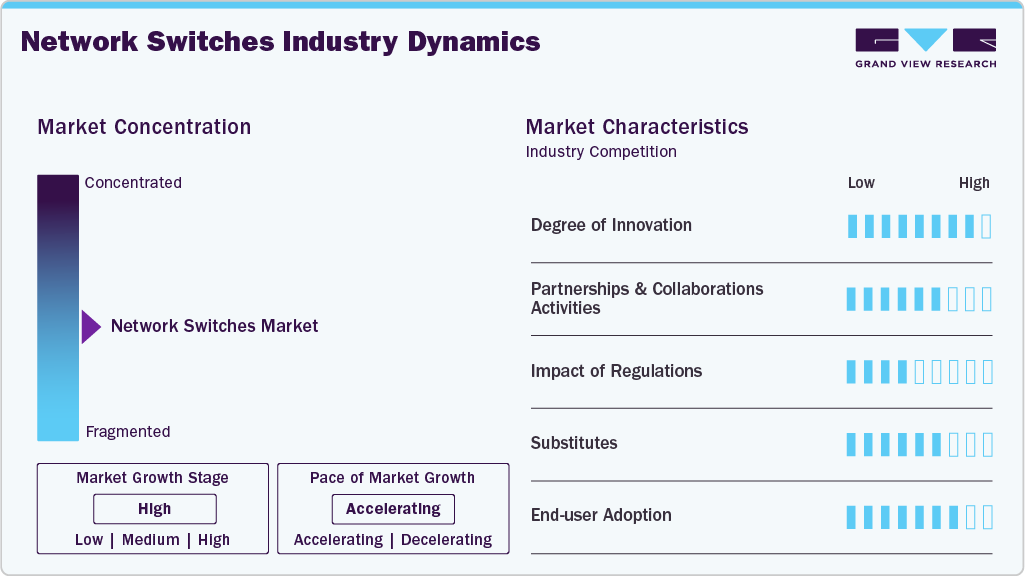
The market characteristics further support this moderately consolidated structure. The chart indicates a high degree of innovation, as companies continue to improve switch speed, capacity, energy efficiency, automation, and support for AI and data center applications. Partnerships and collaborations are also relatively high, helping companies expand their technology capabilities and market reach. The impact of regulations is moderate, while the presence of substitute technologies is relatively limited, supporting continued demand for network switches. End-user adoption is relatively high because businesses, data centers, cloud providers, and other organizations depend on network switches to connect and manage network equipment. These characteristics create strong competition while allowing established players to maintain their market positions.
Analyst Perspective
The network switches market is moving from conventional connectivity infrastructure toward higher-speed, programmable, and increasingly AI-oriented networking platforms. Growth is being driven by cloud expansion, data center modernization, IoT adoption, and rising bandwidth requirements. Technology development is increasingly focused on 400G, 800G, 1.6T, automation, telemetry, and software-driven network management. The investment direction is expected to remain concentrated in data centers, AI infrastructure, cloud networks, and high-capacity enterprise environments. Competitive positioning is also shifting toward vendors capable of combining high-performance switching hardware with automation, security, analytics, and cloud-based management.
Type Insights
The fixed configuration switches segment accounted for the largest global revenue share of 76.0% in 2025, due to their suitability for a wide range of business networking requirements. The segment is divided into unmanaged, smart, and managed switches, allowing organizations to select solutions based on their network complexity and management needs. Their relatively low cost, simple deployment, and availability at different performance levels support widespread adoption in offices, retail facilities, educational institutions, and other commercial environments. The broad applicability of these switches continues to support their strong market position.
The modular switches segment is projected to grow at the fastest CAGR over the forecast period. The modular switches segment is gaining adoption as organizations increasingly require flexible network infrastructure that can expand with changing business needs. These switches allow additional ports and other capabilities to be added as network requirements increase, reducing the need to replace equipment entirely. Growing investments in large enterprises, data centers, and complex network environments are creating opportunities for modular switches. However, higher equipment and expansion costs can limit adoption compared with those of fixed-configuration switches.
Port Speed Insights
The 100 Mbps & 1 Gbps segment accounted for the largest revenue share of 42.2% in 2025, due to continued demand for affordable and reliable network connectivity across conventional business environments. These port speeds are widely used by small and medium-sized businesses, branch offices, educational institutions, healthcare facilities, and retail establishments. Organizations continue to rely on these configurations for everyday business applications where extremely high data transfer speeds are not required. Their cost-effectiveness, established infrastructure, and broad availability support continued market adoption.
The above 200 Gbps segment is projected to grow at the fastest CAGR over the forecast period. The segment is gaining momentum as businesses and service providers handle increasing volumes of data across digital infrastructure. The expansion of cloud services, data centers, artificial intelligence, and other data-intensive applications is increasing the need for faster network connections. Data center operators and large enterprises are upgrading their infrastructure to support growing data volumes and maintain reliable connectivity. These developments are creating strong growth opportunities for network switches with speeds above 200 Gbps.
End Use Insights
The telecom operators / ISPs segment accounted for the largest market revenue share of 27.1% in 2025. The expansion of broadband, fiber connectivity, and mobile networks is sustaining strong demand from telecom operators and ISPs. Increasing internet usage and mobile data consumption are increasing the amount of traffic handled across telecommunications networks. Operators are investing in network expansion and upgrades to support a growing customer base and improve service reliability. These ongoing infrastructure investments contribute to the strong market position of the telecom operators and the ISPs segment.
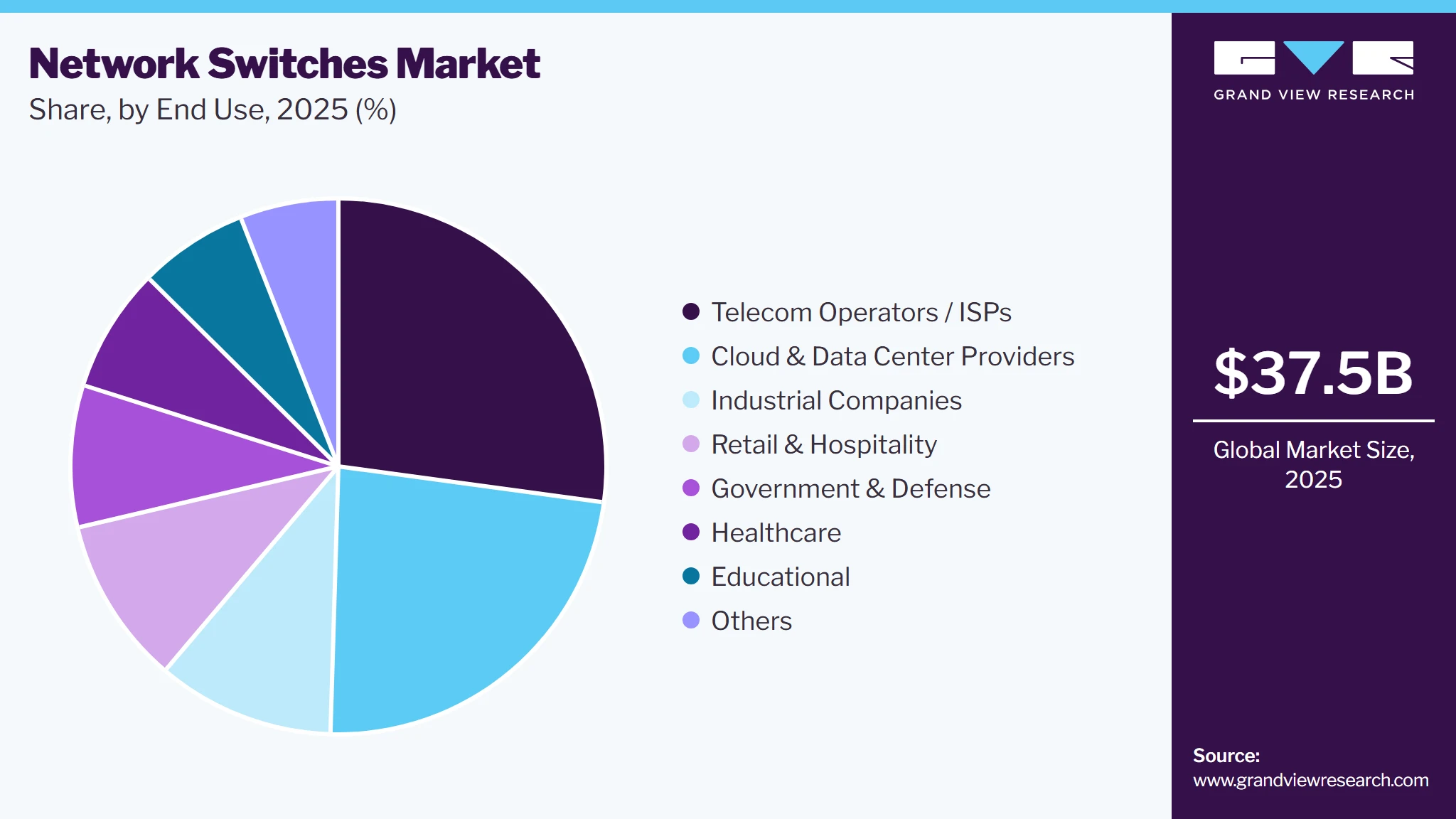
The cloud & data center providers segment is projected to grow at the fastest CAGR over the forecast period. Rising investments in cloud infrastructure and data center facilities are increasing the need for advanced network equipment. Growing use of online applications, data storage, artificial intelligence, and digital services is resulting in higher volumes of data being handled by these facilities. Providers are expanding and upgrading their infrastructure to support increasing customer demand and maintain reliable connectivity. This trend is creating new opportunities for network switch adoption among cloud and data center providers.
Regional Insights
North America network switches market led the global market and accounted for 33.2% of the global revenue in 2025, driven by extensive enterprise networking, cloud infrastructure, and data center investments. Businesses across the region are upgrading their network infrastructure to manage rising data traffic and support digital operations. Increasing deployment of advanced computing infrastructure is creating additional demand for high-performance network switches.

U.S. Network Switches Market Trends
The U.S. network switches market is anticipated to register a largest growth from 2026 to 2033, with substantial spending on data centers, cloud computing, artificial intelligence, and enterprise technology. Large technology companies and businesses are expanding their digital infrastructure to accommodate growing data requirements. Continued development of data center facilities and modernization of enterprise networks are creating opportunities for network switch manufacturers.
Asia Pacific Network Switches Market Trends
The Asia Pacific network switches market is expected to register the highest growth from 2026 to 2033, due to its high vehicle production volumes and expanding automotive electronics industry. Rapid electrification and increasing adoption of connected vehicle technologies are raising the electronic content of vehicles across the region. Growing passenger vehicle sales and investments in advanced vehicle technologies are creating further demand for network switches.
The China network switches market has the largest market share in the Asia Pacific market, driven by the rapid development of data centers, cloud services, telecommunications networks, and digital platforms. Growing adoption of artificial intelligence and other digital technologies is increasing the volume of information handled across network infrastructure. Investments in large-scale digital infrastructure are creating sustained demand for network switching equipment.
The Japan network switches market is expected to grow at a significant CAGR over the forecast period, supported by widespread digital adoption across enterprises, telecommunications, and technology industries. Growing investments in data centers, cloud services, and digital infrastructure are creating demand for reliable and higher-capacity network equipment. The modernization of enterprise networks and increasing use of connected technologies are expected to support continued adoption of network switches.
Europe Network Switches Market Trends
The Europe network switches market is poised for significant growth from 2026 to 2033. Europe is experiencing rising demand for network switches as businesses across industries modernize their digital and communication infrastructure. Organizations are investing in modern network infrastructure to improve connectivity and manage increasing volumes of digital information. Greater emphasis on reliable and secure digital systems is encouraging businesses to replace older networking equipment.
The UK network switches market is witnessing increasing demand as businesses expand their use of cloud platforms, digital applications, and connected services. Data center development and investments in digital infrastructure are creating additional requirements for network equipment. Enterprises are also upgrading existing networks to improve connectivity and accommodate increasing data traffic.
The Germany network switches market held a largest share in the Europe market. Germany presents strong opportunities for network switch adoption, particularly across industrial, enterprise, and technology applications. Manufacturers are increasing their use of digital systems and connected operations, creating greater requirements for reliable network infrastructure. Expansion of cloud services and data center facilities is further increasing demand for network equipment.
Key Network Switches Company Insights
Key players operating in the network switches market include Cisco Systems, Inc., Huawei Technologies Co., Ltd., Hewlett Packard Enterprise Development LP., Juniper Networks, Inc., Arista Networks, Inc., NETGEAR, Dell Inc., Extreme Networks., STORDIS GmbH., and Allied Telesis, Inc. Key players in the network switches market are focusing on product innovation, portfolio expansion, strategic partnerships, and higher-speed networking solutions to strengthen their market position. Companies are expanding their offerings to address growing demand from enterprises, telecom operators, cloud providers, and data centers.
-
Cisco Systems, Inc. is a technology company. The company provides networking, security, observability, collaboration, computing, and cloud solutions. Its networking portfolio includes access networking, data center and cloud networking, industrial IoT networking, wide-area networking, and networking software. Cisco Systems, Inc. offers a broad portfolio of network switches, including fixed and modular models designed for enterprise, data center, cloud, industrial, and small business networks.
-
Huawei Technologies Co., Ltd. is a global ICT infrastructure and smart device company. Its strategy focuses on building a fully connected, intelligent world by serving enterprises, carrier, consumer, cloud, and digital power markets. The company offers network switches for various applications and network sizes, including campus networks and cloud data centers, along with network management, control, and analysis software.
Key Network Switches Companies
The following key companies have been profiled for this study on the network switches market.
-
Cisco Systems, Inc.
-
Huawei Technologies Co., Ltd.
-
Hewlett Packard Enterprise Development LP
-
Juniper Networks, Inc.
-
Arista Networks, Inc.
-
NETGEAR
-
Dell Inc.
-
Extreme Networks.
-
STORDIS GmbH.
-
Allied Telesis, Inc.
Competitive Benchmarking
Operating Strategies
Competitive Edge
Weaknesses
Mature Players: Cisco Systems, Inc., Huawei Technologies Co., Ltd., Hewlett Packard Enterprise Development LP, Juniper Networks, Inc.
- Mature players in the network switches market are focus on broad networking portfolios, enterprise and data-center solutions, cloud networking, managed services, and continuous product development.
- These companies also use strong global sales channels, strategic partnerships, and integrated networking solutions to maintain their market positions.
- Mature players gain a competitive advantage through strong global presence, broad product portfolios, established customer relationships, extensive channel networks, and strong R&D capabilities.
- Their ability to provide complete networking solutions gives them an advantage in large enterprise and data-center deployments.
- These companies often face challenges related to high product and solution complexity can increase costs and implementation requirements.
- Large organizations may also have slower decision-making and longer product-development cycles, which can make it harder to respond quickly to changing customer requirements.
Emerging Players: Arista Networks, Inc., NETGEAR, Extreme Networks
- Emerging players in the network switches market are focus on targeted networking segments such as cloud networking, data centers, enterprise networks, SMBs, and high-performance Ethernet solutions.
- These companies emphasize product innovation, specialized solutions, competitive pricing, and customer-specific networking requirements.
- Emerging players gain market traction through strong specialization in selected networking applications, flexible product offerings, and the ability to respond quickly to specific market requirements.
- Some players also benefit from strong positions in high-growth data center or SMB networking segments.
- Emerging players face limitations due to their narrower portfolio breadth and smaller global scale can limit their ability to compete for large, complex networking projects.
- Compared with established players, they may also have fewer resources for global distribution, large-scale R&D, and integrated end-to-end solutions.
Recent Developments
-
In July 2025, Hewlett Packard Enterprise Development LP completed the acquisition of Juniper Networks, strengthening its position in the networking market. The transaction expanded its networking portfolio across data centers, enterprise networks, service providers, AI, and cloud networking. The combined portfolio includes networking hardware, software, security, and services, enabling broader customer coverage. This expansion strengthens its ability to address the growing demand for advanced network infrastructure.
-
In May 2025, Dell Inc. expanded its networking portfolio through the Dell AI Factory with NVIDIA, introducing the PowerSwitch SN5600 and SN2201 Ethernet switches, along with NVIDIA Corporation Quantum-X800 InfiniBand switches. The new switches provide up to 800 Gbps throughput and are designed to support AI and data center environments. The portfolio expansion strengthens Dell Inc.'s networking offerings to meet growing data processing and connectivity requirements.
Network Switches Market Report Scope
Report Attribute
Details
Market size in 2025
USD 37.5 billion
Estimated market size in 2026
USD 39.5 billion
Projected market size by 2033
USD 63.1 billion
Growth rate
CAGR of 6.9% from 2026 to 2033
Base year for estimation
2025
Historical data
2021 - 2024
Forecast period
2026 - 2033
Quantitative units
Revenue in USD billion and CAGR from 2026 to 2033
Report coverage
Revenue forecast, company ranking, competitive landscape, growth factors, and trends
Segments covered
Type, port speed, end use, region
Regional scope
North America; Europe; Asia Pacific; Latin America; MEA
Country scope
U.S.; Canada; Mexico; Germany; UK; France; China; Japan; India; South Korea; Australia; Brazil; KSA; UAE; South Africa
Key companies profiled
Cisco Systems, Inc.; Huawei Technologies Co., Ltd.; Hewlett Packard Enterprise Development LP.; Juniper Networks, Inc.; Arista Networks, Inc.; NETGEAR; Dell Inc.; Extreme Networks.; STORDIS GmbH.; Allied Telesis, Inc.
Customization scope
Free report customization (equivalent up to 8 analysts working days) with purchase. Addition or alteration to country, regional & segment scope.
Pricing and purchase options
Avail customized purchase options to meet your exact research needs. Explore purchase options
Global Network Switches Market Report Segmentation
The report forecasts revenue growth at global, regional, and country levels and provides an analysis of the latest industry trends in each of the sub-segments from 2021 to 2033. For the purpose of this study, Grand View Research has segmented the network switches market based on type, port speed, end use, and region.
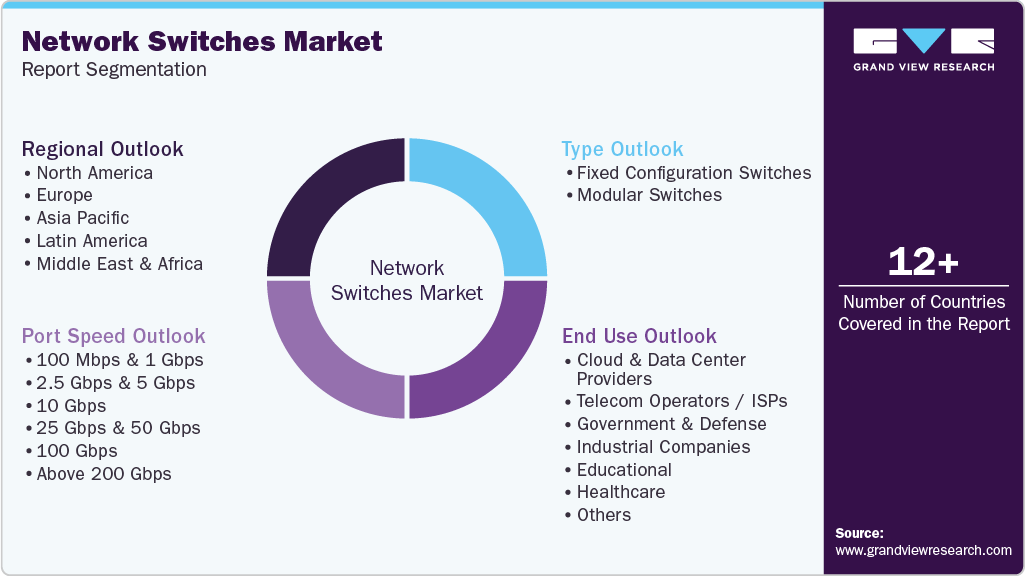
-
Type Outlook (Revenue, USD Billion, 2021 - 2033)
-
Fixed Configuration Switches
-
Unmanaged Switches
-
Managed Switches
-
Smart Switches
-
-
Modular Switches
-
-
Port Speed Outlook (Revenue, USD Billion, 2021 - 2033)
-
100 Mbps & 1 Gbps
-
2.5 Gbps & 5 Gbps
-
10 Gbps
-
25 Gbps & 50 Gbps
-
100 Gbps
-
Above 200 Gbps
-
-
End Use Outlook (Revenue, USD Billion, 2021 - 2033)
-
Cloud & Data Center Providers
-
Telecom Operators / ISPs
-
Government & Defense
-
Industrial Companies
-
Educational
-
Healthcare
-
Retail & Hospitality
-
Others
-
-
Regional Outlook (Revenue, USD Billion, 2021 - 2033)
-
North America
-
U.S.
-
Canada
-
Mexico
-
-
Europe
-
Germany
-
UK
-
France
-
-
Asia Pacific
-
China
-
India
-
Japan
-
South Korea
-
Australia
-
-
Latin America
-
Brazil
-
-
Middle East & Africa (MEA)
-
UAE
-
Kingdom of Saudi Arabia (KSA)
-
South Africa
-
-
Research Methodology
The network switches market figures in this report are based on a proven research process that combines executive interviews with secondary research from proprietary databases, company filings, and recognized regulatory and institutional sources. Market size is built through value-chain sizing-reconciling supply-side and demand-side estimates-and triangulated with bottom-up and top-down approaches. Every estimate passes multiple levels of expert validation before publication, with each network switches segment quantified using the revenue-capture definitions in the table below.
Segment Definition
Type
Revenue capture definition
Fixed Configuration Switches
The segment revenue is generated from the sale of switches with a predefined number of ports and fixed hardware configurations, including unmanaged, managed, and smart switches. Revenue includes equipment sales and, where applicable, associated software, licensing, support, and maintenance directly attributable to the fixed switch products. The segment includes fixed configuration switches such as unmanaged switches, managed switches and smart switches.
- Unmanaged Switches: Revenue is generated from the sale of plug-and-play Ethernet switches that provide basic connectivity without centralized configuration or advanced network management capabilities.
- Managed Switches: Revenue is generated from switches offering configurable network management functions such as VLANs, routing, QoS, security controls, monitoring, and centralized administration. Revenue may include associated software licenses, management subscriptions, support, and maintenance.
- Smart Switches: Revenue is generated from switches offering a combination of basic plug-and-play functionality and selected managed features, including VLAN configuration, traffic monitoring, QoS, and security functions.
Modular Switches
The segment revenue is generated from chassis-based switches that allow customers to add or replace line cards, modules, power supplies, and other hardware components. Revenue includes chassis, switching modules, line cards, expansion modules, and related software, support, and maintenance.
Port Speed
Revenue capture definition
100 Mbps & 1 Gbps
Revenue is generated from Ethernet switches supporting 100 Mbps and 1 Gbps port speeds, primarily serving basic enterprise, SMB, branch, campus, IoT, and general connectivity requirements.
2.5 Gbps & 5 Gbps
Revenue is generated from multi-gigabit switches supporting 2.5 Gbps and 5 Gbps connectivity, including equipment used for Wi-Fi, enterprise access, IoT, automation, and higher-bandwidth edge applications.
10 Gbps
Revenue is generated from switches that support 10 Gbps Ethernet connectivity for enterprise networks, data center access, storage, aggregation, and high-bandwidth applications.
25 Gbps & 50 Gbps
Revenue is generated from switches supporting 25 Gbps and 50 Gbps Ethernet ports for server connectivity, data-center leaf networks, enterprise aggregation, and emerging high-bandwidth applications.
100 Gbps
Revenue is generated from high-speed switches supporting 100 Gbps connectivity for data-center aggregation, spine/leaf architecture, cloud infrastructure, service-provider networks, and high-performance computing.
Above 200 Gbps
Revenue is generated from switches supporting 200 Gbps, 400 Gbps, 800 Gbps, and emerging 1.6 Tbps-class Ethernet connectivity, primarily for hyperscale data centers, AI infrastructure, cloud computing, and high-performance computing.
End Use
Revenue capture definition
Cloud & Data Center Providers
Revenue is generated from switches purchased for data-center networks, cloud infrastructure, AI clusters, server connectivity, storage networks, and spine-leaf architectures.
Telecom Operators / ISPs
Revenue is generated from switches deployed in telecom, broadband, internet service provider, metro, access, aggregation, and carrier network infrastructure.
Government & Defense
Revenue is generated from switches deployed across government offices, defense facilities, secure communication networks, public infrastructure, and mission-critical applications.
Industrial Companies
Revenue is generated from switches used in factories, industrial automation, manufacturing facilities, utilities, transportation, and other operational technology environments.
Climate & Control Switches
Revenue is generated from switches used in schools, universities, research institutions, campuses, laboratories, and education-focused data and communication networks.
Healthcare
Revenue is generated from switches deployed across hospitals, clinics, laboratories, medical campuses, healthcare data centers, and connected medical environments.
Retail & Hospitality
Revenue is generated from switches used across retail stores, hotels, restaurants, entertainment facilities, point-of-sale networks, security systems, guest connectivity, and IoT infrastructure.
Others
Revenue is generated from switches deployed in applications outside the specified end-use categories, including professional services, transportation, financial institutions, and other commercial environments.
Estimation Model
Layer Name
Key Question
Description
Network Infrastructure Base
How large is the addressable network infrastructure?
This layer evaluates the installed and newly deployed base of Ethernet network infrastructure across enterprises, data centers, telecom networks, government facilities, and industrial environments. It considers the number and type of network environments requiring switching equipment. The analysis identifies replacement demand as well as new deployments. This establishes the overall addressable base for network switch demand.
Switch Deployment & Configuration
How many switches are required within these networks?
This layer estimates switch requirements based on network architecture, number of connected devices, port density, deployment scale, and application requirements. Fixed and modular configurations are assessed separately. Managed, unmanaged, and smart switches are also evaluated according to their respective deployment environments. The layer converts network infrastructure requirements into potential switch unit demand.
ASP & Technology Mix
What value is generated per switch?
This layer evaluates average selling prices according to switch type, port speed, configuration, port density, management capabilities, and end-use application. Higher-speed switches generally represent higher-value equipment than basic access switches. The model also considers the transition toward 100G, 200G, 400G, 800G, and higher-speed products. Technology migration therefore influences the overall revenue value even when unit growth is moderate.
Market Revenue Validation
What is the final market revenue?
The final layer combines estimated switch volumes with applicable average selling prices to calculate market revenue. Revenue is then cross-checked by type, port speed, end use, and geography to avoid double counting. Vendor product portfolios, customer deployments, industry investments, and technology adoption trends are used as validation inputs. The resulting estimate represents the total revenue generated from network switch hardware and directly attributable commercial components included within the market scope.
Delivered Customizations
This report has been delivered with the following In-depth customizations
Client Request
Customization Delivered
Value Adds
Regional Network Switches Market Opportunity Assessment
Country/region-wise market sizing and forecasts
Analysis of demand, adoption trends, and regulatory landscape
Identification of high-growth regions and investment hotspots
Identified region-specific growth opportunities
Supported expansion and go-to-market strategy
Enabled informed regional investment decisions
Cross-Segmentation Analysis for the Network Switches Market
Criss-cross market analysis by type, port speed, end use
Demand and adoption assessment across key segments
Segment attractiveness and growth potential passenger benchmarking
Identified high-potential market segments
Supported targeted type positioning and marketing strategy
Improved customer and segment prioritization
Competitive Benchmarking and Strategic Positioning in the Network Switches Market
Benchmarking of key competitors across types, pricing, partnerships, and innovation
Comparative assessment of market share, capabilities, and strategies
Analysis of competitive strengths, gaps, and differentiation areas
Identified competitive white spaces and growth gaps
Supported strategic positioning and differentiation
Enabled data-driven competitive strategy development
Frequently Asked Questions About This Report
The global network switches market size was estimated at USD 37.5 billion in 2025 and is expected to reach USD 39.5 billion in 2026.
Some key players operating in the network switches market include Cisco Systems, Inc., Huawei Technologies Co., Ltd., Hewlett Packard Enterprise Development LP., Juniper Networks, Inc., Arista Networks, Inc.., NETGEAR, Dell Inc., Extreme Networks., STORDIS GmbH., Allied Telesis, Inc.
Asia Pacific is the fastest-growing region over the forecast period.
The global network switches market is expected to grow at a CAGR of 6.9% from 2026 to 2033, reaching USD 63.1 billion by 2033.
Fixed configuration switches segment accounted for 76.0%, the largest share of global revenue in 2025, due to their suitability for a wide range of business networking requirements
North America network switches led the global market and accounted for 33.2% of the global revenue in 2025.
Key factors include increasing demand for data center and cloud infrastructure is driving the growth of the network switches market.
100 Mbps & 1 Gbps segment accounted for 42.2%, the largest share of global revenue in 2025, while above 200 Gbps is is second fastest growing market.
The telecom operators / ISPs segment accounted for the largest market revenue share of 27.1% in 2025, while cloud & data center providers segment is expected to be the fastest-growing market.
About the Author(s)
Communications Infrastructure Research Team
Technology · Communications InfrastructureThis report was authored by the communications infrastructure research team at Grand View Research - comprising two research analysts, one senior research analyst, and one industry expert - with specialized expertise in the communications infrastructure segment of the technology industry. All findings are based on proprietary technology databases, executive interviews, and regulatory analysis, subject to internal peer review prior to publication.
Last Updated:
Speak to Analyst


Customize this report to your needs — add regions, segments, or data points, with 20% free customization.
Or view our licence options:


ISO 9001:2015 & 27001:2022 Certified
We are GDPR and CCPA compliant! Your transaction & personal information is safe and secure. For more details, please read our privacy policy.


