
- Home
- »
- Pharmaceuticals
- »
-
North America Cannabis Waste Disposal Market Report 2033GVR Report cover

North America Cannabis Waste Disposal Market (2026 - 2033)
Size, Share & Trends Analysis Report By Waste Type (Plant-Based, THC-Containing Product), By Source of Waste, By Disposal Method (Grinding & Mixing, Incineration), By Service, By Country, And Segment Forecasts
Market Size, 2025
$450.8MMarket Estimate, 2026
$500.1MMarket Forecast, 2033
$965.1MCAGR, 2026–2033
9.8%North America Cannabis Waste Disposal Market Summary
The North America cannabis waste disposal market size was valued at USD 450.8 million in 2025 and is projected to grow from USD 500.1 million in 2026 to USD 965.1 million by 2033, at a CAGR of 9.8% from 2026 to 2033. The market growth is driven by increasing regulatory enforcement across the U.S. and Canada, rising cannabis production volumes, and the growing need for compliant, traceable, and environmentally sustainable waste management solutions. The expansion of licensed cultivation and processing facilities, along with the adoption of circular-economy-based disposal technologies, is further supporting market growth.
Key Market Trends & Insights
- By waste type: The plant-based waste segment held the highest market share of 40.1% in 2025.
- By source of waste: The cultivators/growers segment held the highest market share of 40.4% in 2025.
- By disposal method: The grinding & mixing segment held the highest market share of 39.8% in 2025.
- By service: The off-site disposal services segment held the highest market share of 30.5% in 2025.
Market Size & Forecast
- Market Size in 2025: USD 450.8 Million
- Estimated Market Size in 2026: USD 500.1 Million
- Projected Market Size by 2033: USD 965.1 Million
- CAGR (2026-2033): 9.8%
Prism AI by Grand View Research Free to tryAsk a question about the north america cannabis waste disposal marketTry asking✓Every figure cited from GVR research Prefer the report? Download free sample →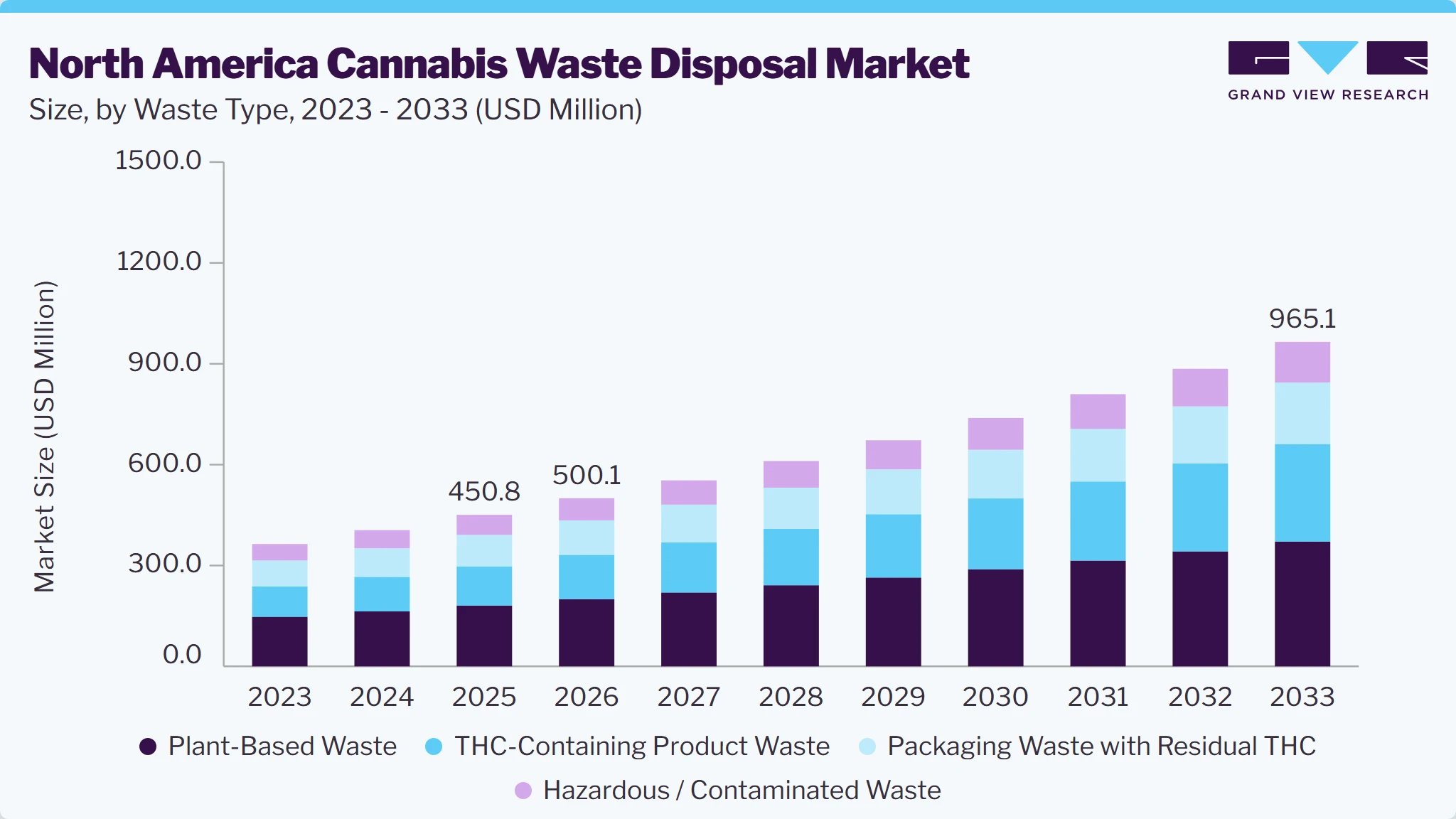 Source: Grand View Research, IR Documents, Primary Interviews, Paid DatabasesTo learn more about this report,
 Download Free Sample Report
Market Dynamics
The expanding legalization of cannabis, increasing cannabis cultivation and processing activities, rising regulatory emphasis on compliant waste disposal, and growing adoption of sustainable waste management practices are driving market growth. As licensed cannabis operators continue to scale production across medical and recreational markets, the volume of plant biomass, THC-containing products, packaging materials, and hazardous waste requiring secure disposal is increasing substantially. Stringent state and provincial regulations governing waste collection, transportation, destruction, and documentation are encouraging cultivators, manufacturers, and dispensaries to partner with specialized waste disposal providers.
Moreover, sustainability initiatives, including composting, recycling, bio-digestion, and circular economy programs, are transforming the industry's waste management practices. However, regulatory fragmentation across jurisdictions and the high cost of compliance continue to present operational challenges. The ongoing technological advancements in waste processing, digital waste tracking, and environmentally responsible disposal solutions are expected to create significant growth opportunities for market participants over the forecast period.
The continued legalization and commercialization of medical and recreational cannabis across North America remains the most significant market driver. As additional U.S. states expand medical and adult-use cannabis programs and Canada continues to scale licensed production capacity, the number of cultivation sites, processing facilities, extraction laboratories, manufacturing plants, and retail dispensaries continues to increase. As cultivation acreage, processing capacity, and cannabis product manufacturing activities continue to expand, the volume of plant biomass, extraction residues, expired products, packaging waste, and contaminated materials generated throughout the value chain also increases. This growth in waste generation is driving demand for specialized cannabis waste management services to ensure regulatory compliance and proper disposal.
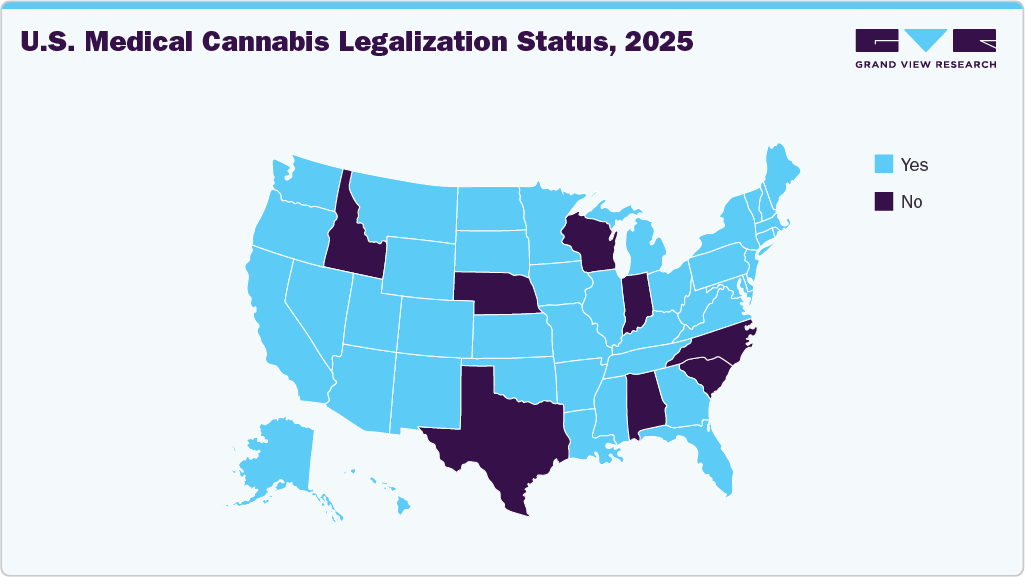
The regulatory landscape continues to support market growth. Medical cannabis is currently legal in 42 U.S. states and Washington, D.C., while recreational cannabis legalization continues to expand across major markets. Canada's federally regulated cannabis industry continues to grow, with licensed marijuana production increasing by approximately 10.6% between March 2024 and March 2025 as per a report by StratCann. As production volumes rise, waste generation increases proportionally, creating a predictable and recurring demand stream for disposal service providers. The figure below illustrates the current legal status of cannabis across the U.S., highlighting the widespread adoption of medical cannabis programs and the continued expansion of adult-use legalization, both of which are contributing to higher cultivation volumes and increasing demand for compliant cannabis waste disposal services.
 To learn more about this report, Download Free Sample Report
As shown in Figure 1, the widespread legalization of cannabis across the U.S. has significantly expanded the number of licensed cultivation, processing, and manufacturing facilities. These operations generate substantial waste throughout the production lifecycle, including stalks, stems, leaves, roots, growing media, non-saleable biomass, extraction residues, contaminated solvents, packaging materials, expired inventory, and recalled products. Since cannabis waste cannot be disposed of through conventional municipal waste streams, regulatory authorities require it to be rendered unusable and unrecognizable before disposal. Furthermore, the continued expansion of medical and adult-use cannabis programs is expected to increase the volume of regulated cannabis waste, driving sustained demand for specialized collection, transportation, treatment, and disposal services.
The increasing dominance of indoor and greenhouse cultivation facilities has further strengthened demand for specialized waste disposal services. Indoor cultivation operations utilize a variety of growing media and cultivation inputs, including rockwool, coco coir, hydroponic systems, irrigation components, plastic containers, and nutrient delivery equipment. Many of these materials require separate handling and disposal procedures due to contamination risks and recycling limitations.
The indoor cannabis facilities generate mixed waste streams that require professional collection, sorting, transportation, and processing. The growing concentration of large-scale indoor cultivation facilities across North America is increasing the complexity and value of waste management contracts, creating opportunities for specialized service providers offering integrated disposal and recycling solutions.
Cannabis waste disposal is one of the most heavily regulated operational functions within the legal cannabis industry. Regulatory authorities require licensed operators to follow strict procedures for waste segregation, inventory reconciliation, secure storage, transportation, documentation, and destruction. In many jurisdictions, including California, Colorado, and Massachusetts, cannabis waste must be rendered unusable and unrecognizable before disposal, and disposal activities must be recorded in seed-to-sale tracking systems and retained for regulatory audits.
These requirements create significant operational expenses for cultivators, processors, and dispensaries. Costs associated with specialized waste containers, employee training, compliance management, transportation, recordkeeping, and third-party destruction services place a substantial financial burden on cannabis businesses. Smaller cultivators and independent operators are particularly affected, as they often lack the economies of scale available to large multi-state operators. Some businesses continue to manage portions of their waste internally or seek lower-cost disposal alternatives, limiting the adoption of premium third-party cannabis waste management services. The high cost of regulatory compliance, therefore, remains a key factor constraining market growth.
Market Concentration & Characteristics
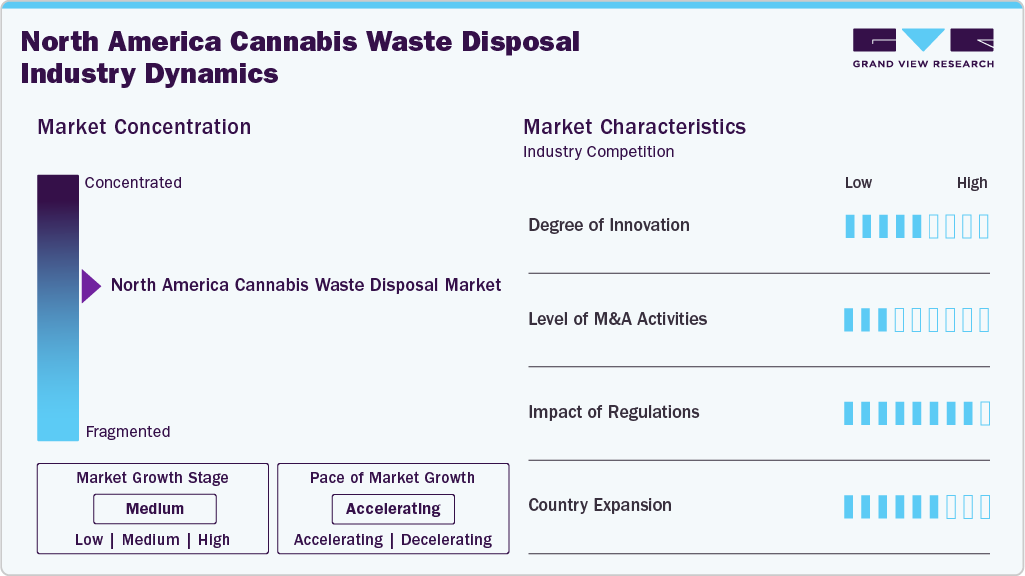
The market demonstrates a moderate level of innovation, driven by the adoption of sustainable waste-treatment technologies, automated destruction systems, and digital compliance platforms. Market participants are increasingly investing in biodigesters, cannabis biomass recycling, and waste tracking solutions to improve operational efficiency while meeting evolving regulatory requirements. For instance, in March 2025, Power Knot LLC launched its LCD Biodigester, an automated system that converts organic cannabis waste into reusable water within 24 hours while eliminating residual THC and CBD, thereby supporting both compliance and sustainability objectives.
The market exhibits low-to-medium M&A activity, with companies primarily focusing on strategic partnerships and collaborative initiatives rather than large-scale acquisitions. These collaborations aim to strengthen recycling infrastructure, enhance sustainability programs, and expand compliant waste management capabilities. For instance, in November 2025, Monarch Waste Co. expanded its collaboration with Cúrador by sponsoring its Vape Pen Takeback Program to support cannabis vape recycling and strengthen sustainable waste management across licensed dispensaries.
 To learn more about this report, Download Free Sample Report
The impact of regulations on the market is significant, as cannabis waste disposal is governed by stringent state and provincial requirements that cover waste segregation, transportation, destruction, chain-of-custody documentation, and recordkeeping. Compliance with these regulations is mandatory for all licensed cannabis operators, making specialized disposal services essential. For instance, states such as Washington and Utah require cannabis plant waste to be rendered unusable by mixing it with at least 50% non-cannabis material before disposal, driving demand for certified cannabis waste management providers.
The market is witnessing a medium level of regional expansion, supported by the continued legalization of cannabis and the gradual expansion of waste management providers into newly regulated markets. Companies are extending their geographic presence to serve emerging cultivation and processing hubs while strengthening service networks in established cannabis markets. For instance, in May 2024, Monarch Waste Co. expanded its operations into Kansas City, Missouri, strengthening its statewide presence and enhancing its ability to serve licensed cultivators, manufacturers, and dispensaries across Missouri's rapidly growing cannabis industry.
Analyst Perspective
The market is transitioning from a regulatory compliance-driven service industry to a more technology-enabled and sustainability-focused ecosystem. As cannabis legalization continues to expand across the U.S. and Canada, the volume and complexity of cannabis waste generated throughout cultivation, manufacturing, extraction, and retail operations are increasing significantly. This is driving demand for specialized waste management providers capable of ensuring secure collection, compliant destruction, chain-of-custody documentation, and environmentally responsible disposal. In addition, increasingly stringent state and provincial regulations governing cannabis waste handling are encouraging licensed operators to outsource waste management to certified service providers rather than managing these processes internally.
Waste Type Insights
The plant-based waste segment accounted for the largest share of around 40.1% in 2025. As licensed medical and recreational cannabis production expands in the U.S., plant waste generation is rising, increasing the need for compliant and sustainable waste management. For instance, Washington and Utah mandate mixing cannabis material with at least 50% non-cannabis waste to prevent diversion. In New York State, registered cannabis organizations that generate more than 0.5 tons of organic waste per week and are within 25 miles of an organic recycling facility must divert this waste for composting or anaerobic digestion. These regulations and sustainability efforts are increasing demand for certified cannabis waste-disposal providers and environmentally responsible plant-waste management solutions nationwide.
The THC-containing product waste segment is expected to grow significantly over the forecast period. The increased retail availability of these products has led to a significant rise in THC-containing waste, driving demand for compliant disposal services. States such as Illinois allow regulated cannabis waste to be processed through approved composting facilities, anaerobic digesters, or other authorized sites, encouraging collaboration with certified waste disposal companies.
Source of Waste Insights
The cultivators/growers segment held the largest market share of 40.4% in 2025. The segment's dominance is primarily attributed to the increasing number of licensed cannabis cultivation facilities across the U.S. and Canada, coupled with rising production volumes to meet growing medical and adult-use cannabis demand. Cultivation operations generate the highest volumes of cannabis waste, including stems, stalks, roots, fan leaves, trim, immature flowers, and excess biomass produced during planting, harvesting, pruning, and post-harvest processing. Regulatory requirements mandating that cannabis waste be rendered unusable before disposal have further increased demand for specialized waste management services. In addition, sustainability initiatives are becoming integral to cultivation practices, with many operators adopting composting, biomass recovery, anaerobic digestion, and recycling programs to reduce reliance on landfills, improve resource efficiency, and support corporate environmental goals.
The processors/manufacturers segment is expected to register the fastest CAGR during the forecast period, driven by the rapid expansion of cannabis extraction, processing, infused product manufacturing, and packaging activities across North America. These facilities generate diverse, compliance-intensive waste streams, including extraction residues, failed quality-control batches, contaminated products, packaging materials, vape components, and laboratory waste, all of which require specialized handling and destruction. Increasing regulatory scrutiny surrounding product recalls, THC-containing waste, and hazardous byproducts is encouraging processors to adopt certified disposal solutions that ensure complete traceability and compliance. Furthermore, large cannabis operators are increasingly investing in on-site waste processing technologies such as Power Knot's LCD Biodigester and Micron Waste Technologies' Cannavore system, which neutralize residual cannabinoids and convert cannabis waste into environmentally safe byproducts. The growing emphasis on operational efficiency, sustainability, and regulatory compliance is expected to continue driving demand for advanced waste management solutions within the processing and manufacturing segment.
Disposal Method Insights
The grinding & mixing segment held a significant market share of 39.8% in 2025. The segment benefits from the large volume of plant biomass generated during cannabis cultivation and processing. As legal cannabis production continues to expand across North America, operators require disposal methods capable of handling significant quantities of stems, leaves, roots, cultivation residues, and expired products. Grinding and mixing provide a practical solution that can be implemented on-site or integrated into broader waste management programs without requiring substantial capital investment.
The incineration segment is anticipated to witness the fastest CAGR during the forecast period, owing to the growing need for secure, irreversible destruction of high-risk cannabis waste streams. Incineration is widely utilized for disposing of contaminated cannabis products, pesticide-treated biomass, extraction residues, recalled inventory, laboratory waste, vape cartridges, controlled substances, and seized cannabis materials where regulatory authorities mandate destruction. The method provides a high level of security by eliminating the risk of diversion, product recovery, or environmental contamination while ensuring full regulatory compliance and audit defensibility. As cannabis product portfolios continue to diversify and regulatory agencies strengthen oversight of THC-containing and hazardous waste, demand for advanced thermal destruction technologies is expected to increase.
Service Insights
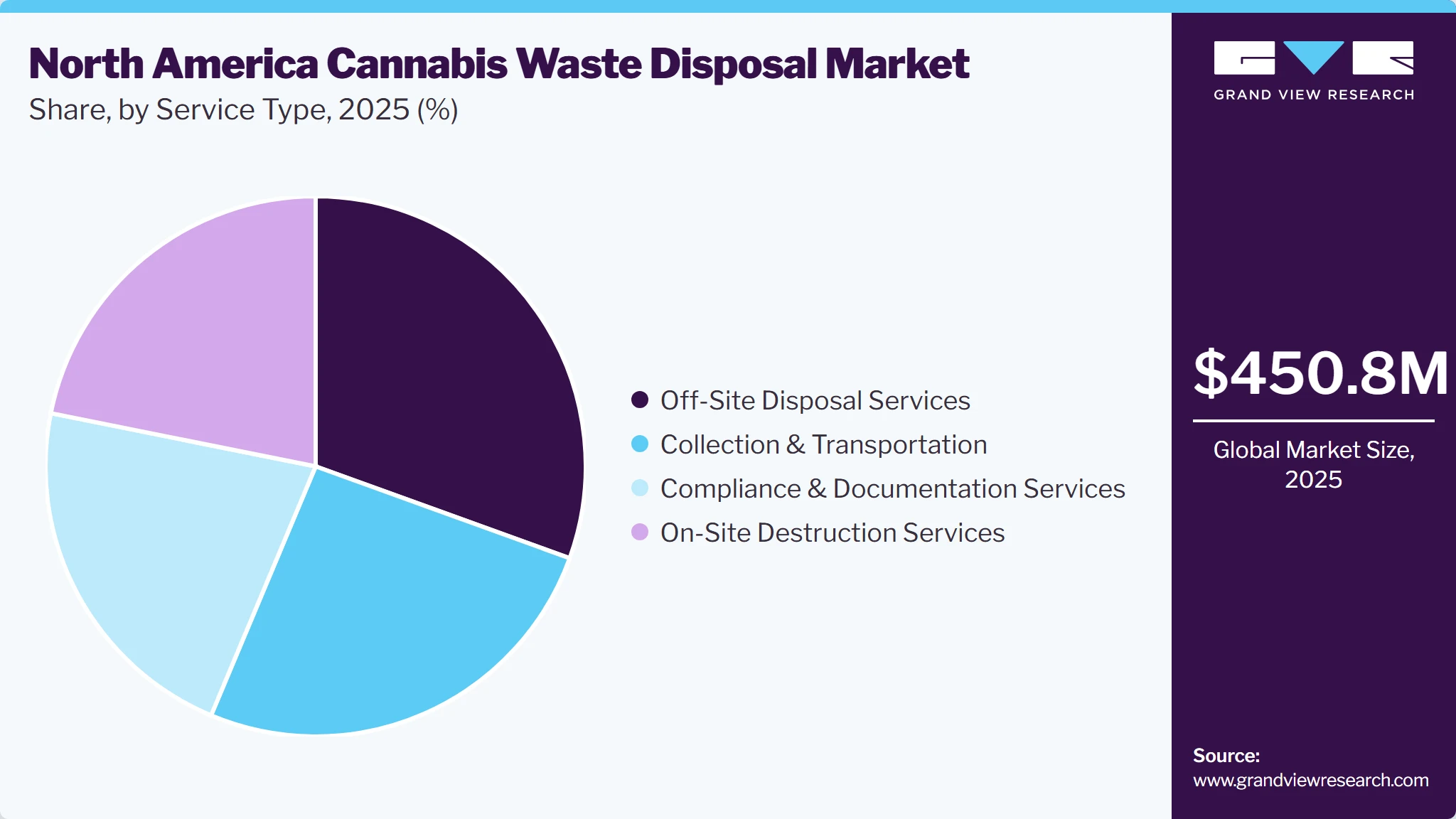
The off-site disposal services segment accounted for the largest revenue share of 30.5% in 2025. The segment's dominance is primarily driven by the increasing complexity and volume of cannabis waste generated across cultivation, processing, manufacturing, retail, and laboratory operations. Off-site disposal providers offer comprehensive waste management solutions, including secure collection, transportation, treatment, destruction, and regulatory documentation, enabling cannabis businesses to comply with stringent waste disposal requirements. Cost efficiency remains a key advantage of off-site disposal services, as small and medium-sized cannabis operators often lack the capital investment, infrastructure, and trained personnel required to implement dedicated on-site destruction systems. In addition, licensed third-party disposal providers offer specialized treatment technologies, established compliance procedures, and certified destruction services, reducing operational complexity while ensuring adherence to evolving state and provincial regulations. The continued expansion of licensed cannabis businesses and increasing reliance on outsourced compliance solutions are expected to sustain demand for off-site disposal services throughout the forecast period.
 To learn more about this report, Download Free Sample Report
The compliance & documentation services segment is anticipated to register the fastest CAGR over the forecast period, driven by increasingly stringent regulatory requirements governing cannabis waste handling, transportation, destruction, and recordkeeping across North America. Licensed cannabis operators are required to maintain detailed waste manifests, chain-of-custody records, certificates of destruction, audit logs, and regulatory reports to demonstrate compliance with state, provincial, and federal regulations. Growing enforcement activities and heightened regulatory scrutiny have made accurate documentation an essential component of cannabis waste management, encouraging operators to increasingly outsource compliance-related activities to specialized service providers. Furthermore, the ongoing digitalization of cannabis compliance through electronic manifests, cloud-based compliance platforms, automated reporting systems, and integration with seed-to-sale tracking platforms is improving operational efficiency, enhancing traceability, and reducing administrative burden.
Country Insights
The continued expansion of the legal cannabis industry in the U.S. is a primary factor driving demand for cannabis waste disposal services. As additional states legalize medical and adult-use cannabis, the number of cultivation facilities, processing centers, manufacturing operations, and dispensaries continues to increase. In addition, the expansion of adult-use cannabis programs in states such as New York, Maryland, Missouri, Connecticut, and New Mexico has created additional demand for compliant waste disposal infrastructure. For instance, in December 2025, New York State partnered with SUNY ESF to launch a vape recycling pilot program.
U.S. State-Level Analysis
Sr. No.
State
State Driver
Regulatory Framework
Sustainability & Waste Management Initiatives
1
California
Largest U.S. cannabis market with dense cultivation clusters in Northern California and high-volume manufacturing and retail activity driving continuous waste generation across the value chain
Regulated by the Department of Cannabis Control; mandatory rendering of waste as unusable and unrecognizable; METRC-based tracking required with disposal through licensed haulers and approved solid waste pathways, including composting and landfill
California remains a leading market for sustainable cannabis operations supported by stringent environmental compliance requirements. Operators are increasingly adopting composting, recycling, and organic waste diversion practices. State-level SB 1383 implementation has strengthened broader organic waste diversion frameworks, indirectly reinforcing sustainable cannabis waste handling practices
2
Colorado
Mature cannabis ecosystem with strong cultivation and extraction base generating biomass, solvent, and post-processing waste; ongoing license churn contributes to steady disposal demand
Regulated by the Marijuana Enforcement Division and CDPHE, cannabis waste must be mixed with non-cannabis material before removal and tracked via METRC; hazardous waste is governed under state and EPA standards
Colorado promotes environmentally responsible cannabis production through structured waste-rendering and resource-efficiency practices. Expansion of state-supported circular economy and diversion initiatives has encouraged operators to reduce landfill dependence and improve recycling and recovery practices
Key North America Cannabis Waste Disposal Company Insights
Key participants in the North America cannabis waste disposal industry are focusing on devising innovative business growth strategies, such as expanding their product portfolios, partnerships, and collaborations, and expanding their business footprints.
Key North America Cannabis Waste Disposal Companies:
-
Gaiaca
-
Cannacycl LLP
-
Monarch Waste Co.
-
Egnite Waste Management
-
Ecowaste Services
-
Reel Waste and Recycling LLC
Competitive Benchmarking
Category
Cannabis-Specific Disposal Vendors
Integrated Waste Management Providers
Overview
Companies dedicated exclusively to providing waste disposal and compliance services for licensed cannabis operators across cultivation, manufacturing, retail, distribution, and laboratories.
Companies offering waste management services across multiple regulated industries (hazardous, pharmaceutical, industrial, healthcare, and controlled substances), with cannabis waste among several service offerings.
Business Model
Vertically specialized within the cannabis value chain with a compliance-driven service model.
Diversified, asset-intensive waste management model serving multiple regulated industries.
Primary Waste Streams
• Cultivation waste (plant biomass, stems, leaves, root balls)
• Manufacturing waste (extract residues, defective batches, packaging waste)
• Retail waste (expired, returned, unsellable products)
• Laboratory waste (testing residues, contaminated materials)• Hazardous waste
• Controlled substances
• Industrial waste
• Healthcare and pharmaceutical waste
• Cannabis waste (secondary business line)Regulatory Focus
State cannabis regulations, chain-of-custody documentation, waste classification, manifests, audit readiness, and diversion prevention.
RCRA hazardous waste regulations, DEA controlled substance destruction requirements, environmental transport regulations, and federal/state waste management standards.
Service Delivery Model
Scheduled pickups, onsite containers, waste segregation, transportation, disposal coordination, compliance documentation, recurring service contracts.
Standardized collection, transportation, treatment, destruction, and disposal using centralized compliance systems and specialized facilities.
Operational Infrastructure
Facility-level waste collection and compliance services with state or regional operations.
Licensed hazardous waste facilities, mobile destruction units, specialized transport fleets, and centralized compliance infrastructure.
Geographic Presence
Primarily state or regional operations; expansion depends on licensing approvals and state-specific cannabis regulations.
Multi-state or regional operations with broader regulatory approvals and larger infrastructure networks.
Recent Developments:
-
In November 2025, Monarch Waste Co. expanded its collaboration with Cúrador by sponsoring its Vape Pen Takeback Program. The partnership assures long-term sustainability efforts and supports the continued expansion of cannabis vape recycling infrastructure across participating dispensary locations.
-
In May 2025, Monarch Waste Co. introduced a disposable cannabis vape recycling initiative focused on collecting and separating lithium-ion batteries from vape devices. The program supports waste diversion and recycling within licensed cannabis retail and distribution channels.
-
In June 2024, Curaleaf partnered with TerraCycle to launch a nationwide cannabis packaging recycling initiative to divert hard-to-recycle packaging from landfills. The program enables consumers to collect used cannabis packaging and send it through dedicated recycling channels where materials are sorted, processed, and converted into raw material feedstock for manufacturing new products. The initiative leverages TerraCycle’s specialized recycling infrastructure designed for traditionally non-recyclable waste streams, supporting circular economy objectives within the cannabis industry.
North America Cannabis Waste Disposal Market Report Scope
Report Attribute
Details
Market size in 2025
USD 450.8 million
Estimated market size in 2026
USD 500.1 million
Projected market size by 2033
USD 965.1 million
Growth rate
CAGR of 9.8% from 2026 to 2033
Actual data
2021 - 2025
Forecast data
2026 - 2033
Quantitative units
Revenue in USD million/billion and CAGR from 2026 to 2033
Report coverage
Revenue forecast, company ranking, competitive landscape, growth factors, and trends
Segments covered
Waste type, source of waste, disposal method, service, region
Regional scope
North America
Country scope
U.S.; Canada
Key companies profiled
Gaiaca; Cannacycl LLP; Monarch Waste Co.; Egnite Waste Management; Ecowaste Services; Reel Waste and Recycling LLC.
Customization scope
Free report customization (equivalent up to 8 analysts working days) with purchase. Addition or alteration to country, regional & segment scope.
Pricing and purchase options
Avail customized purchase options to meet your exact research needs. Explore purchase options
North America Cannabis Waste Disposal Market Segmentation
This report forecasts revenue growth and provides, at the regional and country levels, an analysis of the latest trends in each of the sub-segments from 2021 to 2033. For this report, Grand View Research has segmented the North America cannabis waste disposal market report based on waste type, source of waste, disposal method, service, and region:
-
Waste Type Outlook (Revenue, USD Million, 2021 - 2033)
-
Plant-Based Waste
-
THC-Containing Product Waste
-
Hazardous / Contaminated Waste
-
Packaging Waste with Residual THC
-
-
Source of Waste Outlook (Revenue, USD Million, 2021 - 2033)
-
Cultivators / Growers
-
Processors / Manufacturers
-
Testing Laboratories
-
Retailers / Dispensaries
-
Law Enforcement Agencies
-
-
Disposal Method Outlook (Revenue, USD Million, 2021 - 2033)
-
Composting/Organic Decomposition
-
Chemical Deactivation
-
Grinding & Mixing
-
Incineration
-
-
Service Outlook (Revenue, USD Million, 2021 - 2033)
-
Collection & Transportation
-
On-Site Destruction Services
-
Off-Site Disposal Services
-
Compliance & Documentation Services
-
-
Country Outlook (Revenue, USD Million, 2021 - 2033)
-
U.S.
-
Canada
-
Research Methodology
The North America cannabis waste disposal market figures in this report are based on a proven research process that combines executive interviews with secondary research from proprietary databases, company filings, and recognized regulatory and institutional sources. Market size is built through value-chain sizing-reconciling supply-side and demand-side estimates-and triangulated with bottom-up and top-down approaches. Every estimate passes multiple levels of expert validation before publication, with each North America cannabis waste disposal segment quantified using the revenue-capture definitions in the table below.
Segment Definition
Segment - Waste Type
Revenue capture definition
Plant-Based Waste
Includes organic cannabis biomass generated during cultivation and post-harvest activities, such as plant, leaves, stems, stalks, roots, branches, fan leaves, and trim waste. This waste stream primarily consists of non-processed plant biomass produced during routine cultivation, harvesting, pruning, trimming, and plant maintenance operations. Plant-based biomass represents the largest volume of cannabis waste and typically requires secure collection, rendering, composting, or other compliant disposal methods before final disposal.
THC-Containing Product Waste
Includes finished or semi-finished cannabis products that contain active THC and are no longer suitable for sale or consumption. This includes edibles, oils, tinctures, concentrates, vape cartridges, and unusable or rejected biomass from manufacturing and processing operations.
Hazardous / Contaminated Waste
Includes cannabis-related materials that are classified as hazardous due to contamination or exposure risks. This includes pesticide-contaminated crops, mold-infected batches, chemically exposed materials, and waste requiring regulated hazardous disposal pathways.
Packaging Waste with Residual THC
Includes secondary and tertiary packaging materials, such as bottles, jars, wrappers, and containers, that may contain trace amounts of THC residue after product use, due to spoilage, or as a result of rejection, requiring compliant handling and disposal.
Segment - Source of Waste
Revenue capture definition
Cultivators / Growers
Cannabis cultivation facilities generate plant-based waste during growing, harvesting, trimming, and crop maintenance processes. These facilities are the primary upstream source of biomass waste.
Processors / Manufacturers
Facilities involved in extraction, formulation, and product manufacturing that generate THC-containing waste, off-spec batches, solvents, and production byproducts requiring regulated disposal.
Testing Laboratories
Analytical laboratories that generate chemical, biological, and sample-related waste from cannabis testing, including contaminated samples, reagents, and laboratory consumables.
Retailers / Dispensaries
Licensed retail outlets that generate waste from expired, returned, damaged, or unsellable cannabis products, including packaging waste and customer-returned inventory.
Law Enforcement Agencies
Government and enforcement bodies are responsible for seized, confiscated, or evidence-based cannabis material that requires secure destruction and chain-of-custody-compliant disposal.
Segment - Disposal Method
Revenue capture definition
Composting/Organic Decomposition
A biological waste treatment method used primarily for plant-based cannabis waste, where organic materials are broken down naturally under controlled conditions to produce compost or soil amendments.
Chemical Deactivation
A regulated process where active cannabis compounds (primarily THC) are neutralized or rendered non-psychoactive through chemical treatment methods, ensuring waste is non-retrievable and non-usable.
Grinding & Mixing
A mechanical destruction process where cannabis material is physically shredded or ground and mixed with inert substances to render it unrecognizable, unusable, and compliant for disposal or further treatment.
Incineration
High-temperature thermal destruction process used for the complete elimination of cannabis waste, typically applied to hazardous, contaminated, or controlled substances under strict regulatory supervision.
Segment - Service
Revenue capture definition
Collection & Transportation
The process of collecting cannabis waste from licensed facilities and securely transporting it to approved treatment, destruction, or disposal facilities under regulated chain-of-custody protocols.
On-Site Destruction Services
Services where cannabis waste is physically destroyed or rendered non-retrievable at the client facility using mechanical, chemical, or hybrid destruction methods before transport.
Off-Site Disposal Services
Waste management services where cannabis waste is transported to external licensed facilities for treatment, destruction, recycling, or landfill disposal in compliance with regulatory frameworks.
Compliance & Documentation Services
Services focused on generating regulatory documentation such as manifests, certificates of destruction, audit reports, and chain-of-custody records required for legal and regulatory compliance.
Estimation Model
Research Methodology
The North America market has been estimated using a robust bottom-up market modeling framework supported by extensive secondary research, primary interviews, quantitative surveys, and data triangulation. The methodology quantifies cannabis waste generated across cultivation, processing, manufacturing, retail, laboratory, and enforcement activities and estimates revenue from regulated commercial waste-disposal services.
Market Definition
The market includes services associated with the collection, transportation, treatment, destruction, documentation, and final disposal of cannabis-related waste generated throughout the legal cannabis value chain. Waste streams covered include plant-based biomass, THC-containing products, contaminated and hazardous waste, packaging containing cannabis residue, recalled products, expired inventory, laboratory waste, and seized cannabis materials.
Research Approach
Secondary Research
Comprehensive secondary research was conducted using:
-
Federal, state, and provincial cannabis regulations
-
Cannabis licensing databases and compliance guidelines
-
Cultivation, production, and sales statistics
-
Company annual reports, sustainability reports, and investor presentations
-
Vendor websites and pricing references
-
Environmental and waste management publications
-
Academic research and industry journals
The research focused on cannabis waste generation, disposal practices, regulatory requirements, pricing structures, treatment technologies, and country-level market dynamics across the U.S. and Canada.
Primary Research
Findings were validated through a biannual primary research program comprising in-depth interviews and quantitative surveys with industry stakeholders, including:
-
Cannabis cultivators and manufacturers
-
Testing laboratories
-
Retail dispensaries
-
Cannabis waste disposal companies
-
Environmental compliance consultants
-
Waste treatment operators
-
Regulatory authorities
Primary research provided insights into waste generation volumes, disposal practices, treatment method adoption, collection frequency, pricing, compliance costs, and future market trends.
Market Estimation
The market was estimated using a bottom-up revenue model based on:
-
Cannabis cultivation acreage and production volumes
-
Processing and manufacturing activity
-
Waste generation coefficients by waste type
-
Commercial waste capture rates
-
Disposal method utilization
-
Average realized disposal pricing
-
Regulatory compliance requirements
Revenue estimates reflect waste managed through licensed commercial disposal providers, not total waste generated.
Forecasting Methodology
Forecasts were developed using historical market trends and forward-looking indicators, including:
-
Expansion of legalized cannabis cultivation
-
Growth in cannabis processing and manufacturing
-
Increasing regulatory enforcement
-
Rising demand for certified destruction services
-
Adoption of sustainable waste management practices
-
Growth in commercial cannabis production and retail networks
-
Pricing and compliance cost trends
Data Validation
All market estimates were validated through multi-level triangulation combining secondary research, primary interviews, survey findings, company disclosures, regulatory databases, and proprietary market models to ensure consistency and accuracy across all market segments.
Delivered Customizations
This report has been delivered with the following In-depth customizations
Client Request
Customization Delivered
Value Adds
Analysis of waste generation trends from licensed cannabis facilities
Included a dedicated section evaluating waste volume growth from existing licensed cannabis cultivation, manufacturing, and processing facilities, highlighting the impact of increased production on demand for disposal services.
Helped clients identify future demand drivers for cannabis waste disposal services and assess capacity expansion opportunities for waste management providers.
Comprehensive overview of cannabis legalization and regulatory landscape
Expanded the report with a detailed analysis covering legalization overview, reasons for legalization, cannabis cultivation norms, and U.S. regulations for indoor and outdoor cannabis cultivation.
Provided a clearer understanding of the regulatory environment influencing cannabis production, waste generation, and compliance requirements across key markets.
Post-legalization market assessment
Incorporated a dedicated analysis of the post-legalization market scenario, including consumer behavior analysis and the competitive landscape after legalization, to evaluate industry evolution and changing market dynamics.
Offered strategic insights into shifting consumer preferences, competitive positioning, and long-term growth opportunities arising from cannabis market legalization.
Frequently Asked Questions About This Report
The cultivators / growers segment led with a 40.4% revenue share in 2025, and processors / manufacturers is the fastest-growing segment.
The grinding & mixing segment led with a 39.8% revenue share in 2025, and incineration is the fastest-growing segment.
The off-site disposal services segment led with a 30.5% revenue share in 2025, and compliance & documentation services is the fastest-growing segment.
The North America cannabis waste disposal market was valued at USD 450.8 million in 2025 and is projected to grow from USD 500.1 million in 2026.
The North America cannabis waste disposal market is expected to grow at a CAGR of 9.8% from 2026 to 2033, reaching USD 965.1 million by 2033.
The plant-based waste segment led with a 40.1% revenue share in 2025, while THC-containing product waste is the fastest-growing segment.
The market growth is driven by increasing regulatory enforcement across the U.S. and Canada, rising cannabis production volumes, and the growing need for compliant, traceable, and environmentally sustainable waste management solutions.
Key players include Gaiaca; Cannacycl LLP; Monarch Waste Co.; Egnite Waste Management; Ecowaste Services; Reel Waste and Recycling LLC.
About the Author(s)
Pharmaceuticals Research Team
Healthcare · PharmaceuticalsThis report was authored by the pharmaceuticals research team at Grand View Research - comprising two research analysts, one senior research analyst, and one industry expert - with specialized expertise in the pharmaceuticals segment of the healthcare industry. All findings are based on proprietary healthcare databases, executive interviews, and regulatory analysis, subject to internal peer review prior to publication.
Last Updated:
Speak to Analyst

Customize this report to your needs - add regions, segments, or data points, with 20% free customization.
Or view our licence options:


ISO 9001:2015 & 27001:2022 Certified
We are GDPR and CCPA compliant! Your transaction & personal information is safe and secure. For more details, please read our privacy policy.


