
- Home
- »
- Clothing, Footwear & Accessories
- »
-
Online Clothing Rental Market Size & Growth Report, 2030GVR Report cover

Online Clothing Rental Market (2022 - 2030) Size, Share & Trends Analysis Report By End-user (Men, Women), By Dress Code (Formal, Casual, Traditional), By Region, And Segment Forecasts
Online Clothing Rental Market Summary
The global online clothing rental market size was estimated at USD 1.12 billion in 2021 and is projected to reach USD 2.33 billion by 2030, growing at a CAGR of 8.5% from 2022 to 2030. The online clothing rental market is expected to expand due to increasing online retail. It is the primary driving factor for this growth.
Key Market Trends & Insights
- In 2021, North America led with a market share of around 39.13% and is anticipated to witness a significant CAGR in near future.
- Based on end-user, the women segment accounted for the leading market share of more than 59.13% in 2021
- By dress code, traditional renting is expected to register a CAGR of more than 8.7% during the forecast period.
Market Size & Forecast
- 2021 Market Size: USD 1.12 Billion
- 2030 Projected Market Size: USD 2.33 Billion
- CAGR (2022-2030): 8.5%
- North America: Largest market in 2021
Three ways to get this report
Buy it, customize it, or ask a question.Ask an Analyst
Analyst response in 1 business day
- AccessReport author, directly
- Reply timeWithin 1 working day
- No sales callDirect answer only
- FormatEmail reply
- CostFree, no cost
Get the Full Report
What the study covers
- FormatsPDF · Excel · Dashboard
- Timeline2022–2030 annual, 2021 base
- Coverage20+ countries, 5 regions
- Companies10+ key players profiled
Customize the Report
20% free customization
- IncludeCountries, segments, points
- TailorTo your product definition
- ExtendDeeper competitor detail
- OrA fully bespoke study
- Turnaround5–10 working days
Moreover, technological advancements, internet penetration, and the increasing popularity of online shopping portals during the last few years are the factors driving the market. Furthermore, the rise in the popularity of fashion vlogs, the film industry, and the television industry is expected to fuel market growth. These industries require clothes for a short duration and thus, they prefer renting them instead of buying them.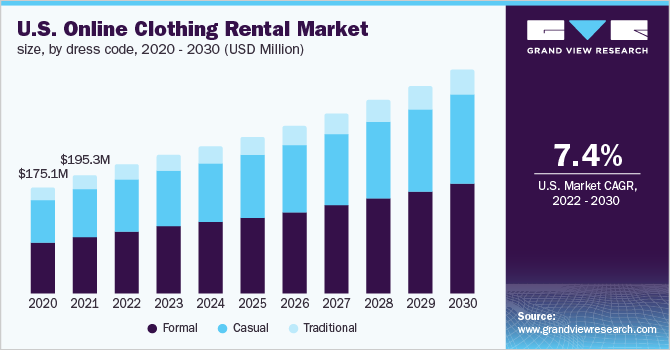 Source: Grand View Research, IR Documents, Primary Interviews, Paid DatabasesTo learn more about this report,
 Download Free Sample Report
 The COVID-19 has negatively impacted the online clothing rental market. As a result of the lockdown, all businesses except essential services were closed which disrupted the supply and distribution of online clothing thereby affecting the garments manufacturers. When the epidemic hit, demand for clothing rentals, which typically geared to working professionals in urban locations and those getting ready for a big night out, suddenly dropped.
As more people started working from home and occasions like weddings and banquets were postponed, canceled, or held online, rental platforms in particular experienced a decline in demand. According to a report published by the Royal Geographical Society with IBG in 2020, at the beginning of the pandemic, consumer spending on apparel was reduced by more than 50% in major markets including the U.S., U.K., and Germany.
For instance, one Australian rental platform entrepreneur reported daily sales decreased from USD 2258 (A$3,500) to less than USD 193 (A$300) in March 2020. However, the market is expected to eventually return to the pre-pandemic situation as people resume their normal life and start attending weddings, banquets, and other events after a long gap. This trend is anticipated to impact positively during the forecast period.
Fashion-conscious individuals who lack the finances to purchase clothes of their choice are anticipated to make use of the available resources to the fullest. Renting a product is always cost-efficient, and more so in this industry where the trends keep changing and consumers do not prefer repeating clothes. As a result, consumers prefer renting clothes to stay trendy.
Increasing e-commerce, especially in Asia Pacific is expected to propel the market in the near future. However, improper regulations, low consumer awareness, and less societal acceptance are the factors likely to hinder the growth of the market to an extent. Furthermore, the market is adopting a new style of online clothing rental as a subscription model. The subscription model creates seasonal income in addition to customers’ choices and preferences.
The main restrain is the difference in the size of the clothes. Rented clothes cannot be altered based on the size of the individual. Thus, to overcome these restraints, the companies are coming up with innovative methods such as live chats with fashion experts. Some companies also offer the same product in two sizes so that consumers can opt for the most fitting product.
Online Clothing Rental Market Trends
Soaring demand for luxury designer dresses, as well as continuous shifts in consumer fashion sense, are the factors predicted to fuel the rise of the online garment rental sector. In addition, consumers’ increased spending on fashionable pursuits as their disposable income rises, coupled with the rapid growth in the number of fashion brands, is a major element driving the market.
The evolving style statement among young people as well as an increase in the renting of formal clothing items such as premium jackets and suits among price-conscious individuals are the factors, predicted to drive the market expansion. Furthermore, the desire for sports apparel owing to an increase in the number of people playing sports, combined with growth in the number of sporting events, is expected to fuel the expansion of the market.
Manufacturers' increased attention to children's segments is expected to provide profitable market opportunities in the coming years. Kids have become more style- and brand-conscious as a result of their parents' changing lifestyles, which is likely to boost the growth of the online clothing rental space. However, the industry is significantly fragmented in nature due to the presence of several unorganized manufacturers selling low-cost, non-branded goods, which can act as a restraint and hamper market growth.
End-User Insights
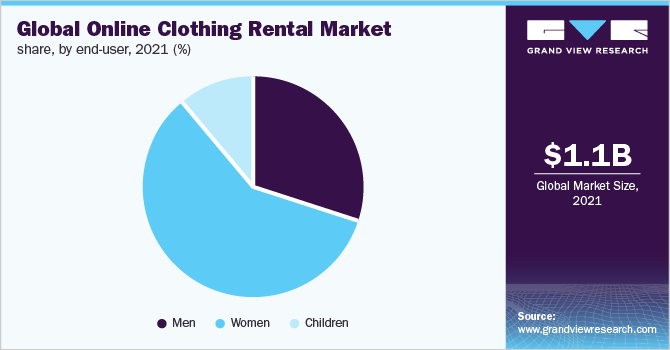
Based on end-user, the market is segmented into men, women, and kids. The women segment accounted for the leading market share of more than 59.13% in 2021 and is expected to witness significant growth in the near future. Constantly changing fashion trends are anticipated to propel the segment growth.
 To learn more about this report, Download Free Sample Report
 On the other hand, the kids segment is expected to register a significant CAGR during the forecast period. The kids grow fast and hence their clothes require constant replacement, thus, the parents prefer renting the clothes. This is anticipated to increase the subscription of rental companies, positively impacting the market growth.
Dress Code Insights
Traditional renting is expected to register a CAGR of more than 8.7% during the forecast period. Traditional clothes are worn during festivals, at rare and special occasions thus, are used very less. Hence, consumers prefer renting them instead of purchasing them.
Formal clothes held the largest market share of around 46.17% in 2021. Formal clothes such as suits and blazers are expensive and require maintenance, thus price-conscious and young consumers find renting as a better option. The casual wear segment is anticipated to hold a significant market share during the forecast period. It includes sportswear, for instance, players who are not able to get sports apparel can rent through online portals.
Regional Insights
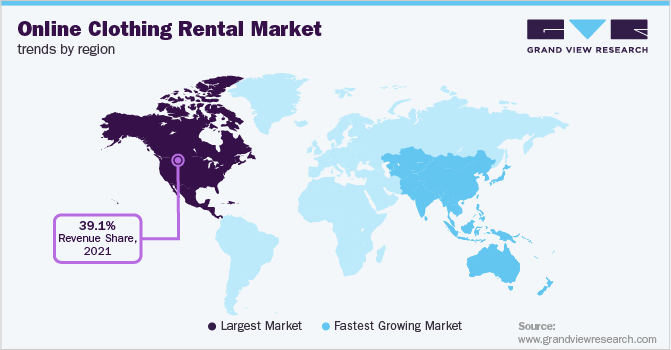
In 2021, North America led with a market share of around 39.13% and is anticipated to witness a significant CAGR in near future. In North America, Mexico contributes to the majority of the share and is expected to register a CAGR of more than 8.1% during the forecast period. Europe is the second-largest segment with a market share of around 26.91% in 2021. Western Europe is the dominant segment, due to the high purchasing power and fashion-conscious consumers in the countries, such as France, Italy, and the U.K.
Asia Pacific is the fastest-growing segment, due to the high demand from developing countries such as India and China. Growing consumer awareness and internet penetration are among the prominent growth drivers for the region. India and china account for more than 34.0% share of the global population, thus, rising consumer awareness in these countries is projected to impact overall growth. In these developing nations, consumers are finding a better way of accessing the clothes of their choice instead of having to buy them thus; clothing rental is a suitable solution for them.
 To learn more about this report, Download Free Sample Report
 Increasing purchasing power and changing fashion trends due to the rising adoption of western trends in developing nations are also the factors driving the market growth in Asia Pacific. Various government initiatives, such as Startup India by the government of India, encourage entrepreneurs to come up with innovative ideas. The idea of online clothing rental came into existence, in India, in 2012. These startups offer rental services at a very low cost to enhance customer experience. Many manufacturers offer high-end designer clothes with added benefits such as free trials at home.
Key Companies & Market Share Insights
The market poses a moderate to low entry barrier as this industry is new. Hence, to expand the business further, many new companies are joining the market. The overall market is driven by product innovation and the introduction of advanced features to enhance the consumer experience.
-
In December 2021, Fly robe, a fashion rental business crossed 1.0 million customers for the fashion rental business, as it starts to recover from the pandemic. Customers are currently serviced by the company in 30 Indian cities.
-
In April 2022, Fly robe joined hands with Franchise Mart for the franchise expansion At RENT IT BAE. The unique online premium rental service brings the latest fashion to the doorstep services.
Some of the prominent players in the global online clothing rental market include:
-
The Clothing Rental
-
Rent the runway
-
Flyrobe.com
-
Share Wardrobe
-
Secoo Holding Limited
-
Gwynnie Bee
-
Le Tote
-
Swapdom
-
Style Lend
-
Dress Hire
Online Clothing Rental Market Report Scope
Report Attribute
Details
Market size value in 2022
USD 1.23 billion
Revenue forecast in 2030
USD 2.33 billion
Growth rate
CAGR of 8.5% from 2022 to 2030
Base year for estimation
2021
Historical data
2019 - 2021
Forecast period
2017 - 2030
Quantitative units
Revenue in USD million/billion, CAGR from 2022 to 2030
Report coverage
Revenue forecast, company ranking, competitive landscape, growth factors, trends
Segments covered
End-use, dress code, region
Regional scope
North America; Europe; Asia Pacific; Central & South America; Middle East & Africa
Country scope
U.S.; Mexico; U.K.; France; China; India; Argentina; UAE
Key companies profiled
Clothing Rental; Rent the runway; Flyrobe.com; Share Wardrobe; Secoo Holding Limited; Gwynnie Bee; Le Tote; Swapdom; Style Lend; Dress Hire.
Customization scope
Free report customization (equivalent up to 8 analysts’ working days) with purchase. Addition or alteration to country, regional & segment scope.
Pricing and purchase options
Avail customized purchase options to meet your exact research needs. Explore purchase options
Global Online Clothing Rental Market Segmentation
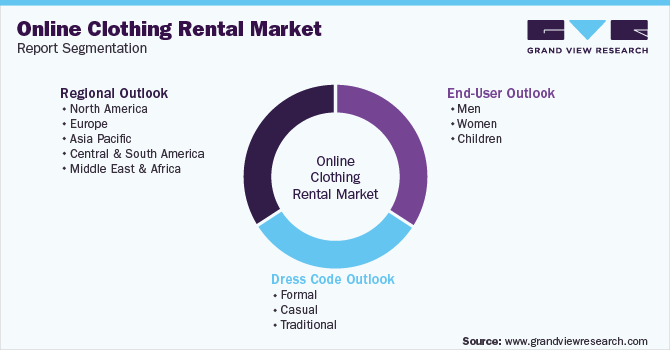
This report forecasts revenue growth at the global, regional & country levels and provides an analysis of the latest trends and opportunities in each of the sub-segment from 2017 to 2030. For this study, Grand View Research has segmented the online clothing rental market based on the end-user, dress code, and region.
 To learn more about this report, Download Free Sample Report
 -
End-User Outlook (Revenue, USD Million; 2017 - 2030)
-
Men
-
Women
-
Children
-
-
Dress Code Outlook (Revenue, USD Million; 2017 - 2030)
-
Formal
-
Casual
-
Traditional
-
-
Regional Outlook (Revenue, USD Million; 2017 - 2030)
-
North America
-
U.S.
-
Mexico
-
-
Europe
-
U.K.
-
France
-
-
Asia Pacific
-
China
-
India
-
-
Central & South America
-
Argentina
-
-
Middle East & Africa
-
UAE
-
-
Frequently Asked Questions About This Report
The global online clothing rental market size was estimated at USD 1.12 billion in 2021 and is expected to reach USD 1.23 billion in 2022.
The global online clothing rental market is expected to grow at a compound annual growth rate of 8.5% from 2022 to 2030 to reach USD 2.33 billion by 2030.
North America dominated the online clothing rental market with a share of 39.1% in 2021. This is attributable to increasing purchasing power among consumers paired with rapidly evolving fashion trends in the region.
Some key players operating in the online clothing rental market include The Clothing Rental, Rent the runway, Flyrobe.com, Share Wardrobe, Secoo Holding li Mited, Gwynnie Bee, Le Tote, Swapdom, StyleLend, and Dress Hire.
Key factors that are driving the market growth include the increasing popularity of online shopping portals and the ongoing trend of high end designer clothes.
About the Author(s)
Clothing, Footwear & Accessories Research Team
Consumer Goods · Clothing, Footwear & AccessoriesThis report was authored by the clothing, footwear & accessories research team at Grand View Research - comprising two research analysts, one senior research analyst, and one industry expert - with specialized expertise in the clothing, footwear & accessories segment of the consumer goods industry. All findings are based on proprietary consumer goods databases, executive interviews, and regulatory analysis, subject to internal peer review prior to publication.
Last Updated:
Speak to Analyst

Customize this report to your needs - add regions, segments, or data points, with 20% free customization.
Or view our licence options:


ISO 9001:2015 & 27001:2022 Certified
We are GDPR and CCPA compliant! Your transaction & personal information is safe and secure. For more details, please read our privacy policy.


