
- Home
- »
- Next Generation Technologies
- »
-
Open Source Services Market Size, Growth Report, 2026-2033GVR Report cover

Open Source Services Market (2026 - 2033)
Size, Share & Trends Analysis Report By Services (Integration & Deployment, Training & Consulting, Managed Services), By Deployment, By Application, By End Use, By Region, And Segment Forecasts
Market Size, 2025
$38.6BMarket Estimate, 2026
$42.1BMarket Forecast, 2033
$83.3BCAGR, 2026–2033
10.4%Open Source Services Market Summary
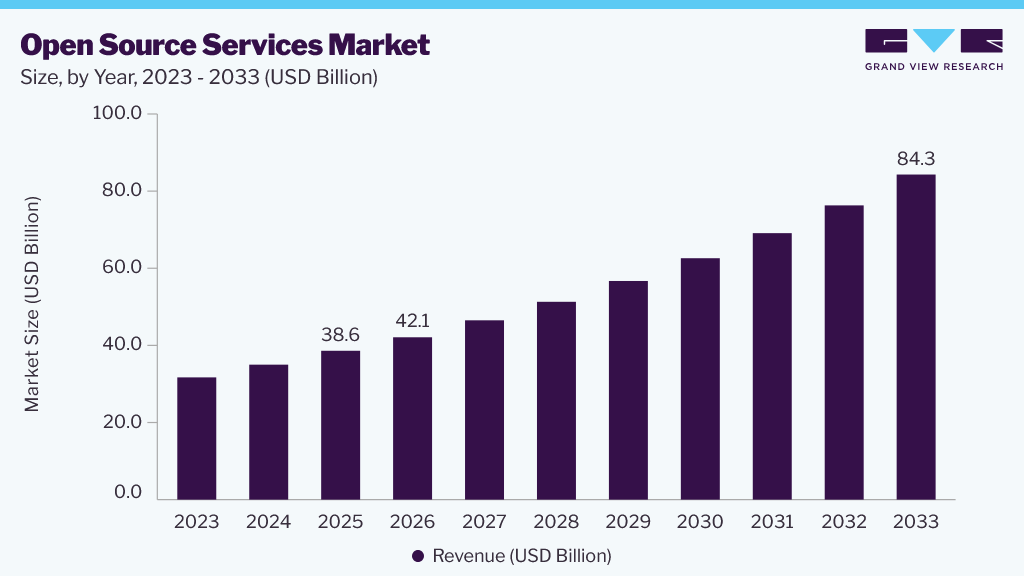
The global open source services market size was valued at USD 38.6 billion in 2025 and is projected to grow from USD 42.1 billion in 2026 to USD 84.3 billion by 2033, at a CAGR of 10.4% from 2026 to 2033. North America dominated the market with the largest revenue share of more than 25.0% in the global market in 2025. This is further supported by the rapid adoption of cloud computing, AI-driven analytics, and automation tools across enterprises in the region.
Key Market Trends & Insights
- By deployment: The hybrid segment held the largest market share of around 40.0%.
- By services: The integration & deployment segment held the largest market share of over 30.0%.
- By end use: The large enterprises segment held the largest market share of more than 70.0% in 2025.
- By application: The IT & ITeS segment held the largest market share of around 25.0% in 2025.
Regional Insights
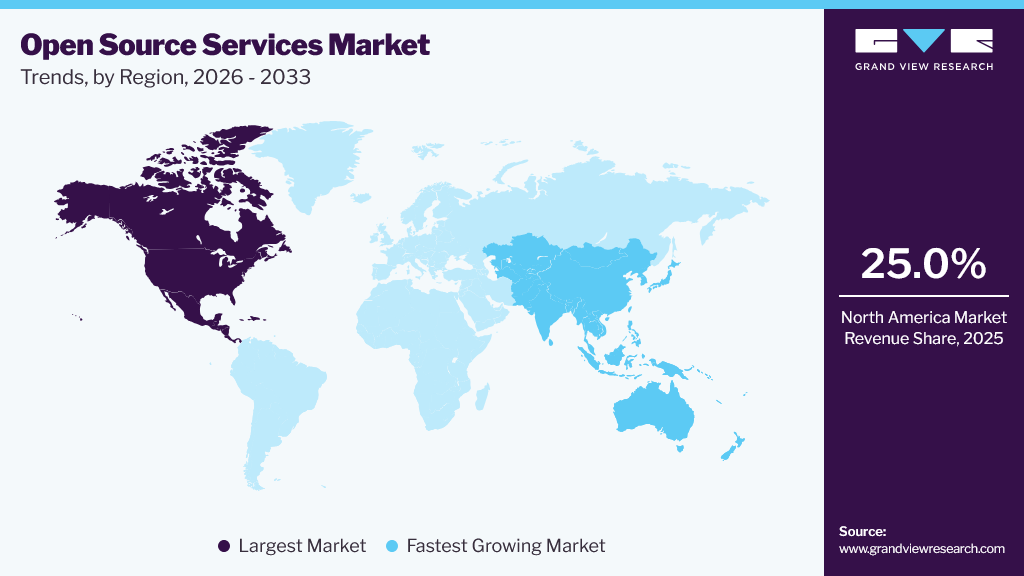
- Largest regional market: North America (25.0% revenue share, 2025)
- Fastest-growing regional market: Asia Pacific (highest CAGR, 2026-2033)
Market Size & Forecast
- Market size in 2025: USD 38.6 Billion
- Estimated market size in 2026: USD 42.1 Billion
- Projected market size by 2033: USD 84.3 Billion
- CAGR (2026-2033): 10.4%
Three ways to get this report
Buy it, customize it, or ask a question.Ask an Analyst
Analyst response in 1 business day
- AccessReport author, directly
- Reply timeWithin 1 working day
- No sales callDirect answer only
- FormatEmail reply
- CostFree, no cost
Get the Full Report
What the study covers
- FormatsPDF · Excel · Dashboard
- Timeline2026–2033 annual, 2025 base
- Coverage20+ countries, 5 regions
- Companies10+ key players profiled
Customize the Report
20% free customization
- IncludeCountries, segments, points
- TailorTo your product definition
- ExtendDeeper competitor detail
- OrA fully bespoke study
- Turnaround5–10 working days
The strong technology ecosystems and high digital maturity among industries such as healthcare, BFSI, and retail continue to accelerate market growth in North America.
 Source: Grand View Research, IR Documents, Primary Interviews, Paid DatabasesTo learn more about this report,
 Download Free Sample Report
 Companies are increasingly using digital technologies to optimize their operations, reduce costs, and improve customer experience. Open-source tools provide cost-effective, flexible solutions that can be easily integrated into existing systems. This has led to increased demand for open-source services as companies seek to leverage the benefits of digital transformation.
Moreover, the growth of cloud computing is another driver of growth. Cloud computing has become an essential component of digital transformation, enabling businesses to scale their operations and reduce infrastructure costs. Companies are looking for innovative solutions that can help them stay ahead of the competition. Open source platforms are a natural fit for cloud computing, as they provide a flexible and cost-effective way to build and deploy cloud-based applications.
The proliferation of Artificial Intelligence (AI) and Machine Learning (ML) technologies is fueling demand for open source services. These technologies offer significant advantages for businesses seeking to automate their operations, optimize their workflows, and improve their decision-making capabilities.
Open-source services provide a flexible and cost-effective platform for developing and deploying AI and ML solutions, enabling companies to harness the full potential of these technologies without significant investment in proprietary software. Furthermore, the availability of open-source libraries, frameworks, and tools has lowered the barriers to entry for businesses seeking to adopt these technologies, enabling them to leverage the latest innovations without incurring high costs.
With the increasing prevalence of cyber threats, companies are searching for secure solutions to safeguard their data and systems. Open-source systems provide a transparent and collaborative approach to security, enabling greater scrutiny and faster detection and resolution of vulnerabilities. Because open-source projects are typically available for anyone to view, test, and modify, this can improve their overall security posture. In addition, open source solutions are frequently audited by a large community of users and contributors, which can further enhance their security and reliability.
One of the constraints of the open-source market is the perceived lack of support and accountability compared to proprietary software. While open-source solutions are typically well supported by vibrant developer communities, some businesses may feel more comfortable with proprietary software providers that offer dedicated support and service-level agreements.
To overcome this restraint, open source service providers can invest in building robust support and training programs that offer customers the same level of accountability and responsiveness they would expect from a proprietary software vendor. In addition, open-source providers can leverage emerging technologies such as AI and ML to deliver intelligent, automated support and troubleshooting, enhancing the customer experience and reducing the need for human intervention.
Analyst Perspective
The open-source services industry is experiencing steady growth due to the increasing adoption of flexible, cost-effective, and customizable technology solutions by businesses seeking to accelerate digital transformation. The market is witnessing rising demand for cloud-based open source platforms, AI and machine learning frameworks, automation tools, and secure software solutions as organizations focus on improving operational efficiency, reducing technology costs, and building scalable digital infrastructure. Even though challenges such as limited enterprise support, security concerns, and integration complexities remain, advancements in cloud computing, AI-driven development, cybersecurity solutions, and managed open source services will continue to create new opportunities. Companies that adopt secure, scalable, and industry-specific open-source solutions are expected to benefit from the market’s long-term growth by driving innovation, enhancing agility, and reducing dependence on traditional proprietary software.
Services Insights
The integration & deployment segment led the market with the largest revenue share of above 30.0% in 2025. Organizations are increasingly adopting open-source software solutions to meet their business needs, leading to a surge in demand for experts to integrate and deploy these solutions.
Moreover, open source technologies are highly modular and can be customized to suit specific business needs. This requires expertise in integration and deployment, as organizations seek to integrate these solutions seamlessly into their existing IT infrastructure. Furthermore, integrating and deploying open-source solutions can be complex, and organizations are seeking to work with experts who can guide them through the process and ensure successful implementation.
The managed services segment is anticipated to register at a significant CAGR over the forecast period. As more organizations adopt open source technologies, they require specialized skills and expertise to manage and maintain these solutions. Managed services providers (MSPs) offer a range of services, including monitoring, maintenance, and troubleshooting, that can help organizations reduce IT costs and improve operational efficiency. The managed services segment is also growing due to the increasing complexity of IT environments, which has led to a shortage of skilled IT professionals.
By partnering with MSPs, organizations can access a team of experienced professionals who can manage their IT infrastructure effectively and efficiently, allowing them to focus on their core business activities. For instance, Red Hat expanded its managed cloud services portfolio by enhancing Red Hat OpenShift, enabling organizations to simplify the deployment, management, and scaling of cloud-native applications across hybrid cloud environments. These developments highlight the growing demand for open-source integration and managed services, as enterprises increasingly require expert support to deploy, operate, and optimize open-source-based platforms within complex IT infrastructures.
Deployment Insights
The hybrid segment led the market with the largest revenue share of around 40.0% in 2025. Many organizations have unique IT requirements and operate in complex environments that require a combination of on-premises and cloud-based solutions. The hybrid deployment model offers the flexibility to leverage the benefits of both environments while minimizing the potential drawbacks. Moreover, open-source solutions are highly modular and can be customized to meet specific business needs. The hybrid deployment model allows organizations to leverage these benefits while maintaining the ability to scale and add new capabilities as needed.
The cloud segment is anticipated to grow at a significant CAGR over the forecast period. Cloud deployment offers numerous benefits, including scalability, agility, and reduced IT infrastructure costs, making it an attractive option for organizations of all sizes. Open source solutions are well-suited for cloud deployment, as they are highly modular and can be easily integrated into cloud environments. Moreover, open source technologies are often developed with the cloud in mind, providing organizations with access to a wide range of cloud-native tools and services. Cloud deployment also allows organizations to leverage advanced analytics and machine learning capabilities, which are increasingly becoming critical components of modern business operations.
Application Insights
The IT & ITeS segment led the market with the largest revenue share of over 25.0% in 2025. The IT & ITeS industry is a key driver of innovation and is at the forefront of digital transformation. Open source technologies are flexible and customizable, making them an ideal fit for IT & ITeS applications. Moreover, open source solutions are often developed by communities, making them highly collaborative and transparent. This allows organizations to leverage the expertise of a vast network of developers and users to develop innovative solutions and address complex business challenges.
The BFSI segment is anticipated to grow at a significant CAGR over the forecast period. The BFSI industry is highly regulated and requires robust, secure, and scalable technology solutions to manage large volumes of sensitive data. Open-source solutions offer a transparent and collaborative approach to security, enabling organizations to quickly identify and remediate vulnerabilities. Moreover, open-source solutions can be easily integrated into existing IT infrastructure, enabling BFSI organizations to modernize their technology stack without disrupting operations.
End Use Insights
The large enterprises segment led the market with the largest revenue share of more than 70.0% in 2025, owing to their ability to invest heavily in research and development, enabling them to leverage cutting-edge open-source technologies and drive innovation in the market. Large enterprises also have the resources to build and maintain internal teams of open-source experts, enabling them to optimize their use of open-source solutions and contribute to the community. In addition, large enterprises often operate globally and require solutions that can be easily scaled and localized to meet the needs of different regions and markets. Open-source solutions provide the flexibility and customization needed to address these challenges, making them an attractive option for large enterprises.
The small & medium enterprises (SMEs) segment is anticipated to register at the fastest CAGR over the forecast period. Open source solutions offer cost savings and reduce vendor lock-in, which is critical for SMEs with limited IT budgets and resources. Open-source solutions often have lower upfront costs and provide SMEs with greater flexibility to optimize their IT spending. SMEs can leverage open-source solutions to develop and implement innovative solutions quickly, without being constrained by proprietary software.
Regional Insights
North America dominated the global open-source services market with the largest revenue share of more than 25.0% in 2025. The region has a strong culture of collaboration and innovation, which has helped foster the growth of open-source communities and networks of expertise. Moreover, the region has a highly skilled and educated workforce, which has helped drive the development and adoption of open-source solutions across a wide range of industries. Furthermore, the region has well-established regulations and standards for data privacy and security, making it an attractive market for companies seeking secure, transparent, open-source solutions.
 To learn more about this report, Download Free Sample Report
 For instance, in June 2026, the U.S.-based Linux Foundation announced the expansion of its open source AI and cloud ecosystem initiatives through new industry collaborations with major technology firms such as IBM, Microsoft, and Google. The initiative focuses on accelerating enterprise adoption of open source software in areas such as AI infrastructure, cloud-native development, and cybersecurity. This development highlights North America’s strong innovation ecosystem and collaborative open-source culture, which continue to drive large-scale adoption of open-source services across industries.
Asia Pacific Open Source Services Market Trends
The open-source services market in the Asia Pacific is expected to grow at the fastest-CAGR over the forecast period. The region has a large and rapidly expanding technology market, with many companies and organizations seeking cost-effective, customizable solutions to meet their IT needs. For instance, in June 2026, Red Hat highlighted growing demand for its open-source and hybrid cloud solutions in India as enterprises increasingly focus on AI sovereignty, data control, and reducing dependence on proprietary technology providers. The company noted that Indian organizations are actively evaluating open source platforms to build secure and flexible AI infrastructure that aligns with local regulatory and operational requirements. This development reflects the broader trend of enterprises adopting open source services to strengthen digital sovereignty and build scalable, customizable technology ecosystems. Open-source solutions offer an attractive option for these companies, providing flexibility and scalability, as well as cost savings compared to proprietary software. The region has a large and growing pool of startups and entrepreneurs who are increasingly turning to open source solutions to drive innovation and growth.
Key Open Source Services Company Insights
Market players are adopting various strategies to gain a competitive advantage and drive growth. Many companies are partnering with other organizations to combine complementary open-source technologies and services, or acquiring smaller firms to gain access to their expertise and customer base. This approach allows companies to quickly expand their capabilities and reach, and offer more comprehensive solutions to their customers. Moreover, the companies are also investing in R&D to innovate and differentiate their offerings.
For instance, in June 2026, Databricks announced OpenSharing, a new open standard built on top of its Delta Sharing ecosystem, designed to enable secure sharing of data, AI models, and agent skills across platforms and organizations. The solution also introduces marketplace-like capabilities that allow enterprises to publish, discover, and consume AI assets in a vendor-neutral way, strengthening ecosystem collaboration and simplifying integration across cloud environments.
Key Open Source Services Companies
The following key companies have been profiled for this study on the global open source services market:
-
Red Hat, Inc. (IBM)
-
MuleSoft (Salesforce, Inc.)
-
Amazon Web Services, Inc. (Amazon)
-
Databricks
-
HashiCorp
-
Alphabet, Inc. (Google)
-
Cisco
-
Microsoft
-
Oracle
-
SAP SE
Recent Developments
- In June 2026, the Linux Foundation announced the launch of the OpenSharing Project, a new vendor-neutral open protocol designed to standardize the sharing of AI models, agent skills, and data across platforms. The initiative aims to improve interoperability and simplify collaboration between enterprises using open-source and cloud-native ecosystems. This reflects the growing industry shift toward open, standardized frameworks for AI and data exchange in enterprise environments.
- In December 2025, SUSE strengthened its collaboration with AWS by expanding integration of its enterprise open source solutions with Amazon Q and AWS AI services. The partnership is designed to support organizations in building, deploying, and managing cloud-native and AI applications using open source infrastructure across hybrid environments. This reflects the growing importance of open source in enterprise cloud and AI modernization strategies.
- In May 2025, Red Hat expanded its open source AI portfolio with new tools for distributed inference, model management, and Kubernetes-based AI workloads under its OpenShift AI platform. These updates are designed to help enterprises deploy and scale AI applications using open source frameworks, reducing reliance on proprietary AI infrastructure.
Open Source Services Market Report Scope
Report Attribute
Details
Market size in 2025
USD 38.6 billion
Estimated market size in 2026
USD 42.1 billion
Projected market size by 2033
USD 84.3 billion
Growth rate
CAGR of 10.4% from 2026 to 2033
Base year for estimation
2025
Historical data
2021 – 2024
Forecast period
2026 – 2033
Quantitative units
Revenue in USD million/billion, and CAGR from 2026 to 2033
Report coverage
Revenue forecast, company ranking, competitive landscape, growth factors, and trends
Segments covered
Services, deployment, application, end use, region
Regional scope
North America; Europe; Asia Pacific; Latin America; Middle East & Africa
Country scope
U.S.; Canada; UK; Germany; France; China; Japan; India; South Korea; Australia; Brazil; Mexico; Kingdom of Saudi Arabia; UAE; South Africa
Key companies profiled
Red Hat, Inc. (IBM); MuleSoft (Salesforce, Inc.); Amazon Web Services, Inc. (Amazon); Databricks; HashiCorp; Alphabet, Inc. (Google); Cisco; Microsoft; Oracle; SAP SE
Customization scope
Free report customization (equivalent up to 8 analysts working days) with purchase. Addition or alteration to country, regional & segment scope.
Pricing and purchase options
Avail of customized purchase options to meet your exact research needs. Explore purchase options
Global Open Source Services Market Report Segmentation
The report forecasts revenue growth at the global, regional, and country levels and provides an analysis of the latest industry trends across each sub-segment from 2021 to 2033. For this study, Grand View Research has segmented the global open source services market report based on services, deployment, application, end use, and region.
- Services Outlook (Revenue, USD Billion, 2021 - 2033)
- Integration & Deployment
- Training & Consulting
- Managed Services
- Support & Maintenance
- Deployment Outlook (Revenue, USD Billion, 2021 - 2033)
- Cloud
- Hybrid
- On-premise
- Application Outlook (Revenue, USD Billion, 2021 - 2033)
- BFSI
- IT & ITeS
- Telecommunication & Media
- Industrial
- Retail & E-commerce
- Others
- End Use Outlook (Revenue, USD Billion, 2021 - 2033)
- Large Enterprises
- Small & Medium Enterprises
- Regional Outlook (Revenue, USD Billion, 2021 - 2033)
- North America
- U.S.
- Canada
- Europe
- UK
- Germany
- France
- Asia Pacific
- China
- Japan
- India
- South Korea
- Australia
- Latin America
- Brazil
- Mexico
- Middle East & Africa
- Kingdom of Saudi Arabia (KSA)
- UAE
- South Africa
- North America
Frequently Asked Questions About This Report
The global open source services market size was valued at USD 38.6 billion in 2025 and is estimated at USD 42.1 billion for 2026
The global open source services market is expected to grow at a CAGR of 10.4% from 2026 to 2033, reaching USD 84.3 billion
North America dominated with an approximately 25.0% revenue share in 2025.
The integration & deployment segment dominated the market in 2025 with a revenue share of above 25.0%.
Key players in the market include Red Hat, Inc. (IBM); MuleSoft (Salesforce, Inc.); Amazon Web Services, Inc. (Amazon); Databricks; HashiCorp; Alphabet, Inc. (Google); Cisco; Microsoft; Oracle; SAP SE, and others.
About the Author(s)
Next Generation Technologies Research Team
Technology · Next Generation TechnologiesThis report was authored by the next generation technologies research team at Grand View Research - comprising two research analysts, one senior research analyst, and one industry expert - with specialized expertise in the next generation technologies segment of the technology industry. All findings are based on proprietary technology databases, executive interviews, and regulatory analysis, subject to internal peer review prior to publication.
Last Updated:
Speak to Analyst

Customize this report to your needs - add regions, segments, or data points, with 20% free customization.
Or view our licence options:


ISO 9001:2015 & 27001:2022 Certified
We are GDPR and CCPA compliant! Your transaction & personal information is safe and secure. For more details, please read our privacy policy.


