
- Home
- »
- Next Generation Technologies
- »
-
Operational Technology Security Market Report, 2026-2033GVR Report cover

Operational Technology Security Market (2026 - 2033)
Size, Share & Trends Analysis Report By Component (Software, Services), By Deployment (Cloud, On-Premises), By Enterprise Size (SMEs, Large Enterprises), By Vertical (Manufacturing), By Region, And Segment Forecasts
Market Size, 2025
$26.3BMarket Estimate, 2026
$30.9BMarket Forecast, 2033
$88.7BCAGR, 2026–2033
15.7%Operational Technology Security Market Summary
The global operational technology security market size was valued at USD 26.3 billion in 2025 and is projected to grow from USD 30.9 billion in 2026 to USD 88.7 billion in 2033, at a CAGR of 15.7% from 2026 to 2033. North America dominated the global market with the largest revenue share of 40.0% in 2025. This growth is driven by expanding connectivity and the digitization of industrial control systems (ICS) used in critical infrastructure such as power grids and manufacturing plants.
Key Market Trends & Insights
- By component: Solutions segment accounted for the largest revenue share of 75.0% in 2025.
- By deployment: On-premises held the largest market share of 60.0% in 2025.
- By enterprise size: Large enterprises segment led the market share of 70.0% in 2025.
- By vertical: Oil & gas operations segment accounted for the largest revenue share of 20.0% in 2025.
Regional Highlights
- Largest regional market: North America (40.0% revenue share, 2025)
- Fastest-growing regional market: Asia Pacific (highest CAGR, 2026-2033)
Market Size & Forecast
- Market size in 2025: USD 26.3 Billion
- Estimated market size in 2026: USD 30.9 Billion
- Projected market size by 2033: USD 88.7 Billion
- CAGR (2026-2033): 15.7%
Three ways to get this report
Buy it, customize it, or ask a question.Ask an Analyst
Analyst response in 1 business day
- AccessReport author, directly
- Reply timeWithin 1 working day
- No sales callDirect answer only
- FormatEmail reply
- CostFree, no cost
Get the Full Report
What the study covers
- FormatsPDF · Excel · Dashboard
- Timeline2026–2033 annual, 2025 base
- Coverage20+ countries, 5 regions
- Companies10+ key players profiled
Customize the Report
20% free customization
- IncludeCountries, segments, points
- TailorTo your product definition
- ExtendDeeper competitor detail
- OrA fully bespoke study
- Turnaround5–10 working days
This increased connectivity heightens vulnerability to cyberattacks. Organizations increasingly recognize these risks and invest in protective solutions, while stringent government regulations propel demand for compliant security measures. Introducing technologies such as cloud computing, artificial intelligence, and the Internet of Things (IoT) poses new security challenges to operational technology systems. For instance, in April 2023, Trustwave Holdings, Inc. introduced its operational technology security maturity diagnostic offering, designed to assess and advise organizations on their operational technology security status. This offering utilizes the NIST cybersecurity framework and the IEC 62443 standards, evaluating operational technology security across people, processes, and technology. The assessment encompasses key areas such as security training, asset management, access control, network security, vulnerability management, and incident response.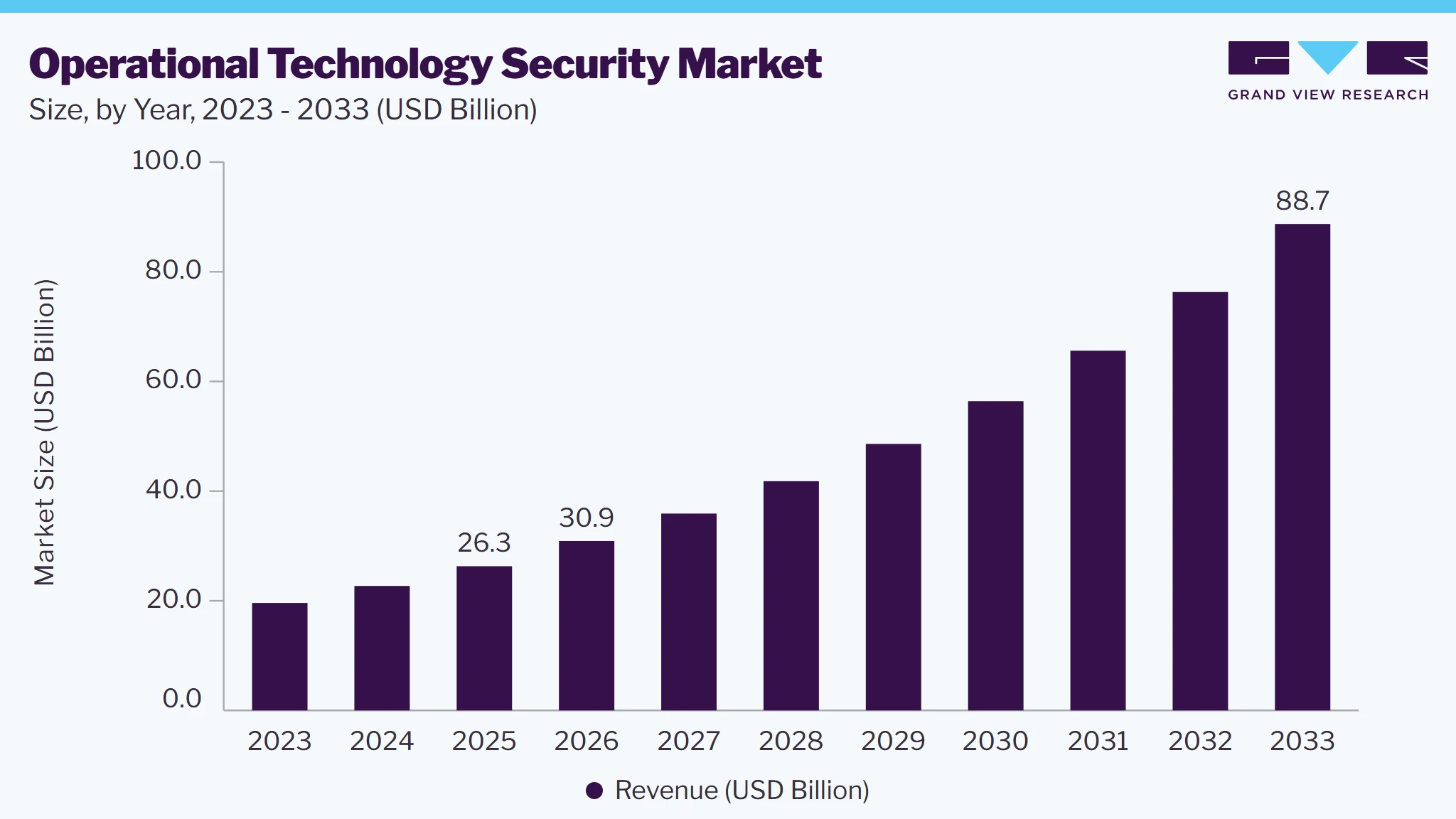 Source: Grand View Research, IR Documents, Primary Interviews, Paid DatabasesTo learn more about this report,
 Download Free Sample Report
 The operational technology security industry is experiencing swift expansion due to the growing convergence of IT and operational technology networks, which amplifies the vulnerability of operational technology systems to cyberattacks. Adopting cloud computing and mobile devices within operational technology environments introduces new security risks. The growing sophistication of cyber attackers has led to more frequent and effective targeting of operational technology systems. The primary goals of operational technology security include protecting critical infrastructure from cyber threats, upholding the safety and reliability of industrial operations, and ensuring compliance with regulatory requirements.
The growth of the operational technology security industry is propelled by integrating government initiatives into security standards and the increasing adoption of cloud-based operational technology security solutions. Cloud-based solutions offer scalability, flexibility, and cost-effectiveness compared to traditional on-premises alternatives. They also make updates easier to implement to counter evolving threats. Moreover, governments worldwide emphasize operational technology security through guidelines and recommendations by the U.S.'s CISA (Cybersecurity & Infrastructure Security Agency). These initiatives raise awareness and foster demand for effective operational technology security solutions that safeguard critical infrastructure.
The surge in government investments in operational technology security drives the market's growth. The connection of operational technology systems to the internet has heightened their vulnerability to operational technology attacks. Governments are addressing this risk by allocating resources to operational technology security, establishing regulatory frameworks, and providing training and support to organizations that manage operational technology systems. This proactive approach aims to safeguard these vital systems from potential threats.
For instance, in February 2023, the Technology Modernization Fund (TMF), a government initiative that allocates funds to federal agencies to upgrade their technology systems, announced that it raised around USD 650 million to enhance cybersecurity and digital services through various projects. This funding is designed to bolster agencies' cybersecurity measures, reduce their dependence on outdated systems, and enhance service delivery.
Market Dynamics
The operational technology security industry is driven by the increase in the number of cyberattacks on critical IT infrastructure. With the increase in connectivity between the operational and information technological environment, they have become more prone to cyberattacks. Frequent attacks force organizations to invest in high-end operational technology security solutions to safeguard their critical operations from malicious activity. As a result, the market keeps expanding as cyberattacks against critical infrastructure increase around the world. The fact that cyberattacks are usually directed at operational technology because disruptions to their operations could lead to serious monetary losses, production delays, safety risks, legal action, and reputational damage. For instance, in April, 2026, the U.S. Cybersecurity and Infrastructure Security Agency (CISA), alongside the FBI and international defense partners, launched a joint initiative called “CI Fortify”.
The operational technology security skills gap is a major challenge that impedes the growth of the industry. The impact of this shortage amplifies because it is not only the task of the cybersecurity professionals to protect and understand the cybersecurity issue, but also to confront security issues arising from the old and sometimes outdated process control systems.The demand for operational technology security skilled workers seems to have increased, especially due to the multiple ransomware attacks that affect operational technology environments, such as the SolarWinds incident. For instance, in May 2026, SAANS released a report titled "Cybersecurity Skills Gap Is Now the Top CISO Concern," which also provided nine strategic recommendations, led by developing formal AI governance programs and baseline AI security training.
Analyst perspective
The operational technology (OT) security market is becoming increasingly critical as industrial systems become more connected and exposed to cyber risks. Unlike traditional IT security, operational technology environments require continuous operations, making downtime a major concern. As a result, organizations are prioritizing security solutions that can protect critical infrastructure without disrupting operations. Companies with deep industrial expertise, strong regulatory alignment, and the ability to integrate security across complex operational environments are expected to hold a strong position in the market.
Component Insights
The solutions segment led the market with the largest revenue share of 75.0 % in 2025. The high share can be attributed to organizations' growing inclination towards adopting operational technology security solutions to safeguard their critical infrastructure against cyberattacks. The market is primarily characterized by two types of operational technology security solutions: integrated platforms and standalone solutions. Integrated platform solutions encompass a comprehensive suite of operational technology security products and services that work seamlessly together, providing a unified approach to addressing operational technology security challenges.
In contrast, standalone solutions entail individual operational technology security products or services that can be procured and implemented separately, often proving cost-effective for organizations seeking specific security solutions. For instance, in February 2026, Dragos Inc., a global leader in cybersecurity for operational technology (OT) environments, announced an expanded collaboration with Microsoft to enable organizations to update their operational technology infrastructures against the backdrop of growing digital transformation.
The services segment is predicted to grow at the fastest CAGR over the forecast period. The growth can be attributed to organizations outsourcing their operational technology security needs to third-party providers. Operational technology security services include monitoring, incident detection and response, and training and consulting. Monitoring, incident detection, and response aids organizations in threat monitoring and incident handling. Training and consulting services also play a crucial role by educating organizational personnel about optimal operational technology security practices and assisting in successfully deploying efficient operational technology security solutions.
In December 2025, NTT DATA, one of the world’s leading firms in the fields of artificial intelligence, has introduced its four new autonomous Cyber Defense Centers based on AI technology in Bengaluru, Hyderabad, Noida, and Mumbai, besides two more that is opened in Birmingham (UK) and Dallas (USA), in December 2025 and January 2026, respectively.
Deployment Insights
The on-premises segment led the market with the largest revenue share of 60.0% in 2025, attributed to organizations prioritizing the on-premises approach to maintain absolute control over their operational technology security solutions. Concerns about security and privacy further drive this preference, as on-premises solutions mitigate potential risks associated with cloud-based alternatives. The demand for optimal performance and the continuous availability of operational technology security solutions contribute to the segment growth. For instance, in April 2025,Rockwell Automation, a leading industrial automation organization, introduced their Security Monitoring & Response Services service. It is completely based on their localized Security Operations Center (SOC) approach that offers minimal trust visibility without exposing their data into the public cloud.
The cloud segment is anticipated to grow at the fastest CAGR during the forecast period. The surge in demand for heightened security measures for operational technology systems due to the increase in cyberattacks propels the momentum toward cloud-based operational technology security solutions. These solutions safeguard such critical systems from malicious intrusions. Furthermore, the availability of a diverse array of cloud-based operational technology security solutions streamlines the adoption process for organizations, augmenting the attractiveness of cloud-based options. For instance, in February 2025, Dragos announced an expansion to its core platform of Microsoft Azure by collaborating with the latter to Deliver Operational Technology-Native Cybersecurity at a global level.
Enterprise Size Insights
The large enterprises segment led the market with the largest revenue share of 70% in 2025, attributed to the complex and crucial nature of their operational technology landscapes, which attract cyber threats. These enterprises possess interconnected operational technology systems that enable attackers to move laterally within networks with ease. In addition, their numerous remote access points provide fertile ground for exploitation. The drive for cyber attackers is heightened by high-value proprietary data and intellectual property within these organizations. Moreover, the consequences of a data breach for large enterprises were more substantial, encompassing financial implications and operational disruptions. Thus, these enterprises invested considerably in operational technology security to safeguard against such risks.
For instance, in January 2024, the global industry leader Schneider Electric was hit by a massive ransomware attack carried out by "Cactus." This attack compromised the sustainability business unit of Schneider Electric and the software used in the business unit called “Resource Advisor.”
The SMEs segment is anticipated to grow at the fastest CAGR during the forecast period. There are numerous small and medium-sized businesses in nearly every country. SMEs prefer the more affordable option due to their limited financial resources. These organizations are increasingly seen as attractive targets, thereby contributing to the rising threat landscape.
Thus, due to this vulnerability, SMEs are expected to invest substantially in enhancing their operational technology security infrastructure. Despite SMEs' limited financial resources, the market is expected to expand due to the increasing scalability of operational technology security solutions, widespread accessibility, and cloud-based deployments.
Vertical Insights
The oil & gas operations segment led the market with the largest revenue share of 20.0% in 2025, driven by the crucial role of operational technology security in managing oil & gas operations, which have become a central focus of cyber threats. These systems oversee and regulate core processes such as drilling, refining, and transportation, often interconnected with the internet, rendering them susceptible to cyber-attacks. Further, the surge in internet-connected operational technology systems, the advancing complexity of cyber threats, compliance mandates, and the increased recognition of the significance of operational technology security have driven market growth in the segment. For instance, in February 2026, the official Dragos 2026, Operational Technology/ICS Cybersecurity Report, which is published via BusinessWire, states that the vulnerability of oil and gas businesses towards cybercrime attacks is increasing because of the complexity of the interconnected gateway devices.
The manufacturing segment is expected to grow at the fastest CAGR over the forecast period, driven by the rising integration of operational technology systems and devices into networks, which heightens their vulnerability to cyberattacks. The manufacturing industry's role as an essential infrastructure sector makes it a potential target for cyber incidents that could profoundly disrupt production and supply chains. The sector's increasing adoption of digital technologies such as cloud computing and big data analytics further enhances the vulnerability to cyber threats. In addition, imposing more stringent regulatory requirements compels manufacturers to allocate resources toward bolstering operational technology security to ensure compliance.
Regional Insights
North America dominated the global operational technology security market with the largest revenue share of 40.0% in 2025, attributed to the critical infrastructure, advanced industrial sectors, and the heightened demand for robust security measures. Moreover, North America's strict regulatory frameworks, exemplified by the North American Electric Reliability Corporation (NERC) Critical Infrastructure Protection (CIP) standards, mandate the implementation of comprehensive operational technology security protocols. These regulations have played a pivotal role in fostering an awareness of the significance of operational technology security across the North American region.
 To learn more about this report, Download Free Sample Report
 For instance, in July 2025, the Federal Energy Regulatory Commission (FERC) and the North American Electric Reliability Corporation (NERC) officially adopted a key regulatory requirement, the NERC CIP-015-1 Standard, which requires electric utilities to have a comprehensive monitoring capability for their internal network operations.
Asia Pacific Operational Technology Security Market Trends
The operational technology security market in the Asia Pacific is anticipated to grow at the fastest CAGR during the forecast period. The region is home to some of the world's fastest-growing economies, including China, India, and Indonesia, actively channeling investments into automation and digitization. This drive fuels the adoption of operational technology solutions, which are pivotal for overseeing critical infrastructure such as power plants, water treatment facilities, and transportation systems. As the need for operational technology solutions increases, the demand for operational technology security also increases. Furthermore, growing awareness of operational technology security risks is compelling organizations throughout the Asia Pacific to invest in solutions to safeguard their critical infrastructure against potential cyberattacks.
For instance, in July 2025, the Ministry of Electronics & IT (Press Information Bureau, Government of India) issued a press release stating that the government has massively increased the security oversight to defend the nation's digital and physical infrastructure.
Key Operational Technology Security Company Insights
Emerging players have exhibited traction for inorganic and organic strategies to tap into the global markets. Furthermore, industry players are poised to focus on partnerships, mergers & acquisitions, geographical expansion, innovation, technological advancements, and product offerings. For instance, in June 2023, L&T Technology Services Limited partnered with Palo Alto Networks as a managed security service provider (MSSP) partner for operational technology Security offerings. This partnership aims to extend security services to end customers across industrial sectors through L&T Technology Services Limited.
Leveraging L&T Technology Services Limited's engineering, operations, and security expertise with Palo Alto Networks' operational technology security solutions, the partnership aims to help customers safeguard their vital infrastructure from cyberattacks.
Key Operational Technology Security Companies
The following key companies have been profiled for this study on the operational technology security market.
-
Broadcom
-
Cisco Systems, Inc
-
CyberArk Software Ltd.
-
Darktrace Holdings Limited.
-
Fortinet, Inc.
-
Forcepoint
-
Nozomi Networks Inc.
-
Qualys, Inc.
-
Sophos Ltd.
-
Zscaler, Inc.
Recent Developments
-
In June 2026, Dragos, Inc., an innovator in the world of industrial cybersecurity, acquired Phosphorus, a firm specializing in IoT security. This is part of the evolving dynamics in the industry. The trend is now moving from concentrating on older industrial control systems to the Extended Operational Technology environment.
-
In November 2025, Claroty, which is one of the leading cybersecurity providers of cyber-physical systems security solutions worldwide, has recently introduced a significant upgrade to its product portfolio through the integration of automated risk analytics and remediation.
Operational Technology Security Market Report Scope
Report Attribute
Details
Market size in 2025
USD 26.3 billion
Estimated Market size in 2026
USD 30.9 billion
Projected Market size by 2033
USD 88.7 billion
Growth rate
CAGR of 15.7% from 2026 to 2033
Base year for estimation
2025
Historical data
2021 - 2024
Forecast period
2026 - 2033
Quantitative units
Revenue in USD million/billion, and CAGR from 2026 to 2033
Report coverage
Revenue forecast, company ranking, competitive landscape, growth factors, and trends
Segments covered
Component, deployment, enterprise size, vertical, region
Regional scope
North America; Europe; Asia Pacific; Latin America; Middle East & Africa
Country scope
U.S.; Canada; Mexico; Germany; France; UK; Italy; Spain; China; India; Japan; South Korea; Australia; Brazil; Argentina; Saudi Arabia
Key companies profiled
Broadcom; Cisco Systems, Inc.; CyberArk Software Ltd; Darktrace Holdings Limited; Fortinet, Inc.; Forcepoint; Nozomi Networks Inc.; Qualys; Inc.; Sophos Ltd.; Zscaler, Inc.
Customization scope
Free report customization (equivalent up to 8 analysts working days) with purchase. Addition or alteration to country, regional & segment scope.
Pricing and purchase options
Avail of customized purchase options to meet your exact research needs. Explore purchase options
Global Operational Technology Security Market Report Segmentation
This report forecasts revenue growth at the regional and country levels and provides an analysis on the latest industry trends and opportunities in each of the sub-segments from 2021 to 2033. For this study, Grand View Research has segmented the global operational technology security market report based on the component, deployment, enterprise size, vertical, and region:
-
Component Outlook (Revenue, USD Billion, 2021 - 2033)
-
Solution
-
Services
-
-
Deployment Outlook (Revenue, USD Billion, 2021 - 2033)
-
Cloud
-
On-premises
-
-
Enterprise Size Outlook (Revenue, USD Billion, 2021 - 2033)
-
SMEs
-
Large Enterprises
-
-
Vertical Outlook (Revenue, USD Billion, 2021 - 2033)
-
Manufacturing
-
Transportation & Logistics
-
Energy & Utilities
-
Oil & Gas Operations
-
Government
-
Healthcare & Pharmaceuticals
-
Others
-
-
Regional Outlook (Revenue, USD Billion, 2021 - 2033)
-
North America
-
U.S.
-
Canada
-
Mexico
-
-
Europe
-
Germany
-
France
-
UK
-
Italy
-
Spain
-
-
Asia Pacific
-
China
-
Japan
-
India
-
South Korea
-
Australia
-
-
Latin America
-
Brazil
-
Argentina
-
-
Middle East and Africa
-
Saudi Arabia
-
UAE
-
South Africa
-
-
Frequently Asked Questions About This Report
The global operational technology security market size was estimated at USD 26.3 billion in 2025 and is expected to reach USD 30.9 billion in 2026.
The global operational technology security market is expected to grow at a compound annual growth rate of 15.7% from 2026 to 2033 to reach USD 88.7 billion in 2033.
North America dominated with a 40.0% revenue share in 2025.
Some key players operating in the operational technology security market include Broadcom; Cisco Systems, Inc; CyberArk Software Ltd.; Darktrace Holdings Limited; Fortinet, Inc.; Forcepoint; Nozomi Networks Inc; Qualys, Inc.; Sophos Ltd; Zscaler, Inc.
Based on component, the solutions segment accounted for the largest revenue share of 75.0% in 2025.
About the Author(s)
Next Generation Technologies Research Team
Technology · Next Generation TechnologiesThis report was authored by the next generation technologies research team at Grand View Research - comprising two research analysts, one senior research analyst, and one industry expert - with specialized expertise in the next generation technologies segment of the technology industry. All findings are based on proprietary technology databases, executive interviews, and regulatory analysis, subject to internal peer review prior to publication.
Last Updated:
Speak to Analyst

Customize this report to your needs - add regions, segments, or data points, with 20% free customization.
Or view our licence options:


ISO 9001:2015 & 27001:2022 Certified
We are GDPR and CCPA compliant! Your transaction & personal information is safe and secure. For more details, please read our privacy policy.


