
- Home
- »
- Medical Devices
- »
-
Ophthalmic Clinical Trials Market Size Report, 2026-2033GVR Report cover

Ophthalmic Clinical Trials Market (2026 - 2033)
Size, Share & Trends Analysis Report By Product (Devices, Drugs), By Phase (Discovery Phase, Clinical Phase, Preclinical Phase), By Indication (Macular Degeneration), By Sponsor Type, By Region, And Segment Forecasts
Market Size, 2025
$2.9BMarket Estimate, 2026
$3.1BMarket Forecast, 2033
$5.9BCAGR, 2026–2033
9.7%Ophthalmic Clinical Trials Market Summary
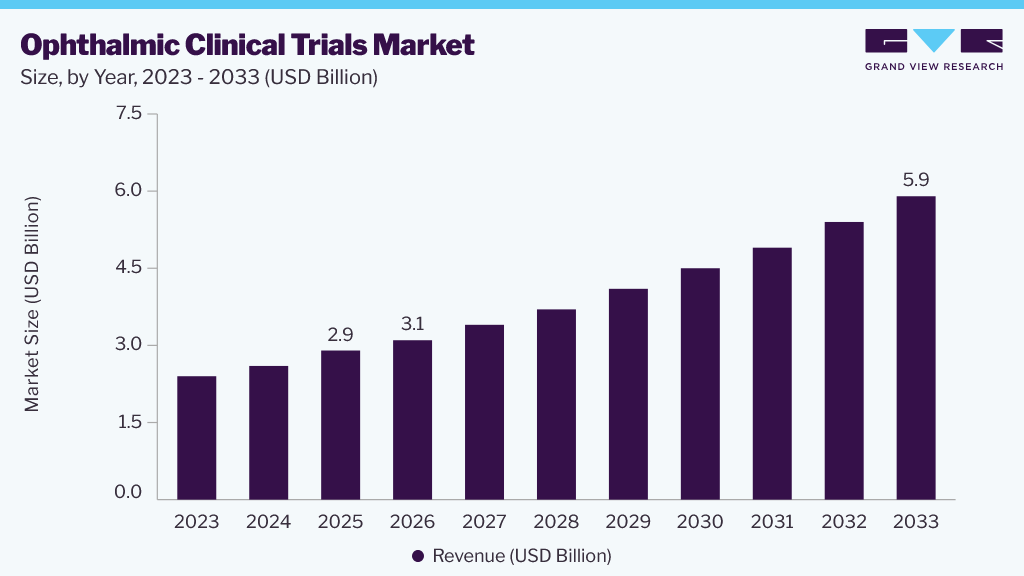
The global ophthalmic clinical trials market size was valued at USD 2.9 billion in 2025 and is projected to grow from USD 3.1 billion in 2026 to USD 5.9 billion in 2033, at a CAGR of 9.7% from 2026 to 2033. North America dominated the market, accounting for a revenue share of 45.0% in 2025. Increasing demand for ocular therapies is a key driver of market growth.
Key Market Trends & Insights
- By product: The drugs segment dominated the market, accounting for the largest revenue share of around 75.0% in 2025.
- By indication: The retinopathy segment dominated the market, accounting for the largest revenue share of over 25.0% in 2025.
- By phase: The clinical phase segment dominated the market, accounting for around 80.0% of revenue in 2025.
- By sponsor type: Pharmaceutical/biopharmaceutical companies dominated the market, accounting for more than 40.0% of revenue in 2025.
Regional Insights
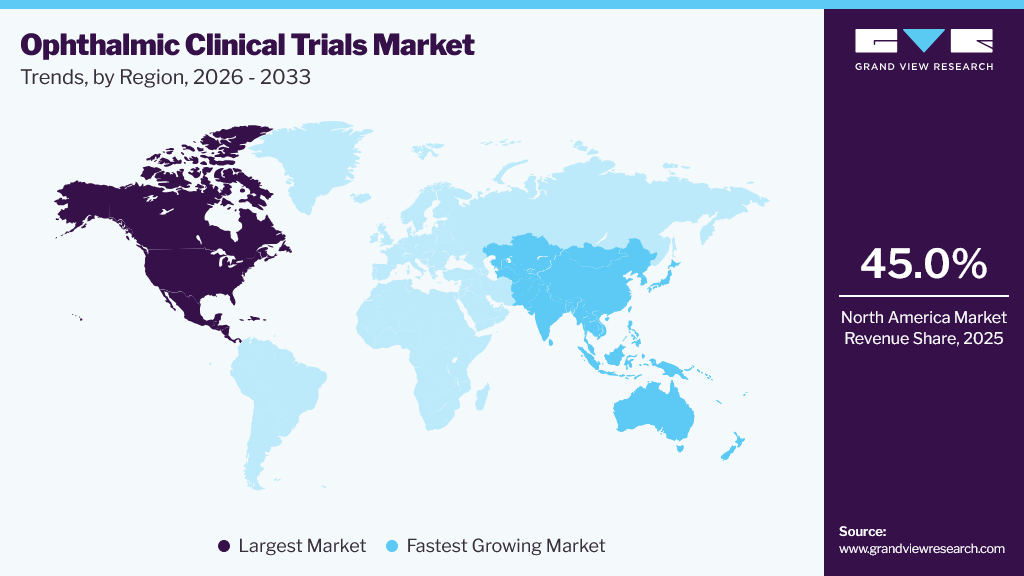
- Largest regional market: North America (45.0% revenue share, 2025)
- Fastest-growing regional market: Asia Pacific (highest CAGR, 2026-2033)
Market Size & Forecast
- Market size in 2025: USD 2.9 Billion
- Estimated market size in 2026: USD 3.1 Billion
- Projected market size by 2033: USD 5.9 Billion
- CAGR (2026-2033): 9.7%
Prism AI by Grand View Research Free to tryAsk a question about the ophthalmic clinical trials marketTry asking✓Every figure cited from GVR research Prefer the report? Download free sample →Advances in ophthalmology are crucial for the treatment and prevention of several ophthalmic ailments, and relevant research and development activities are growing rapidly, forming valuable knowledge networks for treating complex ocular conditions. Diseases such as macular degeneration, glaucoma, and a few other optical diseases were previously considered irreparable blindness-causing ailments. However, therapeutic advances have been made to alleviate or cure them through new technologies or by targeting new pathways.
In June 2025, Perfuse Therapeutics announced positive Phase 2 clinical trial results for PER-001, an intravitreal implant designed to treat glaucoma and diabetic retinopathy by improving retinal blood flow and targeting underlying ischemic damage. The randomized controlled trials demonstrated improvements in vision outcomes and retinal structure compared with control groups, suggesting potential disease-modifying effects rather than merely symptom management. This development reflects the ongoing shift in ophthalmic clinical trials toward regenerative and mechanism-based therapies for previously irreversible causes of blindness, such as glaucoma and retinal degeneration.
 Source: Grand View Research, IR Documents, Primary Interviews, Paid DatabasesTo learn more about this report,
 Download Free Sample Report
In addition, increased research funding for ocular therapeutics is a prominent driver of market growth. According to the Journal of Pediatric Ophthalmology & Strabismus, in 2026, global ophthalmology clinical research spending grew significantly, supported by increasing investments from pharmaceutical companies and CROs focused on developing treatments for retinal disorders such as age-related macular degeneration and diabetic macular edema. Industry data show that ophthalmic clinical trials account for a growing share of total clinical research expenditure due to the high unmet need and the strong pipeline of biologics and gene therapies. This trend reinforces the role of increasing research funding in driving the growth of ophthalmic clinical trials worldwide.
Moreover, several companies are focusing on building a knowledge hub to ensure smooth operations across ophthalmic research, thereby enabling the development of innovative therapeutic solutions for complex ocular conditions. According to an article by Ophthalmology Science, ophthalmology clinical research ecosystems are adopting integrated data platforms and collaborative knowledge systems to streamline trial design, imaging data management, and patient outcome tracking across retinal disease studies. Open ophthalmic research infrastructures, such as multimodal data repositories and AI-enabled clinical knowledge platforms, are being used by research organizations and CROs to centralize clinical trial data, standardize protocols, and improve collaboration among investigators, thereby accelerating the development of therapies for complex ocular conditions, including age-related macular degeneration and glaucoma.
Analyst Perspective
The market is experiencing steady growth due to the rising prevalence of retinal disorders, glaucoma, and age-related macular degeneration, as well as the growing demand for advanced, disease-modifying therapeutic solutions. The market is witnessing growing adoption of biologics, gene therapies, regenerative medicine, and AI-enabled diagnostic tools as researchers and pharmaceutical companies focus on improving treatment outcomes and addressing previously irreversible causes of vision loss.
Although challenges such as high clinical trial costs, lengthy regulatory approvals, patient recruitment complexities, and limited availability of specialized clinical infrastructure persist, advancements in digital trial management systems, AI-driven imaging analysis, and integrated clinical data platforms continue to create new opportunities. Companies that adopt innovative, data-driven, and precision medicine-focused clinical trial approaches are expected to benefit from the market’s long-term growth by accelerating drug development and improving success rates in ophthalmic therapeutics.
Product Insights
The drugs segment dominated the market, accounting for the largest revenue share of around 75.0% in 2025. The growing pipeline of optical therapeutics is a key driver of the segment’s robust revenue share during the analysis period. Furthermore, the segment is driven by the high global demand for novel ophthalmic pharmaceuticals and biopharmaceuticals. For Instance, in November 2025, Regeneron Pharmaceuticals announced that the U.S. FDA approved EYLEA HD for expanded use in retinal diseases, based on outcomes from Phase 3 clinical trials that evaluated dosing efficacy and visual acuity in retinal vein occlusion. This reinforces the ongoing expansion of anti-VEGF drug pipelines and supports the continued dominance of the drugs segment in ophthalmic clinical development.
The devices segment, on the other hand, is anticipated to register a stable CAGR over the forecast period from 2026 to 2033, driven by technological advancements in ocular medical devices. The incorporation of artificial intelligence for detecting and diagnosing eye conditions is a major technological advancement in ocular medical devices, thereby supporting market growth. For instance, in May 2026, Heidelberg Engineering showcased AI-enabled OCT imaging and data management solutions at the ARVO Annual Meeting. These technologies enhance retinal image analysis and support clinical trial data processing in ophthalmic research.
Indication Insights
The retinopathy segment dominated the market, accounting for over 25.0% of revenue in 2025, driven by increasing research and development activities in the retinopathy indication. Several companies are on the verge of developing novel treatment options for the condition, thereby bolstering their pipelines and supporting segmental market growth. For instance, in May 2026, Kodiak Sciences reported positive topline results from its Phase 3 GLOW2 clinical trial evaluating tarcocimab tedromer for diabetic retinopathy, demonstrating significant reductions in retinal disease severity and sight-threatening complications.
The glaucoma segment is anticipated to register a lucrative CAGR over the forecast period of 2026 to 2033, attributed to the expanding pipeline of glaucoma therapeutics and rising investment by contract researchers in developing glaucoma drugs. For instance, in January 2026, Glaukos Corporation reported continued clinical progress for its iDose TR and other sustained-release glaucoma therapies in ongoing Phase 3 and Phase 4 studies, with a focus on long-term intraocular pressure control and reduced treatment burden in glaucoma patients. This reflects increasing R&D investment and pipeline expansion in glaucoma therapeutics, supporting growth in the segment.
Phase Insights
The clinical phase segment dominated the market, accounting for around 80.0% of revenue in 2025, driven by increased clinical research across the ophthalmology treatment industry. The majority of therapeutics are in observational clinical practice, thereby supporting the segment’s growth. For instance, in March 2026, Oculis Holding AG announced positive Phase 3 DIAMOND trial results for OCS-01 (dexamethasone eye drops) in diabetic macular edema, demonstrating significant improvements in retinal thickness and visual acuity compared with placebo. This reinforces strong late-stage clinical development activity in ophthalmic therapeutics, supporting market growth in the clinical-phase segment. Hence, the presence of a robust pipeline of products across clinical phases, from phase I to observational commercialization, is a major driver of growth in the clinical-phase segment of the market.
The preclinical phase, on the other hand, is poised to witness a lucrative CAGR over the forecast period, driven by increasing interest among researchers in the discovery and development of novel therapeutics for ocular diseases. Hence, the increasing research and development activities have led contract research organizations (CROs) to play a significant role in the market. Several pharmaceutical and biopharmaceutical companies have outsourced their preclinical services to CROs to fast-track drug discovery. For instance, Labcorp Drug Development reports strong preclinical ophthalmology capabilities, including in vitro, toxicology, and pharmacology testing for ocular diseases such as glaucoma and retinal disorders, supporting early-stage drug development programs for biopharma clients. This reflects growing outsourcing of preclinical ophthalmic research to CROs to accelerate drug discovery.
Sponsor Type Insights
Pharmaceutical and biopharmaceutical companies dominated the market, accounting for more than 40.0% of revenue in 2025, owing to the growing number of companies focusing on the research and development of novel ophthalmic drugs. For instance, in January 2026, SpyGlass Pharma initiated two registrational Phase 3 clinical trials (SGP-005 and SGP-006) evaluating its bimatoprost drug-eluting intraocular lens system for the treatment of glaucoma and ocular hypertension. These studies reflect strong pharmaceutical and biopharmaceutical investment in novel glaucoma therapies, further supporting the growth of the ophthalmology clinical pipeline.
The other segment, which includes CROs and medical institutes, etc., is poised to register a lucrative CAGR over the forecast period, largely due to the increasing trend of outsourcing clinical research to contract developers. For instance, several ophthalmology-focused contract research organizations (CROs), such as Syneos Health, expanded their clinical trial support services for biopharma clients, including study design, patient recruitment, and the execution of late-stage ophthalmic trials across retinal and glaucoma indications. This reflects the growing reliance on CRO partnerships and academic collaborations to accelerate ophthalmic drug development and to outsource clinical research.
Regional Insights
North America dominated the ophthalmic clinical trials market, accounting for the largest revenue share of around 45.0% in 2025. The increasing prevalence of eye diseases, the rising demand for personalized medicine, and R&D investments by pharmaceutical companies are the key factors driving market growth in the region. Furthermore, the U.S. accounted for the largest ophthalmic clinical trial market in North America due to its favorable regulatory environment, healthcare infrastructure, and large patient pool. For instance, Santen Pharmaceutical Co., Ltd. is currently developing three therapies in the U.S., including treatments for glaucoma, ocular hypertension, Fuchs Endothelial Corneal Dystrophy (FECD), and Presbyopia. For instance, in May 2025, Emmes Group launched OptymEdge, a dedicated ophthalmology clinical trial platform unveiled at the ARVO Annual Meeting, designed to streamline ophthalmic clinical trials through eSource data capture and specialized visual function endpoints. This showcases the growing CRO specialization in ophthalmology research and strengthens North America’s leadership in clinical trial execution infrastructure.
 To learn more about this report, Download Free Sample Report
Asia Pacific Ophthalmic Clinical Trials Market Trends
The ophthalmic clinical trials market in the Asia Pacific is anticipated to register the fastest CAGR during the forecast period. The key factors driving the market are the increasing prevalence of eye diseases, an aging population, and the rising number of clinical trials conducted in the region, primarily in countries such as India, Japan, and China. For instance, in August 2025, Kowa Company Ltd., based in Japan, initiated a Phase 3 clinical trial of NCX 470 for ocular hypertension in Japan in collaboration with Nicox, marking continued late-stage ophthalmic drug development activity in the Asia Pacific region. The trial is part of a broader multi-regional clinical program spanning Japan, China, and the U.S., reflecting increasing ophthalmic research activity in key APAC markets such as Japan.
Key Ophthalmic Clinical Trials Company Insights
The major players in the market are focusing on inorganic growth strategies, such as mergers, partnerships, and acquisitions. Furthermore, several players are focusing on developing novel therapeutics, thereby supporting market growth. In May 2026, ICON plc announced the expansion of its early-phase clinical research capabilities in the U.S. by opening a new state-of-the-art clinical research unit in San Antonio, as well as additional outpatient clinics in Texas and Kansas. The expansion strengthens its capacity to conduct first-in-human and early clinical studies, thereby supporting faster, more efficient clinical trial execution across therapeutic areas.
Key Ophthalmic Clinical Trials Companies
The following key companies have been profiled for this study on the ophthalmic clinical trials market.
-
Charles River Laboratories International, Inc.
-
ICON Plc
-
IQVIA
-
Laboratory Corporation of America Holdings
-
Vial
-
Medpace
-
ProTrials Research, Inc.
-
Syneos Health
-
Worldwide Clinical Trials, Inc.
-
ProRelix Services LLP.
Recent Developments
-
In June 2026, Oculis Holding AG announced that it had randomized the first patient in its PREDICT-1 registrational Phase 3 clinical trial evaluating licaminlimab for dry eye disease. The study is designed as a genotype-based precision medicine trial. It represents one of the first ophthalmology programs applying personalized treatment approaches in late-stage clinical development, reflecting continued innovation in ophthalmic clinical research.
-
In May 2026, Roche presented extensive ophthalmology data at the ARVO 2026 Annual Meeting, including real-world evidence supporting Vabysmo (faricimab) and pipeline assets across retinal diseases such as diabetic macular edema, retinal vein occlusion, and geographic atrophy. The company also highlighted continued development of sustained delivery and anti-inflammatory therapies, reinforcing strong clinical trial activity across multiple ophthalmic indications.
-
In March 2026, EyePoint Pharmaceuticals, Inc. initiated two global Phase 3 clinical trials, namely COMO and CAPRI, to evaluate sustained-release ophthalmic therapy DURAVYU for diabetic macular edema. The trials are designed to assess extended dosing intervals compared with standard anti-VEGF therapy, highlighting the industry’s focus on improving treatment durability in retinal diseases.
-
In January 2026, Novaliq GmbH received U.S. FDA IND clearance to advance NOV05 into a Phase II clinical trial for non-infectious anterior uveitis. The study supports expansion of topical ocular therapies into posterior eye diseases, demonstrating continued early- and mid-stage innovation in ophthalmic drug development.
Ophthalmic Clinical Trials Market Report Scope
Report Attribute
Details
Market size in 2025
USD 2.9 billion
Estimated market size in 2026
USD 3.1 billion
Projected market size by 2033
USD 5.9 billion
Growth rate
CAGR of 9.7% from 2026 to 2033
Actual data
2021 - 2025
Forecast period
2026 - 2033
Quantitative units
Revenue in USD billion, and CAGR from 2026 to 2033
Report coverage
Revenue forecast, company ranking, competitive landscape, growth factors, and trends
Segments covered
Product, indication, phase, sponsor type, region
Regional Scope
North America; Europe; Asia Pacific; Latin America; MEA
Country Scope
U.S.; Canada; UK; Germany; France; Italy; Spain; Denmark; Sweden; Norway; China; India; Japan; Australia; Thailand; South Korea; Brazil; Mexico; Argentina; South Africa, Saudi Arabia; UAE; Kuwait
Key companies profiled
Charles River Laboratories International, Inc.; ICON Plc; IQVIA; Laboratory Corporation of America Holdings; Vial; Medpace; ProTrials Research, Inc.; Syneos Health; Worldwide Clinical Trials, Inc.; ProRelix Services LLP.
Customization scope
Free report customization (equivalent up to 8 analysts working days) with purchase. Addition or alteration to country, regional & segment scope.
Pricing and purchase options
Avail of customized purchase options to meet your exact research needs. Explore purchase options
Global Ophthalmic Clinical Trials Market Report Segmentation
This report forecasts revenue growth at global, regional, and country levels and provides an analysis of the latest industry trends in each of the sub-segments from 2021 to 2033. For this study, Grand View Research has segmented the global ophthalmic clinical trials market report based on product, indication, phase, sponsor type, and region:
-
Product Outlook (Revenue, USD Million, 2021 - 2033)
-
Devices
-
Surgical & Diagnostics Devices
-
Vision care Devices
-
-
Drugs
-
OTC Drugs
-
Prescription Drugs
-
-
-
Indication Outlook (Revenue, USD Million, 2021 - 2033)
-
Macular Degeneration
-
Glaucoma
-
Dry Eye Disease
-
Retinopathy
-
Uveitis
-
Macular Edema
-
Blepharitis
-
Cataract
-
Optic Neuropathy
-
Others
-
-
Phase Outlook (Revenue, USD Million, 2021 - 2033)
-
Discovery Phase
-
Preclinical Phase
-
Clinical Phase
-
-
Sponsor Type Outlook (Revenue, USD Million, 2021 - 2033)
-
Pharmaceutical/Biopharmaceutical Companies
-
Medical Device Companies
-
Others
-
-
Regional Outlook (Revenue, USD Million, 2021 - 2033)
-
North America
-
U.S.
-
Canada
-
-
Europe
-
U.K.
-
Germany
-
France
-
Italy
-
Spain
-
Denmark
-
Sweden
-
Norway
-
-
Asia Pacific
-
Japan
-
China
-
India
-
Australia
-
South Korea
-
Thailand
-
-
Latin America
-
Brazil
-
Mexico
-
Argentina
-
-
Middle East & Africa
-
South Africa
-
Saudi Arabia
-
UAE
-
Kuwait
-
-
Frequently Asked Questions About This Report
The global ophthalmic clinical trials market size was valued at USD 2.9 billion in 2025 and is estimated at USD 3.1 billion for 2026.
Key players include Charles River Laboratories International, Inc.; ICON Plc; IQVIA; Laboratory Corporation of America Holdings; Vial; Medpace; ProTrials Research, Inc.; Syneos Health; Worldwide Clinical Trials, Inc.; ProRelix Services LLP.
North America dominated with a 45.0% revenue share in 2025.
Drugs dominated the ophthalmic clinical trials market with a share of around 75.0% in 2025.
The global ophthalmic clinical trials market is expected to grow at a CAGR of 9.7% from 2026 to 2033, reaching USD 5.9 billion.
About the Author(s)
Medical Devices Research Team
Healthcare · Medical DevicesThis report was authored by the medical devices research team at Grand View Research - comprising two research analysts, one senior research analyst, and one industry expert - with specialized expertise in the medical devices segment of the healthcare industry. All findings are based on proprietary healthcare databases, executive interviews, and regulatory analysis, subject to internal peer review prior to publication.
Last Updated:
Speak to Analyst

Customize this report to your needs - add regions, segments, or data points, with 20% free customization.
Or view our licence options:


ISO 9001:2015 & 27001:2022 Certified
We are GDPR and CCPA compliant! Your transaction & personal information is safe and secure. For more details, please read our privacy policy.


