
- Home
- »
- Medical Devices
- »
-
Orthodontic Burs Market Size & Share Report, 2026-2033GVR Report cover
![Orthodontic Burs Market (2026 - 2033)Report]()
Orthodontic Burs Market (2026 - 2033)
Size, Share & Trends Analysis Report By Material (Carbide, Diamond), By Clinical Function (Debonding, Finishing/Polishing Burs, IPR), By Sterility, By End Use, By Region, And Segment Forecasts
Market Size, 2025
$75.9MMarket Estimate, 2026
$79.9MMarket Forecast, 2033
$117.2MCAGR, 2026–2033
5.6%Orthodontic Burs Market Summary
The global orthodontic burs market size was valued at USD 75.9 million in 2025 and is projected to grow from USD 79.9 million in 2026 to USD 117.2 million by 2033, at a CAGR of 5.6% from 2026 to 2033. The market in North America dominated with a revenue share of 38.3% in 2025. This market growth is driven by rising orthodontic treatment volumes, increasing adoption of clear aligners requiring interproximal reduction, the consumable nature of burs with frequent replacement, stricter infection-control standards supporting single-use products, and ongoing technological advancements in diamond and carbide bur design that improve clinical efficiency and enamel safety.
Key Market Trends & Insights
- By material: Diamond burs segment held the largest market share of 47.8% in 2025.
- By clinical function: Debonding segment held the largest market share of 39.0% in 2025.
- By sterility: Reusable segment held the largest market share of 71.2% in 2025.
- By end-use: Dental clinics segment held the largest market share in 2025.
Regional Highlights
- Largest regional market: North America (38.3% revenue share, 2025)
- Fastest-growing regional market: Asia Pacific (highest CAGR, 2026-2033)
- By country: The U.S. held the largest market share in 2025
Market Size & Forecast
- Market size in 2025: USD 75.9 Million
- Estimated market size in 2026: USD 79.9 Million
- Projected market size by 2033: USD 117.2 Million
- CAGR (2026-2033): 5.6%
Strategic distribution partnerships represent an important market expansion mechanism, supporting improved product accessibility and broader clinical adoption within regional dental markets. Such collaborations contribute to market development by strengthening distribution reach, enhancing brand visibility, and facilitating the introduction of advanced clinical solutions. For instance, in January 2026, the U.S. dental equipment manufacturer Microcopy signed an exclusive partnership with CTM Global to distribute its full range of premium rotary dental products in Thailand.
The agreement covers dental burs, polishers, saliva absorbents, and other clinical tools, reflecting Microcopy’s expanding global footprint-now present in over 60 countries. CTM Global will handle nationwide marketing and regulatory support, aiming to strengthen product availability and clinical outcomes for Thai dental professionals. Strategic distribution alliances function as powerful growth enablers, facilitating market penetration, strengthening competitive positioning, and driving sustained demand through improved availability, clinical integration, and practitioner engagement.
Increasing Orthodontic Patient Base, Accelerating Treatment Activity
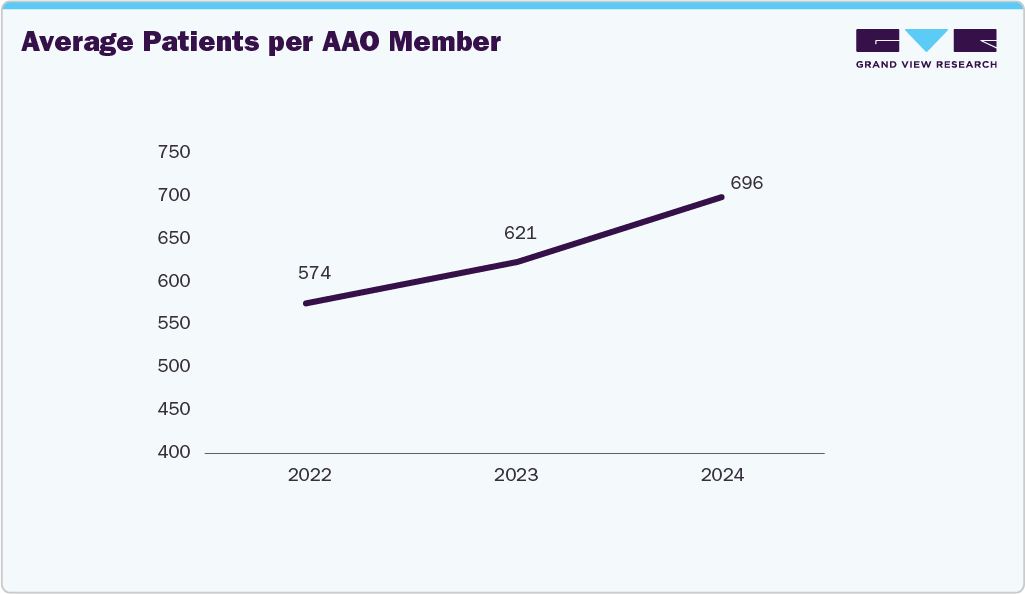
According to the 2025 Economics of Orthodontics and Patient Census Survey by the American Association of Orthodontists (AAO), the number of patients in active orthodontic treatment has reached an all-time high, underscoring strong demand for orthodontic care. The survey found that the average number of patients per AAO member increased from 574 in 2022 to 696 in 2024, marking the highest per-practitioner patient count since the survey’s inception in 1987. This represents more than a 10 % increase over the previous record and highlights expanding treatment volumes across the U.S. and Canada.
Among AAO members in the U.S. and Canada, the estimated number of patients undergoing active orthodontic treatment is approximately 6.66 million, with adult patients accounting for around 1.91 million, up from 1.64 million in 2022, reflecting the growing adult orthodontic market.

In response to this sustained growth in patient volumes, many practices reported fee increases for braces and clear aligners, indicating stronger market pricing power and improving practice economics.
This surge in orthodontic patients has clear implications for the market, as higher treatment volumes directly increase consumable usage (e.g., debonding, finishing, and IPR burs) and support demand for advanced rotary instruments aligned with expanding clinical workflows.
Clinical and Scientific Evidence Supporting Advanced Bur Utilization
Clinical research further reinforces the importance of specialized bur usage. A longitudinal study titled “Biological and Biomechanical Impacts of Interproximal Reduction (IPR) Burs on Periodontal Health and Enamel Integrity,” published on the Mr. Bur educational blog in August 2025, highlights that improper IPR technique or inappropriate bur selection can negatively affect periodontal tissues and enamel integrity. The study emphasizes the need for fine-grit IPR burs, careful polishing, and post-procedure remineralization, supporting demand for advanced, procedure-specific orthodontic burs.
In addition, the study “Fracture of Rotary Instruments in Third Molar Extraction,” published in Medicina (MDPI), Volume 16, Issue in January 2026, demonstrates that bur material, rotational speed, applied force, and access difficulty significantly influence rotary instrument failure. The findings underscore the importance of correct bur selection and controlled clinical use, reinforcing the value of high-quality, purpose-designed burs.
From an institutional perspective, the Indian Army’s approval in September 2025 of revised Scales of Accommodation for Dental Platoons in Field Hospitals, including the incorporation of dedicated dental laboratories and enhanced dental service norms, reflects increasing investment in dental infrastructure and procedural capacity. Such upgrades further support demand for dental and orthodontic rotary instruments.
Finally, evidence from materials science and infection control strengthens the shift toward newer product formats. The SEM study “Influence of Repeated Use and Sterilization on the Performance of Diamond Burs,” published by Athenaeum Publications in August 2025, demonstrated that repeated use and autoclave sterilization degrade diamond grit and bonding matrices, reducing cutting efficiency. These findings align with CDC dental infection control guidance (June 3, 2024), which defines single-use devices as items intended for one patient and one procedure only, discouraging reuse due to safety risks. Together, these factors support growing adoption of single-use and high-performance orthodontic burs.
This shift is further supported by Key Opinion Leader (KOL) feedback from practicing clinicians and manufacturers. Reflecting growing clinical acceptance of disposable instruments, Dr. Christian Yaste, a general dentist based in Charlotte, North Carolina, stated that he was “very excited to learn that Komet now has a disposable option,” noting that consistent quality and reliability are critical to his clinical workflows. From a manufacturer's perspective, Todd Blanton, CEO of Komet USA, emphasized that the company’s German-engineered diamond and carbide burs are designed based on continuous feedback from clinicians and professional partners, highlighting the industry’s focus on aligning product innovation with real-world clinical needs.
Market Concentration & Characteristics
The orthodontic burs industry is in a medium growth stage with an accelerating growth trajectory, supported by rising volumes of orthodontic and dental procedures. Market expansion is driven by increasing demand for bracket debonding, finishing and polishing, and interproximal reduction (IPR) associated with fixed appliances and clear aligner therapy. The growing prevalence of malocclusion, expanding adult orthodontics, higher procedural throughput in dental clinics, and stronger emphasis on infection-control compliance and enamel.
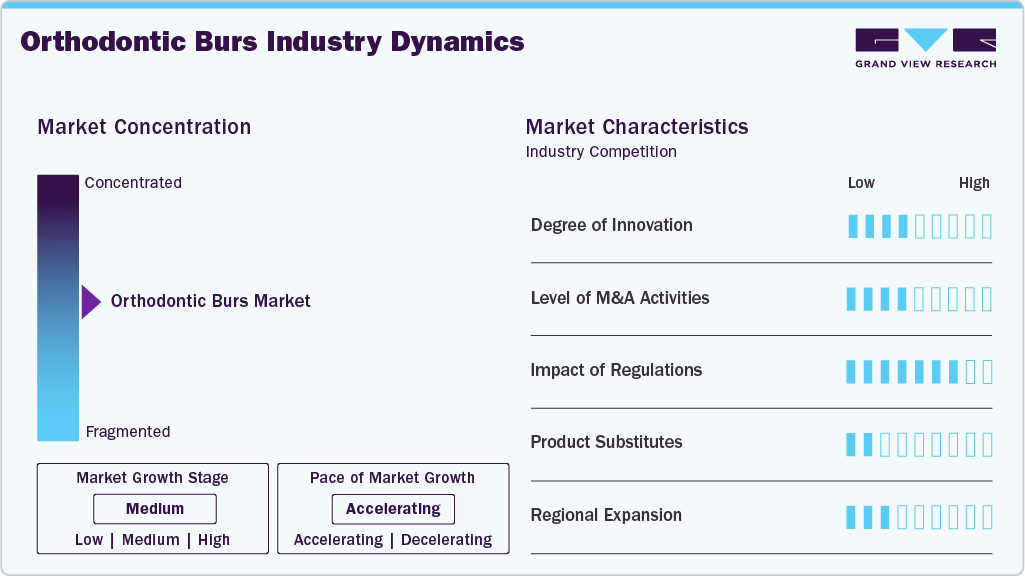
Innovation in the orthodontic burs industry is moderate to high, driven by advancements in diamond bonding technologies, multilayer coatings, vibration reduction, and single-use sterile designs. Manufacturers focus on improving cutting efficiency, enamel safety, and durability rather than disruptive redesigns. Recent launches emphasize procedure-specific burs (IPR, debonding, finishing) and disposable formats aligned with infection-control and workflow efficiency needs. For instance, in January 2025, Premier Dental, a recognized provider in dental innovation and a trusted provider of professional dental products, announced the launch of Two Striper TSZtech Diamond Burs. Specially engineered for precise adjustment and removal of zirconia restorations, TSZtech Diamond Burs deliver enhanced cutting efficiency, durability, and clinical precision-setting a new benchmark in advanced restorative and orthodontic procedures.
Key Benefits Include
-
Up to 30% faster cutting and greater durability than conventional zirconia burs.
-
Uniform diamond layer height, ensuring full surface contact for optimal cutting performance and efficiency.
-
Engineered to minimize cutting vibration, providing smoother handling and greater clinical control during procedures.
Regulatory impact is moderate but increasing, particularly around infection control, sterilization, and single-use device compliance. Guidelines from bodies such as the CDC and equivalent authorities discourage reuse of single-use devices, supporting the adoption of disposable burs. While burs are typically low-risk devices, compliance with labeling, material safety, and sterilization standards influences product design and procurement decisions.
M&A activity in the orthodontic burs industry is low to moderate, as the segment is dominated by established dental instrument manufacturers with strong in-house capabilities. Strategic acquisitions are more common at the portfolio or distribution level rather than large-scale consolidation. Companies prioritize incremental innovation, regional expansion, and partnerships over aggressive acquisition-led growth.
The threat from product substitutes is low to moderate. While manual strips, discs, or alternative finishing tools can replace burs in limited applications, they generally lack the efficiency, precision, and consistency required in routine orthodontic procedures. Rotary burs remain the preferred solution for debonding, finishing, and IPR, making full substitution unlikely in clinical practice.
Regional expansion is most active in Asia-Pacific, the Middle East, and parts of Latin America, driven by rising orthodontic awareness, growing middle-class populations, and expanding private dental clinic networks. Mature markets such as North America and Europe focus on premiumization and disposable adoption, while emerging regions contribute primarily to volume growth in orthodontic burs demand.
Material Insights
The diamond burs segment dominated the market and accounted for the highest revenue share of 47.82% in 2025 due to its superior precision, efficiency, and durability in cutting hard dental tissues such as enamel, ceramics, and IPR surfaces. Diamond burs provide controlled enamel removal and smooth finishes, reducing chair time and enhancing procedural outcomes. Their abrasive diamond coating offers greater longevity and consistent performance compared with other materials, making them preferred in restorative and orthodontic workflows. Industry guides confirm that diamond burs’ hardness and precision improve clinical accuracy and efficiency for orthodontic procedures.
The carbide burs segment recorded significant growth and accounted for the highest revenue market share in 2025, driven by their clinical effectiveness in debonding and adhesive removal procedures, which are mandatory at the end of fixed orthodontic treatments. Tungsten carbide burs are widely preferred due to their high cutting efficiency, precision, and ability to remove residual cement while preserving enamel integrity. Clinical evidence supports this preference: a 2026 study by Flores-Fraile et al., published in Clinical and Experimental Dental Research, demonstrated that tungsten carbide burs removed significantly more adhesive cement than diamond or Arkansas burs (p < 0.005) following orthodontic bracket removal, reinforcing their dominant clinical and commercial adoption.
Clinical Function Insights
The debonding dominated the market and accounted for a revenue share of 39.01% in 2025 due to its universal clinical necessity and high procedural frequency at the end of fixed-appliance treatments. Debonding involves the removal of orthodontic brackets and residual adhesive, a task that routinely uses specialized burs to achieve optimal enamel surface outcomes and minimize damage. Research shows that adhesive removal after debonding is a critical component of treatment workflow and that the choice of bur affects enamel surface roughness and clinical efficiency, reinforcing the ongoing demand for debonding-specific burs.
The interproximal reduction (IPR) segment is expected to witness significant growth during the forecast period, driven by the increasing adoption of clear aligner therapy and non-extraction orthodontic approaches. IPR helps correct mild to moderate crowding, reshape contact points, and reduce treatment time without extractions, making it integral to contemporary workflows. Clinical evidence from the review “Enamel Reduction Techniques in Orthodontics,” published in March 2025, indicates that over 60% of aligner patients require enamel reduction, underscoring the rising clinical adoption and value of IPR procedures.
Sterility Insights
The reusable segment dominated the market and accounted for a revenue share of 71.23% in 2025, primarily because most dental practices continue to rely on sterilizable burs that can be cleaned and reused across multiple patients, reducing per-procedure costs and supporting clinic efficiency. Reusable burs-especially carbide and diamond-are routinely cleaned, disinfected, and autoclaved following manufacturer and CDC guidelines to ensure sterile conditions before each use, making them a trusted standard in everyday orthodontic workflows. Evidence shows that most dental instruments, including burs, are repeatedly sterilized in practice despite infection-control challenges, underscoring continued reliance on reusable formats in clinical settings.
The single-use segment is expected to demonstrate the fastest growth during the forecast period as dental professionals prioritize infection control and patient safety. Guidelines from health authorities such as the Centers for Disease Control and Prevention (CDC) recommend treating burs as single-use devices to minimize cross-contamination because they are difficult to clean effectively between patients. This increased emphasis on disposable instruments is driving the adoption of single-use orthodontic burs in clinics, where sterility and workflow efficiency are critical.
End User Insights
The dental clinics segment dominated the market in 2025 and is expected to grow fastest in the forecast period because most orthodontic treatments are delivered in outpatient clinical settings where dentists and orthodontists manage bracket placement, debonding, finishing, and interproximal reduction procedures with high frequency. Private and specialty clinics have expanded significantly, with advanced chairside workflows, growing patient satisfaction, and increasing case volumes driving consumable usage. Research shows orthodontic services are widely provided by dental practices and that orthodontic care remains a core offering within booming dental clinic sectors globally.

The hospital segment is significantly growing, driven by increasing demand for complex orthodontic care and multidisciplinary treatment pathways within hospital settings. Hospitals provide specialist orthodontic services for severe malocclusion, craniofacial anomalies, impacted teeth, and combined surgical-orthodontic cases, requiring advanced clinical workflows and high-precision instruments. For instance, major teaching hospitals such as St George’s University Hospitals NHS Foundation Trust maintain dedicated orthodontic departments that manage complex referrals and advanced treatments, reflecting broader institutional demand for orthodontic services.
Regional Insights
The North America orthodontic burs market dominated the global market and accounted for the largest revenue share of 38.30% in 2025, driven by high orthodontic treatment penetration, advanced clinical infrastructure, and strong purchasing power. The region benefits from a large base of specialist orthodontists and widespread adoption of fixed appliances, clear aligners, and IPR procedures, all of which require frequent bur usage. According to the American Association of Orthodontists (AAO), active orthodontic patient numbers reached an all-time high in 2024, directly supporting sustained demand for orthodontic consumables such as burs.

U.S. Orthodontic Burs Market Trends
The orthodontic burs market in the U.S. led North America in 2025, supported by high orthodontist density, rising adult orthodontics, and large private clinic networks. AAO survey data show increasing patient loads per orthodontist, resulting in higher procedural throughput for debonding, finishing, and IPR. In addition, stricter infection-control practices and growing adoption of single-use burs in clinics further contribute to market leadership.
Adult Orthodontic Treatment Trends
Statistic
Value
Percentage of orthodontic patients who are adults
25%
Adults starting orthodontic treatment annually
Over 1.5 million
Adults who could benefit from orthodontic care
70%
Growth in adult orthodontic treatment since 1989
40% increase
Source: RankMyDentist
Europe Orthodontic Burs Market Trends
The orthodontic burs market in Europe held a substantial share in 2025, supported by publicly funded orthodontic care, strong specialist training systems, and standardized clinical protocols. Many European countries provide orthodontic treatment through public health systems for children and adolescents, ensuring stable procedural volumes. This sustains consistent demand for orthodontic burs across hospital and clinic settings.
Germany orthodontic burs market dominated Europe in 2025 due to its well-established statutory health insurance coverage for orthodontics, particularly among pediatric patients. The country has one of the highest dentist-to-population ratios in Europe, with orthodontic treatment commonly initiated early. These factors support continuous demand for carbide and diamond burs used in bonding, debonding, and finishing procedures.
The orthodontic burs market in the UK is supported by strong NHS-funded orthodontic activity, particularly for children and adolescents. NHS data show millions of dental treatment courses delivered annually, with orthodontics forming a core service line. Rising patient throughput in NHS and private clinics drives recurring demand for orthodontic consumables, including debonding and finishing burs.
Orthodontic Statistics In The UK
Category
Statistic
Value
UK - Youth Treatment
Young people receiving NHS-funded orthodontic treatment
~200,000 annually
UK - Children Need
Children who could benefit from orthodontics
~1/3 of UK children
UK - NHS Waiting Time
Waiting time for NHS braces (in some areas, 2025)
Up to 2 years
UK - Extractions Before Braces
Young people requiring tooth extraction before fixed braces
~25%
UK - Adult Demand Growth
Private orthodontists reporting increased adult patients (last 3 years)
76%
UK - “Zoom Boom” Effect
Orthodontists citing video calls/online meetings as major factor
65%+
UK - Social Media Influence
Orthodontists reporting the influence of celebrities/social media
35%+
UK - Adult Age Group
Adult orthodontic patients aged 26-55
83%
UK - DIY Concerns
Orthodontists are concerned about DIY treatment
88%
Source: Accessible Orthodontics
France orthodontic burs market benefits from broad reimbursement coverage for orthodontic treatment in children and adolescents, combined with a growing private orthodontics segment. Early diagnosis and preventive orthodontic interventions are common, leading to sustained procedural volumes that support steady consumption of orthodontic burs across clinical practices.
Asia Pacific Orthodontic Burs Market Trends
The orthodontic burs market in the Asia Pacific is expected to grow at the fastest CAGR, driven by rising orthodontic awareness, expanding middle-class populations, and the rapid growth of private dental clinics. Increasing adoption of modern orthodontic treatments, including clear aligners, is accelerating demand for IPR and finishing burs, particularly in urban centers.
Japan orthodontic burs market dominated the Asia Pacific in 2025 due to advanced dental infrastructure, high standards of clinical precision, and early adoption of modern orthodontic techniques. Strong emphasis on enamel preservation and procedural accuracy supports demand for high-quality carbide and diamond burs across specialist clinics.
The orthodontic burs market in Chinais supported by a high burden of early childhood dental disease and malocclusion, combined with expanding access to orthodontic care. Public health studies report rising prevalence of dental caries and orthodontic abnormalities among children, driving early intervention and sustained demand for orthodontic procedures and related consumables.
Middle East & Africa Orthodontic Burs Market Trends
The orthodontic burs market in the MEA is driven by healthcare infrastructure expansion, rising medical tourism, and increasing government investment in dental services. Growing private hospital and specialty clinic capacity is supporting moderate but steady growth in orthodontic procedures requiring rotary instruments.
Saudi Arabia orthodontic burs market is supported by Vision 2030 healthcare reforms, which emphasize modernization of dental services and expansion of specialist care. Government investment in hospitals and dental training programs is increasing orthodontic procedure volumes, supporting demand for orthodontic burs.
The orthodontic burs market in Kuwaitis positively influenced by high per-capita healthcare spending and widespread access to specialist dental care. Strong public healthcare coverage and increasing demand for aesthetic orthodontic treatments support consistent use of orthodontic consumables in both hospital and clinic settings.
Key Orthodontic Burs Company Insights
Key companies in the global market include Kerr Dental (SimpliCut Diamond Burs), Mr. Bur, Eagle Dental Burs, Prima Dental, and SS White Dental, among others. Major companies in the market maintain global competitiveness by investing in advanced technology, offering high-quality, precision-engineered products, and expanding their product lines to meet diverse consumer needs. They focus on innovation, including the development of durable, efficient burs with cutting-edge materials. Strategic partnerships, strong distribution networks, and compliance with global standards also help them stay ahead in the market.
Key Orthodontic Burs Companies:
The following key companies have been profiled for this study on the orthodontic burs market.
- Kerr Dental (SimpliCut Diamond Burs)
- Mr Bur
- Eagle Dental Burs
- Prima Dental
- SS White Dental
- StraussDiamond
- DSI LTD
- COLTENE Inc.
- Hager & Meisinger GmbH
- HORICO DENTAL Hopf, Ringleb & Co. GmbH & Cie.
- Premier Dental Co.
Recent Developments
-
In January 2026, the U.S. International Trade Commission (USITC) officially initiated a Section 337 investigation into the importation and sale of certain dental burs and kits, based on a complaint alleging patent and trademark infringement by products from a range of foreign and domestic companies. The probe will determine whether these products violate U.S. trade law, with hearings and a final determination expected later in the process.
-
In January 2025, Premier Dental announced the launch of its new TSZtech Diamond Burs featuring LTech Technology, engineered to improve zirconia restoration removal and adjustment with greater speed and precision. The advanced design reduces diamond dislodgement, offers 30 % faster cutting, and minimizes vibration for smoother operation. The TSZtech line includes models for coarse removal, moderate adjustments, and fine finishing, enhancing efficiency and clinician control.
-
In February 2024, Kerr Dental introduced SimpliCut Rotary Single-Use Diamond Burs, a new line designed for orthodontic and restorative applications. These single-use, sterile burs are engineered to provide consistent cutting performance and eliminate sterilization needs, reducing cross-contamination risk. The product line delivers sharp, controlled enamel and restorative material removal while simplifying infection control protocols in busy clinical settings. SimpliCut burs aim to improve chairside efficiency and safety by combining disposable convenience with predictable cutting results.
Orthodontic Burs Market Report Scope
Report Attribute
Details
Market size in 2025
USD 75.9 million
Estimated market size in 2026
USD 79.9 million
Projected market size by 2033
USD 117.2 million
Growth rate
CAGR of 5.6% from 2026 to 2033
Base year for estimation
2025
Historical data
2021 - 2024
Forecast period
2026 - 2033
Quantitative units
Revenue in USD million/billion, and CAGR from 2026 to 2033
Report coverage
Revenue forecast, company ranking, competitive landscape, growth factors, and trends
Segments covered
Material, clinical function, sterility, end use, region
Regional scope
North America; Europe; Asia Pacific; Latin America; MEA
Country scope
U.S.; Canada; Mexico; UK; Germany; France; Italy; Spain; Denmark; Sweden; Norway; Japan; China; India; Australia; South Korea; Thailand; Brazil; Argentina; South Africa; Saudi Arabia; UAE; Kuwait
Key companies profiled
Kerr Dental; Mr Bur; Eagle Dental Burs; Prima Dental; SS White Dental; StraussDiamond; DSI LTD; COLTENE Inc.; Hager & Meisinger GmbH; HORICO DENTAL Hopf; Ringleb & Co. GmbH & Cie.; Premier Dental Co.
Customization scope
Free report customization (equivalent up to 8 analysts working days) with purchase. Addition or alteration to country, regional & segment scope.
Pricing and purchase options
Avail customized purchase options to meet your exact research needs. Explore purchase options
Global Orthodontic Burs Market Report Segmentation
This report forecasts revenue growth at global, regional, and country levels and provides an analysis of the latest industry trends in each of the sub-segments from 2021 to 2033. For this study, Grand View Research has segmented the global orthodontic burs market report based on material, clinical function, sterility, end use, and region:
-
Material Outlook (Revenue, USD Million, 2021 - 2033)
-
Carbide Burs
-
Diamond Burs
-
Stainless/Steel burs
-
-
Clinical Function Outlook (Revenue, USD Million, 2021 - 2033)
-
Debonding
-
Finishing / Polishing
-
Interproximal Reduction (IPR)
-
Others
-
-
Sterility Outlook (Revenue, USD Million, 2021 - 2033)
-
Reusable
-
Single-Use
-
-
End Use Outlook (Revenue, USD Million, 2021 - 2033)
-
Dental Clinics
-
Hospitals
-
Others
-
-
Regional Outlook (Revenue, USD Million, 2021 - 2033)
-
North America
-
U.S.
-
Canada
-
Mexico
-
-
Europe
-
UK
-
Germany
-
France
-
Italy
-
Spain
-
Denmark
-
Sweden
-
Norway
-
-
Asia Pacific
-
Japan
-
China
-
India
-
Australia
-
South Korea
-
Thailand
-
-
Latin America
-
Brazil
-
Argentina
-
-
Middle East & Africa
-
South Africa
-
Saudi Arabia
-
UAE
-
Kuwait
-
-
Frequently Asked Questions About This Report
Based on material, diamond burs segment dominated the orthodontic burs market and accounted for the highest revenue share of 47.82% in 2025
Key companies in the global orthodontic burs market include Kerr Dental (SimpliCut Diamond Burs), Mr Bur, Eagle Dental Burs, Prima Dental, SS White Dental among others
The orthodontic burs market is driven by rising orthodontic treatment volumes, increasing adoption of clear aligners requiring interproximal reduction, the consumable nature of burs with frequent replacement, stricter infection-control standards supporting single-use products, and ongoing technological advancements in diamond and carbide bur design that improve clinical efficiency and enamel safety.
The global orthodontic burs market size was estimated at USD 75.9 million in 2025 and is expected to reach USD 79.9 million in 2026.
The global orthodontic burs market is projected to grow at a CAGR of 5.6% from 2026 to 2033 to reach USD 117.2 million by 2033.
The diamond burs segment led with a 47.8% revenue share in 2025.
Debonding held the largest revenue share 39.0% in 2025.
Reusable held the largest share (over 71.2%) in 2025, and single-use is the fastest-growing market.
North America dominated with a 38.3% revenue share in 2025.
About the Author(s)
Medical Devices Research Team
Healthcare · Medical DevicesThis report was authored by the medical devices research team at Grand View Research - comprising two research analysts, one senior research analyst, and one industry expert - with specialized expertise in the medical devices segment of the healthcare industry. All findings are based on proprietary healthcare databases, executive interviews, and regulatory analysis, subject to internal peer review prior to publication.
Last Updated:
Speak to Analyst


Customize this report to your needs — add regions, segments, or data points, with 20% free customization.
Or view our licence options:


ISO 9001:2015 & 27001:2022 Certified
We are GDPR and CCPA compliant! Your transaction & personal information is safe and secure. For more details, please read our privacy policy.


