
- Home
- »
- Advanced Interior Materials
- »
-
Packaged Wastewater Treatment Market Report, 2025-2033GVR Report cover

Packaged Wastewater Treatment Market (2025 - 2033)
Size, Share & Trends Analysis Report By Technology (Extended Aeration, Moving Bed Biofilm Reactor), By System Type, By End Use, By Region, And Segment Forecasts
Market Size, 2024
$28.9BMarket Estimate, 2026
$32.9BMarket Forecast, 2033
$60.4BCAGR, 2025–2033
8.8%Packaged Wastewater Treatment Market Summary
The global packaged wastewater treatment market size was valued at USD 28.9 billion in 2024 and is projected to grow from USD 32.9 billion in 2026 to USD 60.4 billion by 2033, at a CAGR of 8.8% from 2025 to 2033. Asia Pacific dominated the market, accounting for a revenue share of 33.0% in 2024. The rising demand for clean water, driven by rapid urbanization and industrialization, is a major factor propelling the packaged wastewater treatment market.
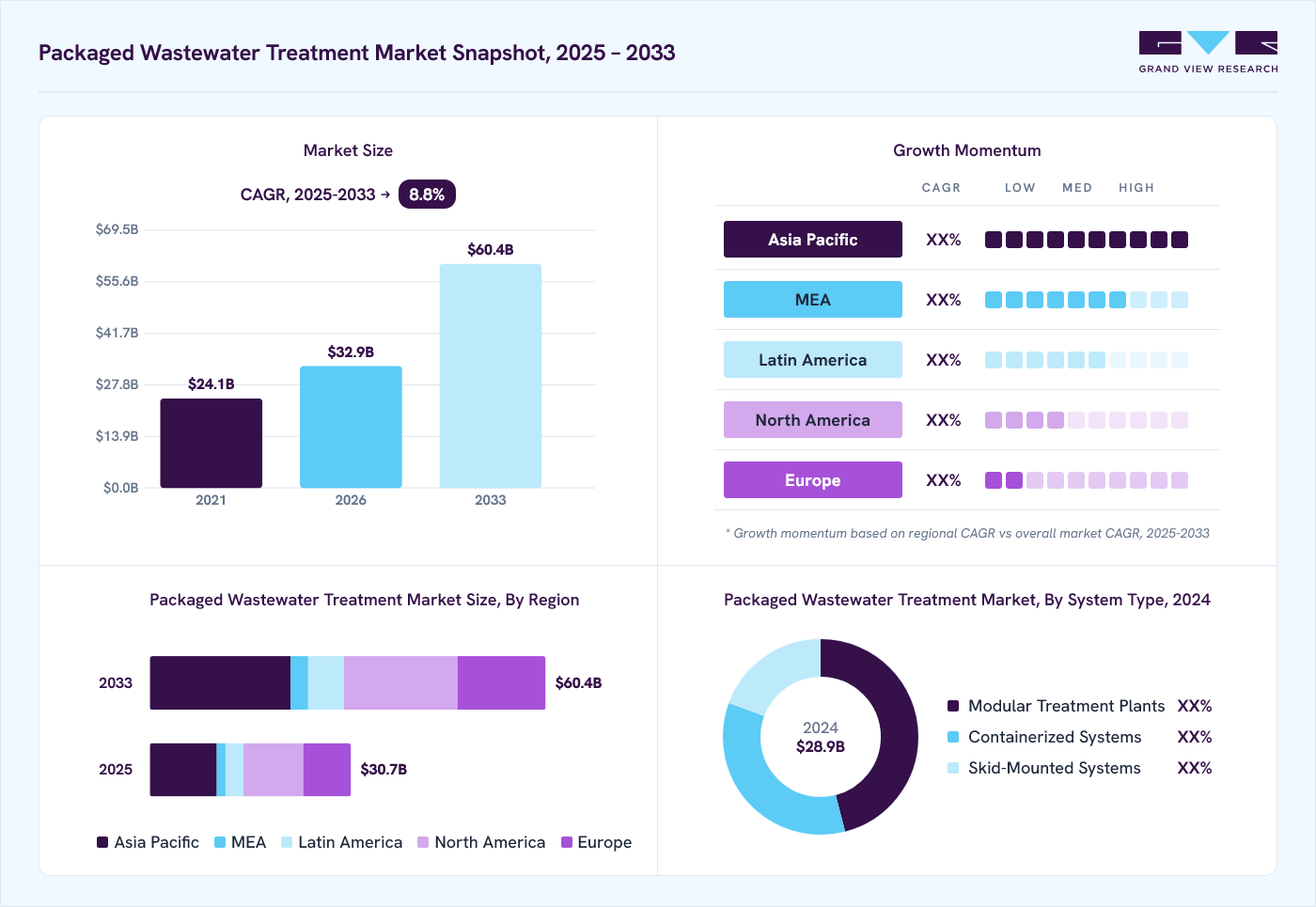 Source: Grand View Research, IR Documents, Primary Interviews, Paid DatabasesTo learn more about this report,
 Download Free Sample Report
Key Market Trends & Insights
- The packaged wastewater treatment market in the U.S. is expected to grow at a substantial CAGR of 8.6% from 2025 to 2033.
- By technology, the membrane aerated biofilm reactor (MABR) segment is expected to grow at a considerable revenue CAGR of 10.3% from 2025 to 2033.
- By system type, the containerized systems segment is expected to grow in revenue at a considerable CAGR of 9.3% from 2025 to 2033.
- By end use, the industrial segment is expected to grow in revenue at a considerable CAGR of 9.4% from 2025 to 2033.
Market Size & Forecast
- 2024 Market Size: USD 28.9 Billion
- 2033 Projected Market Size: USD 60.4 Billion
- CAGR (2025-2033): 8.8%
- Asia Pacific: Largest market in 2024
Three ways to get this report
Buy it, customize it, or ask a question.Ask an Analyst
Analyst response in 1 business day
- AccessReport author, directly
- Reply timeWithin 1 working day
- No sales callDirect answer only
- FormatEmail reply
- CostFree, no cost
Get the Full Report
What the study covers
- FormatsPDF · Excel · Dashboard
- Timeline2025–2033 annual, 2024 base
- Coverage20+ countries, 5 regions
- Companies10+ key players profiled
Customize the Report
20% free customization
- IncludeCountries, segments, points
- TailorTo your product definition
- ExtendDeeper competitor detail
- OrA fully bespoke study
- Turnaround5–10 working days
These systems are ideal for remote areas, small towns, and industries with limited space and infrastructure. Additionally, technological advancements have made packaged wastewater systems more efficient, compact, and cost-effective. Growing awareness of the environmental impact of untreated wastewater is prompting industries to install onsite treatment units. The hospitality, healthcare, and construction sectors are key adopters due to regulatory compliance and water reuse goals. The pressure to manage wastewater sustainably drives market expansion as global populations grow. To learn more about this report, Download Free Sample Report
Market Concentration & Characteristics
The global packaged wastewater treatment market is fragmented, with numerous regional and international players competing across diverse geographies. Small and medium enterprises often dominate local markets, offering customized, cost-effective solutions. However, a few large companies hold significant shares in developed regions due to their technological capabilities. Overall, the market lacks a dominant player globally, reflecting its fragmented nature.
The packaged wastewater treatment market shows a moderate to high degree of innovation, driven by the need for energy-efficient and compact systems. Companies are integrating smart monitoring, membrane bioreactors, and modular technologies. Innovations focus on improving treatment quality while reducing footprint and operational costs. R&D investments continue to grow, especially in developed regions prioritizing sustainability.
 To learn more about this report, Download Free Sample Report
The market has seen moderate M&A activity, with large players acquiring smaller firms to expand their technological capabilities and global presence. M&A helps gain access to local markets and strengthen service offerings. Strategic alliances also occur to enter emerging regions with growing demand. However, fragmentation still limits consolidation on a global scale.
Regulations significantly impact the packaged wastewater treatment market, especially regarding technology standards and discharge limits. Stringent environmental laws in North America, Europe, and parts of Asia drive demand for compliant treatment systems. Regulatory frameworks also support funding for wastewater infrastructure in rural and underserved areas. Non-compliance risks and penalties make regulation a key market driver.
Drivers, Opportunities & Restraints
Rising urbanization and industrialization are increasing the demand for effective wastewater treatment solutions. Water scarcity and growing environmental awareness are pushing the adoption of packaged systems. Government regulations and policies are supporting decentralized wastewater treatment. Compact design and low operational costs further drive market growth.
Emerging economies offer significant growth potential due to inadequate centralized wastewater infrastructure. Advancements in membrane and modular technologies can enhance system performance and scalability. Integration of IoT and automation opens doors for smart wastewater solutions. Increasing investments in sustainable water management present long-term opportunities.
High initial costs and limited awareness in rural areas can hinder adoption. Lack of skilled operators for advanced systems is a challenge in developing regions. Variability in regulations across countries complicates standardization and expansion. Space limitations and maintenance issues may also restrict deployment in some applications.
Technology Insights
The moving bed biofilm reactor (MBBR) segment accounted for a share of 27.1% in 2024, due to its operational simplicity and high efficiency. It offers effective treatment in a compact footprint, making it ideal for decentralized systems. The low maintenance and flexible scalability further boost its adoption across industrial and municipal sectors. Its proven performance in varying loads and climates supports widespread usage globally.
MABR is the fastest growing due to its superior energy efficiency and enhanced nitrogen removal capabilities. This advanced technology uses passive aeration, reducing energy costs significantly compared to traditional methods. The growing demand for low-energy and sustainable wastewater solutions is accelerating their uptake. MABR’s potential for high-quality effluent output makes it attractive for water reuse applications.
End Use Insights
The municipal segment accounted for 62.0% in 2024 owing to growing urban populations and expanding sanitation infrastructure. Governments are increasingly adopting decentralized systems for rural and peri-urban areas. Public sector investments and regulatory mandates are driving large-scale municipal installations. Packaged systems offer fast deployment and cost-effective solutions for managing municipal wastewater loads.
 To learn more about this report, Download Free Sample Report
The industrial segment is growing fastest due to rising regulatory pressure on effluent discharge and water reuse. Industries such as pharmaceuticals, food & beverage, and chemicals require compact, high-efficiency treatment solutions. Growing awareness of environmental sustainability and water conservation is boosting adoption. On-site treatment systems help industries reduce operational costs and meet compliance requirements.
System Type Insights
The modular treatment plants segment accounted for 45.9% in 2024. Modular treatment plants dominate the market due to their flexibility, scalability, and easy on-site assembly. These systems can be expanded or relocated as needed, making them ideal for growing or remote communities. Their ability to integrate with existing infrastructure adds to their appeal. Municipal and industrial users prefer them for long-term, adaptable wastewater management.
Containerized systems are the fastest-growing segment due to their plug-and-play design and rapid deployment capabilities. These fully enclosed units are ideal for emergency, temporary, or mobile applications. Increasing demand from construction sites, disaster zones, and off-grid industries drives their adoption. Their compact footprint and ease of transport make them highly practical and efficient.
Regional Insights
North America is growing significantly at a CAGR of 8.3%, driven by stringent environmental regulations and the replacement of aging infrastructure. The U.S. and Canada focus on water reuse and decentralized systems in rural areas. Technological advancements and smart monitoring systems enhance market appeal. Industrial demand for on-site treatment is also contributing to expansion.
U.S. Packaged Wastewater Treatment Market Trends
The packaged wastewater treatment market in the U.S. is expected to grow at a CAGR of 8.6% from 2025 to 2033. The U.S. dominates the North America packaged wastewater treatment market due to well-established environmental regulations and advanced infrastructure. Aging municipal systems are being replaced with compact, decentralized units. High industrial demand and strong investment in water reuse technologies support market expansion. Federal and state-level initiatives further encourage sustainable wastewater management.
Canada is experiencing significant growth, driven by increasing rural development and an emphasis on environmental protection. Government support for clean water projects boosts the adoption of packaged systems in remote and Indigenous communities. Rising industrial activity in mining, oil, and gas also fuels demand. Canada's focus on climate resilience and sustainability enhances market momentum.
Europe Packaged Wastewater Treatment Market Trends
Europe maintains steady demand, driven by strict EU wastewater directives and strong sustainability goals. Advanced economies like Germany and France are upgrading older treatment plants with modern, energy-efficient systems. Supportive public policies and funding for environmental projects boost adoption. Reuse and circular water practices are gaining traction.
The Germany packaged wastewater treatment market is experiencing steady growth, driven by strict environmental regulations and a strong focus on water reuse. The country is upgrading aging infrastructure with energy-efficient, compact systems. Industrial sectors, especially chemicals and manufacturing, are adopting on-site treatment solutions. Government incentives and technological innovation further drive market growth.
The United Kingdom packaged wastewater treatment marketis witnessing notable growth, fueled by regulatory pressure and water scarcity concerns. Rural and coastal areas increasingly rely on decentralized treatment due to limited access to centralized networks. Infrastructure modernization projects and sustainability targets fuel adoption. Public-private partnerships support deployment in both municipal and industrial sectors.
Asia Pacific Packaged Wastewater Treatment Market Trends
Asia Pacific is a dominant market with a 33.0% share, owing to rapid urbanization, industrial growth, and rising water stress. Countries like China and India are investing heavily in decentralized sanitation infrastructure. Government initiatives and foreign investments support technology adoption. High population density drives demand for compact and efficient treatment solutions.
 To learn more about this report, Download Free Sample Report
China leads the Asia Pacific packaged wastewater treatment market, driven by strict pollution control regulations and rising urbanization. The government is investing heavily in rural sanitation and decentralized treatment solutions. Industrial zones are adopting on-site systems to comply with environmental standards. Technological advancements and local manufacturing boost accessibility and adoption.
India is witnessing rapid growth in the packaged wastewater treatment market growth, fueled by government initiatives like the Swachh Bharat Mission and AMRUT. Rapid urban expansion and inadequate centralized infrastructure create strong demand for packaged systems. Rural areas and small towns benefit from modular, low-maintenance treatment solutions. Supportive policies and rising public awareness enhance market momentum.
Middle East & Africa Packaged Wastewater Treatment Market Trends
The Middle East & Africa region sees increasing interest due to water scarcity and rapid urban development. Countries like the UAE and Saudi Arabia are focusing on water reuse technologies. Decentralized, low-footprint systems are suitable for arid and remote areas. However, political instability and funding limitations challenge consistent growth.
The UAE packaged wastewater treatment market is witnessing strong growth due to severe water scarcity and a focus on reuse. Government-led sustainability initiatives like the UAE Water Security Strategy 2036 are driving adoption. The country invests in decentralized systems for remote areas, industrial zones, and tourism hubs. Advanced technology and public-private partnerships support market expansion.
Latin America Packaged Wastewater Treatment Market Trends
In Latin America, growing urban populations and inadequate centralized systems create strong demand for packaged units. Countries like Brazil and Mexico are investing in rural water infrastructure. Economic constraints slow widespread adoption, but international aid programs help bridge the gap. Industrial applications are gradually expanding in the region.
The Brazil packaged wastewater treatment market is growing due to increasing urbanization and inadequate access to centralized sewage systems. Government programs aim to improve sanitation coverage, especially in underserved and rural areas. The need for fast, cost-effective wastewater solutions drives demand for modular systems. Environmental regulations and international funding further support market development.
Key Packaged Wastewater Treatment Company Insights
Some key players operating in the market include Bio-Microbics, Inc., Clearford Water Systems Inc., and Corix Group of Companies.
-
Bio-Microbics, Inc. specializes in decentralized wastewater and stormwater treatment solutions, primarily for residential, commercial, and community applications. The company is known for its advanced fixed integrated treatment technologies, such as FAST systems, which provide efficient biological treatment in compact footprints. These systems are designed to meet stringent effluent standards and are often used where traditional sewer infrastructure is unavailable or impractical. Bio-Microbics also integrates water reuse features into its treatment systems, aligning with sustainable development practices.
-
Clearford Water Systems Inc. delivers turnkey water and wastewater infrastructure services through its proprietary Clearford One system, which integrates small-diameter sewer networks with decentralized treatment. The company focuses on full-service project delivery—design, construction, operation, and maintenance—particularly in underserved or hard-to-reach communities. It provides sustainable solutions for municipal, industrial, and commercial clients, emphasizing long-term operational cost savings and regulatory compliance through its modular and scalable system architecture.
Key Packaged Wastewater Treatment Companies:
The following are the leading companies in the packaged wastewater treatment market. These companies collectively hold the largest market share and dictate industry trends.
- Bio-Microbics, Inc.
- Clearford Water Systems Inc.
- Corix Group of Companies
- CST Wastewater Solution
- Fluence Corporation Limited
- Global Treat, Inc.
- Organica Water, Inc.
- Pollution Control Systems, Inc.
- Smith & Loveless, Inc.
- Veolia Environment SA
- Westech Engineering, Inc.
- Xylem Inc.
- Evoqua Water Technologies LLC
- Aquatech International LLC
- Hitachi Zosen Corporation
Recent Developments
-
In March 2024, Fluence Corporation received new wastewater treatment contracts in Colorado and Indiana, marking the company’s first MABR installations in those states. The systems will serve a residential community in Colorado and a school in Indiana. These projects expand Fluence’s presence in the U.S. municipal market. Additionally, the company secured industrial and biogas contracts in Italy, reflecting broader global growth.
-
In October 2024, Corix DE Systems introduced a new energy system in Bellingham’s Waterfront District that operates on low-carbon principles. It utilizes excess heat from a nearby energy facility to deliver efficient heating and cooling. Starting with 200,000 sq ft, the system is set to expand to over 1.6 million sq ft. This project is designed to lower emissions and promote sustainable urban development.
-
In March 2022, CST Wastewater Solutions started fully manufacturing its screening technology locally in Australia and New Zealand. This move enhances equipment quality and delivery reliability by using corrosion-resistant stainless steel. It also shortens lead times, improves maintenance access, and benefits customers and workers. The shift supports regional job creation and strengthens the local manufacturing supply chain.
Packaged Wastewater Treatment Market Report Scope
Report Attribute
Details
Market size value in 2024
USD 28.9 billion
Estimated Market size in 2026
USD 32.9 million
Revenue forecast in 2033
USD 60.4 billion
Growth rate
CAGR of 8.8% from 2025 to 2033
Historical data
2021 - 2023
Forecast period
2025 - 2033
Quantitative units
Revenue in USD million/billion and CAGR from 2025 to 2033
Report coverage
Revenue forecast, company ranking, competitive landscape, growth factors, and trends
Segments covered
Technology, system type, end use, and region.
Regional scope
North America; Europe; Asia Pacific; Latin America; Middle East & Africa
Country scope
U.S.; Canada; Mexico; UK; Germany; France; Spain; Italy; China; Japan; India; Australia; South Korea; Brazil; Argentina; Saudi Arabia; South Africa; UAE
Key companies profiled
Bio-Microbics, Inc.; Clearford Water Systems Inc.; Corix Group of Companies; CST Wastewater Solution; Fluence Corporation Limited; Global Treat, Inc.; Organica Water, Inc.; Pollution Control Systems, Inc.; Smith & Loveless, Inc.; Veolia Environment SA; Westech Engineering, Inc.; Xylem Inc.; Evoqua Water Technologies LLC; Aquatech International LLC; Hitachi Zosen Corporation
Customization scope
Free report customization (equivalent up to 8 analysts working days) with purchase. Addition or alteration to country, regional & segment scope.
Pricing and purchase options
Avail customized purchase options to meet your exact research needs. Explore purchase options
Global Packaged Wastewater Treatment Market Report Segmentation
This report forecasts revenue growth at the global, regional, and country levels and provides an analysis of the latest industry trends in each of the sub-segments from 2021 to 2033. For this study, Grand View Research has segmented the global packaged wastewater treatment market report based on technology,system type, end use, and region.
 To learn more about this report, Download Free Sample Report
-
Technology Outlook (Revenue, USD Million, 2021 - 2033)
-
Extended Aeration
-
Moving Bed Biofilm Reactor (MBBR)
-
Reverse Osmosis (RO)
-
Membrane Bioreactor (MBR)
-
Sequential Batch Reactor (SBR)
-
Membrane Aerated Biofilm Reactor (MABR)
-
Others
-
-
System Type Outlook (Revenue, USD Million, 2021 - 2033)
-
Modular Treatment Plants
-
Containerized Systems
-
Skid-Mounted Systems
-
-
End Use Outlook (Revenue, USD Million, 2021 - 2033)
-
Municipal
-
Industrial
-
Chemical and Pharma
-
Oil and Gas
-
Food, Pulp, and Paper
-
Metal and Mining
-
Power Generation
-
Others
-
-
-
Regional Outlook (Revenue, USD Million, 2021 - 2033)
-
North America
-
U.S.
-
Canada
-
Mexico
-
-
Europe
-
Germany
-
France
-
Italy
-
Spain
-
UK
-
-
Asia Pacific
-
China
-
India
-
Japan
-
South Korea
-
Australia
-
-
Latin America
-
Brazil
-
Argentina
-
-
Middle East and Africa
-
Saudi Arabia
-
UAE
-
South Africa
-
-
Frequently Asked Questions About This Report
The municipal segment held the largest share of 62.0% in the global packaged wastewater treatment market in 2024, driven by urban population growth, expanding sanitation infrastructure, and rising public sector investments in decentralized and cost-effective treatment solutions.
Some of the key players operating in the global packaged wastewater treatment market include Bio-Microbics, Inc.; Clearford Water Systems Inc.; Corix Group of Companies; CST Wastewater Solution; Fluence Corporation Limited; Global Treat, Inc.; Organica Water, Inc.; Pollution Control Systems, Inc.; Smith & Loveless, Inc.; Veolia Environment SA; Westech Engineering, Inc.; Xylem Inc.; Evoqua Water Technologies LLC; Aquatech International LLC; Hitachi Zosen Corporation.
Key factors driving the global packaged wastewater treatment market include rapid urbanization, expanding industrial activities, strict environmental regulations, rising water scarcity, and growing demand for decentralized treatment solutions. Government support for sustainable wastewater management further fuels market growth.
The global packaged wastewater treatment market size was valued at USD 28.9 billion in 2024 and is estimated at USD 32.9 billion for 2026.
The global packaged wastewater treatment market is expected to grow at a CAGR of 8.8% from 2025 to 2033, reaching USD 60.4 billion by 2033.
About the Author(s)
Advanced Interior Materials Research Team
Advanced Materials · Advanced Interior MaterialsThis report was authored by the advanced interior materials research team at Grand View Research - comprising two research analysts, one senior research analyst, and one industry expert - with specialized expertise in the advanced interior materials segment of the advanced materials industry. All findings are based on proprietary advanced materials databases, executive interviews, and regulatory analysis, subject to internal peer review prior to publication.
Last Updated:
Speak to Analyst

Customize this report to your needs - add regions, segments, or data points, with 20% free customization.
Or view our licence options:


ISO 9001:2015 & 27001:2022 Certified
We are GDPR and CCPA compliant! Your transaction & personal information is safe and secure. For more details, please read our privacy policy.


