
- Home
- »
- Next Generation Technologies
- »
-
Passenger Information System Market Report, 2026-2033GVR Report cover

Passenger Information System Market (2026 - 2033)
Size, Share & Trends Analysis Report By Component (Solution, Services), By Type, By Location (On Board, In Station), By Transportation Mode, By Region, And Segment Forecasts
Market Size, 2025
$38.8BMarket Estimate, 2026
$44.3BMarket Forecast, 2033
$117.3BCAGR, 2026–2033
14.9%Passenger Information System Market Summary
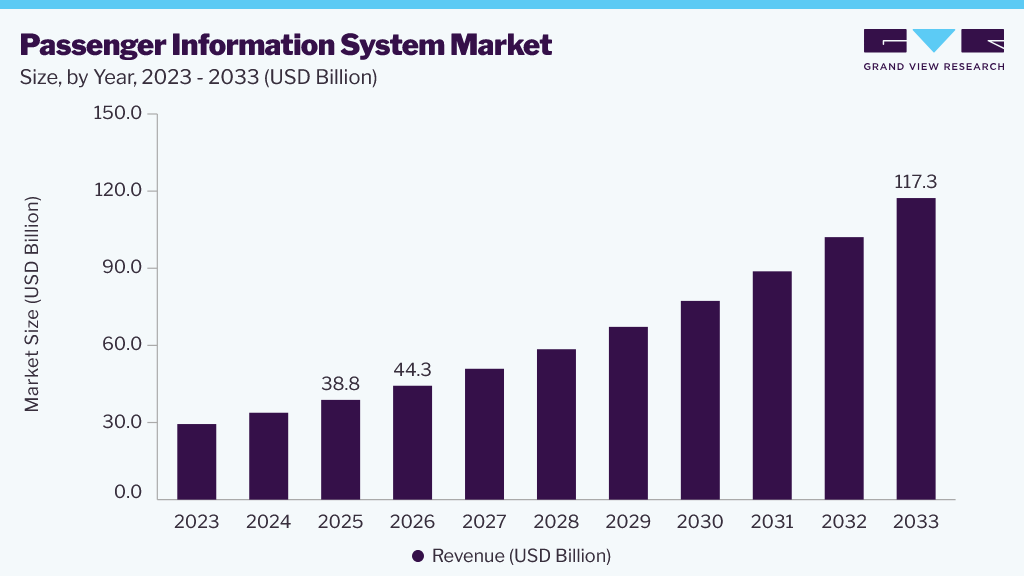
The global passenger information system market size was valued at USD 38.8 billion in 2025 and is projected to grow from USD 44.3 billion in 2026 to USD 117.3 billion by 2033, at a CAGR of 14.9% from 2026 to 2033. North America dominated the market, accounting for the revenue share of approximately 40.0% in 2025. This growth is driven by technological advancements, rising demand for real-time travel information, government initiatives, and increasing urbanization and smart-city investments.
 Source: Grand View Research, IR Documents, Primary Interviews, Paid DatabasesTo learn more about this report,
 Download Free Sample Report
Key Market Trends & Insights
- By component: The solution segment accounted for the largest market revenue share in 2025.
- By type: The display systems segment held the largest revenue share of over 20.0% in 2025.
- By transportation mode: The railway segment dominated the market with the largest revenue share in 2025
Regional Highlights
- Largest regional market: North America (40.0% revenue share, 2025)
- Fastest-growing regional market: Asia Pacific (highest CAGR, 2026-2033)
Market Size & Forecast
- Market size in 2025: USD 38.8 Billion
- Estimated market size in 2026: USD 44.3 Billion
- Projected market size by 2033: USD 117.3 Billion
- CAGR (2026-2033): 14.9%
Prism AI by Grand View Research Free to tryAsk a question about the passenger information system marketTry asking✓Every figure cited from GVR research Prefer the report? Download free sample →There has been a significant increase in mobile device and internet use, leading to a growing demand among travelers for real-time information to enhance connectivity and ensure safer travel. Transportation providers are increasingly focusing on user experience to attract and retain passengers.
Passengers now expect accurate and timely updates about their journeys, including arrival times, delays, and service changes. This demand drives the need for advanced Passenger Information System (PIS) solutions that deliver reliable, real-time data. Technological innovations, particularly in areas such as Artificial Intelligence (AI), the Internet of Things (IoT), and big data analytics, enhance the capabilities of these information systems, improving data integration and user experiences.
Rapid urbanization is resulting in higher population densities in cities, which in turn increases the demand for efficient public transportation systems. As more people rely on public transit, the need for effective passenger information systems grows. Many governments are investing in smart city initiatives and transportation infrastructure to promote sustainable urban mobility, often implementing advanced passenger information systems as part of these efforts.
The ability of these systems to integrate with other platforms, such as ticketing systems, mobile applications, and traffic management systems, further enhances their value and functionality.
Analyst Perspective
The passenger information system market is becoming increasingly important as transportation operators focus on improving the overall travel experience through real-time communication and digital services. Railways, airports, metro networks, buses, and other public transit systems are investing in intelligent information platforms that provide live updates on schedules, delays, routes, and service disruptions. As cities expand their smart mobility initiatives, passenger information systems are being integrated with mobile applications, digital displays, and cloud-based management platforms to deliver consistent and accurate information across multiple channels. Companies with strong software capabilities, reliable communication technologies, and expertise in transportation infrastructure are likely to strengthen their market position. In the coming years, competitive advantage will depend on system interoperability, AI-enabled analytics, cybersecurity, and the ability to deliver seamless, real-time passenger information that improves operational efficiency and customer satisfaction.
Type Insights
The display systems segment held the largest revenue share of over 20.0% in 2025. Display systems serve as the primary interface between the transit authority and passengers. They provide real-time information regarding schedules, delays, route changes, and other essential updates. The visibility of these displays ensures that passengers are promptly informed, which is crucial for maintaining operational efficiency and enhancing the user experience. Moreover, recent advancements in display technology, such as LED screens, LCDs, and digital signage, have enabled the dynamic, attractive presentation of information. These technologies enable high-resolution graphics and animations that convey complex information quickly and effectively, thereby increasing demand for display systems.
The mobile applications segment is expected to grow at the fastest CAGR during the forecast period, driven by technological advancements, user-centric design, real-time information distribution, increased smartphone penetration, and growing demand for personalized services. Mobile applications offer unparalleled convenience, allowing users to access information anytime and anywhere. Passengers can now use their mobile phones to get information about their trip. They do not have to rely solely on signs at the station or on announcements there. Transit agencies are expanding mobile platforms to deliver integrated, real-time passenger information and improve the overall travel experience. For instance, in May 2025, the Washington Metropolitan Area Transit Authority launched the MetroPulse mobile app with real-time arrivals, trip planning, service alerts, and live customer support.
Component Insights
The solution segment accounted for the largest market revenue share in 2025. The solution component in PIS refers to the integrated technologies and methodologies that facilitate the collection, processing, and dissemination of information to passengers. Rapid technological advancements have made it easier and more cost-effective to implement sophisticated PIS solutions that leverage big data analytics, machine learning algorithms, and cloud computing. Moreover, innovations such as AI, Machine Learning (ML), the Internet of Things, and big data analytics have made it easier to collect, process, and disseminate information effectively. These technologies enhance predictive capabilities regarding traffic patterns or potential delays.
The services segment is expected to grow at the fastest CAGR from 2026 to 2033. This growth can be attributed to the increasing demand for an enhanced passenger experience, technological advancements, and the growing complexity of transportation networks. Moreover, with advancements in technologies such as IoT, cloud computing, and mobile applications, there is a greater capacity to collect and disseminate data more quickly. This has led to increased demand for sophisticated service offerings that leverage these technologies. Transportation operators are increasingly adopting managed digital services to enhance real-time passenger communication and operational efficiency. For instance, in July 2026, Hitachi Rail acquired Clever Devices, a U.S.-based company specializing in intelligent transport systems technologies for public transit authorities.
Location Insights
The on-board segment led the market with the largest revenue share in 2025. Passenger information systems across various transportation modes, particularly in public transit and aviation, are driven by several factors that enhance the overall travel experience, improve operational efficiency, and meet regulatory requirements. These systems are designed to enhance the travel experience by providing real-time information about schedules, routes, delays, and other essential updates. As technology advances and consumer expectations evolve, the adoption of these systems has become increasingly prevalent.
The in-station segment is expected to grow at a significant CAGR during the forecast period. In-station PIS contributes to safety by keeping passengers informed about emergency procedures or incidents affecting service. Clear communication during emergencies is crucial for maintaining order and ensuring passenger safety. Many regions have regulations requiring public transport systems to provide accessible information for all passengers, including those with disabilities. PIS can be designed to meet these requirements through features such as audio announcements and visual displays that cater to diverse needs.
Transportation Mode Insights
The railway segment accounted for the largest market revenue share in 2025. Passenger information systems contribute to safety by providing alerts about emergencies or service disruptions. In the event of an incident, timely communication through PIS can guide passengers on necessary actions and evacuation procedures, thereby reducing panic and ensuring orderly conduct during crises. Modern PIS is designed to be inclusive, catering to diverse passenger needs, including those with disabilities. Features such as audio announcements and visual displays ensure that all passengers receive critical information regardless of their physical capabilities. Rail operators continue to invest in advanced passenger information systems to enhance safety, emergency communication, and service reliability. For instance, in December 2025, MIC Electronics secured a contract with South Central Railway to deploy an Integrated Passenger Information System with real-time displays, public announcements, and GPS-based information across two stations.
The roadway segment is projected to grow at the fastest CAGR during the forecast period. This use can be attributed to enhancing travelers' efficiency, safety, and overall experience. As urban populations grow and traffic congestion becomes more prevalent, there is a heightened demand for timely and accurate information. Passengers expect to receive updates on transit schedules, delays, and alternative routes. PIS helps meet this expectation by delivering real-time data across various platforms, including electronic displays, mobile applications, and websites.
Regional Insights
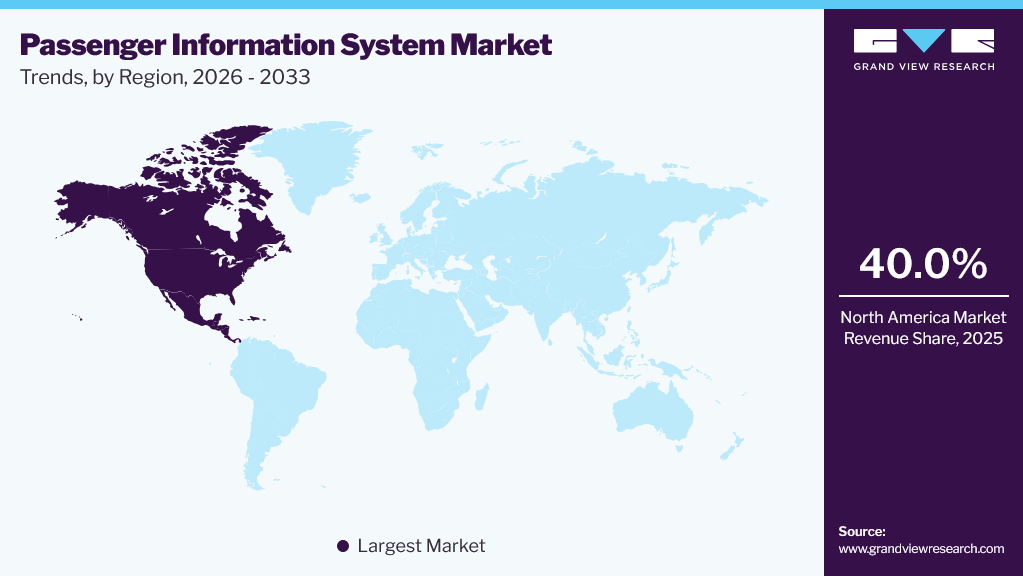
The North America passenger information system market held the largest revenue share of around 40.0% in 2025, driven by growing urbanization, which has increased urban migration and thus surged demand for efficient public transportation systems that can provide real-time information and manage data. Moreover, government initiatives such as the Bipartisan Infrastructure Law have also fueled the market significantly in the region. Transit agencies across North America continue investing in advanced passenger information technologies to improve service quality and modernize public transportation. For instance, in February 2025, Cubic Transportation Systems introduced the FEnX fare gate platform, integrating AI-powered real-time monitoring, accessibility features, and remote management capabilities for North American transit operators.
 To learn more about this report, Download Free Sample Report
U.S. Passenger Information System Market Trends
The passenger information system market in the U.S. accounted for the largest market revenue share in North America in 2025. The driving forces behind the market's growth in the country are rapid technological advancements that have enabled GPS tracking, mobile applications, digital signage, and other features that have revolutionized passenger access to real-time information and management. Moreover, the growing emphasis on safety and security has fueled market growth, driven by increasing demand for emergency alerts and data privacy.
Asia Pacific Passenger Information System Market
The passenger information system market in the Asia Pacific is expected to grow at the fastest CAGR over the forecast period. This is attributed to the rapid urbanization of the region's major economies, which has heightened demand for PIS solutions. In addition, technological advancements such as IoT and AI integration have transformed the market by disseminating passenger information and enabling context-aware services and personalization, thereby encouraging passengers to use the products and services. In addition, the electric-vehicle revolution is driving growth in the region's onboard passenger information system market.
The China passenger information system market held a significant share in the Asia Pacific in 2025. The market growth in the country is influenced by the growing emphasis on public safety in the public transport system, thereby increasing demand for real-time journey information and spurring demand for systems with efficient transit schedule updates. Moreover, the goal of reducing carbon emissions has fruitfully shaped the Chinese PIS market in recent years.
Europe Passenger Information System Market
The passenger information system market in Europe was identified as a lucrative region in 2025. The factors that have propelled the market in the region are attributed to the integration of smart transportation networks into the PIS, which has revolutionized the overall market with mobility-as-a-service platforms that have reduced congestion. Globalization and other economic factors have also played key roles in enhancing the region's transportation systems.
The UK passenger information system market held a substantial market share in Europe in 2025, owing to consumer preference for tech-savvy PIS, leading to diversification across channels such as mobile apps, on-site displays, and websites to access real-time information and avail required services.
Key Passenger Information System Company Insights
Some of the key companies in the passenger information system industry include Acapela Group, Advantech Co., Ltd., Alstom SA, Huawei Technologies Co., Ltd., and others. Organizations in the market are focusing on innovative passenger information systems to enhance consumer experience. Therefore, key players are taking several strategic initiatives, such as mergers and acquisitions, and partnerships with other major companies.
- Huawei Technologies Co., Ltd. provides intelligent passenger information system solutions by integrating ICT infrastructure, cloud computing, AI, and wireless communication technologies. Its portfolio includes intelligent terminals, communication networks, edge computing platforms, and centralized data management systems that enable real-time passenger information, station operations, and smart transit management across rail and urban transportation networks.
- Advantech Co., Ltd. offers industrial computing platforms and display solutions for passenger information systems, including the ARS-P3800 high-resolution display for metro and railway applications. The company continues to strengthen its transportation portfolio through investments in intelligent transportation systems, edge computing, and strategic partnerships that support smart mobility and rail automation.
Key Passenger Information System Companies
The following key companies have been profiled for this study on the global passenger information system market:
-
Acapela Group
-
Advantech Co., Ltd.
-
Alstom SA
-
Cubic Transportation Systems, Inc.
-
Hitachi, Ltd.
-
Huawei Technologies Co., Ltd.
-
Nokia Corporation
-
Siemens Mobility GmbH
-
Thales Group
-
Westinghouse Air Brake Technologies Corporation (Wabtec)
Recent Developments
-
In March 2025, Delhi International Airport Limited (DIAL) launched India's first Virtual Information Display (VID) kiosks at Terminals 1 and 3 of Delhi Airport. The AI-powered passenger information system provides real-time flight information, terminal navigation, and travel assistance, supporting the growing adoption of intelligent self-service technologies in transportation hubs.
-
In April 2024, Alstom SA signed a Memorandum of Understanding with Tag i Bergslagen (TiB) to develop next-generation railway technologies, including advanced passenger information systems, to enhance passenger experience and improve rail network efficiency.
Passenger Information System Market Report Scope
Report Attribute
Details
Market size in 2025
USD 38.8 billion
Estimated market size in 2026
USD 44.3 billion
Projected market size by 2033
USD 117.3 billion
Growth rate
CAGR of 14.9% from 2026 to 2033
Base year for estimation
2025
Historical data
2021 – 2024
Forecast period
2026 – 2033
Quantitative units
Revenue in USD billion, and CAGR from 2026 to 2033
Report coverage
Revenue forecast, company ranking, competitive landscape, growth factors, and trends
Segments covered
Type, component, location, transportation mode, region
Regional scope
North America; Europe; Asia Pacific; Latin America; Middle East & Africa
Country scope
U.S.; Canada; Mexico; UK; Germany; France; Japan; China; India; Australia; South Korea; Brazil; South Africa; UAE
Key companies profiled
Acapela Group; Advantech Co., Ltd.; Alstom SA; Cubic Transportation Systems, Inc.; Hitachi, Ltd.; Huawei Technologies Co., Ltd.; Nokia Corporation; Siemens Mobility GmbH; Thales Group; Westinghouse Air Brake Technologies Corporation (Wabtec)
Customization scope
Free report customization (equivalent up to 8 analysts working days) with purchase. Addition or alteration to country, regional & segment scope.
Pricing and purchase options
Avail of customized purchase options to meet your exact research needs. Explore purchase options
Global Passenger Information System Market Report Segmentation
This report forecasts revenue growth at global, regional, and country levels and provides an analysis of the latest industry trends and opportunities in each of the sub-segments from 2021 to 2033. For this study, Grand View Research has segmented the global passenger information system market report based on type, component, location, transportation mode, and region:
-
Type Outlook (Revenue, USD Billion, 2021 - 2033)
-
Display Systems
-
Announcement Systems
-
Infotainment System
-
Mobile Applications
-
Video Surveillance System
-
Emergency Communication Systems
-
Others
-
-
Component Outlook (Revenue, USD Billion, 2021 - 2033)
-
Solution
-
Services
-
-
Location Outlook (Revenue, USD Billion, 2021 - 2033)
-
On Board
-
In Station
-
-
Transportation Mode Outlook (Revenue, USD Billion, 2021 - 2033)
-
Airway & Waterway
-
Railway
-
Roadway
-
-
Regional Outlook (Revenue, USD Billion; 2021 - 2033)
-
North America
-
U.S.
-
Canada
-
Mexico
-
-
Europe
-
UK
-
Germany
-
France
-
-
Asia Pacific
-
Japan
-
China
-
India
-
Australia
-
South Korea
-
-
Latin America
-
Brazil
-
-
Middle East & Africa (MEA)
-
South Africa
-
UAE
-
-
Frequently Asked Questions About This Report
The display systems segment held the largest revenue share of over 20.0% in 2025.
North America dominated with an approximately 40.0% revenue share in 2025.
The global passenger information system market size was estimated at USD 38.8 billion in 2025 and is expected to reach USD 44.3 billion in 2026.
The global passenger information system market is expected to witness a compound annual growth rate of 14.9% from 2026 to 2033 to reach 117.3 billion by 2033.
Some key players operating in the passenger information system market include Acapela Group; Advantech Co., Ltd.; Alstom SA; Cubic Transportation Systems, Inc.; Hitachi, Ltd.; Huawei Technologies Co., Ltd.; Nokia Corporation; Siemens Mobility GmbH; Thales Group; Westinghouse Air Brake Technologies Corporation (Wabtec), and others.
About the Author(s)
Next Generation Technologies Research Team
Technology · Next Generation TechnologiesThis report was authored by the next generation technologies research team at Grand View Research - comprising two research analysts, one senior research analyst, and one industry expert - with specialized expertise in the next generation technologies segment of the technology industry. All findings are based on proprietary technology databases, executive interviews, and regulatory analysis, subject to internal peer review prior to publication.
Last Updated:
Speak to Analyst

Customize this report to your needs - add regions, segments, or data points, with 20% free customization.
Or view our licence options:


ISO 9001:2015 & 27001:2022 Certified
We are GDPR and CCPA compliant! Your transaction & personal information is safe and secure. For more details, please read our privacy policy.


