
- Home
- »
- Next Generation Technologies
- »
-
People Counting System Market Size, Share Report, 2033GVR Report cover

People Counting System Market (2026 - 2033)
Size, Share & Trends Analysis Report By Type (Unidirectional, Bidirectional), By Offering (Hardware, Software), By Technology, by Mounting Platform, By End Use, By Region, And Segment Forecasts
Market Size, 2025
$1.4BMarket Estimate, 2026
$1.6BMarket Forecast, 2033
$4.5BCAGR, 2026–2033
16.3%People Counting System Market Summary
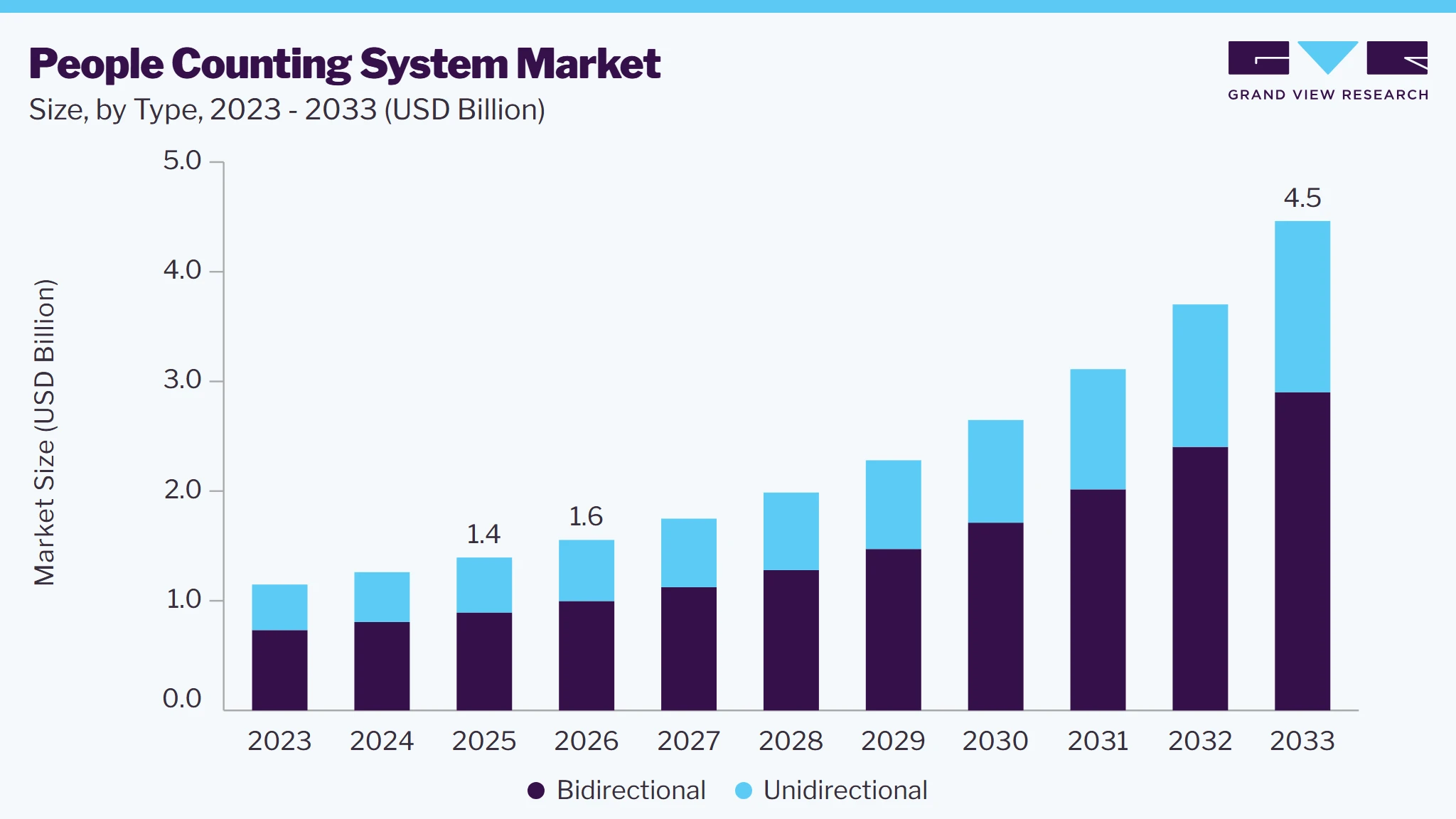
The global people counting system market size was valued at USD 1.4 billion in 2025 and is projected to grow from USD 1.6 billion in 2026 to USD 4.5 billion by 2033, at a CAGR of 16.3% from 2026 to 2033. The market in North America dominated with a revenue share of 33.4% in 2025. This growth is driven by the rapid adoption of occupancy-based analytics for optimizing retail stores, transportation hubs, and commercial buildings amid rising labor costs and stringent energy-efficiency requirements.
 Source: Grand View Research, IR Documents, Primary Interviews, Paid DatabasesTo learn more about this report,
 Download Free Sample Report
Key Market Trends & Insights
- By type: Bidirectional led the market and accounted for a share of 64.0% in 2025.
- By offering: Hardware segment dominated the market, with a revenue share of 61.8% in 2025.
- By technology: Infrared beam segment dominated the market, with a revenue share of 33.1% in 2025.
- By mounting platform: Ceiling segment dominated the market, with a revenue share of 39.4% in 2025.
- By end use: Retail, supermarkets, and shopping malls segment held the largest revenue share in 2025.
Regional Highlights
- Largest regional market: North America (33.4% revenue share, 2025)
- Fastest-growing regional market: Asia Pacific (highest CAGR, 2026-2033)
- By country: The U.S. held the largest market share in 2025.
Market Size & Forecast
- Market size in 2025: USD 1.4 Billion
- Estimated market size in 2026: USD 1.6 Billion
- Projected market size by 2033: USD 4.5 Billion
- CAGR (2026-2033): 16.3%
GVR research-powered AIAsk Prism AI about the people counting system marketGet cited answers from GVR research on market growth, segments, regulations and forecasts.Start with✓ Source-linked answers ✓ Market-specific context ✓ Traceable figuresExplore Prism AI ↗Businesses place significant value on accurate foot traffic data to enhance decision-making. By analyzing how people move and behave in different spaces, companies can optimize staffing levels, manage inventory more efficiently, and refine their marketing strategies. This real-time data is particularly crucial in large public areas and retail environments, where understanding peak times and customer preferences can greatly influence revenue. The rise of IoT and cloud-based solutions has streamlined data collection, prompting more organizations to adopt people counting systems.
 To learn more about this report, Download Free Sample Report
As smart building concepts become more popular, especially in developed regions, the integration of people counting systems has become essential. These systems optimize energy use by adjusting heating and lighting based on occupancy, leading to improved overall building management. The Internet of Things (IoT) plays a crucial role by enabling connected devices and sensors to collect and transmit data about building occupancy. Additionally, people counting technologies are increasingly integrated with other smart building solutions, creating a more comprehensive and intelligent environment.
With a growing emphasis on security in both public and private spaces, people counting systems are increasingly being used to enhance surveillance and manage crowd control. Airports, shopping malls, and stadiums rely on these systems to monitor occupancy levels, ensure public safety, and comply with regulations regarding maximum capacity. By analyzing crowd movement patterns, security teams can proactively address bottlenecks and high-density situations, ultimately reducing the risks associated with overcrowding.
The rise of e-commerce has significantly affected physical retail spaces, prompting many stores to reassess how they attract foot traffic. With fewer customers visiting in person, brick-and-mortar stores are focusing on maximizing the impact of each visitor. People counting technology enables retailers to measure the effectiveness of promotions, optimize store layouts, and refine staffing schedules. As physical stores continue to adapt to the challenges posed by e-commerce, they are increasingly investing in people-counting systems to enhance the shopping experience and improve operational efficiency.
Market Dynamics
The global people counting system market is experiencing steady growth as organizations increasingly adopt intelligent occupancy analytics and real-time visitor monitoring solutions to optimize space utilization, improve operational efficiency, and enhance customer experiences. Retail stores, shopping malls, airports, transportation hubs, corporate offices, healthcare facilities, educational institutions, hospitality venues, smart buildings, and public infrastructure are deploying people counting systems to measure foot traffic, monitor occupancy levels, ensure regulatory compliance, and support data-driven decision-making. Modern people counting solutions integrate AI-powered video analytics, 3D stereoscopic vision, thermal imaging, infrared sensors, Wi-Fi and Bluetooth tracking, edge computing, cloud-based analytics, and IoT connectivity into unified monitoring platforms. The growing emphasis on smart buildings, workplace optimization, retail analytics, public safety, and intelligent facility management is driving adoption of advanced people counting systems that provide accurate occupancy insights, improve resource allocation, reduce operational costs, and support business intelligence initiatives.
The increasing deployment of AI-powered occupancy analytics and smart building technologies is a major driver of the global people counting system market. Organizations are implementing intelligent people counting solutions to gain real-time insights into visitor traffic, occupancy patterns, customer behavior, and workforce movement while optimizing staffing, energy consumption, and facility operations. Advanced systems leverage computer vision, artificial intelligence, machine learning, edge analytics, and cloud connectivity to deliver high-accuracy counting, queue monitoring, heat mapping, and predictive occupancy analysis across diverse environments. These capabilities help organizations improve operational efficiency, enhance customer experiences, strengthen security, and support data-driven planning. For instance, in January 2026, AIStorm announced advancements in its edge AI technology that address key people counting challenges by embedding artificial intelligence directly into sensors, enabling highly accurate real-time occupancy tracking while reducing latency, power consumption, and system complexity.
Privacy concerns, deployment complexity, and accuracy limitations remain significant restraints for the global people counting system market. Organizations deploying camera-based and sensor-based people counting solutions must comply with evolving data privacy regulations and cybersecurity requirements governing the collection and processing of occupancy data. Retrofitting legacy buildings with advanced sensors and integrating people counting systems with existing building management, security, and enterprise platforms can increase implementation costs and complexity. Additionally, environmental conditions such as poor lighting, crowded environments, multiple entry points, and occlusions may affect counting accuracy, while ongoing calibration, maintenance, and software updates are required to ensure consistent system performance.
The rapid expansion of smart city initiatives, intelligent transportation systems, and AI-enabled facility management presents a significant growth opportunity for the global People Counting System market. Governments and enterprises are increasingly investing in intelligent occupancy monitoring solutions to improve public safety, optimize transportation networks, manage public venues, and enhance energy efficiency in commercial buildings. The growing adoption of cloud computing, IoT-enabled sensors, edge AI, digital twins, and advanced analytics is enabling vendors to deliver scalable people counting platforms with real-time dashboards, predictive occupancy forecasting, automated alerts, and seamless integration with building management, security, and HVAC systems. Continued innovation in computer vision, multimodal sensing technologies, and AI-driven behavioral analytics is expected to accelerate adoption across retail, healthcare, transportation, education, and smart infrastructure applications, creating substantial long-term market growth opportunities.
Analyst Perspective
The people counting system market is positioned at the convergence of artificial intelligence, computer vision, IoT, smart buildings, and intelligent facility management. Organizations across retail, transportation, hospitality, corporate offices, healthcare, and public infrastructure are increasingly deploying people counting systems to gain real-time occupancy insights, optimize space utilization, enhance customer experiences, and improve operational efficiency. Unlike conventional footfall monitoring solutions, modern people counting systems integrate AI-powered video analytics, 3D stereoscopic vision, thermal imaging, infrared sensing, cloud analytics, and edge computing into unified platforms that deliver accurate visitor counting, occupancy monitoring, queue management, and behavioral analytics. The growing adoption of smart buildings, digital workplaces, and data-driven facility management is further accelerating demand for intelligent people counting solutions that support resource optimization, regulatory compliance, energy efficiency, and security management.
Type Insights
Based on type, the bidirectional segment led the market with the largest revenue share of 64.0% in 2025 due to the growing demand for highly accurate data on occupancy and customer movement. By distinguishing between inbound and outbound foot traffic, these systems provide businesses with a clear picture of actual occupancy rates, peak times, and conversion ratios. Retailers, for instance, can precisely calculate how many unique visitors convert to customers or leave without making purchases. The high accuracy of bidirectional systems makes them invaluable for optimizing staffing, improving marketing strategies, and fine-tuning the customer experience.
The unidirectional segment is expected to grow at a CAGR of 17.0% over the forecast period. Advancements in sensor technology have improved the accuracy and reliability of unidirectional systems, drivers their adoption. Infrared and thermal sensors can accurately detect and count individuals as they move through an entry or exit point, even in challenging lighting or weather conditions. These advancements help minimize errors such as double counting or missing individuals, which is critical for locations where precise occupancy data is necessary. This improved accuracy expands the range of environments in which unidirectional systems can be used effectively, enhancing their appeal.
Offering Insights
Based on offering, the hardware segment led the market with the largest revenue share of 61.8% in 2025. As sustainability initiatives become more prominent, there is a growing focus on energy-efficient hardware in the market. Many organizations are prioritizing hardware that consumes minimal power, operates efficiently, and has a long operational life. Manufacturers are responding by designing energy-efficient people-counting devices that comply with green building standards, appealing to organizations focused on reducing their environmental footprint. This demand for sustainable hardware is particularly high in smart building projects, which aim to reduce energy usage through automated lighting and HVAC systems based on occupancy data.
The software segment is expected to grow at a significant CAGR over the forecast period. AI and machine learning technologies are transforming people counting systems by making them more accurate. Advances in facial recognition, image processing, and sensor technology allow these systems to identify and count individuals with high accuracy in challenging environments. Modern systems can distinguish between individuals based on attributes such as height or walking patterns, providing specific data that can be used to analyze customer demographics and behavior.
Hardware Insights
The thermal cameras segment accounted for the largest revenue share of over 61.0% in 2024. The cost of thermal camera technology has decreased significantly due to advancements in manufacturing processes and increased competition among suppliers. This drop in price, along with the improved affordability of related hardware and software, has made thermal cameras more accessible to a wider range of businesses and organizations. Additionally, the lower total cost of ownership associated with thermal cameras such as reduced maintenance requirements and longer lifespans makes them an attractive option for budget-conscious buyers.
The fixed cameras segment is expected to grow at a significant CAGR over the forecast period owing to the significant advancements in imaging technology, such as high-definition (HD) and 4K video capabilities. These improvements enhance the accuracy and reliability of people counting, as high-resolution images can capture clearer details of individuals in diverse lighting conditions and environments. In addition, features like wide-angle lenses and low-light performance expand the usability of fixed cameras, making them suitable for various mounting platforms in retail stores, public transport systems, and large venues.
Technology Insights
Based on technology, the infrared beam segment led the market with the largest revenue share of 33.1% in 2025 Infrared beam people counting systems are often more cost-effective compared to more advanced technologies, such as 3D or thermal imaging systems. Their relatively simple installation and low maintenance needs make them an attractive choice for businesses looking to implement people counting solutions without a significant financial burden. This cost advantage is particularly appealing for small to medium-sized enterprises and public spaces that need efficient monitoring without extensive investment.
The video-based technology segment is expected to grow at a significant CAGR over the forecast period. As businesses strive to enhance customer experience and optimize operations, video-based people counting systems provide valuable insights. By understanding customer behavior, businesses create more engaging environments and improve service delivery.
Mounting Platform Insights
Based on mounting platform, the ceiling segment led the market with the largest revenue share of 39.4% in 2025. The rise of smart building solutions is a major growth driver for the ceiling mounting platform segment. Many organizations are now incorporating people counting systems into broader smart building frameworks that utilize IoT technology to manage various building operations. Ceiling-mounted systems can seamlessly integrate with other smart devices, such as HVAC systems, lighting controls, and security systems, to optimize energy use and enhance occupant comfort.
The wall segment is expected to grow at a significant CAGR over the forecast period. The flexibility of wall-mounted people counting systems allows them to be used across a wide range of industries beyond traditional retail and hospitality. For example, educational institutions are increasingly adopting these systems to monitor classroom occupancy, optimize space usage, and enhance safety protocols. Healthcare facilities utilize wall-mounted people counting for patient flow analysis and to ensure compliance with safety regulations. As more sectors recognize the benefits of people counting technology, the growth potential for wall-mounted platforms expands.
End Use Insights
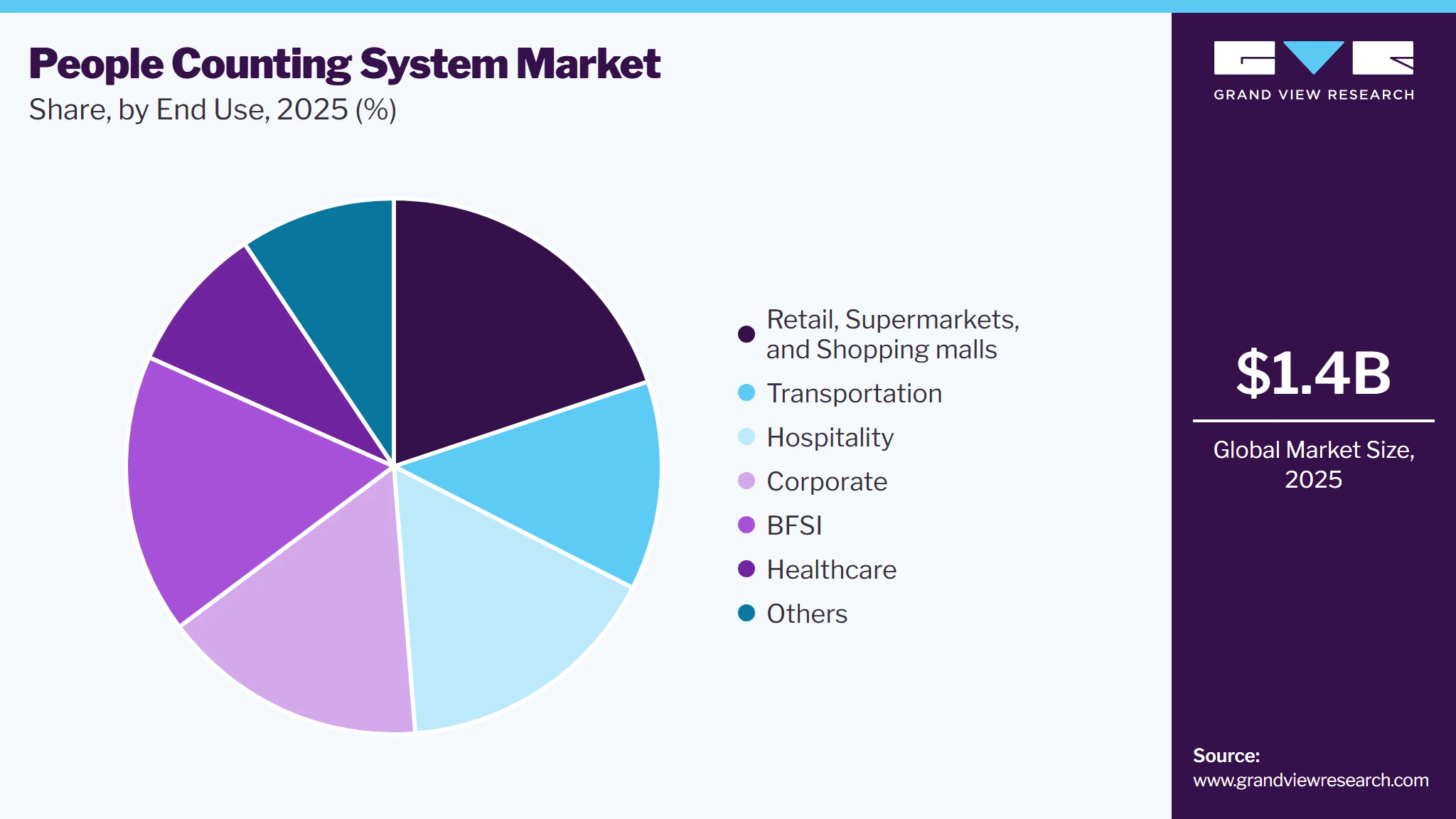
Based on end use, retail, supermarkets, and shopping malls segment led the market with the largest revenue share of 19.9% in 2025. With the retail industry becoming more data-centric, the demand for advanced analytics tools is on the rise. People counting systems contribute significantly to retail analytics by offering insights that help retailers understand customer behavior, preferences, and trends. Retailers can use this data to refine marketing strategies, optimize promotional activities, and enhance the overall shopping experience. The growing emphasis on analytics as a competitive differentiator drives further investment in people counting technologies.
 To learn more about this report, Download Free Sample Report
The hospitality segment is expected to grow at a significant CAGR over the forecast period in the people counting system industry. The hospitality industry is increasingly adopting smart technologies to enhance operational capabilities and guest experiences. People counting systems are being integrated with other smart solutions such as automated lighting, HVAC systems, and security features. For example, occupancy data can trigger energy-efficient adjustments to heating and cooling systems, leading to cost savings and a reduced environmental footprint.
Regional Insights
North America dominated the global people counting system market with the largest revenue share of 33.4% in 2025 owing to the widespread adoption of advanced people counting systems. The integration of artificial intelligence (AI), machine learning, and computer vision is enhancing the accuracy and functionality of these systems. These technologies enable real-time data analytics, allowing businesses to gain deeper insights into customer behavior and occupancy patterns.
 To learn more about this report, Download Free Sample Report
U.S. People Counting System Industry Trends
The people counting system market in the U.S. held the largest share in the North America region in 2025 driven by the integration of artificial intelligence (AI) and machine. These technologies enhance the accuracy and functionality of counting solutions, enabling businesses to gather richer data insights. For instance, AI algorithms can analyze patterns in foot traffic, allowing organizations to forecast trends, optimize layouts, and improve customer engagement strategies.
Europe People Counting System Industry Trends
The people counting system market in Europe is growing with a significant CAGR from 2025 to 2033. European cities are increasingly implementing people counting technologies in buses, trains, and metro systems to monitor passenger flows and optimize schedules. This trend is complemented by the rise of smart mobility solutions, where data collected from people counting systems informs transportation planning and enhances the efficiency of public transport services.
The UK people counting system market is expected to grow rapidly in the coming years. As companies focus on employee well-being and safety, the need for people counting systems to monitor employee occupancy and social distancing is on the rise. These systems help businesses track employee attendance in offices, warehouses, and manufacturing plants, ensuring a safe working environment and compliance with health guidelines.
The people counting system industry in Germany held a substantial market share in 2024. Businesses in Germany are seeking customizable and flexible people counting solutions that can adapt to their unique operational needs. This trend is leading to the development of modular systems that can be tailored to fit different environments, such as retail stores, transportation hubs, and corporate offices. Vendors are focusing on providing solutions that allow organizations to implement and scale systems based on their specific requirements.
Asia Pacific People Counting System Market Trends
Asia Pacific is growing significantly at a CAGR of 15.6% from 2025 to 2033 due to the growing urbanization, with large populations migrating to urban centers. This trend has led to increased foot traffic in various sectors, including retail, transportation, and hospitality. People counting systems are being adopted to manage and analyze this foot traffic effectively, enabling businesses to optimize operations, enhance customer experiences, and improve safety measures in densely populated areas.
The Japan people counting system industry is expected to grow rapidly in the coming years. People counting systems in Japan are increasingly being integrated with other technologies, such as customer relationship management (CRM) systems, marketing automation tools, and building management systems. This integration enables businesses to utilize foot traffic data more effectively, enhancing customer engagement strategies and improving operational efficiencies.
The people counting system market in China held a substantial market share in 2024.The Chinese government is actively promoting smart city initiatives, which include the technology of people counting systems. These systems are used to gather data on pedestrian traffic, assisting urban planners and policymakers in making informed decisions regarding infrastructure development, public transport, and community services. The integration of people counting solutions into smart city frameworks is fostering a data-driven approach to urban management, enhancing the quality of life in urban areas.
Key People Counting System Company Insights
Key players operating in the people counting system industry are Axis Communications AB, Hikvision Digital Technology Co., Ltd., InfraRed Integrated Systems Ltd (IRISYS),Sensormatic Solutions, and RetailNext Inc. The companies are focusing on various strategic initiatives, including new product development, partnerships & collaborations, and agreements to gain a competitive advantage over their rivals. The following are some instances of such initiatives.
-
In May 2024, Sensormatic Solutions partnered with Thruvision Ltd, a UK-based security screening technology provider, to make advanced people screening more accessible to retailers worldwide. Thruvision Ltd’s passive terahertz camera technology and scanning software will complement Sensormatic’s loss prevention solutions, offering retailers a fast, respectful, and effective option for people screening in distribution centers and logistics facilities, aimed at reducing internal shrink.
-
In March 2024, Axis Communications AB launched a thermographic camera that is explosion-proof and specifically engineered for use in Zone and Division 2 hazardous environments. The camera allows for remote temperature monitoring, improving operational efficiency and extending its detection capabilities into Zone and Division 1 areas. With its automated alert functionality, the camera can provide early warnings about equipment overheating, enabling faster and more effective responses compared to traditional handheld devices that require manual location checks.
Key People Counting System Companies
The following key companies have been profiled for this study on the people counting system market.
-
Axis Communications AB
-
DILAX Intelcom GmbH
-
HELLA Aglaia Mobile Vision GmbH
-
Hikvision Digital Technology Co., Ltd.
-
RetailNext Inc.
-
Sensormatic Solutions
-
ShopperTrak
-
Teledyne FLIR LLC
-
V-Count
- Xovis AG
Competitive Benchmarking
Category
Operating Strategies
Competitive Edge
Weakness
Established Players (Axis Communications AB, Hikvision Digital Technology Co., Ltd., Sensormatic Solutions, ShopperTrak)
Invest in AI-powered computer vision, edge analytics, and cloud-based occupancy platforms.
Expand integrated solutions for retail, transportation, smart buildings, and public infrastructure.
Strengthen ecosystems through partnerships with building management, security, and IoT platform providers.
Strong global brand recognition and extensive installed customer base.
Broad product portfolios spanning hardware, software, and cloud analytics.
High R&D investment enabling continuous AI and computer vision innovation.
Higher acquisition, deployment, and maintenance costs than smaller competitors.
Longer procurement and implementation cycles for enterprise projects.
Complex integration with legacy infrastructure in some deployments.
Emerging Players (DILAX Intelcom GmbH, V-Count, Xovis AG)
Focus on AI-enabled occupancy analytics and high-accuracy 3D sensing technologies.
Expand cloud-native analytics platforms with real-time dashboards and reporting.
Target transportation, retail, airports, and smart buildings with industry-specific solutions.
Faster innovation cycles and quicker feature enhancements.
High counting accuracy using advanced AI, stereo vision, and sensor fusion technologies.
Flexible deployment and competitive pricing compared to larger vendors.
Smaller global customer base and limited brand visibility.
Lower investment capacity for global expansion and R&D compared to market leaders.
Limited channel partner and after-sales support networks in some regions.
Greater dependence on selected industry verticals and regional markets.
People Counting System Market Report Scope
Report Attribute
Details
Market size in 2025
USD 1.4 billion
Estimated market size in 2026
USD 1.6 billion
Projected market size by 2033
USD 4.5 billion
Growth rate
CAGR of 16.3% from 2026 to 2033
Base year for estimation
2025
Historical data
2021 - 2024
Forecast period
2026 - 2033
Quantitative units
Revenue in USD million/billion and CAGR from 2026 to 2033
Report coverage
Revenue forecast, company market share analysis, competitive landscape, growth factors, and trends
Segments covered
Type, offering, technology, mounting platform, end use, region
Regional scope
North America; Europe; Asia Pacific; Latin America; MEA
Country scope
U.S.; Canada; Mexico; Germany; UK; France; China; Japan; India; South Korea; Australia; Brazil; Saudi Arabia; South Africa; UAE
Key companies profiled
Axis Communications AB; DILAX Intelcom GmbH; HELLA Aglaia Mobile Vision GmbH; Hikvision Digital Technology Co., Ltd.; InfraRed Integrated Systems Ltd (IRISYS); RetailNext Inc.; Sensormatic Solutions; ShopperTrak; V-Count; Xovis AG
Customization scope
Free report customization (equivalent up to 8 analysts' working days) with purchase. Addition or alteration to country, regional & segment scope.
Pricing and purchase options
Avail customized purchase options to meet your exact research needs. Explore purchase options
Global People Counting System Market Report Segmentation
This report forecasts revenue growth at global, regional, and country levels and provides an analysis of the latest industry trends in each of the sub-segments from 2021 to 2033. For this study, Grand View Research has segmented the people counting system market report based on type, offering, technology, mounting platform, end use, and region:
-
Type Outlook (Revenue, USD Million, 2021 - 2033)
-
Unidirectional
-
Bidirectional
-
-
Offering Outlook (Revenue, USD Million, 2021 - 2033)
-
Hardware
-
Thermal Cameras
-
Infrared Sensors
-
Fixed Cameras
-
Fixed Dome Cameras
-
Pan-Tilt-Zoom Cameras
-
-
Software
-
-
Technology Outlook (Revenue, USD Million, 2021 - 2033)
-
Infrared beam
-
Thermal Imaging
-
Video- based Technology
-
Others
-
-
Mounting Platform Outlook (Revenue, USD Million, 2021 - 2033)
-
Ceiling
-
Wall
-
Floor
-
-
End Use Outlook (Revenue, USD Million, 2021 - 2033)
-
Retail, Supermarkets, and Shopping malls
-
Transportation
-
Hospitality
-
Corporate
-
BFSI
-
Healthcare
-
Others
-
-
Regional Outlook (Revenue, USD Million, 2021 - 2033)
-
North America
-
U.S.
-
Canada
-
Mexico
-
-
Europe
-
UK
-
Germany
-
France
-
-
Asia Pacific
-
China
-
India
-
Japan
-
South Korea
-
Australia
-
-
Latin America
-
Brazil
-
-
Middle East & Africa
-
UAE
-
Saudi Arabia
-
South Africa
-
-
Research Methodology
The people counting system Market figures in this report are based on a proven research process that combines executive interviews with secondary research from proprietary databases, company filings, and recognized regulatory and institutional sources. Market size is built through value-chain sizing - reconciling supply-side and demand-side estimates - and triangulated with bottom-up and top-down approaches. Every estimate passes multiple levels of expert validation before publication, with each people counting system Market segment quantified using the revenue-capture definitions in the table below.
Segment Definition
Segment - Type
Revenue capture definition
Unidirectional
Revenue is generated from people counting systems that monitor pedestrian movement in a single direction at entrances or exits using infrared, thermal, video, or other sensing technologies. Revenue includes hardware devices, embedded software, analytics licenses, cloud subscriptions, installation, and maintenance services.
Bidirectional
Revenue is generated from people counting systems capable of simultaneously tracking inbound and outbound pedestrian traffic to provide real-time occupancy and flow analytics. Revenue includes intelligent counting hardware, analytics software, AI-enabled monitoring platforms, cloud-based subscriptions, deployment, upgrades, and ongoing support services.
Segment - Offering
Revenue capture definition
Hardware
Revenue is generated from people counting devices including AI cameras, infrared sensors, thermal sensors, stereoscopic cameras, edge processors, controllers, gateways, and associated mounting accessories used for occupancy monitoring and visitor tracking.
Software
Revenue is generated from occupancy analytics software, cloud-based management platforms, AI-powered video analytics, dashboards, reporting tools, mobile applications, API integrations, software licenses, SaaS subscriptions, upgrades, and software maintenance used for people counting and occupancy management.
Segment - Technology
Revenue capture definition
Infrared beam
Revenue is generated from infrared sensor-based people counting systems that detect pedestrian movement by interrupting infrared beams at entry and exit points.
Thermal Imaging
Revenue is generated from thermal imaging-based people counting systems that detect heat signatures to accurately monitor occupancy under varying lighting and environmental conditions.
Video- based Technology
Revenue is generated from AI-enabled video analytics and computer vision systems that analyze camera feeds for real-time people counting, occupancy monitoring, queue management, and behavioral analytics.
Others
Revenue is generated from alternative technologies including Wi-Fi tracking, Bluetooth sensing, LiDAR, time-of-flight (ToF), stereoscopic vision, pressure sensors, and hybrid occupancy monitoring solutions.
Segment - Mounting Platform
Revenue capture definition
Ceiling
Revenue is generated from ceiling-mounted people counting devices installed to provide overhead occupancy monitoring and visitor flow analytics across entrances, corridors, retail spaces, and public facilities.
Wall
Revenue is generated from wall-mounted people counting systems deployed at doorways, entrances, exits, and passageways for pedestrian counting and occupancy measurement.
Floor
Revenue is generated from floor-mounted or embedded sensing systems that detect pedestrian movement through pressure-sensitive or embedded sensor technologies.
Segment - End Use
Revenue capture definition
Retail, Supermarkets, and Shopping malls
Revenue is generated from people counting systems deployed for visitor analytics, conversion rate measurement, queue management, occupancy monitoring, and store performance optimization.
Transportation
Revenue is generated from people counting systems installed in airports, railway stations, metro stations, bus terminals, and transit hubs for passenger flow analysis, crowd management, and operational planning.
Hospitality
Revenue is generated from occupancy monitoring systems deployed in hotels, resorts, convention centers, and entertainment venues to optimize guest experiences and facility utilization.
Corporate
Revenue is generated from occupancy monitoring solutions used in office buildings and commercial facilities for workspace optimization, meeting room utilization, and energy management.
BFSI
Revenue is generated from people counting solutions deployed in bank branches and financial institutions for visitor analytics, branch optimization, queue management, and security monitoring.
Healthcare
Revenue is generated from occupancy monitoring systems used in hospitals, clinics, and healthcare facilities for patient flow management, resource allocation, and infection control.
Others
Revenue is generated from people counting systems deployed across educational institutions, government buildings, museums, sports venues, religious institutions, and smart city infrastructure.
Estimation Model
Layer
Question
Analysis
Enterprise Demand Layer
Who can benefit from people counting systems?
Identify organizations that require real-time occupancy monitoring, visitor analytics, and pedestrian flow management to improve operational efficiency, customer experience, safety, and space utilization. Key demand originates from retail, transportation, hospitality, healthcare, corporate offices, BFSI, educational institutions, government facilities, and smart city infrastructure.
Infrastructure & Deployment Readiness Layer
Who can deploy people counting systems?
Evaluate organizations based on digital infrastructure, surveillance systems, network connectivity, cloud adoption, IoT readiness, AI capabilities, and building management integration. Facilities equipped with CCTV networks, edge computing, smart building platforms, and security infrastructure demonstrate greater readiness for deploying advanced people counting solutions.
Adoption & Utilization Layer
Who actively uses people counting systems?
Analyze adoption across retail chains, shopping malls, airports, railway stations, hospitals, hotels, corporate campuses, financial institutions, and public infrastructure. Active users leverage people counting systems for occupancy monitoring, queue management, workforce optimization, visitor analytics, energy efficiency, security, and regulatory compliance.
Monetization Layer
How much revenue is generated?
Assess revenue generated through sales of people counting hardware, AI-enabled cameras, sensors, analytics software, SaaS subscriptions, cloud platforms, installation, system integration, customization, technical support, managed services, software upgrades, maintenance contracts, and AI-powered occupancy analytics solutions supporting intelligent facility management and operational optimization.
Delivered Customizations
This report has been delivered with the following In-depth customizations
Client Request
Customization Delivered
Value Adds
AI-Powered Occupancy Analytics & Smart Building Trends
Conducted a comprehensive analysis of AI-enabled people counting technologies, covering computer vision, edge AI, 3D stereoscopic imaging, thermal sensing, cloud-based occupancy analytics, smart building integration, and real-time visitor behavior analysis.
Helps stakeholders identify emerging occupancy analytics technologies, evaluate innovation opportunities, and assess intelligent monitoring solutions that improve operational efficiency and customer experience.
Competitive Benchmarking of People Counting System Vendors
Conducted a detailed benchmarking of leading people counting system vendors based on product portfolio, sensing technologies, AI capabilities, deployment models, analytics features, geographic presence, end-user focus, partnerships, and strategic developments.
Helps stakeholders compare vendor capabilities, identify competitive gaps, evaluate technology leadership, and support vendor selection and strategic partnership decisions.
Regional Smart Infrastructure & Occupancy Analytics Assessment
Conducted an analysis of smart city initiatives, digital infrastructure investments, retail modernization, transportation digitization, regulatory developments, and occupancy analytics adoption across North America, Europe, Asia Pacific, Latin America, and the Middle East & Africa.
Helps stakeholders identify high-growth regional opportunities, understand technology adoption trends, and prioritize market expansion strategies based on infrastructure development and digital transformation initiatives.
Frequently Asked Questions About This Report
The global people counting system market size was estimated at USD 1.4 billion in 2025 and is expected to reach USD 1.6 billion in 2026.
The global people counting system market is expected to grow at a compound annual growth rate of 16.3% from 2026 to 2033 to reach USD 4.5 billion by 2033.
Key factors include organizations' increasing adoption of intelligent occupancy analytics and real-time visitor monitoring solutions to optimize space utilization, improve operational efficiency, and enhance customer experiences.
The bidirectional segment led with a 64.0% revenue share in 2025, while the unidirectional segment is the fastest-growing segment.
The hardware segment led with a 61.8% revenue share in 2025, while the software segment is the fastest-growing segment.
Key players operating in the people counting system market include Axis Communications AB; DILAX Intelcom GmbH; HELLA Aglaia Mobile Vision GmbH; Hikvision Digital Technology Co., Ltd.; InfraRed Integrated Systems Ltd (IRISYS); RetailNext Inc.; Sensormatic Solutions; ShopperTrak; V-Count; Xovis AG
North America dominated, with a 33.4% revenue share in 2025.
Asia Pacific is the fastest-growing region over the forecast period.
The infrared beam segment held the largest share (over 33.1%) in 2025, while the video-based Technology segment is the fastest-growing segment.
About the Author(s)
Next Generation Technologies Research Team
Technology · Next Generation TechnologiesThis report was authored by the next generation technologies research team at Grand View Research - comprising two research analysts, one senior research analyst, and one industry expert - with specialized expertise in the next generation technologies segment of the technology industry. All findings are based on proprietary technology databases, executive interviews, and regulatory analysis, subject to internal peer review prior to publication.
Last Updated:
Speak to Analyst

Customize this report to your needs - add regions, segments, or data points, with 20% free customization.
Or view our licence options:


ISO 9001:2015 & 27001:2022 Certified
We are GDPR and CCPA compliant! Your transaction & personal information is safe and secure. For more details, please read our privacy policy.


