
- Home
- »
- Clothing, Footwear & Accessories
- »
-
Pepper Spray Market Size, Share, Growth Report 2026-2033GVR Report cover

Pepper Spray Market (2026 - 2033)
Size, Share & Trends Analysis Report By Product (Stream, Gel), By Product Format (Standard Handheld, Keychain / Pocket), By End User (Individual Consumers, Private Security), By Distribution Channel (Offline, Online), By Region, And Segment Forecasts
Market Size, 2025
$103.5MMarket Estimate, 2026
$108.1MMarket Forecast, 2033
$144.6MCAGR, 2026–2033
4.2%Pepper Spray Market Summary
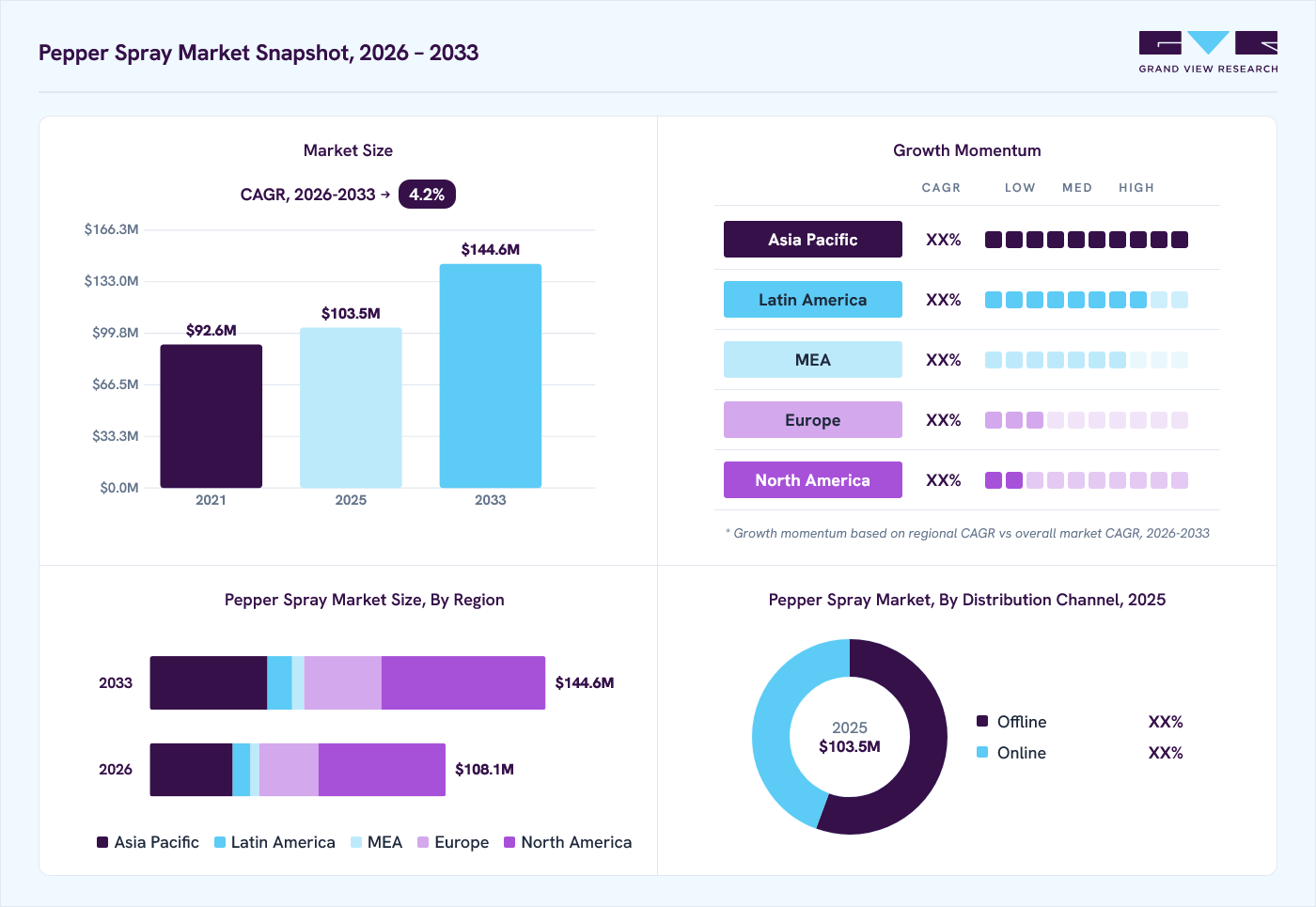
The global pepper spray market size was valued at USD 103.5 million in 2025 and is projected to grow from USD 108.1 million in 2026 to USD 144.6 million by 2033, at a CAGR of 4.2% from 2026 to 2033. North America dominated the market, accounting for a revenue share of 43.2% in 2025. The market is growing due to rising personal-safety concerns, increasing adoption of civilian self-defense products, greater awareness of pepper spray as a non-lethal protection option, and expanding availability through retail and online channels.
 Source: Grand View Research, IR Documents, Primary Interviews, Paid DatabasesTo learn more about this report,
 Download Free Sample Report
 Key Market Trends & Insights
- By product: Stream pepper spray accounted for the largest share of 43.4% of the global revenue in 2025.
- By product format: Standard handheld pepper spray accounted for the largest share of 35.2% of the global revenue in 2025.
- By end user: Individual consumers accounted for 78.3% of global revenue in 2025.
- By distribution channel: Sales of pepper sprays through offline channels accounted for a revenue share of 55.6% in 2025.
Regional Highlights
- Largest regional market: North America (43.2% revenue share in 2025)
- Fastest growing regional market: Asia Pacific (highest CAGR 10.4%, 2026-2033)
- By Country: The U.S. held the largest market share in 2025
Market Size & Forecast
- Market size in 2025: USD 103.5 Million
- Estimated market size in 2026: USD 108.1 Million
- Projected Market Size by 2033: USD 144.6 Million
- CAGR (2026-2033): 4.2%
Three ways to get this report
Buy it, customize it, or ask a question.Ask an Analyst
Analyst response in 1 business day
- AccessReport author, directly
- Reply timeWithin 1 working day
- No sales callDirect answer only
- FormatEmail reply
- CostFree, no cost
Get the Full Report
What the study covers
- FormatsPDF · Excel · Dashboard
- Timeline2026–2033 annual, 2025 base
- Coverage20+ countries, 5 regions
- Companies10+ key players profiled
Customize the Report
20% free customization
- IncludeCountries, segments, points
- TailorTo your product definition
- ExtendDeeper competitor detail
- OrA fully bespoke study
- Turnaround5–10 working days
Personal safety concerns converting into actual carry behavior is another key factor driving the market. Demand for pepper spray is supported when consumers perceive a practical need for an immediately available defensive option, particularly among people who commute, walk, travel, work late hours, or regularly spend time alone outside the home.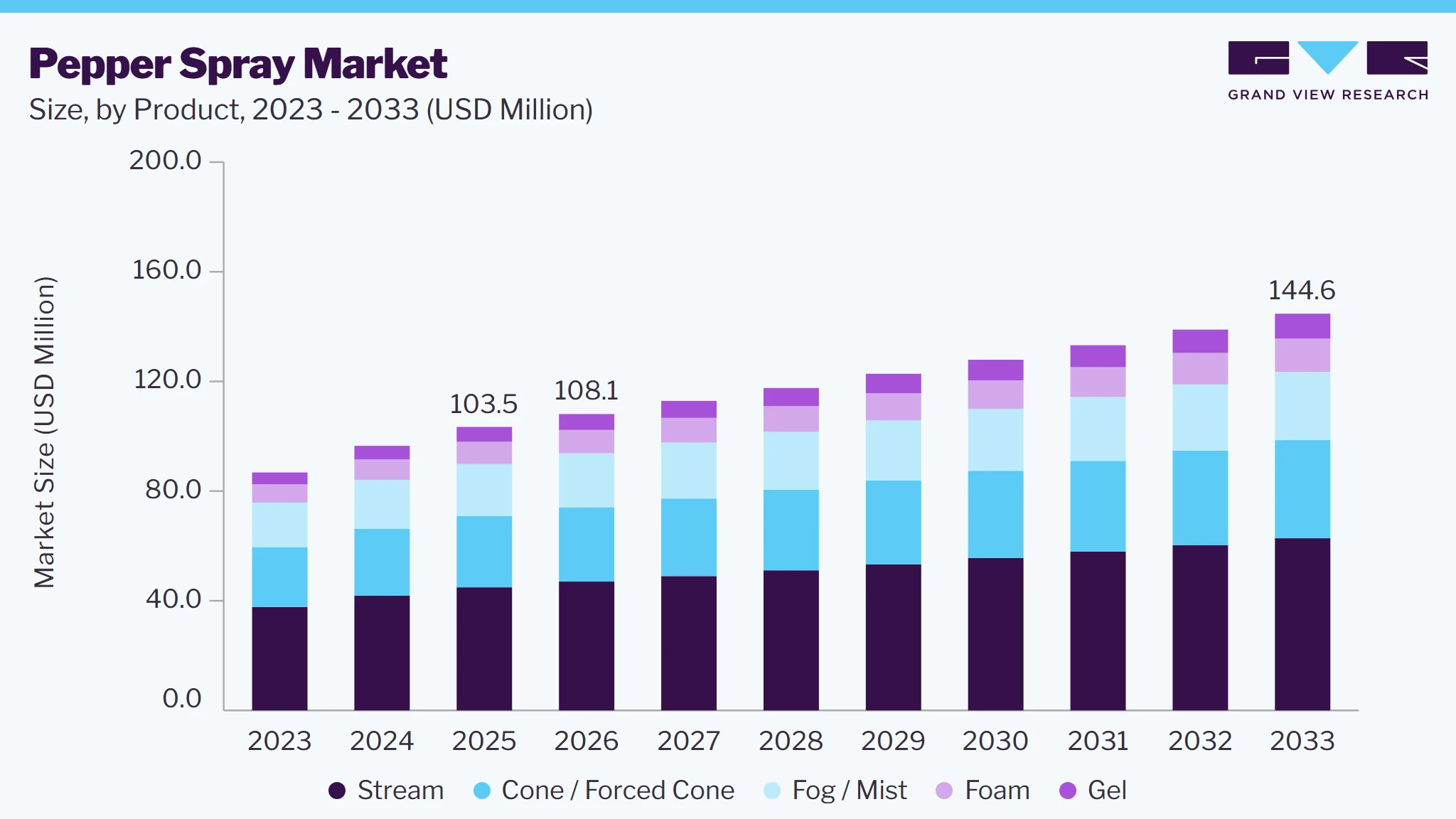 To learn more about this report, Download Free Sample Report
 For instance, the 2026 WIN Worldviews Survey found that only 50% of women globally felt safe or confident walking alone at night, while 42% said they did not, based on a survey of more than 44,000 respondents across markets. While women represent an important consumer group, personal safety concerns also extend to the broader population, including individuals seeking protection during commuting, travel, outdoor activities, and other situations where immediate assistance may not be available. These patterns point to a market driven less by frequent product use than by the desire to have a readily available contingency option when consumers anticipate higher-risk situations.
Rising demand for portable personal protection is a critical driver, propelling market growth. Pepper spray benefits from being a relatively small, low-cost product that can be carried without substantially changing a consumer’s daily routine. This makes it relevant to a broad range of individual users seeking a convenient defensive option, while also supporting adoption among private security personnel who require compact, readily accessible equipment as part of their duties. In a U.S. Gallup survey, 26% of adults reported carrying mace or pepper spray for protection in 2021, up from 14% in 2007; the increase was particularly pronounced among women, with 38% of women versus 15% of men reporting carrying it.
Demand is also increasingly shaped by whether consumers can realistically carry, access, and activate the product under stress, rather than simply by OC concentration or advertised range. A civilian usability study by Strybel and Kumar of San José State University found that spray design materially affected response time: safety mechanism and trigger-finger configuration produced significant differences in deployment performance, while users rated a side-slide design better for effectiveness, aiming, firing speed, and ease of use. The finding creates a direct product-development opportunity around compact formats, secure carry, intuitive safeties, controlled spray patterns, and easier deployment.
Market Dynamics
The pepper spray market is supported by the adoption of private security, in which OC spray can be part of defensive equipment. The U.S. Bureau of Labor Statistics reported that there were approximately 1.1 million security guards in 2021, with 90% employed in the private sector. In Texas, the Texas Department of Public Safety requires approved training for private security officers using chemical-dispensing devices. This creates a more structured purchasing environment than individual consumer demand, with requirements for standardized equipment, training, replacement, and compliance supporting recurring demand.
Pepper spray regulations vary significantly across countries, affecting product legality, permitted formulations, technical specifications, purchase conditions, and carrying requirements. For example, pepper spray is prohibited for civilian use in the UK and Canada, while Germany permits certain irritant-spray devices subject to technical and marking requirements. Such regulatory differences can restrict addressable demand in certain markets, increase compliance requirements, and make it difficult for manufacturers to standardize products globally.
Manufacturers can expand the value proposition of pepper spray by integrating personal-safety technology and connected features that provide additional functionality beyond conventional defensive use. This can help brands differentiate products, justify premium pricing, and increase consumer engagement in a relatively commoditized category. For instance, in July 2026, SABRE launched its Smart Pepper Spray, which integrates GPS location sharing, emergency notifications, and a companion personal safety app. This demonstrates an emerging opportunity to position pepper spray as part of a broader connected personal-safety ecosystem.
Consumer Insights
 To learn more about this report, Download Free Sample Report
 -
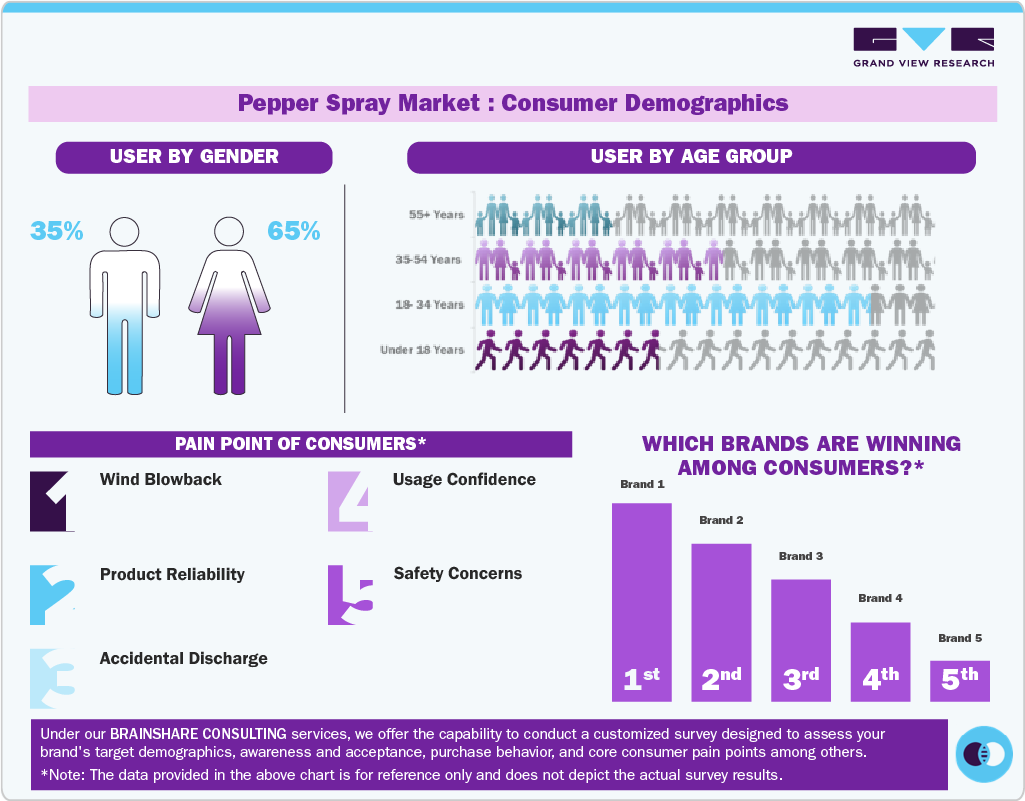
Female-led Demand: Women form the core consumer base, with pepper spray typically purchased as a “just-in-case” protection product for commuting, walking, travel, late-evening outings, and other situations where users may feel vulnerable. This makes compactness and easy access critical for buyers.
-
Young-adult Concentration: The 18-34 age group forms the largest user segment, reflecting higher day-to-day mobility and greater exposure to commuting, independent travel, campus/workplace movement, and activities outside the home. Compact pocket, purse, and keychain formats are therefore particularly relevant.
-
Consumer Priorities: Purchase decisions extend beyond spray strength and price. Consumers look for reliable discharge, manageable size, secure grip, simple activation, and predictable spray direction, particularly because the product may remain unused for long periods before an emergency.
-
Key Pain Points: Wind Blowback, Product Reliability, Accidental Discharge, Safety Concerns, and Usage Confidence create clear product-design priorities for manufacturers. Brands are responding by emphasizing controlled spray patterns, dependable discharge systems, secure safety mechanisms, ergonomic grips, compact carry formats, and clearer user guidance to reduce hesitation and improve confidence at the point of use.
-
Market Implication: Demand is shifting toward everyday-carry products that are compact, dependable, secure, and intuitive to deploy, creating opportunities for controlled spray patterns, improved safety mechanisms, ergonomic designs, and user-friendly carry formats.
Regulatory Landscape
Country
Civilian Use Status
Key Regulatory Evidence
Implication
UK
Prohibited
GOV.UK explicitly classifies pepper spray and other self-defense sprays as prohibited items, while the UK firearms guidance includes personal-protection sprays containing CS, Mace, or OC pepper among prohibited weapons.
Effectively excludes the conventional civilian human-defense market.
Canada
Prohibited for human self-defense
Canadian government materials classify pepper spray, mace, and capsicum spray intended for use against people as prohibited weapons. Animal repellents are treated separately.
Civilian human-defense demand is highly restricted.
China
Highly restricted
Pepper spray is subject to restrictions on possession and transport, including explicit restrictions in civil aviation. The regulatory environment does not provide a broad, standardized civilian self-defense market comparable with the U.S.
Limited civilian accessibility and higher regulatory uncertainty constrain addressable demand.
Japan
Conditionally permitted / restricted carrying
Pepper spray is not categorically prohibited as a weapon under Japan's firearms legislation, but carrying it without a legitimate reason can fall under the Minor Offenses Act.
A restricted civilian market, where possession and especially public carrying depend on circumstances and purpose.
Brazil
Conditionally permitted / regulated
Federal Law No. 15,474, enacted in July 2026, permits women aged 18+ to purchase and possess pepper-extract aerosol for personal defense, subject to identification, authorization, and technical requirements.
Creates a newly formalized civilian market, but access remains regulated.
Australia
Predominantly prohibited; jurisdiction-specific exception
Regulations differ by state/territory. NSW and Victoria classify capsicum/OC spray as prohibited, while Queensland requires a weapons license and does not recognize self-defense as a genuine reason. The Northern Territory currently permits eligible adults to purchase, possess, and carry OC spray for self-defense under a government trial extended to December 31, 2026.
One of the clearest examples of sub-national regulatory fragmentation: most jurisdictions restrict civilian access, while the NT creates a limited legal market.
Germany
Conditionally permitted/regulated
Certain irritant-spray devices can be legally marketed subject to technical, composition, and marking requirements under German weapons regulations.
Creates a regulated civilian market, with compliance requirements influencing product specifications and commercialization.
U.S.
Generally permitted; state-regulated
Civilian pepper spray is broadly legal, but individual states impose varying requirements regarding product specifications, purchase eligibility, and possession.
Represents a large, accessible civilian market, although manufacturers must account for state-level requirements.
Analyst Perspective
The market is evolving from a conventional personal-defense product toward a more portable, user-oriented, and application-specific safety category, with stream sprays remaining widely used while gel, foam, and forced-cone formats gain traction. Growing personal safety awareness, demand for compact everyday carry products, and expanding online availability are supporting market growth, while varying regulatory requirements continue to influence product accessibility and distribution. Manufacturers are increasingly focusing on portability, controlled spray patterns, safety features, and product reliability to strengthen adoption among individual consumers and private-security users.
Product Insights
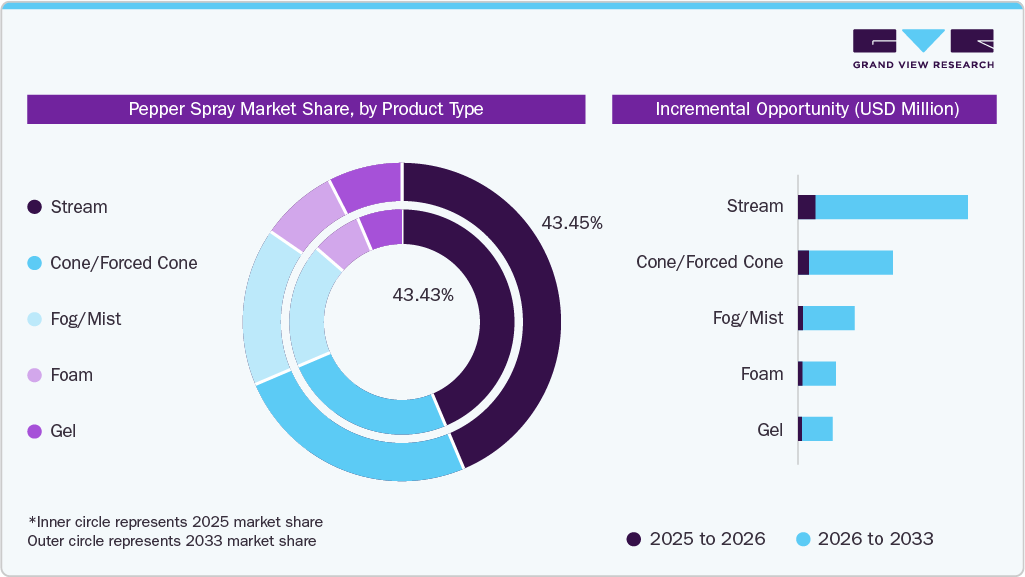
Stream pepper spray accounted for 43.4% of global revenue in 2025. Stream spray remains the leading format owing to its focused discharge, which provides greater aiming precision and is less affected by air movement than fog/mist, making it well-suited to individual users seeking controlled deployment. The U.S. National Institute of Justice identifies stream as more accurate than fog and less influenced by air movement, supporting its continued relevance for personal-defense applications.
 To learn more about this report, Download Free Sample Report
 Gel pepper spray is projected to grow at a CAGR of 6.6% from 2026 to 2033. Gel pepper spray is gaining traction as consumers look for lower-drift products that reduce blowback and airborne contamination, particularly for use around homes, vehicles, or in windy conditions. For instance, SABRE's civilian pepper-gel products emphasize reduced wind blowback and indoor usability; SABRE also cited an AAU survey in which 43% of respondents reported having a pepper product at home for personal safety, supporting the broader relevance of home-defense applications.
Product Format Insights
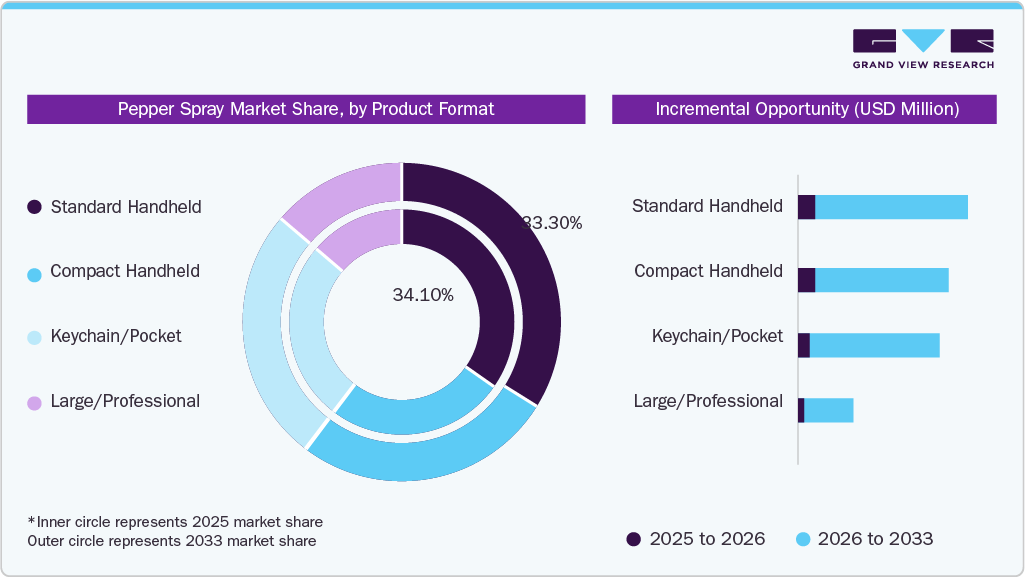
Standard handheld pepper spray accounted for 35.2% of global revenue in 2025, as it offers a balance of portability, ease of handling, and spray capacity, making it suitable for routine personal defense use. A civilian usability study by Strybel and Kumar, published in the International Journal of Industrial Ergonomics, found that 73% of participants rated a side-slide safety mechanism easier to use than a flip-top design, highlighting the importance of ergonomic design in handheld deployment.
 To learn more about this report, Download Free Sample Report
 Keychain/pocket pepper spray is projected to grow at a CAGR of 4.9% from 2026 to 2033. This product format is gaining traction as consumers seek items that remain readily accessible during daily activities without adding significant bulk. The civilian usability study by Strybel and Kumar, published in the International Journal of Industrial Ergonomics, found that 37% of respondents carried pepper spray in a bag or purse during the day, while 13% carried it in a pants pocket, supporting the relevance of compact formats for everyday carry.
End User Insights
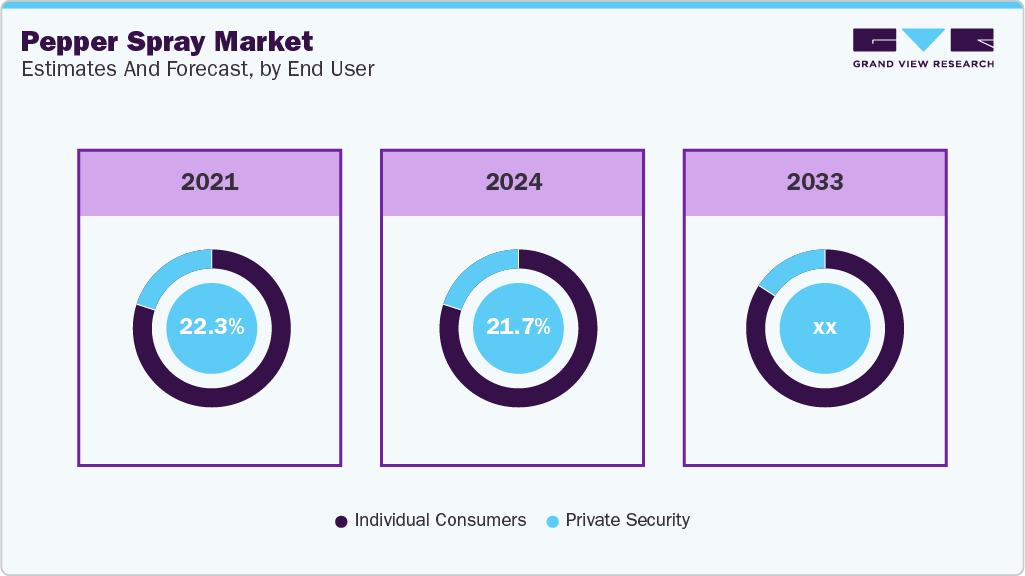
Pepper spray for individual consumers accounted for 78.3% of global revenue in 2025, as pepper spray is increasingly used as a readily accessible personal-safety option for people who want protection without carrying a firearm. For instance, when Australia’s Northern Territory introduced a 12-month trial allowing eligible residents to purchase OC spray in September 2025, retailers reported strong initial demand, with one retailer selling out of stock within two days. By January 2026, 2,148 people had purchased 3,531 canisters during the trial, indicating tangible consumer demand when regulated civilian access is available.
 To learn more about this report, Download Free Sample Report
 Pepper spray for private security is projected to grow at a CAGR of 3.6% from 2026 to 2033, driven by the need for private security personnel to manage confrontational and potentially violent situations while maintaining a less-lethal response option. OC spray provides security personnel with a portable defensive tool that can be carried during routine duties and deployed when physical intervention may otherwise be required. For instance, in May 2024, the Northern Territory amended its weapons regulations to allow eligible private-security employees to obtain approval to possess, carry, and use OC spray while performing specified crowd-controller duties, subject to employer approval, training, and other conditions.
Distribution Channel Insights
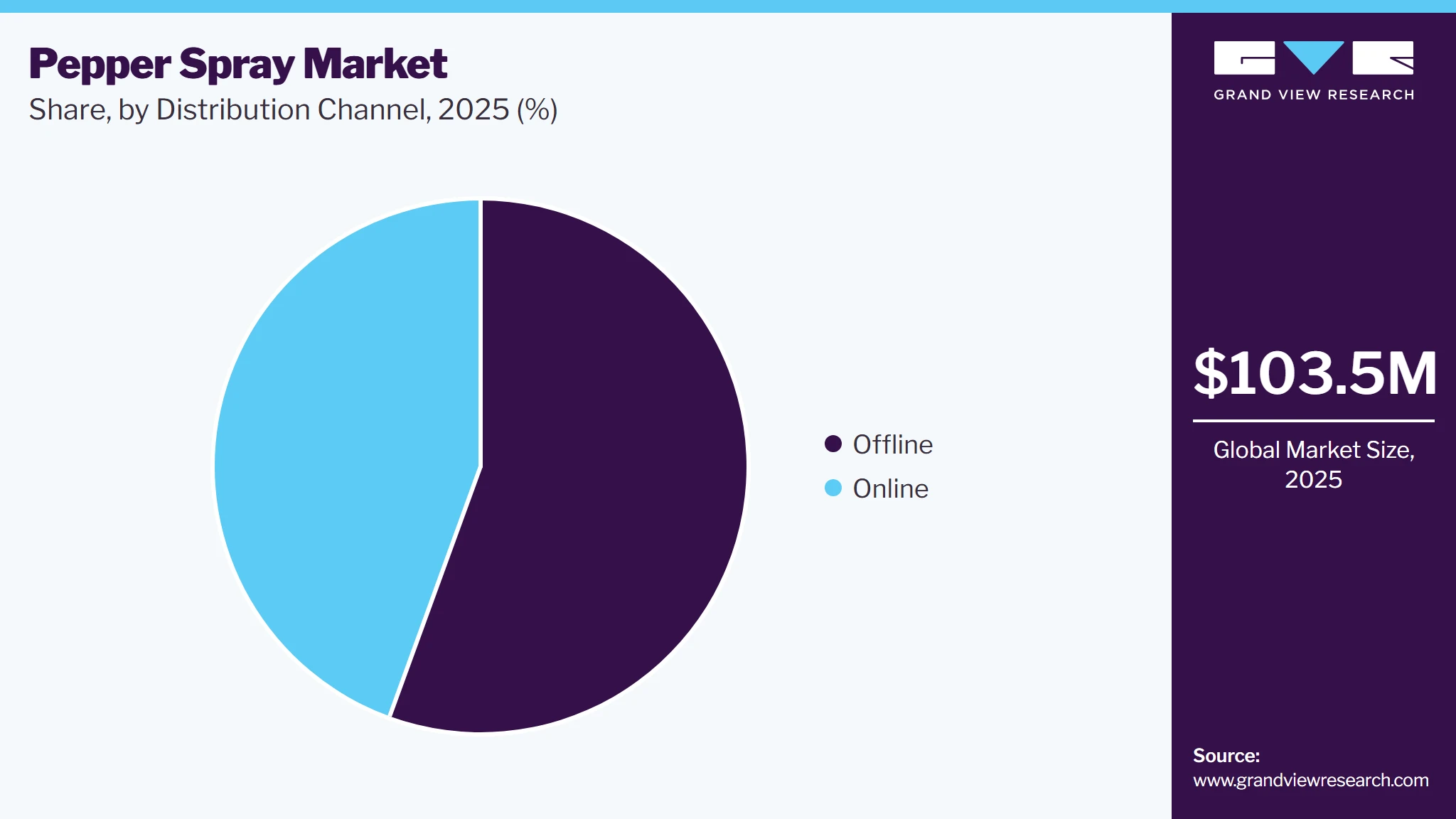
The sale of pepper sprays through offline retail and dealers accounted for 55.6% of global revenue in 2025, supported by established retail distribution and the visibility of pepper-spray products at physical points of purchase. In February 2025, Tactical Retailer highlighted counter displays as an effective way to generate pepper-spray sales, noting that customers may purchase the product as an add-on when it is displayed at checkout. Similarly, in June 2026, Streetwise Security Products identified pepper-spray keychains as its top-selling format and highlighted their strong performance across retail channels, reinforcing the importance of physical merchandising and dealer networks in the category.
 To learn more about this report, Download Free Sample Report
 The sale of pepper sprays through online channel is projected to grow at a CAGR of 4.9% from 2026 to 2033, supported by the increasing integration of pepper spray with digital-first personal-safety shopping. For instance, in November 2025, SABRE promoted its Smart Pepper Spray through an online Black Friday bundle, combining the connected pepper spray with an online self-defense course and offering the bundle directly to consumers. This illustrates how manufacturers are increasingly using online channels not only for product sales but also to package pepper spray with complementary digital safety services.
Regional Insights
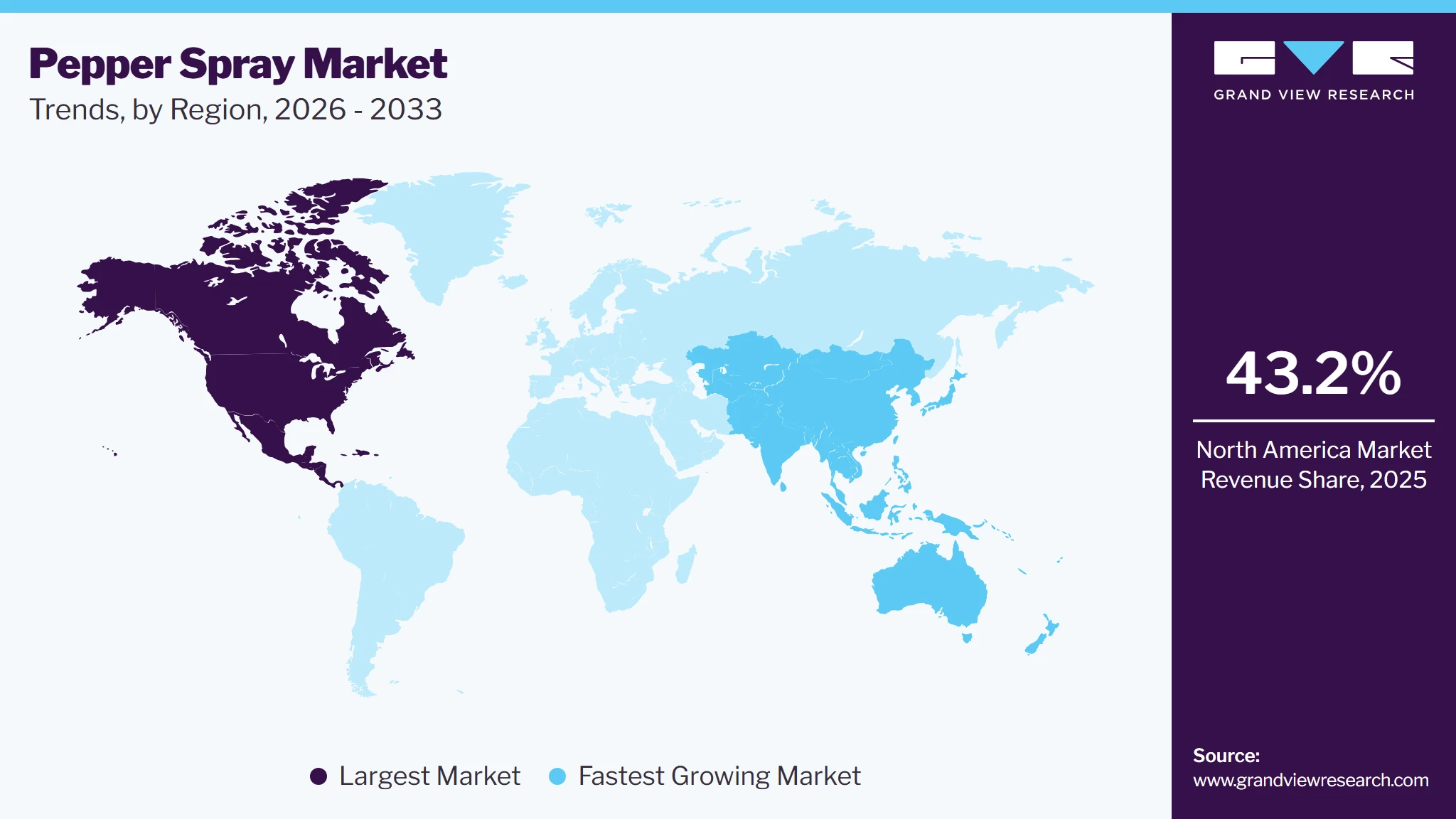
The pepper spray market in North America led the global market, accounting for the largest revenue share of 43.2% in 2025, supported by established consumer adoption of personal-defense products, broad retail availability, and relatively accessible civilian regulations across the region. The U.S. remains the primary demand center, supported by widespread availability of portable OC sprays through pharmacies, specialty stores, and online channels.
 To learn more about this report, Download Free Sample Report
 U.S. Pepper Spray Market Trends
The U.S. accounted for approximately 90.0% of the North American pepper spray market in 2025, supported by widespread civilian access to pepper spray and a well-established personal-defense product ecosystem. Demand is further supported by the availability of multiple product formats, including compact keychain, handheld, gel, and stream sprays, allowing manufacturers to address different consumer carry and usage preferences.
Europe Pepper Spray Market Trends
The Europe pepper spray market accounted for 20.1% of the global market in 2025. European demand is supported by persistent personal safety concerns, although regulatory conditions vary substantially across countries. The EU Gender-Based Violence Survey found that 30.8% of women in the EU-27 had experienced sexual harassment at work during their lifetime, while the rate reached 41.6% among women aged 18-29. This indicates a sizeable underlying personal safety concern among European consumers, particularly among younger women.
The pepper spray market in Germany accounted for the largest revenue share of around 22.1% in 2025. Germany's relatively large share is supported by its established regulatory framework for irritant-spray devices, which provides a defined pathway for compliant civilian products. German regulations require applicable devices to satisfy requirements concerning construction, irritant effects, permitted quantities, testing, and product marking. This creates a structured market in which manufacturers can compete through compliant formulations and product formats rather than operating in an outright prohibited market.
The France pepper spray industry is projected to grow at a CAGR of 3.4% from 2026 to 2033. France presents demand potential due to ongoing public concern about personal security, while its regulatory framework limits the types and conditions under which defensive sprays can be possessed. In 2025, France's Ministry of the Interior launched its Vécu et Ressenti en matière de Sécurité survey, sampling 200,000 adults to measure citizens' experiences and perceptions of safety and insecurity. The scale of the survey reflects the government's continuing focus on personal and public security concerns, which underpin demand for personal protection products.
The pepper spray industry in Spain is projected to grow at a CAGR of 4.9% from 2026 to 2033. Spain's relatively faster growth can be linked to consumer demand for compact personal-protection products and high tourist exposure to petty crime. In 2025, Spain received a record 96.8 million international tourists, an increase of 3.2% from the previous year, while the Ministry of the Interior continued its dedicated Safe Tourism Plan to address security risks affecting visitors
Asia Pacific Pepper Spray Market Trends
The Asia Pacific pepper spray market is projected to grow at a CAGR of 5.2% from 2026 to 2033. The region presents a strong growth opportunity as personal-safety concerns remain significant across several markets while consumer awareness of portable safety products increases. UN Women reports that up to 75% of women over 18 in Asia and the Pacific have experienced sexual harassment, indicating a substantial underlying need for personal-safety measures.
India led the Asia Pacific pepper spray industry and accounted for 44.8 % of the market in 2025. The pepper spray market in India is supported by persistent women's safety concerns and existing adoption of portable self-defense products. In 2024, India recorded 441,534 registered crimes against women, equivalent to roughly one case every 71 seconds, while NARI 2025 found that 4 in 10 women across 31 cities felt unsafe in urban environments. A CVoter survey also found that 21% of women reported keeping safety equipment such as pepper spray or sharpened objects in their bags, indicating an established consumer base for portable personal-protection products.
The pepper spray market in Japan is projected to grow at a CAGR of 4.5% from 2026 to 2033, supported by persistent concerns around stalking and personal safety. Japan recorded 22,881 stalking-related consultations in 2025, with cases remaining at historically high levels, strengthening demand for portable self-defense products.
Central & South America Pepper Spray Market Trends
The Central & South America pepper spray industry is projected to grow at a CAGR of 4.7% from 2026 to 2033, driven by heightened consumer concerns about crime and personal security. In 2025, 55% of Latin Americans identified crime and violence as their country's biggest concern, compared with 34% globally, strengthening demand for accessible personal-protection products.
Middle East & Africa Pepper Spray Market Trends
The pepper spray market in Middle East & Africa is projected to grow at a CAGR of 4.4% from 2026 to 2033. This can be attributed to rising consumer use of personal-protection measures in markets affected by crime and perceived insecurity. In South Africa, Statistics South Africa's 2024/25 Governance, Public Safety and Justice Survey recorded 131 respondents carrying pepper spray as a personal crime-protection measure, alongside 2,546 who reported enrolling in self-defense classes, providing direct evidence of civilian demand for protective measures.
Key Pepper Spray Company Insights
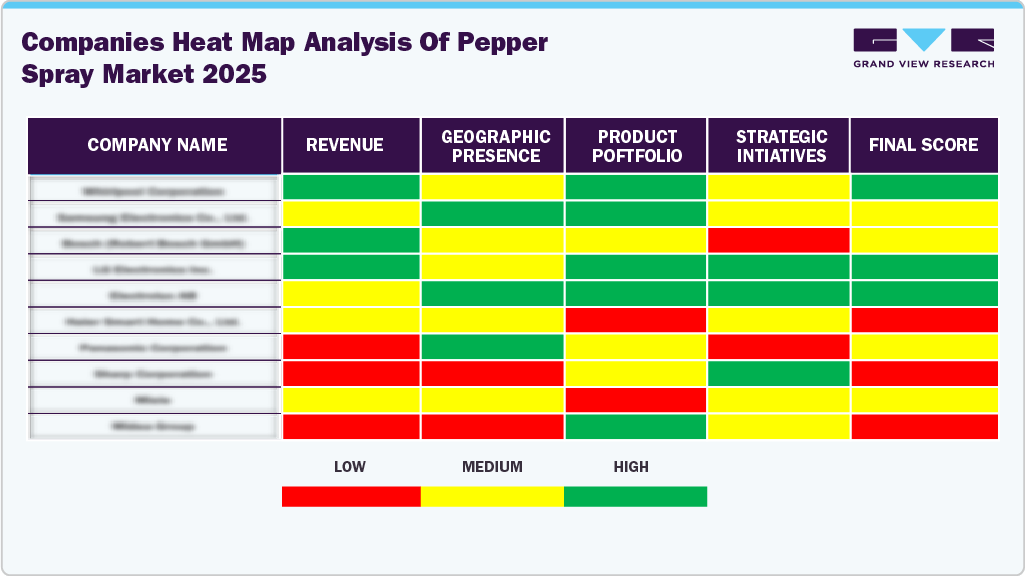
The global pepper spray market is moderately fragmented, with competition distributed across established personal-safety brands, specialized manufacturers, mixed-portfolio defense-spray suppliers, and smaller consumer-focused players. The market includes manufacturers that supply qualifying OC/capsaicin-based human-defense pepper sprays to individual consumers and private security users, even when they also serve law enforcement, military, corrections, or other markets.Competition is shaped by brand strength, product breadth, pricing, formulation, portability, and retail and online distribution reach.
-
Established Personal-Safety Brands: SABRE, Mace Security International, Fox Labs International, and POM Industries compete through strong consumer recognition, broad product portfolios, and extensive retail and online availability.
-
Established Multi-Market Manufacturers: Guardian Protective Devices, Zarc International, UDAP Industries, and Aerko International leverage manufacturing capabilities, formulation expertise, and experience serving multiple customer segments. Only qualifying human-defense OC/capsaicin products are included in the assessed market.
-
Consumer-Focused & Niche Players: Plegium, Guard Dog Security, Streetwise Security Products, and J&L Self Defense Products target specific consumer use cases through compact products, distinctive designs, and focused online or specialty distribution.
 To learn more about this report, Download Free Sample Report
 Key Pepper Spray Companies
The following key companies have been profiled for this study on the pepper spray market.
-
SABRE (Security Equipment Corporation)
-
Mace Security International
-
Fox Labs International
-
POM Industries
-
Plegium
-
Guard Dog Security
-
Streetwise Security Products (Cutting Edge Products)
-
Guardian Protective Devices
-
Zarc International
-
J&L Self Defense Products
Competitive Benchmarking
Category
Operating Strategies
Competitive Edge
Key Challenges
Established Players (SABRE (Security Equipment Corporation); Mace Security International; Fox Labs International; POM Industries; Guardian Protective Devices; Zarc International)
- Focus on OC/capsaicin-based human-defense pepper sprays across multiple spray patterns and carry formats, supported by established retail, online, distributor, and specialty channels. Emphasis is placed on product reliability, portability, spray control, safety features, and broad availability to individual consumers and private-security users.
- Strong brand recognition, established distribution relationships, broad product portfolios, manufacturing capabilities, formulation expertise, and customer trust.
- Intense competition, price pressure, regulatory variation across markets, product commoditization, and the need to differentiate through spray pattern, format, formulation, usability, and product features.
Emerging / Niche Players (Plegium; Guard Dog Security; Streetwise Security Products; J&L Self Defense Products)
- Focus on compact everyday-carry products, differentiated designs, targeted product formats, and consumer-oriented features, supported primarily by online, specialty, and direct distribution channels. Emphasis is placed on portability, ease of carry, product design, and addressing specific personal-safety use cases.
- Agile product development, focused positioning, differentiated product designs, specialized offerings, and ability to address specific consumer needs and usage occasions.
- Lower brand recognition, narrower distribution reach, smaller operating scale, customer acquisition costs, limited retail presence, and difficulty competing for shelf space and visibility against established brands.
Recent Developments
-
In July 2026, SABRE launched the SABRE Smart Pepper Spray, combining pepper spray with connected GPS functionality and a companion mobile app. The product can share the user's live location and trigger emergency notifications, reflecting the industry's move toward connected personal-safety products.
-
In June 2026, Arcus Hunting and Smith & Wesson launched a new line of personal-defense pepper sprays, including jogger-style, keychain, and belt-clip configurations. The range is designed for everyday personal protection and is being distributed through sporting-goods and online retail channels.
-
In August 2025, SABRE launched the Quick Grip Pepper Spray with Practice Spray, featuring an index-finger loop for faster access and improved grip stability, along with an extended spray duration, UV marking dye, and a water-based practice canister. The launch specifically targeted student and campus personal-safety use.
-
In November 2025, Crotega Safety Solutions expanded its REPULS Defense Spray line with Keychain and Jogger/Hiker models, extending the product from its existing professional-security base toward everyday consumer protection. The products use a non-aerosol, water-based ocular-irritant formulation rather than conventional aerosol pepper spray.
Pepper Spray Market Report Scope
Report Attribute
Details
Market size in 2025
USD 103.5 million
Estimated market size in 2026
USD 108.1 million
Projected market size by 2033
USD 144.6 million
Growth rate
CAGR of 4.2% from 2026 to 2033
Base year
2025
Actuals
2021 - 2024
Forecast period
2026 - 2033
Quantitative units
Revenue in USD million and CAGR from 2026 to 2033
Report coverage
Revenue forecast, company ranking, competitive landscape, growth factors, and trends
Segments covered
Product, product format, end user, distribution channel, region
Regional scope
North America; Europe; Asia Pacific; Central & South America; Middle East & Africa
Country scope
U.S.; Mexico; Germany; France; Italy; Spain; Japan; India; South Korea; Australia; Argentina; South Africa
Key companies profiled
SABRE (Security Equipment Corporation); Mace Security International; Fox Labs International; POM Industries; Plegium; Guard Dog Security; Streetwise Security Products (Cutting Edge Products); Guardian Protective Devices; Zarc International; J&L Self Defense Product
Customization scope
Free report customization (equivalent up to 8 analysts’ working days) with purchase. Addition or alteration to country, regional & segment scope.
Pricing and purchase options
Avail customized purchase options to meet your exact research needs. Explore purchase options
Global Pepper Spray Market Report Segmentation
This report forecasts revenue growth at the global, regional & country levels and provides an analysis of the latest trends and opportunities in each sub-segment from 2021 to 2033. For this study, Grand View Research has segmented the global pepper spray market report by product, product format, end user, distribution channel, and region.
-
Product Outlook (Revenue, USD Million, 2021 - 2033)
-
Stream
-
Cone / Forced Cone
-
Fog / Mist
-
Foam
-
Gel
-
-
Product Format Outlook (Revenue, USD Million, 2021 - 2033)
-
Keychain / Pocket
-
Compact Handheld
-
Standard Handheld
-
Large / Professional
-
-
End User Outlook (Revenue, USD Million, 2021 - 2033)
-
Individual Consumers
-
Private Security
-
-
Distribution Channel Outlook (Revenue, USD Million, 2021 - 2033)
-
Offline
-
Online
-
-
Regional Outlook (Revenue, USD Million, 2021 - 2033)
-
North America
-
U.S.
-
Mexico
-
-
Europe
-
Germany
-
France
-
Italy
-
Spain
-
-
Asia Pacific
-
Japan
-
India
-
South Korea
-
Australia
-
-
Central & South America
-
Argentina
-
-
Middle East & Africa
-
South Africa
-
-
Research Methodology
The pepper spray market figures in this report are based on a proven research process that combines executive interviews with secondary research from proprietary databases, company filings, and recognized regulatory and institutional sources. Market size is built through value-chain sizing-reconciling supply-side and demand-side estimates-and triangulated with bottom-up and top-down approaches. Every estimate passes multiple levels of expert validation before publication, with each pepper spray segment quantified using the revenue-capture definitions in the table below.
Segment Definition
Segment - PRODUCT
Revenue capture definition
Stream
Revenue from OC/capsaicin-based pepper sprays that discharge the formulation in a narrow, directed stream designed for targeted human-to-human self-defense. Includes consumer and private-security products sold in aerosol/canister formats through offline, online, and direct channels.
Excludes non-OC sprays, animal-defense sprays, and products intended primarily for law enforcement, military, corrections, or other excluded institutional applications.Cone / Forced Cone
Revenue from OC/capsaicin-based pepper sprays that discharge the formulation in a broader cone-shaped pattern, including forced-cone designs engineered to provide wider coverage while remaining suitable for human-to-human self-defense. Includes civilian and private-security products.
Excludes animal-defense sprays, non-OC formulations, and products whose intended market is law enforcement, military, corrections, or other excluded institutional users.Fog / Mist
Revenue from OC/capsaicin-based pepper sprays that disperse the formulation as a fine aerosol, fog, or mist, creating a relatively broad area of coverage for human-to-human self-defense. Includes consumer and private-security products across applicable retail, online, and direct channels.
Excludes bear spray, dog spray, other animal repellents, non-OC sprays, and excluded government or institutional applications.Foam
Revenue from OC/capsaicin-based pepper sprays that discharge as a foam formulation, depositing the active agent onto the target while reducing airborne dispersion relative to fog/mist products. Includes civilian and private-security human-defense products.
Excludes non-OC foam sprays, animal-defense products, and products intended for law enforcement, military, corrections, or other excluded institutional applications.Gel
Revenue from OC/capsaicin-based pepper sprays that use a gel-based formulation designed to produce a concentrated, adherent stream or pattern upon discharge for human-to-human self-defense. Includes consumer and private-security gel pepper sprays sold through qualifying channels.
Excludes non-OC gels, animal-defense sprays, and products intended primarily for law enforcement, military, corrections, or other excluded institutional applications.Estimation Model
Title
Key Question
Description
Human-Defense Addressable Base Layer
Who forms the addressable user base?
Individuals and private-security personnel who may purchase or carry OC/capsaicin-based pepper spray for human-to-human self-defense, including consumers seeking personal protection and active security personnel requiring defensive spray as part of their duties.
Pepper Spray Demand Layer
Which users actually require or purchase pepper spray?
The addressable base is narrowed to users with a practical need, willingness, and propensity to purchase pepper spray for human-to-human defense, based on personal safety concerns, security requirements, carry behavior, regulatory accessibility, and replacement needs.
Purchase Profile Layer
What type of pepper spray is purchased, by whom, and through which channel?
The purchasing base is allocated across Individual Consumers and Private Security, then segmented by product type, product format, and distribution channel based on purchasing preferences.
Monetisation Layer
How much revenue is generated?
The estimated number of pepper spray units sold is converted into market revenue using average selling price, product-type mix, product-format mix, end-user pricing, channel-specific pricing, and replacement/purchase-frequency assumptions.
Delivered Customizations
This report has been delivered with the following In-depth customizations
CLIENT REQUEST
CUSTOMIZATION DELIVERED
VALUE ADDS
Product × Format × End User Demand Mapping
Developed a cross-segment demand model mapping product against product format and end user, quantifying the demand profile of relevant product configurations across Individual Consumers and Private Security.
Identified high-value product configurations and emerging demand pockets, supporting SKU prioritization, portfolio expansion, and product-market fit decisions.
Regulatory Accessibility & Market Entry Assessment
Mapped country-level requirements covering possession, purchase, sale, formulation, canister size, labeling, and distribution, and assessed their impact on the commercial accessibility of pepper spray products.
Identified markets with stronger addressable demand and lower regulatory barriers, supporting geographic prioritization, compliant product planning, and route-to-market decisions.
Consumer Need × Competitor Offering Gap Analysis
Benchmarked competing products against consumer purchase priorities, including portability, spray control, safety mechanism, ease of carry, capacity, price, and product format, to identify areas where existing offerings fail to fully address user needs.
Revealed specific features and positioning gaps, enabling differentiated product development, sharper value propositions, and targeted competitive positioning.
Frequently Asked Questions About This Report
The global pepper spray market size was valued at USD 103.5 million in 2025 and is estimated at USD 108.1 million for 2026.
The global pepper spray market is expected to grow at a CAGR of 4.2% from 2026 to 2033, reaching USD 144.6 million.
Key factors driving the pepper spray market growth include rising personal-safety concerns, increasing adoption of civilian self-defense products, greater awareness of pepper spray as a non-lethal protection option, and expanding availability through retail and online channels.
North America dominated with a 43.2% revenue share in 2025.
Asia Pacific is the fastest-growing region over the forecast period.
The stream pepper spray led with a 43.4% revenue share in 2025, while gel pepper spray is the fastest-growing segment.
The sale of pepper sprays through offline retail and dealers accounted for a revenue share of 55.6% in 2025 and is the fastest-growing distribution channel.
Standard handheld pepper spray accounted for the largest revenue share in 2025, while keychain/pocket pepper spray is the fastest-growing segment.
Key players include SABRE (Security Equipment Corporation); Mace Security International; Fox Labs International; POM Industries; Plegium; Guard Dog Security; Streetwise Security Products (Cutting Edge Products); Guardian Protective Devices; Zarc International; J&L Self Defense Product
About the Author(s)
Clothing, Footwear & Accessories Research Team
Consumer Goods · Clothing, Footwear & AccessoriesThis report was authored by the clothing, footwear & accessories research team at Grand View Research - comprising two research analysts, one senior research analyst, and one industry expert - with specialized expertise in the clothing, footwear & accessories segment of the consumer goods industry. All findings are based on proprietary consumer goods databases, executive interviews, and regulatory analysis, subject to internal peer review prior to publication.
Last Updated:
Speak to Analyst

Customize this report to your needs - add regions, segments, or data points, with 20% free customization.
Or view our licence options:


ISO 9001:2015 & 27001:2022 Certified
We are GDPR and CCPA compliant! Your transaction & personal information is safe and secure. For more details, please read our privacy policy.


