
- Home
- »
- Disinfectants & Preservatives
- »
-
Peracetic Acid Market Size, Share, Trends Report, 2026-2033GVR Report cover

Peracetic Acid Market (2026 - 2033)
Size, Share & Trends Analysis Report By Grade (<5% Grade, 5%-15% Grade, >15% Grade) By Application (Disinfectant, Sanitizer, Sterilant), By End Use (Food & Beverage, Healthcare), By Region, And Segment Forecasts
Market Size, 2025
$1.2BMarket Estimate, 2026
$1.3BMarket Forecast, 2033
$2.3BCAGR, 2026–2033
8.3%Peracetic Acid Market Summary
The global peracetic acid market size was valued at USD 1.2 billion in 2025 and is projected to grow from USD 1.3 billion in 2026 to USD 2.3 billion by 2033, at a CAGR of 8.3% from 2026 to 2033. The market in Europe dominated with a revenue share of 35.2% in 2025. The growth is driven by increasing demand for high-performance disinfectants and sterilization solutions across healthcare, food processing, and water treatment industries.
 Source: Grand View Research, IR Documents, Primary Interviews, Paid DatabasesTo learn more about this report,
 Download Free Sample Report
 Key Market Trends & Insights
- By grade: >15% grade segment held the largest market share of 57.4% in 2025.
- By application: Disinfectant segment held the largest market share of 43.7% in 2025.
- By end use: Food & beverage segment held the largest market share of 30.7% in 2025.
Regional Highlights
- Largest regional market: Europe (35.2% revenue share, 2025)
- Fastest-growing regional market: Asia Pacific (highest CAGR, 2026-2033)
- By country: Germany held the largest market share in 2025
Market Size & Forecast
- Market size in 2025: USD 1.2 Billion
- Estimated market size in 2026: USD 1.3 Billion
- Projected market size by 2033: USD 2.3 Billion
- CAGR (2026-2033): 8.3%
Three ways to get this report
Buy it, customize it, or ask a question.Ask an Analyst
Analyst response in 1 business day
- AccessReport author, directly
- Reply timeWithin 1 working day
- No sales callDirect answer only
- FormatEmail reply
- CostFree, no cost
Get the Full Report
What the study covers
- FormatsPDF · Excel · Dashboard
- Timeline2026–2033 annual, 2025 base
- Coverage20+ countries, 5 regions
- Companies10+ key players profiled
Customize the Report
20% free customization
- IncludeCountries, segments, points
- TailorTo your product definition
- ExtendDeeper competitor detail
- OrA fully bespoke study
- Turnaround5–10 working days
Rising regulatory emphasis on hygiene standards, coupled with growing adoption of environmentally sustainable and chlorine-free disinfection technologies. The increasing demand for high-performance disinfectants and sterilization solutions across healthcare, food processing, and water treatment industries primarily drives the market growth. Rising awareness regarding hygiene standards, infection control, and food safety regulations has accelerated the adoption due to its broad-spectrum antimicrobial efficacy and environmentally favorable decomposition characteristics. In the healthcare sector, the growing volume of surgical procedures and stringent hospital sanitation protocols continue to support demand for sterilants and disinfectants. The expansion of processed food production and beverage bottling has increased the use of equipment, sanitation, and surface disinfection. Increasing investments in wastewater treatment infrastructure and the shift toward chlorine-free disinfection technologies are further contributing to sustained market growth. To learn more about this report, Download Free Sample Report
 The market presents growth opportunities as the adoption of sustainable, eco-friendly disinfection chemistries rises across industrial and municipal applications. Increasing regulatory pressure to minimize harmful chemical residues and by-products is encouraging end users to transition toward peracetic acid-based formulations, particularly in water treatment and food processing operations. Emerging economies are witnessing rapid industrialization, expanding healthcare infrastructure, and increasing packaged food consumption, creating favorable demand conditions for advanced sanitation solutions. The ongoing technological advancements in stabilized peracetic acid formulations, automated dosing systems, and high-concentration grades are expected to improve operational efficiency and broaden application potential. Growing demand from niche applications such as pharmaceutical manufacturing, agriculture, sanitation, and industrial cleaning is also expected to create new revenue streams.
Market Dynamics
The increasing emphasis on hygiene, infection prevention, and food safety standards is significantly driving demand across healthcare, food & beverage, and water treatment industries. Its strong antimicrobial properties, rapid action, and effectiveness against bacteria, viruses, and spores make it a preferred disinfectant and sterilant. The compound decomposes into environmentally benign by-products, supporting its adoption as a sustainable alternative to chlorine-based chemicals. Growing regulatory compliance requirements and sanitation investments across industrial facilities are further strengthening market expansion.
Despite its growing adoption, there are challenges associated with its highly reactive and corrosive nature. The chemical requires specialized storage, transportation, and handling procedures to ensure operational safety, which increases overall compliance and infrastructure costs for end users. Exposure to concentrated formulations may pose health risks, including skin and respiratory irritation, limiting their usage in certain environments. The relatively lower stability of the compound compared to conventional disinfectants can create logistical and shelf-life constraints for manufacturers and distributors.
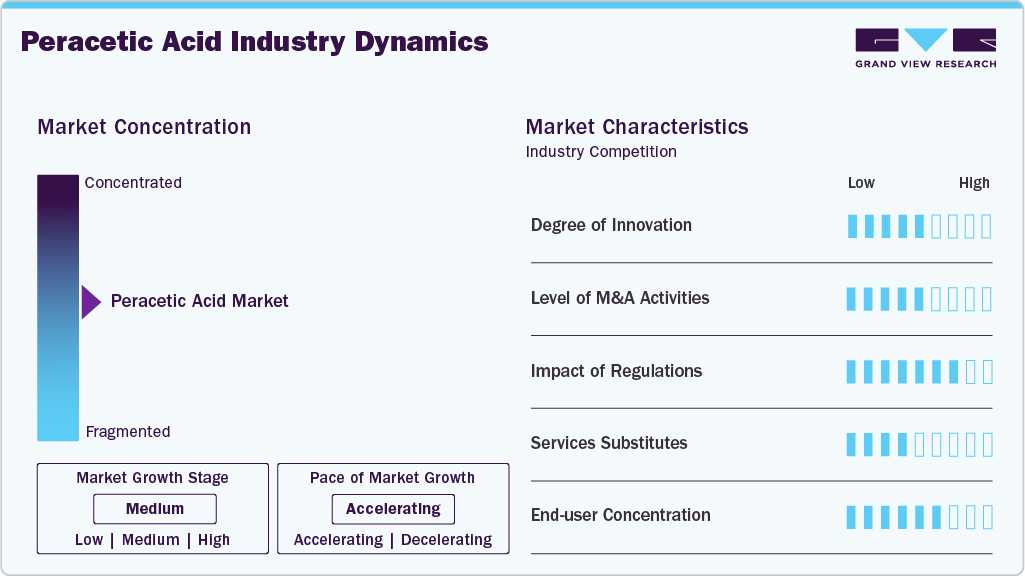
Market Concentration & Characteristics
The peracetic acid industry is characterized by the presence of several global and regional chemical manufacturers competing based on product quality, formulation stability, pricing, distribution capabilities, and application-specific solutions. Leading companies such as Ecolab, Evonik Industries AG, Solvay, and Kemira maintain strong market positions through extensive product portfolios, established customer relationships, and global supply chain networks. Participants are increasingly focusing on strategic partnerships, expanding production capacity, and product innovation to strengthen their competitive advantage and address evolving regulatory requirements in sanitation and environmental sustainability.
 To learn more about this report, Download Free Sample Report
 Companies are also investing in advanced formulations with enhanced stability, higher concentrations, and application-specific performance to meet the growing demand from the healthcare, food processing, and water treatment industries. Regional manufacturers and niche players, including Enviro Tech Chemical Services, Inc. and Hydrite Chemical Co., are competing through customized solutions and strong local distribution networks. The increasing emphasis on eco-friendly disinfection technologies and compliance with stringent hygiene standards is intensifying competition and encouraging continuous technological advancements across the market.
Grade Insights
The >15% grade segment led the market with the largest revenue share of 57.4% in 2025, due to its high effectiveness in industrial-scale disinfection, sterilization, and wastewater treatment applications. These high-concentration formulations are widely utilized across food processing plants, healthcare facilities, and municipal water treatment systems where strong antimicrobial performance and operational efficiency are critical. The segment also benefits from growing demand for concentrated sanitization solutions that reduce transportation and storage costs while improving dosing efficiency. Increasing adoption in large-scale industrial cleaning and biosecurity applications continues to strengthen the dominance of this segment.
The 5%-15% grade segment is expected to grow at the fastest CAGR of 8.8% from 2026 to 2033, due to rising demand for low-concentration disinfectants in applications requiring safer handling and controlled chemical exposure. These formulations are increasingly preferred in healthcare support services, institutional cleaning, and light-duty sanitation operations where lower corrosiveness and ease of application are important. Growth is also supported by expanding usage in packaged food sanitation and surface disinfection applications.
Application Insights
The disinfectant segment led the market with the largest revenue share of 43.7% in 2025, due to the widespread usage in infection control, industrial sanitation, and water treatment applications. Its broad-spectrum antimicrobial properties and rapid action against bacteria, viruses, fungi, and spores make it highly effective across healthcare and food processing environments. The segment is also benefiting from increasing regulatory focus on hygiene compliance and contamination prevention. The shift toward chlorine-free and environmentally sustainable disinfectant technologies continues to support market expansion.
The sanitizer segment is expected to grow at the fastest CAGR of 8.6% during the forecast period, due to increasing hygiene awareness and rising demand for efficient sanitation solutions across commercial and industrial facilities. Sanitizers are gaining traction in food & beverage processing and institutional cleaning applications because of their effectiveness at low concentrations and minimal residue formation. Growing investments in automated sanitation systems and clean-in-place technologies are further supporting segment growth. Stricter food safety regulations and public health standards are accelerating the adoption of advanced sanitization chemistries.
End Use Insights
The food & beverage segment led the market with the largest revenue share of 30.7% in 2025. Because of the extensive usage in equipment sterilization, surface sanitation, and microbial control during food processing operations. The increasing consumption of packaged foods, processed meat products, and bottled beverages has significantly increased the demand for reliable and residue-free disinfecting agents. The compound is widely preferred for its strong antimicrobial activity and environmentally favorable decomposition profile.
 To learn more about this report, Download Free Sample Report
 The healthcare segment is expected to grow at the fastest CAGR of 8.7% from 2026 to 2033, due to increasing demand for high-level disinfectants and sterilization solutions in hospitals, clinics, and surgical centers. Rising concerns about healthcare-associated infections and stricter infection-prevention protocols are accelerating the adoption of peracetic acid for medical instrument sterilization and surface disinfection. The segment is also benefiting from growing healthcare infrastructure investments and increasing surgical procedure volumes globally. The chemical’s effectiveness against resistant microorganisms and spores supports its expanding application in critical healthcare environments.
Regional Insights
The peracetic acid market in North America has a strong demand for high-performance disinfectants and sterilization solutions across healthcare, food processing, and municipal water treatment industries. Increasing regulatory focus on food safety, infection prevention, and wastewater management has accelerated the adoption of peracetic acid-based formulations. The region also benefits from the presence of major market participants investing in advanced sanitation technologies and product innovation.
U.S. Peracetic Acid Market Trends
The peracetic acid market in the U.S. is a major contributor to the North America, due to the large-scale presence of healthcare facilities, packaged food manufacturers, and water treatment infrastructure. The U.S. market is increasingly focused on infection control, food contamination prevention, and sustainable disinfection technologies, which continue to support market expansion. Rising adoption of automated sanitation systems and stringent EPA regulations are driving demand for advanced antimicrobial solutions.
Europe Peracetic Acid Market Trends
Europe dominated the global peracetic acid market with the largest revenue share of 35.2% in 2025, because of stringent environmental regulations, advanced sanitation standards, and strong adoption across healthcare, food processing, and water treatment industries. The region has witnessed significant demand for chlorine-free disinfectants and sustainable oxidation chemicals, particularly in municipal wastewater treatment and industrial hygiene applications. Increasing investments in sustainable manufacturing and circular water management practices continue to support regional market growth.
 To learn more about this report, Download Free Sample Report
 The Germany peracetic acid market accounted for the largest market revenue share in 2025, owing to its well-established chemical manufacturing sector, advanced healthcare infrastructure, and strong food & beverage processing industry. The country has seen increasing adoption of peracetic acid for industrial disinfection, pharmaceutical sterilization, and wastewater treatment. Strict regulatory compliance related to hygiene, occupational safety, and environmental sustainability continues to drive product demand across multiple industrial sectors.
Asia Pacific Peracetic Acid Market Trends
The peracetic acid market in the Asia Pacific is anticipated to grow at the fastest CAGR during the forecast period, due to increasing industrialization, expanding healthcare infrastructure, and rising food processing activities across emerging economies. The Japanese market is raising awareness of hygiene standards, and growing investments in water treatment facilities are driving demand for peracetic acid-based disinfectants and sterilants. The region’s expanding manufacturing sector and rising consumption of packaged foods are also driving sustained market growth.
The China peracetic acid market is a major market in Asia Pacific because of its large industrial base, rapidly growing food & beverage sector, and increasing investments in healthcare and wastewater treatment infrastructure. Government initiatives focused on environmental protection and industrial sanitation are encouraging the use of eco-friendly disinfection chemicals, including peracetic acid. In addition, rising pharmaceutical manufacturing activities and growing public health awareness continue to strengthen domestic demand.
Middle East & Africa Peracetic Acid Market Trends
The peracetic acid market in the Middle East & Africa is experiencing gradual growth, driven by expanding water treatment projects, improved healthcare infrastructure, and rising demand for industrial sanitation solutions. Growing investments in municipal wastewater treatment and food processing industries are supporting the adoption of peracetic acid-based disinfectants. Rising awareness regarding hygiene and public health standards is expected to create additional growth opportunities across the region.
Latin America Peracetic Acid Market Trends
The peracetic acid market in Latin America is experiencing increasing demand driven by the expansion of food & beverage processing, agriculture, and water treatment industries. Countries across the region are increasingly adopting advanced disinfection technologies to improve food safety standards and wastewater management practices. In addition, rising industrial activity and growing focus on sustainable sanitation solutions are expected to support long-term market growth.
Key Peracetic Acid Company Insights
Companies operating in the industry are increasingly focusing on strategic partnerships, capacity expansions, and product innovation to strengthen their competitive positioning and expand their customer base. Participants are investing in advanced formulation technologies, sustainable disinfection solutions, and application-specific products to address evolving regulatory standards and industry requirements. Businesses are enhancing their regional distribution networks and pursuing acquisitions or collaborations to improve market penetration across healthcare, food processing, and water treatment sectors.
-
Solvay is a prominent participant, leveraging its strong expertise in specialty chemicals and sustainable industrial solutions. The company focuses on delivering high-performance oxidizing and disinfection chemistries for applications across healthcare, food processing, water treatment, and industrial sanitation. Its global manufacturing footprint, advanced research capabilities, and emphasis on environmentally responsible products strengthen its competitive position in the market. Solvay’s strategic focus on innovation, operational efficiency, and regulatory compliance enables the company to cater to evolving customer requirements and stringent hygiene standards across multiple industries.
-
Diversey, Inc. is a key provider of hygiene, infection prevention, and cleaning solutions with a strong presence in the industry. The company offers specialized disinfection and sanitization products tailored for the food & beverage, healthcare, hospitality, and institutional sectors. Diversey’s competitive strength lies in its integrated hygiene management solutions, extensive service network, and customer-focused approach. The company continues to expand its presence through product innovation, sustainability-driven initiatives, and advanced sanitation technologies designed to improve operational safety and regulatory compliance for end users.
Key Peracetic Acid Companies
The following key companies have been profiled for this study on the peracetic acid market.
-
Ecolab
-
MITSUBISHI GAS CHEMICAL COMPANY, INC.
-
Evonik Industries AG
-
Solvay
-
Kemira
-
Diversey, Inc.
-
FMC Corporation
-
Enviro Tech Chemical Services, Inc.
-
Aditya Birla Management Corporation Pvt. Ltd.
-
SEITZ GmbH
-
Hydrite Chemical Co.
Competitive Benchmarking
Operating Strategies
Competitive Edge
Weaknesses
Mature Players:Ecolab; MITSUBISHI GAS CHEMICAL COMPANY, INC.; Evonik Industries AG; Solvay; Kemira; Diversey, Inc.; FMC Corporation
- Focus on long-term supply agreements, global distribution expansion, and integrated hygiene solutions across multiple End Use industries.
- Invest heavily in R&D, regulatory compliance, and advanced formulation technologies to strengthen product differentiation and operational efficiency.
- Strong brand recognition, extensive customer networks, and large-scale manufacturing capabilities support consistent market leadership.
- Broad product portfolios and established technical expertise enable them to serve diversified applications with high reliability and quality assurance.
- High operational and compliance costs may reduce flexibility in price-sensitive regional markets.
- Large organizational structures can slow decision-making and limit responsiveness to niche or rapidly changing customer requirements.
Emerging Players: Enviro Tech Chemical Services, Inc.; Aditya Birla Management Corporation Pvt. Ltd.; SEITZ GmbH; Hydrite Chemical Co.
- Emphasize customized formulations, niche application targeting, and regional distribution partnerships to expand market presence.
- Focus on flexible production capabilities and customer-specific service offerings to compete with larger multinational companies.
- Greater operational agility enables faster response to evolving customer demands and localized market trends.
- Competitive pricing strategies and specialized application expertise help strengthen penetration in underserved markets.
- Limited global presence and comparatively smaller production capacities may restrict large-scale contract opportunities.
- Lower investment capabilities in R&D and regulatory certifications can affect technological advancement and long-term competitiveness.
Recent Developments
-
In March 2025, Enviro Tech Chemical Services, Inc. obtained an EPA label amendment for its PeraGuard AH dry peracetic acid formulation, broadening its approved applications for surface disinfection against avian influenza and various animal viruses. This advancement further reinforces the company’s presence in biosecurity and agricultural sanitation markets.
Peracetic Acid Market Report Scope
Report Attribute
Details
Market size in 2025
USD 1.2 billion
Estimated market size in 2026
USD 1.3 billion
Projected market size by 2033
USD 2.3 billion
Growth rate
CAGR of 8.3% from 2026 to 2033
Base year for estimation
2025
Historical data
2021 - 2024
Forecast period
2026 - 2033
Quantitative units
Revenue in USD million/billion, Volume in kilotons, and CAGR from 2026 to 2033
Report coverage
Revenue forecast, volume forecast, company ranking, competitive landscape, growth factors, and trends
Segments covered
Grade, application, end use, region
Regional scope
North America; Europe; Asia Pacific; Middle East & Africa; Latin America
Country scope
U.S.; Canada; Mexico; Germany; UK; France; Italy; Spain; China; India; Japan; South Korea; Brazil; Argentina; South Africa; Saudi Arabia
Key companies profiled
Ecolab; MITSUBISHI GAS CHEMICAL COMPANY; INC.; Evonik Industries AG; Solvay; Kemira; Diversey, Inc.; FMC Corporation; Enviro Tech Chemical Services, Inc.; Aditya Birla Management Corporation Pvt. Ltd.; SEITZ GmbH; Hydrite Chemical Co.
Customization scope
Free report customization (equivalent up to 8 analysts’ working days) with purchase. Addition or alteration to country, regional & segment scope.
Pricing and purchase options
Avail customized purchase options to meet your exact research needs. Explore purchase options
Global Peracetic Acid Market Report Segmentation
This report forecasts volume & revenue growth at global, regional, and country levels and provides an analysis of the latest industry trends in each of the sub-segments from 2021 to 2033. For this study, Grand View Research has segmented the global peracetic acid market report based on grade, application, end use and region:
 To learn more about this report, Download Free Sample Report
 -
Grade Outlook (Volume, Kilotons; Revenue, USD Billion, 2021 - 2033)
-
<5% Grade
-
5%-15% Grade
-
>15% Grade
-
-
Application Outlook (Volume, Kilotons; Revenue, USD Billion, 2021 - 2033)
-
Disinfectant
-
Sanitizer
-
Sterilant
-
Other Applications
-
-
End Use Outlook (Volume, Kilotons; Revenue, USD Billion, 2021 - 2033)
-
Food & Beverage
-
Bottling & Beverage
-
Fresh Produce
-
Meats, Poultry & Seafood
-
-
Healthcare
-
Medical
-
Surgical
-
Dental
-
-
Pulp & Paper
-
Bleaching
-
Others
-
-
Water Treatment
-
Tertiary Disinfectant
-
CSO Disinfectant
-
Blend Disinfectant
-
Others
-
-
Other End Uses
-
-
Regional Outlook (Volume, Kilotons; Revenue, USD Billion, 2021 - 2033)
-
North America
-
U.S.
-
Canada
-
Mexico
-
-
Europe
-
Germany
-
UK
-
France
-
Italy
-
Spain
-
-
Asia Pacific
-
China
-
India
-
Japan
-
South Korea
-
-
Latin America
-
Brazil
-
Argentina
-
-
Middle East & Africa
-
Saudi Arabia
-
South Africa
-
-
Delivered Customizations
This report has been delivered with the following In-depth customizations
Client Request
Customization Delivered
Value Adds
Pricing Analysis
Evaluation of pricing trends considering hydrogen peroxide and acetic acid feedstock movements, concentration grade differentials, packaging and transportation requirements, regulatory compliance costs, and demand fluctuations across healthcare and food processing sectors. Includes analysis of pricing variations between industrial-grade and high-purity formulations.
Improve understanding of cost drivers and market pricing behavior. Support procurement decisions, contract negotiations, and forecasting of profitability and margin risks.
Opportunity Assessment
Identification of emerging growth avenues associated with high-level disinfectants, automated dosing systems, sustainable water treatment chemistries, pharmaceutical sanitation, biosecurity applications, and advanced food processing disinfection systems. The analysis further evaluates opportunity attractiveness by application, concentration grade, and end-use industry.
Help prioritize high-growth application segments and uncover new revenue streams beyond traditional disinfection markets. Support portfolio expansion and targeted commercialization strategies.
Cross-segmentation
Detailed cross-analysis of concentration grade by application and end-use, including >15%, 5–15%, and specialty formulations across disinfectants, sanitizers, sterilants, food & beverages, healthcare, water treatment, and pulp & paper industries. The study evaluates demand concentration and commercial attractiveness across grade-application combinations.
Reveal the most commercially attractive grade-end-use combinations and support product portfolio optimization and market prioritization initiatives.
Frequently Asked Questions About This Report
The global peracetic acid market size was valued at USD 1.2 billion in 2025 and is estimated at USD 1.3 billion for 2026.
The global peracetic acid market is expected to grow at a CAGR of 8.3% from 2026 to 2033, reaching USD 2.3 billion by 2033.
The increasing global emphasis on hygiene, sanitation, and infection prevention across healthcare, food processing, and water treatment industries primarily drives the peracetic acid market. Rising regulatory requirements related to food safety and hospital sterilization are accelerating the adoption of high-performance disinfectants and antimicrobial agents.
The >15% grade segment led with a 57.4% revenue share in 2025, while the 5%-15% grade segment is the fastest-growing.
The disinfectant segment led with a 43.7% revenue share in 2025, while the sanitizer segment is the fastest-growing.
The food & beverage segment led with a 30.7% revenue share in 2025, while the healthcare segment is the fastest-growing.
Europe dominated with a 35.2% revenue share in 2025.
Asia Pacific is the fastest-growing region over the forecast period.
Key players include Ecolab; MITSUBISHI GAS CHEMICAL COMPANY; INC.; Evonik Industries AG; Solvay; Kemira; Diversey, Inc.; FMC Corporation; Enviro Tech Chemical Services, Inc.; Aditya Birla Management Corporation Pvt. Ltd.; SEITZ GmbH; Hydrite Chemical Co.
About the Author(s)
Disinfectants & Preservatives Research Team
Bulk Chemicals · Disinfectants & PreservativesThis report was authored by the disinfectants & preservatives research team at Grand View Research - comprising two research analysts, one senior research analyst, and one industry expert - with specialized expertise in the disinfectants & preservatives segment of the bulk chemicals industry. All findings are based on proprietary bulk chemicals databases, executive interviews, and regulatory analysis, subject to internal peer review prior to publication.
Last Updated:
Speak to Analyst

Customize this report to your needs - add regions, segments, or data points, with 20% free customization.
Or view our licence options:


ISO 9001:2015 & 27001:2022 Certified
We are GDPR and CCPA compliant! Your transaction & personal information is safe and secure. For more details, please read our privacy policy.


