
- Home
- »
- Medical Devices
- »
-
Pharmaceutical Dissolution Testing Services Market Report, 2033GVR Report cover

Pharmaceutical Dissolution Testing Services Market (2026 - 2033)
Size, Share & Trends Analysis Report By Method (In Vitro, In Vivo), By Dosage Form (Capsules, Tablets), By Dissolution Apparatus (Basket, Paddle), By Region, And Segment Forecasts
Market Size, 2025
$485.8MMarket Estimate, 2026
$525.5MMarket Forecast, 2033
$966.3MCAGR, 2026–2033
9.1%Pharmaceutical Dissolution Testing Services Market Summary
The global pharmaceutical dissolution testing services market size was valued at USD 485.8 million in 2025 and is projected to grow from USD 525.5 million in 2026 to USD 966.3 million by 2033, at a CAGR of 9.1% from 2026 to 2033. The market in North America dominated with a revenue share of 55.8% in 2025. Rising demand for generic drugs and bioequivalence studies, constant regulatory emphasis on consistent drug release profiles and quality control, and growing outsourcing activities are driving the growth of the market.
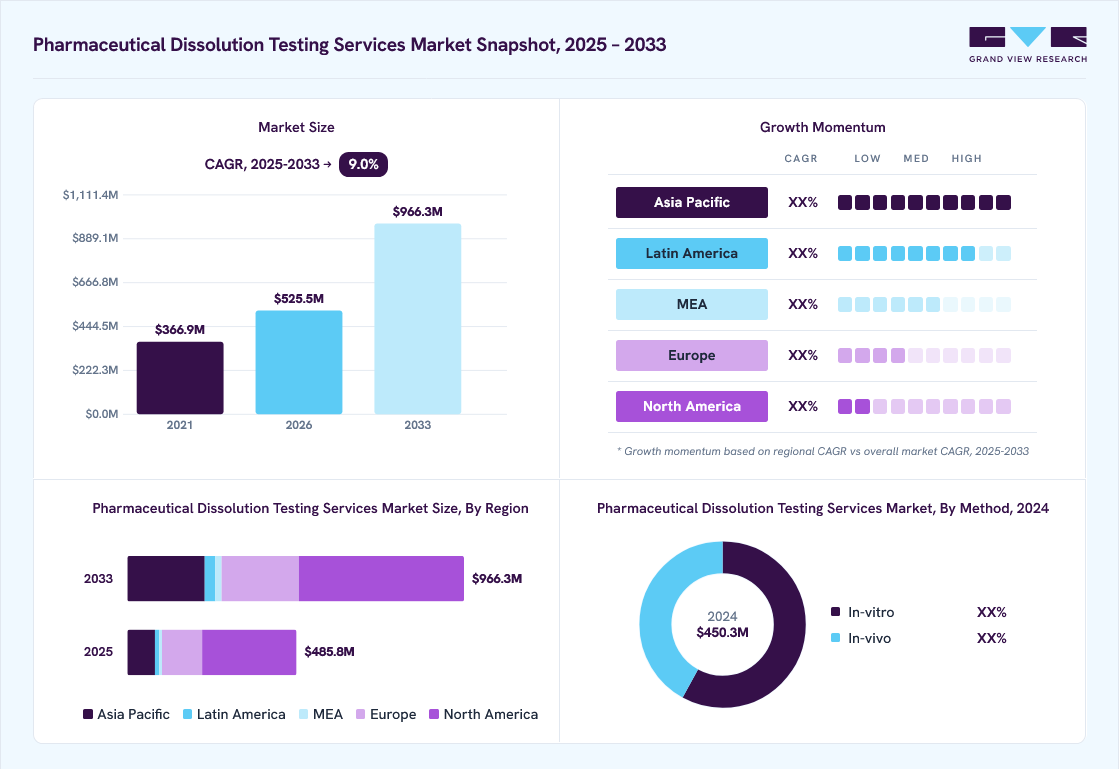 Source: Grand View Research, IR Documents, Primary Interviews, Paid DatabasesTo learn more about this report,
 Download Free Sample Report
 Key Market Trends & Insights
- By method: In-vitro segment held the largest market share of 58.0% in 2025.
- By dosage form: Tablets segment held the largest market share of 65.4% in 2025.
- By dissolution apparatus: Paddle segment held the largest market share of 70.7% in 2025.
Regional Highlights
- Largest regional market: North America (55.8% revenue share, 2025)
- Fastest-growing regional market: Asia Pacific (highest CAGR, 2026-2033)
- By country: The U.S. held the largest market share in 2025
Market Size & Forecast
- Market size in 2025: USD 485.8 Million
- Estimated market size in 2026: USD 525.5 Million
- Projected market size by 2033: USD 966.3 Million
- CAGR (2026-2033): 9.1%
Three ways to get this report
Buy it, customize it, or ask a question.Ask an Analyst
A direct answer, usually in 1 working day
- AccessReport author, directly
- Reply timeWithin 1 working day
- No sales callDirect answer only
- FormatEmail reply
- CostFree, no cost
Get the Full Report
What the study covers
- FormatsPDF · Excel · Dashboard
- Timeline2026–2033 annual, 2025 base
- Coverage20+ countries, 5 regions
- Companies10+ key players profiled
Customize the Report
20% free customization
- IncludeCountries, segments, points
- TailorTo your product definition
- ExtendDeeper competitor detail
- OrA fully bespoke study
- Turnaround5–10 working days
The market is being driven by the increasing regulatory stringency surrounding drug quality, safety, and bioavailability. Health authorities such as the U.S. FDA, EMA, and CDSCO mandate dissolution testing as a core requirement in the approval process for both branded and generic pharmaceuticals. This has led to a growing need for advanced, reliable, and standardized dissolution testing to ensure consistent drug release profiles. The rising volume of generic drug approvals globally has intensified the demand for comparative dissolution testing in bioequivalence studies, making it essential for companies to outsource these services for faster and cost-effective regulatory compliance. Moreover, the complexity of modern drug formulations, such as sustained-release and poorly soluble drugs, necessitates customized and high-precision testing protocols, prompting pharma firms to rely on specialized contract service providers with technical expertise and instrumentation capabilities. To learn more about this report, Download Free Sample Report
 Furthermore, the rapid expansion of pharmaceutical R&D pipelines, especially in emerging markets, creates heightened demand for dissolution testing across early- and late-phase development. Small and mid-sized pharmaceutical and biotech firms, often operating with limited in-house infrastructure, are increasingly turning to third-party service providers for dissolution testing to accelerate timelines and reduce operational burdens. Furthermore, the rise in personalized medicine and novel drug delivery systems, including nanotechnology and 3D-printed tablets, reshapes dissolution testing needs. Advances in automation, real-time analytics, and integration of dissolution testing with other quality control technologies are streamlining workflows and improving data accuracy, further incentivizing outsourcing.
Market Dynamics
The pharmaceutical dissolution testing services market is evolving as a critical analytical support area within drug development and commercial manufacturing. The demand is supported by the continued expansion of oral solid dosage pipelines, rising formulation optimization activities, and the growing need for reliable product performance assessment across development and post-approval stages. Pharmaceutical sponsors are increasingly outsourcing dissolution testing to specialized laboratories to improve operational efficiency, access validated methods, and manage fluctuating testing volumes without expanding internal infrastructure.
The market growth is attributed to rising use of dissolution testing in lifecycle management, formulation comparison, stability monitoring, and scale-up activities. As drug products become more complex, sponsors require advanced testing capabilities covering multiple dosage forms, apparatus types, media conditions, and method transfer requirements. This is increasing the value of service providers that can offer integrated analytical support with strong documentation, technical interpretation, and regulatory alignment.
Thus, the market outlook remains positive, with growth concentrated around high-volume tablet and capsule testing, complex release profiles, generic drug development, and global submission support. Service providers with automation, compliance strength, flexible capacity, and formulation-specific expertise are expected to capture stronger commercial opportunities.
Increasing R&D activities are supporting growth in the pharmaceutical dissolution testing services market, as drug developers require reliable analytical testing across formulation development, product optimization, stability assessment, and regulatory submission stages. Rising investment in generic drugs, complex oral solid dosage forms, modified-release products, and poorly soluble compounds is increasing the need for dissolution method development, validation, and comparative release profiling. As pharmaceutical pipelines expand, sponsors are outsourcing dissolution testing to specialized laboratories to manage testing volumes, reduce internal capacity pressure, and access technical expertise. Dissolution testing also plays an important role in evaluating formulation performance during scale-up, technology transfer, and post-approval changes. This creates recurring demand from pharmaceutical companies, CROs, CDMOs, and research organizations. The increasing focus on data quality, reproducibility, and regulatory-ready documentation further strengthens outsourcing demand. Thus, growing R&D intensity is expanding the role of dissolution testing from routine quality control to a strategic analytical service across drug development and lifecycle management.
A key restraint in the pharmaceutical dissolution testing services market is the technical complexity involved in developing robust, reproducible, and product-specific dissolution methods. Dissolution outcomes can be affected by dosage form characteristics, media selection, apparatus type, agitation speed, sink conditions, drug solubility, excipient behavior, and sampling variability. These challenges are more pronounced for poorly soluble drugs, modified-release formulations, soft gelatin capsules, combination products, and non-oral dosage forms. Any inconsistency in method performance can lead to failed validation, delayed batch release, repeated testing, regulatory queries, and additional development costs. Service providers must also maintain strict compliance with analytical validation expectations, equipment calibration, data integrity, and method transfer requirements, which increases operational complexity. Smaller laboratories may face limitations in advanced apparatus availability, trained analysts, and specialized formulation expertise. As a result, high method-development burden and reproducibility risks can restrain faster outsourcing adoption, particularly for complex formulations requiring customized dissolution approaches.
The opportunity lies in the rising demand for dissolution testing services for complex, poorly soluble, and modified-release pharmaceutical formulations. As drug developers increasingly focus on extended-release tablets, delayed-release capsules, multiparticulate systems, amorphous solid dispersions, lipid-based formulations, and high-potency oral products, standard dissolution approaches are often insufficient. This creates demand for specialized services such as discriminatory method development, biorelevant media testing, IVIVC/IVIVR support, comparative dissolution profiling, and advanced apparatus-based testing. Service providers that can support complex formulation behavior, regulatory-ready validation, and lifecycle testing are well-positioned to capture premium service revenue. The opportunity is further supported by growing generic competition, post-approval formulation changes, and the need to demonstrate product equivalence across global markets. Laboratories with automation, digital data systems, method transfer expertise, and multi-apparatus capabilities can differentiate themselves by offering integrated dissolution testing support from early formulation development to commercial quality control and regulatory submission.
Market Concentration & Characteristics
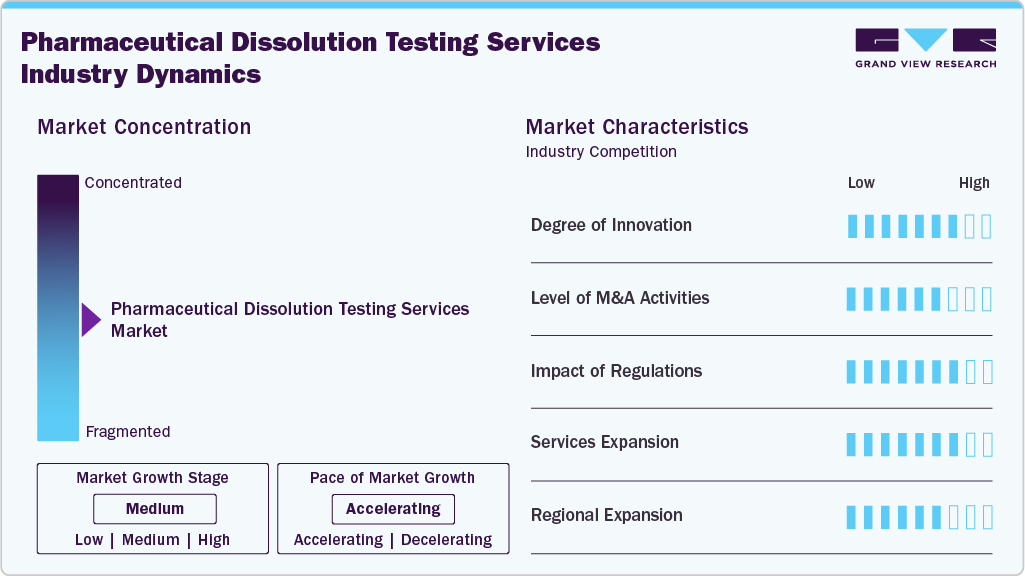
The pharmaceutical dissolution testing services market growth stage is medium, and growth is accelerating. The market is characterized by the degree of innovation, level of M&A activities, regulatory impact, service expansion, and regional expansion.
Innovation in the pharmaceutical dissolution testing services market is increasing with the adoption of automated dissolution systems, advanced sampling technologies, biorelevant media, digital data capture, and improved analytical software. These advancements enhance reproducibility, reduce manual errors, and support faster method development and validation. Service providers are increasingly integrating automation, electronic documentation, and data integrity tools to deliver consistent, regulatory-ready dissolution results across tablets, capsules, modified-release formulations, and complex dosage forms.
M&A activity in the market remains moderate, with larger analytical testing companies, CROs, CDMOs, and life science service providers expanding capabilities through acquisitions, partnerships, and laboratory network integration. These activities help strengthen dissolution testing capacity, broaden analytical service portfolios, and improve access to specialized method development expertise. Consolidation also enables providers to offer integrated support across formulation development, stability testing, bioequivalence studies, quality control, and regulatory submission requirements.
 To learn more about this report, Download Free Sample Report
 Regulations have a strong impact on the pharmaceutical dissolution testing services market, as dissolution data is essential for product quality assessment, batch release, stability evaluation, formulation comparison, and regulatory submissions. Agencies expect validated methods, reproducible results, proper documentation, and strong data integrity practices. This increases demand for compliant laboratories with GMP/GLP capabilities, trained analysts, calibrated apparatus, and regulatory knowledge. Service providers play a critical role in helping sponsors meet global quality and approval requirements.
Service providers are expanding beyond routine dissolution testing to offer method development, method validation, comparative dissolution profiling, IVIVC support, stability study testing, bioequivalence support, method transfer, and regulatory documentation. This broader service model helps sponsors reduce dependency on multiple vendors and improves continuity across development, approval, and commercial manufacturing stages. Integrated offerings are becoming especially important for complex formulations, modified-release products, poorly soluble drugs, and global regulatory submission programs.
Regional expansion is gaining importance as pharmaceutical manufacturing, generic drug development, and outsourced analytical testing increase across North America, Europe, Asia Pacific, Latin America, and MEA. Service providers are strengthening laboratory presence in regulated and emerging markets to support local quality control, faster turnaround, and region-specific regulatory requirements. Expansion into high-growth pharmaceutical hubs helps improve client access, support multinational submissions, and capture rising demand from pharmaceutical companies, CROs, CDMOs, and generic manufacturers.
Impact of U.S. Tariffs on the Global Viral Vaccines CDMO Market
U.S. tariffs can indirectly influence the global pharmaceutical dissolution testing services market by increasing the cost of imported laboratory instruments, dissolution apparatus, analytical equipment, consumables, reagents, spare parts, and automation components. Since dissolution testing laboratories depend on calibrated systems, media preparation tools, sampling accessories, filters, vessels, and validation materials, higher import duties may increase operating costs for service providers. These cost pressures can be passed on to pharmaceutical sponsors through higher service pricing, especially for complex method development, validation, stability, and comparative dissolution studies.
Tariff-related supply chain uncertainty can also extend equipment procurement timelines, delay laboratory expansion, and affect replacement cycles for specialized apparatus. This may encourage service providers to diversify vendor networks, increase inventory buffers, localize sourcing, and strengthen supplier qualification programs. For global sponsors, tariffs may influence outsourcing decisions by making regional testing hubs more attractive when they offer lower cost structures and faster turnaround.
Overall, the tariff impact is expected to be moderate but strategically relevant. Providers with multi-region laboratory networks, strong procurement planning, and flexible pricing models are better positioned to protect margins and maintain service continuity, while smaller laboratories may face higher cost sensitivity and slower capacity expansion.
Analyst Perspective
The pharmaceutical dissolution testing services market is expected to witness steady growth, supported by the rising need for reliable drug release assessment, formulation optimization, and regulatory-compliant quality testing. Dissolution testing remains a critical requirement across drug development, batch release, stability studies, bioequivalence evaluation, and lifecycle management, particularly for oral solid dosage forms and modified-release formulations. The market demand is being shaped by increasing generic drug development, complex formulation pipelines, and stricter expectations for method validation, reproducibility, and data integrity. Outsourcing is gaining traction as sponsors seek specialized analytical expertise, faster turnaround, and cost-efficient testing infrastructure without expanding in-house laboratory capacity. In-vitro dissolution testing is expected to remain central, while advanced apparatus, automation, and IVIVC-related services are improving test relevance and decision-making. Thus, the market outlook remains positive, with growth opportunities linked to complex dosage forms, regulatory submissions, stability programs, and integrated analytical support across pharmaceutical development and commercial manufacturing.
Opportunity Analysis
The pharmaceutical dissolution testing services market is poised for significant growth as drug development becomes more globalized and complex. A major opportunity lies in the increasing demand for dissolution testing in developing regions such as Asia-Pacific, Latin America, and the Middle East, where local regulatory bodies align with global drug quality and bioavailability standards. Multinational pharmaceutical companies expanding into these regions often require local testing partners to meet compliance, which opens opportunities for regional CROs and analytical service providers.
 To learn more about this report, Download Free Sample Report
 Technological Advancements
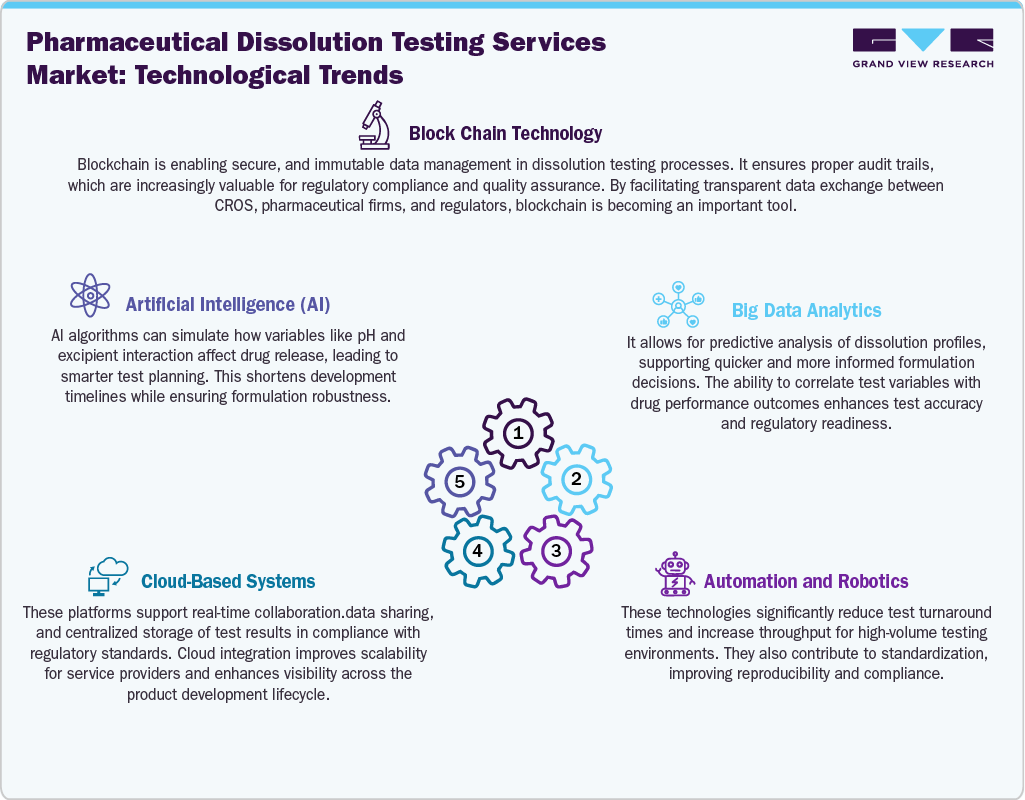
The market is experiencing significant evolution driven by rapid technological advancements that enhance testing accuracy, efficiency, and regulatory compliance. Automated dissolution systems equipped with robotics and integrated data analytics are reducing manual errors and increasing throughput, especially for high-volume generic drug production. Technologies such as UV fiber optic systems allow real-time monitoring without interrupting the dissolution process, aligning with Process Analytical Technology (PAT) principles. In addition, integrating software platforms for 21 CFR Part 11 compliance and cloud-based data management has streamlined regulatory submissions and remote auditing. These innovations not only accelerate formulation development and bioequivalence testing but also expand the service scope of CROs, making advanced dissolution testing more accessible for virtual pharma companies and complex drug developers.
 To learn more about this report, Download Free Sample Report
 Pricing Analysis
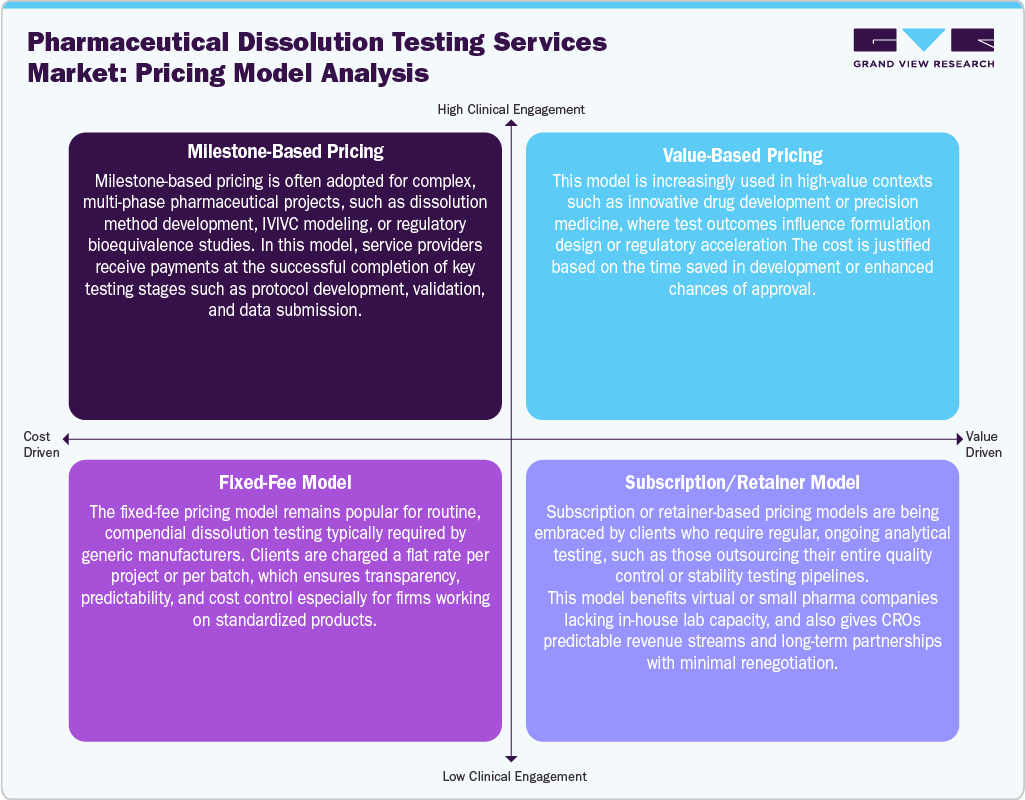
The pricing analysis model for the pharmaceutical dissolution testing services market is primarily structured around test complexity, drug type (immediate vs. controlled release), method validation needs, regulatory requirements, and sample volume. Service providers offer tiered pricing models, with basic in-vitro dissolution tests priced lower than customized, USP-compliant, or IVIVC-based studies. Pricing also depends on whether the service includes method development, stability testing, or bioequivalence support. In addition, bundled pricing for high-throughput screening or long-term contracts is increasingly adopted to attract virtual pharma and generic drug developers. At the same time, premium charges apply for rapid turnaround and 21 CFR Part 11-compliant digital reporting.
 To learn more about this report, Download Free Sample Report
 Method Insights
The market is classified into in vitro and in vivo methods. The in-vitro segment led the market with the largest revenue share of 58.0% in 2025 and is expected to grow at the fastest CAGR over the forecast period. The growth of the segment is due to its cost-effectiveness, regulatory acceptance, and widespread use in early-stage drug development and quality control. In vitro methods are less complex, quicker to execute, and do not require human or animal subjects, making them ideal for high-throughput screening of generic formulations and routine batch testing.
The in-vivo segment is anticipated to grow at a lucrative CAGR during the forecast period. The segment's growth is driven by its crucial role in bridging in vitro data with real-world drug performance. The growing need for IVIVC (in vitro-in vivo correlation) studies, especially for complex formulations like controlled-release and poorly soluble drugs, is fueling this demand. In addition, innovations in pharmacokinetic modeling and increasing regulatory support for biorelevant dissolution assessments are making in vivo testing services more strategic and necessary.
Dosage Form Insights
The tablets segment led the market with the largest revenue share of 65.4% in 2025 and is expected to grow at the fastest CAGR over the forecast period. The tablets segment held the largest market share in 2024, due to the widespread use of solid oral dosage forms in branded and generic pharmaceuticals. Tablets are the most common and cost-effective drug delivery method, and regulatory agencies mandate robust dissolution testing for quality assurance, bioequivalence, and batch consistency. This segment benefits from a high volume of generic product filings and routine quality control testing.
The capsule segment is anticipated to grow at the second fastest CAGR over the forecast period. The segment's growth is due to its increasing application in specialty drugs and modified-release formulations. The rising demand for personalized therapies and innovations in capsule-based multiparticulate systems is pushing the need for more sophisticated and tailored dissolution testing protocols, particularly in bio-relevant media.
Dissolution Apparatus Insights
The paddle segment led the market with the largest revenue share of 70.7% in 2025. The paddle segment held the largest market share in 2024 due to its widespread use and versatility in testing various dosage forms. Its adoption is due to the paddle apparatus's ability to provide consistent and reliable dissolution results, making it a preferred choice among pharmaceutical companies.
 To learn more about this report, Download Free Sample Report
 In addition, the basket segment is anticipated to witness the second fastest CAGR growth during the forecast period. This growth can be attributed to its suitability for testing formulations that tend to float or have low density, which the paddle method may not handle as effectively. Increasing demand for specialized dissolution testing methods to accommodate diverse drug formulations drives the basket segment's expansion, positioning it as a key growth area within the overall dissolution testing services market.
Regional Insights
North America dominated the pharmaceutical dissolution testing services market with the largest revenue share of 55.8% in 2025. This is attributed to its advanced pharmaceutical industry, stringent regulatory environment, and high adoption of technologically advanced testing methods. Increasing R&D investments by pharmaceutical companies and the presence of leading contract research organizations (CROs) further fuel market growth. The U.S. dominates the region with substantial demand driven by a large generic drug market and regulatory requirements set by the FDA to ensure drug quality and efficacy.
 To learn more about this report, Download Free Sample Report
 U.S. Pharmaceutical Dissolution Testing Services Market Trends
The pharmaceutical dissolution testing services market in the U.S. held the largest share in the North America region in 2025. The country’s growth is due to a strong pharmaceutical sector, extensive clinical research activities, and stringent FDA regulations mandating dissolution testing for drug approval. Rising demand for outsourcing testing services and growing focus on generic drug approvals contribute to the robust market growth.
Europe Pharmaceutical Dissolution Testing Services Market Trends
The pharmaceutical dissolution testing services market in Europe is expected to grow significantly due to the well-established pharmaceutical sector and stringent regulations from agencies such as the EMA. Moreover, growth is driven by the need to comply with regulatory standards, increasing generic drug approvals, and rising outsourcing of testing services to specialized labs.
The pharmaceutical dissolution testing services market in Germany held the largest share in 2025, owing to the country’s focus on quality assurance and regulatory compliance, coupled with investment in pharmaceutical innovation, which fuels growth. German CROs are expanding their dissolution testing capabilities to serve domestic and international clients.
The pharmaceutical dissolution testing services market in the UK held the largest share in 2025. The UK market benefits from a strong R&D pharmaceutical base and a growing number of CROs offering dissolution testing. Regulatory compliance with MHRA and EMA guidelines drives demand for dissolution testing services, supporting steady market growth.
Asia Pacific Pharmaceutical Dissolution Testing Services Market Trends
Asia Pacific is expected to be the fastest-growing market due to growing pharmaceutical manufacturing hubs, increasing outsourcing trends, and regulatory harmonization with global standards. Rapid industrialization, an expanding generics market, and cost advantages encourage pharmaceutical companies to outsource dissolution testing services here.
The pharmaceutical dissolution testing services market in China held the largest share in 2025. The growth is due to an increasing domestic pharmaceutical manufacturing, especially in the generic and innovative drug segments, which is fueling demand for robust dissolution testing to ensure drug quality and regulatory compliance. The Chinese regulatory authorities, including the National Medical Products Administration (NMPA), have strengthened their guidelines and enforcement around dissolution testing, aligning more closely with global standards such as those from the USFDA and ICH, which is pushing pharmaceutical companies to adopt advanced testing methods.
The pharmaceutical dissolution testing services market in Japan is expected to grow over the forecast period. The demand for dissolution testing services is driven by the need to comply with the PMDA’s requirements and continuous innovation in drug formulations. Established CROs and testing laboratories support market growth.
The pharmaceutical dissolution testing services market in India is anticipated to grow at a lucrative CAGR over the forecast period. This can be attributed to its status as a major generic drug producer and increasing regulatory alignment with global standards like the USFDA and EMA. The country offers cost-effective testing services, attracting outsourcing from international pharmaceutical companies. Rising R&D investment and government initiatives to improve pharmaceutical quality assurance drive the market.
Key Pharmaceutical Dissolution Testing Services Company Insights
Several key players are acquiring various strategic initiatives to strengthen their market position and offer diverse services to customers. The prominent strategies adopted by companies are service launches, mergers and acquisitions/joint ventures, partnerships and agreements, expansions, and others to increase market presence and revenue and gain a competitive edge, which drives market growth.
Key Pharmaceutical Dissolution Testing Services Companies:
The following key companies have been profiled for this study on the pharmaceutical dissolution testing services market.
-
Intertek Group Plc.
-
Avivia BV
-
Almac Group
-
Agilent Technologies, Inc.
-
Catalent, Inc.
-
Thermo Fisher Scientific Inc.
-
Cambrex
-
Charles River Laboratories
-
Boston Analytical
-
Pace Analytical Life Sciences
-
SOTAX
-
AMRI
-
SGS SA
Competitive Benchmarking
Category
Operating Strategies
Competitive Edge
Weakness
Established Players (Intertek Group Plc.; Almac Group; Agilent Technologies, Inc.)
- Established players focus on expanding GMP-compliant analytical testing networks, strengthening dissolution method development capabilities, and offering integrated services across formulation, stability, bioequivalence, and regulatory testing. They also invest in automation, global laboratory capacity, strategic partnerships, and end-to-end support for pharmaceutical and biopharmaceutical clients.
- Established players benefit from global laboratory infrastructure, strong regulatory expertise, broad customer relationships, and diversified analytical testing portfolios. Their ability to support complex dosage forms, validated methods, high-volume testing, and multi-region regulatory submissions provides a strong advantage in serving large pharmaceutical companies, CDMOs, and generic drug manufacturers.
- Established players may face higher operating costs due to large-scale infrastructure, stringent compliance systems, and multi-site quality management requirements. Their service pricing can be relatively high, and project turnaround may be slower in certain cases due to complex internal processes, capacity constraints, and standardized service workflows.
Emerging Players (Avivia BV; Boston Analytical)
- Emerging players focus on specialized dissolution testing services, flexible client engagement, faster turnaround, and customized analytical support for small and mid-sized pharmaceutical companies. They often compete through niche expertise, personalized service models, cost-effective pricing, and targeted capabilities in method development, validation, stability support, and formulation-focused testing.
- Emerging players offer agility, faster decision-making, customized project handling, and closer client collaboration. Their lean operating structures allow competitive pricing and flexible testing models. They are well-positioned to support early-stage formulation developers, regional pharmaceutical companies, and clients requiring tailored dissolution testing support with responsive technical assistance.
- Emerging players may have limited geographic presence, smaller laboratory capacity, narrower service portfolios, and lower brand recognition compared to global providers. Their ability to support large-volume projects, multi-country regulatory submissions, highly complex dosage forms, and integrated analytical programs may be constrained by scale, infrastructure, and resource availability.
Recent Developments
-
In February 2025, Thermo Fisher Scientific Inc. acquired Solventum's Purification & Filtration business for USD 4.1 billion. The acquisition aims to strengthen the company’s ability to offer integrated, end-to-end drug development solutions, increasing pharmaceutical companies' demand for comprehensive testing and purification services.
-
In October 2022, Agilent Technologies, Inc. announced that it would open its Dissolution Center of Excellence in Craven Arms, UK-a new site that consolidates dissolution R&D, quality control, customer support, and application development under one roof. This strategic move strengthens Agilent’s global footprint, enabling enhanced training, virtual demonstrations, and direct workflows centered on dissolution processes.
Pharmaceutical Dissolution Testing Services Market Report Scope
Report Attribute
Details
Market size in 2025
USD 485.8 million
Estimated market size in 2026
USD 525.5 million
Projected market size by 2033
USD 966.3 million
Growth rate
CAGR of 9.1% from 2026 to 2033
Historical data
2021 - 2025
Forecast period
2026 - 2033
Quantitative units
Revenue in USD million/billion and CAGR from 2026 to 2033
Report coverage
Revenue forecast, company ranking, competitive landscape, growth factors, and trends
Segments covered
Method, dosage form, dissolution apparatus, and region
Regional scope
North America; Europe; Asia Pacific; Latin America; MEA
Country scope
U.S., Canada, Mexico, UK, Germany, France, Italy, Spain, Denmark, Sweden, Norway, Japan, China, India, Thailand, South Korea, Australia, Brazil, Argentina, South Africa, Saudi Arabia, UAE, Kuwait, Oman, Qatar
Key companies profiled
Intertek Group Plc.; Avivia BV; Almac Group; Agilent Technologies, Inc.; Catalent, Inc.; Thermo Fisher Scientific Inc., Cambrex Corp; Charles River Laboratories; Boston Analytical; Pace Analytical Life Sciences; SOTAX; AMRI; SGS SA
Customization scope
Free report customization (equivalent up to 8 analysts' working days) with purchase. Addition or alteration to country, regional & segment scope.
Pricing and purchase options
Avail customized purchase options to meet your exact research needs. Explore purchase options
Global Pharmaceutical Dissolution Testing Services Market Report
This report forecasts revenue growth at the global, regional, and country levels and provides an analysis of the latest industry trends in each of the sub-segments from 2021 to 2033. For this study, Grand View Research has segmented the global pharmaceutical dissolution testing services market report based on method, dosage form, dissolution apparatus, and region.
 To learn more about this report, Download Free Sample Report
 -
Method Outlook (Revenue, USD Million, 2021 - 2033)
-
In-Vitro
-
In-Vivo
-
-
Dosage Form Outlook (Revenue, USD Million, 2021 - 2033)
-
Capsule
-
Tablets
-
Others
-
-
Dissolution Apparatus Outlook (Revenue, USD Million, 2021 - 2033)
-
Basket
-
Paddle
-
Others
-
-
Regional Outlook (Revenue, USD Million, 2021 - 2033)
-
North America
-
U.S.
-
Canada
-
Mexico
-
-
Europe
-
UK
-
Germany
-
France
-
Italy
-
Spain
-
Denmark
-
Norway
-
Sweden
-
-
Asia Pacific
-
Japan
-
China
-
India
-
Australia
-
South Korea
-
Thailand
-
-
Latin America
-
Brazil
-
Argentina
-
-
Middle East and Africa (MEA)
-
South Africa
-
Saudi Arabia
-
UAE
-
Kuwait
-
-
Research Methodology
The pharmaceutical dissolution testing services market figures in this report are based on a proven research process that combines executive interviews with secondary research from proprietary databases, company filings, and recognized regulatory and institutional sources. Market size is built through value-chain sizing - reconciling supply-side and demand-side estimates - and triangulated with bottom-up and top-down approaches. Every estimate passes multiple levels of expert validation before publication, with each pharmaceutical dissolution testing services segment quantified using the revenue-capture definitions in the table below.
Segment Definition
Segment - Method
Definition
In-Vitro
The segment covers revenue generated by providing services for pharmaceutical dissolution testing in-vitro method to end users. The segment includes dissolution profile testing, method development and validation, comparative dissolution studies, bioequivalence support, quality control testing, stability study support, and regulatory submission-related dissolution data generation for tablets, capsules, suspensions, and other dosage forms.
In-Vivo
The segment captures revenue generated by providing services for pharmaceutical dissolution testing in-vivo method to end users. The segment includes in-vivo performance assessment, correlation of dissolution behavior with drug absorption, IVIVC/IVIVR support, pharmacokinetic evaluation support, bioavailability and bioequivalence study assistance, and clinical or preclinical data support for evaluating drug release and absorption behavior in biological systems.
Segment - Dosage Form
Definition
Capsule
The segment covers revenue generated by providing services for pharmaceutical dissolution testing for capsule dosage forms to end users. The segment includes dissolution testing for hard gelatin capsules, soft gelatin capsules, modified-release capsules, enteric-coated capsules, capsule shell performance evaluation, drug release profiling, method development, validation, stability support, and regulatory submission-related testing.
Tablets
The segment captures revenue generated by providing services for pharmaceutical dissolution testing for tablet dosage forms to end users. The segment includes dissolution testing for immediate-release, delayed-release, extended-release, coated, uncoated, orally disintegrating, chewable, and sustained-release tablets, along with dissolution profile comparison, method validation, batch release testing, stability testing, and bioequivalence support.
Others
The segment includes revenue generated by providing services for pharmaceutical dissolution testing for other dosage forms to end users. The segment includes testing for suspensions, powders, granules, implants, transdermal systems, suppositories, multiparticulate systems, films, and specialty formulations, covering drug release evaluation, method development, performance comparison, stability support, and regulatory documentation.
Segment - Dissolution Apparatus
Definition
Basket
The segment covers revenue generated by providing services for pharmaceutical dissolution testing using basket dissolution apparatus to end users. The segment includes USP Apparatus 1-based testing, dissolution profiling for capsules and floating dosage forms, controlled agitation studies, method development, method validation, quality control testing, stability study support, batch release testing, and regulatory documentation.
Paddle
The segment captures revenue generated by providing services for pharmaceutical dissolution testing using paddle dissolution apparatus to end users. The segment includes USP Apparatus 2-based testing, dissolution testing for tablets, capsules, suspensions, and modified-release formulations, drug release profiling, comparative dissolution studies, method transfer, method validation, routine QC testing, and bioequivalence support.
Others
The segment includes revenue generated by providing services for pharmaceutical dissolution testing using other dissolution apparatus to end users. The segment includes testing using reciprocating cylinder, flow-through cell, paddle-over-disk, rotating cylinder, reciprocating holder, and specialized apparatus for transdermal systems, implants, extended-release products, poorly soluble drugs, and complex dosage forms.
Delivered Customizations
This report has been delivered with the following In-depth customizations
Client Request
Customization Delivered
Value Adds
Extensive Cross-Segmentation Analysis
Detailed analysis can be delivered across method, dosage form, dissolution apparatus, and region, such as in-vitro tablet dissolution testing using paddle apparatus or capsule dissolution testing using basket apparatus across key countries.
Enabled to identify high-value service segments, dosage-form-specific demand, preferred apparatus usage, and regional outsourcing opportunities.
Regional Extension & Market Entry Strategy
Country-level assessment can be delivered across North America, Europe, Asia Pacific, Latin America, and MEA, covering pharmaceutical manufacturing activity, regulatory testing demand, lab infrastructure, outsourcing maturity, and pricing feasibility.
Supports regional prioritization, market entry planning, laboratory expansion, partnership decisions, and service positioning.
Competitive Dynamics & Service Benchmarking
Provider benchmarking can be delivered based on service portfolio, GMP/GLP compliance, method development capability, apparatus availability, turnaround time, pricing models, regulatory support, and client base.
Enables identification of competitive gaps, service differentiation opportunities, and positioning strategies for dissolution testing service providers.
Volume, Pricing & Demand Analysis
Test-volume and pricing analysis can be delivered across formulation development, batch release testing, stability studies, bioequivalence support, and regulatory submissions by dosage form, apparatus type, complexity, and region.
Improves market sizing accuracy by linking revenue estimates with test volumes, average pricing, utilization rates, and end-user demand patterns.
Frequently Asked Questions About This Report
The global pharmaceutical dissolution testing services market size was valued at USD 485.8 million in 2025 and is estimated at USD 525.5 million for 2026.
The global pharmaceutical dissolution testing services market is expected to grow at a CAGR of 9.1% from 2026 to 2033, reaching USD 966.3 million by 2033.
The in-vitro segment led with a 58.0% revenue share in 2025, and is the fastest-growing segment.
Some key players operating in the pharmaceutical dissolution testing services market include Intertek Group Plc.; Avivia BV; Almac Group; Agilent Technologies, Inc.; Catalent, Inc.; Thermo Fisher Scientific Inc., Cambrex Corp; Charles River Laboratories; Boston Analytical; Pace Analytical Life Sciences; SOTAX; AMRI; and SGS SA among others.
North America dominated with a 55.8% revenue share in 2025.
Asia Pacific is the fastest-growing region over the forecast period.
The tablets segment led with a 65.4% revenue share in 2025, and is the fastest-growing segment.
The paddle segment led with a 70.7% revenue share in 2025, and is the fastest-growing segment.
Key factors driving growth in the pharmaceutical dissolution testing services market include the rising burden of chronic and infectious diseases and increasing R&D activity.
About the Author(s)
Medical Devices Research Team
Healthcare · Medical DevicesThis report was authored by the medical devices research team at Grand View Research - comprising two research analysts, one senior research analyst, and one industry expert - with specialized expertise in the medical devices segment of the healthcare industry. All findings are based on proprietary healthcare databases, executive interviews, and regulatory analysis, subject to internal peer review prior to publication.
Last Updated:
Speak to Analyst

Customize this report to your needs - add regions, segments, or data points, with 20% free customization.
Or view our licence options:


ISO 9001:2015 & 27001:2022 Certified
We are GDPR and CCPA compliant! Your transaction & personal information is safe and secure. For more details, please read our privacy policy.


