
- Home
- »
- Advanced Interior Materials
- »
-
Pharmaceutical Packaging Equipment Market Report, 2026-2033GVR Report cover

Pharmaceutical Packaging Equipment Market (2026 - 2033)
Size, Share & Trends Analysis Report By Machine Type (Filling, Labelling, Form Fill & Seal, Cartoning, Wrapping, Palletizing, Cleaning), By Region (North America, Europe, APAC), And Segment Forecasts
Market Size, 2025
$7.0BMarket Estimate, 2026
$7.5BMarket Forecast, 2033
$12.7BCAGR, 2026–2033
7.8%Pharmaceutical Packaging Equipment Market Summary
The global pharmaceutical packaging equipment market size was valued at USD 7.0 billion in 2025 and is projected to grow from USD 7.5 billion in 2026 to USD 12.7 billion by 2033, at a CAGR of 7.8% from 2026 to 2033. The market in Asia Pacific dominated with a revenue share of 40.7% in 2025. Rising global health awareness, coupled with the growing prevalence of chronic diseases, is propelling pharmaceutical production, which is, in turn, fueling the need for efficient and compliant packaging equipment.
 Source: Grand View Research, IR Documents, Primary Interviews, Paid DatabasesTo learn more about this report,
 Download Free Sample Report
 Key Market Trends & Insights
- By machine type: Filling segment held the largest market share of 35.7% in 2025.
Regional Highlights
- Largest regional market: Asia Pacific (40.7% revenue share, 2025)
- By country: China held the largest market share in 2025.
Market Size & Forecast
- Market size in 2025: USD 7.0 Billion
- Estimated market size in 2026: USD 7.5 Billion
- Projected market size by 2033: USD 12.7 Billion
- CAGR (2026-2033): 7.8%
Three ways to get this report
Buy it, customize it, or ask a question.Ask an Analyst
Analyst response in 1 business day
- AccessReport author, directly
- Reply timeWithin 1 working day
- No sales callDirect answer only
- FormatEmail reply
- CostFree, no cost
Get the Full Report
What the study covers
- FormatsPDF · Excel · Dashboard
- Timeline2026–2033 annual, 2025 base
- Coverage20+ countries, 5 regions
- Companies10+ key players profiled
Customize the Report
20% free customization
- IncludeCountries, segments, points
- TailorTo your product definition
- ExtendDeeper competitor detail
- OrA fully bespoke study
- Turnaround5–10 working days
The market is further influenced by various driving factors, reflecting the dynamic landscape of the pharmaceutical industry. Furthermore, the growing demand for a diverse range of pharmaceutical products, driven by factors such as an aging population, increasing healthcare needs, and advancements in medical research, necessitates efficient and advanced packaging solutions.Moreover, the pharmaceutical industry is subject to strict regulations imposed by agencies such as the Food and Drug Administration (FDA). Compliance with these regulations is essential to ensure the safety, efficacy, and quality of pharmaceutical products. As a result, pharmaceutical companies invest in packaging equipment that meets the stringent standards set by regulatory authorities, such as tamper-evident packaging and serialization requirements.
 To learn more about this report, Download Free Sample Report
 Pharmaceutical production in Europe increased significantly from USD 137,704 million in 2000 to USD 421,200 million in 2023, representing an impressive rise of approximately 205%. This surge in production can be attributed to factors such as rising global health demands, increased prevalence of chronic diseases, and a heightened focus on healthcare innovation. As pharmaceutical companies expand their operations to meet this growing demand, the need for efficient and scalable manufacturing processes becomes critical.
As the pharmaceutical industry expands, the demand for advanced packaging equipment will likely surge. Manufacturers will need packaging solutions that can accommodate increased production volumes while ensuring quality and compliance with regulatory requirements. Furthermore, the focus on sustainability will drive innovation in packaging materials and processes, creating opportunities for equipment suppliers to meet these evolving needs.
Market Dynamics
The pharmaceutical packaging equipment market is influenced by a combination of regulatory, technological, operational, and industry-specific factors. Stringent pharmaceutical regulations and Good Manufacturing Practice (GMP) requirements drive demand for advanced equipment capable of ensuring product safety, traceability, and compliance with serialization and anti-counterfeiting standards. Growth in pharmaceutical production, including biologics, vaccines, and personalized medicines, increases the need for flexible and high-precision packaging systems. Demand for sustainable packaging solutions is encouraging equipment manufacturers to develop systems compatible with recyclable and eco-friendly materials.
Stringent pharmaceutical packaging regulations are a major driver for the pharmaceutical packaging equipment market. Regulatory authorities worldwide require pharmaceutical manufacturers to implement serialization, track-and-trace systems, tamper-evident packaging, and comprehensive labeling practices to enhance product safety and combat counterfeit drugs. Compliance with frameworks such as the Drug Supply Chain Security Act (DSCSA) in the U.S. and the Falsified Medicines Directive (FMD) in Europe create a stable environment for investments in advanced packaging equipment capable of coding, inspection, aggregation, and data management. As regulatory requirements continue to evolve, pharmaceutical companies are increasingly upgrading packaging lines to ensure compliance, traceability, and supply chain transparency.
High capital investment requirements remain a significant restraint for the pharmaceutical packaging equipment market. Advanced packaging systems incorporating automation, robotics, vision inspection technologies, and serialization capabilities require substantial upfront expenditures for equipment procurement, installation, validation, and facility modifications. In addition, pharmaceutical manufacturers must incur costs related to regulatory qualification, workforce training, and ongoing maintenance. These financial barriers are particularly challenging for small and medium-sized manufacturers, often delaying modernization initiatives and limiting the adoption of technologically advanced packaging solutions.
The growing investment in biologics, cell and gene therapies, and specialty pharmaceuticals presents a significant opportunity for pharmaceutical packaging equipment manufacturers. These products often require highly specialized packaging processes, including aseptic filling, sterile containment, precise dosing, and temperature-controlled packaging to maintain product integrity and efficacy. As pharmaceutical companies expand production capacities for advanced therapies, demand is increasing for sophisticated packaging equipment capable of handling sensitive, high-value products while meeting stringent regulatory and quality requirements. This trend is encouraging the development of innovative packaging technologies tailored to the unique needs of next-generation therapeutics.
Market Concentration & Characteristics
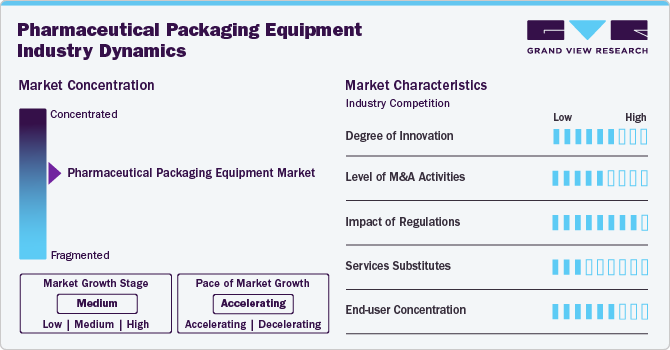
The market growth stage is medium, and the pace of the market growth is accelerating. The market is characterized by a high degree of innovation owing to the rapid technological advancements. Moreover, the companies are further adopting various organic and inorganic growth strategies, such as mergers & acquisitions and collaborations, to strengthen their position in the global market.
The market is also characterized by a high level of merger & acquisition activity by the leading players. Players adopt this strategy to increase the reach of their products in the market and enhance the availability of their products & services in diverse geographical areas. Further, the market for pharmaceutical packaging equipment is also subject to increasing regulatory scrutiny. Regulations governing the market are crucial to ensuring the safety, efficacy, and quality of pharmaceutical products. Various regulatory bodies around the world establish guidelines and standards that manufacturers must adhere to.
 To learn more about this report, Download Free Sample Report
 For instance, In the U.S., the FDA plays a central role in regulating pharmaceuticals and their packaging. Manufacturers of pharmaceutical packaging equipment must comply with FDA regulations, including those related to Current Good Manufacturing Practice (cGMP) for finished pharmaceuticals. The FDA also provides guidance on specific aspects of packaging, such as tamper-evident packaging and barcoding. Moreover, in Europe, the EMA issues guidelines to ensure the quality and safety of medicines. These guidelines cover various aspects of pharmaceutical manufacturing, including packaging. Manufacturers must adhere to EMA guidelines to obtain and maintain marketing authorization for their products.
The pharmaceutical industry has been adopting advanced automation and robotics in packaging processes to improve efficiency, reduce errors, and enhance overall productivity. Automated packaging lines can handle tasks such as filling, labeling, and packaging with precision, contributing to higher throughput. Moreover, the integration of smart packaging technologies has been on the rise. This includes the use of RFID (Radio-Frequency Identification), QR codes, and sensors to enable real-time monitoring of pharmaceutical products throughout the supply chain. Smart packaging enhances traceability and helps in maintaining product quality.
Analyst Perspective
The global pharmaceutical packaging equipment market is undergoing a structural shift driven by the divergent requirements of high-value specialty therapeutics and large-volume generic drug manufacturing. Demand from biologics, GLP-1 therapies, vaccines, and other injectable products is accelerating investment in flexible, aseptic, and highly automated primary packaging systems, including vial, cartridge, and prefilled syringe packaging lines. At the same time, continued expansion of generic pharmaceutical production, particularly across Asia-Pacific and other cost-competitive manufacturing hubs, is sustaining demand for high-throughput packaging equipment optimized for oral solid dosage forms such as blister packs and bottles. Regulatory compliance has evolved from a supporting requirement into a major capital investment driver, with serialization mandates, track-and-trace requirements, data integrity standards, and increasingly stringent aseptic manufacturing expectations encouraging pharmaceutical manufacturers to modernize packaging operations.
Machine Type Insights
Based on machine type, the filling segment led the market with the largest revenue share of 35.7% in 2025. Filling machines in the pharmaceutical industry play a pivotal role in ensuring the precise and sterile dispensing of pharmaceutical products into various containers such as vials, bottles, and syringes. Moreover, advanced filling machines employ state-of-the-art technologies, including peristaltic pumps or volumetric fillers, to handle a diverse range of liquid or powder medications. Additionally, these machines often feature automated controls and monitoring systems to enhance efficiency, reduce human error, and ensure compliance with pharmaceutical quality standards. The flexibility of modern filling machines allows pharmaceutical companies to accommodate various container sizes and formulations, contributing to streamlined production processes and the delivery of high-quality, precisely dosed medications to meet the dynamic demands of the pharmaceutical industry.
Wrapping machines are integral to the pharmaceutical industry, serving the crucial function of securely packaging pharmaceutical products for protection and preservation. These machines are designed to handle a variety of packaging materials, including blister packs, strip packs, and sachets. Employing advanced technology, pharmaceutical wrapping machines ensure the aseptic and tamper-evident sealing of medicines, maintaining their integrity and compliance with regulatory standards. With capabilities for high-speed and precision, these machines contribute to the efficient packaging of pharmaceuticals in standardized formats, enabling convenient distribution and use.
Regional Insights
The pharmaceutical packaging equipment market in North America accounted for a market share of 21.4% in 2025. The North America pharmaceutical packaging equipment market is significantly driven by the increasing demand for advanced packaging equipment that ensure drug safety and efficacy. As the pharmaceutical sector continues to evolve, there's a growing need for packaging methods that comply with stringent regulatory requirements. Innovations such as smart packaging, which includes temperature control and tamper-evident features, are becoming essential in preserving product integrity and enhancing patient safety.
 To learn more about this report, Download Free Sample Report
 U.S. Pharmaceutical Packaging Equipment Market Trends
The pharmaceutical packaging equipment market in the U.S. held a significant share in 2025. The U.S. pharmaceutical packaging equipment market is experiencing robust growth, fueled by the increasing demand for efficient and automated packaging solutions to meet stringent regulatory standards. Innovations in technology, such as serialization and smart packaging, are driving advancements in equipment capabilities, enhancing safety and traceability. Additionally, the rising prevalence of chronic diseases and the corresponding need for pharmaceutical products are contributing to the expansion of packaging operations.
The pharmaceutical packaging equipment market in the Canada is expected to grow at a CAGR of 4.3% over the forecast period. This continuous rise in health expenditures directly correlates with the growing demand for pharmaceutical products and, subsequently, for pharmaceutical packaging equipment in Canada. As the healthcare system expands, the need for efficient, compliant, and innovative packaging solutions becomes increasingly critical.
The pharmaceutical packaging equipment market in the Mexico is expected to grow at a CAGR of 6.8% over the forecast period. According to the International Trade Administration, pharmaceutical sales in Mexico from 2020 to 2023 indicates some fluctuations over the years. In 2020, sales reached USD 11.10 billion, which slightly decreased to USD 11.00 billion in 2021. This decline might reflect challenges faced during the pandemic, including supply chain disruptions. However, in 2022, sales dropped significantly to USD 10.12 billion, suggesting a notable setback for the sector. Moreover, the market rebounded in 2023, with sales rising to USD 10.83 billion, indicating a recovery trend and renewed demand for pharmaceutical products, thereby driving the demand for market.
Europe Pharmaceutical Packaging Equipment Market Trends
The European pharmaceutical packaging equipment market is experiencing robust growth driven by several key factors, including stringent regulatory requirements and a rising emphasis on patient safety. The implementation of regulations such as the Current Good Manufacturing Practice (CGMP) and EU Falsified Medicines Directive (FMD) has mandated enhanced packaging solutions, including serialization and tamper-evident features. This regulatory model not only ensures the integrity of pharmaceuticals but also fosters innovation among manufacturers who are investing in advanced packaging technologies.
Germany pharmaceutical packaging equipment market held 11.9% share in the European market. As Germany continues to be a leading exporter and producer of medicinal products and biopharmaceuticals, manufacturers require advanced packaging solutions to ensure compliance with stringent EU regulations and maintain product integrity. The emphasis on personalized medicine further necessitates specialized packaging that can accommodate diverse formulations and smaller batch sizes.
UK pharmaceutical packaging equipment market held 9.0% share in the European market. According to the Association of the British Pharmaceutical Industry, the UK is regarded as a life sciences powerhouse that is driven by the solid scientific foundation, a growing attitude towards foreign pharmaceutical investments, a skilled manufacturing workforce, and a strong emphasis on safeguarding innovation through intellectual property rights. The UK's regulatory bodies are also considered among the most experienced and sophisticated worldwide.
Asia Pacific Pharmaceutical Packaging Equipment Market Trends
Asia Pacific dominated the pharmaceutical packaging equipment market with the largest revenue share of 40.7% in 2025. The region has seen a significant rise in pharmaceutical production, fueled by population growth, increasing healthcare demands, and higher investments in the pharmaceutical industry. Countries such as Japan, Australia, and Singapore have traditionally aligned well with global industry standards, while others are progressing in that direction. As a result, there is a growing need for advanced and efficient packaging equipment to accommodate the rising production levels.
The pharmaceutical packaging equipment market in China held the largest share in the Asia Pacific region in 2025. The demand for pharmaceutical packaging equipment in China is driven by several key factors such as the rapid growth of the pharmaceutical industry. This is fueled by increasing investment in healthcare and a rising prevalence of chronic diseases, which has created a need for efficient packaging solutions.
India pharmaceutical packaging equipment market held 18.5% share in the Asia Pacific market. The demand for pharmaceutical packaging equipment in India is driven by several specific factors related to the country's unique landscape. The expansion of the pharmaceutical sector, supported by government initiatives like the Pharma Vision 2020, aims to make India a global manufacturing hub and a leader in end-to-end drug innovation and discovery. This growth necessitates advanced packaging solutions to ensure product integrity and compliance with international standards.
Central & South Pharmaceutical Packaging Equipment Market Trends
The pharmaceutical packaging equipment market in Central & South America is experiencing significant growth, fueled by increasing healthcare investments and a rising demand for pharmaceuticals across the region. The pharmaceutical market in Central & South America is driven by factors such as a growing middle class, improved access to healthcare, and heightened awareness of health issues.
Brazil is one of the dominant markets for pharmaceutical packaging in Central & South America owing to the presence of big pharmaceutical manufacturing companies and a large population base. Leading pharmaceutical manufacturers operating in the country include Ache, EMS Pharma, Eurofarma, NEO Quimica, Mantecorp Farmasa, and others. Presence of such prominent pharmaceutical manufacturing companies makes Brazil an attractive market for manufacturers of pharmaceutical packaging equipment.
Middle East & Africa Pharmaceutical Packaging Equipment Market Trends
The Middle East & Africa pharmaceutical packaging equipment market is witnessing significant growth, driven by increasing healthcare investments and a rising demand for pharmaceutical products. This growth is bolstered by governments in the region prioritizing healthcare infrastructure development, such as the Saudi Vision 2030 initiative, which aims to enhance healthcare services and boost local pharmaceutical manufacturing capabilities.
This robust push for local production and innovation is significantly driving demand for pharmaceutical packaging equipment in Saudi Arabia. As the country enhances its manufacturing capabilities and expands its range of pharmaceutical products, there will be a heightened need for advanced packaging solutions that ensure compliance with regulatory standards and maintain product integrity.
Key Pharmaceutical Packaging Equipment Company Insights
Some of the key players operating in the market include IMA Group, Marchesini Group, and Uhlmann.
-
IMA Group is a global company that designs and manufactures automatic machines for processing and packaging in various sectors, including pharmaceuticals, cosmetics, food, tea, and coffee. The company specializes in creating advanced automated solutions that enhance efficiency and productivity for its clients. IMA’s product range includes machines for filling, sealing, labeling, and cartoning, among others. With a strong international presence, it operates in about 80 countries and has established numerous subsidiaries and partnerships worldwide. This global reach allows the company to cater to diverse market needs while focusing on local customer requirements.
-
Uhlmann Group is an international provider of packaging solutions primarily focused on the pharmaceutical sector. The company has evolved from a mechanical engineering company into a comprehensive network of brands that includes Uhlmann Pac-Systeme, Koch Pac-Systeme, Cremer Special machines, Wonder Packing Machinery, and Axito. The company has a strong global presence with sales in 18 locations across 14 countries. It specializes in high-tech packaging machines and services for various industries, such as blistering, bottling, and cartooning. The company offers integrated services that encompass consulting, project management, implementation, and ongoing support.
Vanguard Pharmaceutical Machinery, Inc., BONFIGLIOLI ENGINEERING (TASI Group) are some of the emerging market participants in the market.
-
Vanguard Pharmaceutical Machinery, Inc., is a global manufacturer of processing, packaging, and laboratory equipment. The company offers equipment to customers in over 85 countries, including prominent clients such as Aventis, Schwarz Pharma, Cardinal Health UK, Kimberly Clark, Procter & Gamble, Bayer, and Novartis. The company serves industries including pharmaceuticals, food, beverage, cosmetics, and chemicals. It emphasizes investing resources in streamlining how companies purchase equipment and eliminating the traditional premium costs associated with high-quality products and services.
-
Bonfiglioli Engineering is an Italian company and is part of the TASI Group. It specializes in inspection machines pertaining to pharmaceutical packaging. The company focuses on noninvasive leak testing inspection and serves a variety of sectors, including pharmaceuticals, food and beverages, aerosols, and cosmetics. Its product offerings encompass sachets, pouches, bags, bottles, vials, ampoules, and metal cans. The company has a global presence in 75 countries and over 5,000 installations worldwide. It invests significantly in research and development and has an extensive global sales network.
Key Pharmaceutical Packaging Equipment Companies
The following key companies have been profiled for this study on the pharmaceutical packaging equipment market.
-
Robert Bosch
-
Romaco Holding
-
Marchesini Group
-
Korber AG
-
I.M.A. Industria Macchine Automatiche S.p.A.
-
Uhlmann Group
-
Accutek Packaging Equipment Companies
-
Bausch + Ströbel
-
Coesia
-
Vanguard Pharmaceuticals Equipment
-
MULTIVAC Group
-
OPTIMA Packaging Group
-
ACG Worldwide
-
BREVETTI CEA S.P.A
Competitive Benchmarking
Category
Operating Strategies
Competitive Edge
Weakness
Established Players (e.g., I.M.A. Industria Macchine Automatiche S.p.A., Marchesini Group S.p.A.)
- These players focus on providing end-to-end pharmaceutical packaging lines spanning primary, secondary, and tertiary packaging operations
- They tend to invest heavily in automation, digitalization, serialization, and Industry 4.0-enabled packaging solutions.
- They expand market presence through acquisitions, strategic partnerships, and global service networks
- These players possess extensive installed bases and strong brand recognition across global pharmaceutical manufacturing facilities.
- They maintain offer broad product portfolios covering multiple packaging processes and dosage formats.
- They have strong research and development investments that enable continuous product innovation and technology leadership.
- High equipment costs can limit adoption among small and mid-sized pharmaceutical manufacturers
- Large organizational structures may reduce responsiveness to niche customer requirements
- Dependence on large-scale projects may create revenue fluctuations during periods of reduced investment activity.
Emerging & Regional Players (e.g., Delta Plus Group, Intech Safety Pvt. Ltd, regional players)
- Emerging players tend to focus on specialized pharmaceutical packaging applications such as injectables, containment systems, or cost-efficient packaging solutions.
- They tend to compete by offering flexible customization and shorter project execution timelines.
- They expand through regional market penetration and targeted international distribution partnerships.
- Competitive pricing supports penetration into emerging pharmaceutical manufacturing markets.
- Lower organizational complexity often supports faster decision-making and product adaptation.
- Ability to address niche requirements that may receive less attention from larger competitors.
- They have a comparatively limited global presence and smaller service networks compared to established multinational competitors.
- Narrower product portfolios may restrict participation in large turnkey packaging projects.
- Greater dependence on regional demand patterns and distributor relationships can constrain growth and increase risk during times of local instability.
Recent Developments
-
In August 2024, I.M.A. Industria Macchine Automatiche S.p.A. acquired Sarong's packaging machinery and e-packaging materials divisions, a move aimed at enhancing its product offerings in the packaging sector. This acquisition will expand the company’s capabilities in providing innovative and sustainable packaging solutions, particularly in the food and pharmaceutical industries. The integration of Sarong's expertise allows I.M.A. Industria Macchine Automatiche S.p. A. to strengthen its market position and respond effectively to evolving customer demands. The deal aligns with the company’s strategy to enhance its technological portfolio and offer comprehensive solutions to its clients.
-
In December 2023, MULTIVAC Group inaugurated its latest production facility in India. With an investment of approximately USD 9 million, the state-of-the-art Sales and Production complex boasts a 10,000-square-meter floor area and is set to commence operations in early 2024. The facility will initially employ about 60 individuals, aiming to enhance customer service in India, Sri Lanka, and Bangladesh by strategically positioning itself regionally and reducing delivery times.
Pharmaceutical Packaging Equipment Market Report Scope
Report Attribute
Details
Market size in 2025
USD 7.0 billion
Estimated market size in 2026
USD 7.5 billion
Projected market size by 2033
USD 12.7 billion
Growth rate
CAGR of 7.8% from 2026 to 2033
Base year for estimation
2025
Historical data
2021 – 2024
Forecast period
2026 - 2033
Quantitative units
Revenue in USD billion and CAGR from 2026 to 2033
Report coverage
Revenue forecast, company ranking, competitive landscape, growth factors, and trends
Segments covered
Machine type, region
Regional scope
North America; Europe; Asia Pacific; Latin America; Middle East & Africa
Country scope
U.S.; Canada; Mexico; Germany; UK; France; Italy; Spain; Russia; Japan; China; India; Australia; Indonesia; Thailand; Malaysia; South Korea; Brazil; Argentina; Saudi Arabia; South Africa; UAE
Key companies profiled
U.S.; Canada; Mexico; Germany; UK; Spain; Italy; Russia; China; India; Japan; South Korea; Australia; Brazil; Saudi Arabia; UAE
Customization scope
Free report customization (equivalent up to 8 analysts' working days) with purchase. Addition or alteration to country, regional & segment scope.
Pricing and purchase options
Avail customized purchase options to meet your exact research needs. Explore purchase options
Global Pharmaceutical Packaging Equipment Market Report Segmentation
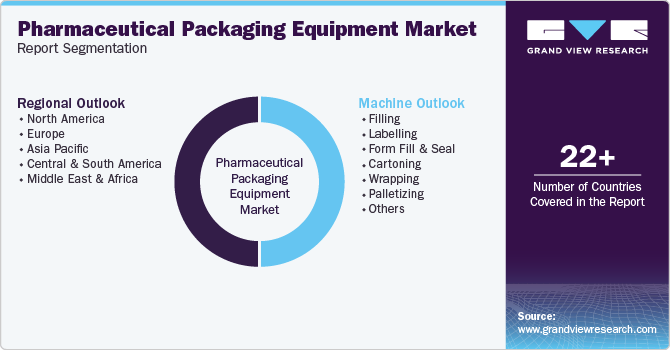
This report forecasts revenue growth at country levels and provides an analysis of the latest industry trends in each of the sub-segments from 2021 to 2033. For this study, Grand View Research has segmented the pharmaceutical packaging equipment market report based on Machine, and region.
 To learn more about this report, Download Free Sample Report
 -
Machine Outlook (Revenue, USD Million, 2021 - 2033)
-
Filling
-
Labelling
-
Form Fill & Seal
-
Cartoning
-
Wrapping
-
Palletizing
-
Cleaning
-
Others
-
-
Regional Outlook (Revenue, USD Million, 2021 - 2033)
-
North America
-
U.S.
-
Canada
-
Mexico
-
-
Europe
-
Germany
-
Russia
-
UK
-
Spain
-
Italy
-
-
Asia Pacific
-
China
-
Japan
-
South Korea
-
Australia
-
India
-
-
Central & South America
-
Brazil
-
-
Middle East & Africa
-
Saudi Arabia
-
UAE
-
-
Research Methodology
The pharmaceutical packaging equipment market figures in this report are based on a proven research process that combines executive interviews with secondary research from proprietary databases, company filings, and recognized regulatory and institutional sources. Market size is built through value-chain sizing - reconciling supply-side and demand-side estimates - and triangulated with bottom-up and top-down approaches. Every estimate passes multiple levels of expert validation before publication, with each pharmaceutical packaging equipment segment quantified using the revenue-capture definitions in the table below.
Segment Definition
Segment - Machine Type
Revenue Capture Definition
Air Purifying Respirators (APR)
Includes revenue generated from the sale of equipment used to accurately dispense pharmaceutical products into primary packaging formats such as vials, ampoules, syringes, cartridges, bottles, pouches, and blister cavities
Labelling
Includes revenue generated from the sale of equipment used to apply, print, verify, and inspect labels on pharmaceutical packaging. This segment covers bottle labelers, vial labelers, carton labelling systems, serialization-enabled labelling machines, and track-and-trace labeling solutions that support regulatory compliance and product identification.
Form Fill & Seal
Includes revenue generated from the sale of equipment that forms packaging from rollstock material, fills it with pharmaceutical products, and seals it in a continuous process. The segment includes blister packaging machines, sachet packaging systems, strip pack machines, and pouch packaging equipment used for solid and liquid pharmaceutical products.
Cartoning
Includes revenue generated from equipment used to erect, load, and seal cartons containing pharmaceutical products. The segment covers horizontal and vertical cartoning machines utilized for packaging bottles, blister packs, vials, syringes, medical devices, and other pharmaceutical products into secondary packaging.
Wrapping
Includes revenue generated from equipment used to apply protective films, overwraps, shrink wraps, and bundling materials around pharmaceutical products and cartons. These systems enhance product protection, tamper evidence, shelf appearance, and transportation efficiency.
Palletizing
Includes revenue generated from equipment used to automatically stack, arrange, and prepare packaged pharmaceutical products for warehousing and distribution.
Cleaning
Includes revenue generated from equipment designed to clean pharmaceutical containers, packaging components, and packaging machinery before or during packaging operations. The segment includes vial washers, bottle cleaning systems, container rinsers, clean-in-place (CIP) systems, and related cleaning equipment that support contamination control and regulatory compliance.
Others
This segment primarily includes closing equipment (capping and sealing systems), case and tray handling equipment, bottling line systems, bundling machines, conveying systems, feeding and product handling equipment, and inspection and testing equipment used for quality assurance, product verification, material movement, and end-of-line packaging operations.
Estimation Model
Layer Name
Key Question
Description
Pharmaceutical Production Demand Layer
Where is packaging equipment required?
Analyze pharmaceutical production volumes across prescription drugs, OTC products, biologics, vaccines, injectables, and nutraceuticals. Assess packaging requirements for tablets, capsules, liquids, powders, and sterile products to establish the addressable demand base for packaging equipment.
Manufacturing Capacity Expansion Layer
Where is new equipment demand being created?
Evaluate investments in pharmaceutical manufacturing facilities, contract manufacturing organizations (CMOs), and packaging plants. Assess greenfield and brownfield expansion projects, regulatory compliance upgrades, and production automation initiatives that drive demand for new packaging equipment.
Equipment Adoption Layer
Which packaging machines are being deployed?
Segment demand by machine type including filling, labeling, cartoning, wrapping, form-fill-seal, palletizing, and cleaning equipment. Apply adoption rates based on pharmaceutical product type, production scale, serialization requirements, and packaging automation trends.
Revenue Generation Layer
How much market revenue is generated?
Estimate annual equipment demand by machine type, automation level, and production capacity. Apply average selling prices based on machine complexity, throughput, regulatory compliance features, and integration requirements.
Delivered Customizations
This report has been delivered with the following In-depth customizations
Client Request
Customization Delivered
Value Adds
Company Market Share Analysis
A comprehensive assessment of established pharmaceutical packaging equipment manufacturers in terms of estimated market shares on the basis of financial strength, competitive positioning, product portfolio strength, geographic reach, technological capabilities, and strategic focus areas. The analysis also evaluates each company's presence across primary, secondary, and tertiary packaging segments, along with their strengths in automation, serialization, aseptic packaging, and turnkey line solutions.
This assessment provides a clear understanding of market concentration, competitive intensity, and leadership dynamics within the industry. Stakeholders can benchmark their market position against key competitors, identify potential partnership or acquisition targets, evaluate competitive gaps, and refine strategic initiatives based on evolving competitive trends.
Regional Segmentation
A detailed regional breakdown of the pharmaceutical packaging equipment market across various regions and several countries was delivered. The analysis covered market size, growth rates, regulatory influences, pharmaceutical manufacturing capacity, packaging format demand, and investment trends.
This analysis enables stakeholders to identify the most attractive regional markets for expansion, prioritize resource allocation, assess regional demand potential for specific equipment categories, and develop targeted go-to-market strategies.
Opportunity assessment
A targeted evaluation of high-growth opportunities across equipment types, packaging formats, dosage forms, end-user categories, and geographic markets. The assessment identifies emerging demand areas driven by biologics, injectable therapies, pharmaceutical capacity expansions, automation upgrades, serialization requirements, and evolving regulatory standards.
The analysis helps stakeholders prioritize investments toward the most lucrative growth segments, optimize product development roadmaps, and focus commercial efforts on the highest-potential applications and regions.
Frequently Asked Questions About This Report
The global pharmaceutical packaging equipment market size was valued at USD 7.0 billion in 2025 and is expected to be USD 7.5 billion in 2026.
The global pharmaceutical packaging equipment market, in terms of revenue, is expected to grow at a compound annual growth rate of 7.8% from 2026 to 2033 to reach USD 12.7 billion by 2033.
The filling segment led the market with the largest revenue share of 35.7% in 2025.
Some of the key players operating in the pharmaceutical packaging equipment market include Robert Bosch, Romaco Holding, Marchesini Group, Korber AG, I.M.A. Industria Macchine Automatiche S.p.A., Uhlmann Group, Accutek Packaging Equipment Companies, Bausch + Ströbel, Coesia, Vanguard Pharmaceuticals Equipment, MULTIVAC Group, OPTIMA Packaging Group, ACG Worldwide, BREVETTI CEA S.P.A.
The market is anticipated to be driven by the growing focus on brand enhancement and product differentiation by pharmaceutical manufacturers. Besides, increasing prevalence of chronic diseases due to changing lifestyles, and growing government focus towards strengthening of healthcare facilities and insurance coverage are expanding the demand for pharmaceuticals, which in turn, fueling pharmaceutical packaging equipment market.
Asia Pacific dominated the pharmaceutical packaging equipment market with the largest revenue share of 40.7% in 2025.
Asia Pacific is anticipated to be one of the fastest-growing regional markets over the forecast period, driven by expanding pharmaceutical manufacturing capacity, increasing healthcare expenditure, and growing investments in packaging automation.
China held the largest share of the Asia Pacific pharmaceutical packaging equipment market in 2025.
Key trends include increasing adoption of automated and high-speed packaging lines, growing implementation of track-and-trace technologies, rising demand for flexible packaging solutions, and integration of smart manufacturing systems.
About the Author(s)
Advanced Interior Materials Research Team
Advanced Materials · Advanced Interior MaterialsThis report was authored by the advanced interior materials research team at Grand View Research - comprising two research analysts, one senior research analyst, and one industry expert - with specialized expertise in the advanced interior materials segment of the advanced materials industry. All findings are based on proprietary advanced materials databases, executive interviews, and regulatory analysis, subject to internal peer review prior to publication.
Last Updated:
Speak to Analyst

Customize this report to your needs - add regions, segments, or data points, with 20% free customization.
Or view our licence options:


ISO 9001:2015 & 27001:2022 Certified
We are GDPR and CCPA compliant! Your transaction & personal information is safe and secure. For more details, please read our privacy policy.


