
- Home
- »
- Advanced Interior Materials
- »
-
Plant Operations & Maintenance Services Market Report, 2033GVR Report cover

Plant Operations & Maintenance Services Market (2026 - 2033)
Size, Share & Trends Analysis Report By Operation (In-House Maintenance, Third Party Maintenance Services), By End Use (Power Generation, Chemical & Petrochemical), By Region, And Segment Forecasts
Market Size, 2025
$262.0BMarket Estimate, 2026
$272.9BMarket Forecast, 2033
$396.9BCAGR, 2026–2033
5.5%Plant Operations & Maintenance Services Market Summary
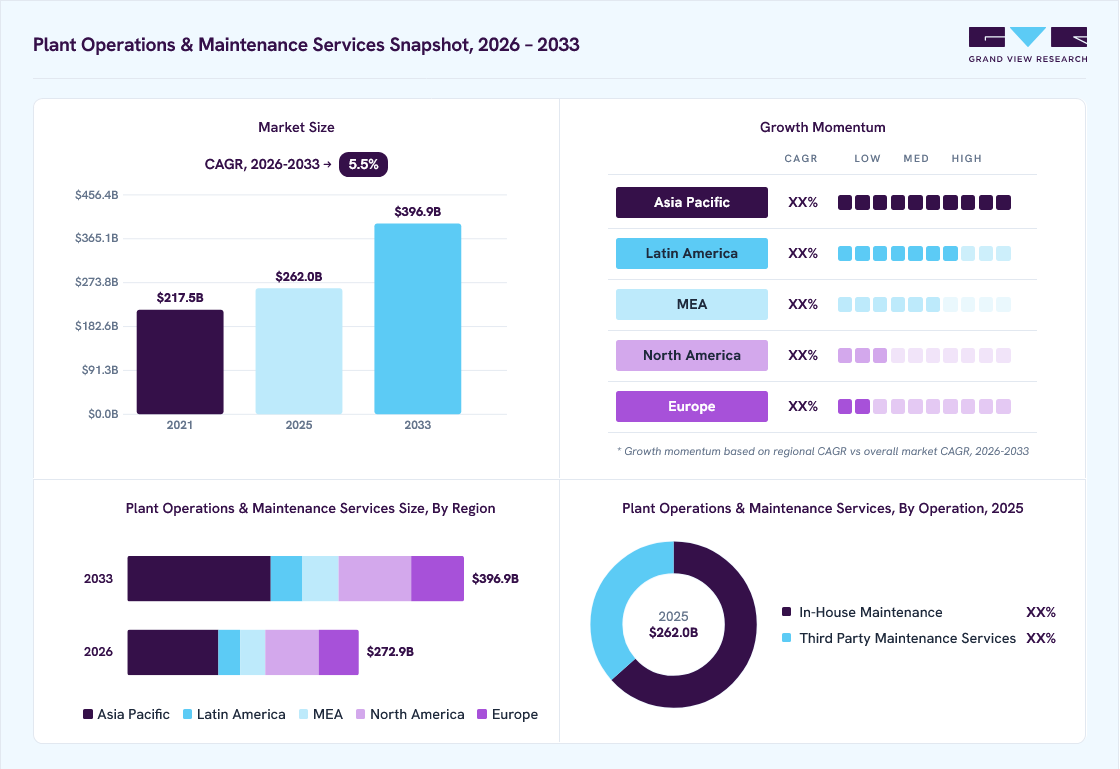
The global plant operations & maintenance services market size was valued at USD 262.0 billion in 2025 and is projected to grow from USD 272.9 billion in 2026 to USD 396.9 billion by 2033, at a CAGR of 5.5% from 2026 to 2033. Asia Pacific dominated the global plant operations & maintenance services market with the largest revenue share of 38.8% in 2025. The global market is driven by the increasing need to sustain equipment reliability, improve asset utilization, and minimize unplanned production interruptions across asset-intensive industries.
 Source: Grand View Research, IR Documents, Primary Interviews, Paid DatabasesTo learn more about this report,
 Download Free Sample Report
Key Market Trends & Insights
- By operation: The in-house maintenance services segment accounted for the largest revenue share of 63.3% in 2025.
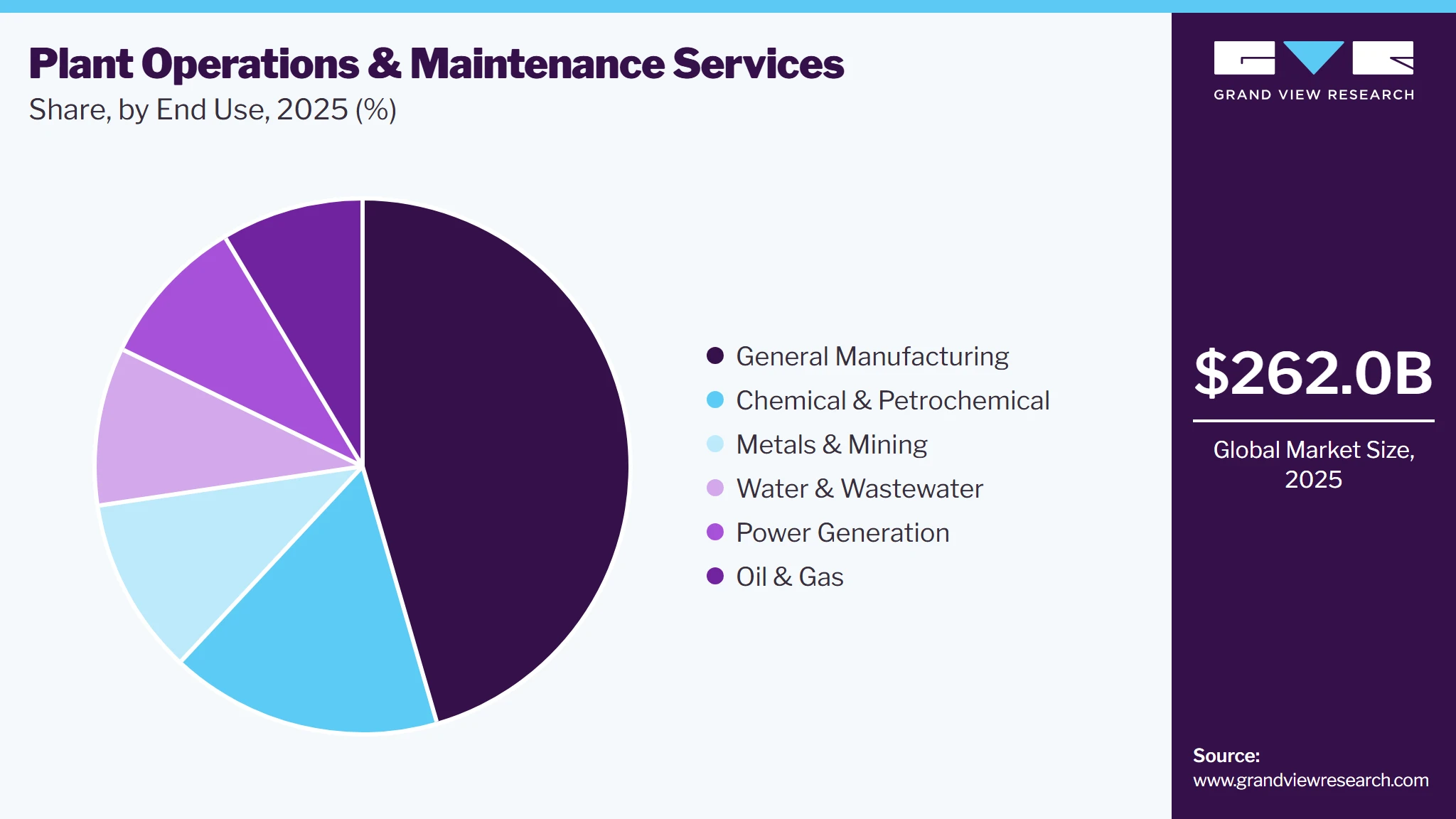
- By end use: The general manufacturing dominated the market with the largest revenue share of 45.5% in 2025.
Regional Highlights
- Largest regional market: Asia Pacific (38.8% revenue share, 2025)
- Fastest-growing regional market: Asia Pacific (highest CAGR, 2026-2033)
- By country: The China dominated the Asia Pacific with the largest revenue share in 2025
Market Size & Forecast
- Market size in 2025: USD 262.0 Billion
- Estimated market size in 2026: USD 272.9 Billion
- Projected market size by 2033: USD 396.9 Billion
- CAGR (2026-2033): 5.5%
Three ways to get this report
Buy it, customize it, or ask a question.Ask an Analyst
Analyst response in 1 business day
- AccessReport author, directly
- Reply timeWithin 1 working day
- No sales callDirect answer only
- FormatEmail reply
- CostFree, no cost
Get the Full Report
What the study covers
- FormatsPDF · Excel · Dashboard
- Timeline2026–2033 annual, 2025 base
- Coverage20+ countries, 5 regions
- Companies10+ key players profiled
Customize the Report
20% free customization
- IncludeCountries, segments, points
- TailorTo your product definition
- ExtendDeeper competitor detail
- OrA fully bespoke study
- Turnaround5–10 working days
Aging industrial infrastructure, rising equipment complexity, and stringent operational safety requirements are prompting plant owners to adopt structured maintenance strategies that encompass preventive servicing, predictive diagnostics, equipment inspections, and scheduled overhauls.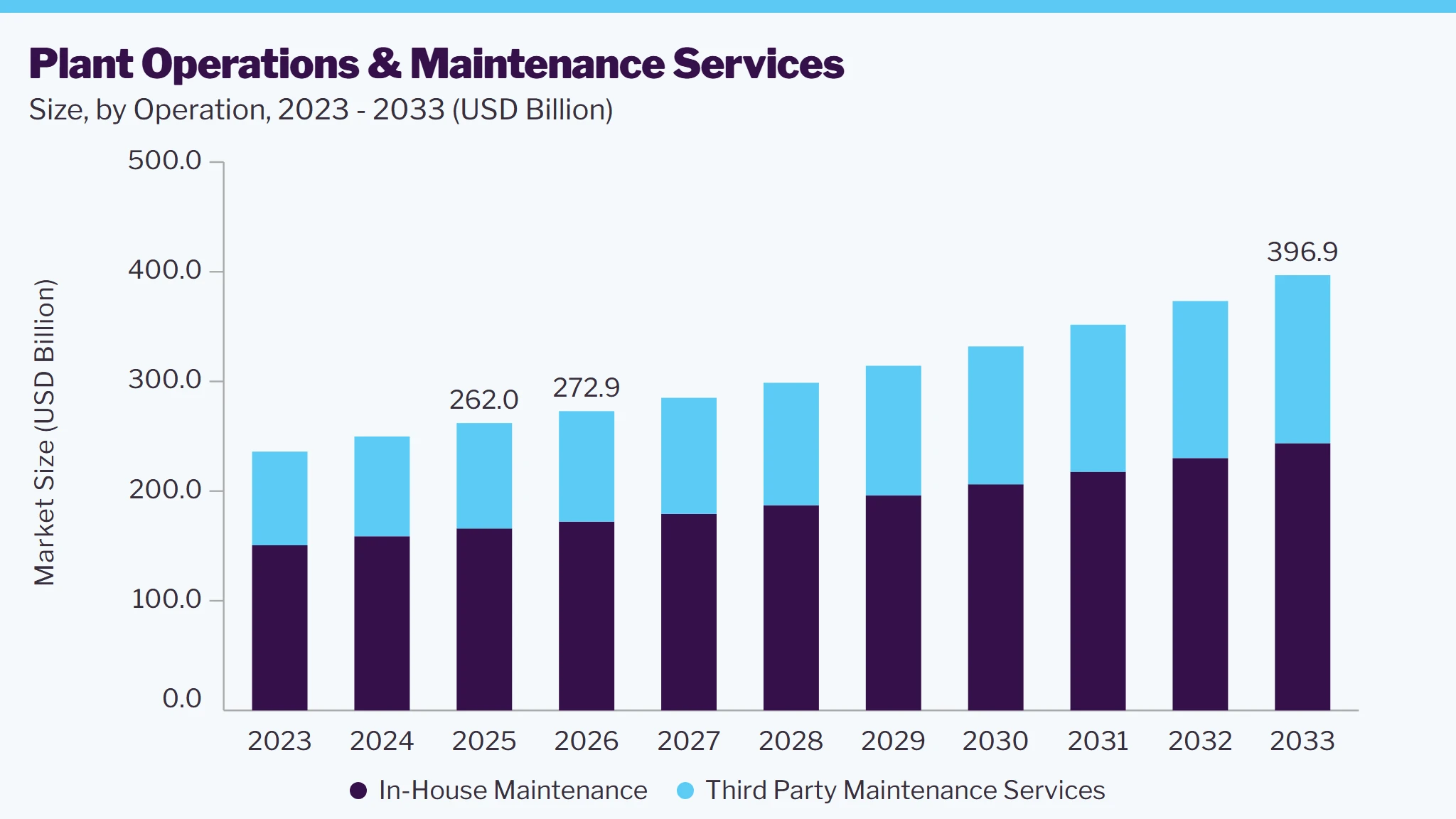 To learn more about this report, Download Free Sample Report
In addition, the integration of industrial Internet of Things (IIoT), artificial intelligence, remote monitoring, and computerized maintenance management systems is reshaping maintenance practices by enabling condition-based interventions and data-driven asset management. Investments in manufacturing facilities, power generation, oil and gas, chemicals, and water infrastructure are expanding the installed base of industrial equipment and generating recurring requirements for mechanical, electrical, instrumentation, and plant shutdown maintenance services.
Market Dynamics
The global market is characterized by evolving industrial outsourcing practices, cost optimization priorities, and increasing demand for specialized service delivery. Industrial operators are reassessing the allocation of operational responsibilities between internal teams and external contractors, while service providers are broadening their portfolios to address diverse facility requirements. Market development is further influenced by contract structures, labor availability, service implementation costs, and the growing preference for consolidated maintenance arrangements across industrial sites.
Industrial enterprises are increasingly engaging specialized contractors to manage selected operational functions and maintenance activities, allowing internal resources to remain focused on core production and strategic priorities. External providers offer access to multidisciplinary technical personnel, established service procedures, and flexible workforce deployment without requiring customers to maintain equivalent permanent staffing levels.
The transfer of plant operations and maintenance responsibilities to external providers can entail considerable initial expenditure associated with workforce deployment, site familiarization, technical documentation, training, and administrative integration. Service contractors must also allocate supervisory personnel and specialized resources before achieving full operational utilization. These requirements can increase implementation costs and complicate contract transitions, particularly at facilities with intricate operating procedures or stringent qualification requirements.
The growing preference for consolidated procurement is creating opportunities for service providers capable of integrating plant operations, maintenance, technical support, and facility management into comprehensive contractual arrangements. Integrated agreements can simplify vendor administration, establish clearer accountability, and standardize service delivery across multiple locations. For industrial customers, this model offers a coordinated approach to managing diverse service requirements, while providers can broaden their contractual scope and strengthen long-term client relationships.
Market Concentration & Characteristics
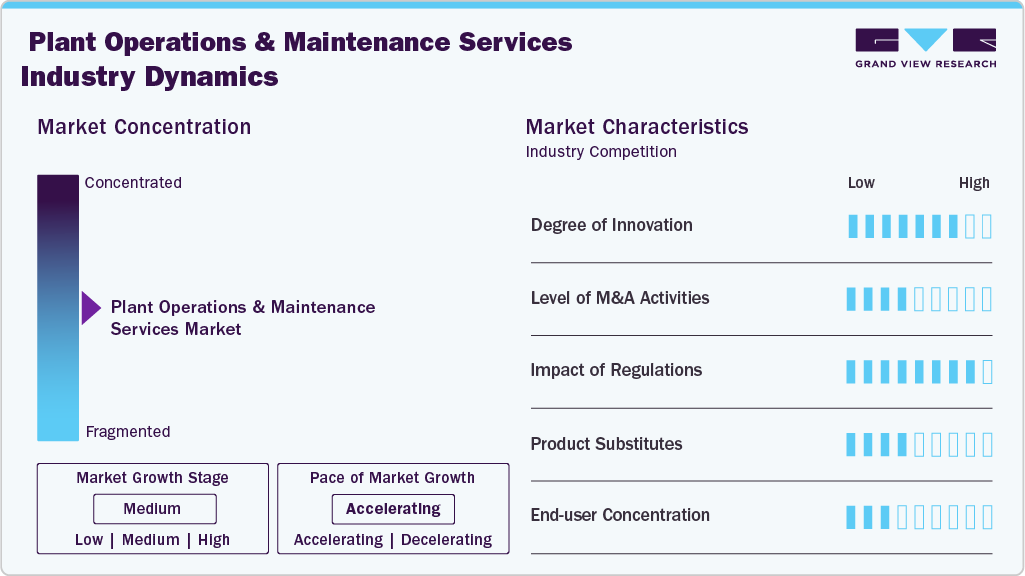
The global industry is fragmented, comprising diversified engineering conglomerates, integrated industrial service providers, independent maintenance contractors, and niche technical specialists. Competitive intensity varies across service categories and geographic markets, reflecting differences in contractor availability, technical qualification requirements, industrial specialization, and customer operating requirements. Large service providers compete through multidisciplinary execution capabilities, international delivery networks, and the capacity to manage complex, multi-site engagements, whereas smaller firms establish competitive positions through localized expertise, specialized technical competencies, and flexible service arrangements.
The industry encompasses a broad spectrum of activities, turnaround management, and facility support. Providers differ in the extent of operational responsibility assumed, ranging from task-specific assignments to comprehensive contracts covering day-to-day plant management. Commercial arrangements include fixed-fee agreements, time-and-material engagements, framework contracts, and performance-linked models, with selection influenced by service complexity, risk allocation, budget predictability, and the customer's internal technical resources.
 To learn more about this report, Download Free Sample Report
Demand characteristics vary across various sectors. Hydrocarbon and chemical facilities require specialized competencies in hazardous environments and process equipment, whereas manufacturing and power installations emphasize machinery servicing, maintenance coordination, and adherence to site-specific operating procedures. Procurement decisions are influenced by contractor qualification protocols, health and safety credentials, mobilization capacity, technical documentation, and contractual accountability.
Analyst Perspective
The plant operations and maintenance services industry is shaped by the maintenance intensity of industrial assets, operational risk exposure, and the technical requirements of process-driven facilities. The choice between in-house capabilities and third-party service providers depends on internal engineering resources, cost structures, specialized skill requirements, and the scope of maintenance responsibilities. Long-term service agreements offer continuity for recurring maintenance requirements, whereas short-duration contracts and project-based engagements address specific operational needs. Advancements in predictive maintenance, condition monitoring, and digital asset management are influencing service delivery models, placing greater emphasis on diagnostic capabilities, maintenance planning, and lifecycle cost management.
Operation Insights
The in-house maintenance services segment accounted for the largest revenue share of 63.3% in 2025. Industrial operators maintain internal technical teams to retain direct control over maintenance planning, personnel allocation, and equipment servicing. This approach is particularly relevant for facilities with specialized production processes, proprietary machinery, and site-specific operational protocols. Internal teams also facilitate coordination between maintenance and production functions, enabling organizations to align service schedules with plant requirements and retain technical knowledge of their installed equipment base.
The third-party maintenance services segment is projected to grow at the fastest CAGR during the forecast period. Demand is increasing as industrial operators seek external expertise for specialized engineering tasks, equipment overhauls, statutory inspections, and planned shutdowns. Contracting with independent providers allows companies to access qualified personnel and technical capabilities without incurring the fixed costs of maintaining an extensive in-house workforce.
End Use Insights
The general manufacturing segment led the market with the largest revenue share of 45.5% in 2025, supported by maintenance requirements across diverse production environments, including machinery-intensive facilities, assembly operations, and automated manufacturing lines. Equipment servicing, electrical system maintenance, instrumentation support, and facility upkeep constitute essential service requirements across these settings. Variations in production technology and plant configuration create demand for service arrangements tailored to specific machinery, operating schedules, and technical specifications, establishing general manufacturing as a broad-based source of market demand.
 To learn more about this report, Download Free Sample Report
The oil and gas segment is projected to grow at the fastest CAGR of 7.0% during the forecast period. The sector's extensive infrastructure, comprising exploration facilities, pipelines, processing units, and refineries, requires specialized maintenance capabilities to address equipment degradation, process integrity, and stringent safety obligations. Complex operating conditions and rigorous inspection protocols increase demand for technical services encompassing asset integrity assessment, mechanical servicing, instrumentation maintenance, and turnaround execution. Maintenance requirements across geographically dispersed installations further create opportunities for service providers capable of delivering specialized field support and coordinated maintenance programs.
Regional Insights
The plant operations & maintenance services market in North America is established, underpinned by a substantial installed base of industrial assets and a well-developed ecosystem of engineering contractors. Service demand spans asset integrity management, facility operations, and scheduled plant shutdowns. Procurement priorities center on technical competence, contractual accountability, regulatory compliance, and the ability to execute maintenance activities without compromising production schedules.
U.S. Plant Operations & Maintenance Services Market Trends
The plant operations & maintenance services market in the U.S. encompasses extensive requirements across manufacturing, refining, chemicals, power generation, and other process-intensive industries. The technical sophistication of industrial installations creates demand for specialized equipment diagnostics, control-system servicing, machinery overhauls, and maintenance planning. Outsourced service arrangements enable operators to access specialist capabilities for complex assignments while retaining flexibility in workforce deployment and maintenance expenditure.
The Mexico plant operations & maintenance services market is closely associated with industrial manufacturing, particularly automotive assembly, electronics, metalworking, and food processing. Production facilities require dependable maintenance of machinery, automated lines, electrical installations, and supporting utilities. The development of manufacturing clusters and export-oriented industrial capacity creates opportunities for service providers offering localized technical personnel, responsive repair capabilities, and maintenance programs aligned with plant operating schedules.
Europe Plant Operations & Maintenance Services Market Trends
The plant operations and maintenance services market in Europe is characterized by mature industrial infrastructure, stringent operating standards, and substantial requirements for equipment lifecycle management. Industrial operators seek to maintain the integrity of existing facilities while accommodating technological upgrades, environmental obligations, and evolving production specifications. These conditions favor service providers with multidisciplinary engineering capabilities, documented execution procedures, and expertise in regulated industrial environments.
The Germany plant operations & maintenance services market is expected to grow at a significant CAGR during the forecast period. The Germany’s manufacturing-intensive economy generates demand for maintenance services across automotive production, industrial machinery, chemicals, and precision engineering. Automated production systems require specialized diagnostics, instrumentation calibration, control-system maintenance, and coordinated equipment refurbishment. The integration of sophisticated machinery into production processes underscores the importance of technically qualified contractors who can work under stringent quality requirements and within tightly managed maintenance windows.
The plant operations & maintenance services market in France presents a diversified service landscape spanning aerospace, pharmaceuticals, chemicals, energy, and food processing. Maintenance requirements differ considerably across these industries, from equipment validation and documentation in regulated manufacturing to inspection and servicing of energy infrastructure. Contractors with sector-specific qualifications and established technical procedures can meet the operational demands of facilities in which equipment reliability, process integrity, and compliance obligations are closely interlinked.
Asia Pacific Plant Operations & Maintenance Services Market Trends
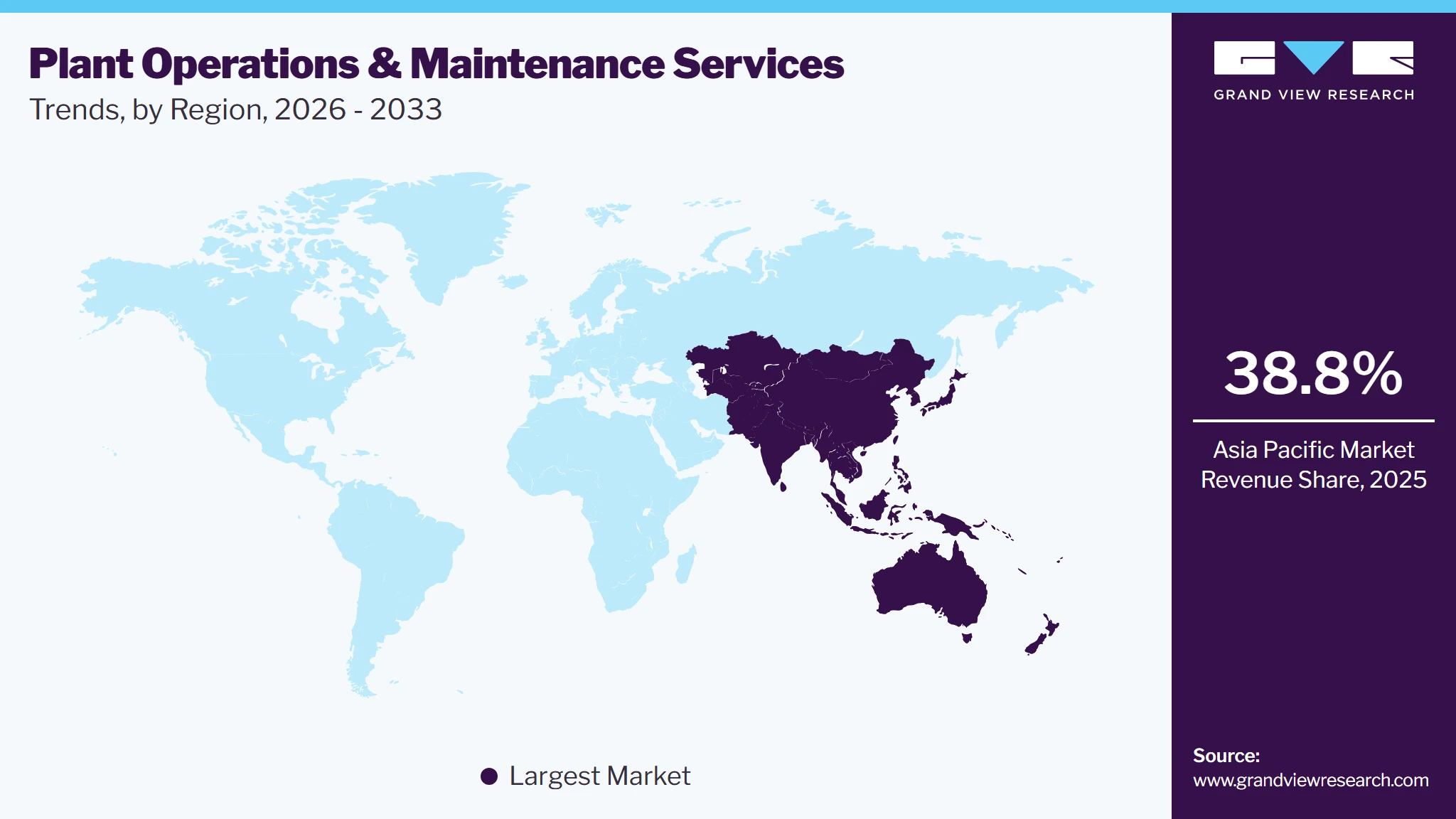
The Asia Pacific plant operations & maintenance services market held the largest revenue share of 38.8% in 2025 and is expected to grow at the fastest CAGR during the forecast period. Its substantial manufacturing footprint, extensive industrial processing capacity, and ongoing infrastructure development generate requirements across routine maintenance, technical inspections, equipment refurbishment, and plant operations support. The region's combination of newly commissioned facilities and long-established industrial installations creates a broad range of service needs, with outsourcing practices and technical capabilities varying across national markets.
 To learn more about this report, Download Free Sample Report
The plant operations & maintenance services market in China accounted for the largest market revenue share in the Asia Pacific in 2025. Industrial modernization, manufacturing investment, and the scale of chemical processing, metals production, power generation, and machinery manufacturing are expanding demand for specialized maintenance expertise. Complex production installations require equipment overhauls, process and system servicing, and coordinated shutdown execution. These requirements create opportunities for contractors capable of deploying multidisciplinary teams and managing maintenance programs across large industrial facilities.
The India plant operations & maintenance services market is supported by industrial capacity development across the cement, metals, energy, manufacturing, and infrastructure sectors. New projects require operational preparation, maintenance-system planning, and technical support during commissioning, while established plants generate recurring needs for machinery servicing, refurbishment, and scheduled shutdowns. The diversity of industrial processes creates opportunities for providers to adapt their maintenance scope, workforce deployment, and service delivery models to different facility configurations.
Middle East & Africa Plant Operations & Maintenance Services Market Trends
The plant operations & maintenance services market in the Middle East and Africa is closely connected to hydrocarbon production, petrochemical processing, power generation, mining, and water infrastructure. Remote operating locations, demanding environmental conditions, and complex process equipment increase requirements for specialized field services, inspection programs, and equipment integrity management. Service delivery also depends on contractors' ability to mobilize qualified personnel, coordinate technical resources, and comply with site-specific safety procedures.
The Saudi Arabia plant operations & maintenance services market is anticipated to grow at a significant CAGR during the forecast period. Saudi Arabia’s extensive hydrocarbon value chain, including production facilities, refineries, petrochemical complexes, and associated utilities, generates substantial technical maintenance requirements. Mechanical servicing, instrumentation support, process equipment inspections, and turnaround management are important components of industrial maintenance activities. Investment in mining, manufacturing, and infrastructure is broadening the range of facilities requiring operational support, creating opportunities for contractors with cross-disciplinary engineering capabilities.
Latin America Plant Operations & Maintenance Services Market Trends
The plant operations and maintenance services market in Latin America reflects the requirements of resource-intensive industries, industrial processing facilities, and established manufacturing operations. Mining, oil and gas, pulp and paper, metals, power generation, and food processing involve distinct equipment configurations and maintenance protocols. Demand encompasses heavy machinery servicing, mechanical repairs, industrial utility maintenance, and specialized interventions, while contractor availability and infrastructure conditions influence service procurement in individual countries.
The Brazil plant operations & maintenance services market is growing rapidly. The Brazil industrial base encompasses mining, offshore oil and gas, metals, pulp and paper, and food processing, each generating distinct maintenance requirements. Mining operations depend on the serviceability of heavy equipment and material-handling systems, whereas offshore installations require technically specialized interventions under demanding marine conditions. Pulp and paper facilities generate requirements for rotating machinery, process equipment, and industrial utilities. Modernization projects, equipment replacement, and the upkeep of large processing installations provide opportunities for service providers with relevant sector expertise and established field-service capabilities.
Key Plant Operations & Maintenance Services Company Insights
Some of the key players operating in the market include Worley, Wood, and Bilfinger.
-
Worley Limited is an Australia-headquartered engineering and professional services company providing project delivery, asset management, and operations and maintenance services across the energy, chemicals, and resources sectors. Its capabilities span operational support, predictive maintenance, asset performance optimization, maintenance planning, and outage management. The company serves industrial facilities and infrastructure throughout the asset lifecycle, from project development and commissioning through operations and decommissioning.
-
Bilfinger SE is a Germany-based industrial services provider specializing in engineering, maintenance, and lifecycle services for process industries. Its portfolio encompasses industrial plant maintenance, mechanical and electrical services, instrumentation and control, inspection, asset integrity management, and plant turnaround execution. The company serves industries including oil and gas, chemicals and petrochemicals, pharmaceuticals, and energy. Its integrated service model combines maintenance planning, technical execution, and digital solutions to address equipment reliability, plant availability, and maintenance cost management.
Key Plant Operations & Maintenance Services Companies
Some prominent players in the global plant operations & maintenance services market include:
-
Bilfinger SE
-
Worley Limited
-
Wood plc
-
Petrofac Limited
-
EnerMech
-
KBR, Inc.
-
Amentum
-
APTIM
-
SPIE
-
Equans
-
Stork
-
Sulzer Ltd.
-
Fluor Corporation
-
Technip Energies
-
Saipem S.p.A.
Market Participant Categorization
Category
Operating Strategies
Competitive Edge
Weakness
Established Players (e.g., Bilfinger SE, Worley Limited, Wood plc, Petrofac Limited, KBR, Inc., Amentum, APTIM, Fluor Corporation, Technip Energies, Saipem S.p.A.)
Expand industrial operations, maintenance, asset integrity, and lifecycle service portfolios across energy, chemicals, manufacturing, and infrastructure. Leverage engineering expertise, long-term customer contracts, turnaround management, digital maintenance tools, and integrated service delivery to address complex facility requirements.
Broad technical capabilities, established relationships with industrial operators, multidisciplinary engineering resources, and experience managing complex projects and industrial assets. These strengths facilitate the delivery of integrated services across multiple facilities and operational stages.
Large organizational structures, extensive workforce requirements, and complex resource allocation can increase service delivery costs. Dependence on capital-intensive industries and large contract awards may expose operations to investment cycles, project delays, and fluctuations in customer maintenance budgets.
Emerging & Regional Players (e.g., EnerMech, SPIE, Equans, Stork, Sulzer Ltd.)
Concentrate on specialized industrial services, equipment maintenance, mechanical and electrical systems, rotating machinery, instrumentation, and infrastructure operations. Strengthen market positions through technical specialization, regional service networks, targeted acquisitions, and customized maintenance agreements.
Focused technical expertise, established field-service capabilities, industry-specific knowledge, and localized workforce deployment enable responsive execution of specialized assignments. Their service models can address defined customer requirements without the broader coordination structures associated with large integrated contractors.
Narrower service coverage in certain technical disciplines or geographic markets can limit participation in comprehensive, multinational maintenance contracts. Exposure to particular industries, equipment categories, or regional demand conditions may also affect revenue stability and capacity utilization.
Recent Developments:
-
In August 2026, SPIE completed its acquisition of Worley Power Services in Australia, expanding its operations and maintenance capabilities across energy infrastructure. The acquired business, subsequently operating as SPIE Power Services, provides services for power generation facilities, wind farms, and gas infrastructure. The transaction strengthensSPIE's Australian presence and broadens its capabilities in the ongoing operation, servicing, and management of energy assets.
-
In April 2026, Bilfinger finalized the acquisition of major business units of Turkiye-based Teknokon Group, adding approximately 1,000 specialists to its workforce. The acquired operations provide industrial plant maintenance, turnaround, installation, and construction services across the oil and gas, energy, and chemical industries. The transaction enhances Bilfinger's technical service capacity in Turkiye and creates a stronger regional platform for serving industrial customers across neighboring markets.
Plant Operations & Maintenance Services Market Report Scope
Report Attribute
Details
Market size in 2025
USD 262.0 billion
Estimated market size in 2026
USD 272.9 billion
Projected market size by 2033
USD 396.9 billion
Growth rate
CAGR of 5.5% from 2026 to 2033
Base year for estimation
2025
Historical data
2021 – 2024
Forecast period
2026 – 2033
Quantitative units
Revenue in USD billion and CAGR from 2026 to 2033
Report coverage
Revenue forecast, company ranking, competitive landscape, growth factors, and trends
Segments covered
Operation, end use, region.
Regional scope
North America; Europe; Asia Pacific; Latin America; Middle East & Africa
Country scope
U.S.; Canada; Mexico; UK; Germany; France; Italy; Spain; China; Japan; India; Australia; South Korea; Brazil; Argentina; Saudi Arabia; South Africa; UAE
Key companies profiled
Bilfinger SE; Worley Limited; Wood plc; Petrofac Limited; KBR, Inc.; EnerMech; APTIM; Amentum; SPIE; Stork; Equans; Technip Energies; Fluor Corporation; Saipem S.p.A.; Sulzer Ltd.
Customization scope
Free report customization (equivalent up to 8 analysts working days) with purchase. Addition or alteration to country, regional & segment scope.
Pricing and purchase options
Avail customized purchase options to meet your exact research needs. Explore purchase options
Global Plant Operations & Maintenance Services Market Report Segmentation
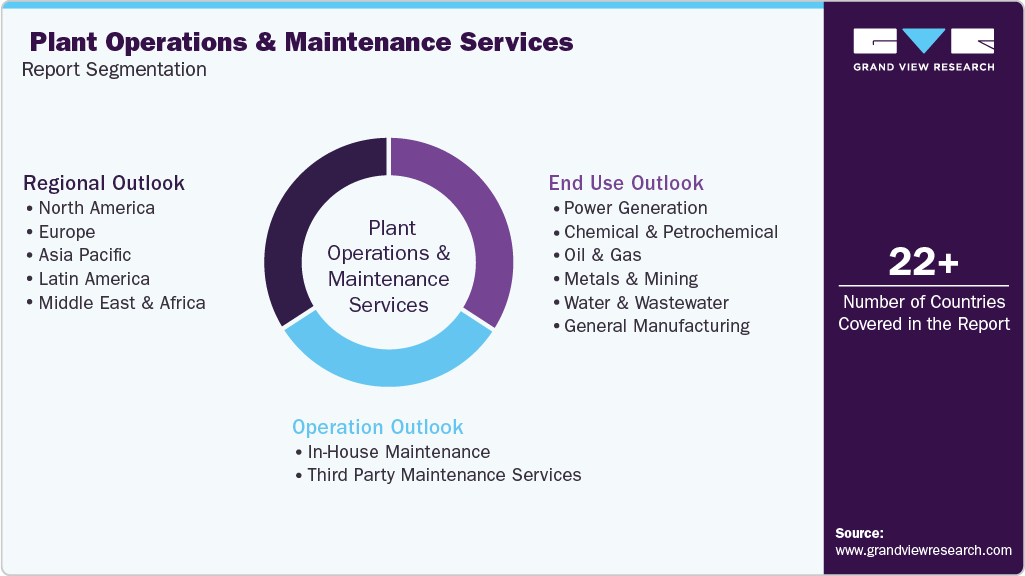
This report forecasts revenue growth at global, regional, and country levels and provides an analysis of the latest industry trends in each of the sub-segments from 2021 to 2033. For this study, Grand View Research has segmented the global plant operations & maintenance services market report based on type, end use, and region.
 To learn more about this report, Download Free Sample Report
-
Operation Outlook (Revenue, USD Billion, 2021 - 2033)
-
In-House Maintenance
-
Third Party Maintenance Services
-
LTSA / Long-Term Contracts
-
Short-/Medium-Term Contracts
-
Project-Based / Ad-hoc Services
-
-
-
End Use Outlook (Revenue, USD Billion, 2021 - 2033)
-
Power Generation
-
Chemical & Petrochemical
-
Oil & Gas
-
Metals & Mining
-
Water & Wastewater
-
General Manufacturing
-
-
Regional Outlook (Revenue, USD Billion, 2021 - 2033)
-
North America
-
U.S.
-
Canada
-
Mexico
-
-
Europe
-
Germany
-
France
-
Italy
-
UK
-
Spain
-
-
Asia Pacific
-
China
-
India
-
Japan
-
Australia
-
South Korea
-
-
Latin America
-
Brazil
-
Argentina
-
-
Middle East and Africa
-
Saudi Arabia
-
UAE
-
South Africa
-
-
Research Methodology
The plant operations & maintenance services marketfigures in this report are based on a proven research process that combines executive interviews with secondary research from proprietary databases, company filings, and recognized regulatory and institutional sources. Market size is built through value-chain sizing—reconciling supply-side and demand-side estimates—and triangulated with bottom-up and top-down approaches. Every estimate passes multiple levels of expert validation before publication, with eachplant operations & maintenance services segment quantified using the revenue-capture definitions in the table below.
Segment Definition
Segment - Operation
Revenue Capture Definition
In-House Maintenance
Revenue generated from plant operations and maintenance activities performed by internal maintenance teams employed by the plant operator, covering routine servicing, equipment inspections, repairs, and ongoing facility upkeep.
Third Party Maintenance Services
Revenue generated from outsourced plant operations and maintenance services delivered by external contractors and specialized service providers through LTSA / long-term contracts, short-/medium-term contracts, and project-based / ad-hoc services.
Segment – End Use
Revenue Capture Definition
Power Generation
Revenue generated from operations and maintenance services for power generation facilities, including turbine and generator servicing, equipment inspections, repairs, and plant upkeep.
Chemical & Petrochemical
Revenue generated from operations and maintenance services for chemical and petrochemical facilities, encompassing process equipment servicing, inspections, repairs, and shutdown maintenance.
Oil & Gas
Revenue generated from operations and maintenance services for oil and gas facilities, including production equipment maintenance, pipeline servicing, rotating equipment repairs, and asset integrity management.
Metals & Mining
Revenue generated from plant operations and maintenance services for metals production, mineral processing, and mining facilities, including equipment inspection, mechanical and electrical maintenance, machinery repairs, and upkeep of processing and material-handling systems.
Water & Wastewater
Revenue generated from operations and maintenance services for water and wastewater treatment facilities, including pump and motor maintenance, process equipment servicing, and system inspections.
General Manufacturing
Revenue generated from operations and maintenance services for manufacturing facilities, covering machinery maintenance, electrical and mechanical repairs, and preventive servicing of production equipment.
Estimation Model
Layer No.
Layer Name
Key Question
Description
01
Industrial Demand Assessment
Which industrial sectors generate demand for plant operations and maintenance services?
Evaluates demand across power generation, oil and gas, chemicals and petrochemicals, metals and manufacturing, and water and wastewater treatment. The assessment considers industrial asset installations, operating conditions, process complexity, equipment criticality, and sector-specific maintenance requirements.
02
Maintenance Operating Model Assessment
How are plant operations and maintenance services delivered and contracted?
Examines in-house maintenance and third-party maintenance services, distinguishing internal maintenance activities from services procured through external providers. Third-party service arrangements are classified into LTSA / long-term contracts, short-/medium-term contracts, and project-based / ad-hoc services, with consideration of contract duration, service scope, and allocation of maintenance responsibilities.
03
Service Procurement & Demand Drivers
What factors determine the procurement of plant operations and maintenance services?
Assesses maintenance requirements arising from equipment wear, asset lifecycle management, preventive servicing, corrective repairs, regulatory compliance, planned shutdowns, and facility upgrades. The analysis also examines outsourcing decisions, maintenance budget allocation, operational continuity requirements, and the procurement of specialized technical services across end-use industries.
04
Market Sizing & Revenue Estimation
How is market revenue measured across service delivery models and end-use industries?
Estimates market revenue across in-house maintenance and third-party maintenance services, with third-party revenue segmented into LTSA / long-term contracts, short-/medium-term contracts, and project-based / ad-hoc services. Estimates incorporate relevant service revenues, contract values, maintenance expenditure, supplier-level financial information, and procurement patterns, using top-down and bottom-up approaches supported by primary research, historical analysis, and data triangulation.
Customization Table
Client Request
Customization Delivered
Value Adds
Regional Segmentation
Evaluated the global plant operations and maintenance services market across North America, Europe, Asia Pacific, Latin America, and the Middle East & Africa. The analysis examined industrial asset concentration, manufacturing activity, infrastructure development, regulatory obligations, maintenance expenditure, and service demand across major end-use industries.
Provided a region-specific perspective on market attractiveness, highlighting differences in industrial maintenance requirements and potential demand for specialized services to guide geographic expansion and investment allocation.
Competitive Benchmarking
Examined the competitive landscape across integrated engineering companies, industrial service providers, and specialized maintenance contractors. Benchmarking criteria included service portfolio breadth, technical specialization, industry coverage, geographic reach, contract structures, digital maintenance capabilities, and strategic business developments.
Enabled a structured comparison of provider capabilities and competitive positioning, helping identify service differentiation opportunities, potential partnerships, and areas for portfolio strengthening.
Opportunity Assessment
Assessed commercial opportunities across in-house maintenance, third-party maintenance services, long-term service agreements, short- and medium-term contracts, and project-based engagements. The analysis considered aging industrial infrastructure, equipment lifecycle requirements, plant modernization, predictive maintenance adoption, and demand for specialized technical services across end-use sectors.
Highlighted potential avenues for market penetration, service-line expansion, and technical capability development, supporting decisions on target industries, service delivery models, and investment priorities.
About the Author(s)
Advanced Interior Materials Research Team
Advanced Materials · Advanced Interior MaterialsThis report was authored by the advanced interior materials research team at Grand View Research - comprising two research analysts, one senior research analyst, and one industry expert - with specialized expertise in the advanced interior materials segment of the advanced materials industry. All findings are based on proprietary advanced materials databases, executive interviews, and regulatory analysis, subject to internal peer review prior to publication.
Last Updated:
Speak to Analyst

Customize this report to your needs - add regions, segments, or data points, with 20% free customization.
Or view our licence options:


ISO 9001:2015 & 27001:2022 Certified
We are GDPR and CCPA compliant! Your transaction & personal information is safe and secure. For more details, please read our privacy policy.


