
- Home
- »
- Plastics, Polymers & Resins
- »
-
Polymers & Biopolymers in Beauty & Personal Care Products Market Report, 2033GVR Report cover

Polymers And Biopolymers In Beauty And Personal Care Products Market (2026 - 2033)
Size, Share & Trends Analysis Report By Function (Conditioning, Styling, Rheology Modifying), By Region (North America, Europe, Asia Pacific, Latin America, Middle East & Africa), And Segment Forecasts
Market Size, 2025
$3.4BMarket Estimate, 2026
$3.6BMarket Forecast, 2033
$4.6BCAGR, 2026–2033
3.7%Polymers & Biopolymers In Beauty & Personal Care Products Market Summary
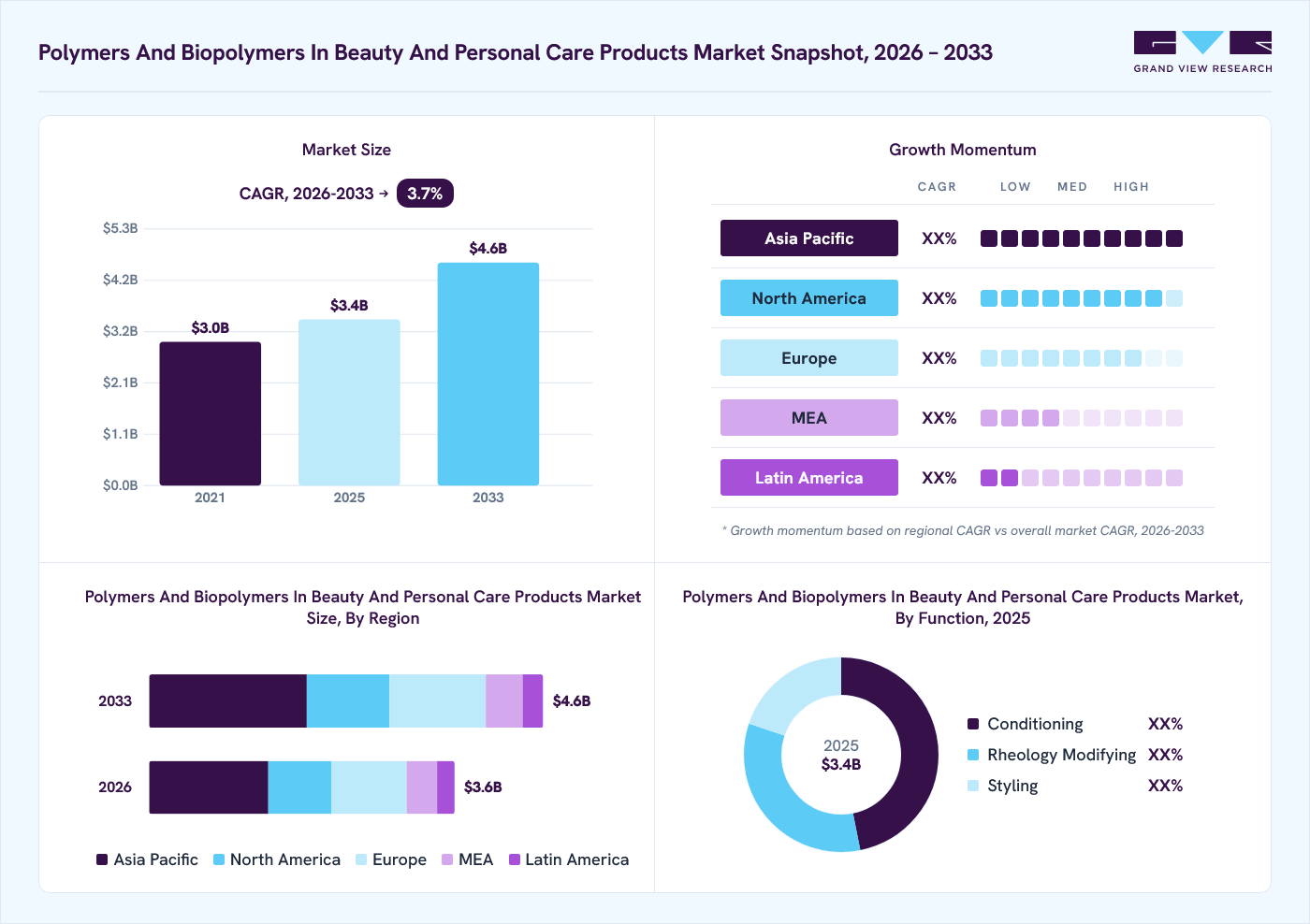
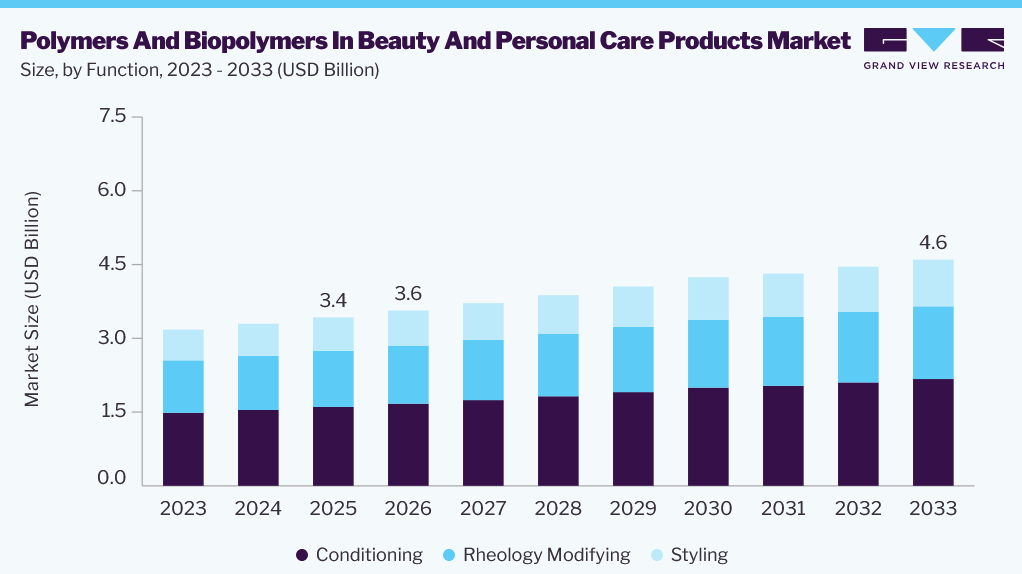
The global polymers & biopolymers in beauty & personal care products market size was valued at USD 3.4 billion in 2025 and is projected to grow from USD 3.6 billion in 2026 to USD 4.6 billion by 2033, growing at a CAGR of 3.7% from 2026 to 2033. Asia Pacific dominated the market, accounting for the largest global share of 38.9% in 2025. The global polymers & biopolymers in beauty & personal care products market is driven by the increasing demand for advanced materials across key applications, including film formers, rheology modifiers, conditioning agents, delivery systems, and packaging.
 Source: Grand View Research, IR Documents, Primary Interviews, Paid DatabasesTo learn more about this report,
 Download Free Sample Report
Key Market Trends & Insights
- By function: Conditioning segment led the market with the largest revenue share of 46.8% in 2025.
Regional Highlights
- Largest regional market: Asia Pacific (38.9% revenue share, 2025)
- By country: The China held the largest share of Asia Pacific in 2025.
Market Size & Forecast
- Market size in 2025: USD 3.4 Billion
- Estimated market size in 2026: USD 3.6 Billion
- Projected market size by 2033: USD 4.6 Billion
- CAGR (2026-2033): 3.7%
Prism AI by Grand View Research Free to tryAsk a question about the polymers and biopolymers in beauty and personal care products marketTry asking✓Every figure cited from GVR research Prefer the report? Download free sample →Rising consumer preference for high-performance, sustainable, and multifunctional beauty formulations, coupled with continuous product innovation and expanding personal care manufacturing, is accelerating market growth. Increasing emphasis on product efficacy, enhanced sensory performance, and eco-friendly packaging further supports market expansion throughout the forecast period.
 To learn more about this report, Download Free Sample Report
Moreover,the increasing awareness of health and skin safety is significantly influencing the market. The increasing awareness of health and skin safety is significantly influencing the polymers & biopolymers in the beauty & personal care products market.The increasing awareness of health and skin safety is significantly influencing the polymers & biopolymers in the beauty & personal care products market.
The increasing awareness of health and skin safety is significantly influencing the polymers & biopolymers in the beauty & personal care products market.The increasing awareness of health and skin safety is significantly influencing the polymers & biopolymers in the beauty & personal care products market.
Market Dynamics
The polymers & biopolymers in beauty & personal care products market is witnessing robust growth, driven by increasing consumer awareness of health, skin safety, and ingredient transparency. Rising preference for non-toxic, biocompatible, and sustainably sourced materials is accelerating the adoption of advanced polymers and biopolymers in cosmetic and personal care formulations. Furthermore, growing demand for clean-label products, stricter regulatory standards for product safety, and continuous innovation in bio-based ingredients are strengthening market expansion. Increasing focus on skin-friendly formulations, environmental sustainability, and high-performance functional ingredients is supporting the long-term growth of the global polymers & biopolymers in beauty & personal care products market.
The polymers & biopolymers in beauty & personal care products market is experiencing steady growth, driven by the rising prevalence of skin disorders associated with urban pollution, prolonged ultraviolet (UV) exposure, and changing environmental conditions. Polymers and biopolymers are increasingly incorporated into moisturizers, cleansers, lotions, sunscreens, and after-sun formulations to enhance product stability, texture, performance, and skin compatibility, supporting the development of safe and effective skincare solutions.
Market growth is further supported by increasing consumer awareness of preventive skincare, rising demand for daily sun protection, and growing adoption of advanced personal care formulations. Increasing incidence of sunburn, premature skin aging, and pollution-induced skin damage is encouraging consumers to use sun care products more frequently. As demand for high-performance, skin-friendly, and sustainable formulations continues to increase, the adoption of polymers and biopolymers is expected to strengthen throughout the forecast period.
Volatile raw material prices remain a significant restraint for the polymers & biopolymers in beauty & personal care products market. Fluctuating prices of petroleum-based feedstocks and bio-based raw materials increase production costs and create uncertainty across the supply chain. In addition, geopolitical tensions, trade restrictions, political instability, and disruptions in major oil-producing regions can significantly impact the availability and pricing of polymer feedstocks. These cost fluctuations reduce profit margins, complicate long-term procurement strategies, and limit pricing stability, thereby constraining market growth and the broader adoption of polymers & biopolymers in beauty & personal care products.
Growing consumer awareness of safe and natural ingredients is creating significant growth opportunities for the polymers & biopolymers in beauty & personal care products market. Increasing access to digital platforms and online information is enabling consumers to make informed purchasing decisions regarding product ingredients and their long-term health effects. Market growth is further supported by rising preference for clean-label, non-toxic, and bio-based formulations that reduce exposure to synthetic chemicals. Additionally, increasing demand for sustainable beauty products and naturally derived functional ingredients is expected to accelerate the adoption of biopolymers and support long-term market growth during the forecast period.
Analyst Perspective
The beauty and personal care market for polymers and biopolymers is shifting from a purely performance-driven model to a sustainability- and innovation-led growth path, fueled by consumer demand for clean-label, bio-based, and eco-friendly products across skincare, haircare, cosmetics, sun care, and hygiene. While multifunctional polymers remain vital for conditioning, rheology modification, film formation, and sensory enhancement, long-term success will rely on biodegradable materials, biotechnology-derived ingredients, renewable feedstocks, and advanced formulation methods that align high performance with strict regulatory standards. Although companies can gain a competitive edge through strong R&D, strategic partnerships, integrated manufacturing, and bio-based portfolios, they face ongoing headwinds from volatile raw material costs, regulatory friction, supply chain delays, pricing pressure, and alternative functional ingredients. Consequently, market leaders must differentiate themselves through continuous innovation, sustainable sourcing, tailored product development, and regional manufacturing expansion to secure long-term profitability.
Drivers, Opportunities & Restraints
The rise in skin diseases and conditions linked to urban pollution and prolonged sun exposure has led to a greater demand for effective skincare and sun care products. These products, including moisturizers, lotions, cleansers, sunscreen lotions, and after-sun products, are formulated with polymers and biopolymers that enhance their effectiveness and safety.Owing to these increased cases, consumers are gradually opting for an increased amount of sun care products.
The widespread use of the internet has given consumers greater access to information, leading to a growing awareness of the harmful chemicals often found in beauty products. This is likely to create opportunities for the market in the coming years. People are now more informed about the long-term side effects of synthetic ingredients, such as skin irritation, hormone disruption, and other health issues. As a result, there has been a shift in consumer preferences toward safer, more natural alternatives, promoting the use of biopolymers in the beauty & personal care products market.
Volatile raw material prices are a significant restraint for the polymers & biopolymers in beauty & personal care products market, driven by various external factors. For polymers, which are often derived from petroleum-based chemicals, geopolitical uncertainty plays a major role in price fluctuations. Political instability, trade sanctions, and conflicts in key oil-producing regions can disrupt the global oil supply chain, leading to sudden increases in the cost of raw materials.
Function Insights
Based on function, the conditioning segment led the market with the largest revenue share of 46.8% in 2025. The growing demand for skin and hair conditioning solutions to improve their health while preventing damage caused by UV radiation, dust, dirt, and pollution is expected to promote the growth of the segment over the forecast period.
The styling segment is expected to grow at the fastest CAGR of 4.2% during the forecast period. In the styling products market, polymers and biopolymers play a pivotal role in achieving the desired hold, texture, and finish for both hair and skin formulations. With changing fashion trends, consumers increasingly utilize styling products to match their outfits and trends. This is propelling the demand for polymers & biopolymers in styling applications.
Rheology modifying segment is also likely to present lucrative opportunities for the market. In the rheology modifying products segment, polymers and biopolymers aid the enhancement of texture and consistency of formulations. The segment is driven by expansion in the e-commerce industry and the rising disposable income of individuals globally.
Regional Insights
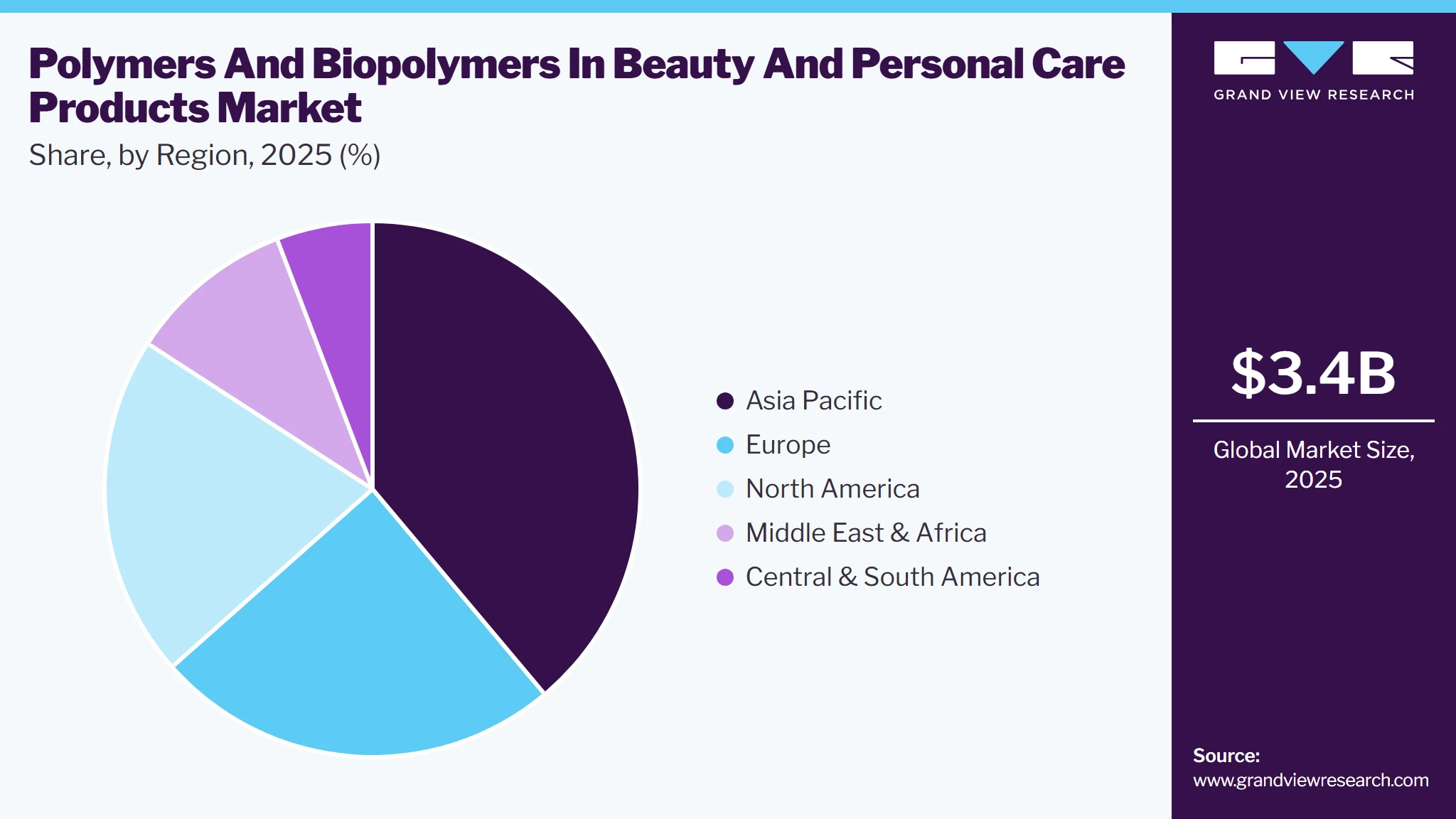
The polymers & biopolymers in beauty & personal care products market in North America is shaped by a rising shift toward sustainability and environmentally conscious choices. With consumers demanding effective and eco-friendly products, the region has registered a surge in the use of biopolymers, particularly in categories like skincare and haircare.
 To learn more about this report, Download Free Sample Report
U.S. Polymers & Biopolymers in Beauty & Personal Care Products Market Trends
The U.S. polymers & biopolymers in beauty & personal care products market is experiencing significant growth, driven primarily by the presence of a hub for innovation, leading to increased investment in research and development (R&D) to provide novel polymers & biopolymers for cosmetic applications.
Asia Pacific Polymers & Biopolymers in Beauty & Personal Care Products Market Trends
Asia Pacific dominated the polymers & biopolymers in beauty & personal care products market with the largest revenue share of 38.9% in 2025. The Asia Pacific market is witnessing rapid expansion due to increasing disposable incomes and a growing appetite for innovative beauty solutions. Furthermore, agricultural abundance in the Asia Pacific region provides a cost advantage for sourcing raw materials needed for biopolymer production, enabling companies to develop more affordable and sustainable product offerings.
China polymers
 To learn more about this report, Download Free Sample Report
& biopolymers in beauty & personal care products market is expected to grow at significant CAGR from 2026 to 2033. The availability of abundant natural resources, coupled with advanced manufacturing capabilities, enables the country to supply a diverse range of biopolymer ingredients. This trend not only boosts local economies through exports but also positions the country as a vital hub for innovation in the beauty and personal care products market, thus catering to a global audience that prioritizes sustainability and quality.
Europe Polymers & Biopolymers in Beauty & Personal Care Products Market Trends
The beauty and personal care industry in Europe is heavily influenced by regulatory pressures and a strong consumer focus on environmental sustainability. The European Union’s policies, such as the Green Deal and initiatives around circular economy practices, are creating significant demand for biopolymer integration.
Key Polymers Biopolymers In Beauty & Personal Care Products Company Insights
The market is highly competitive, with several key players dominating the landscape. Major companies include BASF, Greenitio, SARDA Bio Polymers PVT. LTD., Nouryon, Croda International Plc, Nucera Solutions, International Flavors & Fragrances Inc. (IFF), EcoSynthetix Inc., and Clariant, among others. The market is characterized by a competitive landscape with several key players driving innovation and market growth. Major companies in this sector are investing heavily in research and development to enhance the performance, cost-effectiveness, and sustainability of their products.
Key Polymers Biopolymers In Beauty & Personal Care Products Companies
The following key companies have been profiled for this study on the polymers biopolymers in beauty & personal care products market.
-
BASF
-
Greenitio
-
SARDA Bio Polymers PVT. LTD.
-
Nouryon
-
Croda International Plc
-
Nucera Solutions
-
International Flavors & Fragrances Inc. (IFF)
-
EcoSynthetix Inc.
-
Clariant
-
Evonik Industries
-
Lubrizol Corporation
-
Momentive Performance Materials
-
SNF
-
Ashland
-
NIPPON SHOKUBAI CO., LTD.
Competitive Benchmarking
Category
Operating Strategies
Competitive Edge
Weakness
Established Players (BASF, Nouryon, Croda International Plc, International Flavors & Fragrances Inc. (IFF), Clariant, Evonik Industries, Lubrizol Corporation, Momentive Performance Materials, SNF, Ashland, NIPPON SHOKUBAI CO., LTD.)
- Focus on strengthening their position in the polymers & biopolymers in beauty & personal care products market through the development and commercialization of high-performance functional polymers, specialty biopolymers, conditioning agents, rheology modifiers, film formers, and sustainable formulation ingredients.
- Strong emphasis is placed on expanding bio-based product portfolios, advancing ingredient innovation, improving formulation performance, and supporting clean beauty and premium cosmetic applications.
- Continuous investments in R&D, manufacturing capacity, strategic acquisitions, and collaborations with global beauty brands support long-term market expansion and commercial growth.
- Extensive expertise in specialty polymers, cosmetic formulation science, biotechnology, and advanced material development enables the production of high-performance ingredients for skincare, haircare, color cosmetics, and personal hygiene products.
- Strong global manufacturing capabilities, established customer relationships, broad product portfolios, regulatory expertise, integrated supply chains, and continuous innovation provide sustainable competitive differentiation and recurring revenue opportunities across the global beauty & personal care market.
- High research and development expenditures, stringent cosmetic regulatory compliance, and dependence on volatile petrochemical and bio-based feedstock prices expose companies to operational and financial risks.
- Market growth is influenced by evolving sustainability regulations, increasing demand for natural alternatives, and intense competition from regional ingredient manufacturers.
- Additionally, continuous investments in product innovation, regulatory approvals, and manufacturing modernization may pressure profitability and long-term market share.
Emerging Players (Greenitio, SARDA Bio Polymers Pvt. Ltd., Nucera Solutions, EcoSynthetix Inc.)
- Focus on expanding their presence in the polymers & biopolymers in beauty & personal care products market through bio-based polymer innovation, renewable raw materials, sustainable ingredient development, and customized formulation solutions.
- Emphasis is placed on commercializing biodegradable polymers, expanding regional operations, strengthening collaborations with cosmetic manufacturers, and developing environmentally friendly alternatives to conventional synthetic polymers.
- Strategic investments in technology development, pilot-scale production, and sustainability partnerships support market penetration and long-term growth.
- Strong expertise in renewable materials, bio-based polymer technologies, sustainable formulation development, and agile innovation enables these companies to address the growing demand for clean-label and environmentally responsible beauty ingredients.
- Their flexible business models, rapid product development capabilities, sustainability-focused strategies, and close collaboration with niche cosmetic brands strengthen their competitive positioning in high-growth specialty ingredient markets.
- Limited global manufacturing capacity, relatively lower financial resources, and dependence on successful commercialization of emerging technologies may restrict rapid international expansion.
- High investment requirements for production scale-up, regulatory compliance, and product validation, together with evolving customer qualification requirements and competition from established specialty chemical companies, can constrain long-term growth.
- Additionally, significant investments in capacity expansion, supply chain development, and global distribution networks are required to compete effectively with leading polymers and biopolymers manufacturers.
Recent Developments
-
In April 2024, Lubrizol Corporation launched a new sustainable product called Carbopol Fusion S-20 polymer, which is notable for being both biodegradable and effective. This polymer serves as a rheology modifier, enhancing the thickness and clarity of formulations, and making it suitable for skin cleansing and hair care products.
-
In January 2024, a startup called ApiotiX Technologies launched a new skincare ingredient derived from propolis, a natural substance produced by bees. This ingredient, known as Phenolic Acids Polymer Extract, is designed to enhance skin care products by providing anti-inflammatory, antioxidative, and antimicrobial benefits. The company claims that the product can also reduce the need for common preservatives in formulations.
Polymers & Biopolymers In Beauty & Personal Care Products Market Report Scope
Report Attribute
Details
Market size value in 2025
USD 3.4 billion
Market size value in 2026
USD 3.6 billion
Revenue forecast in 2033
USD 4.6 billion
Growth rate
CAGR of 3.7% from 2026 to 2033
Base year for estimation
2025
Historical data
2021 - 2024
Forecast period
2026 - 2033
Quantitative units
Revenue in USD million/billion, volume in kilotons, and CAGR from 2026 to 2033
Report coverage
Revenue forecast, company ranking, competitive landscape, growth factors, and trends
Segments covered
Function, region
Regional scope
North America; Europe; Asia Pacific; Latin America; Middle East & Africa
Key companies profiled
BASF; Greenitio; SARDA Bio Polymers PVT. LTD.; Nouryon; Croda International Plc; Nucera Solutions; International Flavors & Fragrances Inc. (IFF); EcoSynthetix Inc.; Clariant; Evonik Industries; Lubrizol Corporation; Momentive Performance Materials; SNF; Ashland; NIPPON SHOKUBAI CO., LTD.
Customization scope
Free report customization (equivalent up to 8 analysts' working days) with purchase. Addition or alteration to country, regional & segment scope.
Pricing and purchase options
Avail customized purchase options to meet your exact research needs. Explore purchase options
Global Polymers & Biopolymers In Beauty & Personal Care Products Market Report Segmentation
This report forecasts revenue growth at global, regional, and country levels and provides an analysis of the latest industry trends in each of the sub-segments from 2021 to 2033. For this study, Grand View Research has segmented global polymers & biopolymers in beauty & personal care products market report based on function and region:
 To learn more about this report, Download Free Sample Report
-
Function Outlook (Volume, Kilotons; Revenue, USD Million, 2021 - 2033)
-
Conditioning
-
Synthetic Polymers
-
Polyquaternium-10
-
Others
-
-
Biopolymers
-
Guar Derivatives
-
Others
-
Styling
-
-
Synthetic Polymers
-
PVP
-
PVP/VA
-
-
Biopolymers
-
-
Rheology Modifying
-
Synthetic Polymers
-
Carbomer
-
Polyacrylate Derivatives
-
Acrylates/C10-30 Alkyl Acrylate Cross-polymer
-
Others
-
-
Biopolymers
-
-
Styling
-
Synthetic Polymers
-
PVP
-
PVP/VA
-
-
Biopolymers
-
-
-
Regional Outlook (Volume, Kilotons; Revenue, USD Million, 2021 - 2033)
-
North America
-
U.S.
-
Canada
-
Mexico
-
-
Europe
-
Germany
-
France
-
UK
-
Italy
-
Spain
-
-
Asia Pacific
-
China
-
India
-
Japan
-
South Korea
-
Australia
-
-
Latin America
-
Brazil
-
-
Middle East & Africa
-
Research Methodology
The polymers & biopolymers in beauty & personal care products market figures in this report are based on a proven research process that combines executive interviews with secondary research from proprietary databases, company filings, and recognized regulatory and institutional sources. Market size is built through value-chain sizing - reconciling supply-side and demand-side estimates - and triangulated with bottom-up and top-down approaches. Every estimate passes multiple levels of expert validation before publication, with each polymers & biopolymers in beauty & personal care products segment quantified using the revenue-capture definitions in the table below.
Segment Definition
Segment – Function
Revenue capture definition
Conditioning
Revenue is captured through the incorporation of polymers and biopolymers as conditioning agents in hair care and skincare formulations to improve softness, smoothness, moisture retention, manageability, and sensory performance. Demand is driven by increasing consumer preference for premium personal care products, growing adoption of multifunctional ingredients, rising demand for sulfate-free and clean-label formulations, and continuous innovation in bio-based conditioning polymers.
Styling
Revenue is captured through the use of polymers and biopolymers in hair styling products, including gels, mousses, sprays, creams, and waxes, to provide hold, flexibility, humidity resistance, film formation, and long-lasting styling performance. Growth is supported by rising demand for high-performance styling products, increasing grooming awareness, expanding premium hair care markets, and the development of sustainable and biodegradable styling polymers.
Rheology Modifying
Revenue is captured through the utilization of polymers and biopolymers as rheology modifiers that enhance viscosity, stability, texture, suspension, and spreadability in skincare, hair care, cosmetics, and personal care formulations. Demand is driven by increasing development of advanced cosmetic formulations, growing preference for superior sensory attributes, rising use of natural thickening agents, and continuous innovation in bio-based rheology modifiers that improve formulation performance and stability.
Estimation Model
Layer No.
Layer Name
Key Question
Description
1
Top-Down Polymers & Biopolymers in Beauty & Personal Care Products Demand Assessment Layer
What defines market boundaries?
This layer begins with global demand for beauty & personal care products across skincare, haircare, color cosmetics, oral care, fragrances, and personal hygiene applications. Demand is filtered based on cosmetic production, consumer spending on personal care, premiumization trends, clean beauty adoption, sustainability initiatives, regulatory compliance, and increasing use of functional ingredients across major regional markets.
2
Function and Application Validation Layer
Where is demand generated?
This layer evaluates demand distribution across conditioning, styling, rheology modifying, film forming, emulsifying, and other functional applications of polymers and biopolymers. Market revenue is aligned with critical formulation requirements including viscosity control, texture enhancement, stability, moisture retention, sensory performance, ingredient compatibility, regulatory compliance, and increasing demand for high-performance and sustainable beauty formulations.
3
Material and Formulation Conversion Layer
Who captures market revenue?
This layer converts functional demand into the polymers & biopolymers in beauty & personal care products market revenue by applying material mix ratios across synthetic polymers, natural polymers, and biopolymers. Revenue allocation considers raw material selection, formulation performance, product functionality, sustainability profile, manufacturing costs, regulatory acceptance, innovation intensity, pricing, and value-added ingredient capabilities across the global beauty & personal care value chain.
4
Regional Commercial Cross-Check Layer
How are assumptions validated?
This layer validates demand concentration by comparing Asia Pacific's leadership in cosmetics manufacturing and consumer spending; Europe's demand driven by stringent cosmetic regulations, sustainability initiatives, and clean beauty trends; and North America's growth supported by premium personal care consumption, ingredient innovation, and increasing demand for bio-based formulations. It also evaluates emerging opportunities across Latin America and the Middle East & Africa, supported by rising disposable incomes, expanding beauty industries, increasing consumer awareness, and growing adoption of sustainable personal care products.
Delivered Customizations
This report has been delivered with the following In-depth customizations
Client Request
Customization Delivered
Value Adds
Regional Segmentation
Comprehensive analysis of the Polymers & Biopolymers in Beauty & Personal Care Products Market across North America, Europe, Asia Pacific, Latin America, and the Middle East & Africa, including country-level demand assessment, regulatory landscape, production trends, consumption patterns, raw material availability, and end-use industry analysis.
Enables clients to identify high-growth regional markets, optimize geographic expansion strategies, prioritize investments, and align product portfolios with regional regulatory and consumer preferences.
Competitive Benchmarking
Comparative assessment of leading manufacturers based on product portfolio, bio-based innovation, manufacturing footprint, R&D capabilities, sustainability initiatives, strategic partnerships, mergers & acquisitions, new product launches, application expertise, and competitive positioning.
Supports competitive intelligence, benchmarking against industry leaders, identification of market gaps, partnership opportunities, and long-term strategic planning.
Opportunity Assessment
Strategic evaluation of emerging growth opportunities across biodegradable polymers, biotechnology-derived ingredients, clean beauty formulations, sustainable packaging, multifunctional polymers, premium personal care applications, and high-growth regional markets supported by evolving consumer and regulatory trends.
Enables identification of future investment opportunities, innovation priorities, new product development strategies, market entry potential, and long-term revenue growth avenues in the evolving beauty & personal care ingredients market.
Frequently Asked Questions About This Report
The polymers & biopolymers in beauty & personal care products market was estimated at around USD 3.4 billion in the year 2025 and is expected to reach around USD 3.6 billion in 2026.
The polymers & biopolymers in beauty & personal care products market is expected to grow at a compound annual growth rate of 3.7% from 2026 to 2033 to reach around USD 4.6 billion by 2033.
The key players in the polymers & biopolymers in beauty & personal care products market are BASF; Greenitio; SARDA Bio Polymers PVT. LTD.; Nouryon; Croda International Plc; Nucera Solutions; International Flavors & Fragrances Inc. (IFF); EcoSynthetix Inc.; Clariant; Evonik Industries; Lubrizol Corporation; Momentive Performance Materials; SNF; Ashland; NIPPON SHOKUBAI CO., LTD.
The styling segment, based on function, is expected to grow at a CAGR of 4.2% for the forecast period.
Growing consumer awareness of safe and natural ingredients is creating significant growth opportunities for the polymers & biopolymers in beauty & personal care products market.
The global polymers & biopolymers in beauty & personal care products market is driven by the increasing demand for advanced materials across key applications, including film formers, rheology modifiers, conditioning agents, delivery systems, and packaging. Rising consumer preference for high-performance, sustainable, and multifunctional beauty formulations, coupled with continuous product innovation and expanding personal care manufacturing, is accelerating market growth. Increasing emphasis on product efficacy, enhanced sensory performance, and eco-friendly packaging further supports market expansion throughout the forecast period.
The Asia Pacific polymers & biopolymers in beauty & personal care products market accounted for the largest share of 38.9% market size in 2025.
Based on function, the rheology modifying segment accounted for the share of 33.3% in 2025. Rising demand for stable, high-performance beauty and personal care formulations, coupled with increasing preference for premium sensory attributes, is driving rheology modifying polymer adoption owing to its superior viscosity control, formulation stability, texture enhancement, suspension capability, and broad application across skincare, haircare, and cosmetic products.
The conditioning led the polymers & biopolymers in beauty & personal care products market in 2025 with a 46.8% share. Growing demand for high-performance, multifunctional personal care formulations is driving conditioning polymer adoption owing to its superior moisture retention, improved softness, enhanced manageability, anti-static properties, excellent sensory performance, and broad compatibility across hair care and skincare applications.
About the Author(s)
Plastics, Polymers & Resins Research Team
Bulk Chemicals · Plastics, Polymers & ResinsThis report was authored by the plastics, polymers & resins research team at Grand View Research - comprising two research analysts, one senior research analyst, and one industry expert - with specialized expertise in the plastics, polymers & resins segment of the bulk chemicals industry. All findings are based on proprietary bulk chemicals databases, executive interviews, and regulatory analysis, subject to internal peer review prior to publication.
Last Updated:
Speak to Analyst

Customize this report to your needs - add regions, segments, or data points, with 20% free customization.
Or view our licence options:


ISO 9001:2015 & 27001:2022 Certified
We are GDPR and CCPA compliant! Your transaction & personal information is safe and secure. For more details, please read our privacy policy.


