
- Home
- »
- Consumer F&B
- »
-
Popcorn Market Size, Share & Trends Report, 2026-2033GVR Report cover

Popcorn Market (2026 - 2033)
Size, Share & Trends Analysis Report By Type (Ready-to-Eat Popcorn, Microwave Popcorn), By Distribution Channel (B2B, B2C), By Region (North America, Europe, Asia Pacific, Central & South America, Middle East & Africa), And Segment Forecasts
Market Size, 2025
$7.0BMarket Estimate, 2026
$7.5BMarket Forecast, 2033
$13.6BCAGR, 2026–2033
8.9%Popcorn Market Summary
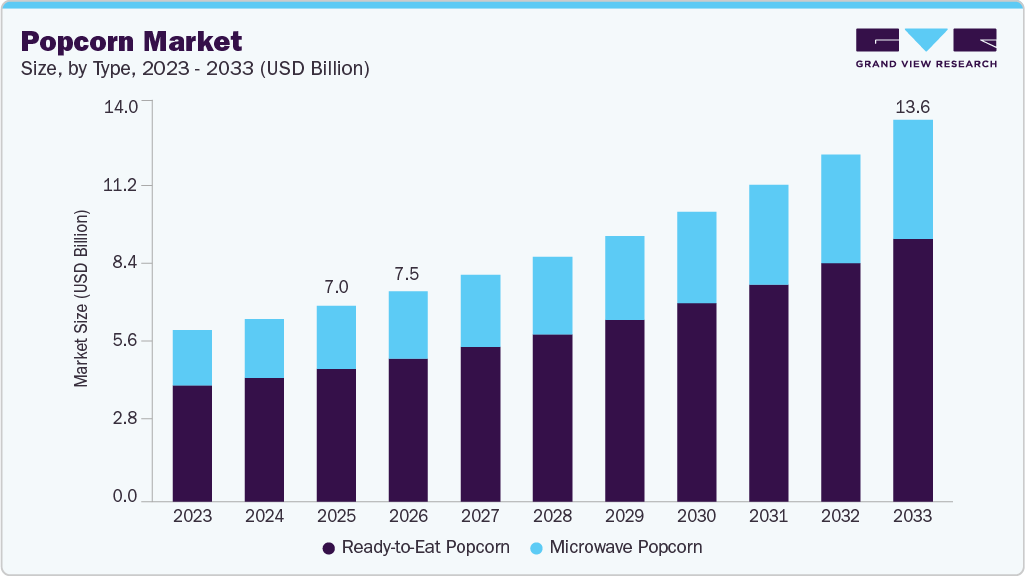
The global popcorn market size was valued at USD 7.0 billion in 2025 and is projected to grow from USD 7.5 billion in 2026 to USD 13.6 billion by 2033, at a CAGR of 8.9% from 2026 to 2033. North America dominated the global market, with a share of 47.9% in 2025. The market growth relies on the global consumer trend toward well-being. Additionally, the industry is being driven by shifting consumer behavior patterns for food and beverages globally.
 Source: Grand View Research, IR Documents, Primary Interviews, Paid DatabasesTo learn more about this report,
 Download Free Sample Report
Key Market Trends & Insights
- By type: Ready-to-eat popcorn segment held the largest market share of 68.1% in 2025.
- By distribution channel: B2C segment held the largest market share of 61.4% in 2025.
Regional Highlights
- Largest regional market: North America (47.9% revenue share, 2025)
- Fastest-growing regional market: Asia Pacific (highest CAGR, 2026-2033)
Market Size & Forecast
- Market size in 2025: USD 7.0 Billion
- Estimated market size in 2026: USD 7.5 Billion
- Projected market size by 2033: USD 13.6 Billion
- CAGR (2026-2033): 8.9%
Three ways to get this report
Buy it, customize it, or ask a question.Ask an Analyst
Analyst response in 1 business day
- AccessReport author, directly
- Reply timeWithin 1 working day
- No sales callDirect answer only
- FormatEmail reply
- CostFree, no cost
Get the Full Report
What the study covers
- FormatsPDF · Excel · Dashboard
- Timeline2026–2033 annual, 2025 base
- Coverage20+ countries, 5 regions
- Companies10+ key players profiled
Customize the Report
20% free customization
- IncludeCountries, segments, points
- TailorTo your product definition
- ExtendDeeper competitor detail
- OrA fully bespoke study
- Turnaround5–10 working days
Personal health and sustainable development, once relegated to the category of "niche" interests, are now at the forefront of buyers' minds, especially when it comes to food purchases. Demand for healthy, convenient, and sustainably-produced foods is on the rise, and plant-based proteins are more popular than ever. People are making more personal purchasing decisions based on sustainability and are becoming increasingly health-conscious due to the pandemic, resulting in a significant shift in consumer expectations. Additionally, the demand for popcorn with various flavors is also driving the market growth.
 To learn more about this report, Download Free Sample Report
The global demand for ready-to-eat snacks is increasing, significantly affecting the food and beverage market. Ready-to-eat (RTE) products dominate the industry. An expanding range of exciting new flavors, consistent product development, and innovation attract consumers and contribute to the increased demand for gourmet-flavored RTE popcorn. Sea salt flavor, for instance, is becoming increasingly popular, and PepsiCo, Inc. is capitalizing on this trend with its Smartfood Delight Sea Salt Popcorn. Companies in the RTE popcorn industry are taking steps to increase their market share through attractive product packaging, a diverse product portfolio, and the promotion of products on online platforms.
Flavor innovations have played a significant role in grabbing consumers' attention. Popcorn manufacturers have introduced a wide range of new and bold flavors, from sweet varieties like caramel and chocolate to savory options such as cheddar, truffle, and sriracha. These diverse offerings cater to a range of consumer preferences, from those seeking indulgence to those seeking healthier alternatives. Additionally, globally inspired flavors like Mexican chili lime or Japanese matcha cater to the increasing consumer interest in trying multicultural and exotic tastes, creating a broader appeal across markets.
Health-focused flavor innovations are also gaining traction, with brands offering lower-calorie or more natural flavorings, such as sea salt and olive oil, to meet the needs of health-conscious consumers. Meanwhile, limited-edition and seasonal flavors are helping brands create excitement and urgency among snackers. Seasonal offerings, like pumpkin spice in the fall or peppermint during the holidays, capture attention and drive purchases by appealing to the desire for novelty and timely treats. These new flavors, along with creative marketing and packaging strategies, keep consumers engaged and curious, driving continuous growth in the popcorn industry.
Market Dynamics
The global popcorn market is experiencing strong growth, primarily driven by the rising consumer inclination toward convenient, on-the-go snacking options and the increasing demand for healthier snack alternatives. As modern lifestyles become more fast-paced, consumers are actively seeking ready-to-eat snacks that require minimal preparation while still offering taste, variety, and indulgence. Popcorn, a versatile, relatively low-calorie snack compared to traditional fried alternatives, has gained significant popularity across diverse age groups and regions.
One of the major growth drivers is the expansion of the “better-for-you” snack segment, where consumers are increasingly shifting toward products perceived as healthier, including air-popped, low-fat, gluten-free, and non-GMO popcorn varieties. The growing awareness regarding health and wellness, coupled with rising concerns over obesity and lifestyle-related disorders, has encouraged consumers to replace high-fat snacks with popcorn-based alternatives. In addition, the introduction of innovative flavors such as cheese blends, caramel, spicy variants, and exotic seasoning combinations has significantly enhanced product appeal and expanded the consumer base.
Increasing scrutiny of packaged snack products, driven by rising consumer health consciousness, is emerging as a major restraint on the global popcorn market. While popcorn in its natural form is often considered a healthier snacking option, many commercially available variants are heavily processed and contain added butter, sugar, salt, artificial flavoring agents, and preservatives. These additives raise concerns among health-conscious consumers about excessive sodium intake, high calorie intake, and potential long-term lifestyle-related health risks, leading to restrained consumption of flavored and packaged popcorn products.
Consumer Insights for Popcorn
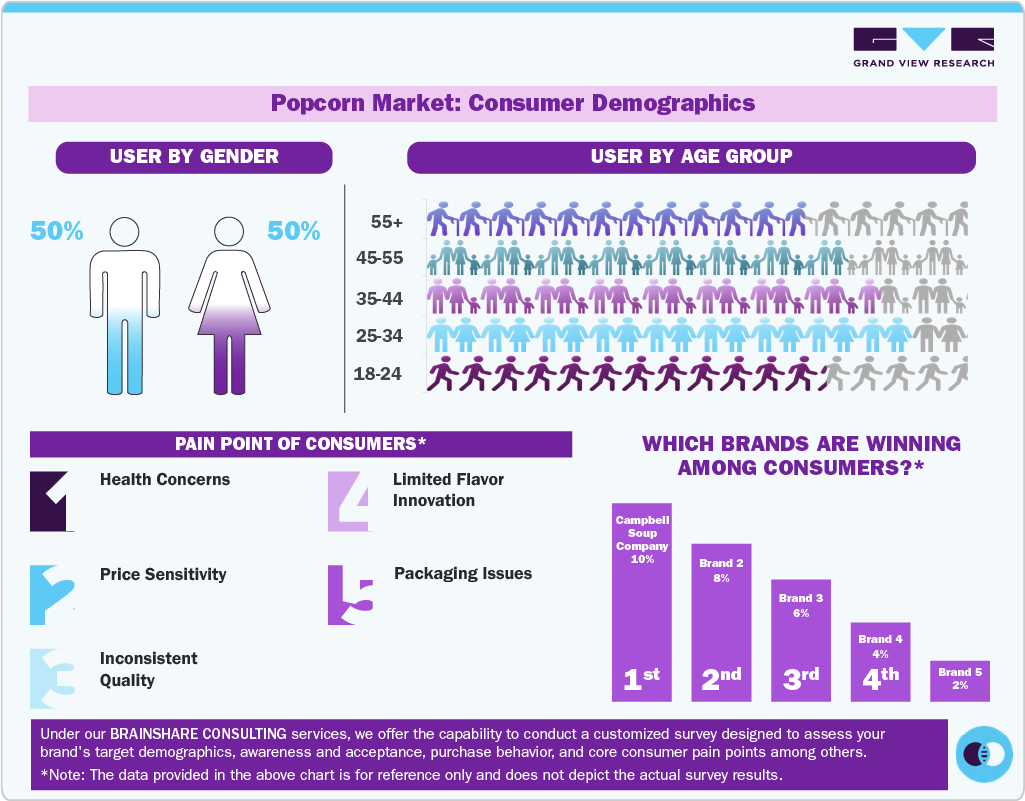
The RTE popcorn market continues to gain strong consumer traction as buyers increasingly seek convenient, ready-to-eat snacking formats that fit busy lifestyles. Health-conscious consumers are gravitating toward low-calorie, clean-label, and air-popped variants, while premium flavors such as caramel, cheese blends, and spicy fusions attract indulgence-driven buyers. Younger consumers, especially Gen Z, prefer portable packs and innovative textures that offer both taste and guilt-free satisfaction. Rising movie-at-home trends and online snacking purchases further boost demand, making RTE popcorn a versatile, impulse-friendly FMCG product.
 To learn more about this report, Download Free Sample Report
Growing awareness about healthy homemade snacks is positively influencing consumer behavior, contributing to the expansion of the popcorn market. Consumers are increasingly opting for home-prepared popcorn, as it enables them to control the amount of oil, seasoning, and calories, aligning with wellness-oriented lifestyles. Families and young adults appreciate the freshness, customization, and cost-effectiveness of home-popped options.
Type Insights
Ready-to-eat popcorn led the popcorn industry, accounting for 68.1% of revenue in 2025. The rising consumption of RTE popcorn at home and in theatres, coupled with a rise in the spending capacity of consumers, is expected to drive the demand for RTE popcorn. The demand is also likely to be driven by the rising health consciousness among individuals. Additionally, a growing range of new flavors, consistent product development, and innovations attract consumers. In November 2021, AMC planned to open five popcorn stores in the first half of 2022, or counters and kiosks in shopping malls in the U.S., including kiosks in select retail locations in malls across the nation.
 To learn more about this report, Download Free Sample Report
The microwave popcorn market is expected to grow at a CAGR of 8.6% from 2026 to 2033. Microwave popcorn offers a quick, easy snack that takes minutes to prepare, appealing to busy consumers seeking a hassle-free way to enjoy popcorn at home. Microwave popcorn often comes in pre-measured servings, making it easier for consumers to control portion sizes. Additionally, healthier microwave options are available, such as low-calorie or air-popped varieties, catering to health-conscious snackers. The availability of a wide range of flavors, from classic butter to gourmet and healthier options, has made microwave popcorn more appealing to a broader audience.
The microwave popcorn industry is also benefiting from the rise of at-home entertainment, as consumers increasingly prefer convenient snacks for movie nights and casual gatherings. Growing retail penetration, attractive promotional offers, and the expansion of private-label brands are making microwave popcorn more accessible and affordable. Manufacturers are focusing on clean-label formulations and innovative packaging to enhance freshness, reduce waste, and meet evolving consumer expectations for healthier, flavorful, and easy-to-prepare snacking options.
Distribution Channel Insights
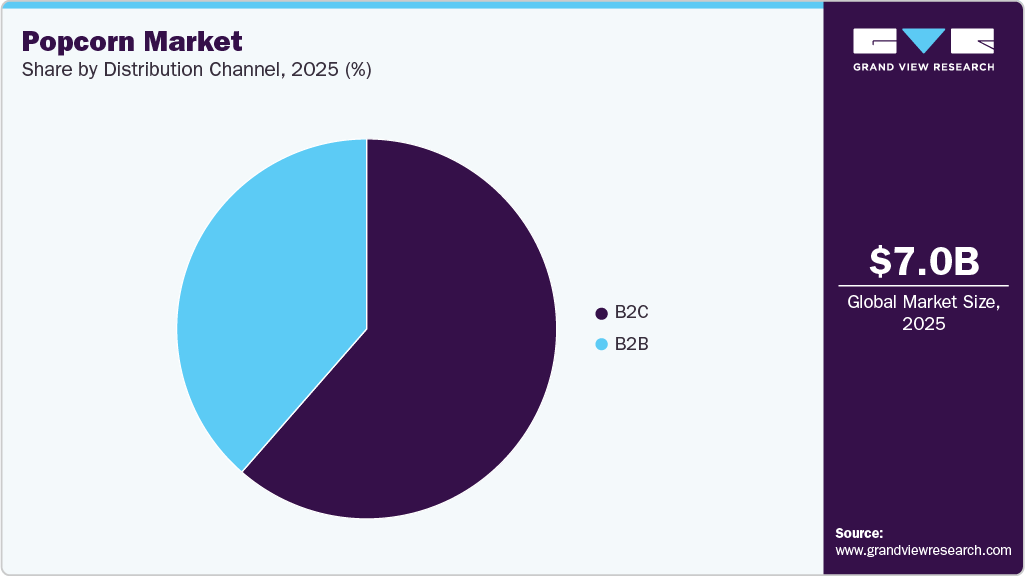
B2C sales led the popcorn market, accounting for 61.4% of revenue in 2025. People's buying habits have been significantly altered by the internet distribution channel, as well as by a variety of options available at supermarkets/hypermarkets & convenience stores, which offer benefits such as doorstep service, simple payment options, substantial savings, and availability of a wide choice of items on a single platform. Due to increased internet usage and customer preference for shopping apps, major market participants are rapidly building e-commerce websites in potential areas. Consumer inclination towards e-commerce is expected to drive growth in the segment. In addition, the prices of products in supermarkets/hypermarkets vary according to brand, and customers have the option of selecting from a variety of brands to fit their budget. Consumer demand for salty snacks, including popcorn, has increased in product portfolio expansions at supermarkets and hypermarkets.
 To learn more about this report, Download Free Sample Report
Sales of popcorn through B2B channels are expected to grow with a CAGR of 8.3% from 2026 to 2033. Popcorn is gaining popularity in the hospitality sector, including hotels, resorts, and event catering. Businesses in these sectors often offer popcorn as a complementary or added-value snack for guests, helping to enhance the customer experience. Popcorn is also being introduced into catering menus for corporate events, conferences, and parties due to its affordability and universal appeal. The growing number of businesses in the hospitality industry seeking unique snacks for their offerings has boosted B2B popcorn sales. Additionally, popcorn remains a staple snack for movie theaters, driving consistent demand in the B2B space. As the cinema industry recovers and grows post-pandemic, theaters are stocking up on bulk popcorn to meet increasing foot traffic.
Regional Insights
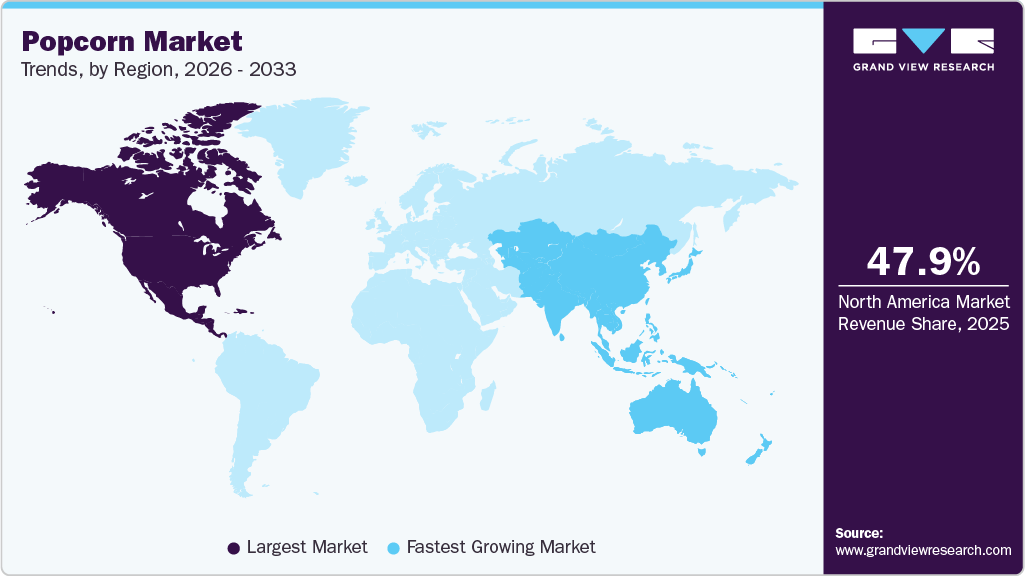
The North America popcorn market accounted for a revenue share of 47.9% in 2025. The rise of streaming platforms like Netflix, Hulu, and Disney+ has transformed the way North Americans consume entertainment, with many opting for home-based movie nights and binge-watching sessions. Popcorn, long associated with cinema culture, has naturally become a go-to snack for these occasions. The convenience of microwave and ready-to-eat (RTE) popcorn, along with its affordability, makes it an easy choice for families and individuals seeking a traditional snack to enjoy while watching movies or TV shows at home.
 To learn more about this report, Download Free Sample Report
Additionally, the growing interest in home cooking and DIY snacking has supported the popcorn seeds market in the region, as consumers seek fresher, customizable alternatives to packaged products. Many health-conscious buyers prefer popping kernels at home to control oil, seasoning, and portion sizes. Retailers are expanding their offerings of organic, non-GMO, and specialty popcorn seeds. At the same time, the increasing use of air poppers and stovetop methods continues to drive demand among households seeking healthier, more flavorful snacking experiences.
U.S. Popcorn Market Trends
The popcorn industry in the U.S. is expected to grow at a CAGR of 7.9% from 2026 to 2033. As American consumers increasingly prioritize healthier snack options, popcorn has gained popularity due to its low-calorie, high-fiber profile. Many people perceive popcorn as a healthier alternative to chips, candy, or other processed snack foods. Air-popped and lightly flavored popcorn varieties align with health trends, particularly those emphasizing clean-label ingredients, non-GMO, gluten-free, and whole-grain products. This has led to increased demand, particularly among health-conscious individuals seeking satisfying yet guilt-free snack options.
Europe Popcorn Market Trends
The Europe popcorn industry is expected to grow at a CAGR of 8.8% from 2026 to 2033. European consumers are becoming more health-conscious and seeking snacks that align with their nutritional goals. Popcorn, particularly air-popped or lightly seasoned varieties, is perceived as a healthier alternative to traditional snacks like crisps or sugary treats. Its low-calorie, high-fiber content appeals to those looking for a guilt-free option that still provides satiety. Many European brands are also promoting popcorn as a gluten-free and whole-grain snack, making it attractive to individuals following specific diets or lifestyle choices.
Asia Pacific Popcorn Market Trends
The Asia Pacific popcorn industry is expected to grow at a CAGR of 10.7% from 2026 to 2033. The Asian consumers are increasingly drawn to innovative and gourmet popcorn flavors, moving beyond classic butter or salted varieties. Unique offerings such as truffle, Mediterranean herbs, chili, and caramel have expanded the appeal of popcorn, catering to a wide range of taste preferences. The growing interest in indulgent, premium snacks has fueled the demand for artisanal and gourmet popcorn, particularly among younger consumers and food enthusiasts who seek out diverse flavor experiences.
Key Popcorn Company Insights
The presence of numerous well-established and emerging players characterizes the global popcorn market. Manufacturers are implementing a range of strategic initiatives to stay ahead of evolving consumer demands and market trends. For instance, in August 2023, Joe & Seph's launched a new range of limited-edition air-popped popcorn flavors inspired by popular baked treats. This exciting collection includes Chocolate Fudge Cake, featuring chocolate caramel with cream cheese and vanilla; Millionaire’s Shortbread, coated in smooth caramel with shortbread and dark chocolate; Birthday Cake, covered in smooth caramel with raspberry and cream cheese frosting; and Peanut Butter Blondie, wrapped in white caramel sauce with crunchy peanut butter.
Key Popcorn Companies:
The following are the leading companies in the popcorn market. These companies collectively hold the largest market share and dictate industry trends.
- Campbell Soup Company
- PepsiCo Inc.
- Conagra Brands, Inc.
- Weaver Popcorn, Inc.
- Quinn Foods LLC
- The Hershey Company
- Eagle Family Foods Group LLC
- PROPER Snacks
- JOLLY TIME
- Intersnack Group GmbH & Co. KG.
Competitive Benchmarking
Operating Strategies
Competitive Edge
Weaknesses
Mature Players: Nestle S.A.
- Mature popcorn players diversify into healthy variants, innovative flavors, and portion-controlled convenient snack formats.
- They focus on retail partnerships, brand positioning, and automation to improve efficiency, while expanding distribution channels, strengthening supply chains, ensuring compliance, and strategically entering emerging markets.
- Mature popcorn players benefit from strong brand equity, wide distribution networks, economies of scale, advanced processing capabilities, and established customer loyalty across global markets.
- Mature popcorn players face limited agility, slower innovation cycles, high operational costs, and difficulty adapting quickly to changing consumer preferences and niche demand trends.
Emerging Players: Arcor
- Emerging popcorn players focus on niche-flavored, organic, or ready-to-eat products, using local sourcing and cost-efficient production to differentiate and grow.
- Emerging popcorn players gain an advantage through agility, niche product innovation, localized sourcing, flexible pricing strategies, and quick responsiveness to evolving consumer preferences and trends.
- Emerging popcorn players struggle with limited brand recognition, constrained distribution networks, lower economies of scale, inconsistent product quality, and vulnerability to aggressive competition from established brands.
Recent Developments
-
In April 2026, PROPER Snacks introduced Box Fresh Popcorn, a microwaveable product that pops open into its own serving box after approximately two minutes. The product launched in Sweet & Salty and Sea Salt varieties, offering a convenient, ready-to-serve format for at-home consumption.
-
In February 2026, The Hershey Company reported that SkinnyPop ready-to-eat popcorn retail sales increased by more than 8% in the fourth quarter of 2025 compared with the prior-year period. Growth was attributed to core product sales velocity and innovation. The company continues to position SkinnyPop within its broader salty-snacks portfolio.
-
In June 2024, Netflix expanded beyond streaming by launching its line of popcorn called "Netflix Now Popping." The popcorn comes in two flavors: "Cult Classic Cheddar Kettle Corn" and "Swoonworthy Cinnamon Kettle Corn," priced at USD 4.50 per bag. This initiative is part of Netflix's broader strategy to enhance its brand presence, which includes plans for "Netflix Houses" and a pop-up restaurant in Los Angeles featuring dishes from its shows.
-
In October 2024, 4700BC launched a new gourmet popcorn range in collaboration with Netflix, featuring flavors inspired by popular Netflix shows. The collection includes “Caramel & Cheese,” “Spicy Jalapeno,” and “Truffle & Cheese.” This partnership aims to enhance the viewing experience for Netflix subscribers, offering unique snack options that complement their favorite shows.
Popcorn Market Report Scope
Report Attribute
Details
Market size in 2025
USD 7.0 billion
Estimated market size in 2026
USD 7.5 billion
Projected market size by 2033
USD 13.6 billion
Growth rate
CAGR of 8.9% from 2026 to 2033
Actuals
2021 - 2025
Forecast period
2026 - 2033
Quantitative units
Revenue in USD million/billion and CAGR from 2026 to 2033
Report coverage
Revenue forecast, company ranking, competitive landscape, growth factors, and trends
Segments covered
Type, distribution channel, region
Regional scope
North America; Europe; Asia Pacific; Central & South America; Middle East & Africa
Country scope
U.S.; Canada; Mexico; Germany; UK; France; Italy; Spain; China; Japan; India; Australia & New Zealand; South Korea; Brazil; Argentina; South Africa
Key companies profiled
Campbell Soup Company; PepsiCo Inc.; Conagra Brands, Inc.; Weaver Popcorn Inc.; Quinn Foods LLC; The Hershey Company; Eagle Family Foods Group LLC; PROPER Snacks; JOLLY TIME; Intersnack Group GmbH & Co. KG
Customization scope
Free report customization (equivalent to up to 8 analyst working days) with purchase. Addition or alteration to country, regional & segment scope.
Pricing and purchase options
Avail customized purchase options to meet your exact research needs. Explore purchase options Global Popcorn Market Report Segmentation
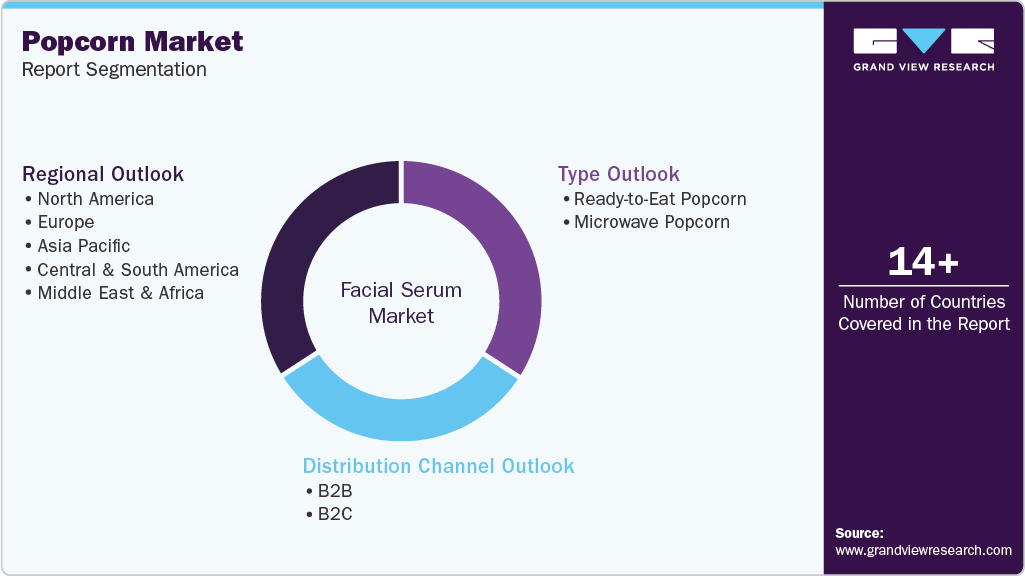
This report forecasts revenue growth at the global, regional, and country levels and provides an analysis of the latest industry trends and opportunities in each of the sub-segments from 2021 to 2033. For this study, Grand View Research has segmented the global popcorn market report based on type, distribution channel, and region:
 To learn more about this report, Download Free Sample Report
-
Type Outlook (Revenue, USD Million, 2021 - 2033)
-
Ready-to-Eat Popcorn
-
Microwave Popcorn
-
-
Distribution Channel Outlook (Revenue, USD Million, 2021 - 2033)
-
B2B
-
B2C
-
Supermarket/Hypermarket
-
Convenience Stores
-
Online
-
Others
-
-
-
Regional Outlook (Revenue, USD Million, 2021 - 2033)
-
North America
-
U.S.
-
Canada
-
Mexico
-
-
Europe
-
Germany
-
UK
-
France
-
Italy
-
Spain
-
-
Asia Pacific
-
China
-
Japan
-
India
-
Australia & New Zealand
-
South Korea
-
-
Central & South America
-
Brazil
-
Argentina
-
-
Middle East & Africa
-
South Africa
-
-
Delivered Customizations
This report has been delivered with the following In-depth customizations
Client Request
Customization Delivered
Value Adds
Risk Assessment & Market Barriers Analysis
Delivered a detailed assessment of key market risks and entry barriers within the global popcorn market, including supply chain disruptions, raw material price volatility, regulatory constraints, and shifting consumer preferences. The analysis also highlights competitive intensity, challenges to brand dominance, and regional trade limitations that impact overall market expansion.
Enabled stakeholders to proactively identify and mitigate key market risks by providing structured insights into regulatory hurdles, supply chain vulnerabilities, and competitive pressures. The analysis supports informed decision-making, reduces entry uncertainties, and helps develop resilient long-term growth strategies in the global popcorn market.
Comprehensive Price Analysis
Delivered a comprehensive evaluation of pricing dynamics across the global popcorn market, covering historical pricing trends, cost structure analysis, and margin distribution across value chains. The study further provides insights into raw material cost fluctuations, packaging influences, regional price variations, and forecasted pricing trends that impact market profitability.
Provided a data-driven pricing framework that helps clients understand cost structures, margin behavior, and regional pricing variations. This enables better pricing optimization, improved profitability planning, and strategic positioning across different market segments while supporting accurate forecasting and investment decision-making.
Market Entry Strategy
Delivered a structured market entry strategy for the global popcorn market, outlining optimal entry modes, distribution channel selection, and competitive positioning approaches. The analysis also includes target consumer segmentation, regional prioritization, branding strategies, and partnership opportunities to support effective and scalable market penetration.
Equipped clients with actionable insights to accelerate market penetration by identifying optimal entry routes, high-potential regions, and effective distribution models. The strategy reduces entry risk, enhances competitive positioning, and supports scalable expansion by aligning business objectives with market demand dynamics and consumer behavior trends.
Frequently Asked Questions About This Report
The key factors that are driving the popcorn market include growing popcorn health and wellness trends among consumers globally, increasing millennial interest in salty snacks, and shifting consumer behavior patterns for food and beverage products.
Some of the key players operating in the popcorn market include Campbell Soup Company, PepsiCo Inc., Conagra Brands, Inc., Weaver Popcorn, Inc., Quinn Foods LLC, The Hershey Company, Eagle Family Foods Group LLC, PROPER Snacks, JOLLY TIME, and Intersnack Group GmbH & Co. KG.
The ready-to-eat popcorn segment led the market with a 68.1% revenue share in 2025.
The B2C segment held the largest revenue share of 61.4% in 2025.
North America dominated the market with a 47.9% revenue share in 2025.
The global popcorn market size was valued at USD 7.0 billion in 2025 and is estimated at USD 7.5 billion for 2026.
The global popcorn market is expected to grow at a CAGR of 8.9% from 2026 to 2033, reaching USD 13.6 billion by 2033.
Asia Pacific is the fastest-growing region over the forecast period.
About the Author(s)
Consumer F&B Research Team
Consumer Goods · Consumer F&BThis report was authored by the consumer f&b research team at Grand View Research - comprising two research analysts, one senior research analyst, and one industry expert - with specialized expertise in the consumer f&b segment of the consumer goods industry. All findings are based on proprietary consumer goods databases, executive interviews, and regulatory analysis, subject to internal peer review prior to publication.
Last Updated:
Speak to Analyst

Customize this report to your needs - add regions, segments, or data points, with 20% free customization.
Or view our licence options:


ISO 9001:2015 & 27001:2022 Certified
We are GDPR and CCPA compliant! Your transaction & personal information is safe and secure. For more details, please read our privacy policy.


