
- Home
- »
- Specialty Glass, Ceramic & Fiber
- »
-
Porous Ceramic Market Size & Share Report, 2026-2033GVR Report cover

Porous Ceramic Market (2026 - 2033)
Size, Share & Trends Analysis Report By Raw Material (Alumina, Titanate, Zirconate, Ferrite, Aluminum Nitride), By Product (Filtration, Insulation), By Application (Automotive, Medical, Industrial), By Region, And Segment Forecasts
Market Size, 2025
$9.4BMarket Estimate, 2026
$10.5BMarket Forecast, 2033
$23.3BCAGR, 2026–2033
12.0%Porous Ceramic Market Summary
The global porous ceramic market size was valued at USD 9.4 billion in 2025 and is projected to grow from USD 10.5 billion in 2026 to USD 23.3 billion by 2033, at a CAGR of 12.0% from 2026 to 2033. Asia Pacific dominated the global market, accounting for the largest revenue share of 43.8% in 2025. The growing demand for filtration products, coupled with the increasing penetration of products in medical devices and equipment, is driving market growth.
Key Market Trends & Insights
- By raw material: Alumina ceramics segment held the largest market share of over 43.0% in 2025.
- By application:Automotive application segment dominated the market, with a revenue share of over 30.0% in 2025.
- By product: Filtration segment held the largest market share of over 34.0% in 2025.
Regional Highlights
- Largest regional market: Asia Pacific (43.8% revenue share, 2025)
- Fastest-growing regional market: Asia Pacific (highest CAGR, 2026-2033)
Market Size & Forecast
- Market size in 2025: USD 9.4 Billion
- Estimated market size in 2026: USD 10.5 Billion
- Projected market size by 2033: USD 23.3 Billion
- CAGR (2026-2033): 12.0%
Three ways to get this report
Buy it, customize it, or ask a question.Ask an Analyst
Analyst response in 1 business day
- AccessReport author, directly
- Reply timeWithin 1 working day
- No sales callDirect answer only
- FormatEmail reply
- CostFree, no cost
Get the Full Report
What the study covers
- FormatsPDF · Excel · Dashboard
- Timeline2026–2033 annual, 2025 base
- Coverage20+ countries, 5 regions
- Companies10+ key players profiled
Customize the Report
20% free customization
- IncludeCountries, segments, points
- TailorTo your product definition
- ExtendDeeper competitor detail
- OrA fully bespoke study
- Turnaround5–10 working days
The rising demand for high-quality, functional safety in medical devices and equipment to meet stringent approval standards and withstand challenges in healthcare practice has increased the need for reliable materials, such as porous ceramics. Thus, wide product usage in the medical devices industry is anticipated to augment the market growth over the forecast period. The U.S. is a prominent producer and consumer of the market. High-purity porous ceramics have a broad range of applications in microelectronics, including piezoelectric devices, custom electronic components, and substrates. The growing demand for electronic devices, coupled with the ongoing technological advancements in the U.S., is projected to propel market growth over the forecast period.The U.S. offers an advanced network of electronics and semiconductor manufacturing clusters. Factors such as a strong business & technical environment, a stringent intellectual property rights regime that protects patents & trademarks, and favorable programs are augmenting investment in the U.S. electronics and semiconductor industry, thereby benefiting market growth.
 Source: Grand View Research, IR Documents, Primary Interviews, Paid DatabasesTo learn more about this report,
 Download Free Sample Report
 For instance, in September 2025, the U.S. government continued to accelerate domestic semiconductor and microelectronics innovation through CHIPS and Science Act-driven funding allocations, supporting advanced manufacturing facilities, next-generation chip research, and supply chain resilience initiatives. The expansion of semiconductor fabrication and microelectronics production is expected to increase demand for high-purity porous ceramics used in wafer-processing equipment, filtration systems, vacuum-handling components, and advanced electronic substrates.
The upward growth trajectory, however, is constrained by high product costs. The cost of the manufacturing process is high, owing to high material & processing costs and initial investments, which further add to the product cost. Rising alumina prices restrict its use and affect market growth.
Analyst Perspective
The porous ceramic market is witnessing steady growth, driven by rising demand for high-performance materials across electronics, automotive, healthcare, energy, and environmental applications. Their thermal stability, chemical resistance, and filtration properties support use in filtration systems, catalyst supports, insulation, and biomedical components. Growing focus on energy efficiency, emissions reduction, water treatment, and electronics miniaturization is further boosting demand. Advancements in materials engineering and increasing investments in semiconductor and clean energy technologies are expected to support long-term market growth.
Raw Material Insights
The alumina ceramics segment held the largest market share of 44.3% in 2025. Alumina, or aluminum oxide, exhibits superior electrical insulation properties and is increasingly used as an advanced ceramic material. In addition, alumina is resistant to wear and corrosion, making it highly suitable for applications such as pump components, automotive sensors, and electronics.
Alumina-based products are highly preferred across the semiconductor, electrical, and medical industries owing to their excellent properties, such as low specific heat, low bulk density, and low thermal conductivity. The rising need for the product, coupled with the superior properties of alumina, is compelling market players to invest in R&D activities for product innovations, thereby promoting the demand for alumina-based products.
The titanate ceramics segment is projected to grow at the fastest CAGR of 13.4% over the forecast period, owing to its deployment in producing porous piezoceramic ceramics. It is also used as a dielectric in capacitors. It is increasingly being used in microphones and transducers as a piezoelectric material. In addition, the pyroelectric and ferroelectric properties of barium titanate are used to manufacture uncooled sensors for thermal cameras.
Application Insights
The automotive application segment dominated the market, accounting for 28.9% of revenue in 2025. Automotive is a key application in which porous ceramics are widely used owing to their superior properties, including high mechanical strength, abrasion resistance, chemical stability, and thermal stability. Investments in the automotive industry, especially for developing Electric Vehicles (EVs), are anticipated to fuel the market growth over the forecast period.
Medical is another key application segment of the porous ceramic market. The increasing adoption of advanced biomaterials and additive manufacturing technologies for producing complex medical components is expected to drive market growth. Porous ceramics are increasingly utilized in orthopedic and dental applications due to their biocompatibility, interconnected pore structures, and ability to support bone ingrowth and tissue integration. For instance, in September 2024, CeramTec highlighted the growing use of high-performance ceramic materials in medical equipment and implantable devices, reflecting the broader trend toward ceramic-based solutions in healthcare and supporting demand for specialized porous ceramic materials used in regenerative and implant applications.
The growth of the electronics & semiconductors segment is attributable to the increasing demand for spark plugs, capacitors, resistors, inductors, sensors, chips, substrates, etc., in smartphones, television sets, computers, and consumer appliances. With advancements in technology, the electronics & semiconductors sector is anticipated to grow rapidly, thus driving the market over the forecast period.
Product Insights
The filtration segment held the largest market share of 32.8% in 2025. Porous ceramic-based filters help remove particles from air and liquids under normal and extreme temperature and pressure conditions. They find use in various industries, such as automotive, chemical, pharmaceutical, and food industries. Thus, the growing requirement for filtration is anticipated to augment product demand over the coming years.
The high-purity materials segment is expected to grow at the fastest CAGR of 13.4% over the forecast period. Components manufactured using high-purity materials exhibit a superior surface finish owing to fine average grain size. They offer several advantages over low-purity materials, including excellent hardness, flexural strength, and dielectric strength. In addition, these materials impart high thermal shock resistance to the components made from them.
Insulation is anticipated to register the second-fastest revenue CAGR over the forecast period. Technological advancements in the ceramic production process have led to the development of highly porous ceramic foams, which are increasingly being used for thermal insulation in blast furnaces and refractories. The rising need for refractories is thus expected to augment the segment growth over the forecast period.
Regional Insights
Asia Pacific dominated the market, accounting for the largest revenue share of 43.8% in 2025. The region is anticipated to continue its dominance over the forecast period. The rising demand for porous ceramics as filtration materials can be attributed to rapid industrialization, coupled with the stringent imposition of regulations by governments of different countries to maintain environmental standards. Stringent laws enforced by the Government of China are anticipated to promote the growth of the market in the country. In addition, stringent rules against excessive industrial pollution are expected to positively aid water and air filtration systems in China. This trend is expected to contribute to the demand for porous ceramics over the predicted timeline. The ongoing investments in industrial wastewater treatment infrastructure and the tightening of wastewater discharge regulations in China have accelerated the adoption of ceramic membrane filtration systems across chemical, manufacturing, and industrial processing facilities. As ceramic membranes rely on porous ceramic materials for high-temperature stability, chemical resistance, and filtration efficiency, the growing deployment of these systems is expected to support demand for porous ceramics in the region.
 To learn more about this report, Download Free Sample Report
 North America Porous Ceramic Market Trends
North America is expected to experience strong growth over the forecast period, growing at a CAGR of over 11.0% over the forecast period. Various government initiatives to encourage sustainable development are expected to play a critical role in boosting the demand for ceramic filters in North America. In addition, technological advancements, such as the implementation of nanotechnology in the filtration process, are projected to drive demand for fine ceramic materials, thereby bolstering overall market growth in the region over the forecast period.
Regulations imposed by the U.S. government, including the Clean Air Act (CAA), direct the EPA to establish National Ambient Air Quality Standards (NAAQS) and regulate toxic emissions across industries. Ceramic filters are increasingly used to remove volatile organic compounds and other gaseous emissions from industrial establishments. Thus, various regulations enforced by the U.S. government, including the CAA, to protect the public from exposure to harmful toxic gases, are expected to drive demand for filters, thereby positively influencing the market's growth in the country. The U.S. Environmental Protection Agency (EPA) has continued implementing stricter Clean Air Act (CAA) emission requirements and National Emission Standards for Hazardous Air Pollutants (NESHAPs) for industrial facilities, aimed at reducing particulate matter and hazardous air pollutant emissions from manufacturing operations. Compliance with these regulations is expected to increase the adoption of high-performance filtration systems, including porous ceramic filters that offer superior thermal stability, chemical resistance, and filtration efficiency in demanding industrial environments, thereby supporting market growth in the U.S.
Key Porous Ceramic Market Company Insights
The global market is characterized by intense competition due to the presence of prominent manufacturers serving major geographies worldwide. These prominent manufacturers compete on product quality and price to expand their products' applications across industries, including healthcare, aerospace, oil & gas, and mining. Technical innovations and improvements in the production process have resulted in products with superior durability and extended lifespans. Market participants are increasingly investing in capacity expansions and advanced manufacturing technologies to strengthen their market position, enhance production capabilities, and meet the growing demand for high-performance ceramic products.
Key Porous Ceramic Companies
The following key companies have been profiled for this study on the porous ceramic market:
-
Applied Materials, Inc.
-
CoorsTek, Inc.
-
Innovacera
-
KeraNor AS
-
Kyocera Corp.
-
Morgan Advanced Materials
-
NGK Spark Plug Co., Ltd.
-
Nishimura Advanced Ceramics Co., Ltd.
-
Porvair plc
-
STC Superior Technical Ceramics
-
Toto Ltd.
Recent Developments
-
In April 2026, Kyocera Corporation expanded its U.S. fine ceramics manufacturing facility by installing advanced Cold Isostatic Press (CIP) technology and increasing production capacity to meet growing demand for high-performance ceramic components for semiconductor, aerospace, and industrial filtration applications. The expansion aims to strengthen localized production capabilities in North America and enhance supply chain responsiveness for advanced ceramic solutions.
-
In December 2025, Nanostone Water expanded its ceramic membrane portfolio by launching the CUF|Flow ceramic ultrafiltration modules for municipal and industrial water treatment applications. The solution is designed to enhance high-efficiency particulate removal through porous ceramic ultrafiltration technology, thereby improving system compactness, operational stability, and long-term performance in demanding filtration environments.
-
In June 2025, Nanostone Water entered into a strategic partnership with Pureflow Filtration Division to support the deployment of ceramic ultrafiltration membrane systems across North America. The collaboration focuses on accelerating the adoption of porous ceramic UF modules for municipal and industrial water treatment applications, particularly for high-contaminant water streams that require advanced separation efficiency and durability.
Porous Ceramic Market Report Scope
Report Attribute
Details
Market size in 2025
USD 9.4 billion
Estimated market size in 2026
USD 10.5 billion
Projected market size by 2033
USD 23.3 billion
Growth rate
CAGR of 12.0% from 2026 to 2033
Base year for estimation
2025
Historical data
2021 - 2024
Forecast period
2026 - 2033
Quantitative units
Revenue in USD billion, volume in kilo tons, and CAGR from 2026 to 2033
Report coverage
Revenue forecast, company ranking, competitive landscape, growth factors, and trends
Segments covered
Raw material, product, application, region
Regional scope
North America; Europe; Asia Pacific; Central & South America; MEA
Country scope
U.S.; Canada; Mexico; UK; Germany; France; Italy; Spain; China; Japan; India; Indonesia; Brazil
Key companies profiled
Applied Materials, Inc.; CoorsTek, Inc.; Innovacera; KeraNor AS; Kyocera Corp.; Morgan Advanced Materials; NGK Spark Plug Co., Ltd.; Nishimura Advanced Ceramics Co., Ltd.; Porvair plc; STC Superior Technical Ceramics; Toto Ltd.
Customization scope
Free report customization (equivalent up to 8 analysts working days) with purchase. Addition or alteration to country, regional & segment scope.
Pricing and purchase options
Avail of customized purchase options to meet your exact research needs. Explore purchase options
Global Porous Ceramic Market Report Segmentation
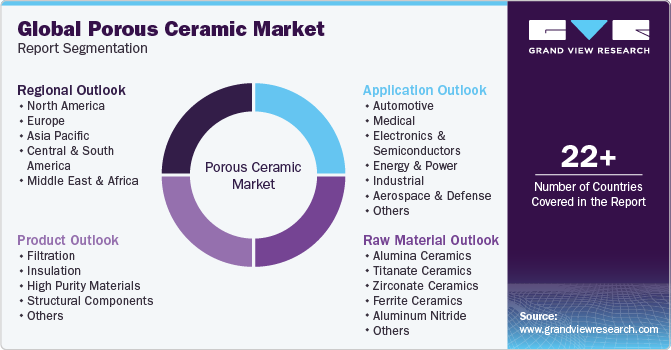
This report forecasts revenue growth at the global, regional, and country levels and provides an analysis of the latest industry trends and opportunities across each sub-segment from 2021 to 2033. For this study, Grand View Research has segmented the global porous ceramic market report based on raw material, product, application, and region:
 To learn more about this report, Download Free Sample Report
 -
Raw Material Outlook (Volume, Kilo Tons; Revenue, USD Billion, 2021 - 2033)
-
Alumina Ceramics
-
Titanate Ceramics
-
Zirconate Ceramics
-
Ferrite Ceramics
-
Aluminum Nitride
-
Others
-
-
Product Outlook (Volume, Kilo Tons; Revenue, USD Billion, 2021 - 2033)
-
Filtration
-
Insulation
-
High Purity Materials
-
Structural Components
-
Others
-
-
Application Outlook (Volume, Kilo Tons; Revenue, USD Billion, 2021 - 2033)
-
Automotive
-
Medical
-
Electronics & Semiconductors
-
Energy & Automotive
-
Industrial
-
Aerospace & Defense
-
Others
-
-
Regional Outlook (Volume, Kilo Tons; Revenue, USD Billion, 2021 - 2033)
-
North America
-
U.S.
-
Canada
-
Mexico
-
-
Europe
-
UK
-
Germany
-
France
-
Italy
-
Spain
-
-
Asia Pacific
-
China
-
Japan
-
India
-
Indonesia
-
-
Central & South America
-
Brazil
-
-
Middle East and Africa
-
Frequently Asked Questions About This Report
The global porous ceramic market size was valued at USD 9.4 billion in 2025 and is projected to grow from USD 10.5 billion in 2026.
The global porous ceramic market is expected to grow at a CAGR of 12.0% from 2026 to 2033, reaching USD 23.3 billion.
Asia Pacific dominated with a 43.8% revenue share in 2025.
The automotive segment accounted for the largest revenue share of 28.9% in 2025.
Some of the key players operating in the porous ceramic market include Applied Materials, Inc., CoorsTek, Inc., Innovacera, KeraNor AS, Kyocera Corp., Morgan Advanced Materials, NGK Spark Plug Co., Ltd., Nishimura Advanced Ceramics Co., Ltd., Porvair plc, STC Superior Technical Ceramics, and Toto Ltd.
About the Author(s)
Specialty Glass, Ceramic & Fiber Research Team
Advanced Materials · Specialty Glass, Ceramic & FiberThis report was authored by the specialty glass, ceramic & fiber research team at Grand View Research - comprising two research analysts, one senior research analyst, and one industry expert - with specialized expertise in the specialty glass, ceramic & fiber segment of the advanced materials industry. All findings are based on proprietary advanced materials databases, executive interviews, and regulatory analysis, subject to internal peer review prior to publication.
Last Updated:
Speak to Analyst

Customize this report to your needs - add regions, segments, or data points, with 20% free customization.
Or view our licence options:


ISO 9001:2015 & 27001:2022 Certified
We are GDPR and CCPA compliant! Your transaction & personal information is safe and secure. For more details, please read our privacy policy.


