
- Home
- »
- Medical Devices
- »
-
Portable Dental Equipment Market Size Report, 2027-2035GVR Report cover

Portable Dental Equipment Market (2027 - 2035)
Size, Share & Trends Analysis Report By Product Type (Portable Dental Treatment & Delivery Systems), By Mobility Format, By Power Source, By Self-Containment, By End Use, By Application, By Region, And Segment Forecasts
Market Size, 2026
$994.1MMarket Estimate, 2027
$1,073.2MMarket Forecast, 2035
$2,019.6MCAGR, 2027–2035
8.2%Portable Dental Equipment Market Summary
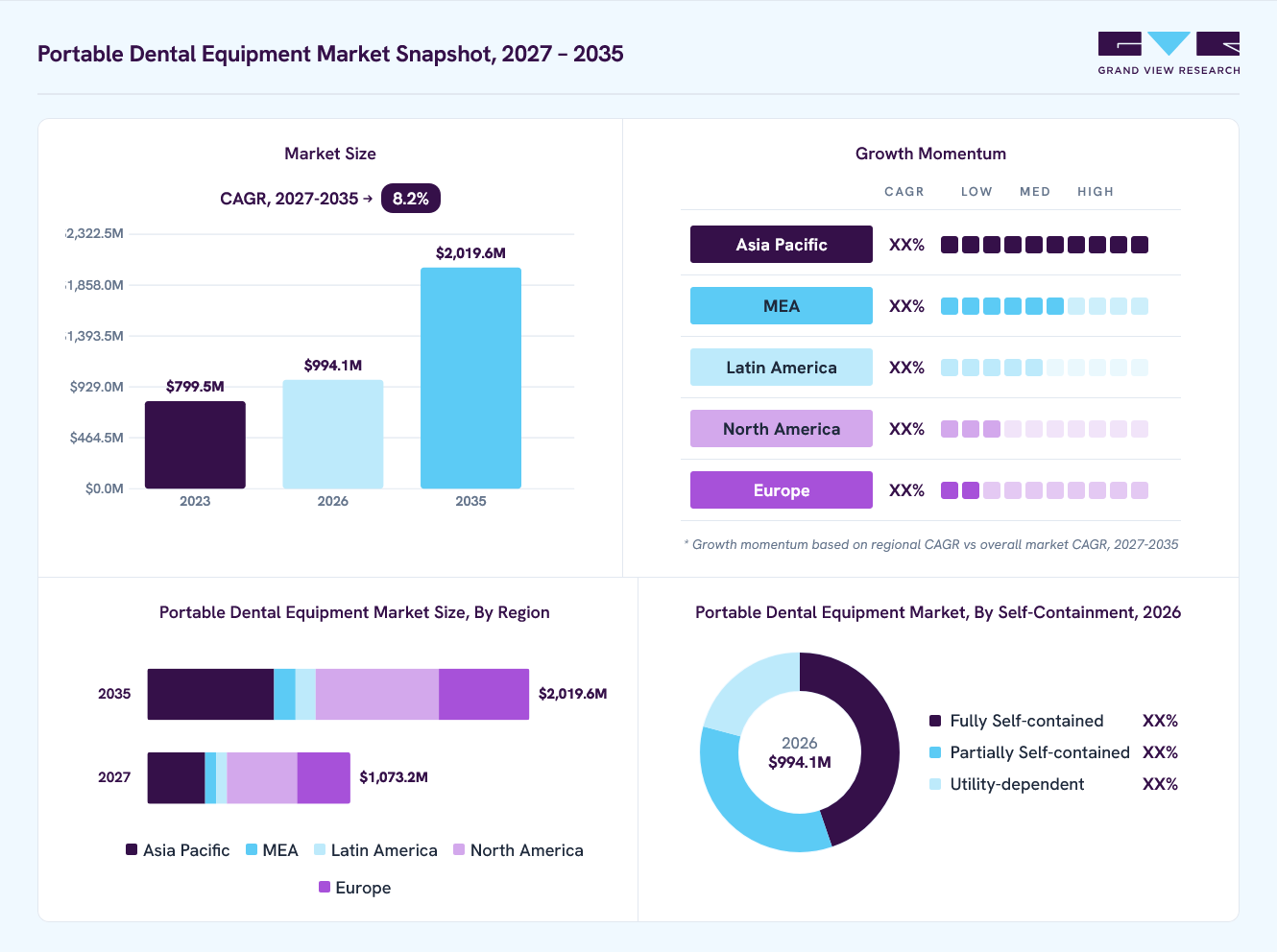
The global portable dental equipment market size was valued at USD 994.1 million in 2026 and is projected to grow from USD 1,073.2 million in 2027 to USD 2,019.6 million by 2035, at a CAGR of 8.2% from 2027 to 2035. North America dominated the market, accounting for a revenue share of 34.8% in 2025. The growth of the global portable dental equipment market is driven by the increasing prevalence of oral diseases, rising demand for accessible dental care, expansion of government-supported mobile dental healthcare programs, and growing adoption of domiciliary dental services.
 Source: Grand View Research, IR Documents, Primary Interviews, Paid DatabasesTo learn more about this report,
 Download Free Sample Report
Key Market Trends & Insights
- By product type: Portable dental treatment & delivery systems segment dominated the market, with a revenue share of 27.8% in 2026.
- By mobility format: Handheld segment held the largest market share of 29.5% in 2026.
- By power source: AC / mains-powered segment held the largest revenue share of 37.0% in 2026.
- By self-containment: Fully self-contained segment accounted for the largest revenue share of 44.7% in 2026.
- By end use: Private dental practices segment dominated the market, with a revenue share of 47.3% in 2026.
- By application: Flexible / multi-operatory clinic use segment led the market with the largest revenue share of 33.9% in 2026.
Regional Highlights
- Largest regional market: North America (34.8% revenue share, 2026)
- Fastest growing market: Asia Pacific (highest CAGR, 2027-2035)
- By country: The U.S. held the largest share in the North America region in 2026.
Market Size & Forecast
- Market size in 2026: USD 994.1 Million
- Estimated market size in 2027: USD 1,073.2 Million
- Projected market size by 2035: USD 2,019.6 Million
- CAGR (2027-2035): 8.2%
Prism AI by Grand View Research Free to tryAsk a question about the portable dental equipment marketTry asking✓Every figure cited from GVR research Prefer the report? Download free sample →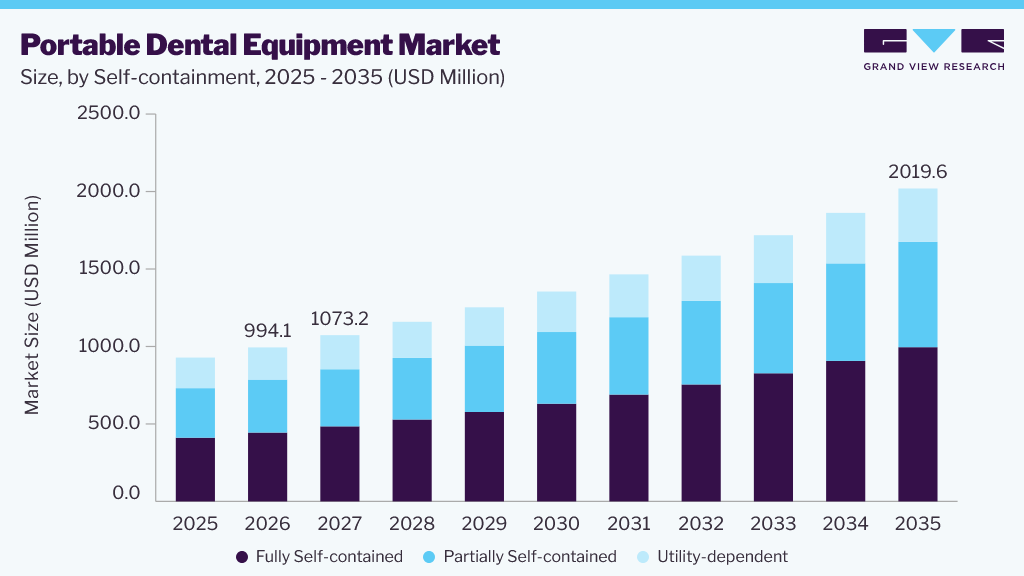 To learn more about this report, Download Free Sample Report
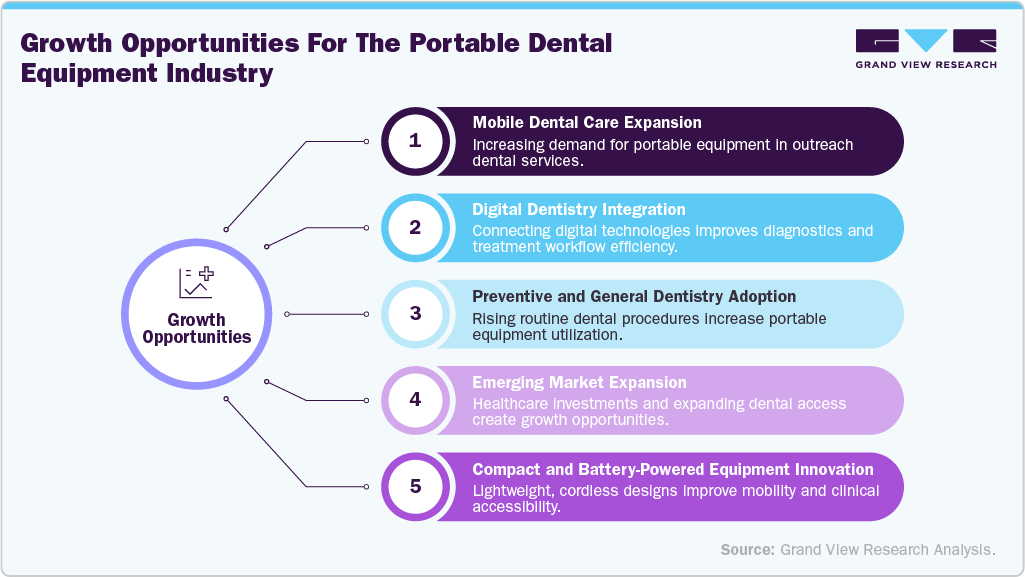
In addition, this growth is due to government investment in mobile dental healthcare infrastructure supported by expanding access to oral healthcare in rural, remote, and underserved communities. Public healthcare authorities are allocating funds for mobile dental clinics and vehicle-based dental treatment units equipped with dental chairs, diagnostic equipment, sterilization systems, compressors and suction devices. These initiatives are increasing institutional procurement of portable dental equipment and creating opportunities for manufacturers supplying integrated mobile dental treatment systems. For instance, in August 2025, Brazil's Ministry of Health delivered 400 Mobile Dental Units (Unidades Odontológicas Móveis) to 400 municipalities under its New PAC Health program, with a total federal investment of BRL 152 million (~ USD 27 million). The program was designed to extend oral healthcare services to remote and underserved populations.
"It's very easy to be a ruler and build an overpass or a bridge. Now, it's very difficult to be a ruler and do what the people need practically, quickly, and very much. And dental care is one of those things," said Lula Brazil's president.
Furthermore, in July 2026, Brazil's Ministry of Health issued technical guidance covering the acquisition, accreditation, registration and financing of mobile dental units, including procurement through government resources and parliamentary amendments.
Rising global burden of dental disorders driving demand for portable dental equipment:
The growing prevalence of dental disorders, including dental caries, tooth loss and advanced periodontal disease, is increasing the need for accessible diagnostic and treatment services across different population groups. In March 2025, according to the World Health Organization (WHO), oral diseases affect approximately 3.7 billion people globally, with untreated dental caries and severe periodontal disease representing major public health concerns. In addition, complete tooth loss affects approximately 7% of adults aged 20 years and older and around 23% of adults aged 60 years and older. The increasing burden of oral diseases, particularly among elderly individuals and underserved populations, is creating a greater need for preventive examinations, restorative procedures and periodontal treatments. However, geographical barriers, limited dental infrastructure and mobility constraints can restrict access to conventional dental clinics. This is increasing the demand for mobile dental services and portable treatment configurations, including portable dental units, treatment chairs, handheld X-ray systems, suction equipment and compact compressors. The growing need to extend dental care beyond conventional clinical settings is expected to support the adoption of portable dental equipment during the forecast period.
 To learn more about this report, Download Free Sample Report
 To learn more about this report, Download Free Sample Report
Market Dynamics
The portable dental equipment market is experiencing strong growth due to the increasing demand for accessible dental care and the expansion of mobile and community-based dental healthcare services. Portable dental equipment enables dental professionals to provide examinations, preventive treatments, restorative procedures and basic dental interventions outside conventional dental clinics. These systems are particularly useful in rural and remote communities, nursing homes, long-term care facilities and home healthcare settings where access to fixed dental infrastructure is limited. The market is further supported by technological advancements in portable dental imaging and treatment systems, including lightweight dental units, battery-operated devices, compact suction systems and handheld dental X-ray equipment.
Technological advancements in portable dental imaging and treatment systems are supporting the adoption of portable dental equipment across mobile dental clinics, rural healthcare facilities and domiciliary care settings. Manufacturers are developing lightweight dental units, compact treatment delivery systems, battery-operated devices and handheld dental X-ray equipment to improve equipment mobility and clinical functionality. These advancements enable dental professionals to conduct diagnostic examinations and provide basic dental treatments in locations with limited clinical infrastructure.
The high initial investment and recurring operating costs associated with portable dental equipment remain important restraints for market growth. Although portable systems generally require less fixed infrastructure than conventional dental installations, fully equipped portable dental units and mobile dental clinics involve considerable procurement and operating expenditure. Dental practitioners and healthcare organizations must invest in treatment units, portable chairs, diagnostic equipment, compressors, suction systems and sterilization devices. Additional expenses related to transportation, equipment maintenance, battery replacement, service, consumables and technical support increase the overall cost of ownership. These financial requirements can restrict adoption among independent dental practitioners, small clinics and healthcare providers operating with limited budgets, particularly in developing economies.
The growing need for home-based healthcare services presents an opportunity for manufacturers to develop lightweight, compact and easily transportable dental equipment for domiciliary applications. Elderly individuals, patients with physical disabilities and individuals with chronic mobility limitations experience difficulties accessing conventional dental facilities. For instance, in November 2025, a multi-country study published in Scientific Reports identified considerable patient interest in portable dentistry, with 75.3% of patients surveyed willing to use portable dental services. Manufacturers can address this opportunity through portable dental chairs, foldable treatment units, lightweight compressors and battery-operated diagnostic equipment designed for home visits and long-term care facilities
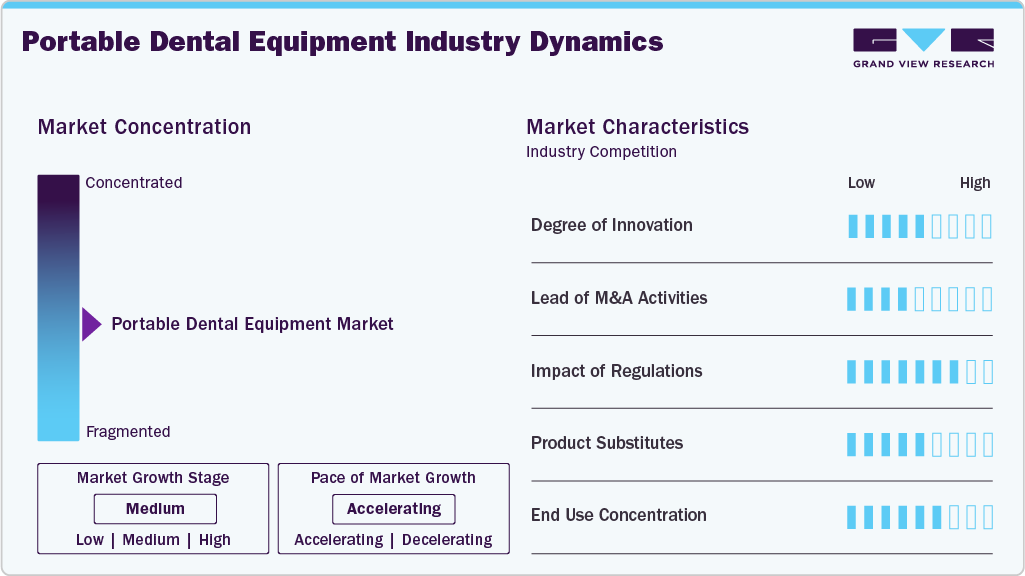
Market Concentration & Characteristics
The market is characterized by continuous product innovation, driven by advancements in equipment miniaturization, battery-powered technology, lightweight materials and compact treatment configurations. For instance, in May 2026, Carestream Dental launched the CS 2500P handheld X-ray unit in the U.S., offering portable intraoral imaging with 70 kV output, a high-capacity battery, and compatibility with multiple intraoral receptors. The device featured safety shielding and an ergonomic design for convenient use across multiple operatories.
The market exhibits relatively limited direct merger and acquisition activity compared with broader dental technology markets. The industry comprises specialized manufacturers supplying portable dental units, handheld radiography systems, portable chairs, suction equipment and mobile treatment solutions. Companies primarily expand their product portfolios through internal product development, technology upgrades, distribution arrangements and partnerships with dental service providers.
 To learn more about this report, Download Free Sample Report
Regulatory requirements have a significant influence on the development, manufacturing and commercialization of portable dental equipment, particularly because these devices are intended for use in non-permanent healthcare environments. Manufacturers must address requirements concerning electrical safety, mechanical stability, transportation durability, infection prevention, water quality and radiation protection for imaging equipment. In July 2026, the International Organization for Standardization (ISO) published the revised ISO 23402-1:2026 standard, specifying general requirements and test methods for portable dental units, patient chairs, operator stools, operating lights, suction equipment and air compressors.
The portable dental equipment market faces competition from conventional fixed dental units, fully equipped dental clinics, hospital-based dental departments and mobile dental clinics with permanently installed treatment systems. For routine dental procedures, healthcare providers prefer conventional dental chairs and fixed treatment units because they offer integrated utilities, greater workspace, stable equipment configurations and access to a wider range of specialized instruments. Similarly, stationary intraoral X-ray systems can serve as substitutes for handheld dental imaging equipment in established dental practices. However, portable dental equipment offers advantages in transportation, rapid deployment and accessibility for patients who cannot easily visit conventional clinics.
Demand for portable dental equipment is concentrated among mobile dental clinics, community healthcare programs, nursing homes, long-term care facilities, educational institutions and humanitarian dental organizations. Mobile dental service providers and public healthcare organizations represent important end users because portable units, patient chairs, operating lights, suction equipment and handheld imaging devices enable dental professionals to provide services in locations without permanent dental infrastructure. Nursing homes and long-term care facilities also represent an important application area because elderly residents and individuals with mobility limitations experience difficulties accessing conventional dental clinics.
Analyst Perspective
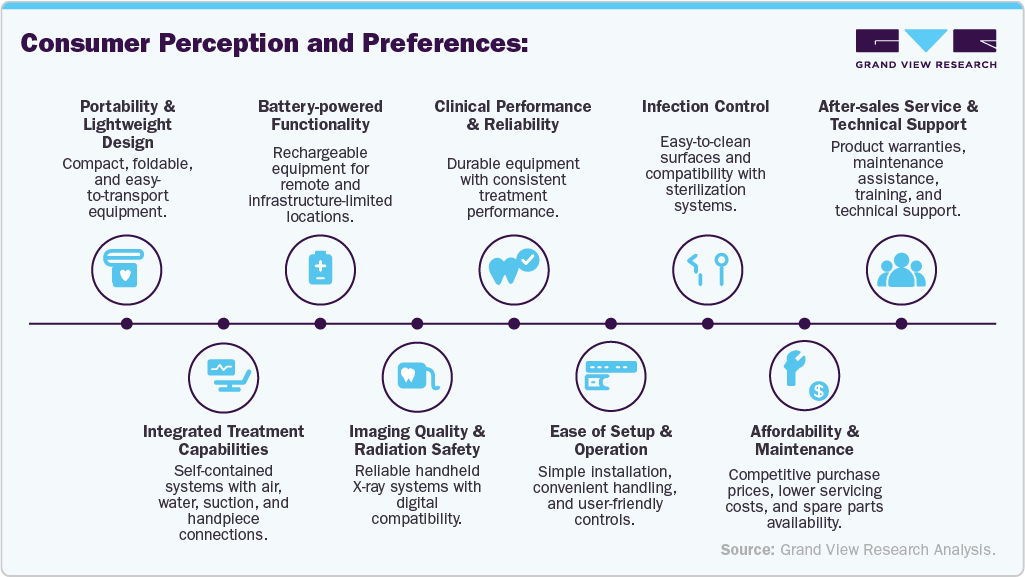
The portable dental equipment market is expected to witness strong growth, supported by the increasing demand for accessible oral healthcare, expansion of mobile dental clinics, rising adoption of domiciliary dental services, and growing government investment in community-based dental programs. The market is also benefiting from technological advancements in lightweight treatment delivery systems, battery-powered equipment, handheld dental imaging, compact air compressors and integrated portable utilities. From an analyst's perspective, companies offering reliable, self-contained, easy-to-transport and cost-effective equipment will be better positioned to strengthen their market presence. Future competitiveness will depend on product innovation, regulatory compliance, distribution expansion, after-sales support and the ability to serve diverse clinical and non-clinical care settings.
Product Type Insights
The portable dental treatment & delivery systems segment dominated the portable dental equipment market, accounting for 27.8% of the market in 2026. This dominance is supported by the increasing need for complete chairside treatment capability outside fixed clinics, including restorative, extraction, and prosthetic care, together with growing outreach to rural, long-term care, and school settings that cannot access conventional operatories. These systems integrate essential dental treatment components, such as handpiece connections, air and water delivery, suction, and associated utility controls, enabling dental professionals to perform a broader range of procedures in non-traditional clinical environments.
The portable dental imaging equipment segment in the portable dental equipment market is expected to grow at the fastest rate during the forecast period due to the increasing demand for point-of-care diagnostic imaging, rising adoption of mobile dental services, and the need for immediate intraoral imaging in remote and underserved locations. For instance, in August 2026, South Korea-based Rayence launched its Anywhere-M and Anywhere-V portable X-ray diagnostic solutions for human healthcare and veterinary applications, respectively. The integrated systems combined portable X-ray generators, high-resolution digital detectors, and dedicated imaging software to support diagnostics in emergency care, disaster relief, military medical units, and field settings. Such technological advancements are expected to accelerate the adoption of portable imaging solutions and contribute to segment growth during the forecast period
Mobility Format Insights
The handheld segment led the market, accounting for 29.5% of the market and is expected to grow at the fastest rate during the forecast period. This dominance is supported by the widespread preference for lightweight, compact devices that a single clinician can carry between operatories, homes, and care facilities, along with their ease of use and no-installation setup. The growing adoption of mobile dental services, community-based oral healthcare programs, and home-based dental care is further increasing demand for handheld equipment. These devices allow dental professionals to provide essential diagnostic and treatment services in locations with limited access to conventional dental infrastructure.
The modular / multi-case system segment in the portable dental equipment market is expected to grow at a significant rate during the forecast period due to the growing need for scalable setups that clinicians can configure for different sites and workloads, such as separating compressed air, suction, and treatment units into transportable modules that can be added to as demand grows. These systems offer greater operational flexibility by allowing dental professionals to select, transport, and assemble only the components required for specific procedures and treatment environments. This flexibility, combined with easier transportation, equipment customization, and cost-effective scalability, is expected to drive the adoption of modular / multi-case systems across mobile dental clinics and non-traditional care settings.
Power Source Insights
The AC / mains-powered segment dominated the market, with a revenue share of 37.0% of the market in 2026. This dominance is supported by the widespread preference for dependable, uninterrupted power to run compressors, suction units, curing lights, sterilizers, and imaging equipment at host sites such as clinics, care homes, and schools where mains outlets are readily available, along with lower running costs and no runtime limits during longer procedures. Furthermore, AC / mains-powered systems offer consistent power output, support the operation of multiple dental instruments, and reduce dependence on battery charging, replacement, and backup arrangements. The availability of established electrical infrastructure across dental clinics, hospitals, and institutional care facilities is expected to sustain demand for AC / mains-powered portable dental equipment during the forecast period.
The battery-powered segment in the portable dental equipment market is expected to grow at the fastest rate during the forecast period due to the rising demand for cordless operation in field, home, and care-home dentistry, where power outlets may be unreliable or inaccessible, along with improvements in battery capacity and compact brushless components. For instance, in July 2025, Renfert introduced SILENT XS, its first portable dental suction unit, which is cordless and battery-powered, captures dust at the source, and offers integrated LED lighting and an H13/HEPA filter with 99.99% filtration efficiency. Such cordless products are expected to widen the use of battery-powered equipment across mobile settings.
Self-Containment Insights
The fully self-contained segment led the market highest revenue share of 44.7% in 2026 and is expected to grow at the fastest rate during the forecast period. This dominance is supported by the widespread preference for autonomous systems with an integrated compressor, suction, and water supply that remove dependence on host-site utilities, enabling treatment in schools, care homes, vans, and remote sites with minimal setup. For instance, in December 2025, BPR Swiss issued its 2025/2026 mobile and portable units’ catalogue, listing autonomous units such as the Combi-Cart Clinic, with an integrated oil-free compressor, silent suction machine, and spray water tanks, and the 12 kg Smart-Port with an integrated compressor, suction, electric motor, and scaler. Such self-contained portfolios are expected to strengthen adoption among mobile and outreach providers.
The partially self-contained segment in the portable dental equipment market is expected to grow at a significant rate during the forecast period due to the preference for lighter, lower-cost units that pair with host-site utilities such as air supply, power, and running water, which makes them easier to transport and set up at care homes, schools, and community sites that are visited repeatedly. Furthermore, these systems reduce equipment weight and storage requirements while allowing clinicians to use existing infrastructure for essential dental procedures, improving operational convenience across multiple treatment locations. The growing deployment of mobile dental services and outreach programs across institutional and community-based care settings is expected to support the adoption of partially self-contained portable dental equipment during the forecast period.
End Use Insights
The private dental practices segment dominated the portable dental equipment market, accounting for 47.3% of the market in 2026. This dominance is supported by the continued role of independent and group private practices as the primary providers of dental care, their use of portable units for domiciliary and care-home visits and as flexible back-up operatories, and ongoing investment in versatile equipment that can be shared across rooms. According to the American Dental Association (ADA) Health Policy Institute, 72.5% of dentists in the U.S. were private practice owners in 2023, compared with 84.7% in 2005, indicating the continued presence of dentist-owned private practices despite a gradual shift toward larger practice models.
The mobile dental service providers segment in the portable dental equipment market is expected to grow at the fastest rate during the forecast period due to the increasing number of government and charity-funded programs that take dental care to regional, remote, and underserved communities, and the rising need for flexible equipment that can be deployed by vans and field teams. For instance, in July 2025, the NSW Government funded the NSW Health Mobile Dental Van Program with AUD 37.5 million (~USD 26.2 Mn) in its 2025-26 State Budget to improve access to oral healthcare for regional, remote, and underserved communities. Such public funding is expected to drive purchases of portable treatment and imaging equipment by mobile dental service providers.
Application Insights
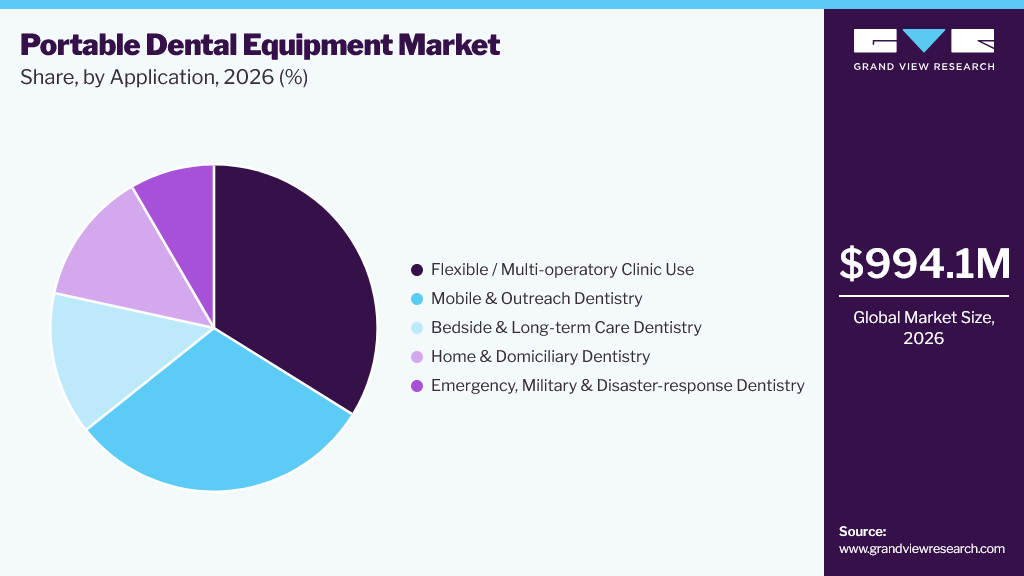
The flexible / multi-operatory clinic use segment held the largest market share of 33.9% in 2026. This dominance is driven by the expansion of multi-chair group practices and DSOs that share equipment among operatories to raise utilization and reduce capital costs, the rising number of de novo openings, and the need to reconfigure rooms quickly as case mix changes. For instance, in July 2025, Bridgepoint agreed to acquire a majority stake in mydentist, which operates over 500 practices, Heartland Dental opened seven de novo practices across five states, and MB2 Dental introduced three new practices, bringing its 2025 total to 37. Such consolidation and de novo expansion are expected to increase demand for movable equipment that can serve several operatories.
 To learn more about this report, Download Free Sample Report
The home & domiciliary dentistry segment of the portable dental equipment market is expected to grow at the fastest rate during the forecast period. Growth is driven by the rising geriatric population, increasing prevalence of mobility limitations, and growing demand for dental care among patients who face difficulties accessing conventional dental clinics. The increasing preference for home-based healthcare and domiciliary dental visits is encouraging dental professionals to adopt lightweight, portable treatment and delivery systems, handheld imaging devices, and compact suction equipment. Furthermore, the expansion of home healthcare services and community-based oral health programs is increasing the need for equipment that enables clinicians to perform examinations, preventive procedures, and basic restorative treatments at patients' residences and care facilities.
Regional Insights
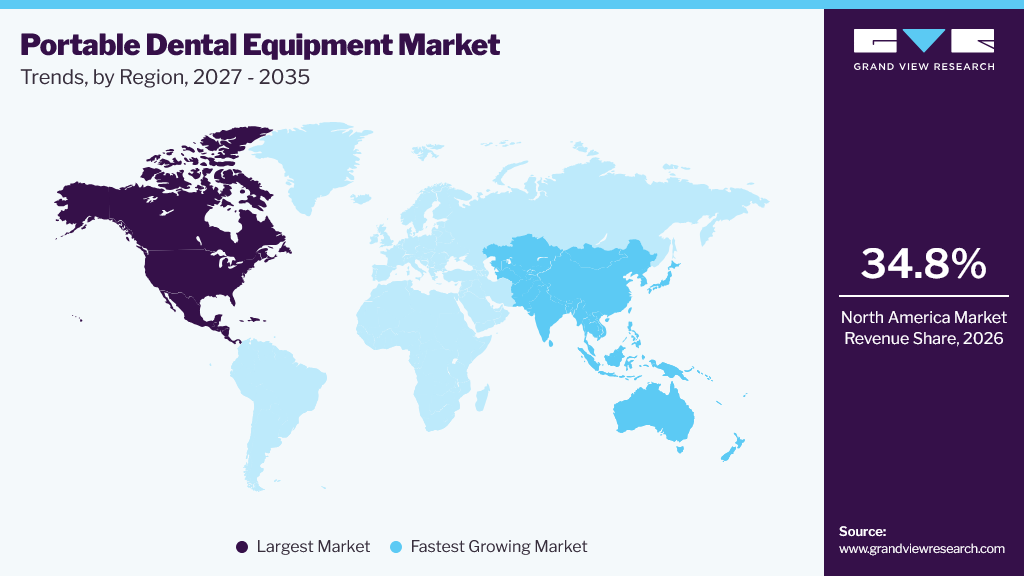
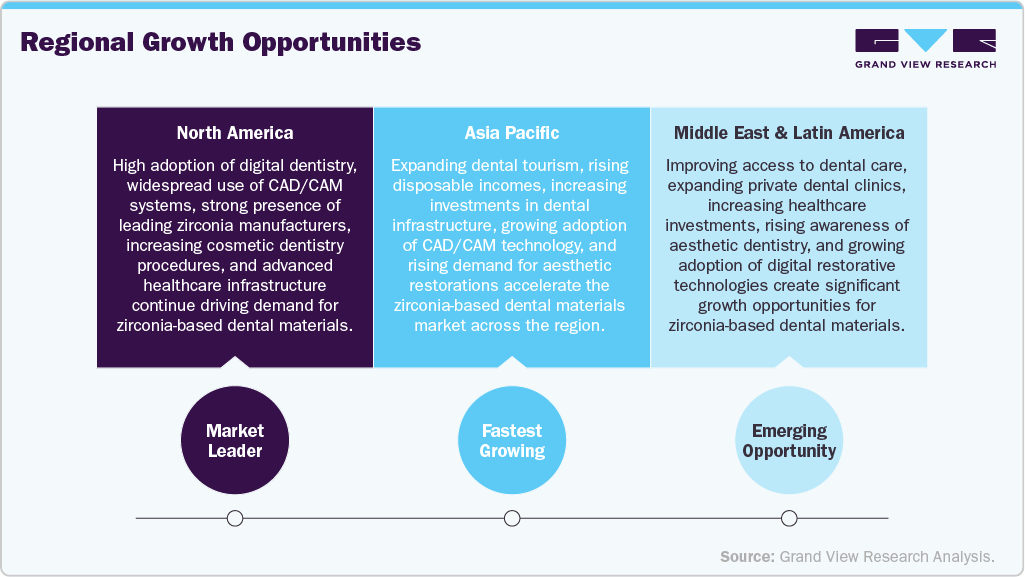
North America held the largest revenue share of 34.8% in 2026. The North America portable dental equipment market is witnessing strong growth, driven by publicly funded programs that extend dental care to Indigenous, remote, and long-term care populations, and by dental education institutions investing in mobile teaching and outreach platforms. Care delivered outside fixed clinics requires compact, self-contained treatment and sterilization equipment. For instance, in November 2025, Health Canada announced more than CAD 35 million (~USD 25 million) over three years under Stream 1 of the Oral Health Access Fund, supporting 30 projects across nine provinces, including six mobile dental units for community outreach at the Vancouver College of Dental Hygiene and mobile dental hygiene units for patients in long-term care at the College of New Caledonia. Such investments are expected to increase procurement of portable treatment, imaging, and sterilization equipment across the region.
 To learn more about this report, Download Free Sample Report
U.S. Portable Dental Equipment Market Trends
The U.S. portable dental equipment market is expected to register the fastest growth due to persistent dental access gaps in rural communities and the growing availability of federal funding to bring care closer to underserved patients. Mobile and portable setups allow dentists to deliver fillings, extractions, and dentures where fixed clinics are scarce. For instance, in May 2026, the Kentucky Department for Public Health invited non-profit organizations to provide definitive mobile dental care in rural areas under its Rooted in Health: Rural Dental Access initiative, funded through the federal Rural Health Transformation Program, which provides USD 50 billion over five years beginning in 2026. Such state-level programs are expected to support demand for self-contained portable treatment systems, compressors, and imaging equipment.
Europe Portable Dental Equipment Market Trends
The Europe portable dental equipment market is expected to grow at a substantial rate as ageing populations retain more natural teeth for longer, increasing the need for periodontal, restorative, and preventive care among seniors and care-dependent patients who cannot easily travel to a dental practice. For instance, in March 2025, the Institute of German Dentists (IDZ), together with the National Association of Statutory Health Insurance Dentists and the German Dental Association, presented the Sixth German Oral Health Study (DMS 6), which found that only 5% of people aged 65-74 are toothless, an 80% decline in this age group, while about 14 million people in Germany have severe periodontitis. Higher tooth retention among seniors is expected to raise treatment needs in home and care-facility settings, supporting demand for portable dental equipment
The UK portable dental equipment market is witnessing strong growth driven by the NHS's focus on improving access for groups facing health inequalities, such as care home residents, people experiencing homelessness, and refugees, through mobile and outreach dental services. For instance, in February 2025, NHS Hampshire and Isle of Wight reported that its partnership with Dentaid The Dental Charity enabled 5,169 residents to be seen on mobile dental units and 20,388 treatments to be delivered in its first 12 months. This expansion of mobile dental services is increasing demand for portable dental treatment systems, patient positioning equipment, and imaging solutions that enable dental professionals to deliver essential care across community and non-traditional healthcare settings.
“This partnership is an innovative way of taking dental services to the communities that need it most,” said Andy Evans, CEO of Dentaid The Dental Charity.
Asia Pacific Portable Dental Equipment Market Trends
The Asia Pacific portable dental equipment market is expected to witness the fastest growth owing to rapid population ageing and the rising need for oral care within nursing homes and community care settings. For instance, in September 2025, the National Dental Centre Singapore launched a mobile dental clinic at Bright Hill Evergreen Home, sponsored by Lion Corporation, to provide screenings and basic treatments in nursing homes, with a target of screening 1,900 seniors across 10 nursing homes by 2028. The clinic is fitted with a wheelchair lift and knee-break dental chairs for patients with limited mobility. Such collaborations between healthcare institutions and industry are expected to encourage adoption of mobility-friendly dental equipment across the region
Ms Cheng Siok Khoong, CEO of Bright Hill Evergreen Home, said that by bringing screening and other dental services directly to its residents, the mobile clinic will help them “maintain proper nutrition and social confidence, which are fundamental for ageing well”.
The China portable dental equipment market is expected to grow at a strong rate, supported by the national emphasis on preventive oral care and school- and community-based screening, which favors lightweight, easy-to-deploy examination tools. For instance, in December 2025, the National Health Commission and 12 other departments issued the Children and Adolescents' Five-Health Promotion Action Plan (2026-2030), under which oral checks are to be included for children aged 0-6, medical institutions are to help schools provide one routine oral check per year, and schools may set up health corners with disposable oral exam kits while communities run caries-check stations. Such outreach-driven screening programs are expected to expand demand for portable examination, lighting, and treatment equipment.
Latin America Portable Dental Equipment Market Trends
The Latin America portable dental equipment market is growing due to expanding government-supported oral healthcare programs, increasing dental outreach activities, and efforts to improve access to dental services among underserved and geographically isolated populations. Brazil is a major contributor to this growth, supported by the expansion of its national oral healthcare initiatives under the Brasil Sorridente (Smiling Brazil) program. The Brazilian Ministry of Health allocated funding for 424 Mobile Dental Units under the 2023 New PAC initiative and announced a further 400 units under the 2025 phase, creating opportunities for procurement of portable dental treatment systems, patient positioning equipment, and diagnostic devices
MEA Portable Dental Equipment Market Trends
The MEA portable dental equipment market is driven by a severe shortage of dental providers and the increasing adoption of community-based outreach models that bring basic oral care closer to underserved populations. For instance, in October 2025, Brown University's School of Public Health reported that the WHO adopted the mOral Health curriculum, developed with Harvard School of Dental Medicine and piloted in Kenya with the Ministry of Health and WHO-AFRO support, to train community health workers in oral care across sub-Saharan Africa, where there is about one dental provider per 23,000 people against the WHO-recommended one per 7,500. Such task-shifting and outreach models are expected to increase the need for portable, low-infrastructure dental equipment.
 To learn more about this report, Download Free Sample Report
Key Portable Dental Equipment Company Insights
These companies are focusing on expanding their customer base and strengthening their competitive positions through strategic initiatives, including product launches, portfolio expansion, distribution agreements, and partnerships with dental clinics, hospitals, and other industry participants.
Key Portable Dental Equipment Companies
The following key companies have been profiled for this study on the portable dental equipment market.
-
Aseptico Inc.
-
DNTLworks
-
BPR Swiss
-
Safari Dental
-
TPC Advanced Technology, Inc
-
Flight Dental Systems
-
DEXCOWIN
-
Genoray
-
ALERIO (IATOME ELECTRIC)
-
DEXIS (Envista Holdings)
-
ACTEON
-
Carestream Dental
-
Vatech America
-
Eighteeth (Changzhou Sifary Medical Technology Co.,Ltd.)
-
Jiangsu Dynamic Medical Technology Co., Ltd.
Competitive Benchmarking
Category
Operating Strategies
Competitive Edge
Weakness
Established Players (Aseptico Inc., TPC Advanced Technology, ACTEON, Carestream Dental)
- Focus on expanding portable dental equipment portfolios through product development in portable treatment delivery systems, and handheld dental imaging.
- Invest in product upgrades, digital imaging compatibility, regulatory compliance and after-sales service to address demand across private practices, mobile dental clinics and institutional healthcare facilities.
- Established industry presence, recognized dental equipment brands, technical expertise and established distribution channels.
- Companies with broader equipment portfolios can serve multiple portable dentistry requirements.
- Higher product development and regulatory compliance costs, competition from lower-priced manufacturers and differences in product portfolio breadth.
- Companies primarily focused on imaging equipment have limited exposure to other portable dental equipment categories.
Emerging Players (BPR Swiss, Safari Dental, Flight Dental Systems, DEXCOWIN, ALERIO)
- Expand market presence through competitively priced portable dental units, compact treatment delivery systems, mobile dental configurations and handheld imaging products.
- Develop products tailored to mobile dental clinics, outreach programmes, independent dental practitioners and cost-sensitive markets.
- Flexible product portfolios, competitive pricing, specialized portable equipment offerings and the ability to address demand for compact and transportable dental systems.
- Manufacturers with integrated portable treatment configurations can serve multiple equipment requirements.
- Comparatively lower international brand recognition for some companies, and limited market penetration in certain developed regions.
- Dependence on distributors, product differentiation and the cost of establishing international servicing infrastructure constrain expansion.
Recent Developments
- In March 2025, Planmeca introduced its first handheld intraoral X-ray device, Planmeca ProX GO, at IDS Cologne. Weighing just over 2 kg, the installation-free device featured 70 kV output, a battery supporting over 300 exposures per charge, radiation shielding, and integration with Planmeca Romexis software.
“Planmeca ProX GO represents just the kind of creative thinking and flexible, future-ready solutions that we want to bring to the dental industry,” states Timo Müller, Vice President of Planmeca’s X-ray division. “There is a real demand for versatile portable products like this, which enable high-quality imaging in fast-paced and changing environments, such as busy clinics, mobile operatories, and emergency situations. We’re truly excited to be bringing yet another tech and usability innovation to dental professionals all over the world, starting in the U.S. market.”
-
in February 2025, Aseptico's AMC-15 Mobile Dental Cart was recognized as a Reader’s Choice Top Innovative Product for 2025 by Dentistry Today. The self-contained system featured integrated air, water, suction, and handpiece connections, enabling general dentistry procedures in nursing homes, hospitals, schools, and other non-traditional care settings.
-
In June 2024, Aseptico Inc. introduced the AEU-350S model of its GO Ultra-Portable Dental System, featuring an integrated piezoelectric ultrasonic scaler with LED illumination. The 32-pound system supported restorative and dental hygiene procedures in mobile and non-traditional care settings, with external battery operation for off-grid use.
Portable Dental Equipment Market Report Scope
Report Attribute
Details
Market size in 2026
USD 994.1million
Estimated market size in 2027
USD 1,073.2 million
Projected market size by 2035
USD 2,019.6 million
Growth rate
CAGR of 8.2% from 2027 to 2035
Base year for estimation
2026
Actual estimates/Historical data
2023 - 2025
Forecast period
2027 - 2035
Quantitative units
Revenue in USD Million and CAGR from 2027 to 2035
Report coverage
Revenue forecast, company ranking, competitive landscape, growth factors, and trends
Segments covered
Product type, mobility format, power source, self-containment, end use, application, region
Regional scope
North America; Europe; Asia Pacific; Latin America; Middle East & Africa
Country scope
U.S.; Canada; Mexico; UK; Germany; France; Italy; Spain; Denmark; Sweden; Norway; Japan; China; India; Thailand; Australia; South Korea; Brazil; Argentina; South Africa; Saudi Arabia; UAE; Kuwait
Key companies profiled
Aseptico Inc., DNTLworks, BPR Swiss, Safari Dental, TPC Advanced Technology, Inc., Flight Dental Systems, DEXCOWIN, Genoray, ALERIO (IATOME ELECTRIC), DEXIS (Envista Holdings), ACTEON, Carestream Dental, Vatech America, Eighteeth (Changzhou Sifary Medical Technology Co.,Ltd.), Jiangsu Dynamic Medical Technology Co., Ltd.
Customization scope
Free report customization (equivalent up to 8 analyst’s working days) with purchase. Addition or alteration to country, regional & segment scope
Pricing and purchase options
Avail customized purchase options to meet your exact research needs. Explore purchase options
Global Portable Dental Equipment Market Report Segmentation
This report forecasts revenue growth at global, regional & country levels and provides an analysis of the latest industry trends in each of the sub-segments from 2023 to 2035. For this study, Grand View Research has segmented the global portable dental equipment market report based on product type, mobility format, power source, self-containment, end use, application, and region:
-
Product Type Outlook (Revenue, USD Million, 2023 - 2035)
-
Portable Dental Treatment & Delivery Systems
-
Self-contained Portable Treatment Systems
-
Externally Supplied Portable Delivery Systems
-
-
Portable Patient Positioning Equipment
-
Dental Chairs
-
Manual / Folding Dental Chairs
-
Powered / Hydraulic Portable Dental Chairs
-
-
Portable Operator Stools
-
-
Portable Dental Imaging Equipment
-
Handheld Intraoral X-ray Generators
-
Integrated Portable X-ray Workflow Systems
-
-
Portable Air & Vacuum Utilities
-
Standalone Portable Dental Air Compressors
-
Standalone Portable Dental Suction / Vacuum Units
-
Combined Portable Air-and-Vacuum Modules
-
-
Portable Operatory Lighting
-
Portable Floor-standing & Clamp-on Examination Lights
-
Headlamps & Loupe-Mounted Operatory Lighting
-
-
Portable Sterilization & Instrument Reprocessing Equipment
-
Portable Dental Sterilizers / Autoclaves
-
Portable Instrument Cleaning / Disinfection Units
-
-
Portable Dental Support Infrastructure
-
Portable Dental Sinks & Water Modules
-
Purpose-built Mobile Dental Stands & Equipment Carts
-
-
-
Mobility Format Outlook (Revenue, USD Million, 2023 - 2035)
-
Handheld
-
Hand-carried / Suitcase
-
Foldable / Collapsible
-
Wheeled Cart / Trolley
-
Modular / Multi-case System
-
-
Power Source Outlook (Revenue, USD Million, 2023 - 2035)
-
Battery-powered
-
AC / Mains-powered
-
Hybrid Battery & Mains
-
Pneumatic / External Compressed Air-powered
-
Non-powered / Manual
-
-
Self-Containment Outlook (Revenue, USD Million, 2023 - 2035)
-
Fully Self-contained
-
Partially Self-contained
-
Utility-dependent
-
-
End Use Outlook (Revenue, USD Million, 2023 - 2035)
-
Private Dental Practices
-
Independent Dental Practices
-
Dental Groups / DSOs
-
-
Hospitals & Institutional Care Providers
-
General & Specialty Hospitals
-
Long-term Care & Senior Living Facilities
-
-
Mobile Dental Service Providers
-
Mobile Dental Clinics & Van Operators
-
Portable Field / Outreach Service Providers
-
-
Government & Public-sector Institutions
-
Public Health Programs
-
Military & Correctional Health Services
-
-
Academic & Research Institutions
-
Non-governmental Organizations
-
-
Application Outlook (Revenue, USD Million, 2023 - 2035)
-
Mobile & Outreach Dentistry
-
Home & Domiciliary Dentistry
-
Bedside & Long-term Care Dentistry
-
Flexible / Multi-operatory Clinic Use
-
Emergency, Military & Disaster-response Dentistry
-
-
Regional Outlook (Revenue, USD Million, 2023-2035)
-
North America
-
U.S.
-
Canada
-
Mexico
-
-
Europe
-
UK
-
Germany
-
France
-
Italy
-
Spain
-
Denmark
-
Sweden
-
Norway
-
-
Asia Pacific
-
Japan
-
China
-
India
-
Thailand
-
Australia
-
South Korea
-
-
Latin America
-
Brazil
-
Argentina
-
-
Middle East & Africa
-
South Africa
-
Saudi Arabia
-
UAE
-
Kuwait
-
-
Research Methodology
The portable dental equipment market figures in this report are based on a proven research process that combines executive interviews with secondary research from proprietary databases, company filings, and recognized regulatory and institutional sources. Market size is built through value-chain sizing-reconciling supply-side and demand-side estimates-and triangulated with bottom-up and top-down approaches. Every estimate passes multiple levels of expert validation before publication, with each portable dental equipment segment quantified using the revenue-capture definitions in the table below.
Segment Definition
Self-Containment
Revenue capture definition
Fully Self-contained
Revenue generated from portable dental equipment systems that integrate the essential treatment and utility components required to perform dental procedures with minimal dependence on external infrastructure.
Partially Self-contained
Revenue generated from portable dental equipment systems that integrate selected treatment or utility components but require one or more external connections or supplementary equipment for operation. These systems include portable delivery units with integrated suction or water supply while depending on external compressors, vacuum systems, water sources or electrical connections.
Utility-dependent
Revenue generated from portable dental equipment that primarily provides treatment, diagnostic or patient-positioning functionality but requires external utility infrastructure, such as fixed electrical supply, compressed air, central vacuum, external water supply or drainage, to operate.
Estimation Model
Market Estimation Approach
Description
Bottom-Up Estimation
The market is estimated by analyzing the annual sales volume of portable dental equipment across key product categories, including portable dental treatment and delivery systems, patient positioning equipment, portable dental imaging equipment, air and vacuum utilities, operatory lighting, sterilization equipment and support infrastructure. The assessment considers unit shipments and average selling prices across private dental clinics, hospitals, and mobile dental service providers.
Top-Down Approach
The market estimation begins with an assessment of the global dental equipment and dental devices market, followed by determining the share attributable to portable dental equipment through secondary research and industry expert validation. The analysis considers key market indicators such as the expansion of mobile dental clinics, government investment in community-based oral healthcare programs, demand for domiciliary and institutional dental services, and oral disease prevalence.
Supply-Side Analysis
The analysis considers manufacturers' production capacities, annual product shipments, sales revenues, product portfolio diversification, manufacturing facilities, average selling prices, regulatory approvals, and regional distribution networks. The assessment covers portable dental treatment and delivery systems, foldable dental chairs, handheld intraoral X-ray generators, portable compressors, suction units, sterilization equipment and related infrastructure.
Delivered Customizations
This report has been delivered with the following In-depth customizations
Client Request
Customization Delivered
Value Adds
Portable Dental Equipment Product Portfolio & Application Analysis
Conducted a comprehensive assessment of the portable dental equipment product portfolio, covering portable dental treatment and delivery systems, portable patient positioning equipment, handheld dental imaging systems, portable air and vacuum utilities, operatory lighting, sterilization equipment and support infrastructure. Evaluated product adoption across mobile and outreach dentistry, home and domiciliary dentistry, bedside and long-term care dentistry, flexible multi-operatory clinic use, and emergency, military and disaster-response dentistry.
Helps stakeholders identify high-growth product categories, assess application-specific demand, understand equipment configuration preferences, and optimize product portfolios according to evolving mobile and decentralized dental care requirements.
End-Use Adoption & Procurement Landscape Analysis
Analyzed portable dental equipment adoption across private dental practices, hospitals, long-term care facilities, mobile dental service providers, government and public-sector institutions, academic and research institutions, and non-governmental organizations. Assessed procurement preferences, equipment mobility requirements, power availability, self-containment needs, maintenance costs, sterilization requirements, and after-sales service considerations.
Enables manufacturers to identify high-demand end-user segments, understand procurement requirements, optimize distribution and servicing networks, improve product configuration strategies, and expand market penetration across established and emerging markets.
Product Positioning & Manufacturer Competitiveness Assessment
Evaluated key portable dental equipment manufacturers and suppliers based on product portfolio breadth, portability, equipment integration, battery and power configurations, self-containment capabilities, imaging technology, ergonomic design, manufacturing capabilities, geographic presence, pricing strategies, regulatory compliance, and distribution strength. The assessment also examined product launch portfolios, competitive positioning, technological developments, strategic partnerships, and competitive differentiation across portable treatment systems, imaging equipment and supporting utilities.
Supports competitive benchmarking, identifies product development opportunities, enables differentiation through equipment design and integrated configurations, strengthens go-to-market strategies, and helps companies improve competitive positioning through product innovation, distribution expansion, and customer-focused equipment solutions.
About the Author(s)
Medical Devices Research Team
Healthcare · Medical DevicesThis report was authored by the medical devices research team at Grand View Research - comprising two research analysts, one senior research analyst, and one industry expert - with specialized expertise in the medical devices segment of the healthcare industry. All findings are based on proprietary healthcare databases, executive interviews, and regulatory analysis, subject to internal peer review prior to publication.
Last Updated:
Speak to Analyst

Customize this report to your needs - add regions, segments, or data points, with 20% free customization.
Or view our licence options:


ISO 9001:2015 & 27001:2022 Certified
We are GDPR and CCPA compliant! Your transaction & personal information is safe and secure. For more details, please read our privacy policy.


