
- Home
- »
- Homecare & Decor
- »
-
Portable Fire Extinguisher Market Size Report, 2026-2033GVR Report cover

Portable Fire Extinguisher Market (2026 - 2033)
Size, Share & Trends Analysis Report By Agent (Dry Chemical, Carbon Dioxide, Water, Foam), By Fire Type (Class A, Class B, Class C, Class D, Class K), By Application , By Region, And Segment Forecasts
Market Size, 2025
$12.4BMarket Estimate, 2026
$13.4BMarket Forecast, 2033
$26.6BCAGR, 2026–2033
10.3%Portable Fire Extinguisher Market Summary
The global portable fire extinguisher market size was valued at USD 12.4 billion in 2025 and is projected to grow from USD 13.4 billion in 2026 to USD 26.6 billion by 2033, growing at a CAGR of 10.3% from 2026 to 2033. The market in North America dominated with a revenue share of 37.8% in 2025. Increasing fire safety regulations across residential, commercial, and industrial sectors are pivotal in driving the portable fire extinguisher market.
 Source: Grand View Research, IR Documents, Primary Interviews, Paid DatabasesTo learn more about this report,
 Download Free Sample Report
 Key Market Trends & Insights
- By agent: Dry Chemical segment led the market with the largest revenue share of 35.0% in 2025
- By fire type: Class C segment led the market with the largest revenue share of 37.5% in 2025
Regional Highlights
- Largest regional market: North America (37.8% revenue share, 2025)
- By country: The U.S. held the largest market share in 2025.
Market Size & Forecast
- Market size in 2025: USD 12.4 Billion
- Estimated market size in 2026: USD 13.4 Billion
- Projected market size by 2033: USD 26.6 Billion
- CAGR (2026-2033): 10.3%
Three ways to get this report
Buy it, customize it, or ask a question.Ask an Analyst
Analyst response in 1 business day
- AccessReport author, directly
- Reply timeWithin 1 working day
- No sales callDirect answer only
- FormatEmail reply
- CostFree, no cost
Get the Full Report
What the study covers
- FormatsPDF · Excel · Dashboard
- Timeline2026–2033 annual, 2025 base
- Coverage20+ countries, 5 regions
- Companies10+ key players profiled
Customize the Report
20% free customization
- IncludeCountries, segments, points
- TailorTo your product definition
- ExtendDeeper competitor detail
- OrA fully bespoke study
- Turnaround5–10 working days
Governments and safety organizations enforce strict fire safety codes, mandating that buildings and businesses maintain accessible, functional fire extinguishers as part of their safety compliance. This regulatory pressure ensures that all establishments, regardless of type, prioritize fire preparedness, thus steadily boosting the demand for portable fire extinguishers. As new structures are built and existing ones upgrade their safety equipment to meet evolving standards, the need for reliable, accessible extinguishers increases, leading to growth in the market as both new and replacement units are required across sectors.Moreover, the rapid growth of urban areas and infrastructure expansion has intensified the demand for fire safety equipment, particularly portable fire extinguishers. As new buildings and facilities emerge, especially in densely populated urban centers, ensuring fire safety becomes a priority to protect occupants and adhere to safety regulations. High-density environments amplify the risk of fire hazards, making compliance with fire safety standards essential. This urban expansion leads to a continuous need for portable fire extinguishers in residential, commercial, and industrial spaces, as each new structure is required to meet safety codes, driving sustained growth in the fire extinguisher market.
 To learn more about this report, Download Free Sample Report
 Growing awareness of fire safety in homes and workplaces significantly boosts the adoption of portable fire extinguishers, as individuals and businesses become more proactive in safeguarding against fire hazards. Educational campaigns that highlight the critical role of extinguishers in early fire suppression raise public awareness and encourage personal responsibility in fire preparedness. As a result, more people are investing in fire-safety equipment to protect their properties and loved ones, creating a ripple effect that fuels steady growth in the portable fire extinguisher market. This heightened awareness, paired with increasing access to affordable, user-friendly extinguishers, strengthens market demand across residential and commercial sectors alike.
Furthermore, innovations in fire extinguisher technology, including lighter designs, improved effectiveness, and environmentally friendly extinguishing agents, are expanding the consumer base for portable fire extinguishers. These advancements make extinguishers more practical and accessible, appealing to individuals and small business owners who prioritize ease of use and environmental impact. Newer models that are simpler to operate and carry encourage adoption among consumers who may have previously found traditional extinguishers too cumbersome or complicated. This user-friendly shift enhances safety and drives demand, particularly in residential and small business settings where convenience is key, fueling market growth.
Market Dynamics
The portable fire extinguisher market is witnessing steady growth due to increasing emphasis on fire safety compliance across residential, commercial, industrial, and institutional sectors. Portable fire extinguishers serve as the first line of defense against small-scale fire incidents and are widely deployed in offices, manufacturing facilities, warehouses, educational institutions, healthcare facilities, hotels, transportation infrastructure, and residential buildings. Growing urbanization, expanding construction activities, stricter building safety regulations, and rising awareness regarding workplace safety are supporting market expansion. Furthermore, increasing investments in industrial safety systems and mandatory installation requirements under fire protection standards are expected to continue driving demand for portable fire extinguishers globally.
The increasing implementation of fire safety regulations by governments and regulatory authorities worldwide is a major driver for the portable fire extinguisher market. Building owners, industrial operators, and commercial establishments are required to install and maintain portable fire extinguishers in compliance with national fire codes, occupational safety standards, and insurance requirements. Rapid urbanization and the expansion of residential complexes, commercial buildings, data centers, manufacturing facilities, airports, hospitals, and educational institutions have significantly increased the need for fire protection equipment.
In addition, rising incidences of electrical fires, industrial accidents, and fire-related property losses have heightened awareness regarding fire preparedness and emergency response measures. The growing focus on worker safety and asset protection across industries is further encouraging organizations to invest in portable fire extinguishers, thereby supporting market growth.
Regular inspection, maintenance, refilling, and replacement requirements remain significant challenges for the portable fire extinguisher market. Fire extinguishers require periodic servicing to ensure operational readiness, creating additional ownership costs for residential and commercial users. In many developing economies, lack of awareness regarding fire safety regulations and improper maintenance practices often result in non-functional or expired extinguishers.
Additionally, some end users perceive portable fire extinguishers as compliance-driven purchases rather than essential safety equipment, limiting replacement demand. The presence of low-quality and uncertified products in price-sensitive markets further affects consumer confidence and can hinder adoption. These factors collectively create challenges for market penetration, particularly in regions where fire safety enforcement remains inconsistent.
The integration of digital monitoring technologies and smart safety systems is creating significant opportunities in the portable fire extinguisher market. Manufacturers are increasingly developing connected fire extinguishers equipped with sensors, GPS tracking, pressure monitoring, and cloud-based maintenance management capabilities that enable real-time status monitoring and predictive servicing. Such innovations help facility managers improve compliance and reduce equipment failure risks. Additionally, rising awareness regarding residential fire safety, supported by government initiatives and insurance-driven safety programs, is expanding demand for portable fire extinguishers in households. The growth of smart buildings, increasing investments in fire protection infrastructure, and the modernization of industrial safety systems are expected to accelerate the adoption of advanced portable fire extinguishing solutions over the coming years.
Analyst Perspective
The portable fire extinguisher market is benefiting from a combination of tightening fire safety regulations, rising urbanization, and increasing awareness of workplace and residential fire preparedness. Demand is shifting beyond regulatory compliance toward proactive risk management, particularly across commercial buildings, manufacturing facilities, data centers, and transportation infrastructure. A key competitive differentiator will be the integration of smart monitoring capabilities, environmentally compliant extinguishing agents, and predictive maintenance services that reduce inspection costs and improve readiness. As sustainability regulations phase out high-global-warming-potential suppressants, manufacturers that successfully balance environmental compliance, product performance, and lifecycle service offerings are likely to capture a disproportionate share of future market growth.
Agent Insights
Based on agent, the Dry Chemical segment led the market with the largest revenue share of 35.0% in 2025 and is expected to grow at the fastest CAGR over the forecast period. The segment's leadership is primarily attributed to its versatility and broad-spectrum fire suppression capability across multiple fire classes, including Class A (ordinary combustibles), Class B (flammable liquids), and Class C (electrical fires). Dry chemical extinguishers are widely deployed across commercial buildings, manufacturing facilities, warehouses, retail establishments, educational institutions, and residential properties because a single unit can address multiple fire risks. Their relatively low acquisition and maintenance costs compared to clean agent and specialized extinguishers further support adoption. In addition, stringent fire safety regulations often recommend or mandate dry chemical extinguishers as a standard fire protection solution, making them the preferred choice for facility owners and safety managers globally. The segment is also expected to register the fastest growth due to rising construction activity, increasing industrialization, and growing investments in workplace fire safety infrastructure.
Fire Type Insights
Portable fire extinguisher for Class A fire type accounted for a market share of around 30% in 2025. The market for fire extinguishers for Class A fires (combustible materials like wood, paper, and fabric) is experiencing steady growth, driven by increasing fire safety regulations, urbanization, and the need for improved fire protection in commercial spaces such as offices, warehouses, and retail outlets. To address the growing demand for portable fire extinguishers for Class A fires, companies are focusing on enhancing the versatility and safety of their products. In August 2024, Bull Products introduced multi-functional extinguishers, such as the LFX lithium-ion fire extinguisher, which not only tackles lithium-ion battery fires but also provides secondary A-class fire protection.
 To learn more about this report, Download Free Sample Report
 The demand for portable fire extinguishers for Class B fire type is expected to grow at a CAGR of 10.9% from 2026 to 2033. The demand for portable fire extinguishers for Class B fires, which involve flammable liquids such as gasoline, oils, and solvents, is seeing steady growth due to the increased usage of these substances in industries like manufacturing, automotive, and oil and gas. Key trends influencing the Class B fire extinguisher market include innovations in fire suppression agents and enhanced portability for quick deployment. Increasingly, companies are moving away from traditional chemical-based agents and incorporating eco-friendly solutions such as clean agents (e.g., Halotron) and wet chemicals to address environmental concerns. This shift is particularly relevant in sectors that require frequent fire safety checks, such as aviation and marine industries, where portability and effectiveness against fuel-based fires are crucial.
Based on fire type, the Class C segment led the market with the largest revenue share of 37.5% in 2025. The dominance of this segment is driven by the rapid proliferation of electrical and electronic equipment across residential, commercial, and industrial environments. Modern buildings increasingly rely on electrical panels, data centers, telecommunications systems, machinery, HVAC equipment, and consumer electronics, all of which present potential electrical fire hazards. Growing digitalization, expansion of industrial automation, and increasing deployment of renewable energy and power distribution infrastructure have further elevated the importance of electrical fire protection. As electrical fires can spread rapidly and pose significant safety risks, regulatory authorities and fire safety standards require the installation of suitable extinguishers in most facilities.
Application Insights
Non-residential applications accounted for a market share of 85.8% in 2025. The demand for portable fire extinguishers in commercial applications is being driven by increasing safety regulations and the rising emphasis on workplace safety culture. The Occupational Safety and Health Administration (OSHA) has specific guidelines requiring the availability of portable fire extinguishers, leading businesses to prioritize fire safety measures. Ensuring proper fire safety measures, including fire extinguishers, is crucial in office environments, where approximately 3,340 fires occur annually, as reported by the National Fire Protection Association. The number of fire extinguishers required in an office is determined by a fire risk assessment that considers the office's size, layout, presence of combustible materials, and the number of employees.
The demand for portable fire extinguishers in residential applications is expected to grow at a CAGR of 10.3% from 2026 to 2033. Homeowners are becoming more cognizant of the risks associated with fires and the importance of having accessible fire safety equipment, leading to greater demand for portable extinguishers. Additionally, local building codes and insurance requirements often mandate the presence of fire extinguishers in homes, further propelling their adoption. The growing availability of user-friendly, lightweight models designed specifically for residential use also makes it easier for homeowners to invest in these essential safety tools. Combined, these factors contribute to a robust market for portable fire extinguishers in residential settings, underscoring their vital role in enhancing home safety and preparedness.
Regional Insights
North America dominated the portable fire extinguisher market with the largest revenue share of 37.8% in 2025. The region's leadership is primarily driven by stringent fire safety regulations, high compliance requirements across commercial and industrial facilities, and widespread adoption of advanced fire protection systems. Regulatory standards established by organizations such as National Fire Protection Association and occupational safety authorities mandate the installation, inspection, and maintenance of portable fire extinguishers across workplaces and public buildings. The presence of a large commercial real estate sector, extensive industrial infrastructure, data centers, healthcare facilities, educational institutions, and transportation networks further supports the demand for portable fire extinguishers. In addition, increasing investments in workplace safety, modernization of fire protection equipment, and growing awareness regarding fire risk mitigation continue to strengthen the region’s market position.
 To learn more about this report, Download Free Sample Report
 U.S. Portable Fire Extinguisher Market Trends
The portable fire extinguisher market in the U.S. held the largest share of about 74.2% in the North America region in 2025, driven by its extensive base of commercial buildings, manufacturing facilities, warehouses, oil & gas infrastructure, healthcare establishments, and institutional facilities that require compliance with stringent fire safety codes. Regular inspection and replacement requirements for portable extinguishers generate a strong recurring demand cycle across end-user industries. Furthermore, the increasing construction of data centers, logistics facilities, multifamily residential complexes, and advanced manufacturing plants is creating additional opportunities for fire protection equipment deployment. The growing adoption of smart fire safety solutions, combined with strict enforcement of fire codes and strong insurance-driven safety practices, continues to support sustained growth in the U.S. portable fire extinguisher market.
Europe Portable Fire Extinguisher Market Trends
The portable fire extinguisher market in Europe accounted for a revenue share of around 30% of global revenue in 2025. As industrial sectors and public facilities are required to meet high safety compliance standards, demand for reliable fire safety equipment, including portable extinguishers, has surged. Additionally, growing urbanization and investments in infrastructure across the region support this demand. Major companies operating in the European market, including Hochiki Corporation, Kidde, Minimax Viking, and Jockel Brandschutztechnik, contribute to the market with a diverse range of extinguishing products designed to meet the varying regulatory requirements across countries like Germany, the U.K., France, and Italy. These companies play a pivotal role in innovating and expanding product offerings to align with evolving European safety standards.
Asia Pacific Portable Fire Extinguisher Market Trends
The portable fire extinguisher market in the Asia Pacific is expected to grow at a CAGR of 12.2% from 2026 to 2033. The rapid growth of the commercial sector across the Asia-Pacific region, driven by strong economic expansion, urbanization, and the rise of industries such as IT, business process outsourcing (BPO), and startups, has led to an increasing demand for commercial real estate. As more businesses establish offices and expand operations, there is a heightened focus on safety regulations, including fire safety compliance. This, in turn, is fueling the demand for commercial portable fire extinguishers in the region.
Key Portable Fire Extinguisher Company Insights
The portable fire extinguisher market is highly competitive, with several major players vying for market share through a variety of strategies. Key companies such as Amerex Corporation, Carrier Global Corporation, and Johnson Controls focus on product innovation, distribution expansion, and compliance with safety regulations to maintain a competitive edge. Companies are also investing in eco-friendly technologies, which align with increasing environmental awareness and regulatory requirements. Strategic mergers, acquisitions, and partnerships are common as these companies seek to expand their geographical reach and enhance their product portfolios to cater to residential, commercial, and industrial sectors.
Key Portable Fire Extinguisher Companies:
The following key companies have been profiled for this study on the portable fire extinguisher market.
-
Amerex Corporation
-
Carrier Global Corporation
-
Johnson Controls
-
Minimax Viking Group
-
FlameStop Australia Pvt Ltd.
-
Feuerschutz Jockel GmbH & Co.
-
Jactone Products Limited
-
Chubb Fire & Security
-
Morita Holdings Corp.
-
Hochiki Corp.
Competitive Benchmarking
Category
Operating Strategies
Competitive Edge
Weakness
Established Players (Johnson Controls International Plc, Raytheon Technologies Corporation, Morita Holdings Corporation, Hochiki Corporation, Yamato Protec Corporation)
- Expand product portfolios through technologically advanced fire suppression solutions and smart monitoring systems. Focus on regulatory compliance, strategic acquisitions, and strengthening distribution networks across commercial, industrial, and institutional sectors. Invest in R&D for environmentally friendly extinguishing agents and connected fire safety systems.
- Strong brand recognition, extensive global distribution networks, and long-standing relationships with government, industrial, and commercial customers. Broad fire protection portfolios enable bundled offerings and recurring service revenues. Significant financial resources support innovation and international expansion.
- High operating and compliance costs due to stringent fire safety regulations across regions. Large organizational structures can slow product development and response to evolving local market requirements. Dependence on mature markets may limit growth rates.
Emerging & Regional Players (Amerex Corporation, Ceasefire Industries Pvt. Ltd., Activar Inc., FlameStop Australia Pty. Ltd., Feuerschutz Jockel GmbH & Co.)
- Focus on regional market penetration, customized fire safety solutions, and competitive pricing strategies. Strengthen dealer networks and after-sales maintenance services while targeting SMEs, residential users, and localized industrial applications. Emphasize rapid product certification and market responsiveness.
- Greater flexibility in addressing local regulatory requirements and customer preferences. Faster decision-making, specialized product expertise, and strong regional distribution relationships enable quick market adaptation. Competitive pricing enhances penetration in developing markets.
- Limited international presence and lower brand visibility compared to multinational competitors. Smaller R&D budgets can restrict technological innovation and smart fire safety integration. Vulnerable to raw material price fluctuations and intense competition from larger global manufacturers.
Recent Developments
-
In August 2024, Ceasefire Industries Pvt Ltd. participated in the Fire & Safety India Expo (FSIE) 2024, showcasing its latest innovations in fire extinguishers, suppression systems, kitchen suppression, in-panel systems, and accessories. The event took place from August 22 to 24, 2024, at the Jio World Convention Centre in Mumbai, bringing together fire, safety, and security professionals from around the globe.
-
In March 2024, Johnson Controls Inc. was recognized as one of the 2024 World's Most Ethical Companies by Ethisphere, marking the 17th time it received this honor. The assessment involved a rigorous evaluation process, requiring over 240 proof points related to ethics, governance, and social responsibility from participating companies.
Portable Fire Extinguisher Market Report Scope
Report Attribute
Details
Market size in 2025
USD 12.4 billion
Estimated market size in 2026
USD 13.4 billion
Projected market size by 2033
USD 26.6 billion
Growth rate
CAGR of 10.3% from 2026 to 2033
Base year for estimation
2025
Historical data
2021 - 2024
Forecast period
2026 - 2033
Quantitative units
Revenue in USD million/billion and CAGR from 2026 to 2033
Report coverage
Revenue forecast, company ranking, competitive landscape, growth factors, and trends
Segments covered
Agent, fire type, application, region
Regional scope
North America; Europe; Asia Pacific; Latin America; MEA
Country scope
U.S.; Canada; Mexico; Germany; UK; France; Italy; Spain; Rest of Europe; China; Japan; India; South Korea; Australia & New Zealand; Rets of APAC; Brazil; Rest of CSA; Saudi Arabia; South Africa; Rest of MEA
Key companies profiled
Amerex Corporation; Carrier Global Corporation; Johnson Controls; Minimax Viking Group; FlameStop Australia Pvt Ltd.; Feuerschutz Jockel GmbH & Co.; Jactone Products Limited; Chubb Fire & Security; Morita Holdings Corp.; Hochiki Corp.
Customization scope
Free report customization (equivalent up to 8 analysts' working days) with purchase. Addition or alteration to country, regional & segment scope.
Pricing and purchase options
Avail customized purchase options to meet your exact research needs. Explore purchase options
Global Portable Fire Extinguisher Market Report Segmentation
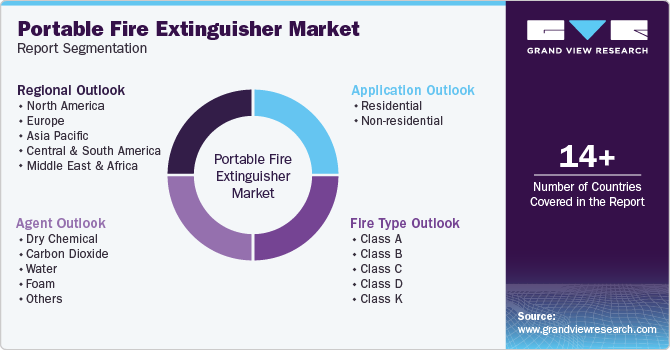
This report forecasts revenue growth at the regional and country levels and provides an analysis of the latest industry trends and opportunities in each of the sub-segments from 2021 to 2033. For this study, Grand View Research has segmented the portable fire extinguisher market report based on agent, fire type, application, and region.
 To learn more about this report, Download Free Sample Report
 -
Agent Outlook (Revenue, USD Billion, 2021 - 2033)
-
Dry Chemical
-
Carbon Dioxide
-
Water
-
Foam
-
Others
-
-
Fire Type Outlook (Revenue, USD Billion, 2021 - 2033)
-
Class A
-
Class B
-
Class C
-
Class D
-
Class K
-
-
Application Outlook (Revenue, USD Billion, 2021 - 2033)
-
Residential
-
Non-residential
-
Office Building
-
Retail Stores & Shopping Malls
-
Hospitality
-
Educational Institutions
-
Transportation
-
Entertainment, Leisure, & Sports Venues
-
Healthcare Facilities
-
Manufacturing Plants & Factories
-
Warehouses & Distribution Centers
-
Construction Sites
-
Gas/Fuel Stations
-
Others
-
-
-
Regional Outlook (Revenue, USD Billion, 2021 - 2033)
-
North America
-
U.S.
-
Canada
-
Mexico
-
-
Europe
-
UK
-
Germany
-
France
-
Italy
-
Spain
-
-
Asia Pacific
-
China
-
Japan
-
India
-
Australia
-
South Korea
-
-
Central & South America
-
Brazil
-
-
Middle East & Africa
-
Saudi Arabia
-
-
Research Methodology
Segment Definition
Segment - Agent
Revenue capture definition
Dry Chemical
Covers portable fire extinguishers utilizing dry chemical extinguishing agents, including monoammonium phosphate, sodium bicarbonate, potassium bicarbonate, and specialty chemical powders. The scope includes stored-pressure and cartridge-operated units, portable cylinders of varying capacities, discharge mechanisms, nozzle configurations, refillable and disposable models, and products supplied for residential, commercial, industrial, and institutional applications.
Carbon Dioxide
Covers portable fire extinguishers charged with carbon dioxide as the extinguishing medium. The scope includes high-pressure cylinder designs, horn-type discharge assemblies, handheld and wheeled portable units, varying cylinder capacities, refillable systems, and equipment deployed across commercial buildings, electrical facilities, industrial premises, data centers, laboratories, and transportation-related environments.
Water
Covers portable fire extinguishers that utilize water-based extinguishing agents, including stored water, deionized water, distilled water, and water-mist technologies. The scope includes pressurized portable units, handheld extinguishers, different tank capacities, spray and mist discharge systems, refillable products, and installations across residential, commercial, institutional, and selected industrial facilities.
Foam
Covers portable fire extinguishers using foam-based extinguishing agents, including aqueous film-forming foam (AFFF), fluorine-free foam, and other firefighting foam formulations. The scope includes portable cylinders, stored-pressure units, discharge hose assemblies, varying capacity ranges, refillable products, and deployment across industrial sites, transportation facilities, warehouses, commercial premises, and fuel-handling environments.
Others
Covers portable fire extinguishers employing alternative extinguishing agents such as wet chemicals, clean agents, halotron substitutes, fluoroketone-based agents, inert gas blends, and specialty suppression compounds. The scope includes portable handheld units, refillable and disposable configurations, specialized discharge systems, and applications across commercial kitchens, sensitive equipment environments, industrial facilities, and institutional settings.
Segment - Fire Type
Revenue capture definition
Class A
Covers portable fire extinguishers specifically rated for Class A fire hazards involving ordinary combustible materials such as wood, paper, textiles, rubber, and plastics. The scope includes certified extinguisher products, portable cylinder designs, capacity variations, rating classifications, discharge systems, and deployment across residential, commercial, educational, institutional, and industrial facilities.
Class B
Covers portable fire extinguishers rated for Class B fire hazards involving flammable liquids and combustible liquid materials. The scope includes extinguisher products designed and certified for liquid-fuel fire suppression, portable units with varying agent types and capacities, performance ratings, discharge mechanisms, and installations across industrial plants, warehouses, fuel storage, transportation, and commercial facilities.
Class C
Covers portable fire extinguishers rated for Class C fire hazards involving energized electrical equipment and electrical installations. The scope includes portable extinguishing units utilizing non-conductive agents, certified product configurations, varying capacity ranges, discharge technologies, and deployment across offices, manufacturing facilities, utility infrastructure, telecommunications sites, data centers, and institutional buildings.
Class D
Covers portable fire extinguishers designed for Class D fire hazards involving combustible metals such as magnesium, titanium, sodium, lithium, potassium, and related alloys. The scope includes specialized dry powder extinguishing systems, portable cylinder designs, certified extinguisher ratings, industrial-grade products, and deployment across metal processing, manufacturing, aerospace, laboratory, and industrial environments.
Class K
Covers portable fire extinguishers rated for Class K fire hazards involving cooking oils, animal fats, and vegetable fats. The scope includes wet chemical extinguisher products, portable cylinder configurations, discharge wand systems, certified performance ratings, refillable units, and installations across commercial kitchens, foodservice establishments, catering facilities, hospitality venues, and institutional food preparation areas.
Estimation Model
Fire Risk Exposure Layer
Compliance & Accessibility Layer
Adoption & Replacement Layer
Monetisation Layer
Who requires fire protection equipment?
Who can be reached through the fire safety ecosystem?
Who actively purchases portable fire extinguishers?
How much revenue is generated?
Identify residential, commercial, industrial, institutional, and transportation facilities exposed to fire hazards. Apply fire-risk occurrence rates and regulatory requirements to determine the global population of locations requiring portable fire extinguishers as a primary fire-suppression solution.
Apply region-specific fire safety regulations, building code compliance rates, and infrastructure development trends to the eligible facility base, deriving the addressable market that can be served through distributors, contractors, OEMs, and safety equipment suppliers.
Apply installation rates, replacement cycles, periodic inspection requirements, and adoption levels across residential and non-residential facilities to convert the addressable base into active purchasers of portable fire extinguishers. Demand is further supported by regulatory audits and safety compliance programs.
Multiply annual extinguisher purchases by blended ASPs across dry chemical, CO₂, water, foam, and specialty extinguishers. Add recurring revenue from inspection, maintenance, testing, certification, refilling, and replacement services to estimate total market revenue.
Delivered Customizations
This report has been delivered with the following In-depth customizations
Client Request
Customization Delivered
Value Adds
Fire Safety Compliance & End-Use Facility Analysis
Comprehensive assessment of portable fire extinguisher demand across commercial buildings, manufacturing facilities, warehouses, healthcare facilities, educational institutions, hospitality establishments, residential complexes, and transportation infrastructure. Analysis includes extinguisher deployment density, compliance requirements, inspection frequency, replacement cycles, and procurement practices by facility type and country.
Identifies the highest-value end-use sectors and facilities with the greatest replacement demand. Supports sales prioritization, regulatory-focused marketing strategies, and targeted expansion into sectors experiencing increasing fire-safety investments and compliance enforcement.
Regulatory Standards & Replacement Market Analysis
Detailed analysis of fire safety regulations, building codes, occupational safety standards, certification requirements, and mandatory inspection frameworks across major countries. Evaluation includes installed base estimation, extinguisher lifespan trends, recharge requirements, and replacement demand forecasting by region and end-use sector.
Supports competitive positioning by identifying channel gaps, service-network expansion opportunities, and regional distribution inefficiencies. Helps companies strengthen market share through optimized route-to-market strategies and value-added service offerings.
Competitive Benchmarking & Distribution Network Analysis
In-depth benchmarking of key market participants based on product certifications, manufacturing footprint, service network coverage, pricing strategies, distributor partnerships, and after-sales maintenance capabilities. Assessment also includes channel-wise analysis across direct sales, fire protection contractors, distributors, safety equipment suppliers, and e-commerce platforms.
Quantifies recurring revenue opportunities generated by replacement, inspection, and maintenance cycles. Assists strategic planning by identifying markets where regulatory changes and stricter enforcement are expected to accelerate demand growth.
Frequently Asked Questions About This Report
The global portable fire extinguisher market was valued at USD 12.4 billion in 2025 and is estimated at USD 13.4 billion in 2026.
The global portable fire extinguisher market is expected to grow at a CAGR of 10.3% from 2026 to 2033, reaching USD 26.6 billion by 2033.
North America dominated the market with a 37.8% revenue share in 2025.
Key players include Amerex Corporation; Carrier Global Corporation; Johnson Controls; Minimax Viking Group; FlameStop Australia Pvt Ltd.; Feuerschutz Jockel GmbH & Co.; Jactone Products Limited; Chubb Fire & Security; Morita Holdings Corp.; Hochiki Corp.
The dry chemical segment led the market with a 35.0% revenue share in 2025, while the CO₂ Extinguisher segment is projected to be the fastest-growing product category.
Asia Pacific is the fastest-growing regional market, projected to expand at a 12.4% CAGR during the forecast period.
The Non-residential segment held the largest revenue share of 85.8% in 2025, while healthcare facilities are expected to witness strong growth during the forecast period.
The Class C Fire Extinguisher segment held the largest share of 37.5% in 2025, while the Class B Fire Extinguisher segment is projected to grow at the fastest rate over the forecast period.
Key factors include increasing fire safety regulations across commercial and industrial sectors, rising construction activities worldwide, growing awareness regarding workplace and residential fire protection, expansion of manufacturing and warehousing facilities, and mandatory installation requirements under building safety codes and insurance compliance frameworks.
About the Author(s)
Homecare & Decor Research Team
Consumer Goods · Homecare & DecorThis report was authored by the homecare & decor research team at Grand View Research - comprising two research analysts, one senior research analyst, and one industry expert - with specialized expertise in the homecare & decor segment of the consumer goods industry. All findings are based on proprietary consumer goods databases, executive interviews, and regulatory analysis, subject to internal peer review prior to publication.
Last Updated:
Speak to Analyst

Customize this report to your needs - add regions, segments, or data points, with 20% free customization.
Or view our licence options:


ISO 9001:2015 & 27001:2022 Certified
We are GDPR and CCPA compliant! Your transaction & personal information is safe and secure. For more details, please read our privacy policy.


