
- Home
- »
- Advanced Interior Materials
- »
-
Pre-engineered Metal Building Market Size Report, 2026-2033GVR Report cover

Pre-engineered Metal Building Market (2026 - 2033) Size, Share & Trends Analysis Report By Application (Office, Warehouse, Healthcare, Education, Recreational, Lodging & Restaurants, Manufacturing, Agriculture, Others), By Region, And Segment Forecasts
Market Size, 2025
$44.1BMarket Estimate, 2026
$47.9BMarket Forecast, 2033
$87.0BCAGR, 2026–2033
8.9%Pre-engineered Metal Building Market Summary
The global pre-engineered metal building market size was valued at USD 44.1 billion in 2025 and is projected to grow from USD 47.9 billion in 2026 to USD 87.0 billion by 2033, at a CAGR of 8.9% from 2026 to 2033. The pre-engineered metal building market held the largest share of 34.1% of the global market in 2025. Rapid industrialization and growth of logistics & warehouse infrastructure are driving demand for fast, cost-efficient construction solutions, making pre-engineered metal buildings (PEMBs) attractive for factories, distribution centers, and commercial facilities.
 Source: Grand View Research, IR Documents, Primary Interviews, Paid DatabasesTo learn more about this report,
 Download Free Sample Report
 Key Market Trends & Insights
- By application: the manufacturing segment dominated the market in 2025 with a 35.2% revenue share.
- By application: the warehouse segment holds a significant share in the market due to the increasing demand for large span storage facilities driven by the rapid growth of e-commerce
Regional Highlights
- Largest regional market: Asia Pacific (34.1% revenue share, 2025)
- The market in China is growing due to rapid industrialization and rising investments in logistics, warehousing, and manufacturing infrastructure
Market Size & Forecast
- Market size in 2025: USD 44.1 Billion
- Estimated market size in 2026: USD 47.9 Billion
- Projected market size by 2033: USD 87.0 Billion
- CAGR (2026-2033): 8.9%
Three ways to get this report
Buy it, customize it, or ask a question.Ask an Analyst
Analyst response in 1 business day
- AccessReport author, directly
- Reply timeWithin 1 working day
- No sales callDirect answer only
- FormatEmail reply
- CostFree, no cost
Get the Full Report
What the study covers
- FormatsPDF · Excel · Dashboard
- Timeline2026–2033 annual, 2025 base
- Coverage20+ countries, 5 regions
- Companies10+ key players profiled
Customize the Report
20% free customization
- IncludeCountries, segments, points
- TailorTo your product definition
- ExtendDeeper competitor detail
- OrA fully bespoke study
- Turnaround5–10 working days
In addition, an increasing preference for sustainable, lightweight, and quick-installation building systems is accelerating adoption, as PEMBs reduce construction time, material waste, and overall project costs compared to conventional construction.Pre-engineered metal structures are manufactured in controlled factory environments and later assembled at the project site, which significantly reduces construction time compared to conventional building methods. This approach lowers labor requirements, minimizes material waste, and ensures predictable project timelines. As businesses increasingly focus on reducing construction costs and accelerating project delivery, the adoption of pre-engineered metal buildings is expanding across warehouses, factories, commercial complexes, and aircraft hangars.
 To learn more about this report, Download Free Sample Report
 The rapid expansion of logistics infrastructure, e-commerce warehouses, and manufacturing facilities worldwide is also propelling market growth. The growth of global trade and e-commerce has created strong demand for large span warehouse facilities and distribution centers that require flexible interior layouts. Pre-engineered metal buildings provide structural strength, wide column-free spaces, and the ability to expand or modify structures based on operational requirements. In addition, government investments in industrial corridors, manufacturing zones, and infrastructure development projects are further supporting the adoption of pre-engineered metal buildings, particularly in emerging economies.
Sustainability considerations and technological advancements in steel fabrication are also supporting market growth. Pre-engineered metal buildings use optimized structural designs and recyclable steel components, which reduce overall material consumption and construction waste. Modern insulation systems, advanced coatings, and energy-efficient roofing technologies also enhance the durability and thermal performance of these buildings. As regulatory authorities and developers increasingly focus on sustainable construction practices and green building standards such as Leadership in Energy and Environmental Design (LEED), the adoption of pre-engineered metal building solutions is expected to continue growing across industrial and commercial construction projects.
Market Concentration & Characteristics
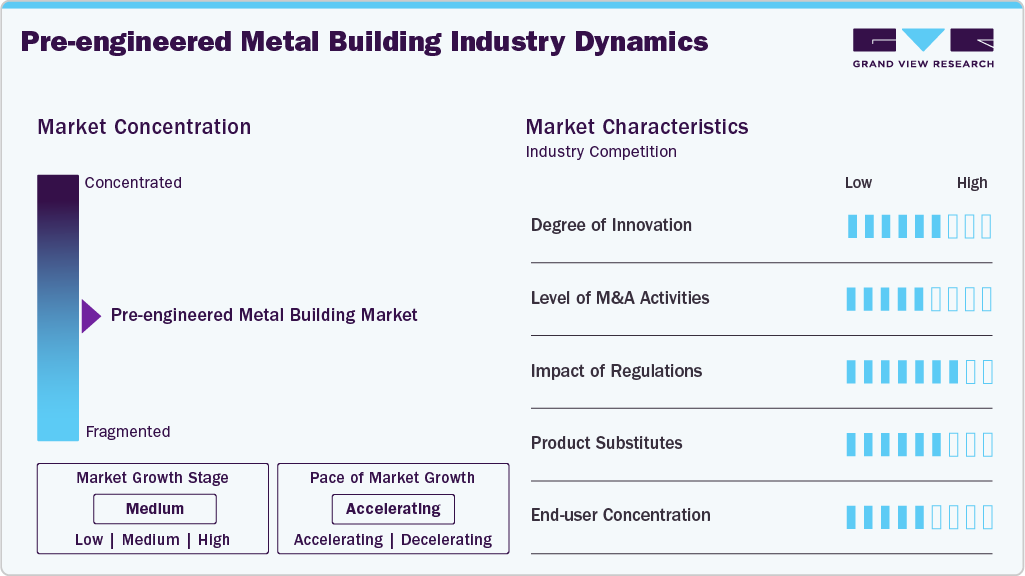
The global pre-engineered metal building industry is characterized by high levels of prefabrication, engineering customization, and project-based demand. Manufacturers design building components such as primary frames, secondary members, roofing systems, and wall panels using advanced engineering software before fabricating them in controlled manufacturing facilities. This approach ensures precise dimensions, efficient material usage, and faster on-site assembly. The industry typically operates on a build-to-order model where structures are designed according to specific project requirements, including span width, load capacity, environmental conditions, and intended end-use applications such as warehouses, factories, or commercial buildings.
 To learn more about this report, Download Free Sample Report
 The market is also characterized by a mix of global engineering firms and regional manufacturers that compete on cost efficiency, customization capabilities, and project delivery timelines. While large multinational companies focus on large-scale industrial and infrastructure projects, regional manufacturers often cater to local commercial buildings, agricultural structures, and small industrial units. Technological adoption, including advanced structural design software, automated fabrication systems, and digital project management tools, plays a crucial role in improving productivity and ensuring compliance with international building standards such as those developed by the American Institute of Steel Construction and the International Code Council.
Application Insights
The manufacturing segment dominated the market in 2025 with a 35.2% revenue share due to the strong demand for large span, cost-efficient, and quickly deployable industrial facilities such as production plants, assembly units, and storage structures. Pre-engineered metal buildings provide flexible layouts, high structural strength, and faster construction timelines, making them highly suitable for expanding manufacturing operations and industrial infrastructure development.
 To learn more about this report, Download Free Sample Report
 The warehouse segment holds a significant share in the market due to the increasing demand for large span storage facilities driven by the rapid growth of e-commerce, logistics networks, and global supply chains. Pre-engineered metal buildings provide column-free spaces, faster construction, and cost-efficient expansion capabilities, making them highly suitable for distribution centers and large-scale warehouse infrastructure.
Regional Insights
Asia Pacific represents the largest revenue share of 34.1% in 2025 and is fastest-growing regional segment in the global pre-engineered metal building market due to rapid industrialization, urban infrastructure development, and the expansion of manufacturing and logistics sectors. Countries such as China, India, and Vietnam are witnessing significant investments in industrial parks, manufacturing hubs, and transportation infrastructure, which is increasing the demand for cost-efficient and quickly deployable building solutions.
 To learn more about this report, Download Free Sample Report
 In addition, government initiatives aimed at strengthening domestic manufacturing capabilities and infrastructure development are further accelerating market adoption. Industrial development programs such as Make in India and Made in China 2025 are encouraging the establishment of new production facilities and industrial clusters, which require fast and economical building solutions. Therefore, pre-engineered metal buildings are increasingly being utilized in factories, processing plants, commercial complexes, and infrastructure projects throughout the region.
China Pre-engineered Metal Building Market Trends
The Pre-Engineered Metal Building Market in China is growing due to rapid industrialization and rising investments in logistics, warehousing, and manufacturing infrastructure. These buildings are increasingly preferred for their fast construction, cost efficiency, and structural flexibility compared to traditional construction. Additionally, expanding industrial parks and e-commerce warehousing facilities are further supporting market demand across the country.
Europe Pre-engineered Metal Building Market Trends
The pre-engineered metal building market in Europe represents a mature yet steadily growing regional segment in the global market, supported by strong industrial infrastructure, stringent building standards, and increasing adoption of sustainable construction practices. Countries such as Germany, France, and the UK are key markets where pre-engineered metal buildings are widely used in manufacturing facilities, logistics centers, and commercial structures. The region’s focus on efficient construction methods and durable building materials has encouraged the adoption of engineered steel building systems.
North America Pre-engineered Metal Building Market Trends
North America represents a well-established region in the global pre-engineered metal building market, supported by advanced construction practices, strong industrial infrastructure, and high adoption of steel building systems. The U.S. pre-engineered metal building market is key contributor to regional demand, driven by the expansion of manufacturing facilities, commercial buildings, and agricultural structures. Pre-engineered
metal buildings are widely preferred in the region due to their durability, design flexibility, and ability to support large span structures required for industrial and commercial applications.
Key Pre-engineered Metal Building Company Insights
The competitive environment of the market is moderately fragmented, with the presence of several global manufacturers and numerous regional steel building suppliers competing on engineering capabilities, pricing, project delivery timelines, and customization services. Leading companies focus on expanding their geographic presence, strengthening fabrication capacity, and offering integrated services such as design engineering, manufacturing, and installation support to gain a competitive advantage.
Technological capabilities such as advanced structural design software, automated fabrication processes, and energy-efficient building systems are also important differentiating factors. Major participants in the industry include companies such as BlueScope Steel Limited, Nucor Corporation, Kirby Building Systems, and PEB Steel Buildings, which compete by offering customized steel building solutions for industrial, commercial, logistics, and infrastructure applications.
Key Pre-engineered Metal Building Companies:
The following key companies have been profiled for this study on the pre-engineered metal building market.
- Nucor Building Systems
- BlueScope Buildings North America
- Kirby Building Systems, LLC
- Cornerstone Building Brands, Inc.
- EPACK Prefab
- Allied Steel Buildings
- Pacific Building Systems
- Titan Steel Structures
- Inland Buildings
- Summit Steel Buildings
- Central States
- BORGA Steel Buildings and Components
Recent Developments
-
In February 2026, Allied Steel Buildings expanded its manufacturing facility in McGregor, Texas, to increase production capacity and improve delivery timelines for steel structures. The expansion internalizes key components such as structural frames, liner systems, and subframing while adding new machinery, reducing supplier dependency, and enhancing production efficiency and quality control.
-
In September 2025, Central States Inc. opened a 100,000-square-foot manufacturing facility in Tooele, Utah, marking its 13th plant and westernmost location. The new facility will manufacture roof and wall panels, trim, structural purlin, and the Alpha Framing System to support the company’s pre-engineered metal building, roofing, siding, post-frame, self-storage, and metal components operations.
-
In September 2025, Cornerstone Building Brands, Inc. acquired Metal Sales Manufacturing Corporation to strengthen its Shelter Solutions segment in the metal building market. The acquisition expands Cornerstone’s manufacturing and distribution network to more than 100 facilities, enhancing its presence in high-growth metal building systems and components markets across North America.
Pre-engineered Metal Building Market Report Scope
Report Attribute
Details
Market size in 2025
USD 44.1 billion
Estimated Market size in 2026
USD 47.9 billion
Projected Market size by 2033
USD 87.0 billion
Growth rate
CAGR of 8.9% from 2026 to 2033
Actual data
2021 - 2025
Forecast period
2026 - 2033
Quantitative units
Revenue in USD million/billion and CAGR from 2026 to 2033
Report coverage
Revenue forecast, company ranking, competitive landscape, growth factors, and trends
Segments covered
Application, region
Regional scope
North America; Europe; Asia Pacific; Latin America; MEA
Country scope
U.S.; Canada; Mexico; Germany; UK; France; Spain; Italy; China; India; Japan
Key companies profiled
Nucor Building Systems; BlueScope Buildings North America; Kirby Building Systems, LLC; Cornerstone Building Brands, Inc.; EPACK Prefab; Allied Steel Buildings; Pacific Building Systems; Titan Steel Structures; Inland Buildings; Summit Steel Buildings; Central States; BORGA Steel Buildings and Components
Customization scope
Free report customization (equivalent up to 8 analysts’ working days) with purchase. Addition or alteration to country, regional, and segment scope.
Pricing and purchase options
Avail customized purchase options to meet your exact research needs. Explore purchase options Global Pre-engineered Metal Building Market Report Segmentation
This report forecasts revenue growth at the global, regional, and country levels and provides an analysis of the latest industry trends in each of the sub-segments from 2021 to 2033. For this study, Grand View Research has segmented the global pre-engineered metal building market report based on application, and region:
 To learn more about this report, Download Free Sample Report
 -
Application Outlook (Revenue, USD Million, 2021 - 2033)
-
Manufacturing
-
Warehouse
-
Agriculture
-
Recreational
-
Other Applications
-
Office
-
Education
-
Healthcare
-
Lodging & Restaurants
-
-
Regional Outlook (Revenue, USD Million, 2021 - 2033)
-
North America
-
U.S.
-
Canada
-
Mexico
-
-
Europe
-
Germany
-
UK
-
France
-
Italy
-
Spain
-
-
Asia Pacific
-
China
-
India
-
Japan
-
-
Latin America
-
Middle East & Africa
-
Frequently Asked Questions About This Report
The global Pre-engineered Metal Building market size was valued at USD 47.9 billion in 2025 and is estimated at USD 87.0 billion for 2026.
The global Pre-engineered Metal Building market is expected to grow at a CAGR of 8.9% from 2026 to 2033, reaching USD 87.0 billion.
Asia Pacific dominated with a 34.1%% revenue share in 2025.
Asia Pacific is the fastest-growing region over the forecast period.
The manufacturing segment led with a 35.2% revenue share in 2025, while services is the fastest-growing segment.
Key factors include cost-efficient construction solutions, making pre-engineered metal buildings (PEMBs) attractive for factories, distribution centers, and commercial facilities.
Key players include Nucor Building Systems, BlueScope Buildings North America, Kirby Building Systems, LLC, Cornerstone Building Brands, Inc., EPACK Prefab, Allied Steel Buildings, Pacific Building Systems, Titan Steel Structures, Inland Buildings, Summit Steel Buildings, Central States, BORGA Steel Buildings and Components
About the Author(s)
Advanced Interior Materials Research Team
Advanced Materials · Advanced Interior MaterialsThis report was authored by the advanced interior materials research team at Grand View Research - comprising two research analysts, one senior research analyst, and one industry expert - with specialized expertise in the advanced interior materials segment of the advanced materials industry. All findings are based on proprietary advanced materials databases, executive interviews, and regulatory analysis, subject to internal peer review prior to publication.
Last Updated:
Speak to Analyst

Customize this report to your needs - add regions, segments, or data points, with 20% free customization.
Or view our licence options:


ISO 9001:2015 & 27001:2022 Certified
We are GDPR and CCPA compliant! Your transaction & personal information is safe and secure. For more details, please read our privacy policy.


