
- Home
- »
- Medical Devices
- »
-
Prehabilitation Market Size, Share, Trends Report, 2026-2033GVR Report cover
![Prehabilitation Market (2026 - 2033)Report]()
Prehabilitation Market (2026 - 2033)
Size, Share & Trends Analysis Report By Service (Physical Therapy, Nutritional Counseling, Psychological Support), By Application (Orthopedic Surgery, Oncology, Others), By Region, And Segment Forecasts
Market Size, 2025
$1.1BMarket Estimate, 2026
$1.2BMarket Forecast, 2033
$1.7BCAGR, 2026–2033
5.5%Prehabilitation Market Summary
The global prehabilitation market size was valued at USD 1.1 billion in 2025 and is projected to grow from USD 1.2 billion in 2026 to USD 1.7 billion by 2033, at a CAGR of 5.5% from 2026 to 2033. The North America held the largest share of 36.8% of the global market in 2025. This growth is attributed to increasing surgical volumes, a rising burden of chronic diseases, growing focus on preventive healthcare, proven clinical benefits, digital health advancements, and the need for cost optimization, collectively driving market expansion.

Key Market Trends & Insights
- By service: Physical therapy segment held the largest market share of 40.1% in 2025.
- By application: Oncology segment held the largest market share of 30.2% in 2025.
- By delivery mode: In-person/center-based segment held the largest market share of 34.6% in 2025.
Regional Highlights
- Largest regional market: North America (36.8% revenue share, 2025)
- By country: The U.S. held the largest share in 2025
Market Size & Forecast
- Market size in 2025: USD 1.1 Billion
- Estimated market size in 2026: USD 1.2 Billion
- Projected market size by 2033: USD 1.7 Billion
- CAGR (2026-2033): 5.5%
The section below outlines the key factors driving market growth, highlighting the rising volume of surgical procedures, increasing prevalence of chronic diseases, and the growing aging population. It also examines the role of preventive care approaches, personalized preoperative programs, and digital health solutions in improving patient outcomes and establishing prehabilitation as an essential component of perioperative care.
Increasing Surgical Procedures And Need For Better Outcomes
The growing number of surgical procedures is driving demand for prehabilitation to improve patient readiness and recovery. Prehabilitation helps enhance physical fitness, reduce complications, and shorten hospital stays, making it an essential component of modern perioperative care. In January 2025, a study done by BMJ suggests that over 300 million surgical procedures are performed each year globally, highlighting the rapidly increasing surgical volume and the growing need for prehabilitation to improve patient outcomes and recovery. In addition, it supports better postoperative outcomes and reduces healthcare costs by minimizing readmissions and recovery time.
Expansion of Rehabilitation Networks and Increasing Access to Prehabilitation Services
The expansion of outpatient rehabilitation networks and increasing accessibility to specialized prehabilitation services are supporting market growth by enabling early intervention and improved patient outcomes. For instance, in June 2024, Ivy Rehab Physical Therapy opened a new clinic in Hamilton, New Jersey, offering prehabilitation programs alongside physical therapy services, as part of its broader network expansion to enhance patient access to preventive and preoperative care.
Advancements in Digital Health
The growing integration of AI in prehabilitation is enabling highly personalized and adaptive care programs tailored to individual patient needs, activity levels, and health goals. AI-driven platforms can analyze user data in real time to deliver customized exercise plans, monitor progress, and provide continuous guidance, improving patient engagement and adherence. This shift toward digital and home-based prehabilitation enhances accessibility, reduces dependency on in-person visits, and supports more efficient, scalable, and outcome-driven preoperative care. In March 2026, Prehab launched its AI-powered “Prehab Coach,” delivering personalized daily recommendations and guidance based on user data, supported by a library of over 4,000 exercises and 55+ structured programs.
Market Characteristics & Concentration
The chart below represents the relationship between industry concentration, industry characteristics, and industry participants. There is a medium degree of innovation, a moderate level of merger & acquisition activities, a high impact of regulations, and moderate expansion of the industry.
The prehabilitation industry demonstrates a high degree of innovation, driven by the integration of digital health technologies, AI-powered personalization, remote monitoring tools, and multimodal care approaches combining exercise, nutrition, and psychological support to enhance patient outcomes and engagement.
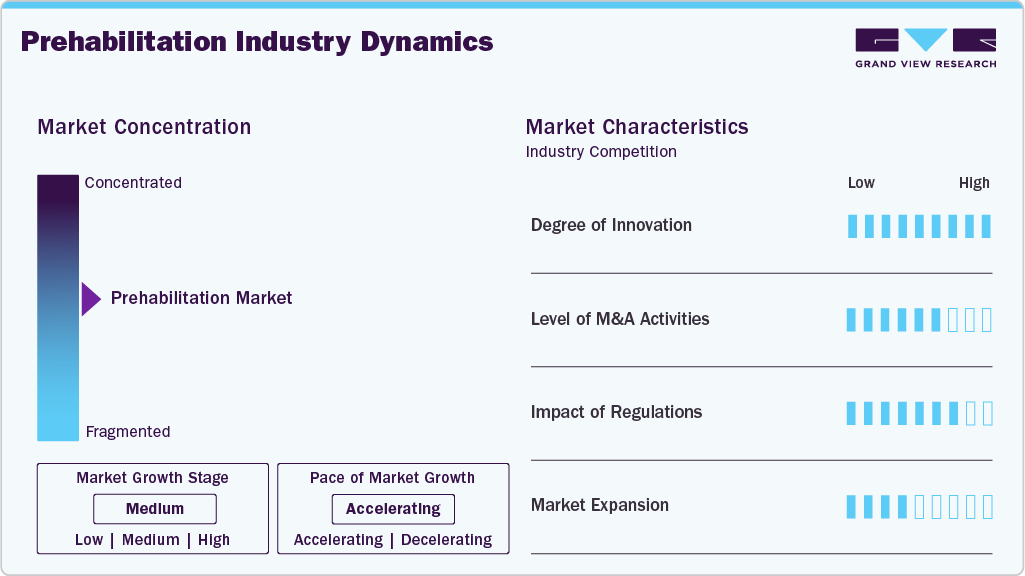
Several key players are actively engaging in mergers & acquisitions to promote growth & innovation and improve their competitiveness by combining the expertise & efforts of different organizations. The prehabilitation industry exhibits a moderate and growing level of mergers and acquisitions, driven by increasing investments from digital health companies, rehabilitation service providers, and private equity firms aiming to expand capabilities, integrate technology, and strengthen market presence. In January 2025, Sword Health acquired Surgery Hero to expand its presence in the UK, integrating prehabilitation capabilities to enhance digital musculoskeletal care, improve patient outcomes, and support healthcare systems facing rising demand and long treatment waitlists.
The prehabilitation industry operates within broader healthcare regulatory frameworks focused on patient safety, clinical standards, and digital health compliance. Regulations governing telehealth, data privacy (such as HIPAA in the U.S.), and clinical practice standards influence the delivery of prehabilitation services. In addition, integration with hospital-based perioperative care pathways requires adherence to established medical guidelines and reimbursement policies, shaping the adoption and scalability of prehabilitation programs.
The prehabilitation industry is expanding through the integration of AI-powered and digital solutions, enabling personalized, scalable, and home-based preoperative care that enhances patient engagement and broadens access to preventive health services. The increasing adoption of remote monitoring tools, mobile health applications, and virtual care platforms is further supporting continuous patient tracking, improving clinical outcomes, and strengthening the overall efficiency of preoperative care pathways.
Service Insights
Physical therapy held a significant share of 40.1% in 2025, driven by the global rise in orthopedic, spinal, and cancer-related surgeries for pre-surgical conditioning programs, where physical therapy plays a central role in preparing patients. In January 2025, a systematic review published in The BMJ analyzed 186 trials involving approximately 15,700 patients and reported that exercise-based prehabilitation reduced postoperative complications by nearly 50% and shortened hospital stays, particularly in patients undergoing major and cancer-related surgical procedures.
The psychological support segment is expected to grow at the fastest CAGR during the forecast period. High levels of pre-surgical anxiety and distress negatively affect recovery, increasing complications and healthcare costs, thereby boosting the adoption of psychological support programs. In June 2025, a UCLA Health study analyzing 20 randomized controlled trials reported that preoperative psychological support improved post-surgical outcomes, reducing pain, anxiety, and hospital stay by 1.62 days, while enhancing mental health and potentially lowering postoperative opioid dependence among patients.
Application Insights
The oncology segment accounted for a significant share of 30.2% in 2025, primarily driven by the rising global incidence of cancer and the high proportion of patients requiring surgery and perioperative optimization. According to the AACR Cancer Progress Report, approximately 18.6 million cancer survivors were living in the U.S. as of January 1, 2025. Furthermore, the economic burden of cancer on individuals and the U.S. healthcare system is expected to increase in the coming decades, underscoring the growing need for advanced care approaches, including prehabilitation, as well as increased investment in medical research and public health.
The orthopedic surgery segment is expected to grow at the fastest CAGR during the forecast period. The increasing number of orthopedic procedures, particularly joint replacements and musculoskeletal surgeries, is driving demand for prehabilitation, as patients require improved strength, mobility, and functional capacity prior to surgery to enhance outcomes and reduce complications. Clinical studies indicate that patients undergoing knee and hip replacement who participate in prehabilitation programs demonstrate improved muscle strength, better functional outcomes, and faster post-operative recovery, supporting its growing adoption in orthopedic care.
Delivery Mode Insights
The in-person/center-based segment accounted for a significant share of 34.6% in 2025, primarily driven by the prehabilitation programs providing direct supervision by healthcare professionals, enabling personalized exercise plans, real-time monitoring, and improved patient safety, which drives higher adoption. A large systematic review found that supervision and personalized guidance are key facilitators of higher adherence (~79%) in prehabilitation programs, highlighting the importance of structured, center-based care.

The virtual/digital segment is expected to grow at the fastest CAGR during the forecast period. Virtual prehabilitation enables patients to access care regardless of location, addressing barriers such as distance, mobility issues, and limited availability of in-person programs. Increasing investments, partnerships, and acquisitions by healthcare organizations are driving the growth of digital prehabilitation, as companies aim to scale services, expand patient access, and align national healthcare strategies promoting digital-first care delivery. In February 2026, Reframe Cancer acquired digital prehabilitation provider Alvie Health to expand scalable, digital-first cancer prehabilitation across the NHS, aiming to improve patient outcomes, increase access beyond 20%, and support nationwide implementation aligned with the National Cancer Plan.
Regional Insights
The North America prehabilitation market held the largest share of 36.8% in 2025. Rising surgical volumes and increasing focus on improving outcomes are driving the demand for prehabilitation in North America. A large geriatric population and high prevalence of chronic conditions such as cancer and cardiovascular diseases are increasing the need for prehabilitation to improve surgical outcomes. Tele-rehabilitation, AI-enabled platforms, and wearable technologies are enabling remote and personalized prehabilitation programs. In October 2024, clinical discussions and trials highlighted integrating prehabilitation into preoperative care, particularly for cancer surgeries, improved patient functional status and recovery, with studies showing reduced fatigue and better postoperative outcomes following personalized prehabilitation programs.

U.S. Prehabilitation Market Trends
The prehabilitation market in the U.S. is experiencing significant growth, as prehabilitation centers are witnessing increased demand from patients undergoing orthopedic and cancer-related surgeries. The large number of orthopedic procedures performed annually in the U.S. is significantly driving the demand for prehabilitation services. With approximately 18.6 million orthopedic procedures conducted in 2022, there is an increasing need to optimize patient readiness, reduce postoperative complications, and improve recovery outcomes through structured prehabilitation programs offered by specialized centers.
Asia Pacific Prehabilitation Market Trends
The prehabilitation market in the Asia Pacific is expected to grow at the fastest CAGR during the forecast period. The Asia Pacific is experiencing steady growth, driven by the region’s expanding healthcare infrastructure, rising surgical volumes, and increasing burden of chronic diseases. Countries such as China, India, and Japan are witnessing a surge in demand for preoperative care due to rapidly aging populations and a higher incidence of conditions requiring surgical intervention, including orthopedic and cardiovascular diseases. Asia-Pacific is witnessing rapid population aging, increasing the prevalence of chronic diseases and demand for surgeries, thereby driving the need for prehabilitation to improve surgical readiness and outcomes. According to the World Health Organization, the number of people aged ≥60 years in the Western Pacific region is expected to nearly double by 2050, significantly increasing demand for surgical and prehabilitation services.
Japan prehabilitation market held a significant revenue share in 2025, driven by the growing technological developments and approvals in the country. Japan’s rapidly aging population and increasing surgical interventions are key factors driving demand for prehabilitation. Elderly patients in Japan face higher perioperative risks, including complications such as reduced physical function and longer recovery times, making prehabilitation programs increasingly important for improving surgical outcomes. In September 2024, Japan’s Ministry of Internal Affairs and Communications reported that the country’s elderly population reached a record 36.25 million, accounting for 29.3% of the total population, highlighting a growing need for prehabilitation to improve surgical outcomes in aging patients.
Europe Prehabilitation Market Trends
The prehabilitation market in Europe is witnessing steady growth, driven by the region’s aging population, rising surgical volumes, and strong emphasis on preventive and value-based healthcare. Countries such as the UK, Germany, and France are increasingly integrating prehabilitation into perioperative care pathways to improve surgical outcomes, reduce hospital stays, and lower healthcare costs. Government-supported healthcare systems and clinical guidelines are encouraging early intervention programs, particularly for oncology and orthopedic surgeries.
Germany prehabilitation market accounted for a significant share of the European industry, driven by its rapidly aging population and the high volume of surgeries among elderly patients, which increases the need for prehabilitation due to elevated risks of postoperative complications and functional decline. In 2024, Germany reported over 178,000 cardiac and vascular procedures across 77 heart surgery centers, reflecting a high and growing surgical volume that reinforces the need for prehabilitation to enhance recovery and reduce postoperative complications.
Latin America Prehabilitation Market Trends
The prehabilitation market in Latin America is growing due to a combination of rising chronic disease burden, increasing surgical volumes, and a gradual shift toward preventive and patient-centric care models. The region is experiencing rapid population aging, with a significant rise in individuals over 60 and a growing prevalence of conditions such as cardiovascular disease, diabetes, and obesity, all of which increase the need for surgical interventions and perioperative optimization
Brazil prehabilitation market is undergoing rapid demographic aging, increasing the number of elderly patients requiring surgery and perioperative care, thereby driving demand for prehabilitation. In 2025, individuals aged 65+ accounted for 11% of Brazil’s population, with higher surgical risks and complications among this group.
Middle East and Africa Prehabilitation Market
The prehabilitation market in MEA is growing significantly due to the rising prevalence of non-communicable diseases (NCDs) such as diabetes, cardiovascular diseases, and obesity is increasing surgical interventions, thereby boosting the demand for prehabilitation programs, and older patients are more prone to surgical complications and require preoperative optimization. According to the WHO, the elderly population in sub-Saharan Africa is projected to increase to 163 million in 2050, highlighting the growing need for perioperative care such as prehabilitation.
The UAE prehabilitation market is experiencing steady growth, driven by increasing surgical volumes and the widespread adoption of advanced and minimally invasive procedures, which require improved preoperative patient optimization. The rising prevalence of chronic diseases such as diabetes and cardiovascular conditions is further contributing to higher surgical demand, thereby supporting the need for prehabilitation programs.
Key Prehabilitation Company Insights
The market is fragmented, with the presence of many region & country level prehabilitation providers. The market players undertake several strategic initiatives, such as partnerships & collaborations, product launches, mergers & acquisitions, and geographical expansion to maintain their position and grow in the market.
Key Prehabilitation Companies:
The following key companies have been profiled for this study on the pehabilitation market.
- Alvie Health
- Harley Street Concierge Ltd.
- Cizzle Biotech
- Huma
- QuestPrehab
- Craetus Digital Healthcare Ltd.
- PreActiv
- Prehab4Life
- Surgery Hero Ltd.
- Sword Health, Inc.
Recent Developments
-
In March 2026, Healthworks, supported by the Northern Cancer Alliance, launched an evidence-based cancer prehabilitation service across Northeast and North Cumbria, delivering virtual and in-person interventions to enhance treatment outcomes, improve accessibility, and reduce delays in cancer care delivery.
-
In February 2026, Prehab launched its rebuilt Prehab Professional platform, integrating asynchronous patient care and synchronous clinical workflows, aiming to bridge consumer health with professional physical therapy and establish a technology-driven infrastructure for hybrid rehabilitation care delivery.
-
In October 2025, Plexāā launched its BLOOM Prehab platform in the U.S., integrating a wearable preconditioning device and mobile application to enhance skin resilience, support wound healing, and reduce post-operative complications in patients undergoing breast surgery.
-
In January 2024, a new prehabilitation service for cancer patients was launched by Technical Health Ltd. across Torbay and South Devon, initially targeting lung, prostate, and head & neck cancer patients, with plans to expand to additional cancer types to improve treatment readiness and outcomes.
Prehabilitation Market Report Scope
Report Attribute
Details
Market size in 2025
USD 1.1 billion
Estimated market size in 2026
USD 1.2 billion
Projected market size by 2033
USD 1.7 billion
Growth rate
CAGR of 5.5% from 2026 to 2033
Actual data
2021 - 2025
Forecast period
2026 - 2033
Quantitative units
Revenue in USD million/billion and CAGR from 2026 to 2033
Report coverage
Revenue forecast, company ranking, competitive landscape, growth factors, and trends
Segments covered
Service, application, delivery mode, region
Regional scope
North America; Europe; Asia Pacific; Latin America; MEA
Country scope
U.S., Canada, Mexico, Germany, UK, France, Italy, Spain, Norway, Denmark, Sweden, China, Japan, India, South Korea, Australia, Thailand, Brazil, Argentina, Saudi Arabia, South Africa, UAE, Kuwait
Key companies profiled
Alvie Health; Harley Street Concierge Ltd.; Cizzle Biotech; Huma; QuestPrehab; Craetus Digital Healthcare Ltd.; PreActiv; Prehab4Life; Surgery Hero Ltd.; Sword Health, Inc.
Customization scope
Free report customization (equivalent up to 8 analysts working days) with purchase. Addition or alteration to country, regional & segment scope.
Pricing and purchase options
Avail customized purchase options to meet your exact research needs. Explore purchase options
Global Prehabilitation Market Report Segmentation
This report forecasts revenue growth at global, regional, and country levels and provides an analysis of the latest industry trends in each of the sub-segments from 2021 to 2033. For this study, Grand View Research has segmented the global prehabilitation market report based on service, application, delivery mode, and region:

-
Service Outlook (Revenue, USD Billion, 2021 - 2033)
-
Physical Therapy
-
Nutritional Counseling
-
Psychological Support
-
Respiratory Therapy
-
Others
-
-
Application Outlook (Revenue, USD Billion, 2021 - 2033)
-
Orthopedic Surgery
-
Oncology
-
Cardiac Surgery
-
General Surgery
-
Others
-
-
Delivery Mode Outlook (Revenue, USD Billion, 2021 - 2033)
-
In-person / Center-based
-
Home-based
-
Virtual / Digital
-
Hybrid
-
Others
-
-
Regional Outlook (Revenue, USD Billion, 2021 - 2033)
-
North America
-
U.S.
-
Canada
-
Mexico
-
-
Europe
-
UK
-
Germany
-
France
-
Italy
-
Spain
-
Denmark
-
Sweden
-
Norway
-
-
Asia Pacific
-
China
-
Japan
-
India
-
South Korea
-
Australia
-
Thailand
-
-
Latin America
-
Brazil
-
Argentina
-
-
Middle East and Africa (MEA)
-
South Africa
-
Saudi Arabia
-
UAE
-
Kuwait
-
-
Frequently Asked Questions About This Report
North America dominated with a 36.8% revenue share in 2025.
The oncology segment led with a 30.2% revenue share in 2025, while the orthopedic surgery segment is the fastest-growing.
The in-person/center-based segment led with a 34.6% revenue share in 2025, while the virtual/digital segment is the fastest-growing.
The global prehabilitation market size was estimated at USD 1.1 billion in 2025 and is expected to reach USD 1.2 billion in 2026.
The global prehabilitation market is expected to grow at a CAGR of 5.5% over the forecast period and reach USD 1.7 billion by 2033.
Physical therapy segment held a significant share of 40.1% in 2025 driven by the global rise in orthopedic, spinal, and cancer-related surgeries for pre-surgical conditioning programs, where physical therapy plays a central role in preparing patients.
Key players in the market include Alvie Health, Harley Street Concierge Ltd, Cizzle Biotech, Huma, QuestPrehab, Craetus Digital Healthcare Ltd, PreActiv, Prehab4Life, Surgery Hero Ltd, Sword Health, Inc
Key factors driving the market include the increasing surgical volumes, a rising burden of chronic diseases, growing focus on preventive healthcare, proven clinical benefits, digital health advancements, and the need for cost optimization, collectively driving the expansion of the prehabilitation market.
About the Author(s)
Medical Devices Research Team
Healthcare · Medical DevicesThis report was authored by the medical devices research team at Grand View Research - comprising two research analysts, one senior research analyst, and one industry expert - with specialized expertise in the medical devices segment of the healthcare industry. All findings are based on proprietary healthcare databases, executive interviews, and regulatory analysis, subject to internal peer review prior to publication.
Last Updated:
Speak to Analyst


Customize this report to your needs — add regions, segments, or data points, with 20% free customization.
Or view our licence options:


ISO 9001:2015 & 27001:2022 Certified
We are GDPR and CCPA compliant! Your transaction & personal information is safe and secure. For more details, please read our privacy policy.












