
- Home
- »
- Medical Devices
- »
-
Premium Intraocular Lens Market Size, Share Report, 2033GVR Report cover

Premium Intraocular Lens Market (2026 - 2033)
Size, Share & Trends Analysis Report By Product (Multifocal IOLs, Trifocal IOLs), By Application (Presbyopia Correction, Astigmatism Correction, Cataract Surgery), By End-use, By Region, And Segment Forecasts
Market Size, 2025
$2.4BMarket Estimate, 2026
$2.6BMarket Forecast, 2033
$4.4BCAGR, 2026–2033
7.7%Premium Intraocular Lens Market Summary
The global premium intraocular lens market size was valued at USD 2.4 billion in 2025 and is projected to grow from USD 2.6 billion in 2026 to USD 4.4 billion by 2033, at a CAGR of 7.7% from 2026 to 2033. North America dominated the market, accounting for a revenue share of 40.7% in 2025. The growth of the global market is attributed to the rising prevalence of cataracts and presbyopia, increasing demand for spectacle independence, and growing adoption of advanced lens technologies.
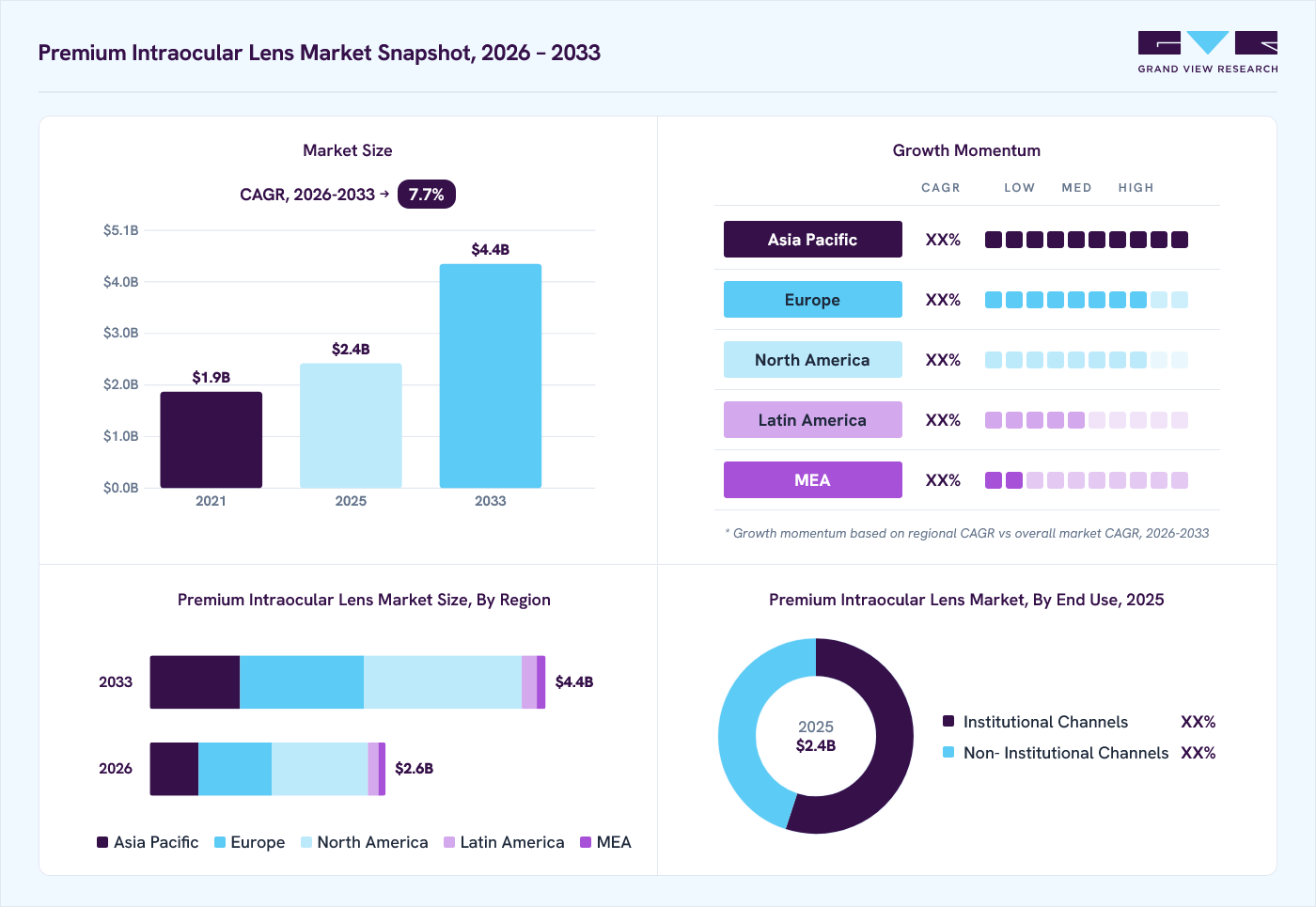 Source: Grand View Research, IR Documents, Primary Interviews, Paid DatabasesTo learn more about this report,
 Download Free Sample Report
Key Market Trends & Insights
- By product: Trifocal IOLs segment held the highest market share of 33.5% in 2025.
- By application: Cataract segment held a leading market share in 2025.
- By end-use: Institutional channels segment held the highest market share in 2025.
Regional Highlights
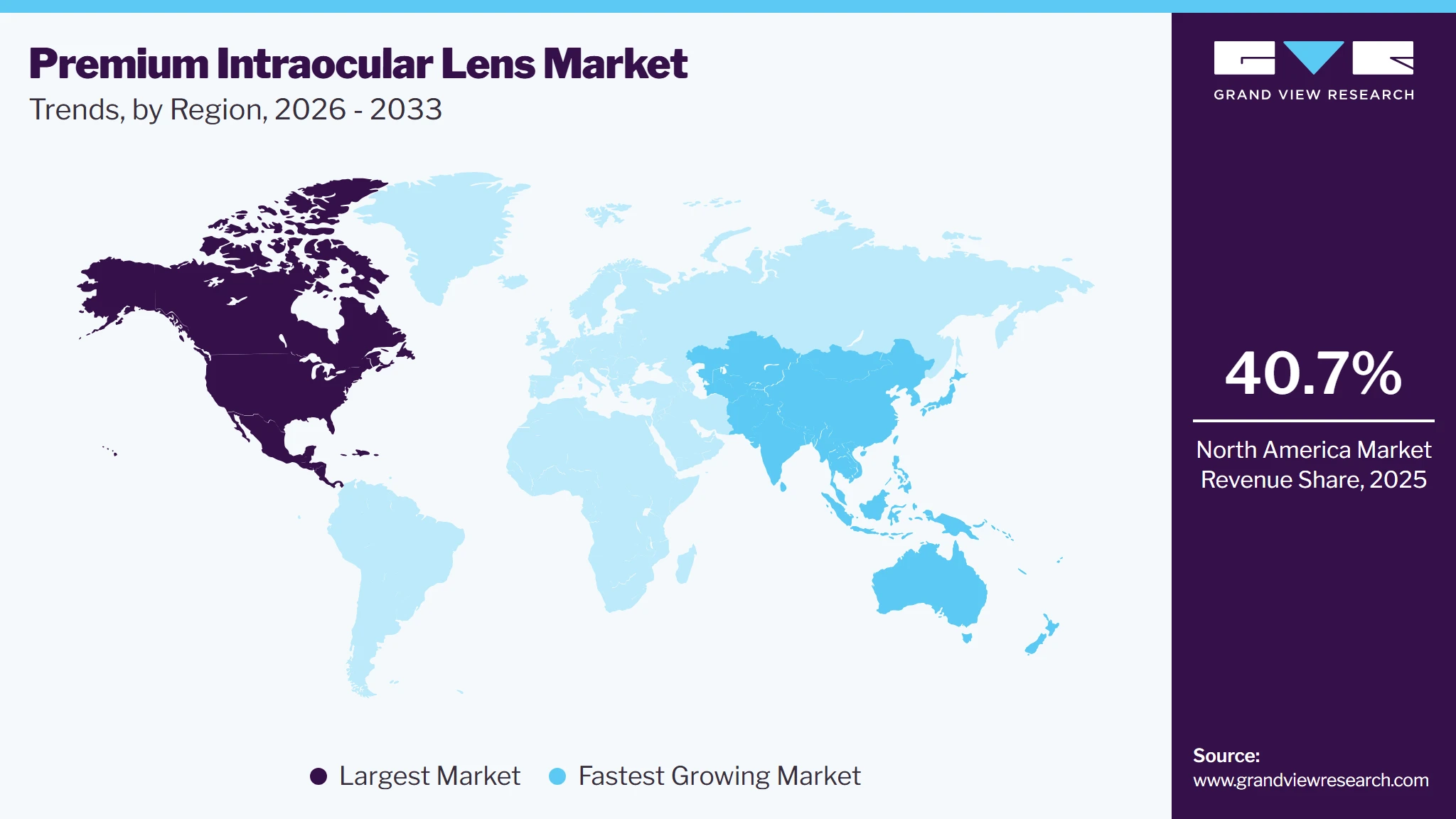
- Largest regional market: North America (40.7% revenue share, 2025)
- Fastest-growing regional market: Asia Pacific (highest CAGR, 2026-2033)
Market Size & Forecast
- Market size in 2025: USD 2.4 Billion
- Estimated market size in 2026: USD 2.6 Billion
- Projected market size by 2033: USD 4.4 Billion
- CAGR (2026-2033): 7.7%
Prism AI by Grand View Research Free to tryAsk a question about the premium intraocular lens marketTry asking✓Every figure cited from GVR research Prefer the report? Download free sample →
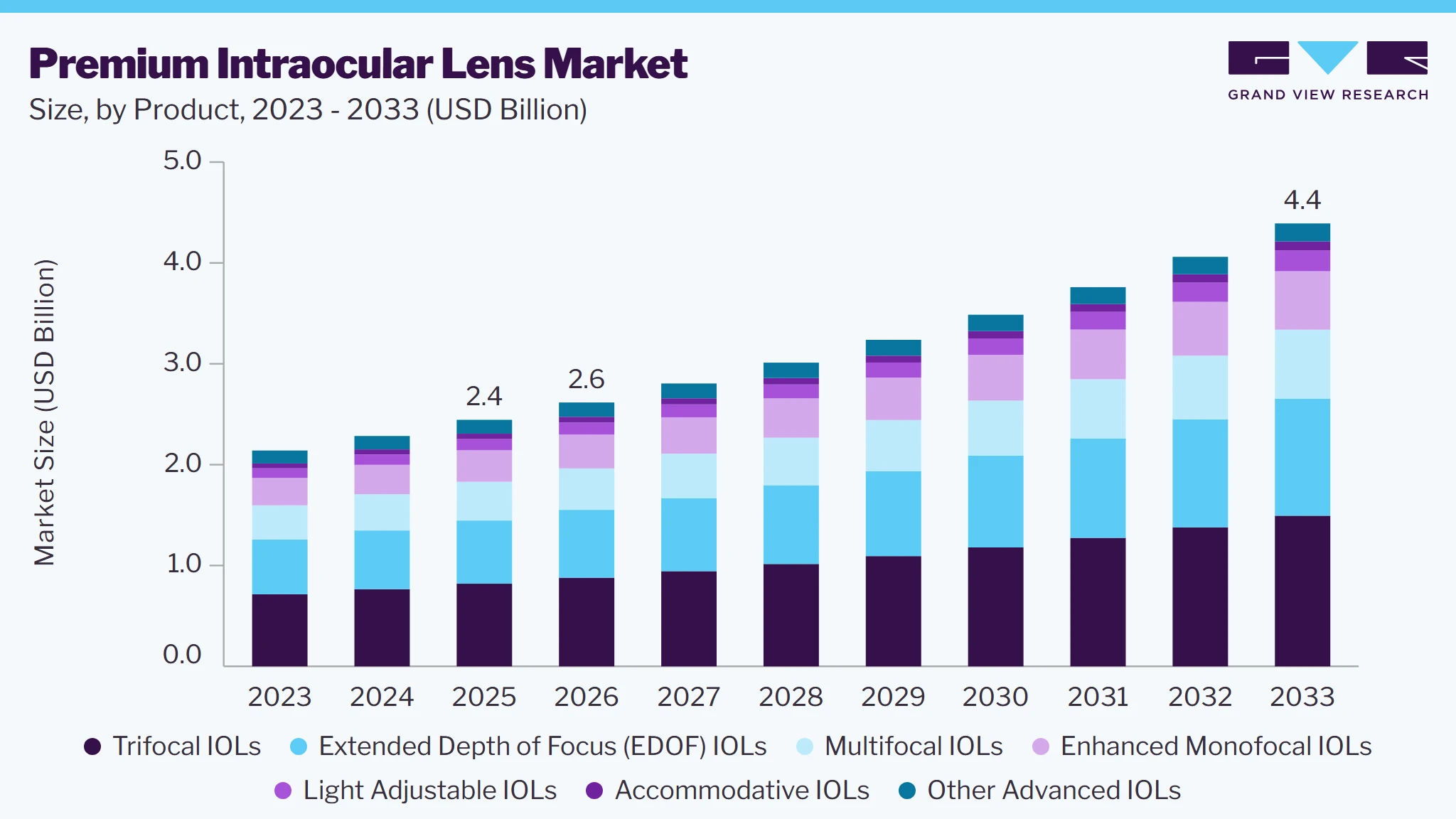
Multifocal, trifocal, extended depth of focus (EDOF), and light-adjustable IOLs offer improved visual outcomes tailored to patients’ diverse needs. An aging global population and increasing awareness of premium vision correction options are further supporting market expansion. Additionally, advancements in optical design, lens materials, and surgical techniques are improving treatment outcomes and broadening the suitability of premium IOLs. However, high product costs and limited reimbursement may constrain adoption in price-sensitive markets.Technological advancements in premium intraocular lenses (IOLs), including multifocal, trifocal, extended depth of focus (EDOF) and light-adjustable lenses, are expanding vision-correction options following cataract surgery. These innovations aim to improve visual function across different distances and reduce dependence on spectacles, while toric IOLs address astigmatism and may be incorporated into premium lens designs.
 To learn more about this report, Download Free Sample Report
In April 2026, Johnson & Johnson MedTech announced that its TECNIS Eyhance enhanced monofocal IOL had surpassed 10 million global implants. The lens is designed to improve intermediate vision while maintaining distance vision quality. This milestone reflects the growing adoption of enhanced monofocal technology among patients seeking improved functional vision without the visual disturbances sometimes associated with multifocal lenses.
Light-adjustable IOL technology is another important development. RxSight's Light Adjustable Lens (LAL) enables clinicians to modify lens power after cataract surgery using controlled ultraviolet light treatments. In February 2026, RxSight reported that its LAL unit sales increased 12% in 2025 to 109,615 units, with more than 300,000 procedures performed since commercialization. This demonstrates increasing adoption of customizable IOL technology, although additional postoperative visits and treatment requirements may affect patient suitability. These developments highlight the growing emphasis on personalized optical correction, improved intermediate and near vision, and reduced spectacle dependence, supporting continued innovation in the premium IOL market.
The aging global population is a major factor supporting demand for IOLs, as cataracts become more common with advancing age. Cataract surgery involves removing the clouded natural lens and replacing it with artificial IOL. Premium lenses provide additional options for patients seeking correction of presbyopia, astigmatism, or visual limitations across different distances.
Demand for premium IOLs is also influenced by patients' expectations regarding postoperative vision. Multifocal and trifocal lenses provide multiple focal points, while EDOF lenses extend the range of functional vision. Enhanced monofocal and light-adjustable lenses offer alternative approaches for patients with different visual priorities. However, suitability depends on ocular health, corneal characteristics, lifestyle, and tolerance for potential visual disturbances.
Projected Global Premium IOL Adoption
Indicator
2024
2029 (projected)
Total IOL units
32.5 million
38.8 million
Premium IOL units
5.0 million
7.4 million
Premium IOL share by units
15.30%
18.80%
Premium IOL share by revenue
45%
53%
Source: Carl Zeiss Meditec investor presentation, citing Market Scope 2024. Figures represent industry estimates and projections, not audited global procedure counts.
The projected increase in premium IOL adoption indicates that these products are expected to grow faster than the overall IOL market. Rising awareness, improvements in lens technology, and patient interest in reduced spectacle dependence are among the factors supporting this trend.
Market Dynamics
The growing demand for reduced spectacle dependence is supporting premium IOL adoption. Multifocal, trifocal, EDOF, toric, and light-adjustable lenses address diverse visual requirements, including presbyopia and astigmatism. According to the World Health Organization, at least 2.2 billion people worldwide experience near or distance vision impairment, and population aging is increasing the risk of eye conditions. Although this figure is not specific to premium IOL candidates, it highlights the broader need for eye care.
Premium IOL demand is also supported by continued product innovation. In July 2026, Alcon and RxSight announced a collaboration to develop adjustable presbyopia-correcting IOLs, combining Alcon's optical designs with RxSight's postoperative light-adjustment technology. This initiative could expand personalized vision-correction options after cataract surgery.
Premium IOLs generally cost more than standard monofocal lenses, and additional expenses may not be fully reimbursed by insurance. Adoption can therefore be constrained in price-sensitive markets. Multifocal lenses may also cause halos, glare, or reduced contrast sensitivity in some patients, while achieving satisfactory outcomes requires careful patient selection, accurate preoperative measurements, and realistic expectations. These factors can limit suitability and patient acceptance despite the potential for greater spectacle independence.
Market Concentration & Characteristics
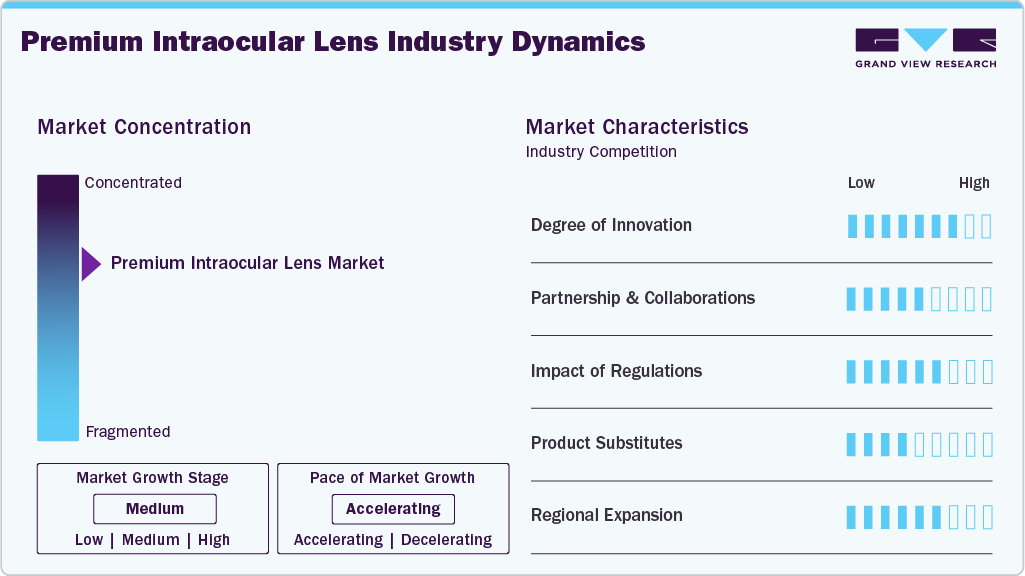
The premium intraocular lens (IOL) market is experiencing steady growth, driven by technological advancements, increasing cataract prevalence, and rising demand for improved postoperative visual outcomes. Continuous innovation in multifocal, trifocal, extended depth of focus (EDOF), and light-adjustable lenses is expanding treatment options and supporting premium lens adoption. Regulatory approvals and clinical research are helping manufacturers introduce advanced products and strengthen confidence in their safety and effectiveness. Major companies, including Alcon, Johnson & Johnson MedTech, Bausch + Lomb, Carl Zeiss Meditec, and RxSight, are strengthening their competitive positions through product innovation, clinical evidence, strategic partnerships, and international market expansion.
Innovation in the premium intraocular lens (IOL) market focuses on improving visual quality, extending the range of vision, and enabling more personalized vision correction. Manufacturers are refining multifocal, trifocal, extended depth of focus (EDOF), enhanced monofocal, and light-adjustable technologies to address diverse patient needs while minimizing visual disturbances. A key area of development is the use of advanced optical designs to extend intermediate vision while preserving distance clarity and contrast sensitivity. At the 2026 European Society of Cataract and Refractive Surgeons (ESCRS) Congress, discussions highlighted emerging optical approaches, enhanced monofocal designs, and preoperative visual simulation tools to support individualized lens selection. These advances reflect the industry's focus on balancing a broader range of vision with high-quality visual outcomes.
 To learn more about this report, Download Free Sample Report
Strategic partnerships are supporting the development of next-generation premium IOL technologies. In July 2026, Alcon and RxSight announced a collaboration to develop adjustable presbyopia-correcting IOLs, combining Alcon's lens-design expertise with RxSight's light-adjustment technology. The agreement includes an upfront payment of USD 60 million and potential milestone payments of up to USD 140 million. This collaboration reflects growing industry interest in customized vision correction and differentiated premium lens offerings.
Regulatory requirements influence product development, clinical evaluation, and commercialization in the premium IOL market. In the U.S., the FDA evaluates applicable IOL devices for safety and effectiveness before granting marketing authorization. In March 2026, Johnson & Johnson received FDA approval for its TECNIS PureSee EDOF IOL, expanding options for patients seeking an extended range of vision. Regulatory clearances support market entry, while clinical evidence and appropriate patient selection remain essential to achieving satisfactory outcomes.
Standard monofocal IOLs represent a cost-effective alternative to premium lenses, particularly for patients prioritizing distance vision or affordability. Spectacles and contact lenses can also correct residual refractive errors following surgery. Meanwhile, enhanced monofocal IOLs offer an intermediate option for patients seeking improved functional vision without the broader optical design of multifocal lenses. Differences in price, visual expectations, potential halos and glare, and clinical suitability influence patient preferences and the adoption of premium IOLs.
Manufacturers are expanding premium IOL availability through geographic launches, surgeon education, and stronger distribution networks. In October 2026, Alcon introduced Clareon PanOptix Pro in India, extending its advanced trifocal lens portfolio in a major cataract surgery market. Regional expansion enables companies to reach more ophthalmologists and patients as access to cataract surgery improves. However, adoption varies according to affordability, reimbursement, surgical infrastructure, and awareness of advanced vision-correction options.
Analyst Perspective
The premium intraocular lens market is driven by the rising prevalence of cataracts and presbyopia, an aging global population, and increasing demand for improved visual outcomes and reduced dependence on spectacles. Growing adoption of advanced lens technologies, including multifocal, trifocal, extended depth of focus (EDOF), and light-adjustable IOLs, is expanding treatment options for patients with diverse visual needs. Innovations in optical design, lens materials, and surgical techniques are further supporting market development. Meanwhile, increasing awareness of premium vision correction, expanding ophthalmic care infrastructure, and rising demand for personalized treatment are creating growth opportunities. However, high product costs, limited reimbursement, and affordability constraints remain significant challenges.
Product Insights
The trifocal IOLs segment accounted for the largest market share of 33.5% in 2025. Its leading position is primarily attributed to the growing demand for advanced vision correction solutions that provide improved visual acuity across near, intermediate, and distant ranges. Trifocal intraocular lenses are increasingly preferred by patients seeking greater spectacle independence following cataract surgery and refractive lens exchange procedures. Rising awareness of premium IOL technologies, advancements in lens design and optical performance, and increasing expectations for postoperative visual outcomes are further supporting segment growth. Additionally, the expanding adoption of premium IOLs among ophthalmic surgeons is contributing to the segment's market position.
The extended depth of focus (EDOF) IOLs market segment is witnessing significant growth at a CAGR of 8.1%, driven by increasing demand for advanced vision correction solutions that provide clear vision across a continuous range of distances. EDOF intraocular lenses are gaining popularity among patients seeking improved intermediate and distance vision with reduced dependence on spectacles after cataract surgery. Technological advancements in optical design, growing awareness of premium IOL options, and increasing adoption of refractive cataract surgery are further supporting segment expansion. Additionally, the rising preference for personalized visual outcomes and innovations aimed at minimizing visual disturbances are expected to create growth opportunities for EDOF IOLs.
Application Insights
The cataract surgery segment accounted for the largest market share in 2025, driven by the high global prevalence of cataracts and the increasing number of surgical procedures performed to restore vision. The growing aging population, rising awareness of cataract treatment, and improved access to ophthalmic care are contributing to procedure volumes. Additionally, advancements in intraocular lens technologies, including premium lenses that improve postoperative visual outcomes, are supporting market demand. The increasing availability of minimally invasive surgical techniques, expanding healthcare infrastructure, and growing adoption of advanced ophthalmic equipment are further strengthening the segment's position. These factors are expected to sustain demand for IOLs in cataract surgery.
The refractive lens exchange segment is witnessing the fastest growth during the forecast period due to increasing demand for elective vision correction procedures among individuals seeking to reduce dependence on spectacles and contact lenses. Growing awareness of premium intraocular lenses, rising disposable incomes, and advancements in lens technologies are encouraging the adoption of refractive lens exchange, particularly among patients with presbyopia. The procedure also offers an alternative for individuals who are unsuitable for certain corneal refractive surgeries. Furthermore, improvements in surgical techniques, enhanced patient counseling, and expanding access to specialized ophthalmic clinics are supporting adoption. These factors are expected to drive segment growth throughout the forecast period.
End-use Insights
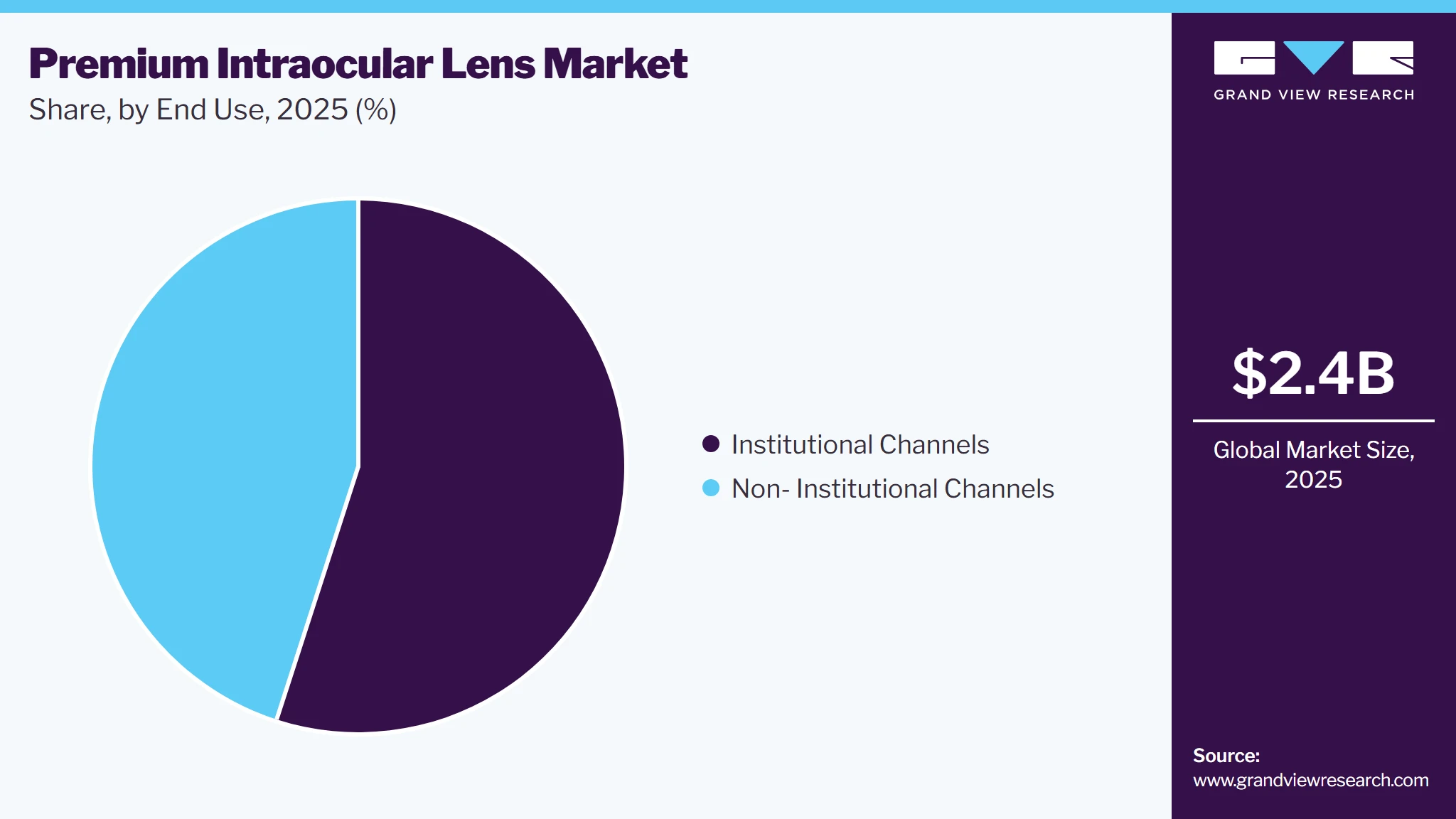
The institutional channels segment is expected to hold the largest market share in 2025, driven by the high volume of premium intraocular lens (IOL) implantations performed in hospitals and ambulatory surgery centers. These facilities benefit from access to advanced ophthalmic equipment, experienced surgeons, and established procurement networks, supporting the adoption of premium IOL technologies. The increasing number of cataract surgeries, growing patient preference for improved postoperative visual outcomes, and rising availability of multifocal, trifocal, and extended depth of focus lenses are further contributing to segment dominance. Additionally, institutional facilities are well-positioned to offer comprehensive surgical care and advanced lens options to eligible patients.
 To learn more about this report, Download Free Sample Report
The non-institutional channels segment is expected to grow significantly during the forecast period, driven by the increasing availability of premium intraocular lenses through independent ophthalmic clinics and specialized eye surgery centers. Growing patient preference for personalized vision correction, rising awareness of advanced IOL technologies, and expanding access to specialized ophthalmic services are supporting segment growth. These facilities increasingly offer premium lens options, including multifocal, trifocal, and extended depth of focus lenses, to address diverse visual needs. Additionally, the expansion of private eye care facilities, improved patient counseling, and rising demand for spectacle independence following cataract surgery are expected to create further growth opportunities for non-institutional channels.
Regional Insights
North America Premium Intraocular Lens Market Trends
North America premium intraocular lens market held the largest share of 40.7% of the global market in 2025. The North American premium intraocular lens market is supported by high cataract surgery volumes, established ophthalmic care infrastructure, and strong demand for advanced vision-correction options. Patients increasingly consider multifocal, trifocal, extended depth of focus (EDOF), toric, and light-adjustable lenses to improve visual function and reduce spectacle dependence. The U.S. is a particularly important market: a 2025 company filing, citing industry reports, estimated that premium IOL procedures accounted for approximately 21% of U.S. cataract surgeries in 2025, compared with about 15% globally. Adoption is also influenced by out-of-pocket costs, patient expectations, surgeon recommendations, and suitability for individual eye conditions.
 To learn more about this report, Download Free Sample Report
The U.S. premium intraocular lens market benefits from a mature cataract surgery ecosystem, a large pool of ophthalmic surgeons, and patient demand for greater spectacle independence. Manufacturers are competing through innovations in presbyopia-correcting optics, extended depth of focus, and postoperative lens adjustment. However, premium lenses may involve additional patient costs beyond standard cataract surgery coverage, making affordability and patient education important determinants of adoption. Clinical suitability also matters because multifocal designs can increase the likelihood of halos, glare, and reduced contrast sensitivity in some patients.
Europe Premium Intraocular Lens Market Trends
The European premium intraocular lens market is shaped by an aging population, established cataract surgery services, and continued development of advanced optical technologies. Multifocal, trifocal, EDOF, enhanced monofocal, and toric designs provide surgeons with alternatives tailored to patients’ visual requirements. Clinical guidance from the European Society of Cataract and Refractive Surgeons emphasizes appropriate patient selection and shared decision-making, particularly when balancing spectacle independence against potential visual disturbances and additional costs. Differences in healthcare funding, reimbursement, and private-pay options contribute to variation in premium IOL adoption across European countries.
The UK premium intraocular lens market is influenced by demand for cataract surgery and patient interest in reducing dependence on spectacles after treatment. Premium lenses offer additional options for patients seeking improved near or intermediate vision, but adoption depends on clinical suitability, patient expectations, and the cost of lens upgrades. EDOF and enhanced monofocal lenses may appeal to some patients who want improved functional vision while seeking to limit the visual disturbances associated with certain multifocal designs. Surgeon-led counselling is therefore important in matching lens characteristics with lifestyle and visual needs.
The France premium intraocular lens market benefits from established ophthalmic services and access to cataract surgery. Demand is supported by interest in advanced vision correction, including lenses designed to address presbyopia and astigmatism. The choice between standard and premium IOLs is shaped by clinical requirements, patient preferences, and the additional costs associated with advanced lens options. Continued developments in multifocal and EDOF technologies are broadening the available choices, although adoption depends on appropriate patient selection and the organization of public and private eye care services.
The German premium intraocular lens market is supported by a well-developed healthcare system and demand for high-quality cataract surgery. Premium lens adoption is encouraged by interest in improved visual performance across multiple distances and reduced reliance on spectacles. Multifocal and trifocal lenses, EDOF designs, and toric options can address different visual requirements, although outcomes depend on patient characteristics and the suitability of each lens design. The cost of premium options and the need to explain possible side effects remain important considerations for surgeons and patients.
Asia Pacific Premium Intraocular Lens Market Trends
The Asia Pacific premium intraocular lens market presents opportunities associated with population aging, high cataract treatment needs, expanding ophthalmic services, and growing interest in advanced vision correction. Adoption differs considerably across countries because of differences in income, healthcare access, reimbursement, surgical infrastructure, and the availability of trained ophthalmic professionals. While affordability remains a barrier in some settings, expanding private eye care services and greater awareness of premium lens options are supporting demand in selected markets. The region includes both high-volume cataract surgery markets and countries with established advanced ophthalmology capabilities.
The Japan premium intraocular lens market is supported by an aging population and an established medical technology sector. Demand for advanced IOLs is linked to the need for cataract surgery and patient interest in improved postoperative vision. Multifocal, EDOF, and other presbyopia-correcting designs can appeal to patients seeking greater spectacle independence, while toric lenses provide an option for correcting corneal astigmatism. Adoption depends on clinical suitability, the cost of advanced lenses, and patient preferences regarding visual performance and potential side effects.
The China premium intraocular lens market is supported by substantial cataract treatment needs and continued development of ophthalmic healthcare services. As access to cataract surgery expands, premium IOLs offer an opportunity to address demand for improved vision across different distances and correction of refractive errors. However, uptake is influenced by affordability, differences in access between urban and less-served areas, and the availability of surgeons experienced in selecting and implanting advanced lens designs. Growth opportunities are particularly linked to greater awareness of premium options and the expansion of services capable of providing advanced cataract surgery.
The India premium intraocular lens market is shaped by a large cataract treatment need, an expanding private ophthalmology sector, and increasing availability of advanced surgical services. Premium multifocal, trifocal, EDOF, and toric lenses offer options for patients seeking improved visual function or correction of refractive errors alongside cataract treatment. However, standard monofocal lenses remain important because of affordability and broad accessibility. Research on IOL use in India highlights the role of public, voluntary, and private providers in cataract care, while advanced lens options may require additional out-of-pocket expenditure. Wider adoption will depend on affordability, patient awareness, and access to suitably equipped facilities and trained surgeons.
Latin America Premium Intraocular Lens Market Trends
The Latin American premium intraocular lens market is influenced by demand for cataract surgery, improving access to ophthalmic care, and growing interest in advanced visual correction. Adoption is supported by private hospitals, ophthalmology clinics, and surgical centers offering premium lens options to patients seeking reduced spectacle dependence. However, affordability, uneven access to specialist services, and differences in public and private healthcare funding influence uptake across the region. Market development is expected to depend on the expansion of cataract surgery capacity, patient awareness, and the availability of advanced lens technologies.
The Brazil premium intraocular lens market is supported by a substantial need for cataract treatment and an established network of public and private ophthalmic providers. Premium IOL adoption is associated with patient demand for improved postoperative vision, including correction of presbyopia and astigmatism. Private clinics can offer multifocal, trifocal, EDOF, and toric options to suitable candidates, while affordability and access to specialized surgical services influence broader uptake. Continued development of ophthalmic infrastructure and greater awareness of advanced lens options could support market expansion, although standard monofocal lenses remain important for cost-sensitive patients.
Middle East & Africa Premium Intraocular Lens Market Trends
The Middle East and Africa premium intraocular lens market is developing alongside improvements in ophthalmic healthcare infrastructure and access to cataract surgery. Demand for premium lenses is influenced by population aging, patient interest in reducing spectacle dependence, and the availability of specialized ophthalmologists and surgical facilities. Adoption varies across the region: markets with greater private healthcare investment and access to advanced surgical services may offer stronger opportunities, while affordability and limited specialist capacity can constrain uptake elsewhere. Expansion will depend on the accessibility of advanced IOL options, surgeon training, and patient awareness of their potential benefits and limitations.
The Saudi Arabia premium intraocular lens market is supported by healthcare modernization, demand for cataract treatment, and the availability of advanced ophthalmic services. Premium lenses offer patients options for improving vision across multiple distances or correcting astigmatism during cataract surgery. Adoption is influenced by access to specialist ophthalmologists, the availability of premium lens products through hospitals and private clinics, and patients’ willingness to pay for advanced visual correction. Continued investment in eye care services may create opportunities for manufacturers offering differentiated lens technologies, subject to clinical suitability and affordability.
Kuwait's premium intraocular lens market is influenced by access to ophthalmic services, demand for cataract surgery, and patient interest in advanced vision-correction options. Multifocal, EDOF, and toric IOLs can serve patients seeking reduced spectacle dependence or correction of refractive errors, depending on their clinical requirements. Market adoption is shaped by the availability of trained surgeons, product access through hospitals and specialty clinics, and the additional cost of premium lenses. Greater awareness of lens alternatives and continued development of specialized eye care services could support demand over the forecast period.
Key Premium Intraocular Lens Company Insights
The premium intraocular lens market is characterized by the presence of established players, including Johnson & Johnson MedTech, Alcon Vision LLC, and Carl Zeiss Meditec AG. Market participants focus on organic and inorganic growth strategies, including product launches, strategic collaborations, and geographic expansion, to strengthen their market positions and address evolving customer needs.
Key Premium Intraocular Lens Companies
The following key companies have been profiled for this study on the premium intraocular lens market:
-
Alcon
-
Johnson & Johnson MedTech
-
Bausch + Lomb
-
Carl Zeiss Meditec
-
Rayner
-
HOYA Corporation
-
Ophtec
-
SIFI
-
RxSight
-
BVI
Competitive Benchmarking
Category
Operating Strategies
Competitive Edge
Weakness
Established Global Imaging and Diagnostic Leaders (Alcon, Johnson & Johnson MedTech, Bausch + Lomb, Carl Zeiss Meditec)
- Expand premium IOL portfolios across multifocal, trifocal, toric, and extended depth-of-focus (EDOF) technologies to address diverse vision-correction needs.
- Invest in advanced optical designs, material innovation, preloaded delivery systems, surgeon education, and global distribution.
- Strong brand recognition established ophthalmologist relationships, extensive clinical evidence, and broad distribution networks support market penetration.
- Advanced lens designs and manufacturing capabilities enable product differentiation based on visual outcomes, optical performance, and implantation efficiency.
- High R&D expenditure, clinical validation requirements, and regulatory compliance costs increase product development complexity.
- Premium pricing and limited reimbursement for elective vision-correction benefits can restrict adoption among price-sensitive patients.
Specialized Ophthalmic Diagnostic Equipment Manufacturers (SIFI, RxSight, BVI)
- Focus on differentiated optical technologies, including innovative EDOF, accommodating, and specialized presbyopia-correcting IOL designs.
- Prioritize clinical partnerships, targeted product launches, regulatory approvals, and collaborations with established ophthalmic distributors.
- Focused R&D and specialized product portfolios enable companies to address specific unmet needs in presbyopia correction and postoperative visual performance.
- Flexible development strategies support niche innovation and differentiation in optical design and lens functionality.
- Limited financial resources, brand awareness, manufacturing scale, and established surgeon relationships can constrain commercial penetration.
- Clinical evidence requirements, regulatory approval timelines, and the need to demonstrate consistent visual outcomes can delay adoption and international expansion.
Recent Developments
-
In September 2026, Rayner announced U.S. FDA approval and commercial availability of RayOne Galaxy and RayOne Galaxy Toric, its AI-developed, non-diffractive spiral intraocular lens platform. The lenses are designed to provide a continuous range of vision while minimizing halos and glare, with the toric version also addressing corneal astigmatism.
-
In February 2026, BVI announced the first U.S. implantations of its FINEVISION HP hydrophobic trifocal intraocular lens (IOL), following FDA approval in October 2025. The lens incorporates the company's POD platform and CoPODize technology to provide distance, intermediate, and near vision, supported by a four-point haptic design for lens stability.
Premium Intraocular Lens Market Report Scope
Report Attribute
Details
Market size in 2025
USD 2.4 billion
Estimated market size in 2026
USD 2.6 billion
Projected market size by 2033
USD 4.4 billion
Growth Rate
CAGR of 7.7% from 2026 to 2033
Actual period
2021 - 2024
Forecast period
2026 - 2033
Quantitative units
Revenue in USD million/billion and CAGR from 2026 to 2033
Report coverage
Revenue forecast, company ranking, competitive landscape, growth factors, and trends
Segments covered
Product, application, end-use, region
Regional scope
North America, Europe, Asia Pacific, Latin America, MEA
Country scope
U.S.; Canada; Mexico; UK; Germany; France; Italy; Spain; Denmark; Sweden; Norway; Japan; China; India; Australia; Thailand; South Korea; Brazil; Argentina; South Africa; Saudi Arabia; UAE; Kuwait.
Key companies profiled
Alcon, Johnson & Johnson MedTech, Bausch + Lomb, Carl Zeiss Meditec, Rayner, HOYA Corporation, Ophtec, SIFI, RxSight, BVI
Customization scope
Free report customization (equivalent up to 8 analysts working days) with purchase. Addition or alteration to country, regional & segment scope.
Pricing and purchase options
Avail customized purchase options to meet your exact research needs. Explore purchase options
Global Premium Intraocular Lens Market Report Segmentation
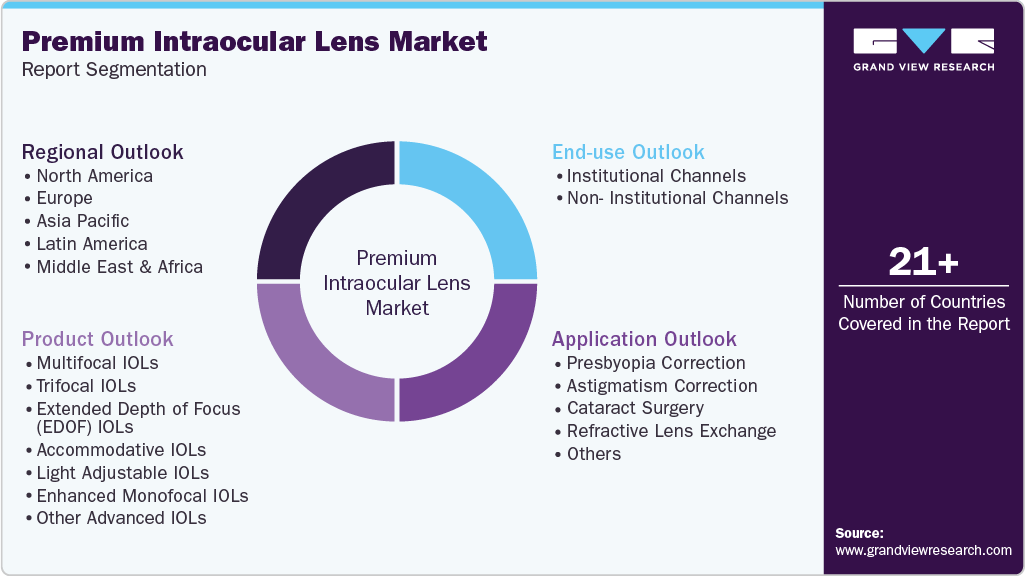
This report forecasts revenue growth at country levels and provides an analysis of the latest industry trends and opportunities in each of the sub-segments from 2021 to 2033. For the purpose of this study, Grand View Research has segmented the premium intraocular lens market report on the basis of product, application, end-use, and region:
 To learn more about this report, Download Free Sample Report
-
Product Outlook (Revenue, USD Million, 2021 - 2033)
-
Multifocal IOLs
-
Trifocal IOLs
-
Extended Depth of Focus (EDOF) IOLs
-
Accommodative IOLs
-
Light Adjustable IOLs
-
Enhanced Monofocal IOLs
-
Other Advanced IOLs
-
-
Application Outlook (Revenue, USD Million, 2021 - 2033)
-
Presbyopia Correction
-
Astigmatism Correction
-
Cataract Surgery
-
Refractive Lens Exchange
-
Others
-
-
End-use Outlook (Revenue, USD Million, 2021 - 2033)
-
Institutional Channels
-
Hospitals
-
Ambulatory Surgery Centers
-
-
Non- Institutional Channels
-
Ophthalmic Clinics
-
Independent Eye Surgery Centers
-
Others
-
-
-
Region Outlook (Revenue, USD Million, 2021 - 2033)
-
North America
-
U.S.
-
Canada
-
Mexico
-
-
Europe
-
UK
-
Germany
-
France
-
Italy
-
Spain
-
Denmark
-
Sweden
-
Norway
-
-
Asia Pacific
-
Japan
-
China
-
India
-
Australia
-
South Korea
-
Thailand
-
-
Latin America
-
Brazil
-
Argentina
-
-
Middle East & Africa
-
South Africa
-
Saudi Arabia
-
UAE
-
Kuwait
-
-
Research Methodology
The premium intraocular lens market figures in this report are based on a proven research process that combines executive interviews with secondary research from proprietary databases, company filings, and recognized regulatory and institutional sources. Market size is built through value-chain sizing-reconciling supply-side and demand-side estimates-and triangulated with bottom-up and top-down approaches. Every estimate passes multiple levels of expert validation before publication, with each premium intraocular lens segment quantified using the revenue-capture definitions in the table below.
Segment Definition
Segment - Product
Revenue capture definition
Multifocal IOLs
Revenue includes sales of multifocal intraocular lenses designed to provide vision at multiple distances, reducing dependence on spectacles following cataract surgery or refractive lens exchange.
Trifocal IOLs
Revenue includes sales of trifocal intraocular lenses designed to provide near, intermediate, and distance vision through three distinct focal points following lens implantation.
Extended Depth of Focus (EDOF) IOLs
Revenue includes sales of EDOF intraocular lenses designed to extend the range of focus and provide continuous vision, particularly at intermediate and distance ranges, with reduced spectacle dependence.
Accommodative IOLs
Revenue includes sales of accommodative intraocular lenses designed to use changes in lens position or shape, or related optical mechanisms, to improve focusing ability across different viewing distances.
Light Adjustable IOLs
Revenue includes sales of light-adjustable intraocular lenses that allow postoperative customization of lens power through controlled ultraviolet light treatments to achieve desired refractive outcomes.
Enhanced Monofocal IOLs
Revenue includes sales of enhanced monofocal intraocular lenses designed to improve intermediate vision and functional visual performance while maintaining the distance-vision characteristics of conventional monofocal lenses.
Other Advanced IOLs
Revenue includes sales of advanced intraocular lenses incorporating specialized optical designs or technologies that do not fall under the separately defined multifocal, trifocal, EDOF, accommodative, light-adjustable, or enhanced monofocal categories.
Segment - Application
Revenue capture definition
Presbyopia Correction
Revenue includes sales of premium intraocular lenses used to address age-related loss of near-vision focusing ability and reduce dependence on spectacles for near and intermediate activities.
Astigmatism Correction
Revenue includes sales of premium intraocular lenses designed to correct pre-existing corneal astigmatism and improve refractive outcomes following cataract surgery or refractive lens exchange.
Cataract Surgery
Revenue includes sales of premium intraocular lenses implanted during cataract surgery to replace the natural lens removed due to cataract formation and improve postoperative visual outcomes.
Refractive Lens Exchange
Revenue includes sales of premium intraocular lenses implanted during elective replacement of the natural crystalline lens to correct refractive errors and reduce dependence on spectacles or contact lenses.
Others
Revenue includes sales of premium intraocular lenses used for other eligible clinical applications not separately categorized under presbyopia correction, astigmatism correction, cataract surgery, or refractive lens exchange.
Segment - End Use
Revenue capture definition
Institutional Channels
Revenue includes sales of premium intraocular lenses to hospitals, specialty eye hospitals, and ambulatory surgery centers for cataract surgery, refractive lens exchange, and other eligible lens implantation procedures.
Non- Institutional Channels
Revenue includes sales of premium intraocular lenses to eligible standalone ophthalmic clinics and independent eye surgery centers for lens implantation procedures, excluding facilities already classified under institutional channels to prevent double counting.
Estimation Model
Step
Guiding Question
Process Steps
Data Sources
Scope Definition
What premium intraocular lens products are included in the market?
- Define premium IOL categories by optical design and functionality.
- Segment the market by product type, application, and end user.
- Establish inclusion criteria for premium versus standard monofocal IOLs.
- Define geographic scope, base year, and forecast period.
FDA, company product portfolios, regulatory databases, ophthalmology associations, clinical publications
Build the Product Base
How many cataract and refractive lens procedures can generate demand for premium IOLs?
- Estimate annual cataract surgery and refractive lens exchange volumes.
- Assess procedure volumes across hospitals, ASCs, and eye clinics.
- Estimate premium IOL eligibility and lens selection patterns.
- Forecast procedure growth using demographic and surgical trends.
National health databases, ophthalmology associations, hospital statistics, clinical studies
Estimate Penetration
What proportion of eligible procedures use premium IOLs?
- Estimate premium IOL adoption across cataract procedures.
- Assess adoption by toric, multifocal, trifocal, EDOF, and other premium lenses.
- Compare penetration across countries and healthcare settings.
- Forecast adoption based on technology advances, surgeon preference, and patient affordability.
Clinical publications, ophthalmology surveys, manufacturer disclosures, regulatory databases
Revenue Conversion
How do premium IOL implantation volumes translate into market revenue?
- Collect average selling prices by premium IOL category and region.
- Calculate revenue using units sold and average selling prices.
- Adjust for product mix, distribution margins, and regional pricing.
- Validate estimates against manufacturer revenues and sales volumes.
Company annual reports, investor presentations, product pricing, distributor data, hospital procurement records
Delivered Customizations
This report has been delivered with the following In-depth customizations
Client Request
Customization Delivered
Value Adds
Application Segment Analysis
Conducted a detailed application-based assessment of the premium intraocular lens market, evaluating the use of advanced IOLs in cataract surgery and refractive lens exchange procedures. The analysis covered major product categories, including multifocal, extended depth of focus (EDOF), toric, and other premium IOLs, with a focus on their application in correcting presbyopia, astigmatism, and other refractive errors alongside cataract removal. The study examined patient eligibility, surgeon preferences, clinical outcomes, adoption of advanced lens technologies, and demand for reduced spectacle dependence. It also assessed the influence of patient affordability, out-of-pocket expenditure, insurance coverage, and the availability of advanced ophthalmic surgical facilities on the selection of premium IOLs.
Enables stakeholders to understand demand patterns across premium IOL applications and identify areas with strong growth potential. The analysis supports product portfolio planning, clinical positioning, and investment decisions by highlighting the role of refractive needs, patient preferences, and surgeon recommendations in lens selection.
PESTEL Analysis
Conducted a comprehensive PESTEL analysis of the premium intraocular lens market, examining political, economic, social, technological, environmental, and legal factors influencing market development. The assessment considered government healthcare policies, public and private healthcare expenditure, import and trade policies, and the regulatory environment for ophthalmic implants. Economic factors included inflation, disposable income, surgical costs, healthcare financing, and the affordability of premium lenses, which are often subject to additional patient payments. Social factors included the growing geriatric population, rising cataract burden, increasing awareness of vision correction options, and patient expectations regarding spectacle independence.
Enables stakeholders to evaluate external factors that may influence market growth, product adoption, and commercial performance. The analysis supports strategic planning by identifying economic barriers to premium IOL adoption, assessing the implications of regulatory changes, and highlighting opportunities arising from demographic shifts and technological advancements.
Geographic Analysis
Conducted a detailed geographic assessment of the premium intraocular lens market across North America, Europe, Asia Pacific, Latin America, and the Middle East & Africa. The study evaluated regional differences in cataract surgery volumes, aging populations, healthcare infrastructure, ophthalmologist availability, adoption of advanced ophthalmic technologies, and access to specialized surgical facilities. The analysis also examined reimbursement policies, private healthcare expenditure, patient purchasing power, and the proportion of premium IOL procedures funded through out-of-pocket payments. In addition, the assessment considered regional regulatory requirements, import dependence, local manufacturing capabilities, currency fluctuations, inflation, and differences in surgical costs.
Enables stakeholders to identify attractive markets for expansion and understand the factors driving regional differences in premium IOL adoption. The analysis supports geographic prioritization, pricing decisions, distribution planning, and resource allocation based on market maturity, healthcare spending, and patient affordability.
About the Author(s)
Medical Devices Research Team
Healthcare · Medical DevicesThis report was authored by the medical devices research team at Grand View Research - comprising two research analysts, one senior research analyst, and one industry expert - with specialized expertise in the medical devices segment of the healthcare industry. All findings are based on proprietary healthcare databases, executive interviews, and regulatory analysis, subject to internal peer review prior to publication.
Last Updated:
Speak to Analyst

Customize this report to your needs - add regions, segments, or data points, with 20% free customization.
Or view our licence options:


ISO 9001:2015 & 27001:2022 Certified
We are GDPR and CCPA compliant! Your transaction & personal information is safe and secure. For more details, please read our privacy policy.


