
- Home
- »
- Green Building Materials
- »
-
Prestressed Concrete Wire And Strand Market Report, 2033GVR Report cover

Prestressed Concrete Wire And Strand Market (2026 - 2033)
Size, Share & Trends Analysis Report By Surface Coating (Uncoated, Galvanized, Epoxy-Coated), By Application (Bridges, Buildings, Railway Sleepers), By Region (North America, Europe, Asia Pacific), And Segment Forecasts
Market Size, 2025
$3.9BMarket Estimate, 2026
$4.0BMarket Forecast, 2033
$6.9BCAGR, 2026–2033
8.3%Prestressed Concrete Wire & Strand Market Summary
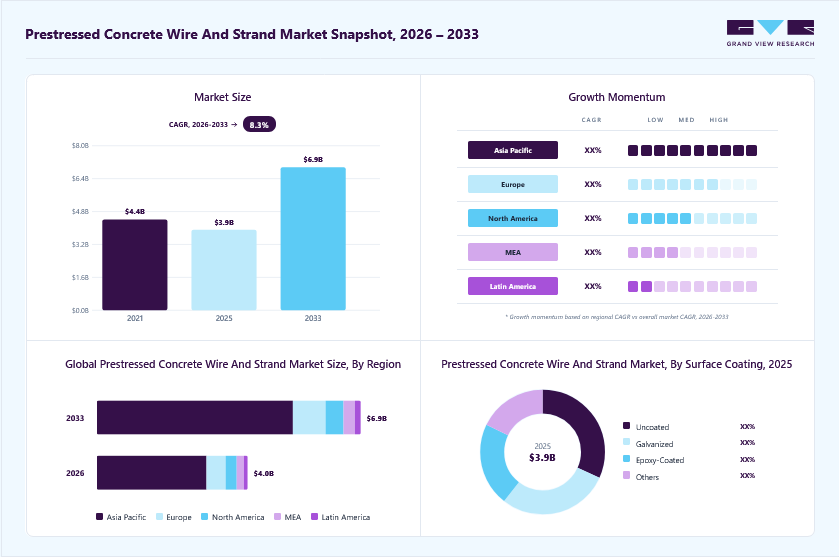
The prestressed concrete wire and strand market size was valued at USD 3.9 billion in 2025 and is projected to grow from USD 4.0 billion in 2026 to USD 6.9 billion by 2033, growing at a CAGR of 8.3% from 2026 to 2033. Asia Pacific dominated the market, accounting for the largest global share of 72.4% in 2025. The rapid growth in infrastructure development, particularly in emerging economies, is significantly boosting demand for prestressed concrete products.
 Source: Grand View Research, IR Documents, Primary Interviews, Paid DatabasesTo learn more about this report,
 Download Free Sample Report
Key Market Trends & Insights
- By surface coating: Uncoated segment held the largest revenue share of 30.9% in 2025.
- By application: Bridges segment held the largest revenue share of 70.1% in 2025.
Regional Highlights
- Largest regional market: Asia Pacific (72.4% revenue share, 2025)
- By country: China held the largest share of Asia pacific in 2025.
Market Size & Forecast
- Market size in 2025: USD 3.9 Billion
- Estimated market size in 2026: USD 4.0 Billion
- Projected market size by 2033: USD 6.9 Billion
- CAGR (2026-2033): 8.3%
Prism AI by Grand View Research Free to tryAsk a question about the prestressed concrete wire and strand marketTry asking✓Every figure cited from GVR research Prefer the report? Download free sample →
Urbanization and the need for durable construction materials are leading to increased investments in roads, bridges, and buildings. In addition, the inclination toward sustainable construction practices has prompted the adoption of prestressed concrete wire and strands, which offer enhanced strength and longevity compared to traditional materials.The rising popularity of prefabricated or offsite construction methods is a significant trend, as these aid in efficient project execution and reduced on-site construction time. This shift is further supported by advancements in manufacturing technologies that improve the quality and performance of prestressed concrete products. Moreover, global government investments in infrastructure projects are expected to create a robust demand for these materials, particularly as countries strive to modernize aging infrastructure and meet increasing urban demands. For instance, in 2021, the government of India introduced the PM Gati Shakti National Master Plan (NMP) to enhance multimodal connectivity across major transport sectors in various economic zones.
 To learn more about this report, Download Free Sample Report
In addition, growing environmental awareness plays a crucial role in shaping the market's future. The emphasis on sustainable building materials aligns with global initiatives to reduce carbon footprint and promote eco-friendly construction practices. Prestressed concrete wire and strands offer advantages, such as recyclability and longer service life, making them an attractive choice for environmentally conscious projects.
Market Dynamics
The rapid expansion of infrastructure development projects worldwide is a major driver of growth for the prestressed concrete wire and strand market. Governments and private investors are increasing spending on highways, bridges, rail networks, airports, ports, and urban transit systems to support economic growth and urbanization. Prestressed concrete wire and strands are widely used in these projects because they provide high tensile strength, enhanced load-bearing capacity, longer structural spans, and improved durability compared to conventional reinforcement materials. The growing need to modernize aging infrastructure in developed economies and the large-scale construction activities across emerging countries such as China, India, and Southeast Asian nations continue to create substantial demand for prestressed concrete reinforcement solutions.
Rapid urbanization in emerging and developed economies is significantly contributing to growth in the prestressed concrete wire and strand market. Rising population levels, increasing migration toward urban centers, and expanding metropolitan areas are creating strong demand for residential housing, commercial complexes, industrial facilities, and public infrastructure. Governments are investing heavily in urban development programs, smart city initiatives, and transportation networks to accommodate growing populations and improve living standards. As a result, the construction industry is increasingly using prestressed concrete wire and strands to enhance structural strength, durability, and load-bearing capacity in modern buildings and infrastructure projects.
In addition, the growing scale and complexity of construction activities are driving the adoption of prestressed concrete systems that enable longer spans, reduced material consumption, and faster project completion. Prestressed concrete wire and strands are widely used in high-rise buildings, parking structures, bridges, flyovers, and precast concrete elements due to their ability to withstand high tensile stresses while maintaining structural integrity. The increasing preference for efficient and cost-effective construction techniques, particularly in rapidly developing regions of the Asia-Pacific, the Middle East, and Latin America, continues to strengthen demand for prestressed concrete reinforcement products, thereby supporting overall market expansion.
Volatility in raw material prices remains a significant challenge for the prestressed concrete wire and strand market, as steel wire rods constitute the primary input in manufacturing these products. Prices of steel are influenced by fluctuations in iron ore, coking coal, energy costs, trade policies, supply chain disruptions, and global demand conditions. Sudden increases in raw material costs can compress profit margins for manufacturers, particularly when long term supply contracts limit their ability to pass higher costs on to customers. In addition, unpredictable pricing creates difficulties in project budgeting and procurement planning for construction companies, leading to delays in purchasing decisions and increased uncertainty across the value chain. This price instability can restrain market growth by affecting production economics and reducing investment confidence in large scale infrastructure and construction projects.
The expansion of high-speed rail and metro projects presents a significant growth opportunity for the prestressed concrete wire and strand market. Governments across the Asia Pacific, Europe, the Middle East, and other regions are investing heavily in modern rail infrastructure to address urban congestion, improve transportation efficiency, and support sustainable mobility goals. Prestressed concrete wire and strands are essential components in railway sleepers, elevated tracks, bridges, viaducts, tunnels, and station structures due to their high tensile strength, durability, and ability to withstand dynamic loads from high-speed trains. As countries continue to expand and modernize their rail networks, demand for reliable, long-lasting prestressed concrete reinforcement materials is expected to increase substantially, creating new revenue opportunities for market participants.
Analyst Perspective
The prestressed concrete wire and strand market is poised for strong growth as governments and private developers continue to invest heavily in transportation infrastructure, urban development, and large-scale construction projects worldwide. These products play a critical role in enhancing the strength, durability, and load-bearing capacity of bridges, railway sleepers, buildings, highways, and precast concrete structures, making them indispensable for modern infrastructure. Rapid urbanization, population growth, and the increasing adoption of cost-efficient construction techniques are driving demand, particularly across the Asia Pacific, the Middle East, and other developing regions.
Surface Coating Insights
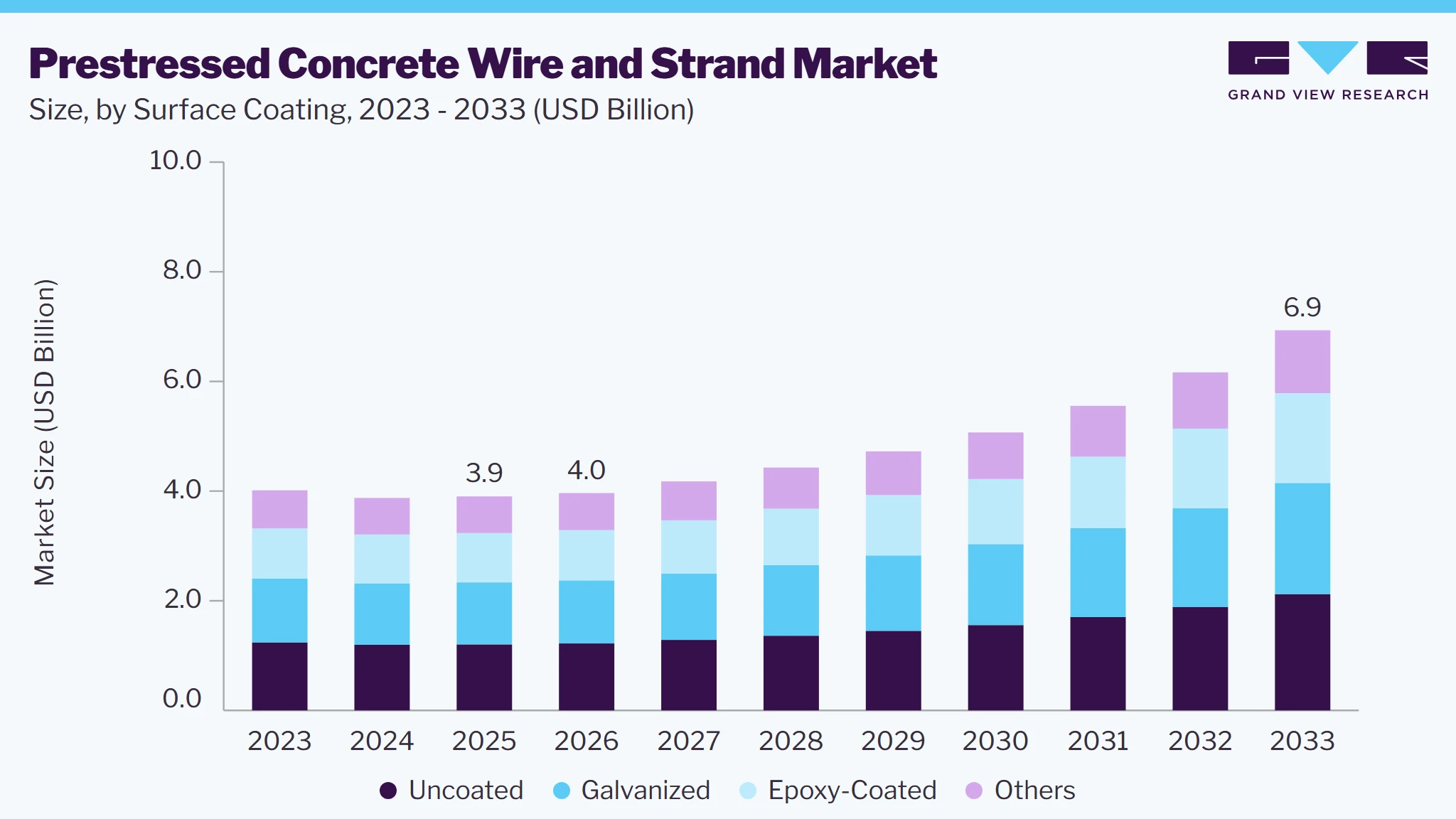
Based on surface coating, the uncoated segment led the market with the largest revenue share of 30.9% in 2025. This dominance can be attributed to various benefits of uncoated wires, including their cost-effectiveness and proven performance in various construction applications. Uncoated prestressed concrete wires are widely utilized because of their high tensile strength, which makes them suitable for critical structures such as bridges, buildings, and parking garages. Their reliability and lower initial costs appeal to contractors and engineers, especially in large-scale projects with budget constraints.
The epoxy-coated segment is expected to grow at the highest CAGR over the forecast period. Epoxy coatings provide additional protection against environmental factors such as moisture, chemicals, and salt, which can lead to premature deterioration of concrete structures. This enhanced durability makes epoxy-coated prestressed concrete wires valuable in coastal areas or regions with harsh weather conditions. As the construction industry becomes more focused on sustainability and long-term performance, the growth of this segment reflects a shift toward materials that not only meet structural requirements but also extend the lifespan of infrastructure investments.
Application Insights
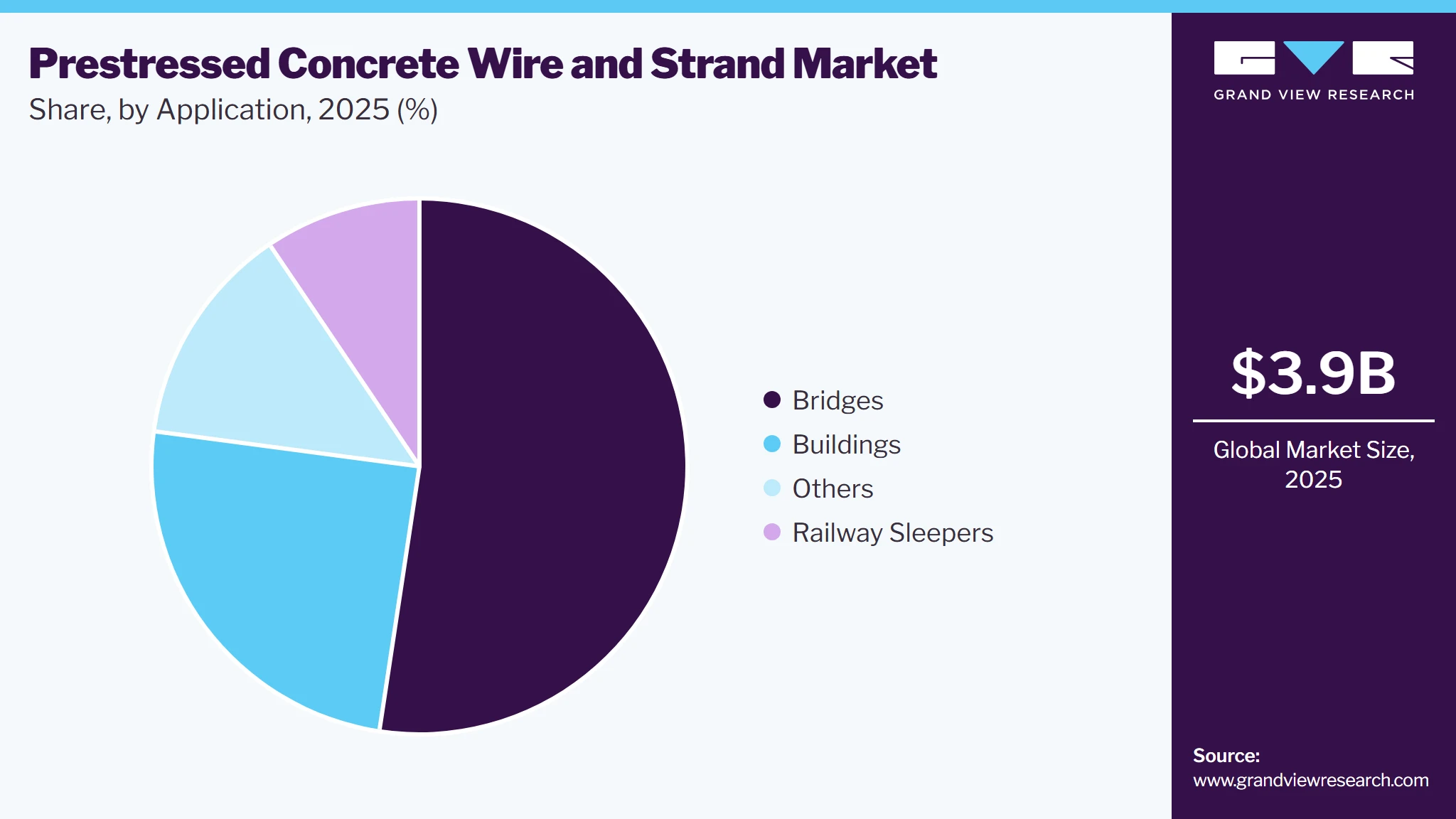
Based on application, the bridges segment led the market with the largest revenue share of 70.1% in 2025. Bridges require robust materials that can withstand heavy loads, dynamic forces, and environmental stresses over time. Prestressed concrete technology is preferred in this segment as it facilitates longer spans and reduced material consumption while maintaining structural integrity. Ongoing investments in the construction and maintenance of bridges globally underscore the sustained growth of the prestressed concrete wire and strand industry.
 To learn more about this report, Download Free Sample Report
The railway sleepers segment is projected to grow at the highest CAGR during the forecast period, with countries increasingly focusing on modernizing rail infrastructure. Prestressed concrete railway sleepers offer superior strength and stability compared to traditional wooden or steel options, making them ideal for supporting heavy trains while minimizing the need for maintenance. The shift toward high-speed rail systems and increased freight transport capacity is further expected to drive demand for durable sleepers that can withstand varying loads and environmental conditions.
Regional Insights
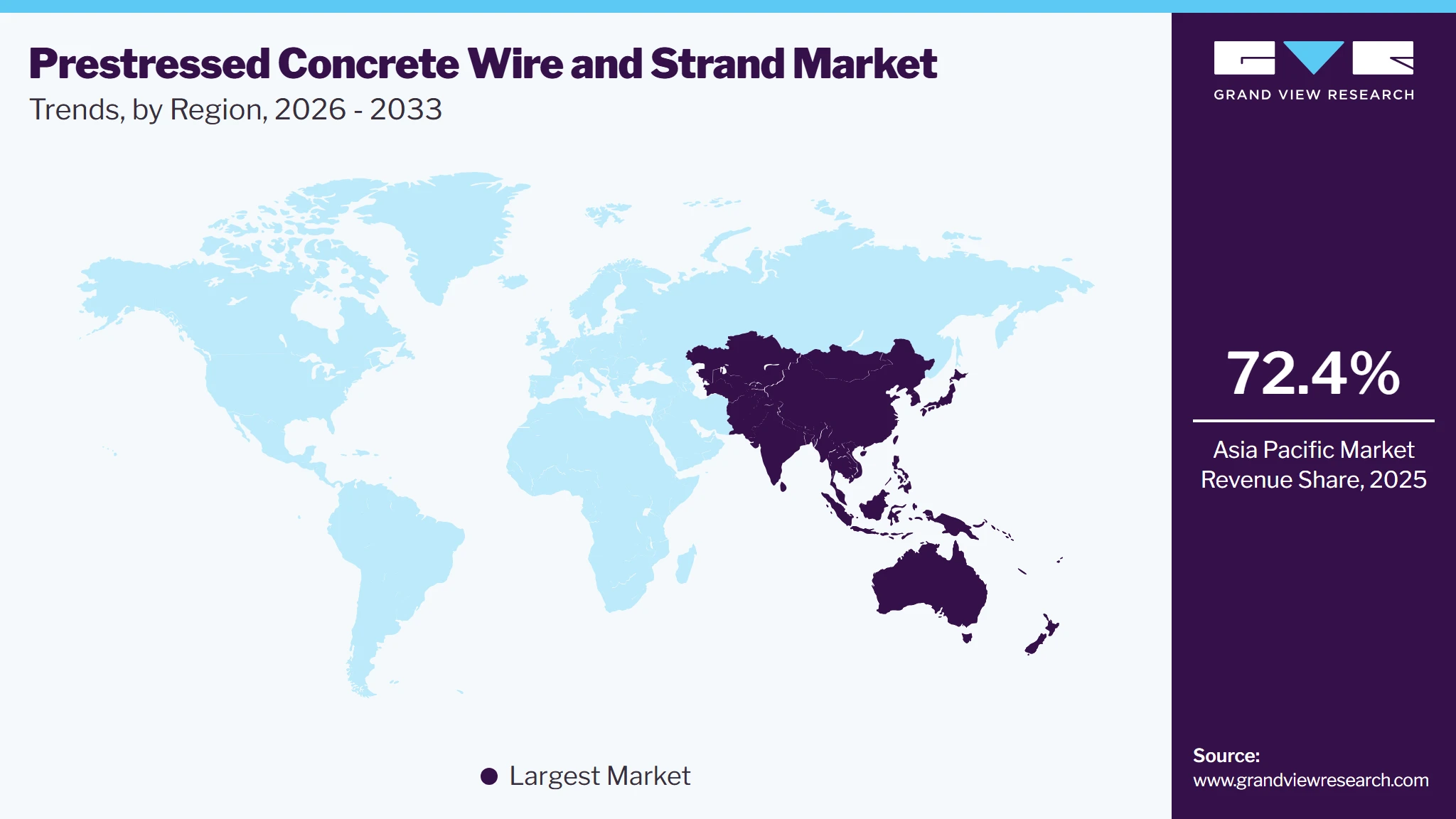
Asia Pacific dominated the prestressed concrete wire and strand market with the largest revenue share of 72.4% in 2025. Rapid urbanization across countries such as China and India has led to extensive infrastructure development initiatives to accommodate the growing population and economic activities. Major projects such as highways, bridges, and urban transit systems have significantly increased the demand for high-performance materials such as prestressed concrete wire and strands.
 To learn more about this report, Download Free Sample Report
China Prestressed Concrete Wire And Strand Market Trends
The prestressed concrete wire and strand market in the China held the largest share in the Asia Pacific region in 2025, reflecting its massive investments in infrastructure projects. The country's ambitious plans to enhance its transportation network include building high-speed rail lines, expanding urban metro systems, and upgrading existing roadways. These initiatives not only support domestic economic growth but also aim to improve connectivity on a global scale through initiatives such as the Belt and Road Initiative (BRI).
Europe Prestressed Concrete Wire And Strand Market Trends
The Europe prestressed concrete wire and strand market is expected to grow at a significant CAGR due to increasing investments in infrastructure modernization across various countries. European nations are focusing on upgrading aging structures while adhering to stringent safety regulations that require advanced materials capable of withstanding environmental stressors. The European Union's commitment to sustainable development has also contributed to the demand for eco-friendly construction practices that use durable materials such as prestressed concrete wires.
The Russia prestressed concrete wire and strand industry dominated the regional market. The country's emphasis on infrastructure development, particularly transportation networks such as roads, bridges, and railways, supports strong demand for these materials. Russia's strategic investments aim to improve connectivity across vast distances while enhancing trade routes within Eurasia. As Russia continues to invest heavily in its infrastructure capabilities amidst economic diversification efforts, its position within the prestressed concrete wire and strand industry remains robust.
North America Prestressed Concrete Wire And Strand Market Trends
The North America prestressed concrete wire and strand market is expected to witness significant growth over the forecast period, driven by increasing infrastructure investments and urbanization. A surge in construction projects, particularly in the public infrastructure sector, is propelling demand for prestressed concrete products that enhance the strength and durability of structures. The emphasis on modernizing aging infrastructure, including bridges and highways, aligns with government initiatives prioritizing safety and sustainability, further contributing to market expansion.
The U.S. prestressed concrete wire and strand market dominated the regional market due to its robust construction industry and substantial investments in infrastructure development. The country’s focus on rebuilding and enhancing transportation networks has led to heightened demand for high-performance materials, including prestressed concrete wire and strands. In addition, the growing trend of prefabricated construction methods in the U.S. supports the use of these materials, as they are essential for creating durable components that can withstand heavy loads and environmental stresses.
Key Prestressed Concrete Wire And Strand Company Insights
The prestressed concrete wire and strand industry includes several key players that shape its landscape. ArcelorMittal produces high-quality prestressing wire and strands, leveraging advanced manufacturing capabilities, while Bekaert offers innovative steel fibers that enhance concrete performance across various sectors. Insteel provides a wide range of reliable prestressed concrete products, while JSW supplies diverse steel products designed for construction and infrastructure projects. These companies play a significant role in shaping the prestressed concrete wire and strand industry.
-
ArcelorMittal specializes in producing steel solutions, particularly prestressed concrete wire and strands. The company also specializes in high-quality steel fibers and wire rods that enhance the performance of concrete structures. With advanced manufacturing facilities in multiple countries, ArcelorMittal focuses on developing innovative reinforcement solutions that improve durability and sustainability in construction projects.
-
Insteel is recognized for its extensive range of prestressed concrete products, including wire and strand solutions designed for various construction applications. The company emphasizes quality and reliability, providing tailored products that meet specific project requirements. Its commitment to innovation and customer service supports its role in the construction industry, ensuring effective reinforcement solutions for infrastructure development.
Key Prestressed Concrete Wire And Strand Companies
The following key companies have been profiled for this study on the prestressed concrete wire and strand market.
-
ArcelorMittal
-
Bekaert
-
Henan Hengxing Science & Technology Co., Ltd.
-
Hjulsbro Steel AB
-
Insteel
-
JFE Steel Corporation
-
Jiangsu Shagang Group
-
JSW
-
Tata Steel
-
Usha Martin Limited
Competitive Benchmarking
Category
Operating Strategies
Competitive Edge
Weakness
Established Players (e.g. ArcelorMittal, Bekaert, Insteel, JFE Steel Corporation.)
- Mature participants in the prestressed concrete wire and strand market primarily focus on large scale manufacturing, product standardization, and long term supply agreements with infrastructure, construction, and precast concrete industries.
- These companies operate integrated steel wire production facilities that include wire rod processing, drawing, stranding, stress relieving, and coating operations.
- Established players possess significant competitive advantages through their extensive manufacturing infrastructure, integrated steel processing capabilities, and strong distribution networks.
- Their large production capacities allow them to achieve economies of scale, optimize raw material procurement, and maintain competitive pricing while meeting high volume project requirements.
- Despite their strong market positions, mature players face challenges related to fluctuations in steel wire rod prices, energy costs, and transportation expenses.
- Since prestressed concrete wire and strand production is highly dependent on steel inputs, changes in raw material costs can directly affect profitability and pricing competitiveness.
Emerging & Regional Players (e.g., Henan Hengxing Science & Technology Co., Ltd., Hjulsbro Steel AB)
- Emerging participants in the prestressed concrete wire and strand market generally focus on regional market opportunities, specialized product offerings, and flexible manufacturing capabilities.
- Rather than competing directly with established producers on production scale, these companies often target local infrastructure projects, precast concrete manufacturers, and mid sized construction firms.
- Emerging companies benefit from operational flexibility and the ability to respond quickly to changing customer requirements and project specifications.
- Their smaller organizational structures often enable faster decision making, customized production scheduling, and more personalized customer support.
- Emerging participants face significant challenges related to limited production capacity, lower economies of scale, and restricted access to capital.
- Competing with established manufacturers that possess integrated steel operations, extensive distribution networks, and strong brand recognition can be difficult, particularly in large infrastructure projects where supply reliability is critical.
Recent Developments
-
In October 2024, Insteel Industries Inc. announced that its subsidiary, Insteel Wire Products Company, acquired Engineered Wire Products, Inc. for USD 70 million. Engineered Wire Products produces essential components such as engineered structural mesh and prestressed concrete strands. Incorporation of these products into its portfolio will help Insteel enhance its operational capabilities and expand its geographic presence in the construction industry. This acquisition also strengthened Insteel's position as a key producer of welded wire products critical for residential and commercial construction.
Prestressed Concrete Wire And Strand Market Report Scope
Report Attribute
Details
Market definition
The market size represents the apparent consumption of prestressed concrete wire and strand across various applications.
Market size value in 2025
USD 3.9 billion
Market size value in 2026
USD 4.0 billion
Revenue forecast in 2033
USD 6.9 billion
Growth rate
CAGR of 8.3% from 2026 to 2033
Base year for estimation
2025
Historical data
2021 - 2024
Forecast period
2026 - 2033
Quantitative units
Revenue in USD million, volume in kilotons, and CAGR from 2026 to 2033
Report coverage
Revenue forecast, volume forecast, company ranking, competitive landscape, growth factors, and trends
Segments covered
Surface coating, application, region.
Regional scope
North America; Europe; Asia Pacific; Latin America; Middle East & Africa
Country scope
U.S., Canada, Mexico, Germany, UK, France, Italy, Russia, India, China, Japan, Brazil, Saudi Arabia, UAE
Key companies profiled
ArcelorMittal; Bekaert; Henan Hengxing Science & Technology Co., Ltd.; Hjulsbro Steel AB; Insteel; JFE Steel Corporation; Jiangsu Shagang Group; JSW; Usha Martin Limited; Tata Steel
Customization scope
Free report customization (equivalent up to 8 analysts' working days) with purchase. Addition or alteration to country, regional & segment scope.
Pricing and purchase options
Avail customized purchase options to meet your exact research needs. Explore purchase options
Global Prestressed Concrete Wire And Strand Market Report Segmentation
This report forecasts revenue growth at global, regional, and country levels and analyzes the latest industry trends in each sub-segment from 2021 to 2033. For this study, Grand View Research has segmented the prestressed concrete wire and strand market report based on surface coating, application, and region.
 To learn more about this report, Download Free Sample Report
-
Surface Coating Outlook (Volume, Kilotons; Revenue, USD Million, 2021 - 2033)
-
Uncoated
-
Galvanized
-
Epoxy-Coated
-
Others
-
-
Application Outlook (Volume, Kilotons; Revenue, USD Million, 2021 - 2033)
-
Bridges
-
Buildings
-
Railway Sleepers
-
Others
-
-
Regional Outlook (Volume, Kilotons; Revenue, USD Million, 2021 - 2033)
-
North America
-
U.S.
-
Canada
-
Mexico
-
-
Europe
-
Germany
-
France
-
UK
-
Italy
-
Russia
-
-
Asia Pacific
-
China
-
India
-
Japan
-
Australia
-
South Korea
-
-
Latin America
-
Brazil
-
-
Middle East and Africa
-
Saudi Arabia
-
-
Research Methodology
The prestressed concrete wire and strand market figures in this report are based on a proven research process that combines executive interviews with secondary research from proprietary databases, company filings, and recognized regulatory and institutional sources. Market size is built through value-chain sizing - reconciling supply-side and demand-side estimates - and triangulated with bottom-up and top-down approaches. Every estimate passes multiple levels of expert validation before publication, with each prestressed concrete wire and strand segment quantified using the revenue-capture definitions in the table below.
Segment Definition
Surface Coating
Revenue Capture Definition
Uncoated
Uncoated prestressed concrete wire and strands are supplied without any protective surface treatment and are primarily used in environments with low corrosion exposure. These products offer high tensile strength and cost effectiveness for standard construction applications such as bridges, buildings, and precast concrete structures.
Galvanized
Galvanized prestressed concrete wire and strands are coated with a layer of zinc to provide enhanced corrosion resistance and extended service life. They are commonly used in marine, coastal, and high humidity environments where protection against rust and environmental degradation is critical.
Epoxy-Coated
Epoxy coated prestressed concrete wire and strands feature a protective epoxy layer that acts as a barrier against moisture, chemicals, and corrosive agents. These products are widely utilized in infrastructure projects exposed to harsh environmental conditions, including bridges, parking structures, and transportation facilities.
Others
The others segment includes specialized surface coated prestressed concrete wire and strands, such as polymer coated, grease filled, and advanced corrosion resistant variants designed for specific performance requirements. These products are used in demanding applications where enhanced durability, protection, and service life are required.
Application
Revenue Capture Definition
Bridges
Prestressed concrete wire and strands used in bridges provide high tensile strength and load carrying capacity, enabling the construction of longer spans with improved structural durability. They help reduce cracking and enhance the lifespan of bridge decks, girders, and supporting structures.
Buildings
In building construction, prestressed concrete wire and strands are utilized in beams, slabs, columns, and foundations to improve structural efficiency and reduce material consumption. Their use allows for larger column free spaces, greater design flexibility, and enhanced load bearing performance.
Railway Sleepers
Prestressed concrete wire and strands are extensively used in railway sleepers to withstand repetitive dynamic loads and vibrations generated by rail traffic. They improve the strength, stability, and durability of railway tracks while minimizing maintenance requirements.
Others
The others segment includes applications such as parking structures, transmission poles, marine structures, stadiums, industrial facilities, and precast concrete components. These applications benefit from the superior strength, crack resistance, and long term durability offered by prestressed concrete reinforcement systems.
Estimation Model
Layer Name
Key Question
Description
Construction & Infrastructure Demand Base Layer
What forms the demand base?
Identify global demand from major construction sectors including bridges, highways, railways, buildings, ports, airports, industrial facilities, and utility infrastructure. Assess investments in residential, commercial, and civil engineering projects that utilize prestressed concrete structures. This layer establishes the total addressable demand for prestressed concrete wire and strand products.
Prestressed Concrete Penetration Layer
Where are prestressed concrete wire and strands utilized?
Estimate the penetration of prestressed concrete technology across key applications including bridge girders, railway sleepers, transmission poles, precast concrete elements, parking structures, high rise buildings, marine structures, and infrastructure projects. Analyze regional adoption trends based on construction practices, engineering standards, and infrastructure development programs.
Wire & Strand Consumption Intensity Layer
How much prestressed concrete wire and strand is consumed?
Analyze consumption intensity based on the volume of prestressed concrete used in construction projects, structural design requirements, load bearing specifications, and project scale. Evaluate the utilization of prestressed concrete wire and seven wire strands across different applications. Consumption intensity varies according to structural complexity, infrastructure investments, and construction methodologies.
Revenue Layer
How is market revenue generated?
Market revenue is quantified through the sale of prestressed concrete wires and strands used in precast and cast in place concrete structures. Revenue generation is driven by demand from transportation infrastructure, commercial construction, residential development, energy projects, and industrial facilities. Market value is influenced by steel prices, coating specifications, tensile strength requirements, and infrastructure spending.
Delivered Customizations
This report has been delivered with the following In-depth customizations
Client Request
Customization Delivered
Value Adds
Regional Segmentation
Detailed regional analysis of the prestressed concrete wire and strand market across North America, Europe, Asia Pacific, Latin America, and Middle East & Africa. Included evaluation of infrastructure investments, bridge construction projects, railway expansion, urban development initiatives, residential and commercial construction activity, precast concrete adoption, and government spending on transportation infrastructure.
Identified high growth infrastructure markets and emerging construction hubs. Enabled regional expansion planning based on public infrastructure investments, urbanization trends, and transportation development projects. Supported demand forecasting and market penetration strategies.
Trade Assessment
Evaluation of global prestressed concrete wire and strand trade flows, export import trends, country level trade balances, sourcing patterns, logistics routes, tariff impacts, and regional manufacturing competitiveness. Included assessment of international shipments serving bridge construction, railway infrastructure, precast concrete manufacturing, and large scale construction projects.
Highlighted export opportunities, sourcing risks, and import dependency trends. Supported strategic procurement decisions, logistics planning, and international market expansion initiatives.
Opportunity Assessment
Identification of high growth opportunities across bridge modernization projects, high speed rail networks, metro systems, precast concrete construction, smart city developments, renewable energy infrastructure, industrial facilities, and large scale transportation projects.
Enabled prioritization of high return growth segments and emerging regional opportunities. Supported long term investment planning, capacity expansion decisions, and strategic business development initiatives aligned with global infrastructure development trends.
Frequently Asked Questions About This Report
Asia Pacific dominated the market with revenue share of 72.4% in 2025.
China dominated the Asia Pacific market with revenue share of 71.4% in 2025.
Asia Pacific is anticipated to register the fastest CAGR over the forecast period.
Based on application, bridges accounted for largest revenue share of 70.1% in 2025, while railway sleepers registered a CAGR of 9.1% over the forecast period.
The prestressed concrete wire and strand market size was valued at USD 3.9 billion in 2025 and is estimated at USD 4.0 billion in 2026.
The prestressed concrete wire and strand market is expected to grow at a compound annual growth rate of 8.3% from 2026 to 2033 to reach USD 6.9 billion by 2033.
Based on surface coating, uncoated accounted for largest revenue share of 30.9% in 2025.
The key players operating in the prestressed concrete wire and strand market are ArcelorMittal; Bekaert; Henan Hengxing Science & Technology Co., Ltd.; Hjulsbro Steel AB; Insteel; JFE Steel Corporation; Jiangsu Shagang Group; JSW; Usha Martin Limited; Tata Steel.
The global prestressed concrete wire and strand market is experiencing growth driven primarily by increasing investments in infrastructure development, rapid urbanization, rising construction of bridges and transportation networks, and growing demand for durable and high strength reinforcement materials in residential, commercial, and industrial construction projects.
About the Author(s)
Green Building Materials Research Team
Advanced Materials · Green Building MaterialsThis report was authored by the green building materials research team at Grand View Research - comprising two research analysts, one senior research analyst, and one industry expert - with specialized expertise in the green building materials segment of the advanced materials industry. All findings are based on proprietary advanced materials databases, executive interviews, and regulatory analysis, subject to internal peer review prior to publication.
Last Updated:
Speak to Analyst

Customize this report to your needs - add regions, segments, or data points, with 20% free customization.
Or view our licence options:


ISO 9001:2015 & 27001:2022 Certified
We are GDPR and CCPA compliant! Your transaction & personal information is safe and secure. For more details, please read our privacy policy.


