
- Home
- »
- Consumer F&B
- »
-
Processed & Frozen Vegetables Market Size Report, 2033GVR Report cover
![Processed & Frozen Vegetables Market (2026 - 2033)Report]()
Processed & Frozen Vegetables Market (2026 - 2033)
Size, Share & Trends Analysis Report By Product (Dried, Canned, Frozen), By Distribution Channel (Offline, Online), By Region (North America, Europe, Asia Pacific, Middle East & Africa, CSA), And Segment Forecasts
Market Size, 2025
$36.4BMarket Estimate, 2026
$38.2BMarket Forecast, 2033
$55.5BCAGR, 2026–2033
5.5%Processed & Frozen Vegetables Market Summary
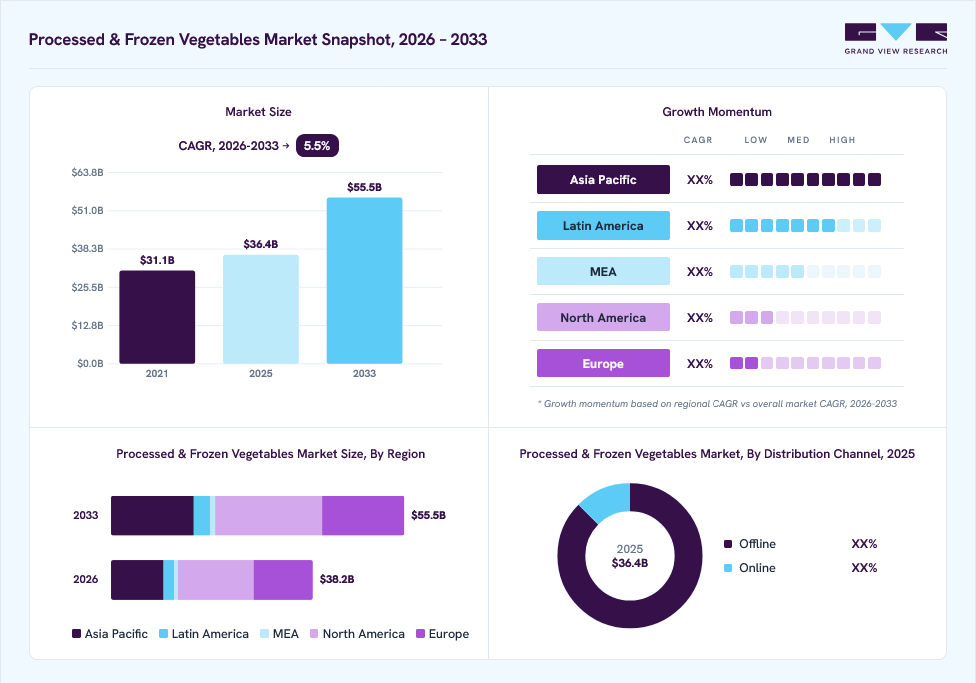
The global processed & frozen vegetables market size was valued at USD 36.4 billion in 2025 and is projected to grow from USD 38.2 billion in 2026 to USD 55.5 billion by 2033, at a CAGR of 5.5% from 2026 to 2033. North America dominated the market, accounting for the largest revenue share of 37.6% in 2025. The processed & frozen vegetables industry is primarily driven by rising consumer demand for convenient, ready-to-cook food products that save time without compromising nutrition.
Key Market Trends & Insights
- By product: The frozen vegetables market held the largest share of 52.5% in 2025.
- By distribution channel: The offline segment held the largest share of 87.3% in 2025.
Regional Highlights
- Largest regional market: North America (37.6% revenue share, 2025)
- Fastest-growing regional market: Asia Pacific (highest CAGR, 2026-2033)
- By country: The U.S. held the largest market share in 2025.
Market Size & Forecast
- Market size in 2025: USD 36.4 Billion
- Estimated market size in 2026: USD 38.2 Billion
- Projected market size by 2033: USD 55.5 Billion
- CAGR (2026-2033): 5.5%
Three ways to get this data
Subscribe to the databook, customize it, or ask a question.Horizon Databook
Unlock every chart on this page and get dashboard access
- Statistics1.2M+ across all markets
- Databooks30K+ global, 120K+ country
- Companies200K+ profiles
- ExportPDF, Dashboard, XLS & PNG, licensed to cite
Customize it
Customize data as per your requirement
- AddCountries, segments, years
- RecutTo your product definition
- ExtendCompany-level detail
- OrA bespoke databook
- Turnaround5–10 working days
Ask Prism AI
A cited answer in seconds
- Corpus30,000 studies, 1.2M points
- ScopeAll markets, not just this
- CitationTraced to report & table
- HonestySays "not covered" if so
- SpeedSeconds, not days
Government support for food processing, improvements in cold chain infrastructure, and the expansion of export opportunities are creating new growth avenues for the processed & frozen vegetable industry. According to the data published in August 2024, companies such as SWIFTHUB, based in Vietnam, have integrated cold chain logistics in their operations to support the rising demand for frozen food, including frozen vegetables. The increasing popularity of plant-based diets and the year-round availability of seasonal vegetables have also strengthened demand. Furthermore, manufacturers are introducing value-added products and sustainable packaging to meet evolving consumer preferences and enhance market competitiveness.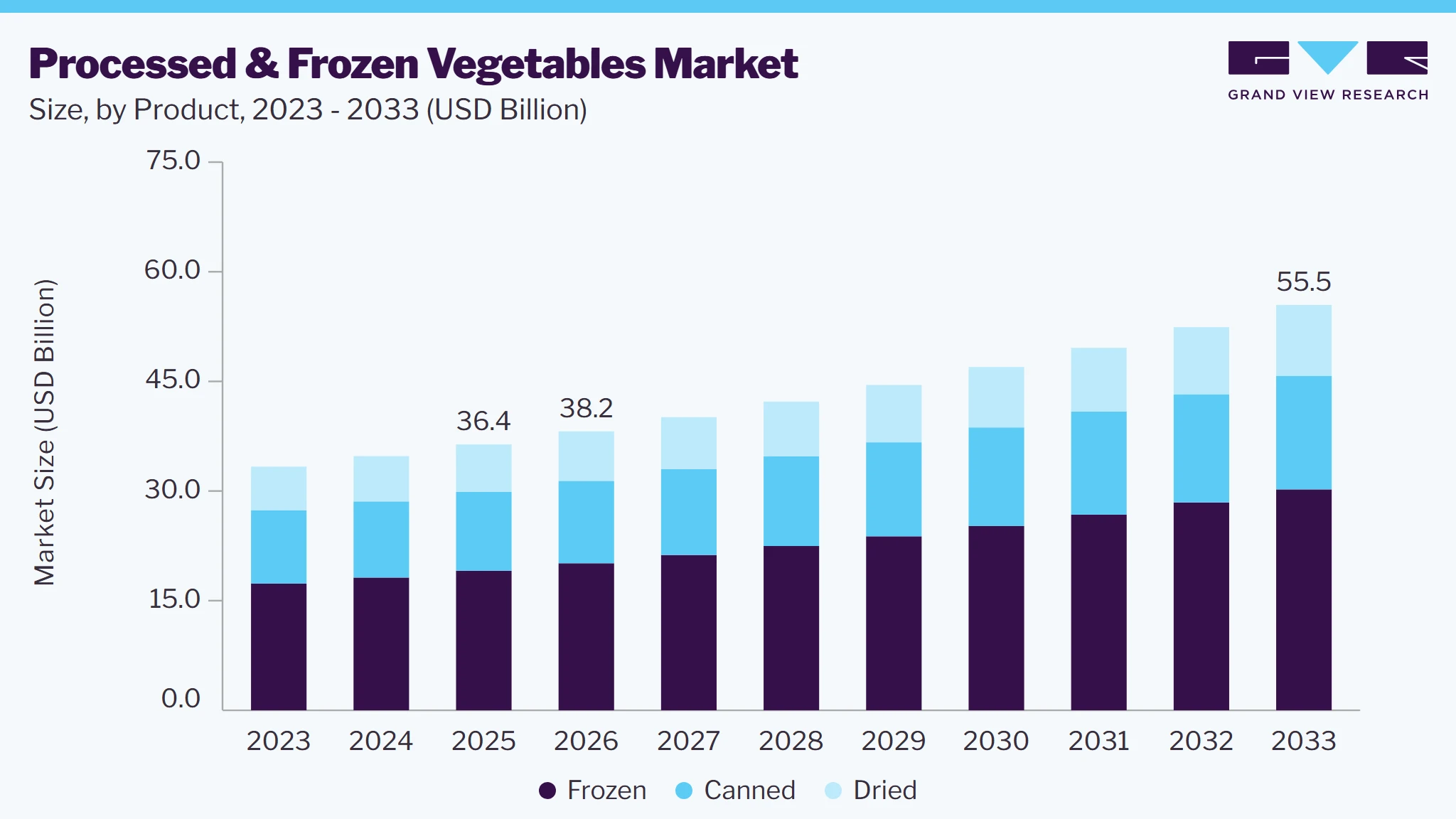
The rapid adoption of e-commerce and online grocery platforms has significantly improved the accessibility of processed & frozen vegetables across diverse consumer segments. Rising investments in automation and quality assurance are enabling manufacturers to enhance production efficiency while maintaining consistent product standards. Moreover, increasing demand from institutional buyers such as hotels, restaurants, and catering services is contributing to steady market growth.
Growing consumer preference for clean-label products with minimal preservatives is encouraging manufacturers to adopt innovative processing methods that naturally preserve freshness. According to the Agriculture Institute data published in February 2024, the Individually Quick Frozen (IQF) method freezes individual pieces rapidly, so they do not form large, damaging ice crystals, while preserving texture, flavor, and nutritional value. The expansion of private-label offerings by supermarkets and retail chains is also increasing product affordability and market penetration. In addition, strategic collaborations between farmers and food processors are strengthening raw material sourcing and improving supply chain resilience.
Market Dynamics
The growing demand for convenient and ready-to-cook food is a major driver of the processed & frozen vegetables market, as consumers increasingly seek meal solutions that reduce preparation time. Processed & frozen vegetables are pre-washed, peeled, chopped, and packaged, making them ideal for quick home cooking without compromising usability. These products also help consumers maintain a balanced diet while accommodating busy work schedules and changing lifestyles. According to the survey published in June 2025, conducted among 2,088 UK adults, about 51% consumers stated frozen food saves time, making it a preferred choice for busy lifestyles. In addition, advancements in freezing technology help maintain the nutritional value and quality of food products. As a result, demand continues to rise across households, foodservice establishments, and institutional kitchens, supporting sustained market growth.
High dependence on cold chain storage and transportation poses a challenge due to the need for continuous temperature control throughout the supply chain. Any disruption in refrigeration systems can affect product quality, shelf life, and overall reliability of distribution networks. Establishing and maintaining efficient cold storage infrastructure also requires significant investment, especially in developing regions. These logistical complexities can increase operational risks and impact market expansion.
The increasing preference for convenient, nutritious, and time-saving food options presents a significant opportunity for the Processed & Frozen Vegetables Market. Busy lifestyles and urbanization are driving demand for ready-to-cook and easy-to-prepare vegetable products. Manufacturers can capitalize on this trend by introducing innovative, clean-label, organic, and nutrient-rich products while expanding their presence through e-commerce and improving cold-chain distribution networks.
Analyst Perspective
The global processed & frozen vegetables Market is expected to witness sustained growth, supported by growing consumer demand for convenient food products with extended shelf life. Rising consumption across restaurants, catering services, and other foodservice channels, together with the expansion of supermarkets and online grocery platforms, is creating new market opportunities. Manufacturers are broadening their product portfolios through innovative vegetable blends, customized cuts, organic products, and ready-to-use formats to meet changing consumer needs. Emerging economies are also offering significant potential as improvements in cold-chain logistics, retail infrastructure, and food-processing facilities strengthen market accessibility.
Product Insights
The frozen product segment accounted for the largest share of 52.5% of the revenue in 2025. The frozen vegetables segment is driven by the ability to provide extended shelf life while preserving the texture, color, and nutritional properties of vegetables. Increasing demand from food manufacturers, restaurants, and catering services supports the adoption of frozen formats for large-scale meal preparation. Technological improvements in freezing methods are enhancing product quality and reducing moisture loss during storage. The availability of diverse frozen vegetable varieties throughout the year is also strengthening consumer and commercial demand. In March 2025, Greenyard and Gelagri Bretagne announced plans to enter negotiations for forming a sustainable partnership and joining forces in Brittany. The collaboration aims to integrate their frozen vegetable production and commercial operations, enhancing their capacity to increase vegetable cultivation, processing, and sales both within Brittany and in broader markets. Additionally, advancements in packaging solutions are improving product handling and convenience.
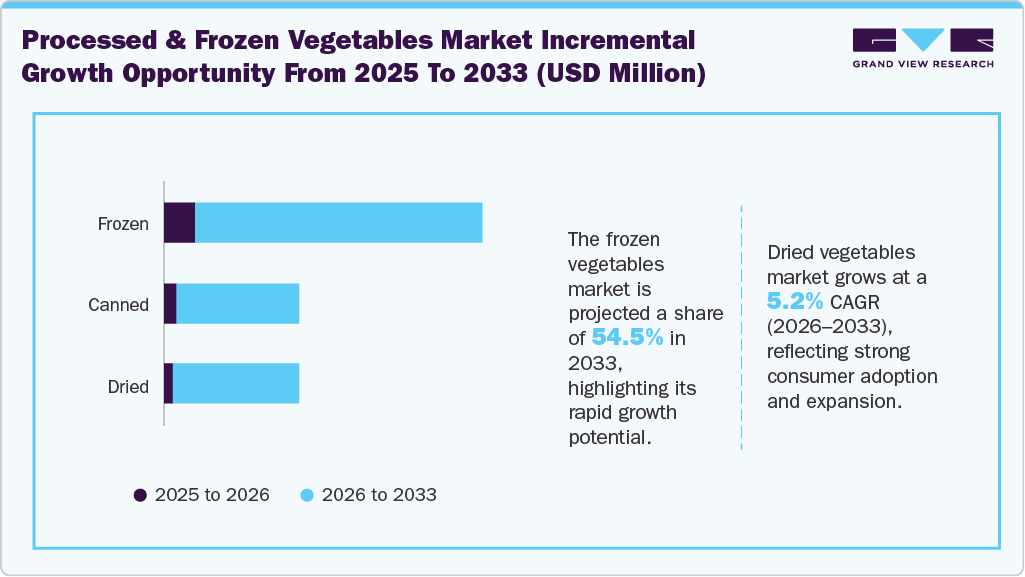
The dried vegetables segment is projected to grow significantly at a CAGR of 5.2% from 2026 to 2033. The dried vegetables segment is gaining traction due to their lightweight nature, easy storage, and suitability for long-distance transportation. These products are widely used in soups, seasoning blends, instant meals, and food processing applications, expanding their industrial demand. Longer shelf stability without refrigeration makes dried vegetables an attractive option for manufacturers and distributors. In March 2025, GEA discussed freeze-drying innovations aimed at converting perishable produce into long-lasting food products, helping reduce waste and improve supply-chain resilience.
Distribution Channel Insights
The offline segment in the processed & frozen vegetables market accounts for the largest share of 87.3% of the global revenue in 2025. The offline distribution segment is driven by strong consumer preference for physical stores, where product quality, packaging, and variety can be evaluated in person before purchase. Supermarkets, hypermarkets, and specialty food stores provide wider product visibility and encourage impulse buying through in-store promotions. Established retail networks enable manufacturers to reach a broader customer base across urban and semi-urban areas.
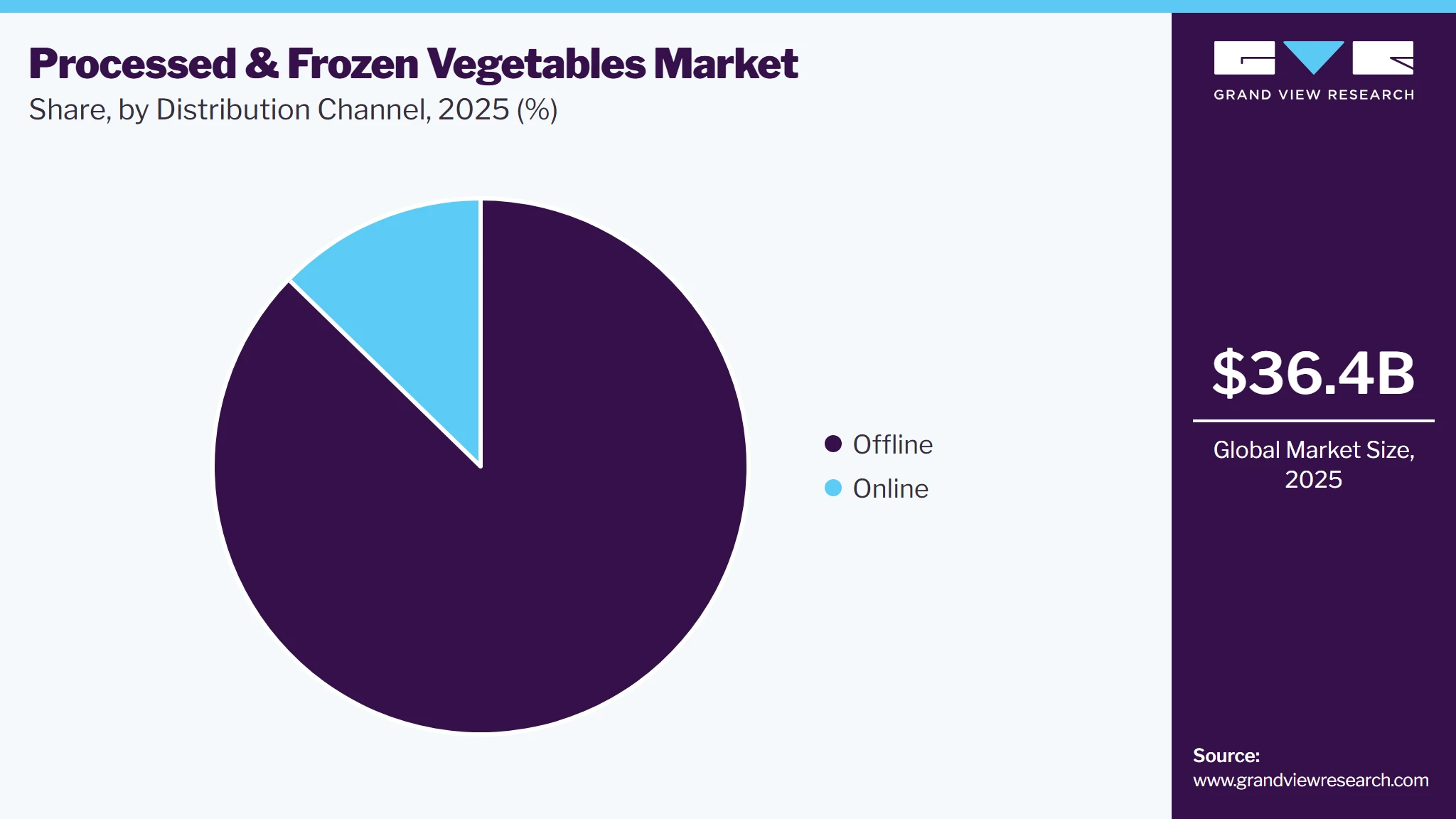
The online segment in the processed & frozen vegetables market is projected to grow at the fastest CAGR of 7.1% from 2026 to 2033. The online distribution segment is expanding due to the increasing use of digital grocery platforms and the convenience of doorstep delivery services. Consumers are gaining access to a wider range of processed & frozen vegetable products through e-commerce channels with easy price comparison and product reviews. Improved logistics capabilities and specialized delivery solutions are helping maintain product quality during transportation. Online platforms also allow brands to target niche customer groups through personalized promotions and digital marketing. The growing adoption of mobile shopping is further contributing to the expansion of this segment.
Regional Insights
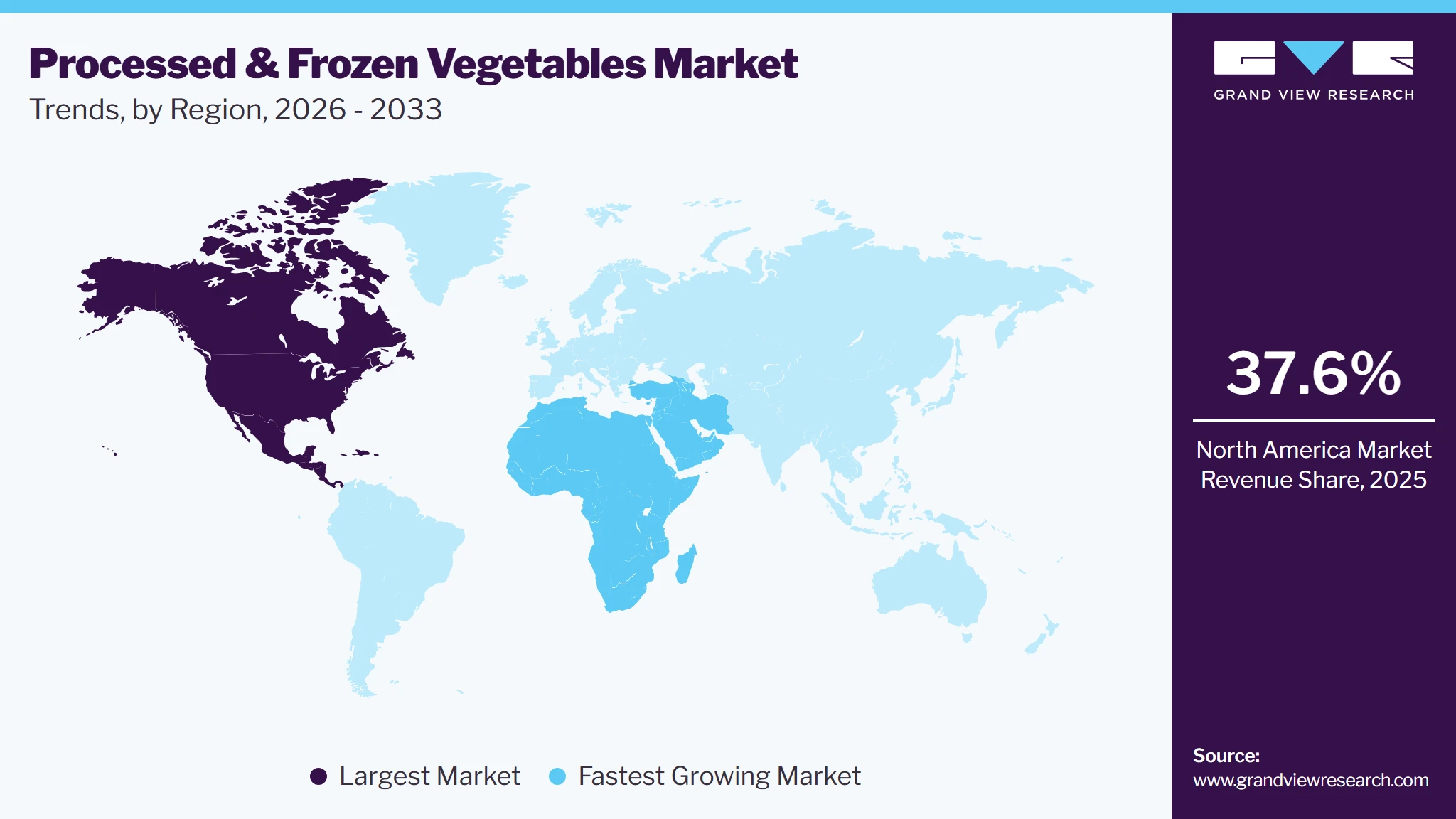
North America processed & frozen vegetables market accounted for the largest market share of 37.6% in 2025. The processed & frozen vegetables market in North America is driven by increasing demand for premium-quality food products with extended usability and consistent availability. The growth of meal kit services and prepared food solutions is encouraging the adoption of frozen vegetable ingredients. Strong investments in food innovation and product diversification are supporting market expansion. Rising preference for organic and specialty vegetable options is also creating new opportunities for manufacturers. Additionally, well-developed retail infrastructure helps brands introduce a wider range of products to consumers.
U.S. Processed & Frozen Vegetables Market Trends
The U.S. led the North American processed & frozen vegetables market in 2025, holding the largest market share with 85.3% of the region’s total revenue. The U.S. processed & frozen vegetables market is supported by growing consumption of convenient meal components among households and commercial food operators. The presence of large-scale food processing companies and advanced manufacturing capabilities strengthens market development. Expansion of private-label brands across grocery chains is improving product availability and affordability. According to the data published in February 2026, frozen food is becoming a regular part of American meal planning due to its affordability, convenience, longer shelf life, and ability to reduce food waste. Consumers are increasingly using frozen options alongside fresh foods to save money, simplify cooking, and maintain balanced meals.
Europe Processed & Frozen Vegetables Market Trends
The processed & frozen vegetables market in Europe is projected to grow at a CAGR of 4.8% from 2026 to 2033. The European processed & frozen vegetables market is driven by rising interest in sustainable food systems and reduced food waste solutions. Consumers are increasingly seeking products with clear sourcing information and responsible production practices. Strong demand from food manufacturers for reliable vegetable ingredients supports market growth. Improvements in processing standards and quality certifications are enhancing consumer confidence. The region’s focus on healthier eating habits is also encouraging broader acceptance of vegetable-based products. In March 2025, Greenyard and Gelagri Bretagne announced plans to enter into negotiations to form a sustainable partnership and join forces in Brittany. The collaboration aims to integrate their frozen-vegetable production and commercial operations, enhancing their capacity to expand vegetable cultivation, processing, and sales both within Brittany and in broader markets.
The Germany processed & frozen vegetables market led the European market in 2025, holding the largest market share of 23.3%. Germany’s processed & frozen vegetables market is influenced by strong demand for high-quality food products and efficient household meal solutions. Consumers’ preference for environmentally responsible packaging and sustainable sourcing is encouraging manufacturers to adopt new approaches. The country’s advanced retail sector provides significant opportunities for product penetration. Growing use of frozen vegetables in restaurants and catering operations further supports consumption.
Asia Pacific Processed & Frozen Vegetables Market Trends
The Asia Pacific processed & frozen vegetables market is expected to grow at the fastest CAGR of 6.7% in 2025. The Asia Pacific processed & frozen vegetables market is expanding due to changing dietary patterns and increasing exposure to international food trends. Rising investments in food processing facilities are improving regional production capabilities. In April 2025, Vendum, a manufacturer and processor of frozen vegetables, inaugurated a state-of-the-art IQF (Individually Quick Frozen) vegetable processing center in Tamil Nadu, India. Developed in collaboration with local farmers and with a strong focus on women’s employment, the facility aims to address key challenges in the HoReCa (Hotel, Restaurant, and Catering) supply chain, including price volatility, quality consistency, and labor shortages. The growth of modern grocery formats and urban food channels is enhancing product reach. Increasing adoption among younger consumers seeking diverse meal options is supporting demand. Furthermore, improvements in logistics networks are enabling better distribution across emerging markets.
The China processed & frozen vegetables market led the Asia Pacific market in 2025, holding the largest market share of 53.7%. China’s processed & frozen vegetables market is driven by increasing demand from the foodservice sector and large-scale food manufacturers. Expanding urban populations are contributing to greater consumption of packaged vegetable products. Development of domestic processing infrastructure is improving supply consistency and product variety. Growing export activities are encouraging producers to enhance quality standards. Additionally, increasing acceptance of frozen ingredients in modern cooking practices is supporting market growth.
Central & South America Processed & Frozen Vegetables Market Trends
The Central & South America processed & frozen vegetables market is projected to grow at a CAGR of 6.0% from 2026 to 2033. The processed & frozen vegetables market in Central and South America is supported by the region’s strong agricultural production base and export potential. Increasing investments in food processing facilities are helping convert locally available crops into value-added products. Rising demand from the hospitality and foodservice industries is creating additional growth opportunities. Expansion of organized retail channels is improving access to processed vegetable products. Moreover, growing interest in agricultural value chains is supporting industry development.
Middle East & Africa Processed & Frozen Vegetables Market Trends
The Middle East & Africa processed & frozen vegetables market is expected to grow at a CAGR of 5.4% from 2026 to 2033. The processed & frozen vegetables market in the Middle East & Africa is driven by increasing reliance on preserved food solutions due to varying climatic conditions and supply challenges. Growing urban populations are boosting demand for packaged food products with longer storage capabilities. Investments in food security initiatives are encouraging local processing and distribution improvements. Expansion of supermarkets and international food retailers is increasing product availability.
Key Processed & Frozen Vegetables Company Insights
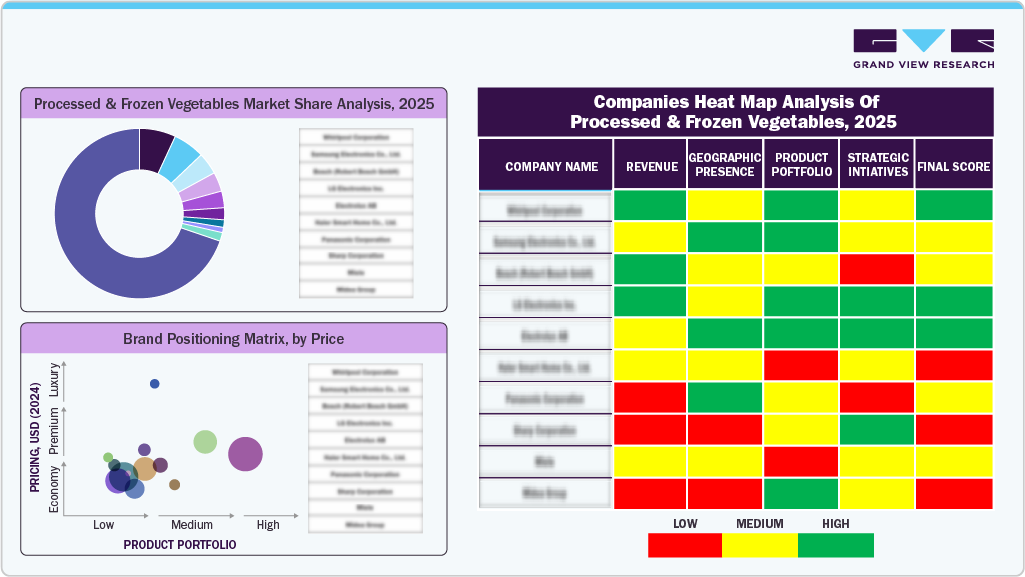
The processed & frozen vegetables industry is characterized by the presence of established global and regional players competing through product innovation, distribution expansion, and portfolio diversification. Market participants are focusing on improving processing technologies, enhancing supply chain efficiency, and introducing value-added vegetable products to strengthen their position.
Leading companies are also investing in sustainable sourcing practices and advanced packaging solutions to meet evolving consumer expectations. The industry remains moderately competitive, with growth opportunities emerging from expanding retail networks and increasing demand across foodservice channels. Strategic partnerships, acquisitions, and regional expansion initiatives continue to influence market share dynamics.
Key Processed & Frozen Vegetables Companies
The following key companies have been profiled for this study on the processed & frozen vegetables market.
-
Seneca Foods
-
Conagra Brands Inc.
-
Dole Food Company.
-
Del Monte Foods Inc.
-
Rhodes Food Group.
-
Kangfa Foods Ingredients
-
Greencore Group PLC
-
McCain Foods Ltd.
-
SVZ USA Inc
-
Bonduelle
Competitive Benchmarking
Category
Operating Strategies
Competitive Edge
Weakness
Established Players (Dole Food Company, Bonduelle)
- Expand processing capabilities, strengthen sourcing networks, and broaden frozen, canned, and value-added portfolios.
- Strong distribution networks, established customer relationships, and broad product offerings.
- Higher operating complexity and exposure to raw material and energy costs.
Emerging Players (SVZ USA Inc.)
- Target niche segments, introduce innovative vegetable formats, and expand through regional partnerships.
- Greater flexibility, specialized products, and quicker response to local demand.
- Limited geographic reach and comparatively lower brand visibility.
Recent Developments
-
In April 2025, Vendum, a manufacturer and processor of frozen vegetables, inaugurated a state-of-the-art IQF (Individually Quick Frozen) vegetable processing center in Tamil Nadu, India. Developed in collaboration with local farmers and with a strong focus on women’s employment, the facility aims to address key challenges in the HoReCa (Hotel, Restaurant, and Catering) supply chain, including price volatility, quality consistency, and labor shortages. The plant boasts a processing capacity of one ton of vegetables per hour and an initial cold storage capacity of 800 metric tonnes, with plans underway to expand by an additional 1,200 metric tonnes.
-
In March 2025, Greenyard and Gelagri Bretagne announced plans to enter negotiations for forming a sustainable partnership and joining forces in Brittany. The collaboration aims to integrate their frozen vegetable production and commercial operations, enhancing their capacity to increase vegetable cultivation, processing, and sales both within Brittany and in broader markets.
Processed & Frozen Vegetables Market Report Scope
Report Attribute
Details
Market size in 2025
USD 36.4 billion
Estimated market size in 2026
USD 38.2 billion
Projected market size by 2033
USD 55.5 billion
Growth rate
CAGR of 5.5% from 2026 to 2033
Actual data
2021 - 2025
Forecast period
2026 - 2033
Quantitative units
Revenue in USD Million, and CAGR from 2026 to 2033
Report coverage
Revenue forecast, company ranking, competitive landscape, growth factors, and trends
Segments covered
Product, distribution channel, region
Regional Scope
North America; Europe; Asia Pacific; Central & South America; Middle East & Africa
Country scope
U.S.; Canada; Mexico; UK; Germany; France; Italy; Spain; China; Japan; India; Australia & New Zealand; South Korea; Brazil; South Africa
Key companies profiled
Seneca Foods; Conagra Brands Inc.; Dole Food Company; Del Monte Foods Inc.; Rhodes Food Group; Kangfa Foods; Greencore Group PLC; McCain Foods Ltd.; SVZ USA Inc; Bonduelle
Customization scope
Free report customization (equivalent up to 8 analysts’ working days) with purchase. Addition or alteration to country, regional & segment scope.
Pricing and purchase options
Avail customized purchase options to meet your exact research needs. Explore purchase options
Global Processed & Frozen Vegetables Market Report Segmentation
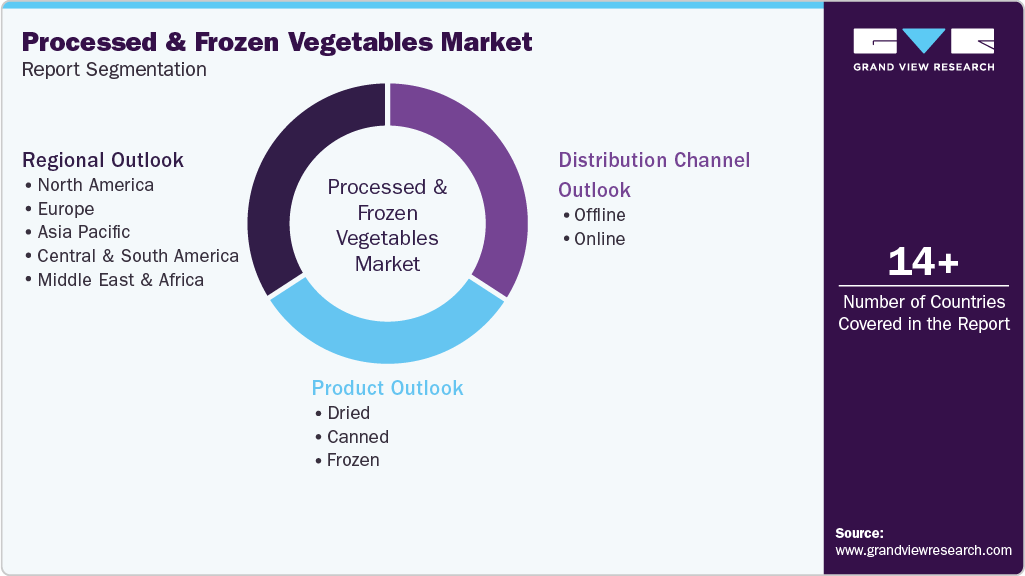
This report forecasts revenue growth at the regional and country levels and provides an analysis of the latest industry trends and opportunities in each of the sub-segments from 2021 to 2033. For the purpose of this study, Grand View Research has segmented the processed & frozen vegetables market report on the basis of product, distribution channel, and region.
-
Product Outlook (Revenue, USD Million, 2021 - 2033)
-
Dried
-
Canned
-
Frozen
-
-
Distribution Channel Outlook (Revenue, USD Million, 2021 - 2033)
-
Offline
-
Online
-
-
Regional Outlook (Revenue, USD Million, 2021 - 2033)
-
North America
-
U.S.
-
Canada
-
Mexico
-
-
Europe
-
UK
-
Germany
-
France
-
Italy
-
Spain
-
-
Asia Pacific
-
China
-
Japan
-
India
-
Australia & New Zealand
-
South Korea
-
-
Central & South America
-
Brazil
-
-
Middle East & Africa
-
South Africa
-
-
Research Methodology
The processed & frozen vegetables market figures in this report are based on a proven research process that combines executive interviews with secondary research from proprietary databases, company filings, and recognized regulatory and institutional sources. Market size is built through value-chain sizing-reconciling supply-side and demand-side estimates-and triangulated with bottom-up and top-down approaches. Every estimate passes multiple levels of expert validation before publication, with each processed & frozen vegetables segment quantified using the revenue-capture definitions in the table below.
Segment Definition
Segment - Product
Revenue capture definition
Dried
Processed vegetable companies generate revenue through the sale of dehydrated and dried vegetables to households, food manufacturers, restaurants, and institutional buyers. Revenue is captured through consumer-sized packs, ingredient formats, and bulk commercial supplies. Products such as dried peas, onions, carrots, mushrooms, and vegetable blends serve different culinary and industrial applications. Specialty processing, seasoning, and convenient ready-to-use formats can support higher-value sales.
Canned
Processed vegetable companies generate revenue by supplying canned vegetables through retail, foodservice, and industrial distribution channels. Sales are captured through single cans, multipacks, and larger formats designed for commercial use. A broad range of vegetables, recipes, pack sizes, and preservation styles enables manufacturers to address different consumption and application needs. Premium ingredients, mixed vegetable combinations, and convenient meal-oriented products can enhance revenue opportunities.
Frozen
Processed vegetable companies generate revenue from frozen vegetables sold to consumers, retailers, restaurants, catering businesses, and food manufacturers. Revenue is captured through retail-ready packs, foodservice quantities, and bulk ingredient formats. Individual vegetables, blends, specialty cuts, and ready-to-cook preparations allow producers to target multiple end-use applications. Value-added combinations, seasoned products, and convenient cooking formats can increase product value and selling potential.
Estimation Model
Layer
Guiding Question
Description
Consumption Profile Layer
Who consumes processed & frozen vegetables?
Identifies consumer groups, usage occasions, purchase frequency, and format preferences.
Channel & Access Layer
Where are products purchased?
Maps retail, foodservice, wholesale, institutional, and e‑commerce channels.
Product Choice Layer
What drives product selection?
Assesses freshness, taste, quality, convenience, price, nutrition, and variety.
Value Generation Layer
Where is value created in the market?
Identifies opportunities across premium products, value‑added formats, private label, and convenience.
Delivered Customizations
This report has been delivered with the following In-depth customizations
Client Request
Customization Delivered
Value Adds
Global Processed & Frozen Vegetables Market Size & Growth Assessment
Analyzed market size, historical performance, growth outlook, and demand trends across major regions and vegetable categories. Assessed consumption patterns, processing trends, distribution channels, and market maturity.
Identifies high-growth markets and emerging demand pockets. Supports regional expansion, investment prioritization, and long-term growth planning.
Global Processed & Frozen Vegetables Competitive Landscape
Assessed leading players, product portfolios, geographic presence, pricing approaches, and competitive strategies. Compared market positioning, product offerings, innovation focus, and strategic initiatives across key participants.
Highlights competitive gaps and differentiation opportunities. Enables benchmarking and supports positioning, partnership, and growth strategies.
Global Processed & Frozen Vegetables Product & Format Assessment
Evaluated demand across frozen, canned, dried, dehydrated, and other processed vegetable formats. Assessed preferences by vegetable type, application, end-use sector, and distribution channel.
Identifies attractive product categories and portfolio expansion opportunities. Supports product development, innovation, and targeted category penetration.
Frequently Asked Questions About This Report
The offline segment held the largest share of 87.3% in 2025.
The frozen vegetables market held the largest share of 52.5% in 2025.
Key players include Seneca Foods, Conagra Brands Inc., Dole Food Company, Del Monte Foods Inc., Rhodes Food Group, Kangfa Foods, Greencore Group PLC, McCain Foods Ltd., SVZ USA Inc, and Bonduelle.
The global processed & frozen vegetable market size was valued at USD 36.4 billion in 2025 and is estimated at USD 38.2 billion for 2026
Key factors driving the processed & frozen vegetable market include rising urbanization, busy lifestyles, increasing demand for convenient and ready-to-cook foods, growing health awareness, longer shelf life, and improvements in cold-chain infrastructure and retail distribution.
North America dominated with a 37.6% revenue share in 2025.
The global processed & frozen vegetable market is expected to grow at a CAGR of 5.5% from 2026 to 2033, reaching USD 55.5 billion in 2033
Asia Pacific is the fastest-growing region over the forecast period.
About the Author(s)
Consumer F&B Research Team
Consumer Goods · Consumer F&BThis report was authored by the consumer f&b research team at Grand View Research - comprising two research analysts, one senior research analyst, and one industry expert - with specialized expertise in the consumer f&b segment of the consumer goods industry. All findings are based on proprietary consumer goods databases, executive interviews, and regulatory analysis, subject to internal peer review prior to publication.
Last Updated:
Speak to Analyst


Customize this report to your needs - add regions, segments, or data points, with 20% free customization.
Or view our licence options:


ISO 9001:2015 & 27001:2022 Certified
We are GDPR and CCPA compliant! Your transaction & personal information is safe and secure. For more details, please read our privacy policy.


