
- Home
- »
- Consumer F&B
- »
-
Processed Vegetable Market Size, Share Report, 2026-2033GVR Report cover
![Processed Vegetable Market (2026 - 2033)Report]()
Processed Vegetable Market (2026 - 2033)
Size, Share & Trends Analysis Report By Product (Frozen, Canned), By End Use (Retail, Food Service), By Region (North America, Europe, Asia-Pacific, Central & South America, Middle East & Africa), And Segment Forecasts
Market Size, 2025
$17.3BMarket Estimate, 2026
$18.0BMarket Forecast, 2033
$25.2BCAGR, 2026–2033
4.9%Processed Vegetable Market Summary
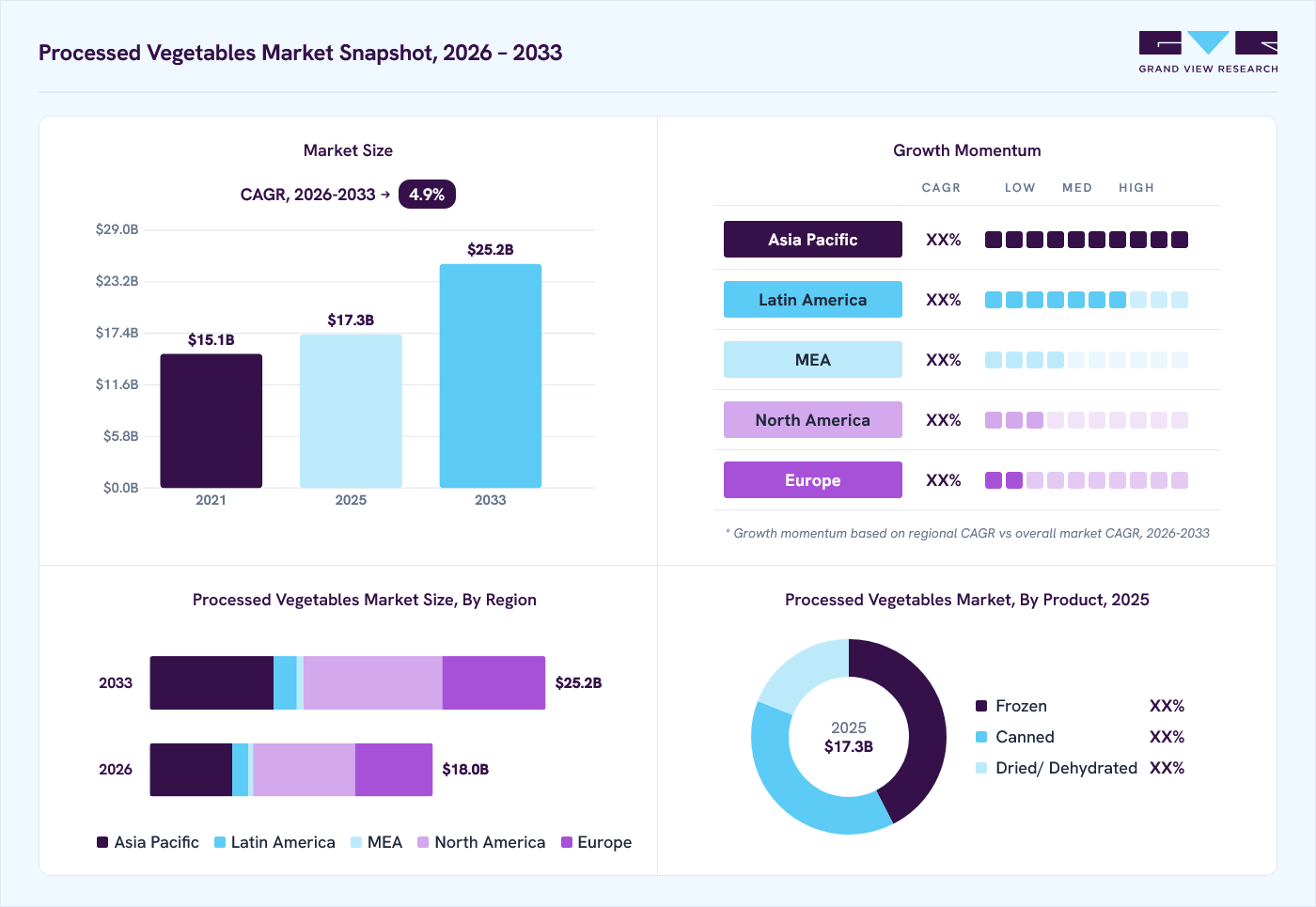
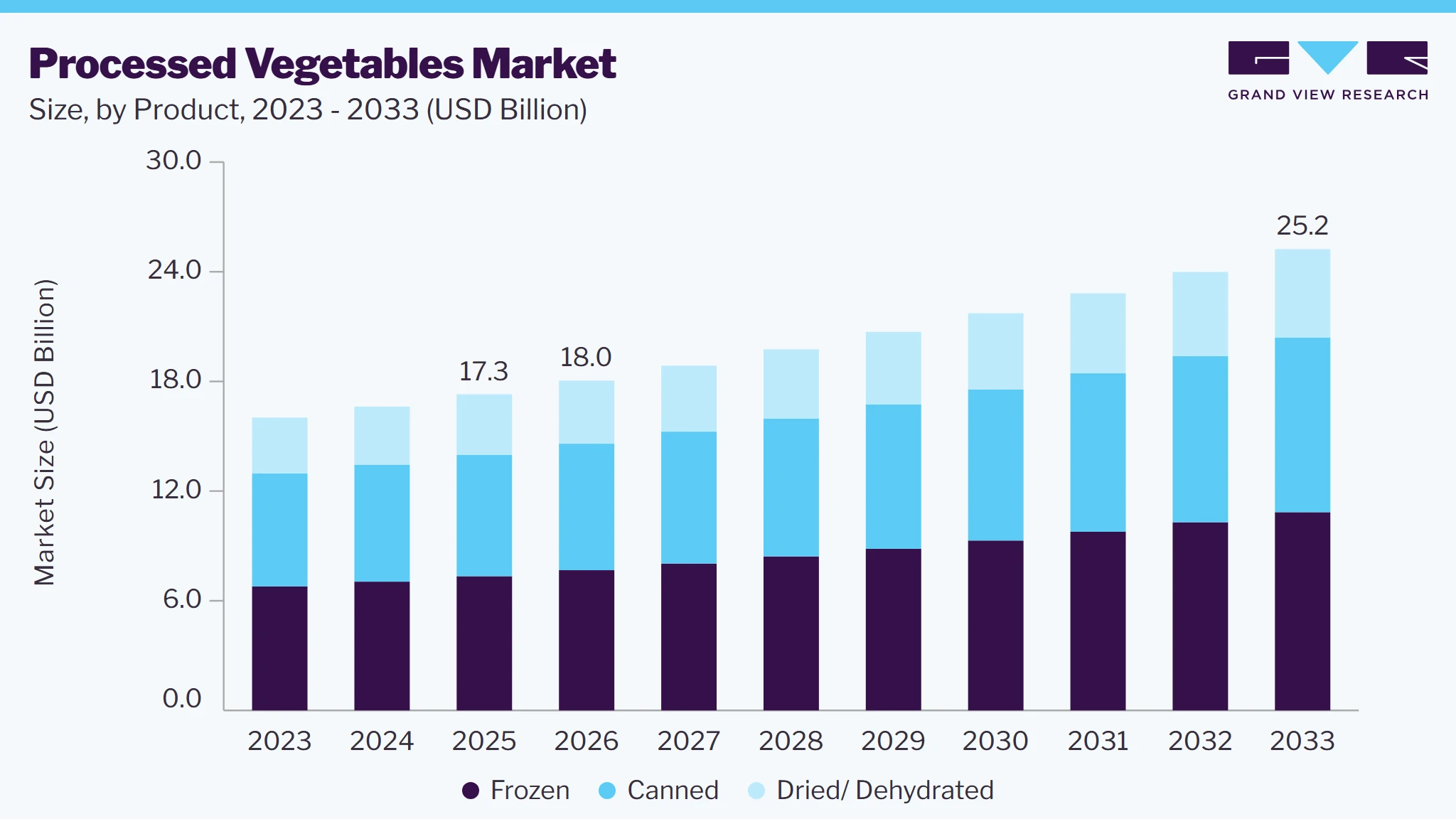
The global processed vegetable market size was valued at USD 17.3 billion in 2025 and is projected to grow from USD 18.0 billion in 2026 to USD 25.2 billion by 2033, at a CAGR of 4.9% from 2026 to 2033. North America dominated the market, accounting for the largest revenue share of 36.2% in 2025. The processed vegetable industry is primarily driven by the growing demand for convenient, ready-to-cook food products.
Key Market Trends & Insights
- By product: The frozen vegetables segment held the largest market share of 42.5% in 2025.
- By end use: The retail channel segment led the market with the largest revenue share of 47.6% in 2025.
Regional Highlights
- Largest regional market: North America (36.2% revenue share, 2025)
- Fastest-growing regional market: Asia Pacific (highest CAGR, 2026-2033)
- By country: The U.S. dominated North America with the largest revenue share in 2025
Market Size & Forecast
- Market size in 2025: USD 17.3 Billion
- Estimated market size in 2026: USD 18.0 Billion
- Projected market size by 2033: USD 25.2 Billion
- CAGR (2026-2033): 4.9%
Busy lifestyles and increasing urbanization encourage consumers to prefer processed vegetables. Changing dietary habits and improved food-processing and storage facilities also support market growth. The market is also supported by the increasing availability of frozen, canned, and dehydrated vegetables. Improved packaging and longer shelf life make processed vegetables more convenient for consumers. Growing awareness of healthy eating and the need for quick meal preparation further boost market demand. According to data published in January 2026, dehydrated fruits and vegetables are gaining popularity as healthy snacks due to their convenience, long shelf life, and nutritional appeal.
Furthermore, the growing use of processed vegetables in hotels, restaurants, and food-service businesses is creating new market opportunities. The expansion of supermarkets and online grocery platforms is making these products more easily accessible to consumers. Technological advancements in processing are also helping improve product quality and preserve nutritional value. According to the data published in February 2024, technological innovations such as Cryogenic freezing systems, Individual quick freezing (IQF) innovations, and High-Pressure freezing technologies help in retaining the firmness and texture of the vegetables.
In addition, changing consumer preferences are encouraging manufacturers to introduce a wider variety of processed vegetable products, while increasing demand from institutional buyers such as schools, hospitals, and catering services is supporting market expansion. Supportive government initiatives and investments in food-processing infrastructure are further strengthening the industry. Canada’s tomato trade further demonstrates this trend, with fresh tomato exports exceeding USD 724 billion in 2025 and processed tomato product imports exceeding USD 511 billion, reflecting strong domestic demand for processed tomato products and potential opportunities to expand local processing capacity.
Consumer Insights
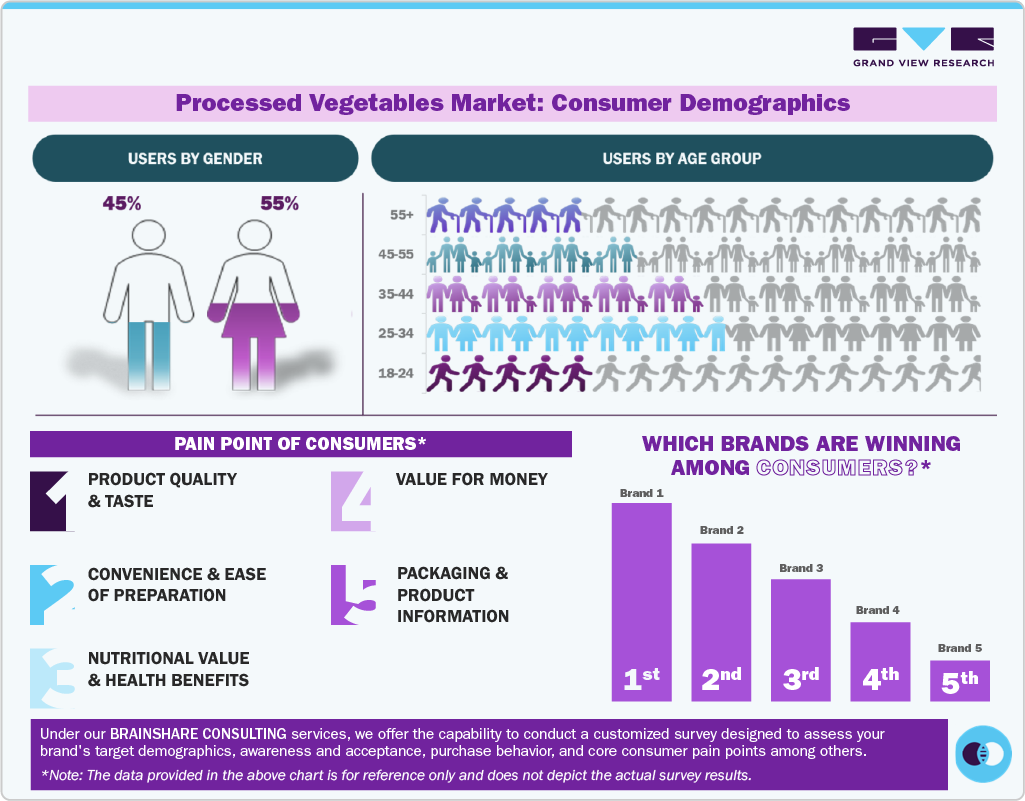
Consumer trends and preferences in the processed vegetable industry are increasingly shaped by demand for convenience, nutrition, and product quality. A key trend is the growing preference for frozen and minimally processed vegetables that retain freshness and nutritional value while reducing preparation effort. Consumers are also showing greater interest in clean-label products with fewer additives and preservatives. Packaging convenience, portion sizes, resealable formats, and sustainable materials are becoming important purchase considerations. Variety, taste, texture, and easy-to-prepare formats are further influencing consumer choices across retail and foodservice channels.
Market Dynamics
Consumers are increasingly seeking food products that reduce preparation time and effort. Processed vegetables offer convenience while fitting into fast-paced daily routines. According to the Japan Frozen Food Association survey conducted among 1,250 consumers in February 2025, more than 70% of women found frozen vegetables easy and convenient to cook. This trend is particularly noticeable among working individuals and urban households. Products requiring minimal washing, cutting, or cooking provide greater convenience. As a result, manufacturers are expanding their product ranges to match these preferences. The growing number of nuclear households further supports this consumption pattern. Changing meal preferences is also encouraging consumers to choose simpler food preparation options.
Processed vegetables require specialized equipment, controlled environments, and careful handling. Maintaining suitable temperatures throughout storage and transportation can increase operational expenses. Packaging requirements may further add to the overall cost of production and distribution. These expenses can place pressure on manufacturers, especially smaller market participants. Higher costs may also limit competitiveness and affect product pricing. Investment in modern processing facilities can require significant capital expenditure. Rising utility and maintenance expenses can further increase the financial burden on producers. According to the Global Cold Chain Alliance’s Q4 2024 Cold Chain Index, refrigerated warehouse expenses increased 4.69% YoY, with rental costs rising 5.55%, labor costs 4.59%, and electricity costs 2.30%. These rising storage, labor, and energy costs underscore the high operating expenses of temperature-controlled supply chains.
Manufacturers can develop products with added features such as seasoning, portion control, and customized cuts. Such products can cater to consumers seeking greater variety and easier meal preparation. There is also scope to introduce premium, differentiated vegetable-based offerings. Product innovation can help companies target new consumer segments and increase market reach. According to The Asia Business Daily, CJ CheilJedang launched “Organic Curly Kale 100,” a freeze-dried vegetable powder, as part of its 2026 Lunar New Year product lineup. The launch demonstrates continued product innovation and diversification in freeze-dried vegetable products, targeting health-conscious consumers.
Analyst Perspective
The global processed vegetable market is experiencing steady growth, driven by rising demand for convenient, nutritious, and longer-lasting food products. Frozen, canned, and dehydrated formats are gaining traction across retail, foodservice, and food manufacturing applications. Advances in freezing, dehydration, and packaging technologies are helping improve product quality and shelf stability. Growing adoption of online grocery and modern retail channels is also expanding product accessibility.
Product Insights
The frozen vegetable segment led the market with the largest revenue share of 42.5% in 2025 and is anticipated to grow at the fastest CAGR during the forecast period. The frozen segment is supported by the ability to maintain vegetables in a usable condition for extended periods. Modern freezing methods help preserve the texture, color, and nutritional characteristics of many vegetables. Growing investments in cold-chain infrastructure are improving distribution across different regions. Frozen vegetables are also increasingly used by food manufacturers and commercial kitchens because of their consistent quality. Improvements in freezing and packaging technologies are further strengthening the segment.
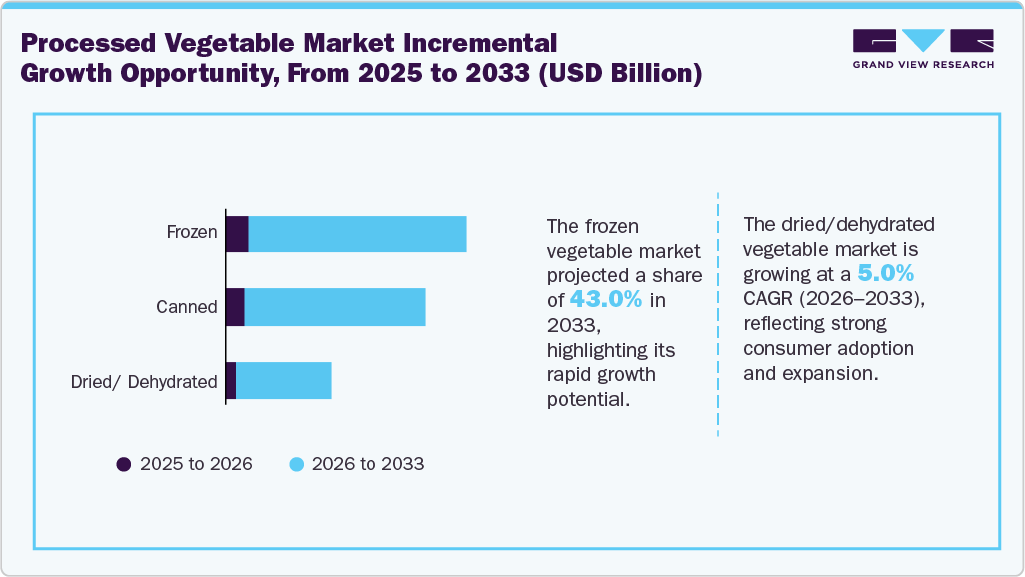
The dried/dehydrated segment is anticipated to grow at a significant CAGR of 5.0% from 2026 to 2033. The dried/dehydrated segment benefits from its lightweight nature, which makes transportation and storage more efficient. Removing moisture significantly reduces spoilage and allows products to be stored without continuous refrigeration. These vegetables are widely used as ingredients in soups, sauces, snacks, instant meals, and seasoning blends. Growing demand from food-processing companies is creating additional applications for dehydrated products. Advances in dehydration techniques are also improving flavor retention, appearance, and overall product quality. In April 2026, Agriture launched an OEM service enabling customized blends from more than 30 types of dried vegetables, including upcycled off-grade produce.
End Use Insights
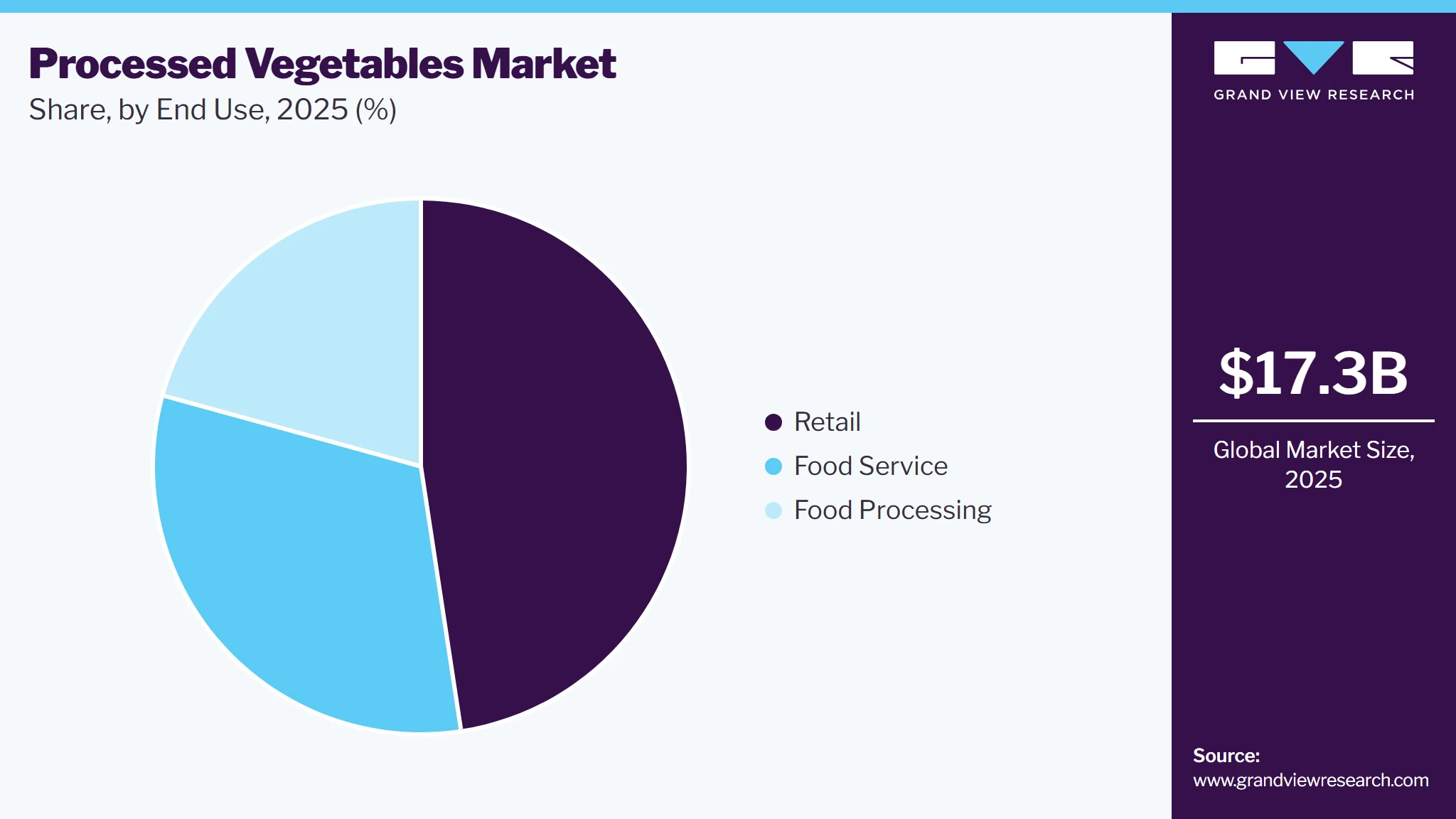
The retail segment led the market with the largest revenue share of 47.6% in 2025. The retail segment is driven by the wider availability of processed vegetables through supermarkets, hypermarkets, and local grocery stores. Attractive packaging and multiple product sizes make these products suitable for different household requirements. Private-label offerings are also encouraging retailers to expand their ranges of processed vegetables. Promotional activities and in-store visibility can further influence purchasing decisions. Greater product variety across retail channels is helping manufacturers reach a broader consumer base.
By End use
The foodservice sector segment is projected to grow at the fastest CAGR of 5.0% from 2026 to 2033. The food service segment is supported by the growing use of processed vegetables in restaurants, cafés, catering operations, and institutional kitchens. These products provide standardized ingredients that can help maintain consistency across large-volume food preparation.
Their availability in bulk is particularly useful for commercial kitchens that handle frequent orders. Processed vegetables can also help food-service operators manage ingredient requirements more efficiently. The expansion of organized food-service outlets is creating additional demand from this segment.
Regional Insights
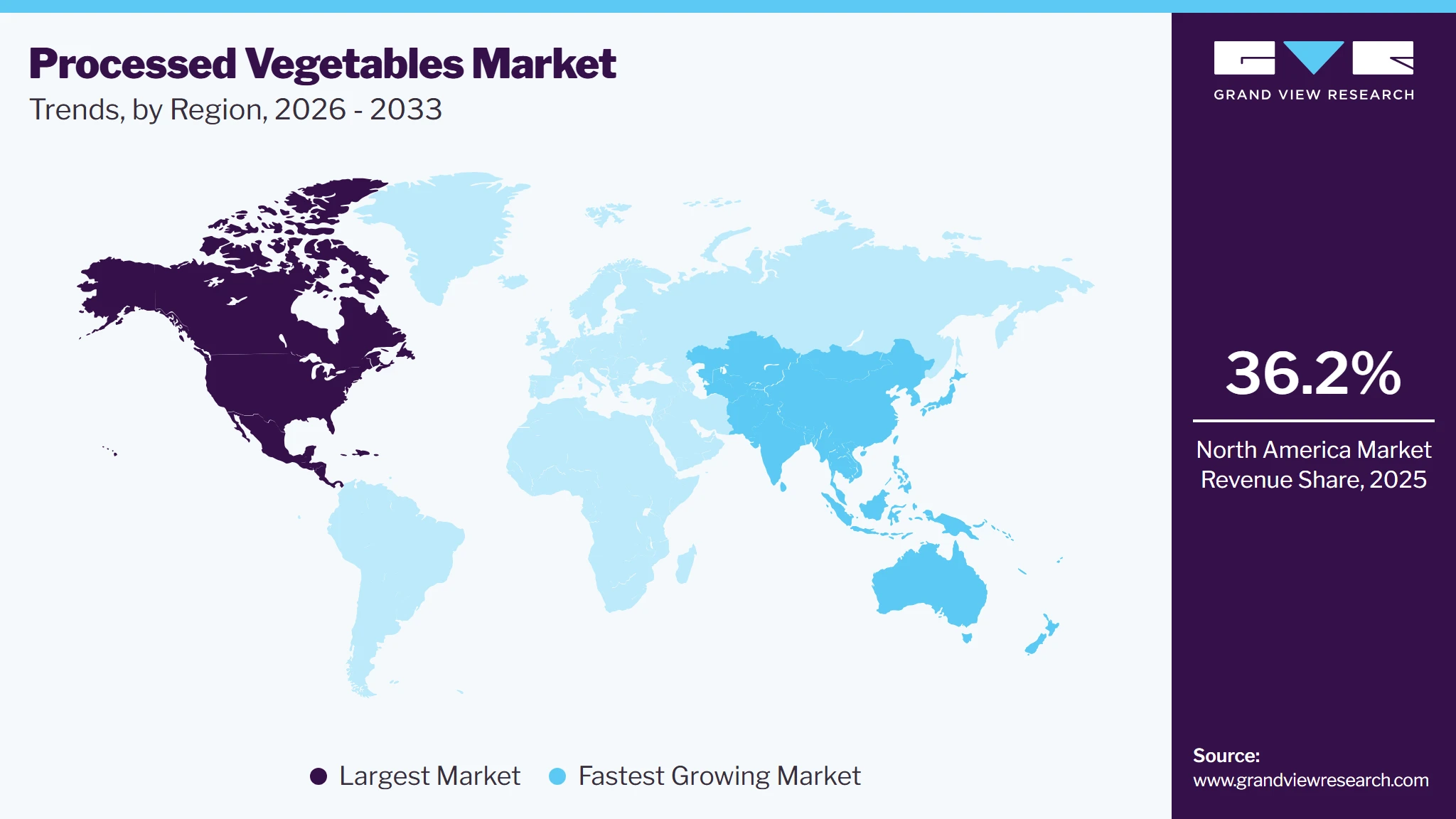
North America dominated the global processed vegetable market with the largest revenue share of 36.2% in 2025, driven by the strong presence of organized food retailers and large-scale food manufacturers. Demand from institutional buyers such as schools, hospitals, and corporate cafeterias supports consistent consumption. Advanced food-processing technologies enable manufacturers to offer a broad range of vegetable formats. Strong logistics networks facilitate the movement of processed products across long distances. Product innovation and premium offerings are also encouraging market expansion.
U.S. Processed Vegetable Market Trends
The processed vegetable market in the U.S. accounted for the largest market revenue share in North America in 2025, driven by the widespread use of processed vegetables in packaged meals, sauces, soups, and other prepared foods. Food manufacturers increasingly rely on standardized vegetable ingredients for large-scale production. The expansion of private-label brands is providing consumers with more product choices at different price points. Strong supermarket and warehouse-club networks provide extensive distribution coverage. Continuous investment in food technology is supporting improvements in product quality and production efficiency. In March 2026, Seneca Foods acquired B&G Foods’ Green Giant U.S. frozen business, including the Green Giant brand and intellectual property, frozen inventory, and a frozen vegetable manufacturing facility in Yuma, Arizona. The deal also included a supply agreement covering certain products manufactured in Mexico.
Europe Processed Vegetable Market Trends
The processed vegetable market in Europe is projected to grow at a significant CAGR of 4.2% from 2026 to 2033, driven by growing consumer interest in sustainable and plant-based food choices. Well-established food-processing industries provide strong demand for vegetables used as ingredients in various food products. Strict quality standards encourage manufacturers to adopt advanced processing and packaging practices. Expansion of premium and organic product categories is creating additional market opportunities. Cross-border trade within the region also supports the wider availability of processed vegetable products. In March 2025, Greenyard and Gelagri Bretagne announced plans to enter into negotiations to form a sustainable partnership and join forces in Brittany. The collaboration aims to integrate their frozen vegetable production and commercial operations, enhancing their capacity to increase vegetable cultivation, processing, and sales both within Brittany and in broader markets
The Germany processed vegetable market held a substantial market revenue share in Europe in 2025. Germany is driven by its highly developed food-processing and retail sectors. Demand for organic and sustainably produced food is encouraging greater use of processed vegetable products. Manufacturers are focusing on environmentally responsible packaging to align with consumer and regulatory expectations. The strong presence of discount supermarkets provides broad access to packaged food products. Innovation in plant-based and ready-meal categories is creating additional applications for processed vegetables.
Asia Pacific Processed Vegetable Market Trends
The processed vegetable market in the Asia Pacific is projected to grow at the fastest CAGR of 6.0% from 2026 to 2033, driven by rapid urban development and the expansion of modern food distribution systems. Growing food manufacturing industries are increasing the use of processed vegetables as commercial ingredients. Rising demand for packaged and convenience-oriented meals is creating new applications. Improvements in cold-chain and storage infrastructure are supporting wider distribution. Increasing investment in food-processing facilities is also strengthening regional production capabilities. In April 2025, Vendum, a manufacturer and processor of frozen vegetables, inaugurated a state-of-the-art IQF (Individually Quick Frozen) vegetable processing center in Tamil Nadu, India. Developed in collaboration with local farmers and with a strong focus on women’s employment, the facility aims to address key challenges in the HoReCa (Hotel, Restaurant, and Catering) supply chain, including price volatility, quality consistency, and labor shortages.
The China processed vegetable market is driven by its large-scale food manufacturing sector and expanding packaged-food industry. The growth of e-commerce and food-delivery platforms is increasing the availability of processed food products. Rising demand for instant meals and prepared dishes is creating additional applications for processed vegetables. Investments in agricultural modernization are improving the supply of suitable raw materials. Expansion of domestic processing facilities is also supporting greater production capacity.
Central & South America Processed Vegetable Market Trends
The processed vegetable market in Central & South America is projected to grow at a significant CAGR of 5.4% from 2026 to 2033. The region is driven by its strong agricultural production and the availability of diverse vegetable varieties. Increasing investment in food-processing facilities is helping convert fresh produce into higher-value products. Growing supermarket networks are improving consumer access to packaged vegetables. Export activity is encouraging producers to improve processing standards and product quality. Efforts to reduce post-harvest losses are also supporting the development of processing operations.
Middle East & Africa Processed Vegetable Market Trends
The processed vegetable market in the Middle East & Africa is driven by increasing investment in food-processing infrastructure and local manufacturing capabilities. High dependence on imported food products in several countries creates demand for products with longer storage stability. Expansion of hospitality and catering industries is increasing commercial use of processed vegetables. Growing modern retail networks are improving product availability in urban markets. Rising food-security initiatives are also encouraging greater development of local processing capacity.
Key Processed Vegetable Company Insights
The processed vegetable industry is characterized by the presence of several established and emerging players across different regions. Market share is influenced by product quality, processing capabilities, distribution reach, and brand recognition. Companies are focusing on expanding their product portfolios to meet changing consumer preferences. Strategic partnerships, acquisitions, and investments in processing facilities are also shaping the competitive landscape. Overall, increasing product diversification and regional expansion are contributing to a competitive market environment.
Key Processed Vegetable Companies
The following key companies have been profiled for this study on the processed vegetable market.
-
Ardo N.V.
-
Conagra Brands, Inc.
-
Del Monte Foods, Inc.
-
Dole Food Company, Inc.
-
Bonduelle Group
-
Greenyard NV
-
Seneca Foods Corporation
-
The Kraft Heinz Company
-
Nomad Foods Limited
-
Greencore Group PLC
Competitive Benchmarking
Category
Operating Strategies
Competitive Edge
Weakness
Established Players (Ardo N.V., Conagra Brands, Inc., Dole Food Company, Inc.)
- Invest in processing capacity, strengthen supply chains, and broaden value-added offerings.
- Established sourcing networks, diversified portfolios, and strong customer relationships.
- High capital requirements and exposure to raw-material price volatility.
Emerging Players (Greenyard NV; Nomad Foods Limited)
- Target niche segments, develop differentiated products, and expand regional distribution.
- Flexible product development, specialized capabilities, and strong market responsiveness.
- Lower category penetration and comparatively limited geographic coverage.
Recent Developments
-
In March 2026, Seneca Foods acquired B&G Foods’ Green Giant U.S. frozen business, including the Green Giant brand and intellectual property, frozen inventory, and a frozen vegetable manufacturing facility in Yuma, Arizona. The deal also included a supply agreement covering certain products manufactured in Mexico.
-
In April 2026, Agriture launched an OEM service enabling customized blends from more than 30 types of dried vegetables, including upcycled off-grade produce. The initiative supports small-lot production and sustainable product development, expanding applications for dried vegetables as customized food and promotional products.
Processed Vegetable Market Report Scope
Report Attribute
Details
Market size in 2025
USD 17.3 billion
Estimated market size in 2026
USD 18.0 billion
Projected market size by 2033
USD 25.2 billion
Growth rate
CAGR of 4.9% from 2026 to 2033
Base year for estimation
2025
Historical data
2021 - 2024
Forecast period
2026 - 2033
Quantitative units
Revenue in USD million/billion, and CAGR from 2026 to 2033
Report coverage
Revenue forecast, company ranking, competitive landscape, growth factors, and trends
Segments covered
Product, end use, region
Regional scope
North America; Europe; Asia-Pacific; Central & South America; Middle East & Africa
Country scope
U.S.; Canada; Mexico; UK; Germany; France; Italy; Spain; China; Japan; India; Australia & New Zealand; South Korea; Brazil; South Africa
Key companies profiled
Ardo N.V.; Conagra Brands, Inc.; Del Monte Foods, Inc.; Dole Food Company, Inc.; Bonduelle Group; Greenyard NV; Seneca Foods Corporation; The Kraft Heinz Company; Nomad Foods Limited; Greencore Group PLC
Customization scope
Free report customization (equivalent up to 8 analysts’ working days) with purchase. Addition or alteration to country, regional & segment scope.
Pricing and purchase options
Avail customized purchase options to meet your exact research needs. Explore purchase options
Global Processed Vegetable Market Report Segmentation
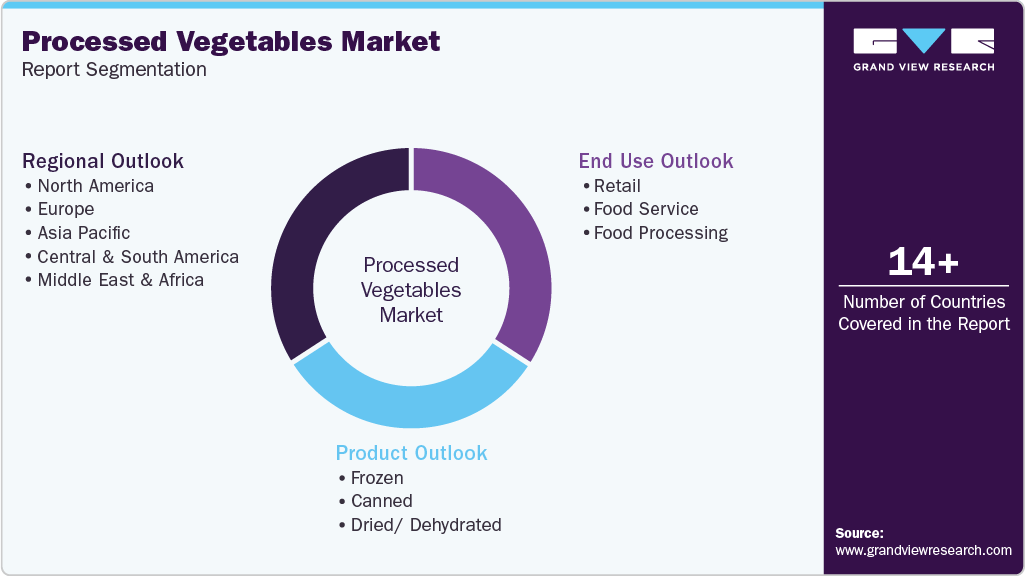
This report forecasts revenue growth at the regional and country levels and provides an analysis of the latest industry trends and opportunities in each of the sub-segments from 2021 to 2033. For this study, Grand View Research has segmented the processed vegetable market report based on the product, end use, and region.
-
Product Outlook (Revenue, USD Billion, 2021 - 2033)
-
Frozen
-
Canned
-
Dried/ Dehydrated
-
-
End Use Outlook (Revenue, USD Billion, 2021 - 2033)
-
Retail
-
Supermarkets/ hypermarkets
-
Convenience stores
-
Online
-
-
Food Service
-
QSR
-
Hotels
-
Catering
-
Others
-
-
Food Processing
-
-
Regional Outlook (Revenue, USD Billion, 2021 - 2033)
-
North America
-
U.S.
-
Canada
-
Mexico
-
-
Europe
-
UK
-
Germany
-
France
-
Italy
-
Spain
-
-
Asia Pacific
-
China
-
Japan
-
India
-
Australia & New Zealand
-
South Korea
-
-
Central & South America
-
Brazil
-
-
Middle East & Africa
-
South Africa
-
-
Research Methodology
The processed vegetable marketfigures in this report are based on a proven research process that combines executive interviews with secondary research from proprietary databases, company filings, and recognized regulatory and institutional sources. Market size is built through value-chain sizing-reconciling supply-side and demand-side estimates-and triangulated with bottom-up and top-down approaches. Every estimate passes multiple levels of expert validation before publication, with eachxx (without ‘market’)segment quantified using the revenue-capture definitions in the table below.
Segment Definition
Segment - Product
Revenue capture definition
Frozen
Processed vegetables generate revenue through the sale of frozen products to households, food-service operators, and food manufacturers. Revenue is captured through retail packs, bulk formats, and branded frozen ranges. Different vegetable varieties, cuts, and package sizes allow companies to target multiple customer segments. Premium freezing methods and value-added preparations can support higher selling prices.
Canned
Processed vegetables generate revenue through canned products designed for convenient storage and extended usability. Revenue is captured through individual cans, multi-packs, and larger institutional formats sold across retail and food-service channels. Product variety, portion sizes, and branded offerings enable manufacturers to address different consumption needs. Specialty recipes and premium formulations can further increase the value generated per unit.
Dried/Dehydrated
Processed vegetables generate revenue through dried and dehydrated products supplied to households, food manufacturers, and commercial kitchens. Revenue is captured through retail packs, ingredient-grade products, and bulk commercial supplies. Their reduced moisture content enables manufacturers to offer lightweight products suitable for efficient transportation and storage. Customized cuts, blends, and specialized ingredients can create additional revenue opportunities.
Delivered Customization
This report has been delivered with the following In-depth customizations
Client Request
Customization Delivered
Value Adds
Global Processed Vegetable Market Channel & Route-to-Market Assessment
Mapped the role of modern grocery, traditional retail, foodservice, institutional procurement, wholesalers, and direct supply models in processed vegetable distribution.
Highlights priority channels, route-to-market gaps, and channel-specific opportunities for market expansion.
Global Processed Vegetable Supply & Sourcing Assessment
Assessed raw-material sourcing patterns, seasonality, supplier structures, processing footprints, logistics considerations, and supply continuity requirements.
Identifies sourcing risks, supply-chain improvement opportunities, and potential areas for procurement and operational optimization.
Global Processed Vegetable Application & End-Use Assessment
Examined demand across applications, including prepared meals, sauces, soups, salads, snacks, food manufacturing, catering, and institutional food programs.
Pinpoints attractive end-use markets and supports targeted product development and commercial prioritization.
Frequently Asked Questions About This Report
The global processed vegetable market size was valued at USD 17.3 billion in 2025 and is estimated at USD 18.0 billion for 2026.
The global processed vegetable market is expected to grow at a CAGR of 4.9% from 2026 to 2033, reaching USD 25.2
Key factors include rising demand for convenient and ready-to-cook foods, urbanization, busy lifestyles, and growing health consciousness, driving consumption of frozen, canned, and minimally processed vegetables.
The frozen vegetable segment led with a 42.5% revenue share in 2025.
The dried/ dehydrated vegetable market is projected to grow at the fastest CAGR of 5.0% from 2026 to 2033.
The North American processed vegetable market led with a 36.2% revenue share in 2025.Which distribution channel segment leads the processed vegetable market?
The sale of processed vegetables through retail channels accounted for the largest share of 47.6% of the revenue in 2025.
The sale of processed vegetables through the food service channel is projected to grow at a CAGR of 5.2% from 2026 to 2033.
Key players include Ardo N.V., Conagra Brands, Inc., Del Monte Foods, Inc., Dole Food Company, Inc., Bonduelle Group, Greenyard NV, Seneca Foods Corporation, The Kraft Heinz Company, Nomad Foods Limited, and Greencore Group PLC.
About the Author(s)
Consumer F&B Research Team
Consumer Goods · Consumer F&BThis report was authored by the consumer f&b research team at Grand View Research - comprising two research analysts, one senior research analyst, and one industry expert - with specialized expertise in the consumer f&b segment of the consumer goods industry. All findings are based on proprietary consumer goods databases, executive interviews, and regulatory analysis, subject to internal peer review prior to publication.
Last Updated:
Speak to Analyst


Customize this report to your needs — add regions, segments, or data points, with 20% free customization.
Or view our licence options:


ISO 9001:2015 & 27001:2022 Certified
We are GDPR and CCPA compliant! Your transaction & personal information is safe and secure. For more details, please read our privacy policy.


