
- Home
- »
- Medical Devices
- »
-
Prosthetics And Orthotics Market Size Report, 2026-2033GVR Report cover

Prosthetics And Orthotics Market (2026 - 2033)
Size, Share & Trends Analysis Report By Type (Orthotics (Upper Limb Orthosis, Lower Limb Orthosis), Prosthetics (Upper Extremity, Lower Extremity)), By Region, And Segment Forecasts
Market Size, 2025
$6.8BMarket Estimate, 2026
$7.1BMarket Forecast, 2033
$9.5BCAGR, 2026–2033
4.2%Prosthetics And Orthotics Market Summary
The global prosthetics and orthotics market size was valued at USD 6.8 billion in 2025 and is projected to grow from USD 7.1 billion in 2026 to USD 9.5 billion by 2033, at a CAGR of 4.2% from 2026 to 2033. The market in North America dominated with a revenue share of 36.8% in 2025. The market is driven by an aging population, rising diabetes-related amputations, and increased incidence of trauma from accidents and sports.
 Source: Grand View Research, IR Documents, Primary Interviews, Paid DatabasesTo learn more about this report,
 Download Free Sample Report
 Key Market Trends & Insights
- By type: Orthotics segment held the largest market share of 58.8% in 2025.
- By type: Prosthetics segment is expected to register the fastest CAGR during the forecast period.
Regional Highlights
- Largest regional market: North America (36.8% revenue share, 2025)
- Fastest-growing regional market: Asia Pacific (highest CAGR, 2026-2033)
- By country: The U.S. held the largest market share in 2025
Market Size & Forecast
- Market size in 2025: USD 6.8 Billion
- Estimated market size in 2026: USD 7.1 Billion
- Projected market size by 2033: USD 9.5 Billion
- CAGR (2026-2033): 4.2%
Three ways to get this report
Buy it, customize it, or ask a question.Ask an Analyst
Analyst response in 1 business day
- AccessReport author, directly
- Reply timeWithin 1 working day
- No sales callDirect answer only
- FormatEmail reply
- CostFree, no cost
Get the Full Report
What the study covers
- FormatsPDF · Excel · Dashboard
- Timeline2026–2033 annual, 2025 base
- Coverage20+ countries, 5 regions
- Companies10+ key players profiled
Customize the Report
20% free customization
- IncludeCountries, segments, points
- TailorTo your product definition
- ExtendDeeper competitor detail
- OrA fully bespoke study
- Turnaround5–10 working days
Technological advancements in bionics, 3D printing, and lightweight materials are accelerating adoption and improving patient outcomes. For instance, Stanford Medicine Children’s Health reported that over 3.5 million children and adolescents in the U.S. experience sports injuries each year. Thus, sports-induced injury is anticipated to drive the demand for prosthetics and orthotics solutions during the forecast period.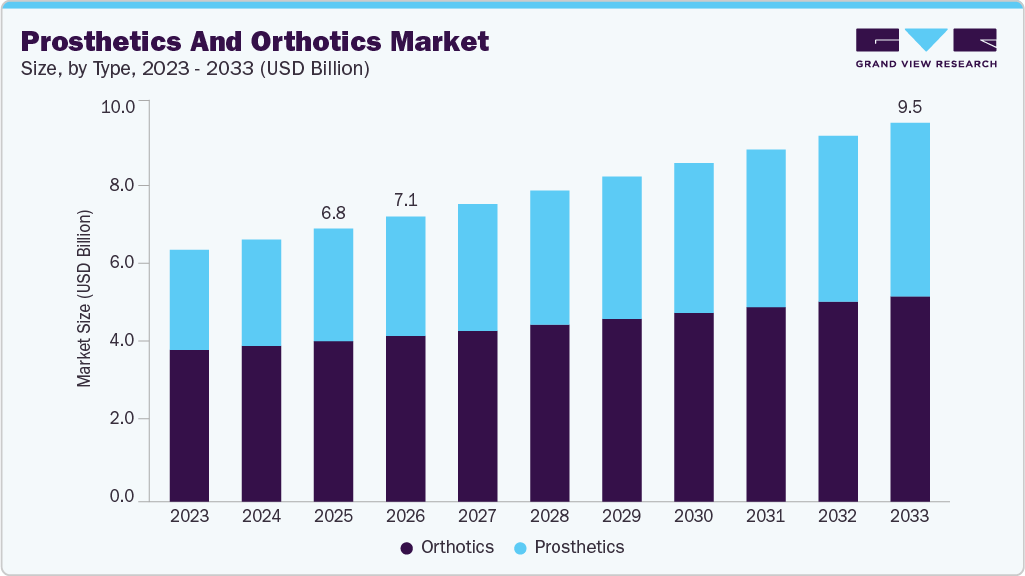 To learn more about this report, Download Free Sample Report
 The section below outlines the key drivers of the prosthetics and orthotics industry, reflecting the growing demand for mobility-assistance devices, rehabilitation solutions, and technologically advanced prosthetic and orthotic systems across healthcare settings.
Rising Incidence of Road Accidents Driving Demand for Rehabilitation Solutions
The rising incidence of road accidents is driving market growth. According to the World Health Organization, around 20 to 50 million people sustain non-fatal injuries from road traffic accidents every year, many of which result in long-term disabilities requiring rehabilitation support. Similarly, according to the Ministry of Road Transport and Highways, approximately 487,705 road accidents were reported in India in 2024. Such incidents frequently lead to fractures, ligament injuries, limb trauma, and mobility impairments, increasing the demand for rehabilitation therapies and mobility-assistance devices. As a result, the adoption of prosthetic limbs, orthopedic braces, and orthotic support solutions is expected to increase over the forecast period.
 To learn more about this report, Download Free Sample Report
 Increasing Diabetes-Related Amputations Supporting Market Expansion
The rise in diabetes-related amputations is fueling market growth. Individuals living with diabetes are at a higher risk of developing foot complications due to nerve damage, which can lead to chronic ulcers and amputation. Diabetes-related foot complications are among the most common and severe complications affecting diabetic patients globally. Several studies indicate that the risk of amputation can be significantly higher among diabetic patients compared to non-diabetic individuals. For instance, according to the American Diabetes Association, approximately 160,000 people with diabetes undergo amputations annually in the U.S., and diabetes complications account for nearly 80% of non-traumatic lower-limb amputations.
Technological Advancements in Prosthetics And Orthotics Accelerating Market Growth
Technological advancements in prosthetics and orthotics are expected to support market growth over the forecast period through the introduction of lightweight, sensor-enabled, and highly customized mobility solutions. The increasing adoption of advanced materials, microprocessor-controlled systems, and 3D printing technologies is improving patient comfort, mobility, and functional performance. For instance, in March 2026, researchers from Chalmers University of Technology and ETH Zurich developed an implantable neurotechnology system capable of decoding leg movement intentions directly from peripheral nerve signals in above-knee amputees. In addition, in February 2024, NIPPON EXPRESS HOLDINGS, INC. announced an investment in Instalimb, Inc. to support the international expansion of its 3D-printed prosthetics business across countries, including India and the Philippines. These strategic investments are aiding in increased accessibility to personalized prosthetic care and enabling faster, more affordable device production, particularly in emerging economies with growing rehabilitation needs.
Rising Adoption of 3D Printing and Personalized Prosthetics
The increasing use of 3D-printing technology is accelerating innovation in the prosthetics and orthotics industry. Customized prosthetic limbs and orthotic devices manufactured through additive manufacturing technologies enable faster production, reduced costs, improved fitting accuracy, and enhanced patient comfort. Several companies and research institutions are investing in personalized prosthetic manufacturing solutions to improve accessibility in emerging economies and underserved regions. The technology is particularly beneficial for pediatric patients and amputees requiring highly customized and lightweight mobility devices.
Expansion of Rehabilitation Centers and Healthcare Infrastructure
The expansion of rehabilitation facilities, trauma care centers, and specialized orthopedic clinics is supporting market growth globally. Governments and healthcare organizations are increasing investments in rehabilitation infrastructure to address the growing burden of disability, trauma injuries, and chronic musculoskeletal disorders. Improved access to rehabilitation services and assistive technologies is encouraging the adoption of prosthetic and orthotic products across both developed and emerging markets.
Increasing Awareness and Favorable Reimbursement Policies
Growing awareness regarding mobility rehabilitation and supportive reimbursement policies are contributing to higher adoption of prosthetic and orthotic devices. Several countries are expanding insurance coverage and reimbursement support for mobility-assistance technologies, rehabilitation procedures, and advanced prosthetic systems. In addition, nonprofit organizations and government healthcare programs are increasing initiatives aimed at improving accessibility to prosthetic care for patients with physical disabilities and limb loss.
Advancements in Bionic and Sensor-Integrated Prosthetics
Rapid advancements in bionic prosthetics, AI-enabled mobility systems, and sensor-integrated devices are enhancing patient outcomes and expanding the functional capabilities of prosthetic limbs. Modern prosthetic systems increasingly incorporate myoelectric sensors, microprocessors, robotic joint mechanisms, and AI-assisted motion control technologies to improve balance, mobility, and movement precision. These innovations are supporting the adoption of technologically advanced prosthetic solutions among both healthcare providers and patients seeking improved mobility and quality of life.
Market Concentration & Characteristics
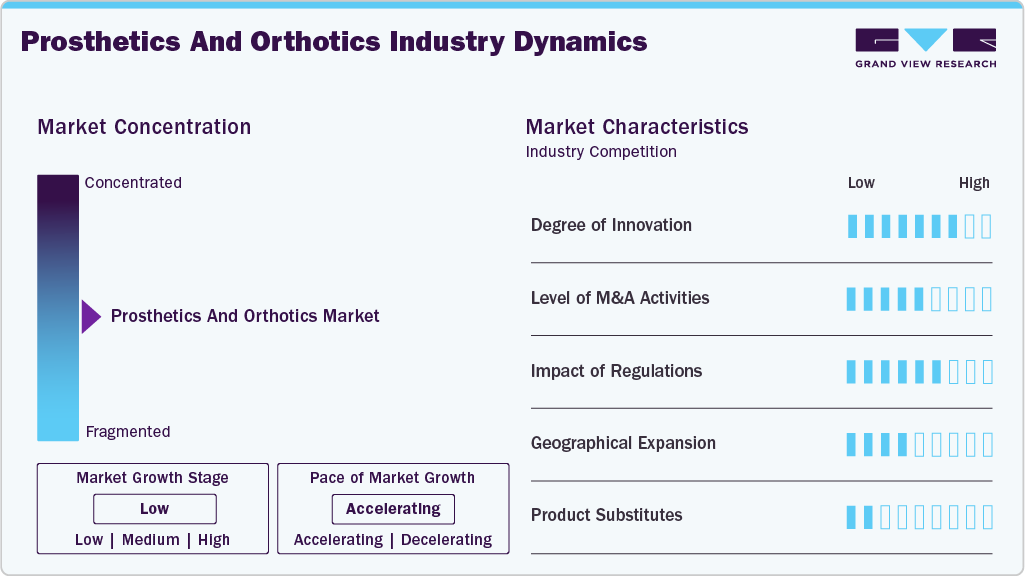
The prosthetics and orthotics industry is characterized by a high degree of innovation due to continuous advancements in smart mobility technologies, sensor integration, and personalized device manufacturing. For instance, in July 2024, researchers at the Massachusetts Institute of Technology (MIT) developed a neuroprosthetic interface that enables amputees to control prosthetic limbs using signals from the body’s nervous system, thereby supporting more natural movement and improved walking performance. Such continuous research advancements highlight the strong pace of innovation in the market and are expected to intensify technological competition among industry participants over the forecast period.
The prosthetics and orthotics industry is characterized by a medium level of merger and acquisition (M&A) activity among leading players, driven by the need to expand technological capabilities, strengthen product portfolios, and enhance global market presence. For instance, in January 2024, Össur acquired FIOR & GENTZ, a Germany-based provider of lower limb neuro-orthotic solutions. The acquisition enabled Össur to expand into the neuro-orthotics segment and strengthen its offerings for patients with neurological mobility impairments. Such strategic acquisitions are enabling companies to broaden their rehabilitation solutions portfolio and strengthen their competitive positioning in the rapidly evolving prosthetics and orthotics industry.
 To learn more about this report, Download Free Sample Report
 The prosthetics and orthotics industry is supported by favorable regulatory frameworks focused on improving accessibility to assistive mobility solutions and rehabilitation care. According to the World Health Organization (WHO), countries adopting the Convention on the Rights of Persons with Disabilities (CRPD) are required to promote access to mobility aids and assistive technologies, including prosthetic and orthotic devices. In addition, the U.S. Food and Drug Administration (FDA) continues to regulate prosthetic and orthotic products under medical device standards to ensure product safety and quality. Such regulatory support is encouraging the adoption of advanced prosthetic and orthotic solutions globally.
Several market players are adopting this strategy to expand their product portfolio and market their products in different regions. For instance, in January 2023, WillowWood Global LLC, a manufacturer and distributor of prosthetic products, partnered with Reboocon Bionics B.V., a manufacturer of motorized prosthetic knees. This partnership focused on the distribution of products in the U.S. market and R&D collaboration to advance prosthetics technology.
The prosthetics and orthotics industry faces a low-to-moderate threat from substitutes, as these devices play a critical role in restoring mobility, physical function, and patient independence following limb loss or musculoskeletal disorders. Although alternatives such as wheelchairs, mobility scooters, walkers, and physical rehabilitation therapies are available, they cannot fully replicate the functional benefits and movement support offered by advanced prosthetic and orthotic solutions. Continuous technological advancements in microprocessor-controlled prosthetics, lightweight materials, and customized orthotic devices are further strengthening product adoption and limiting the impact of substitute solutions.
Type Insights
The orthotics segment accounted for the largest revenue share of 58.8% in 2025. The growth of this segment is attributed to the rising prevalence of osteoarthritis, increasing incidence of sports injuries, and growing penetration of orthopedic technology. According to the Institute for Health Metrics and Evaluation (IHME) and a study published in The Lancet Rheumatology in September 2023, nearly 15% of individuals aged 30 years and above are affected by osteoarthritis globally, and the number of cases is projected to reach approximately 1 billion by 2050. The orthotics segment is further categorized into upper limb, lower limb, and spinal orthotics. Among these, upper limb orthotics accounted for the largest share due to their ability to reduce pain, improve joint stability, and support faster recovery and mobility restoration.
The prosthetics segment is expected to register the fastest CAGR during the forecast period due to the rising global prevalence of disabilities, increasing cases of limb amputations, and growing adoption of technologically advanced prosthetic devices. According to the World Health Organization (WHO), approximately 1.3 billion individuals, or nearly 16% of the global population, experience significant disabilities globally. In addition, advancements in AI-enabled prosthetics, sensor-integrated systems, and robotic limb technologies are improving patient mobility and comfort. For instance, in October 2024, researchers from the Italian Institute of Technology (IIT) introduced Omnia, a motorized lower-limb prosthetic prototype designed to improve walking stability and movement efficiency for transfemoral amputees. Such advancements are expected to accelerate the adoption of advanced prosthetic devices during the forecast period.
Regional Insights
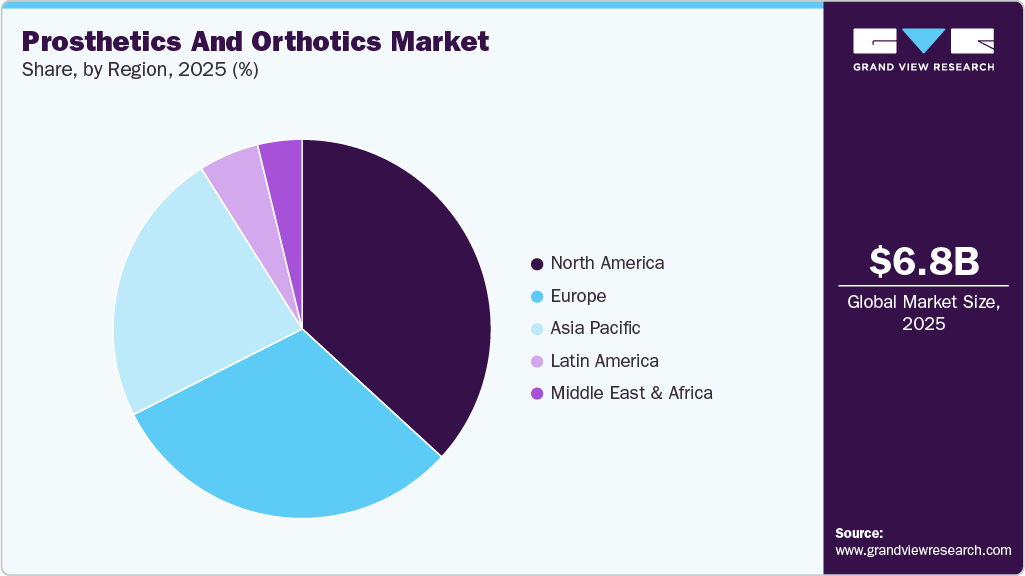
North America prosthetics and orthotics industry dominated the global market with a revenue share of 36.8% in 2025. This growth can be attributed to well-established healthcare infrastructure, increasing R&D investments by companies, and favorable reimbursement policies. The rising prevalence of osteosarcoma and increasing incidence of sports injuries are expected to drive market growth. Moreover, the focus of the U.S. healthcare system on the quality of care and value-based services has led to a favorable market environment for prosthetics & orthotics. For instance, in August 2023, LIMBER Prosthetics & Orthotics, Inc., a San Diego startup company, received an investment of USD 388 thousand to develop its prosthetics & orthotics products.
U.S. Prosthetics And Orthotics Market Trends
The prosthetics and orthotics industry in the U.S. held the largest share in the region in 2025. Growing government initiatives and the rising launch of educational programs in the country boost the market growth. For instance, in June 2024, East Tennessee State University launched its orthotics and prosthetics program to meet the rising demand for certified prosthetists and orthotists nationally. Furthermore, In February 2024, Hanger, Inc. launched Hanger Ventures, a subsidiary to invest in orthotic and prosthetic entrepreneurs and accelerate innovation. It provides resources from incubation to commercialization, enhancing global patient outcomes using Hanger's clinical expertise. Such initiatives are expected to strengthen rehabilitation infrastructure and support market growth in the U.S. during the forecast period.
 To learn more about this report, Download Free Sample Report
 Europe Prosthetics And Orthotics Market Trends
Europe prosthetics and orthotics industry is anticipated to register a steady growth rate during the forecast period. The region's strong focus on research and development fosters continuous innovation in prosthetics and orthotics technologies, enhancing product efficacy and patient outcomes. Furthermore, robust regulatory frameworks and favorable healthcare policies ensure the quality and safety of prosthetics and orthotics, thereby increasing their market growth.
Germany prosthetics and orthotics industry is anticipated to register a considerable growth rate during the forecast period. Rising road accident cases in the country contribute to increased demand for prosthetics and orthotics. According to the Federal Statistical Office of Germany (Destatis), around 366,600 people were injured in road accidents in Germany in 2023. In addition, preliminary Destatis data indicated that approximately 365,000 people were injured in road accidents in 2024. The growing number of accident-related injuries is increasing the demand for prosthetic and orthotic devices for mobility restoration and rehabilitation support.
The UK prosthetics and orthotics industry is anticipated to grow over the forecast period, owing to a rise in research and development activities. For instance, in October 2024, the University of the West of England (UWE) Bristol developed a technologically advanced prosthetic leg for individuals with above-knee amputations. In addition, the growing focus on AI-enabled prosthetics, lightweight materials, and personalized mobility solutions is supporting innovation and product adoption across the UK rehabilitation sector.
Asia Pacific Prosthetics And Orthotics Market Trends
The Asia Pacific prosthetics and orthotics industry is anticipated to record the fastest growth over the forecast period owing to a high number of sports-related injuries and road accidents. The rapidly developing healthcare infrastructure in major countries, such as India, China, & Japan, and the booming medical tourism industry are propelling demand for these devices in the region.
The prosthetics and orthotics industry in Australia is anticipated to witness growth over the coming years with an increasing number of diabetes-related amputations, rise in the number of road accidents, growing funds, and supportive government initiatives. For instance, the Australian government continues to implement reforms under the Prescribed List (formerly Prostheses List) framework to improve patient access, affordability, and reimbursement transparency for prosthetic devices and medical technologies. In July 2025, the government updated the Prescribed List of Medical Devices and Human Tissue Products under the Private Health Insurance framework to strengthen access to approved medical devices for insured patients. Such initiatives are expected to improve accessibility to prosthetic and orthotic solutions across Australia.
Latin America Prosthetics And Orthotics Market Trends
Latin America prosthetics and orthotics industry is witnessing steady growth due to increasing awareness regarding the availability and benefits of prosthetics and orthotics for patients and healthcare professionals. The rise in diabetic foot amputation cases in this region is further contributing to market growth. Improving healthcare infrastructure and increasing access to rehabilitation services across countries such as Brazil and Argentina are supporting the adoption of advanced prosthetic and orthotic solutions. Furthermore, growing investments in assistive healthcare technologies and rising awareness initiatives by healthcare organizations are expected to create favorable growth opportunities for the market in the region.
Brazil prosthetics and orthotics industry is anticipated to register a considerable growth rate during the forecast period. The country's increasing focus on sports and physical activity is fueling market growth. Moreover, the key market players are developing lightweight, technologically advanced, and long-lasting prosthetics to meet users' needs.
Middle East and Africa Prosthetics And Orthotics Market Trends
The Middle East and Africa prosthetics and orthotics industry is expected to record growth over the coming years. Substantial economic development in the region is one of the major factors attracting international investments. The presence of major players in this industry and the constantly developing technologies are further boosting market growth.
South Africa prosthetics and orthotics industry is anticipated to register growth during the forecast period. The use of biosensor technology, better materials, non-invasive methods, and other tools are critical factors aiding the rapidly evolving field of prosthetics and orthotics. Advanced technologies are still being developed and tested and are expected to play a key role in revolutionizing the market in South Africa.
Key Prosthetics And Orthotics Company Insights
Key participants in the prosthetics and orthotics industry are focusing on developing innovative business growth strategies in the form of product portfolio expansions, partnerships & collaborations, mergers & acquisitions, and business footprint expansions.
Key Prosthetics And Orthotics Companies:
The following key companies have been profiled for this study on the prosthetics and orthotics market.
- Össur
- Blatchford Limited
- Fillauer LLC
- Ottobock
- WillowWood Global LLC
- Ultraflex Systems
- Steeper Group
- Bauerfeind
- Aether Biomedical
- Mobius Bionics
Recent Developments
-
In March 2026, Ottobock announced a strategic partnership with Blue Arbor Technologies and invested USD 5 million to advance neuromuscular interface technologies for next-generation prosthetic control systems. The collaboration focuses on improving prosthetic responsiveness and enhancing mobility outcomes for amputees.
-
In April 2025, Össur collaborated with BASF to develop the Pro-Flex Terra prosthetic foot featuring advanced Cellasto foam technology for improved flexibility and impact strength. The product is designed to provide enhanced comfort, energy return, and durability during everyday movement activities.
-
In April 2025, Ottobock invested in Phantom Neuro to support the commercialization of neurotechnology-enabled prosthetic control systems. The investment aims to accelerate the development of intuitive prosthetic devices.
Prosthetics And Orthotics Market Report Scope
Report Attribute
Details
Market size in 2025
USD 6.8 billion
Estimated market size in 2026
USD 7.1 billion
Projected market size by 2033
USD 9.5 billion
Growth rate
CAGR of 4.2% from 2026 to 2033
Actual data
2021 - 2025
Forecast data
2026 - 2033
Quantitative units
Revenue in USD million/billion and CAGR from 2026 to 2033
Report coverage
Revenue forecast, company ranking, competitive landscape, growth factors, and trends
Segments covered
Type and region
Regional scope
North America; Europe; Asia Pacific; Latin America; Middle East and Africa
Country scope
U.S.; Canada; Mexico; Germany; UK; Spain; Italy; France; Norway; Denmark; Sweden; Japan; China; India; Australia; Thailand; South Korea; Brazil; Argentina; South Africa; Saudi Arabia; UAE; Kuwait
Key companies profiled
Össur; Blatchford Limited; Fillauer LLC; Ottobock; WillowWood Global LLC; Ultraflex Systems; Steeper Group; Bauerfeind; Aether Biomedical; Mobius Bionics.
Customization scope
Free report customization (equivalent up to 8 analyst working days) with purchase. Addition or alteration to country, regional & segment scope.
Pricing and purchase options
Avail customized purchase options to meet your exact research needs. Explore purchase options
Global Prosthetics And Orthotics Market Report Segmentation
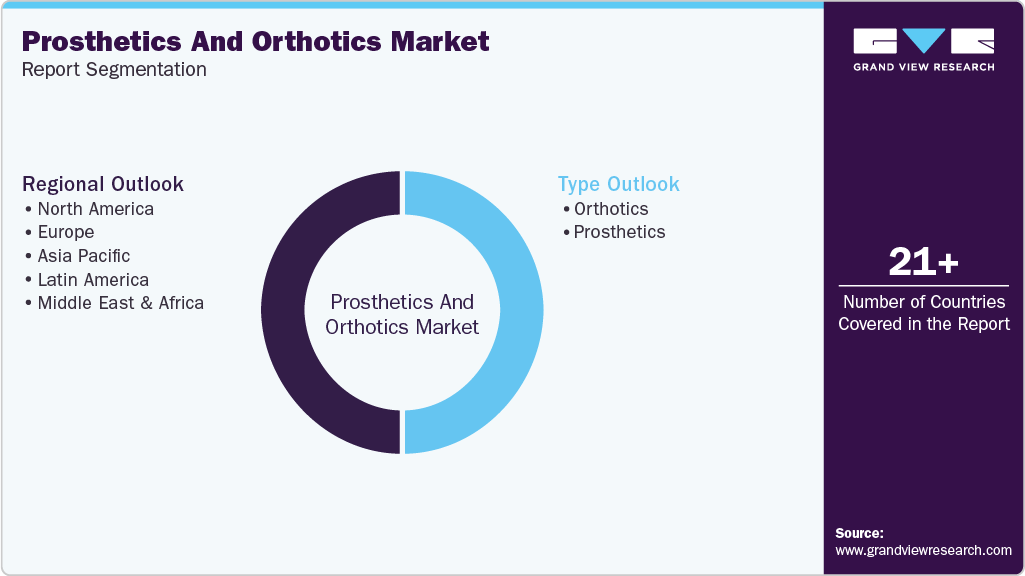
This report forecasts revenue growth at global, regional, and country levels and provides an analysis of the latest industry trends in each of the sub-segments from 2021 to 2033. For this study, Grand View Research has segmented the global prosthetics and orthotics market report based on type and region:
 To learn more about this report, Download Free Sample Report
 -
Type Outlook (Revenue, USD Billion, 2021 - 2033)
-
Orthotics
-
Upper limb Orthotics
-
Lower limb Orthotics
-
Spinal Orthotics
-
-
Prosthetics
-
Upper Extremity Prosthetics
-
Lower Extremity Prosthetics
-
Liners
-
Sockets
-
Modular Components
-
-
-
Regional Outlook (Revenue, USD Billion, 2021 - 2033)
-
North America
-
U.S.
-
Canada
-
Mexico
-
-
Europe
-
Germany
-
UK
-
France
-
Italy
-
Spain
-
Denmark
-
Norway
-
Sweden
-
-
Asia Pacific
-
China
-
Japan
-
India
-
South Korea
-
Australia
-
Thailand
-
-
Latin America
-
Brazil
-
Argentina
-
-
Middle East and Africa (MEA)
-
UAE
-
South Africa
-
Saudi Arabia
-
Kuwait
-
-
Frequently Asked Questions About This Report
Key players include Össur; Blatchford Limited; Fillauer LLC; Ottobock; WillowWood Global LLC; Ultraflex Systems; Steeper Group; Bauerfeind; Aether Biomedical; Mobius Bionics.
Key factors that are driving the prosthetics & orthotics market growth include the increased incidences of sports injuries and the increasing prevalence of osteosarcoma across the globe.
Asia Pacific is the fastest-growing region over the forecast period.
The global prosthetics and orthotics market size was valued at USD 6.8 billion in 2025 and is estimated at USD 7.1 billion for 2026.
The global prosthetics and orthotics market is expected to grow at a CAGR of 4.2% from 2026 to 2033, reaching USD 9.5 billion by 2033.
The orthotics segment held the dominant revenue share of 58.8% in the global prosthetics and orthotics market in 2025. This is attributed to the increased incidence of road accidents and the technological advancement in orthotics & prosthetics.
North America led the global market for prosthetics and orthotics with a revenue share of 36.8% in 2025.
About the Author(s)
Medical Devices Research Team
Healthcare · Medical DevicesThis report was authored by the medical devices research team at Grand View Research - comprising two research analysts, one senior research analyst, and one industry expert - with specialized expertise in the medical devices segment of the healthcare industry. All findings are based on proprietary healthcare databases, executive interviews, and regulatory analysis, subject to internal peer review prior to publication.
Last Updated:
Speak to Analyst

Customize this report to your needs - add regions, segments, or data points, with 20% free customization.
Or view our licence options:


ISO 9001:2015 & 27001:2022 Certified
We are GDPR and CCPA compliant! Your transaction & personal information is safe and secure. For more details, please read our privacy policy.


