
- Home
- »
- Next Generation Technologies
- »
-
Quantum Navigation Systems Market Size Report 2026-2033GVR Report cover
![Quantum Navigation Systems Market Size, Share & Trends Report]()
Quantum Navigation Systems Market (2026 - 2033) Size, Share & Trends Analysis Report By Component (Quantum Sensors, Supporting Hardware), By Application, By Technology, By Platform (Airborne, Naval), By End Use, By Region, And Segment Forecasts
Market Size, 2025
$1.3BMarket Estimate, 2026
$1.6BMarket Forecast, 2033
$8.0BCAGR, 2026–2033
25.4%Quantum Navigation Systems Market Summary
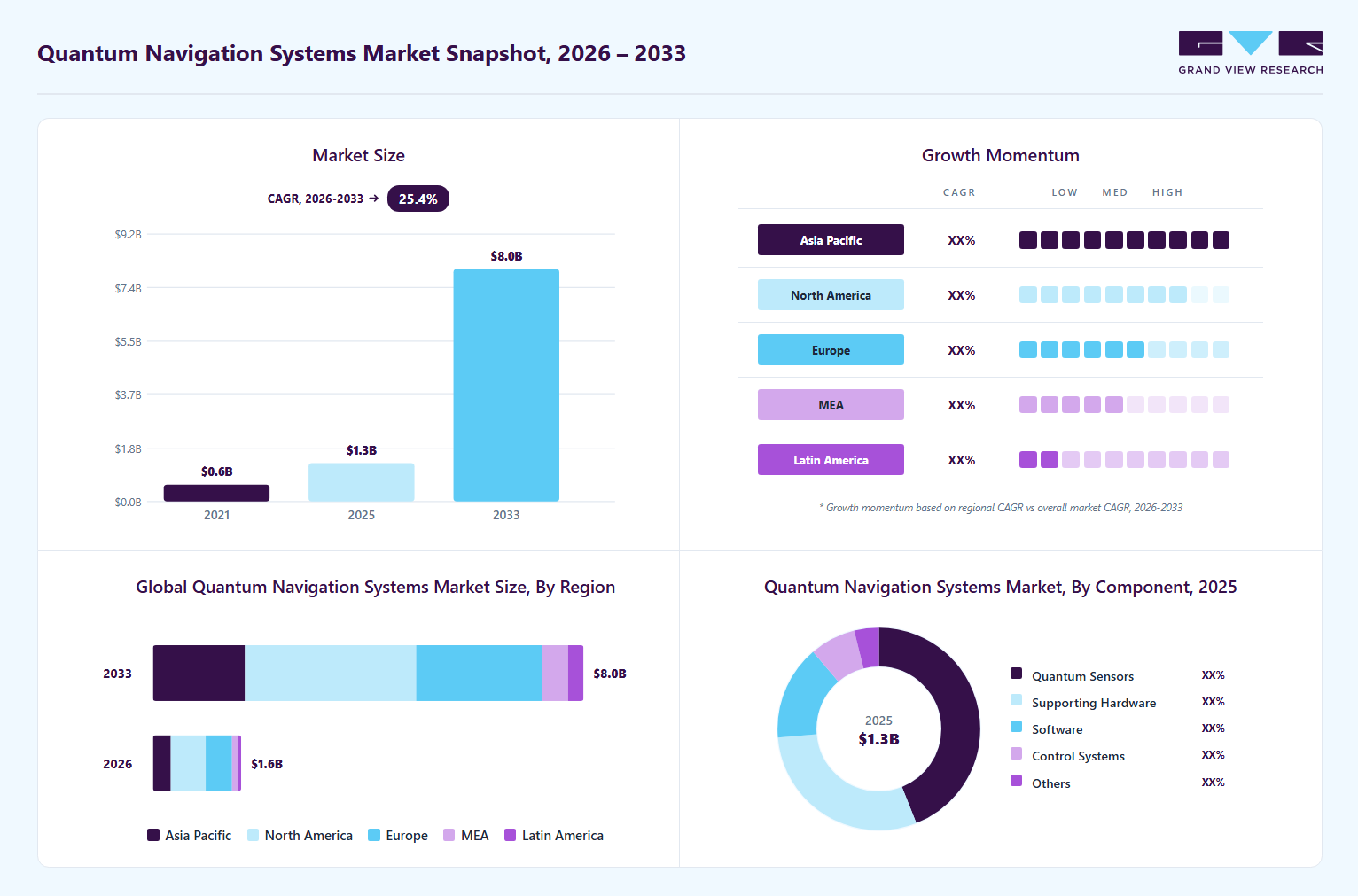
The global quantum navigation systems market size was valued at USD 1.33 billion in 2025, and is projected to grow from USD 1.64 billion in 2026 to USD 8.0 billion by 2033, at a CAGR of 25.4% from 2026 to 2033. North America is expected to hold a significant share of the global quantum navigation systems industry, with a revenue share of 39.5% by 2025. The quantum navigation systems industry is experiencing robust growth, driven by the increasing demand for highly accurate and resilient positioning, navigation, and timing (PNT) solutions that can operate effectively in GPS-denied and contested environments.
Key Market Trends & Insights
- The quantum navigation systems industry in the U.S. led the North American market and held the largest revenue share in 2025.
- By component, the quantum sensors segment led the market and held the largest revenue share of over 43.9% in 2025.
- By application, the aerospace & defense segment led the market and held the largest revenue share of over 39.6% in 2025.
- By technology, the cold atom Interferometry segment is expected to grow at the fastest CAGR of over 25.8% from 2026 to 2033.
Market Size & Forecast
- 2025 Market Size: USD 1.3 Billion
- 2026 Market Size: USD 1.64 Billion
- 2033 Projected Market Size: USD 8.0 Billion
- CAGR (2026-2033): 25.4%
- North America: Largest Market in 2025
- Asia-Pacific: Fastest growing market
Three ways to get this report
Buy it, customize it, or ask a question.Get the Full Report
What the study covers
- FormatsPDF · Excel · Dashboard
- Timeline2026–2033 annual, 2025 base
- Coverage20+ countries, 5 regions
- Companies10+ key players profiled
Customize the Report
20% free customization
- IncludeCountries, segments, points
- TailorTo your product definition
- ExtendDeeper competitor detail
- OrA fully bespoke study
- Turnaround5–10 working days
Ask Prism AI
A cited answer in seconds
- Corpus30K studies, 1.2M points
- ScopeAll markets, not just this
- CitationTraced to report & table
- HonestySays "not covered" if so
- SpeedSeconds, not days
As defense organizations, aerospace companies, space agencies, and autonomous system developers invest in next-generation navigation technologies, quantum navigation systems are becoming critical for delivering ultra-precise inertial sensing, atomic clock synchronization, and real-time positioning capabilities. The demand for quantum navigation systems is increasing as defense organizations, aerospace companies, space agencies, research institutions, and government bodies seek highly accurate and resilient positioning, navigation, and timing (PNT) solutions for operations in GPS-denied and contested environments. Many organizations are increasingly adopting advanced quantum technologies such as cold atom interferometry, quantum accelerometers, quantum gyroscopes, gravimeters, magnetometers, and optical atomic clocks to enable precise inertial navigation, real-time positioning, and long-duration autonomous operation without dependence on satellite-based navigation signals. Additionally, the growing focus on assured navigation for military aircraft, submarines, naval vessels, spacecraft, unmanned aerial vehicles (UAVs), autonomous underwater vehicles (AUVs), and autonomous ground systems is driving the need for highly reliable and interference-resistant navigation platforms.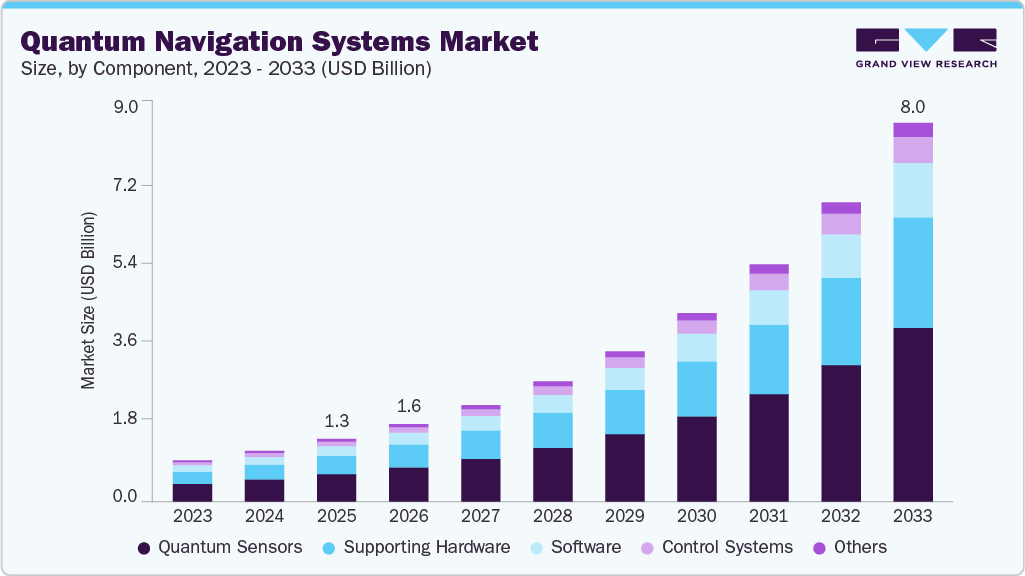
Defense organizations, aerospace companies, space agencies, research institutions, and government organizations are increasingly prioritizing resilient positioning, navigation, and timing (PNT) capabilities, advanced inertial sensing, and GPS-independent navigation, which is driving the adoption of quantum navigation systems across global markets. These systems enable organizations to maintain highly accurate positioning and navigation in contested and GPS-denied environments, support long-duration autonomous operations, and execute mission-critical aerospace, maritime, and defense applications with exceptional precision, stability, and reliability.
Market Dynamics
Quantum navigation systems are advanced positioning, navigation, and timing (PNT) solutions that integrate quantum accelerometers, quantum gyroscopes, cold atom interferometers, and optical atomic clocks to deliver highly accurate navigation without relying on satellite-based GPS signals. The increasing threat of GPS jamming and spoofing, along with the growing need for assured navigation in contested environments, is significantly boosting demand for these systems. Military aircraft, submarines, naval vessels, spacecraft, and autonomous platforms require precise and resilient navigation capabilities to maintain mission effectiveness during long-duration operations where conventional navigation systems may be degraded or unavailable.
As defense organizations, aerospace companies, and government agencies intensify investments in next-generation quantum technologies, quantum navigation systems are becoming critical for improving operational accuracy, enhancing mission security, and reducing dependence on vulnerable satellite infrastructure. These systems combine advanced quantum sensors, signal processing electronics, and navigation software to provide exceptional precision, long-term stability, and reliable performance across highly demanding defense and aerospace applications.
Despite their strategic advantages, quantum navigation systems require substantial research and development investments and involve significant engineering complexity, which can limit near-term commercialization. Developing cold atom interferometers, optical atomic clocks, laser systems, vacuum chambers, and precision control electronics requires specialized materials, advanced manufacturing capabilities, and highly skilled scientific personnel. In addition, integrating these components into compact, rugged, and field-deployable systems remains a major technical challenge.
Quantum navigation platforms also require extensive testing, calibration, and certification to meet stringent military and aerospace performance standards. High costs associated with prototyping, environmental hardening, and low-volume production can constrain adoption, particularly in commercial markets. Furthermore, ongoing challenges related to miniaturization, power consumption, and system robustness may extend deployment timelines and increase overall implementation costs.
Governments worldwide are significantly increasing investments in quantum technologies to strengthen national security, technological sovereignty, and strategic defense capabilities. These initiatives are creating substantial opportunities for quantum navigation system providers as countries seek to develop indigenous GPS-independent navigation solutions for military aircraft, submarines, space missions, and autonomous defense platforms.
Furthermore, the growing emphasis on sovereign quantum ecosystems, defense modernization, and resilient PNT infrastructure is accelerating partnerships among government laboratories, defense contractors, and technology companies. Countries across U.S., UK, Germany, France, China, Japan, India, and Australia are funding national quantum programs and collaborating with leading companies such as BAE Systems, Lockheed Martin, Northrop Grumman, Q-CTRL to accelerate the development and deployment of advanced quantum navigation systems.
Market Concentration & Characteristics
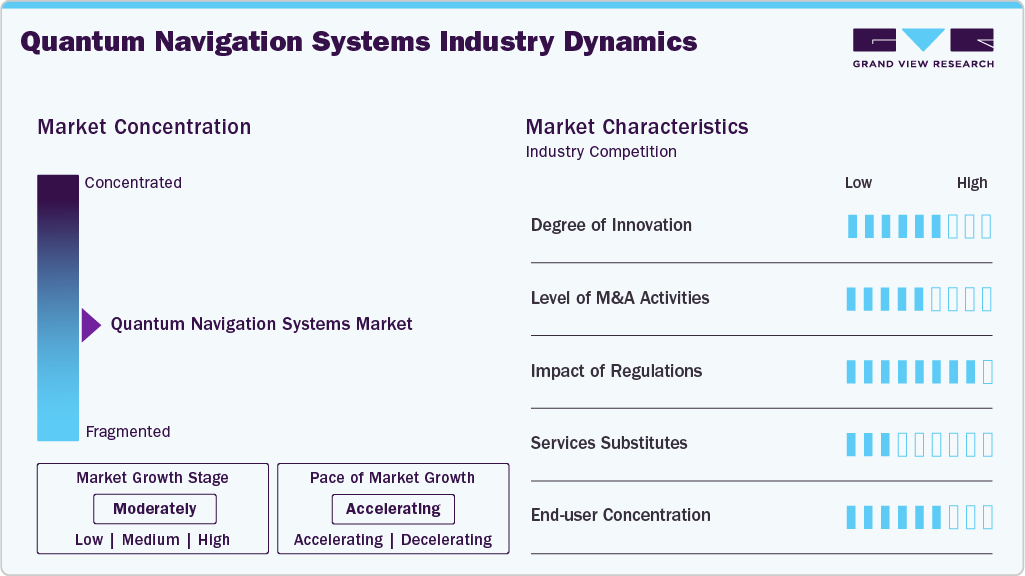
The quantum navigation systems industry is moderately concentrated, with competition led by a relatively small group of established aerospace and defense contractors, specialized quantum technology companies, and government-backed research organizations. The market remains in an early commercialization stage, and high barriers to entry including complex quantum sensor development, extensive testing requirements, and significant research and development investments limit the number of companies capable of delivering operational systems. Leading participants such as BAE Systems, Lockheed Martin, Northrop Grumman, Q-CTRL, and Vector Atomic leverage expertise in quantum sensing, inertial navigation, and defense integration to strengthen their market positions.
Component Insights
The quantum sensors segment dominated the market, accounting for over 43.0% of the global revenue share in 2025, driven by the critical role of quantum accelerometers, quantum gyroscopes, gravimeters, magnetometers, and optical atomic clocks in enabling precise positioning, navigation, and timing (PNT) in GPS-denied environments. These sensors form the core foundation of quantum navigation systems by measuring acceleration, rotation, gravity, and magnetic fields with exceptional accuracy and long-term stability. Their ability to provide highly reliable inertial data, resist signal jamming and spoofing, and support mission-critical applications across military aircraft, submarines, spacecraft, and autonomous platforms has made quantum sensors the largest and most essential component segment in the market.
The supporting hardware segment is also expected to witness significant growth during the forecast period, driven by the increasing demand for advanced laser systems, photonic components, vacuum chambers, signal processing electronics, power management units, and high-speed communication modules required to operate quantum navigation systems. These components play a critical role in stabilizing quantum sensors, processing measurement data, and ensuring reliable performance in harsh defense, aerospace, and maritime environments. As manufacturers focus on miniaturization, ruggedization, and improved energy efficiency, investment in supporting hardware is rising to enable the commercialization and large-scale deployment of compact, high-precision quantum navigation platforms across military, space, and autonomous applications.
Application Insights
The aerospace and defense segment dominated the market, accounting for over 39.0% of the global revenue share in 2025, driven by the growing need for highly accurate and resilient positioning, navigation, and timing (PNT) systems capable of operating in GPS-denied and contested environments. Quantum navigation systems are increasingly being adopted in military aircraft, submarines, naval vessels, spacecraft, missiles, and unmanned systems to ensure precise navigation, targeting, and mission continuity even in the presence of GPS jamming and spoofing. Significant investments by defense agencies and aerospace organizations in assured navigation technologies, quantum sensing, and next-generation inertial systems have made aerospace and defense the largest application segment in the market.
The submarine and underwater navigation segment is expected to witness significant growth during the forecast period, driven by the increasing need for highly accurate and GPS-independent navigation systems for submarines, autonomous underwater vehicles (AUVs), and other naval platforms operating deep beneath the ocean surface. Since satellite signals cannot penetrate underwater, these platforms rely heavily on inertial navigation technologies to maintain precise positioning over extended missions.
Technology Insights
The cold atom interferometry segment dominated the market in 2025, accounting for the largest share of global revenue over 49.0% market share, driven by its superior accuracy and stability in measuring acceleration, rotation, and gravitational changes. Cold atom interferometry utilizes laser-cooled atoms as highly sensitive reference masses to detect minute variations in motion and inertial forces based on quantum interference principles.
The SQUID-based sensors segment is expected to witness significant growth over the forecast period, driven by the increasing demand for ultra-sensitive magnetic field detection and high-precision inertial measurements in advanced navigation applications. Superconducting Quantum Interference Device (SQUID)-based sensors leverage quantum effects in superconducting loops to detect extremely small changes in magnetic fields, enabling accurate detection of position, orientation, and motion in environments where Global Navigation Satellite Systems (GNSS) are unavailable or unreliable.
Platform Insights
The airborne segment dominated the market, accounting for over 32.0% of the global revenue share in 2025, driven by the increasing demand for highly accurate and resilient navigation solutions in military aircraft, commercial aviation, unmanned aerial vehicles (UAVs), and advanced aerospace platforms. Quantum navigation systems deployed in airborne applications utilize quantum accelerometers, gyroscopes, and atomic clocks to provide precise positioning, navigation, and timing without dependence on Global Navigation Satellite Systems (GNSS). This capability is critical for aircraft operating in GPS-denied, jammed, or contested environments, where uninterrupted navigation accuracy is essential for mission success and flight safety.
The naval segment is expected to witness significant growth over the forecast period, driven by the increasing need for highly accurate and autonomous navigation solutions for submarines, warships, and unmanned underwater vehicles operating in environments where Global Navigation Satellite Systems (GNSS) signals are unavailable or severely degraded. Quantum navigation systems leverage quantum accelerometers, gyroscopes, and atomic clocks to provide precise positioning and timing over extended periods without requiring external signal updates.
End Use Insights
The military & defense organizations segment dominated the market, accounting for over 50.0% of the global revenue share in 2025, driven by the increasing need for highly secure, accurate, and resilient navigation solutions in mission-critical environments. Defense organizations are investing heavily in quantum navigation technologies to enable precise positioning, navigation, and timing without reliance on Global Navigation Satellite Systems (GNSS), which are vulnerable to jamming, spoofing, and signal disruption during military operations.
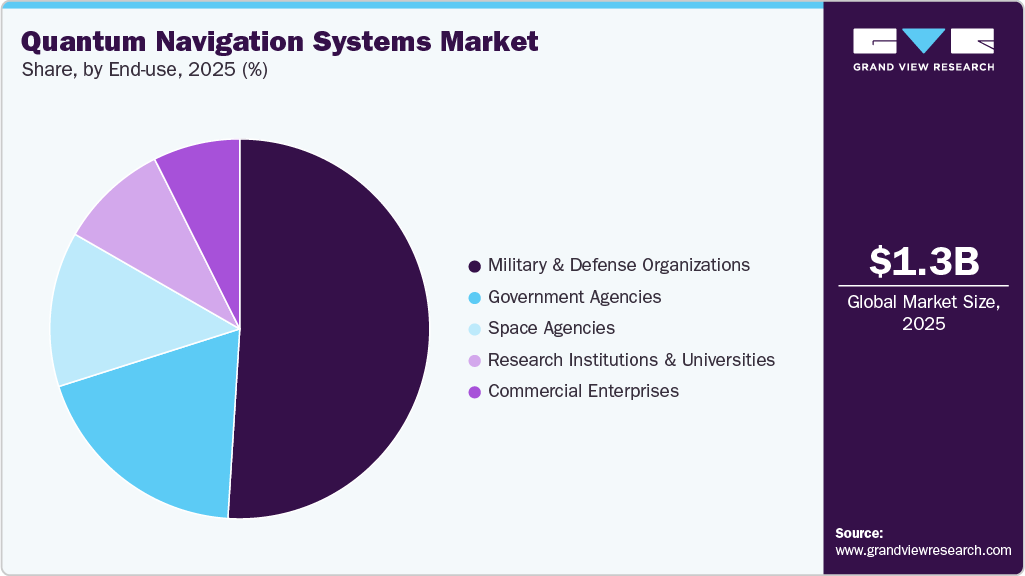
The Government Agencies segment is expected to witness a significant CAGR over the forecast period, driven by increasing investments in national security, space exploration, critical infrastructure, and advanced scientific research. Government agencies are adopting quantum navigation systems to support applications such as defense intelligence, border surveillance, geospatial mapping, disaster response, and satellite missions, where highly accurate and resilient positioning capabilities are essential.
Regional Insights
North America quantum navigation systems industry dominated the global market, accounting for over 39.5% of the global revenue share in 2025, driven by substantial investments in defense modernization, aerospace innovation, and quantum technology research across the region. The market benefits from the strong presence of leading defense contractors, quantum technology developers, research institutions, and government agencies actively advancing next-generation positioning, navigation, and timing solutions.

U.S. Quantum Navigation Systems Market Trends
The U.S. quantum navigation systems industry dominated the North America market due to the strong presence of leading defense contractors, aerospace companies, quantum technology developers, and government research organizations, along with substantial investments in advanced navigation technologies and quantum research and development. The country has a highly developed defense and aerospace ecosystem and is home to major military agencies, national laboratories, and research institutions actively developing quantum navigation systems for aircraft, submarines, spacecraft, and autonomous defense platforms.
Europe Quantum Navigation Systems Market Trends
Europe quantum navigation systems industry is witnessing significant growth due to increasing investments in quantum technology research, defense modernization programs, and advanced aerospace innovation across the region. Governments and research organizations in countries such as the UK, Germany, France, and the Netherlands are actively supporting the development of quantum sensors, atomic clocks, and inertial navigation technologies to strengthen strategic autonomy and reduce dependence on external navigation infrastructure. The growing focus on secure and resilient positioning, navigation, and timing systems for military aircraft, naval platforms, autonomous vehicles, and space missions is accelerating market adoption.
Asia Pacific Quantum Navigation Market Systems Trends
Asia Pacific quantum navigation systems industry is witnessing rapid growth due to increasing investments in defense modernization, space exploration programs, and emerging quantum technology research across major economies such as China, Japan, India, and South Korea. Governments in the region are actively focusing on developing advanced positioning, navigation, and timing technologies to strengthen military capabilities and reduce dependence on Global Navigation Satellite Systems (GNSS). The growing adoption of autonomous systems, unmanned vehicles, advanced naval platforms, and next-generation aerospace technologies is further driving demand for highly accurate and resilient quantum navigation solutions.
Key Quantum Navigation Systems Company Insights
The quantum navigation systems industry features several key players that significantly shape its global landscape through advanced quantum sensing technologies, inertial navigation systems, atomic clocks, and precision positioning solutions. Lockheed Martin is a prominent provider of advanced navigation and defense technologies, widely recognized for developing highly accurate inertial navigation systems and next-generation quantum sensing solutions for aerospace and military applications. The company’s strong presence in defense modernization, autonomous systems, and advanced aerospace technologies supports the deployment of resilient navigation systems capable of operating in GPS-denied or contested environments.
-
Honeywell International Inc. is a prominent player delivering advanced inertial navigation systems, quantum sensing technologies, and aerospace navigation solutions for defense, commercial aviation, and autonomous platforms. The company supports military organizations and aerospace manufacturers by enabling highly accurate positioning, navigation, and timing capabilities for mission-critical applications.
-
Northrop Grumman Corporation provides advanced navigation, guidance, and quantum sensing technologies for military aircraft, naval systems, missiles, and space applications. The company focuses on resilient navigation systems designed to operate effectively in GPS-denied and electronic warfare environments.
Key Quantum Navigation Systems Companies:
The following key companies have been profiled for this study on the quantum navigation systems market.
-
BAE Systems plc
-
RTX Corporation
-
Thales Group
-
Q-CTRL Pty Ltd
-
Vector Atomic Inc.
-
ColdQuanta, Inc. (Infleqtion)
-
Safran S.A.
Competitive Benchmarking
Operating Strategies
Competitive Edge
Weaknesses
Mature Players: BAE Systems Plc; RTX Corporation; Thales Group; Safran S.A.; Northrop Grumman Corporation; Honeywell International Inc.
- Focus on expanding advanced quantum navigation ecosystems through strategic partnerships spanning quantum sensing technologies, and autonomous navigation infrastructure.
- Invest heavily in research and development to deliver next-generation quantum sensors, atomic clocks, inertial navigation systems, superconducting technologies
- Strong global presence, established defense and aerospace customer base, and advanced expertise in quantum sensing and inertial navigation technologies support market leadership.
- Ability to deliver secure, high-precision, and end-to-end quantum navigation systems for military, aerospace, naval, and autonomous navigation applications operating in GPS-denied environments.
- Dependence on complex defense and aerospace supply chains and highly specialized components can slow adaptation to rapidly evolving quantum sensing and navigation technologies.
- Large operational structures and lengthy certification processes may reduce agility and extend product development and deployment timelines compared to emerging quantum technology companies.
Emerging Players: Q-CTRL Pty Ltd; Vector Atomic Inc.; ColdQuanta, Inc.
- Develop specialized and cost-effective quantum navigation solutions tailored to niche applications such as defense missions, autonomous vehicles, submarines, and aerospace systems requiring high-precision positioning capabilities.
- Focus on agility, customization, and rapid innovation to address evolving customer demands for resilient navigation technologies operating in GPS-denied and contested environments.
- Faster speed-to-market enables rapid adoption of emerging quantum sensing technologies, atomic clock innovations, and evolving navigation requirements.
- Strong focus on flexible and customer-centric solutions helps differentiate them in specialized quantum navigation applications such as autonomous systems, defense operations, aerospace missions, and underwater navigation.
- Limited financial resources and smaller market presence can restrict large-scale commercialization, research expansion, and deployment of advanced quantum navigation technologies.
- Lower brand recognition and customer trust compared to established global defense, aerospace, and navigation system providers may hinder large-term contract acquisition and market penetration.
Recent Development
-
In April 2026, Thales Group launched the TopStar Smart Receiver, reinforcing the company’s position in the quantum navigation systems industry through advanced resilient positioning, navigation, and timing technologies designed for electronic warfare environments. The ultra-compact solution integrates anti-jamming capabilities, multi-constellation GNSS support, and secure navigation functions to ensure reliable military operations in contested environments. This development highlights the growing demand for next-generation navigation systems capable of supporting land vehicles, drones, and defense platforms with enhanced resistance to spoofing, signal interference, and GPS disruption.
-
In January 2024, Honeywell International Inc. secured a U.S. government contract to develop advanced quantum navigation technologies, highlighting the company’s expanding presence in the quantum navigation systems industry. The contract emphasizes the growing demand for resilient positioning, navigation, and timing solutions capable of operating in GPS-denied and contested environments.
Quantum Navigation Systems Market Report Scope
Report Attribute
Details
Market size value in 2025
USD 1.3 billion
Market size value in 2026
USD 1.6 billion
Market size value in 2033
USD 8.0 billion
Growth rate
CAGR of 25.4% from 2026 to 2033
Actual data
2021 - 2025
Forecast period
2026 - 2033
Quantitative units
Revenue in USD billion and CAGR from 2026 to 2033
Report coverage
Revenue forecast, company ranking, competitive landscape, growth factors, and trends
Segments covered
Component, application, platform, technology, end use, region
Regional scope
North America; Europe; Asia Pacific; Latin America; MEA
Country scope
U.S.; Canada; Mexico; Germany; UK; France; China; India; Japan; Australia; South Korea; Brazil; UAE; South Africa; KSA
Key companies profiled
BAE Systems plc; RTX Corporation; Thales Group; Q-CTRL Pty Ltd; Vector Atomic Inc.; ColdQuanta, Inc. (Infleqtion); Safran S.A.; Northrop Grumman Corporation; Honeywell International, Inc..
Customization scope
Free report customization (equivalent up to 8 analysts working days) with purchase. Addition or alteration to country, regional & segment scope.
Pricing and purchase options
Avail customized purchase options to meet your exact research needs. Explore purchase options
Global Quantum Navigation Systems Market Report Segmentation
This report forecasts revenue growth at global, regional, and country levels and provides an analysis of the latest industry trends in each of the sub-segments from 2021 to 2033. For this study, Grand View Research has segmented the global quantum navigation systems market report based on component, application, platform, technology, end use, and region.
-
Component Outlook (Revenue, USD Billion, 2021 - 2033)
-
Quantum Sensors
-
Supporting Hardware
-
Software
-
Control Systems
-
Others
-
-
Application Outlook (Revenue, USD Billion, 2021 - 2033)
-
Aerospace & Defense
-
Submarine & Underwater Navigation
-
Autonomous Vehicles
-
Space Exploration
-
Industrial Positioning & Mapping
-
Infrastructure Monitoring
-
-
Technology Outlook (Revenue, USD Billion, 2021 - 2033)
-
Cold Atom Interferometry
-
Optical Atomic Clocks
-
Nitrogen-Vacancy (NV) Diamond Sensors
-
SQUID-Based Sensors
-
Hybrid Quantum Technologies
-
-
Platform Outlook (Revenue, USD Billion, 2021 - 2033)
-
Airborne
-
Naval
-
Land-Based
-
Space-Based
-
Portable/Handheld
-
-
End Use Outlook (Revenue, USD Billion, 2021 - 2033)
-
Military & Defense Organizations
-
Government Agencies
-
Space Agencies
-
Research Institutions & Universities
-
Commercial Enterprises
-
-
Regional Outlook (Revenue, USD Billion, 2021 - 2033)
-
North America
-
U.S.
-
Canada
-
Mexico
-
-
Europe
-
UK
-
Germany
-
France
-
-
Asia Pacific
-
China
-
Japan
-
India
-
Australia
-
South Korea
-
-
Latin America
-
Brazil
-
-
Middle East and Africa (MEA)
-
KSA
-
UAE
-
South Africa
-
-
Delivered Customizations
This report has been delivered with the following In-depth customizations
Client Request
Customization Delivered
Value Adds
North America Quantum Navigation Systems Opportunity Assessment for a Defense and Aerospace Technology Provider
Quantum navigation demand assessment across the U.S. and Canada
Benchmarking of defense, aerospace, naval, and government investments in quantum sensing and inertial navigation technologiesIdentified high-growth regional opportunities
Supported product and go-to-market strategy for quantum navigation solutionsCompetitive Benchmarking and Product Positioning Strategy for a Quantum Navigation Technology Company
Analysis of quantum sensors, atomic clocks, inertial navigation systems, superconducting technologies, and navigation software platforms
Evaluation of precision, reliability, scalability, and technology capabilitiesIdentified product and technology differentiation opportunities
Supported next-generation quantum navigation platform developmentFrequently Asked Questions About This Report
The global quantum navigation systems market size was estimated at USD 1.3 billion in 2025 and is expected to reach USD 1.6 billion in 2026
The global quantum navigation systems market is expected to grow at a compound annual growth rate of 25.4% from 2026 to 2033 to reach USD 8.0 billion by 2033.
North America dominated the quantum navigation systems market with a share of 39.5% in 2025. This dominance is attributed to substantial investments in defense modernization, aerospace innovation, and quantum technology research across the region.
Some key players operating in the quantum navigation systems market include BAE Systems plc, RTX Corporation, Thales Group, Q-CTRL Pty Ltd, Vector Atomic Inc., ColdQuanta, Inc. (Infleqtion), Safran S.A., Northrop Grumman Corporation, and Honeywell International Inc..
Key factors driving the growth of the quantum navigation systems market include increasing demand for GPS-denied navigation capabilities, rising investments in defense modernization programs, and rapid advancements in quantum sensing technologies.
About the Author(s)
Next Generation Technologies Research Team
Technology · Next Generation TechnologiesThis report was authored by the next generation technologies research team at Grand View Research - comprising two research analysts, one senior research analyst, and one industry expert - with specialized expertise in the next generation technologies segment of the technology industry. All findings are based on proprietary technology databases, executive interviews, and regulatory analysis, subject to internal peer review prior to publication.
Last Updated:
Speak to Analyst


Customize this report to your needs - add regions, segments, or data points, with 20% free customization.
Or view our licence options:


ISO 9001:2015 & 27001:2022 Certified
We are GDPR and CCPA compliant! Your transaction & personal information is safe and secure. For more details, please read our privacy policy.


