
- Home
- »
- Medical Devices
- »
-
Radiopharmaceutical CDMO Market Size Report, 2026-2033GVR Report cover

Radiopharmaceutical CDMO Market (2026 - 2033)
Size, Share & Trends Analysis Report By Service (Contract Development, Contract Manufacturing), By Product, By Radioisotopes, By Development Stage, By Application, By End Use, By Region, And Segment Forecasts
Market Size, 2025
$3.5BMarket Estimate, 2026
$3.8BMarket Forecast, 2033
$7.3BCAGR, 2026–2033
9.6%Radiopharmaceutical CDMO Market Summary
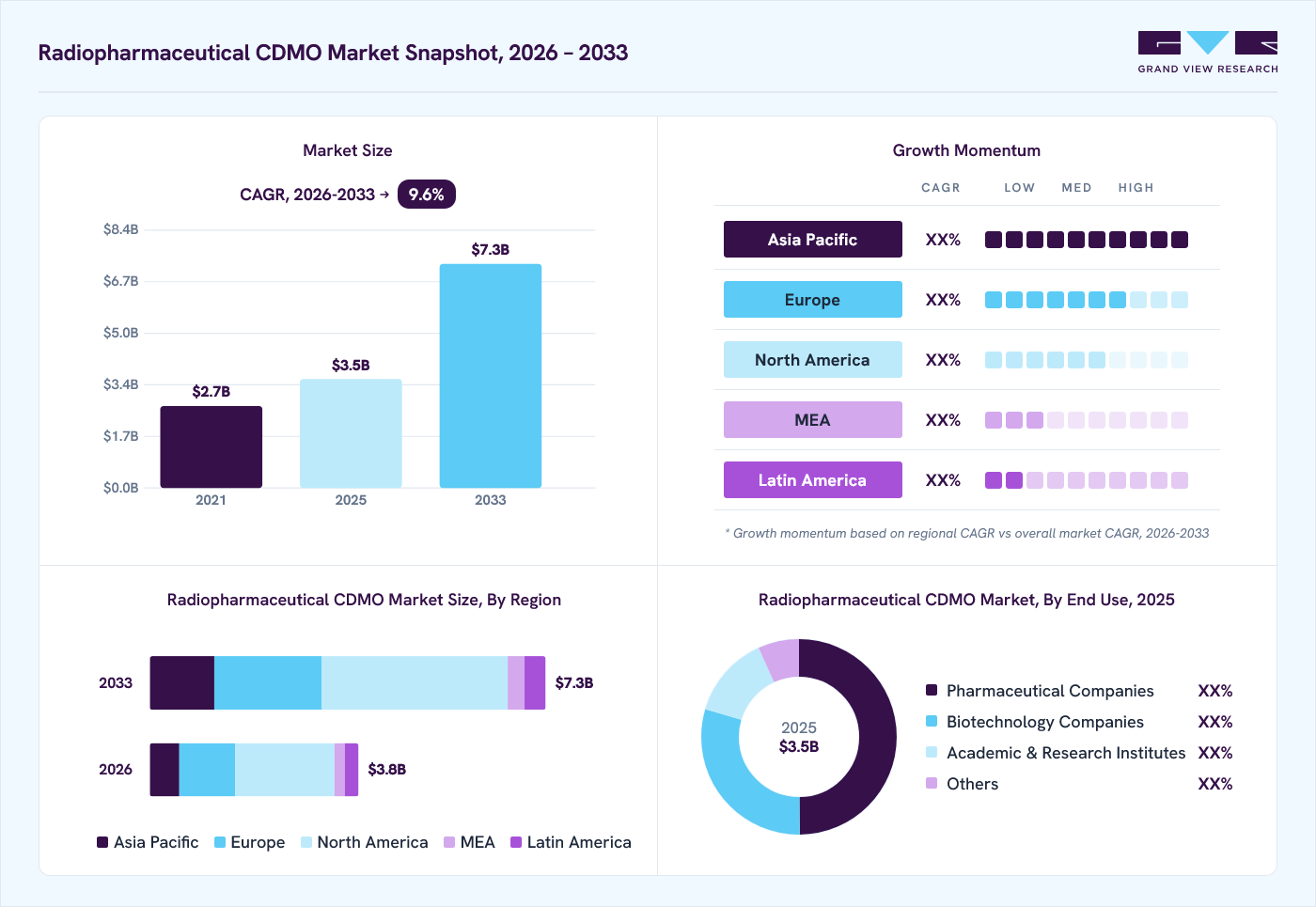
The global radiopharmaceutical CDMO market size was valued at USD 3.5 billion in 2025 and is projected to grow from USD 3.8 billion in 2026 to USD 7.3 billion by 2033, at a CAGR of 9.6% from 2026 to 2033. North America dominated the market, accounting for a revenue share of 47.1% in 2025. The radiopharmaceutical CDMO market is driven by advancing therapeutic pipelines, expanding clinical supply requirements, increasing commercialization activity, rising demand for specialized manufacturing infrastructure, and access to isotope-specific expertise. These factors are expected to drive the outsourcing across process development, radiolabeling, analytical characterization, aseptic production, and technology transfer.
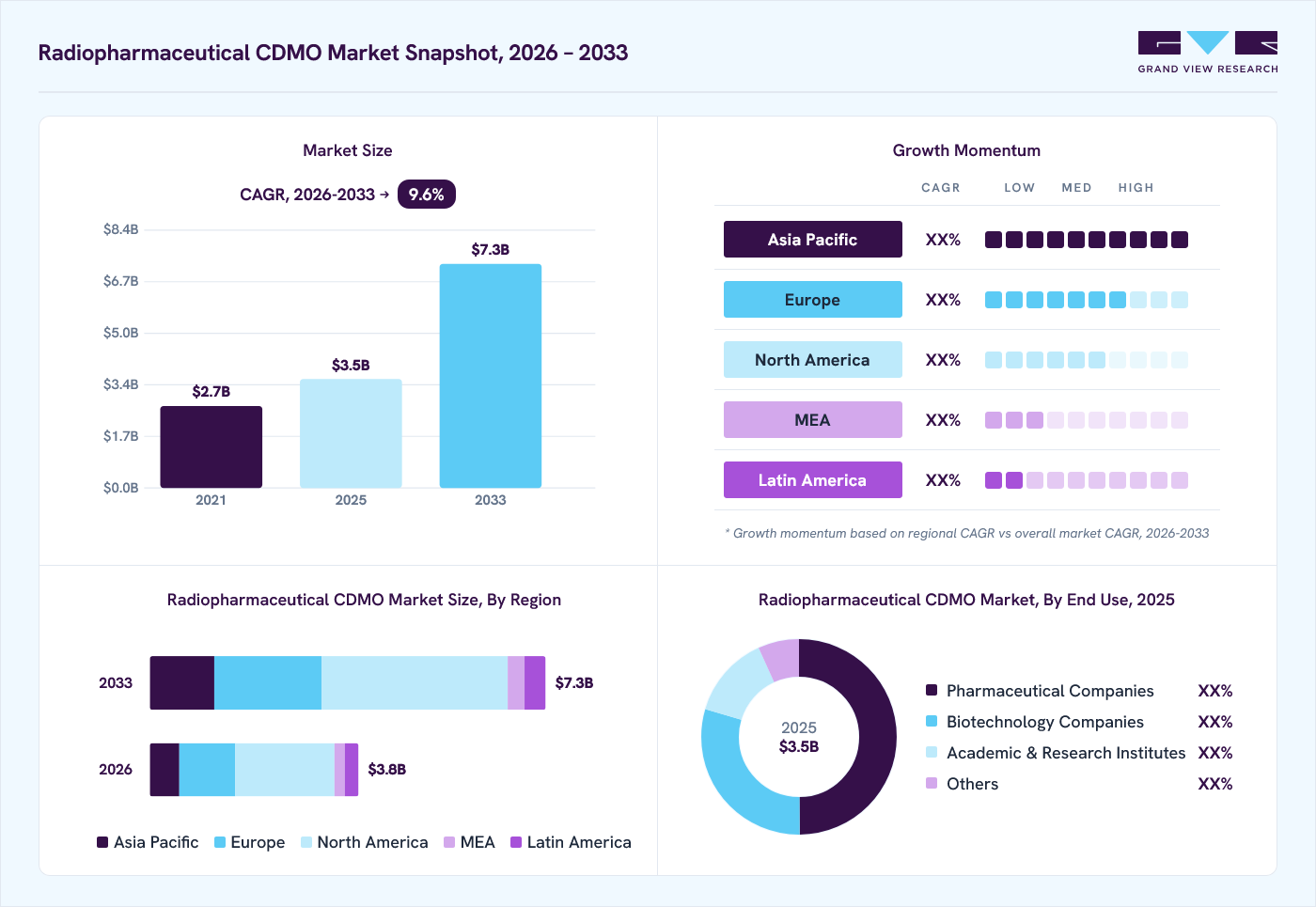 Source: Grand View Research, IR Documents, Primary Interviews, Paid DatabasesTo learn more about this report,
 Download Free Sample Report
Key Market Trends & Insights
- By service: Contract manufacturing segment dominated the market, with a revenue share of 44.7% in 2025.
- By product: Diagnostic radiopharmaceutical segment held the largest market share of 65.6% in 2025.
- By radioisotopes: Fluorine-18 (F-18) segment held the largest revenue share of 30.1% in 2025.
- By development stage: Commercial segment accounted for the largest revenue share of 49.7% in 2025.
- By application: Oncology segment dominated the market, with a revenue share of 69.2% in 2025.
- By end use: Pharmaceutical companies segment held the largest market share of 49.8% in 2025.
Regional Highlights
- Largest regional market: North America (47.1% revenue share, 2025)
- Fastest-growing regional market: Asia Pacific (highest CAGR, 2026-2033)
- By country: The U.S. held the largest market share in 2025.
Market Size & Forecast
- Market size in 2025: USD 3.5 Billion
- Estimated market size in 2026: USD 3.8 Billion
- Projected market size by 2033: USD 7.3 Billion
- CAGR (2026-2033): 9.6%
Prism AI by Grand View Research Free to tryAsk a question about the radiopharmaceutical CDMO marketTry asking✓Every figure cited from GVR research Prefer the report? Download free sample →In addition, integrated development and manufacturing partnerships are fueling market growth. Sponsors increasingly assess providers on their ability to retain product-specific process knowledge, deliver reliable supply, and scale production alongside development milestones. The competitive landscape spans CDMOs and diversified radiopharmaceutical providers, with differentiation shaped by isotope expertise, quality systems, manufacturing flexibility, and access to key clinical and commercial markets.
 To learn more about this report, Download Free Sample Report
Technology investment is focused on automated radiosynthesis, shielded hot-cell infrastructure, aseptic processing, and analytical capabilities tailored to radioactive products. These investments support reproducible manufacturing, efficient isotope handling, and timely batch release. Therapeutic programs further increase the strategic value of conjugation, purification, and formulation expertise, creating opportunities for providers to secure technically demanding development and production contracts.
Furthermore, the growth is shaped by providers’ ability to translate development engagements into sustained clinical supply contracts and long-term commercial manufacturing agreements. Aligning qualified capacity with customer milestones, securing reliable isotope access, and executing efficient technology transfers can strengthen utilization and customer retention. Thus, capacity investment, integrated service capabilities, and reliable supply execution are expected to drive the market growth over the estimated time period.
Market Dynamics
The radiopharmaceutical CDMO market growth is attributed to specialized production requirements, advancing therapeutic programs, and the need for reliable clinical and commercial supply. Sponsors increasingly value partners that integrate radiolabeling development, formulation optimization, analytical characterization, and aseptic manufacturing within quality framework. Early participation in product development allows CDMOs to build process knowledge, strengthen sponsor relationships, and capture additional service revenue as programs advance. Integrated delivery therefore provides a base for customer retention and sustained commercial engagement across the product lifecycle.
In addition, the manufacturing requirements influence competitive positioning across diagnostic and therapeutic radiopharmaceutical CDMO services. For shorter-lived diagnostic agents, production facilities are expected to operate within delivery windows that preserve sufficient activity for patient administration. Besides, commercial returns are shaped by the volume of customer demand served, the efficiency of batch production, and the ability to meet scheduled delivery windows. Therapeutic programs require production capabilities aligned with isotope characteristics, radiation containment, purification requirements, and treatment schedules. Thus, providers are expected to match their service offerings to these product-specific requirements, manufacturing yields, analytical turnaround, and batch-release performance, determining achievable throughput and contract profitability.
Moreover, investment in specialized production suites, aseptic processing infrastructure, and analytical laboratories support the expansion of outsourced manufacturing capacity. The commercial contribution of these investments develops as facilities complete qualification, accommodate customer technology transfers, and establish recurring production schedules. Besides, capacity reservations, committed supply agreements, and phased commissioning support align capital expenditure with customer development milestones. Effective coordination across isotope receipt, manufacturing, testing, release, and dispatch then enables providers to maintain dependable supply while improving facility utilization.
Furthermore, significant commercial opportunities lie in maintaining customer relationships as programs advance from process development to recurring clinical manufacturing and, following regulatory approval, commercial supply. Providers that establish reproducible processes early and prepare for subsequent production requirements can expand their participation across the product lifecycle. Acquisitions and partnerships can strengthen the company’s position by adding complementary isotope expertise, qualified infrastructure, and access to regional markets. Sustained competitive advantage will depend on aligning investment with contracted demand and consistently meeting each program’s quality, delivery, and manufacturing requirements.
Most radiopharmaceutical manufacturing requires sponsors to coordinate radioactive material handling with pharmaceutical production, aseptic controls, and product-specific testing. Each isotope-molecule combination introduces distinct requirements for labeling conditions, purification, formulation stability, and usable activity at administration. Establishing these capabilities internally requires dedicated infrastructure and specialized personnel, strengthening the rationale for outsourcing to experienced radiopharmaceutical CDMOs.
Thus, the outsourcing requirement begins during process development, when sponsors must establish reproducible radiolabeling methods, control impurities, and develop formulations that maintain quality throughout the intended shelf life. As programs enter clinical trials, these processes must support consistent batches, documented quality controls, and supply schedules aligned with patient dosing. CDMOs that manage this transition can expand their role from development support into recurring clinical manufacturing. Besides, the partner selection depends on demonstrated experience with the relevant isotope, molecule, and production process. Qualified hot cells, aseptic manufacturing capabilities, suitable analytical methods, and reliable batch execution directly influence a provider’s ability to secure and retain programs.
Thus, these requirements support outsourcing by making specialized manufacturing expertise integral to program execution. Providers that establish robust processes early and maintain supply continuity are positioned to capture subsequent validation, launch preparation, and commercial manufacturing work.
Expanding radiopharmaceutical CDMO capacity requires investment in infrastructure configured for specific isotopes and production processes. Shielded hot cells, controlled ventilation, aseptic filling systems, radioactive waste management, and specialized analytical equipment must operate within an integrated facility design. In addition, therapeutic isotope capabilities require different shielding, contamination controls, and handling arrangements, increasing the cost and complexity of extending an existing service portfolio.
These investments begin generating manufacturing revenue as facilities complete qualification and customer processes are transferred, validated, and scheduled for production. Installed capacity therefore carries operating costs before utilization matures. The financial exposure is particularly significant when expansion depends on investigational products whose trial progression, dosing requirements, and commercialization timelines remain uncertain. Delayed programs can leave dedicated suites, or reserved production slots underutilized, extending investment recovery periods. This creates a barrier to entry and can slow the addition of commercially available capacity. Providers must assess demand at the isotope, process, and production-suite level because infrastructure suited to one program may require further qualification or modification to accommodate another.
Strategies to manage this exposure include phased commissioning, customer-funded technology transfer, capacity reservation fees, and minimum-volume commitments. Modular expansion and a balanced portfolio of clinical and commercial contracts can further align investment with demand in the market.
Radiopharmaceutical CDMOs are expected to capture greater contract value by establishing manufacturing processes during early clinical development and retaining those programs through commercialization. Product-specific knowledge including isotope-to-ligand ratios, labeling conditions, purification recovery, radiolysis control, and analytical specifications are significantly becoming central to subsequent production. Besides, providers that demonstrate reproducible batches and dependable clinical supply are positioned to compete for validation, launch preparation, and commercial manufacturing assignments.
Thus, as the programs advance, the service requirement shifts toward tighter process controls, documented batch consistency, validated analytical methods, and stability evidence supporting the proposed shelf life. Besides, commercial readiness also requires production schedules that accommodate isotope availability, batch-release testing, and activity requirements at administration. A CDMO capable of integrating these activities can assume a larger role in the sponsor’s manufacturing strategy while preserving continuity with the process used during clinical development.
Moreover, the commercial opportunity depends on translating anticipated milestones into executable supply commitments. Providers can structure capacity reservations, phased technology-transfer packages, and commercial supply agreements around trial expansion, regulatory submission, and launch preparation. Investment should follow the specific hot-cell configuration, aseptic processing, and analytical capacity required by contracted programs. Retaining an approved product can establish recurring demand and opportunities for additional manufacturing sites, geographic launches, or indications. This makes clinical execution a route to longer-term account growth, with revenue visibility determined by program progression, contractual commitments, and sustained supply performance. Such factors are expected to drive the market growth over the estimated time period.
Radiopharmaceutical CDMOs must coordinate production and delivery against a continuously declining radioactive inventory. Manufacturing schedules begin with the activity required at patient administration and work backward through transportation, batch release, testing, filling, and radiolabeling. Each product’s isotope half-life, processing yield, and shelf life determine the available execution window and the activity required at production.
This creates direct commercial exposure to operational delays. An interrupted synthesis, delayed analytical result, or missed shipment can reduce deliverable activity, necessitate replacement production, or disrupt scheduled administration. Providers must consequently align isotope receipt with qualified hot-cell availability, aseptic processing slots, analytical resources, and transport departures. Additional starting activity may compensate for expected decay, but remains subject to process capacity, product specifications, and radiation-handling limits.
Shared facilities face further scheduling pressure when supporting products with different isotope characteristics and release requirements. Equipment changeovers, cleaning, contamination controls, and quality review must fit within tightly defined production schedules. Geographic service coverage is therefore governed by achievable delivery performance and remaining product activity upon arrival. Thus, addressing this challenge requires integrated production planning, validated rapid testing where applicable, qualified transport arrangements, and product-specific contingency procedures. Providers that consistently meet these requirements can protect batch economics, sustain customer supply commitments, and improve the utilization of specialized manufacturing capacity. Such factors are expected to drive market growth.
Market Concentration & Characteristics
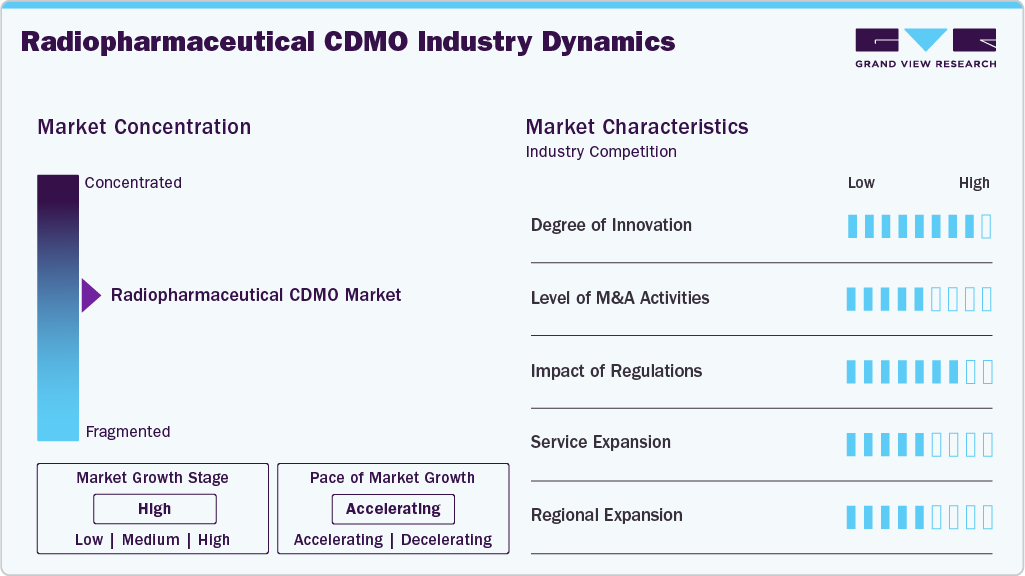
The radiopharmaceutical CDMO market is supported by advancing diagnostic and therapeutic pipelines, specialized manufacturing requirements, and outsourcing across clinical and commercial production. Its competitive evolution reflects technological innovation, strategic transactions, regulatory requirements, and the expansion of services and manufacturing networks.
Innovation focuses on automated radiolabeling, reproducible synthesis, aseptic processing, and analytical characterization. Specialized hot cells and formulations that limit radiolysis support production within isotope-specific timelines. CDMOs translate these capabilities into validated processes, strengthening their ability to accommodate complex diagnostic and therapeutic programs from development through recurring clinical and commercial manufacturing.
 To learn more about this report, Download Free Sample Report
Acquisitions and partnerships expand access to qualified facilities, isotope expertise, technical teams, and customer programs. These strategies can accelerate therapeutic manufacturing entry and geographic expansion. Commercial value depends on integrating quality systems, retaining process knowledge, and aligning acquired capabilities with contracted demand, strengthening participation across clinical and commercial supply agreements.
Regulatory requirements influence facility qualification, process validation, aseptic controls, analytical testing, and batch release. Radiopharmaceutical CDMOs coordinate pharmaceutical quality standards with radiation protection and material-handling obligations. Established compliance capabilities support sponsor qualification and technology transfer, while consistent documentation and quality oversight facilitate commercialization and expansion across products, isotopes, and markets.
Service expansion connects radiolabeling development, formulation optimization, analytical validation, API manufacturing, and finished-product production within integrated offerings. CDMOs extend customer relationships through technology transfer, stability studies, and manufacturing documentation. Aligning these capabilities with program milestones creates opportunities to convert development assignments into recurring clinical supply and long-term commercial manufacturing contracts.
Regional expansion aligns qualified manufacturing capacity with isotope access, sponsor programs, and delivery requirements. Shorter-lived diagnostics favor production near imaging centers, while therapeutic networks reflect isotope characteristics and shipment windows. New facilities, acquisitions, and partnerships broaden coverage, supported by coordinated technology transfer, quality systems, local authorizations, and dependable production scheduling.
The radiopharmaceutical CDMO market is evolving toward integrated partnerships that support sponsors from development through commercial supply. Competitive success depends on isotope expertise, aseptic manufacturing, analytical capabilities, and reliable execution. Diagnostic products provide stable recurring revenue, while therapeutic pipelines create higher-value growth opportunities. Companies are focusing on transforming complex radiolabeling processes into scalable GMP manufacturing. Capacity expansion is increasingly driven by customer demand, isotope availability, and commercialization timelines. Sponsors prioritize technology transfer expertise, strong quality systems, supply reliability, and flexibility across development stages. Geographic expansion is aligning with isotope half-life and delivery requirements, combining centralized and regional production models. Strategic acquisitions and partnerships are helping broaden capabilities, expand isotope coverage, and strengthen customer relationships. Long-term growth will depend on specialized expertise, continued investment, and successful conversion of development programs into recurring manufacturing revenue.
Impact of U.S. Tariffs on the Global Radiopharmaceutical CDMO Market
U.S. tariffs influence the global radiopharmaceutical CDMO market through import costs, procurement decisions, and the geographic allocation of manufacturing capacity. Under the 2026 pharmaceutical tariff framework, qualifying nuclear medicines and associated ingredients can receive conditional zero-duty treatment based on origin or an approved urgent U.S. health need. Tariff exposure therefore varies by product classification, manufacturing origin, and eligibility.
For CDMOs, imported equipment, processing components, and consumables require separate assessment. Where duties apply, higher procurement costs can increase facility development expenditure and affect manufacturing margins. Providers can manage this exposure through supplier diversification, contractual cost-sharing provisions, and selective procurement from alternative locations.
Tariff considerations may strengthen the rationale for establishing U.S. manufacturing capacity dedicated to domestic customers. However, investment decisions must also reflect isotope availability, facility qualification, technology-transfer requirements, and achievable delivery windows. Thus, global providers benefiting from applicable exemptions may retain competitive access to U.S. customers through existing manufacturing networks. Thus, the commercial impact will depend on each provider’s sourcing structure and customer portfolio. Competitive advantage will favor organizations that manage landed costs, maintain eligibility documentation, and preserve reliable supply while aligning geographic expansion with committed manufacturing demand and sustainable facility utilization.
Technological Advancements
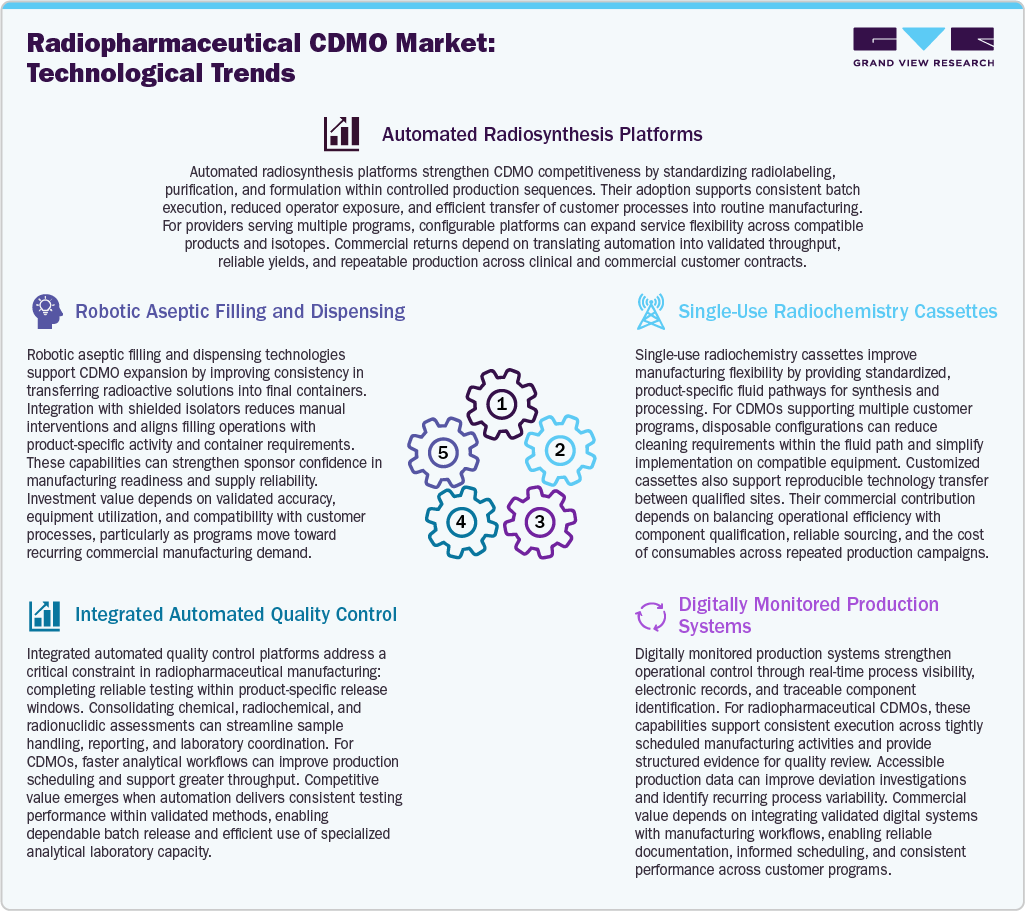
Technology advancements are reshaping the radiopharmaceutical CDMO market by improving the consistency and coordination of specialized manufacturing operations. Automated radiosynthesis platforms bring radiolabeling, purification, and formulation into controlled production sequences, supporting reproducible batches and the transfer of customer processes into routine manufacturing. Their value increases when providers align platform capabilities with product requirements and translate automation into reliable yields and throughput.
 To learn more about this report, Download Free Sample Report
Robotic aseptic filling and dispensing extend this control to final product preparation. Combined with shielded isolators, these systems reduce manual interventions and support consistent filling within defined activity and container specifications. Single-use radiochemistry cassettes further improve operational flexibility by providing standardized fluid pathways that simplify process implementation and reduce cleaning requirements within disposable components.
These production advances are complemented by integrated quality control and digital monitoring. Automated testing and consolidated reporting help laboratories coordinate analytical activities within product-specific release windows, while electronic records and traceable process data support quality review, deviation investigation, and manufacturing oversight. Thus, these capabilities support CDMOs to accommodate a broader range of customer programs while improving the use of qualified capacity. Commercial returns will depend on selecting technologies suited to contracted work and integrating them into validated workflows that consistently meet quality, scheduling, and supply commitments.
Pricing Model Analysis
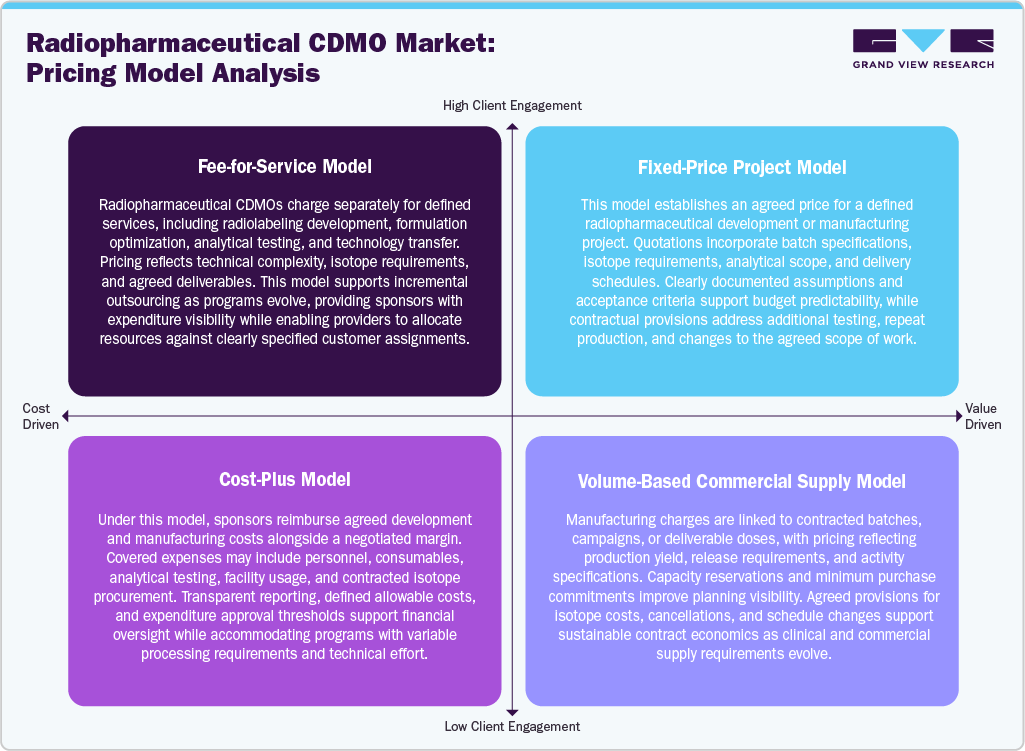
Pricing in the radiopharmaceutical CDMO market reflects isotope-specific processing requirements, dedicated manufacturing resources, and the activity specified at an agreed delivery or calibration time. Hot-cell utilization, radiolabeling complexity, purification, aseptic processing, and release testing determine the resources required to execute each contract. Service charges therefore reflect both batch requirements and the production capacity allocated to the customer program.
 To learn more about this report, Download Free Sample Report
During development, fee-for-service arrangements provide a clear commercial basis for radiolabeling optimization, formulation studies, and analytical method validation. Fixed-price projects support budget predictability through defined deliverables and process assumptions, while cost-plus arrangements align expenditure with technical effort. As programs progress toward recurring clinical and commercial supply, batch or campaign pricing can incorporate capacity reservations and minimum purchase commitments, strengthening production planning and revenue visibility.
Commercial agreements establish how isotope procurement, manufacturing services, and deliverable activity contribute to contract value. Defined activity specifications and calibration times provide a consistent basis for assessing supply performance, while agreed production schedules and scope-adjustment provisions support coordination between sponsors and providers. Thus, an effective pricing framework aligns technical deliverables with capacity commitments and supply expectations. This approach supports sustainable returns for CDMOs while giving sponsors a transparent basis for budgeting, comparing proposals, and planning expenditure across development and commercialization.
Service Insights
Based on service, the contract manufacturing segment dominated the market with the largest revenue share of 44.7% in 2025. The segment is driven by advancing clinical programs, commercial launches, expanding trial coverage, and demand for specialized radiopharmaceutical production. Sponsors require contracted capacity for API manufacturing, final formulation, and aseptic filling, supported by dependable isotope access and timely batch release. Besides, contract manufacturing combines flexible clinical production with commercial readiness and can retain programs as supply requirements expand. Thus, capacity reservations and recurring manufacturing agreements improve utilization and revenue visibility, contributing to segment growth as development programs transition into sustained clinical and commercial supply.
The contract development segment is anticipated to register the fastest growth during the forecast period, driven by demand for specialized radiolabeling expertise, formulation optimization, purification development, and technology transfer. Each isotope-molecule combination requires tailored reaction conditions, impurity controls, and stability assessments, increasing reliance on experienced CDMOs. Sponsors advancing diagnostic and therapeutic candidates outsource these activities to establish reproducible processes suitable for clinical manufacturing. Providers supporting early development can secure additional assignments as programs progress, expanding revenue through process refinement, scale-up, and transfer into qualified clinical and commercial manufacturing facilities globally.
Product Insights
Based on product, the diagnostic radiopharmaceutical segment led the market with the largest revenue share of 65.6% in 2025. The segment is supported by recurring PET and SPECT imaging demand, frequent production requirements, and regional supply expansion. Besides, short product lifetimes require batches aligned with imaging schedules, generating repeat contracts for radiolabeling, formulation, aseptic filling, and quality testing. Sponsors extending geographic coverage require technology transfer and manufacturing-site qualification, creating additional service opportunities for CDMOs offering reliable production, timely release, and coordinated delivery to customers. Such factors are expected to drive market growth.
On the other hand, the therapeutic radiopharmaceutical segment is projected to grow at a significant CAGR during the forecast period. The segment is driven by advancing oncology pipelines, larger clinical studies, repeated treatment cycles, and commercial launches. These programs require isotope-specific radiolabeling, purification, stable formulations, and aseptic manufacturing, supporting demand for specialized CDMO services. Expanding enrollment and additional treatment locations increase production requirements, while approved products create recurring batch commitments. Providers aligning qualified capacity, isotope access, and release testing with sponsor milestones can secure validation assignments and long-term manufacturing contracts, further contributing to market growth.
Radioisotopes Insights
Based on radioisotopes, fluorine-18 (F-18) held the largest share of 30.0% in 2025. The segment is driven by established PET imaging demand, recurring tracer production, and expansion of regional manufacturing networks. Its approximately 110-minute half-life requires coordinated synthesis, quality testing, batch release, and delivery, supporting repeat outsourced manufacturing contracts. New tracer development creates additional opportunities for process optimization and technology transfer. Providers serving concentrated imaging demand can improve batch utilization and deliverable dose volumes, strengthening recurring revenue from radiolabeling and finished-product manufacturing across qualified regional production sites.
On the other hand, the lutetium-177 (Lu-177) segment is projected to grow at a significant CAGR duringthe forecast period. The segment is driven by advancing oncology programs, expanding clinical enrollment, repeated treatment cycles, and commercial manufacturing requirements. Sponsors outsource radiolabeling development, purification, formulation optimization, and aseptic production to achieve consistent activity, purity, and stability across batches. As programs mature, demand extends into process validation, technology transfer, and recurring supply agreements. CDMOs coordinating dependable isotope procurement with qualified production capacity and treatment schedules can strengthen customer retention. Thus, segment growth is supported by the progression of therapeutic programs into recurring manufacturing contracts, underpinned by timely batch release and dependable clinical and commercial supply.
Development Stage Insights
Based on development stage, commercial accounted for the largest share of 49.7% in 2025. The segment is driven by recurring manufacturing demand for approved products, geographic expansion, and continued analytical and stability testing requirements. Sponsors secure contracted production capacity to support routine patient supply, creating sustained demand for manufacturing, quality testing, and packaging services. Providers with validated processes and product-specific expertise can retain commercial programs, while reliable isotope procurement, efficient scheduling, and timely batch release support consistent delivery, improved utilization, and revenue visibility under long-term supply agreements.
On the other hand, the clinical segment is projected to grow at a significant CAGR duringthe forecast period. The segment is driven by new radiopharmaceutical trials, expanding enrollment, additional treatment sites, and repeated patient administrations. These requirements generate outsourced demand for process refinement, clinical batch manufacturing, analytical development, stability studies, and technology transfer. Besides, production schedules reflect recruitment timelines, prescribed activity, and dosing frequency, while geographically dispersed trials require coordinated delivery or qualified regional manufacturing. CDMOs combining flexible production slots with reliable testing and batch release can secure repeat manufacturing campaigns as studies advance, increasing contracted service expenditure across successive phases of diagnostic and therapeutic radiopharmaceutical development programs.
Application Insights
Based on application, oncology held the largest share of 69.2% in 2025. The segment is driven by targeted radiotherapy development, recurring diagnostic tracer production, expanding clinical studies, and commercial supply requirements. Theragnostic programs generate complementary assignments for imaging and therapeutic products, spanning radiolabeling, conjugation, formulation development, analytical testing, and aseptic manufacturing. Different tumor targets and isotope combinations require product-specific processes, strengthening demand for specialized providers. CDMOs supporting assets from clinical development through commercialization can expand contracted services as sponsors increase enrollment, introduce additional indications, and establish recurring manufacturing schedules across markets.
On the other hand, the neurology segment is projected to grow at a significant CAGR duringthe forecast period. The segment is driven by neurological imaging programs, clinical research expansion, and regional tracer availability. Sponsors outsource radiolabeling process development, automated synthesis implementation, analytical validation, and stability testing to support consistent PET tracer production. Expanding trial networks and commercial distribution create additional technology transfer and site qualification requirements. CDMOs offering reproducible manufacturing, timely batch release, and coordinated delivery can secure recurring assignments as neurological diagnostic programs advance commercially. These factors are expected to drive market growth.
End Use Insights
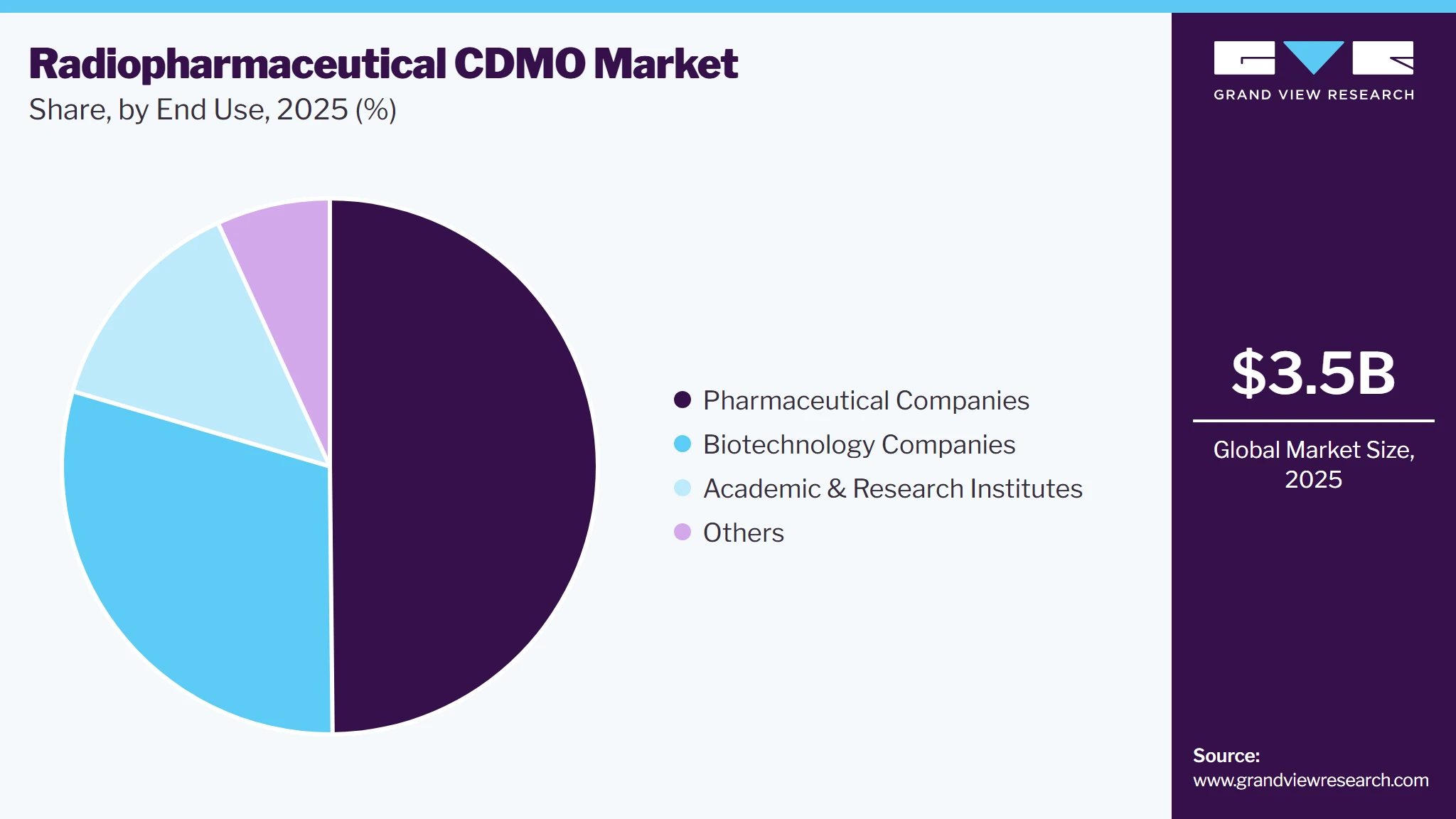
Based on end use, the pharmaceutical companies segment led the market with the largest revenue share of 49.8% in 2025. The growth is driven by the need to support multiple radiopharmaceutical assets, advance late-stage trials, and prepare approved products for broader commercial supply. Their outsourcing strategies combine specialized process development with technology transfer, analytical testing, and reserved manufacturing capacity. Besides, these companies can engage CDMOs to complement internal facilities, establish regional production, and provide redundancies. Providers meeting corporate quality standards and isotope-specific requirements can secure additional contracts as customers expand indications and geographic coverage. Such factors are expected to drive market growth.
 To learn more about this report, Download Free Sample Report
The academic & research institutes segment is anticipated to register the fastest growth during the forecast period due to investigator-led radiopharmaceutical development and outsourced clinical supply requirements. These organizations engage CDMOs for radiolabeling optimization, formulation development, analytical characterization, and investigational batch production where specialized manufacturing infrastructure is required. Research institutes advancing candidates into human studies generate demand for documented processes and qualified supply, while CROs coordinating sponsor programs may procure manufacturing services. Providers aligning batch schedules with study milestones can capture additional assignments as programs progress through subsequent clinical phases.
Regional Insights
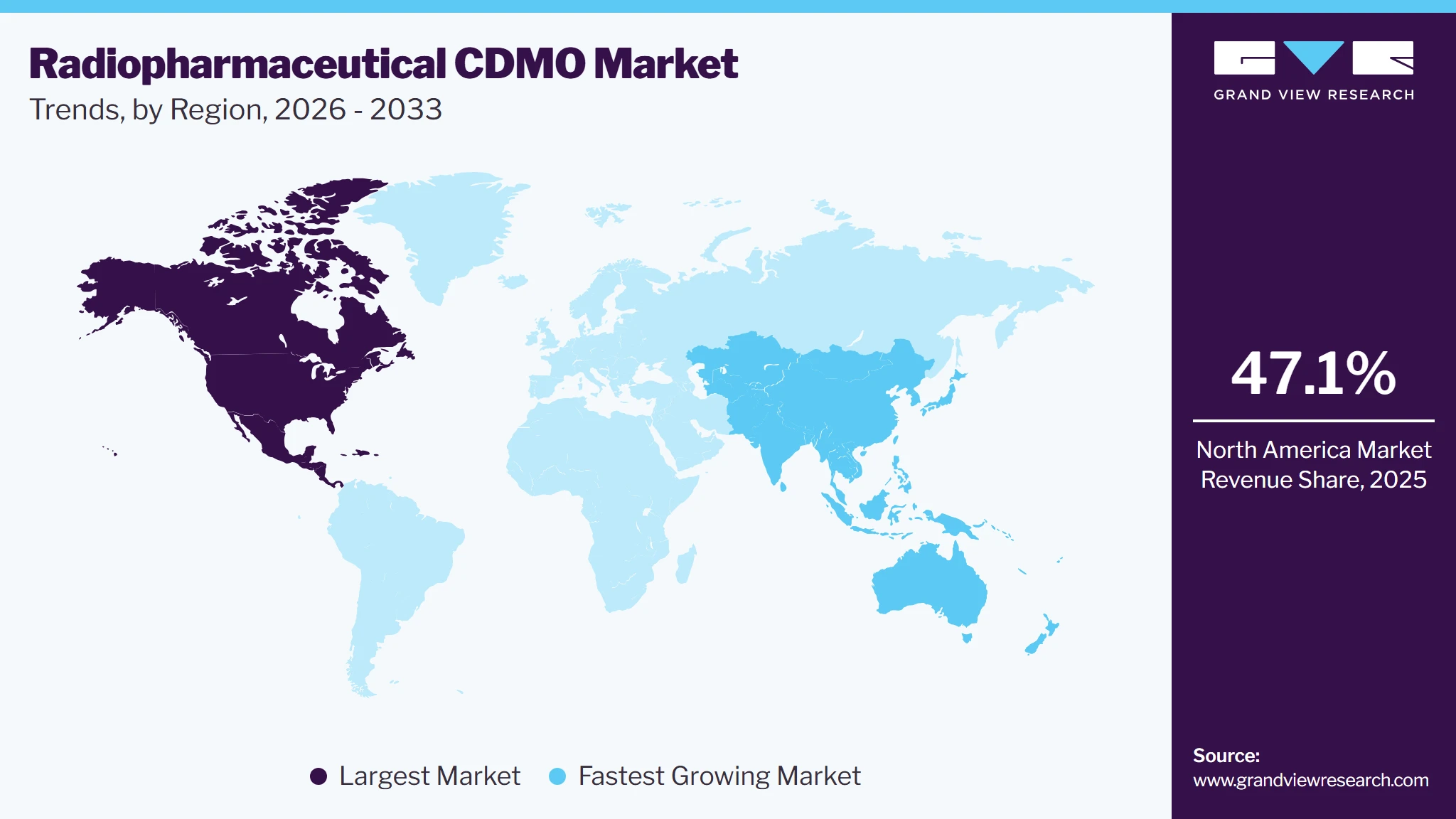
North America dominated the radiopharmaceutical CDMO market with the largest revenue share of 47.1% in 2025, driven by established outsourced manufacturing networks, therapeutic development activity, and recurring diagnostic production. Besides, sponsors access specialized providers offering radiolabeling, analytical development, aseptic manufacturing, and technology transfer. Investment in qualified facilities supports clinical supply expansion and commercial launch preparation strengthens integrated offering and provides sponsors with additional capacity for technically demanding radiopharmaceutical programs. In addition, regional competitiveness is due to coordination among isotope suppliers, manufacturing sites, and treatment centers. Providers combining reliable batch execution with capacity aligned to customer milestones can strengthen utilization and secure recurring clinical and commercial manufacturing agreements across markets. Such factors are expected to drive market growth.
 To learn more about this report, Download Free Sample Report
U.S. Radiopharmaceutical CDMO Market Trends
The radiopharmaceutical CDMO market in the U.S. held the largest share in the North America region in 2025. The country’s growth is supported by established PET production networks, specialized therapeutic manufacturing facilities, and sponsor demand for external development expertise. Providers serve programs requiring process optimization, clinical manufacturing, analytical validation, and commercial supply preparation. Besides, demand for manufacturing sites and backup supply capacity creates opportunities for CDMOs to expand their role in sponsoring supply networks. Providers with dependable isotope access, qualified hot-cell capacity, and efficient release testing are better positioned to support geographically dispersed trials and secure recurring manufacturing contracts for approved radiopharmaceuticals.
The radiopharmaceutical CDMO market in Canada is expected to grow steadily over the forecast period, driven is supported by specialized radiochemistry expertise and investment in outsourced manufacturing. AtomVie’s Hamilton expansion adds capacity for sponsors advancing programs from development into commercial production. Besides radiolabeling and formulation development, the opportunity includes analytical validation, technology transfer, and repeat GMP manufacturing. In addition, coordinating Canadian production with international clinical supply requirements can broaden customer access. Moreover, providers securing production commitments alongside facility qualification are better positioned to translate expanded infrastructure into recurring service revenue.
Europe Radiopharmaceutical CDMO Market Trends:
Europe accounted for a significant share of the global radiopharmaceutical CDMO market in 2025, driven by specialized radiochemistry expertise, qualified GMP facilities, and outsourced diagnostic and therapeutic manufacturing. Integrated providers support sponsors through process development, analytical validation, clinical production, and commercial supply. In addition, multinational programs create demand for regional technology transfer and manufacturing-site qualifications. Expanding isotope capabilities can broaden service portfolios, while coordinated quality oversight, batch release, and transport arrangements strengthen supply continuity. Commercial growth depends on securing customer commitments that translate qualified infrastructure into recurring manufacturing revenue streams.
The radiopharmaceutical CDMO market in Germany held the largest share of the European market in 2025. The country benefits from established radiochemistry expertise and integrated GMP manufacturing capabilities. In the country, the providers support external programs through process development, analytical characterization, and clinical-to-commercial production. In addition, sponsors seeking European manufacturing capacity create opportunities for technology transfer, process validation, and therapeutic supply contracts. Besides, most providers align isotope-specific capabilities with customer milestones can expand service revenue, while reliable batch release and coordinated production schedules strengthen Germany’s position in multinational diagnostic and therapeutic supply networks.
The UK radiopharmaceutical CDMO market is expected to grow significantly over the forecast period supported by demand for specialized precursor synthesis, conjugation, and analytical development. Almac’s capabilities illustrate the country’s role in supporting radiopharmaceutical programs from early development toward commercial readiness. In addition, partnerships connecting these services with qualified radiolabeling and drug-product manufacturing can broaden sponsor access to integrated supply. Providers maintaining process continuity through technology transfer are positioned to gain subsequent validation assignments and recurring clinical and commercial manufacturing contracts.
Asia Pacific Radiopharmaceutical CDMO Market Trends
Asia Pacific is projected to register the fastest CAGR during the forecast period supported by localized radiopharmaceutical development, expanding clinical supply requirements, and investment in specialized manufacturing. Production closer to trial sites and imaging centers improves access within isotope-specific delivery windows. In addition, sponsors establishing regional supply networks create opportunities for technology transfer, analytical testing, and contract manufacturing. Providers combining qualified facilities with dependable isotope access and coordinated batch release can secure recurring assignments as customer programs advance toward commercialization.
The radiopharmaceutical CDMO market in China is expanding through investment in specialized facilities and partnerships connecting international radiochemistry expertise with domestic manufacturing capabilities. Sponsors requiring local supply create demand for radiolabeling development, analytical characterization, technology transfer, and clinical batch production. In addition, manufacturing closer to Chinese trial sites can improve scheduling flexibility and delivery coordination. Providers matching qualified isotope capabilities with customer pipelines can secure additional assignments as programs progress, translating infrastructure investment into recurring clinical production and commercial manufacturing supply contracts.
The radiopharmaceutical CDMO market in Japan is supported by specialized manufacturing expertise and demand for outsourced investigational supply. Besides, the contract capabilities demonstrate opportunities to support pharmaceutical sponsors through radiolabeling, process implementation, and clinical manufacturing. In addition, domestic production helps align batch schedules with local trial requirements and delivery windows. Providers offering reliable technology transfer, analytical support, and consistent quality can expand contracted services as diagnostic and therapeutic programs advance, creating opportunities for recurring clinical production and subsequent commercial supply.
India Radiopharmaceutical CDMO market offers opportunities to extend specialized production capabilities into outsourced development and clinical manufacturing. Sponsor requirements include radiolabeling optimization, analytical method development, stability studies, and investigational batch production. In addition, local technology transfer can support clinical supply requirements within practical delivery windows. Providers combining qualified aseptic facilities, dependable isotope access, and documented release procedures can pursue recurring manufacturing contracts, while partnerships can connect process development expertise with production capacity and coordinated delivery to clinical sites.
Latin America Radiopharmaceutical CDMO Market Trends
The radiopharmaceutical CDMO market in Latin America is expected to witness significant growth as sponsors seek regional clinical and commercial supply options. Besides, the market opportunities include technology transfer, analytical testing, and manufacturing aligned with treatment-site delivery requirements. Short-lived diagnostic agents favor nearby production, while therapeutic programs require specialized isotope handling and qualified supply arrangements. In addition, partnerships support to connect with local facilities with external sponsor programs. Providers securing customer commitments and demonstrating reliable batch release can translate qualified infrastructure into recurring regional manufacturing service revenue.
Brazil Radiopharmaceutical CDMO market is supported by opportunities to develop outsourced services around the country’s radiopharmaceutical research and production infrastructure. The manufacturing capabilities provide a technical foundation for activities such as process transfer, analytical characterization, and investigational supply. In addition, sponsors seeking local production can create demand for qualified manufacturing partners able to coordinate batch release with clinical delivery schedules. Commercial expansion will depend on translating these capabilities into dedicated third-party service contracts that support recurring clinical and commercial supply.
Middle East & Africa Radiopharmaceutical CDMO Market Trends
The Middle East and Africa radiopharmaceutical CDMO market is projected to grow steadily as sponsors seek localized manufacturing and regional supply partnerships. Opportunities span technology transfer, analytical testing, clinical batch production, and commercial manufacturing. Isotope access, transport connections, and proximity to treatment centers shape facility selection and achievable delivery coverage. In addition, partnerships connecting qualified facilities with sponsor programs can broaden service availability. Providers aligning phased capacity investment with customer commitments and demonstrating reliable batch release are better positioned to establish recurring manufacturing contracts.
The UAE Radiopharmaceutical CDMO market offers opportunities to build outsourced services around established local manufacturing capabilities. Besides, in the country, the operations provide infrastructure for radiopharmaceutical production and delivery. Sponsors seeking local supply could generate assignments in process transfer, analytical testing, and clinical manufacturing. In addition, proximity to treatment centers can support product-specific delivery requirements. Commercial expansion depends on establishing qualified third-party offerings and securing customer commitments that translate available production capabilities into recurring manufacturing contracts for regional clinical and commercial programs.
Key Radiopharmaceutical CDMO Company Insights
The key players operating across the market are adopting strategic initiatives such as service launches, mergers & acquisitions, partnerships & agreements, and expansions to gain a competitive edge in the market. For instance, in January 2026, IRE mentioned the selection of Lemer Pax to supply shielded hot cells for its new radiopharmaceutical CDMO facility in Belgium. The investment will support flexible, scalable GMP development and manufacturing across multiple radionuclides. The announcement targeted operational readiness in the second half of 2027.
Key Radiopharmaceutical CDMO Companies
The following key companies have been profiled for this study on the radiopharmaceutical CDMO market.
-
ABX advanced biochemical compounds GmbH
-
AtomVie Global Radiopharma Inc.
-
Cardinal Health, Inc.
-
Cyclotek (Aust) Pty Ltd
-
Eckert & Ziegler SE
-
Evergreen Theragnostics, Inc.
-
Minerva Imaging ApS
-
NorthStar Medical Radioisotopes, LLC
-
Nucleus RadioPharma, Inc.
-
PharmaLogic Holdings Corp.
-
PETNET Solutions, Inc.
-
NukeMed, Inc. d/b/a SpectronRx
Competitive Benchmarking
Category
Operating Strategies
Competitive Edge
Weakness
Established Players (ABX advanced biochemical compounds GmbH; Cardinal Health, Inc.; Cyclotek (Aust) Pty Ltd)
- Established providers expand isotope capabilities, transfer customer processes into qualified facilities, and secure recurring manufacturing agreements. Diagnostic networks prioritize regional coverage and production scheduling, while integrated development, analytical, and manufacturing services support program retention and utilization across existing production infrastructure.
- Qualified facilities, isotope-handling expertise, and established supply networks support customer onboarding and dependable manufacturing. Providers combining process development, analytical testing, and technology transfer can retain programs through commercialization, while regional infrastructure strengthens delivery coverage for products with constrained usable lifetimes.
- Shared facilities face scheduling pressure across products with different processing and delivery requirements. Multisite operations require consistent quality oversight, while therapeutic expansion can involve additional shielding, specialized testing, and facility qualification, increasing investment exposure before customer production volumes mature sufficiently.
Emerging Players (AtomVie Global Radiopharma Inc.; Evergreen Theragnostics, Inc.; Minerva Imaging ApS; NorthStar Medical Radioisotopes, LLC)
- Specialist providers expand dedicated facilities and isotope-specific services around customer pipelines. Strategies connect radiolabeling development, formulation, analytical characterization, and clinical manufacturing with commercial preparation. Partnerships strengthen isotope access, while phased investment aligns qualified capacity with customer milestones and supply commitments.
- Focused radiochemistry expertise supports tailored conjugation, purification, formulation, and analytical development. Differentiated infrastructure includes co-located isotope production, connected CRO/CDMO services, and purpose-built manufacturing facilities. These capabilities enable close technical collaboration and support customer progression from development into recurring manufacturing supply.
- Commissioning and customer qualification can extend revenue ramp-up periods. Concentrated facilities increase reliance on contingency arrangements, while utilization depends on clinical progression, isotope access, and launch timing. Sustained staffing, validation, and quality investment precedes the achievement of planned production volumes.
Recent Developments
-
In September 2026, AtomVie mentioned the opening of 72,300-square-foot radiopharmaceutical manufacturing facility in Ontario, increasing its manufacturing capacity more than tenfold. The facility will support development, clinical supply, and commercial production, strengthening its ability to serve customers throughout the radiopharmaceutical product lifecycle.
-
In January 2025, Lantheus announced an agreement to acquire Evergreen for USD 250 million upfront and up to USD 752.5 million in potential milestone payments. The transaction was designed to add radiopharmaceutical CDMO infrastructure, scalable manufacturing, and early development capabilities, strengthening Lantheus’ integrated development-to-commercialization platform.
-
In October 2024, NorthStar unveiled its 52,000-square-foot Dose Manufacturing Center in Wisconsin, integrating radiopharmaceutical development and manufacturing with isotope production on one campus. The facility will support programs involving Ac-225, Lu-177, Cu-64, Cu-67, and In-111, expanding clinical and commercial manufacturing capabilities.
Radiopharmaceutical CDMO Market Report Scope
Report Attribute
Details
Market size value in 2025
USD 3.5 billion
Estimated market size in 2026
USD 3.8 billion
Projected market size by 2033
USD 7.3 billion
Growth Rate
CAGR of 9.6% from 2026 to 2033
Actual Data
2021 - 2025
Forecast period
2026 - 2033
Quantitative units
Revenue in USD million/billion and CAGR from 2026 to 2033
Report coverage
Revenue forecast, company ranking, competitive landscape, growth factors, and trends
Segments covered
Service, product, radioisotopes, development stage, application, end use, region
Regional scope
North America, Europe, Asia Pacific, Latin America, MEA
Country scope
U.S., Canada, Mexico, UK, Germany, France, Italy, Spain, Denmark, Sweden, Norway, China, India, Japan, Australia, South Korea, Thailand, Brazil, Argentina, South Africa, UAE, Saudi Arabia, Kuwait, Qatar, Oman
Key companies profiled
ABX advanced biochemical compounds GmbH, AtomVie Global Radiopharma Inc., Cardinal Health, Inc., Cyclotek (Aust) Pty Ltd, Eckert & Ziegler SE, Evergreen Theragnostics, Inc., Minerva Imaging ApS, NorthStar Medical, Radioisotopes, LLC, Nucleus RadioPharma, Inc., PharmaLogic Holdings Corp., PETNET Solutions, Inc., and NukeMed, Inc. d/b/a SpectronRx among others.
Customization scope
Free report customization (equivalent up to 8 analysts working days) with purchase. Addition or alteration to country, regional & segment scope.
Pricing and purchase options
Avail customized purchase options to meet your exact research needs. Explore purchase options
Global Radiopharmaceutical CDMO Market Report Segmentation
This report forecasts revenue growth at global, regional, and country levels and provides an analysis of the latest industry trends in each of the sub-segments from 2021 to 2033. For this study, Grand View Research has segmented the global radiopharmaceutical CDMO market report based on service, product, radioisotopes, development stage, application, end use, and region.
-
Service Outlook (Revenue, USD Million, 2021 - 2033)
-
Contract Development
-
Process Development & Optimization
-
Formulation Development
-
Scale-Up & Technology Transfer
-
-
Contract Manufacturing
-
Radiopharmaceutical API Manufacturing
-
Finished Drug Product Manufacturing
-
-
Analytical Development, Testing & Quality Control Services
-
Packaging & Labeling
-
Others
-
-
Product Outlook (Revenue, USD Million, 2021 - 2033)
-
Diagnostic Radiopharmaceutical
-
Therapeutic Radiopharmaceutical
-
-
Radioisotopes Outlook (Revenue, USD Million, 2021 - 2033)
-
Fluorine-18 (F-18)
-
Gallium-68 (Ga-68)
-
Technetium-99m (Tc-99m)
-
Zirconium-89 (Zr-89)
-
Iodine-131 (I-131)
-
Lutetium-177 (Lu-177)
-
Others
-
-
Development Stage Outlook (Revenue, USD Million, 2021 - 2033)
-
Preclinical
-
Clinical
-
Commercial
-
-
Application Outlook (Revenue, USD Million, 2021 - 2033)
-
Oncology
-
Neurology
-
Cardiology
-
Others
-
-
End Use Outlook (Revenue, USD Million, 2021 - 2033)
-
Pharmaceutical Companies
-
Biotechnology Companies
-
Academic & Research Institutes
-
Others
-
-
Regional Outlook (Revenue, USD Million, 2021 - 2033)
-
North America
-
U.S.
-
Canada
-
Mexico
-
-
Europe
-
UK
-
Germany
-
France
-
Italy
-
Spain
-
Denmark
-
Sweden
-
Norway
-
-
Asia Pacific
-
China
-
India
-
Japan
-
Australia
-
South Korea
-
Thailand
-
-
Latin America
-
Brazil
-
Argentina
-
-
Middle East & Africa
-
South Africa
-
UAE
-
Saudi Arabia
-
Kuwait
-
Qatar
-
Oman
-
-
Research Methodology
The radiopharmaceutical CDMO market figures in this report are based on a proven research process that combines executive interviews with secondary research from proprietary databases, company filings, and recognized regulatory and institutional sources. Market size is built through value-chain sizing - reconciling supply-side and demand-side estimates - and triangulated with bottom-up and top-down approaches. Every estimate passes multiple levels of expert validation before publication, with each caffeine supplements segment quantified using the revenue-capture definitions in the table below.
Segment Definition
Service
Definition
Contract Development Services
The segment captures revenue generated by providing outsourced development services that establish and improve radiopharmaceutical production processes and formulations and prepare them for clinical or commercial manufacturing. It includes process development and optimization, formulation development, and scale-up and technology transfer. Separately attributable analytical services are classified under Analytical Development, Testing & Quality Control Services.
Process Development & Optimization
The subsegment captures revenue generated by designing, developing, and optimizing processes used to manufacture radiopharmaceuticals. Services include radiolabeling and radioconjugation method development, reaction optimization, purification process development, yield improvement, and process robustness studies.
Formulation Development
The subsegment captures revenue generated by developing and optimizing radiopharmaceutical formulations suitable for their intended administration and storage conditions. Services include selecting excipients, adjusting pH and composition, and developing approaches to maintain product stability and limit radiolysis. Manufacturing the final formulation is classified under Finished Drug Product Manufacturing.
Scale-Up & Technology Transfer
The subsegment captures revenue generated by adapting established radiopharmaceutical processes to larger production requirements and transferring them between development laboratories, manufacturing facilities, or production systems. Services include process adaptation, equipment compatibility assessment, engineering runs, transfer documentation, and manufacturing implementation support.
Contract Manufacturing Services
The segment captures revenue generated by manufacturing radiopharmaceutical drug substances and finished drug products on behalf of external customers for preclinical, clinical, or commercial use. It includes radiopharmaceutical API manufacturing and finished drug product manufacturing.
Radiopharmaceutical API Manufacturing
The subsegment captures revenue generated by manufacturing the active pharmaceutical ingredient or drug substance used in a radiopharmaceutical. Services include radiolabeling, radioconjugation, purification, and preparation of the drug substance before final dosage-form production.
Finished Drug Product Manufacturing
The subsegment captures revenue generated by converting radiopharmaceutical drug substances into finished dosage forms suitable for administration. Services include final formulation, sterile filtration where applicable, aseptic filling, container closure, and associated manufacturing operations. Separately billed API manufacturing, analytical services, and packaging and labeling are excluded.
Analytical Development, Testing & Quality Control Services
The segment captures revenue generated by developing and validating analytical methods and conducting testing to assess radiopharmaceutical identity, quality, purity, strength, safety, and stability. Services include radiochemical, radionuclidic, and chemical testing; sterility and endotoxin testing; stability studies; and analytical support for batch release.
Packaging & Labeling
The segment captures revenue generated by packaging and labeling radiopharmaceutical products after filling and container closure. Services include secondary packaging, product and clinical-trial labeling, and preparation of compliant protective packaging. Aseptic filling is classified under Finished Drug Product Manufacturing.
Others
The segment captures revenue generated by qualifying outsourced radiopharmaceutical CDMO services not classified under the preceding service categories. These may include separately contracted regulatory and CMC documentation, manufacturing-related consulting, and eligible integrated isotope-sourcing or logistics services.
Product
Definition
Diagnostic Radiopharmaceutical
The segment captures revenue generated by providing outsourced development, manufacturing, analytical, and related in-scope services for radiopharmaceuticals intended to diagnose disease or assess biological processes through nuclear imaging. It includes services supporting diagnostic agents used in PET and SPECT imaging, including diagnostic components of theranostic programs.
Therapeutic Radiopharmaceutical
The segment captures revenue generated by providing outsourced development, manufacturing, analytical, and related in-scope services for radiopharmaceuticals intended to treat disease through the delivery of radiation to targeted tissues or biological sites. It includes services supporting therapeutic components of theranostic programs.
Radioisotopes
Definition
Fluorine-18 (F-18)
The segment captures revenue generated by providing outsourced development, manufacturing, analytical, and related in-scope services for radiopharmaceuticals containing fluorine-18. It includes process and radiolabeling development, GMP production, and quality testing attributable to F-18-labeled products.
Gallium-68 (Ga-68)
The segment captures revenue generated by providing outsourced development, manufacturing, analytical, and related in-scope services for radiopharmaceuticals containing gallium-68. It includes radiolabeling process development, product manufacturing, and quality testing attributable to Ga-68-labeled products.
Technetium-99m (Tc-99m)
The segment captures revenue generated by providing outsourced development, manufacturing, analytical, and related in-scope services for radiopharmaceuticals containing technetium-99m. It includes qualifying services supporting Tc-99m product development and production, while excluding routine hospital or radiopharmacy preparation and dispensing.
Zirconium-89 (Zr-89)
The segment captures revenue generated by providing outsourced development, manufacturing, analytical, and related in-scope services for radiopharmaceuticals containing zirconium-89. It includes radioconjugation development, manufacturing, and characterization of Zr-89-labeled products.
Iodine-131 (I-131)
The segment captures revenue generated by providing outsourced development, manufacturing, analytical, and related in-scope services for radiopharmaceuticals containing iodine-131. It includes qualifying services supporting I-131-containing products across development and commercial production.
Lutetium-177 (Lu-177)
The segment captures revenue generated by providing outsourced development, manufacturing, analytical, and related in-scope services for radiopharmaceuticals containing lutetium-177. It includes radiolabeling and radioconjugation development, drug substances and finished drug product manufacturing, and associated quality testing.
Others
The segment captures revenue generated by providing outsourced radiopharmaceutical CDMO services for products containing radioisotopes actinium-225, copper-64, copper-67, lead-212, iodine-123, and other isotopes within the study scope.
Development Stage
Definition
Preclinical
The segment captures revenue generated by providing outsourced radiopharmaceutical CDMO services supporting nonclinical development before a product enters human clinical trials. Services include process and formulation development, preparation of material for nonclinical studies, and associated analytical characterization. Standalone animal studies and unrelated CRO services are excluded.
Clinical
The segment captures revenue generated by providing outsourced radiopharmaceutical CDMO services supporting investigational products used in human clinical trials. Services include clinical supply manufacturing, process and formulation refinement, scale-up, analytical testing, stability studies, and manufacturing-related regulatory support.
Commercial
The segment captures revenue generated by providing outsourced radiopharmaceutical CDMO services supporting approved products for commercial supply. Services include routine manufacturing, commercial process improvements, technology transfer, analytical testing, stability monitoring, and packaging and labeling.
Application
Definition
Oncology
The segment captures revenue generated by providing outsourced radiopharmaceutical CDMO services for products intended to diagnose, stage, monitor, or treat cancer. It includes services supporting diagnostic imaging agents and therapeutic radiopharmaceuticals for solid tumors and hematological malignancies.
Neurology
The segment captures revenue generated by providing outsourced radiopharmaceutical CDMO services for products intended to investigate, diagnose, monitor, or treat neurological conditions. It includes services supporting agents used to assess neurological disease processes and brain function.
Cardiology
The segment captures revenue generated by providing outsourced radiopharmaceutical CDMO services for products intended to investigate, diagnose, monitor, or treat cardiovascular conditions. It includes services supporting agents used to assess myocardial perfusion, cardiac function, and other cardiovascular processes.
Others
The segment captures revenue generated by providing outsourced radiopharmaceutical CDMO services for applications outside oncology, neurology, and cardiology. These may include renal, pulmonary, endocrine, infectious disease, inflammatory, and non-oncological skeletal applications.
End Use
Definition
Pharmaceutical Companies
The segment captures revenue generated by providing outsourced radiopharmaceutical CDMO services to pharmaceutical companies under the study’s customer-classification framework. It includes services supporting their diagnostic and therapeutic radiopharmaceutical development programs and commercial products.
Biotechnology Companies
The segment captures revenue generated by providing outsourced radiopharmaceutical CDMO services to biotechnology companies under the study’s customer-classification framework. It includes services supporting specialized biotechnology and radiopharmaceutical developers across preclinical, clinical, and commercial activities.
Academic & Research Institutes
The segment captures revenue generated by providing outsourced radiopharmaceutical CDMO services directly to universities, academic medical centers, and research institutes. It includes services supporting investigator-led development programs and research or clinical supply requirements. Internal production undertaken by these institutions is excluded.
Others
The segment captures revenue generated by providing outsourced radiopharmaceutical development and manufacturing services to independent hospitals, government agencies, nonprofit organizations, and other customers.
Estimation Model
BOTTOM-UP MARKET ESTIMATION
PRODUCTION AND SERVICE VALUE MODEL
DEVELOPMENT PIPELINE AND CLINICAL SUPPLY MODEL
SPONSOR EXPENDITURE AND OUTSOURCING MODEL
- The model establishes the market size by aggregating provider revenues attributable to outsourced radiopharmaceutical development, API and finished drug product manufacturing, analytical services, and packaging and labeling.
- Provider assessments integrate financial disclosures, customer programs, manufacturing footprints, operational capacity, and contract activity.
- Service-level revenue allocation and consolidation adjustments create a consistent foundation for assessing company participation, competitive positioning, and market share.
- The model translates outsourced radiopharmaceutical production requirements into service revenue through product- and isotope-specific manufacturing economics.
- Diagnostic and therapeutic products are evaluated according to batch size, production frequency, radiolabeling complexity, aseptic processing, and release-testing requirements.
- Production volumes are valued using applicable fees per batch, campaign, or dose.
- Capacity utilization, radioactive decay, production yields, and manufacturing schedules inform achievable output, while contract-level service mapping captures the associated development and analytical value.
- The model quantifies CDMO demand through a structured assessment of radiopharmaceutical development programs by radioisotope, product purpose, development stage, and sponsor.
- Stage-specific expenditure reflects requirements for radiolabeling development, formulation optimization, analytical validation, technology transfer, and clinical manufacturing.
- Clinical supply estimates incorporate enrollment, doses per participant, production locations, and supply schedules.
- Forecasts apply program progression probabilities and development timelines to estimate future service requirements and the transition toward recurring commercial manufacturing revenue.
- The model assesses addressable CDMO demand by applying service-specific outsourcing rates to radiopharmaceutical development and manufacturing expenditure.
- Outsourcing assumptions reflect sponsor capabilities, development priorities, infrastructure access, and geographic supply requirements.
- The assessment evaluates the role of specialized isotope handling, licensed production facilities, aseptic manufacturing, and analytical expertise in shaping external service procurement.
- This approach connects sponsor investment with revenue opportunities across the radiopharmaceutical CDMO value chain.
Consolidated Assessment
The market integrates provider revenues, production economics, pipeline requirements, and sponsor outsourcing expenditure into a consolidated assessment. Model outputs are evaluated against service coverage, facility readiness, production capacity, and customer program timelines. Forecasts reflect clinical progression, commercial launches, recurring supply agreements, and the operational ramp-up of manufacturing facilities. Consistent allocation of bundled contracts, subcontracted activities, and eligible isotope-related services supports comparable estimates across providers, segments, and geographies.
Delivered Customizations
This report has been delivered with the following In-depth customizations
Client Request
Customization Delivered
Value Adds
Extensive Segmentation & Cross-Segmentation Analysis
The study can provide detailed analysis across service, diagnostic and therapeutic products, radioisotopes, development stage, application, and end user. Cross-segmentation can include service-by-radioisotope, product-by-development stage, application-by-product, and customer type-by-service. Additional customization assesses radiolabeling and conjugation requirements, radiolabeling control, analytical characterization, aseptic processing, technology transfer, and clinical-to-commercial manufacturing requirements. Dedicated analysis can evaluate emerging isotope-specific opportunities, including Ac-225, Pb-212, and Cu-67, alongside established F-18 and Lu-177 service demand.
Identifies attractive service-isotope combinations, prioritizes capability investments, and clarifies customer requirements across diagnostic and therapeutic radiopharmaceutical development and manufacturing.
Regional Extension & Peptide Manufacturing Opportunity Mapping
The report extends to selected countries and manufacturing clusters across North America, Europe, Asia Pacific, Latin America, and the Middle East & Africa. Analysis can map licensed GMP facilities, isotope access, hot-cell infrastructure, aseptic production capacity, analytical capabilities, and clinical supply coverage. Geographic opportunity assessment incorporates isotope half-life, patient access requirements, and shipment-release arrangements. Facility-level mapping distinguishes operational capacity, expansion projects, and commissioned timelines, with separate views of sponsor demand and manufacturing location.
Supports manufacturing-site selection, regional network design, capacity allocation, and identification of locations where specialized CDMO infrastructure supports clinical and commercial supply coverage.
Market Entry Strategy & Competitive Dynamics
The study assesses entry and expansion opportunities across radiopharmaceutical process development, API manufacturing, finished drug product production, and analytical services. Competitive benchmarking can compare providers by isotope handling capabilities, diagnostic versus therapeutic focus, development-stage coverage, GMP infrastructure, technology-transfer experience, and commercial supply track record. Customization evaluates contract structures, pricing by batch or campaign, dedicated-capacity arrangements, isotope-sourcing partnerships, and customer qualification requirements. Build-versus-partner and acquisition assessments identify pathways to establish specialized capabilities and expand geographic reach.
Informs market entry feasibility, differentiated positioning, partnership selection, acquisition screening, and investment priorities for building a competitive radiopharmaceutical CDMO service portfolio.
Clinical Pipeline & Outsourced Manufacturing Demand Assessment
A customized pipeline dataset at radiopharmaceutical assets by sponsor, isotope, targeting approach, application, trial phase, recruitment status, study geography, and anticipated development milestones. Asset-level assessment translates clinical enrollment, administration per patient, production frequency, and supply-site requirements into potential CDMO demand. Program progression scenarios evaluate future requirements for process development, analytical validation, clinical manufacturing, technology transfer, and commercial launch supply.
Identifies prospective customers, supports account prioritization, and aligns business development and capacity planning with the timing and technical requirements of emerging radiopharmaceutical programs.
Frequently Asked Questions About This Report
The global radiopharmaceutical CDMO market size was valued at USD 3.5 billion in 2025 and is estimated at USD 3.8 billion in 2026.
The global radiopharmaceutical CDMO market is expected to grow at a CAGR of 9.6% from 2026 to 2033, reaching USD 7.3 billion by 2033.
Contract manufacturing segment dominated the market, with a revenue share of 44.7% in 2025.
North America radiopharmaceutical CDMO market held the largest share of 47.1% of the global market in 2025.
Key factors driving market growth include advancing therapeutic pipelines, expanding clinical supply requirements, increasing commercialization activity, rising demand for specialized manufacturing infrastructure, and access to isotope-specific expertise. These factors are expected to drive the outsourcing across process development, radiolabeling, analytical characterization, aseptic production, and technology transfer.
Some of the key players operating in the radiopharmaceutical CDMO market include ABX advanced biochemical compounds GmbH, AtomVie Global Radiopharma Inc., Cardinal Health, Inc., Cyclotek (Aust) Pty Ltd, Eckert & Ziegler SE, Evergreen Theragnostics, Inc., Minerva Imaging ApS, NorthStar Medical, Radioisotopes, LLC, Nucleus RadioPharma, Inc., PharmaLogic Holdings Corp., PETNET Solutions, Inc., and NukeMed, Inc. d/b/a SpectronRx among others.
Based on product, the diagnostic radiopharmaceutical segment led the market with the largest revenue share of 65.6% in 2025. The segment is supported by recurring PET and SPECT imaging demand, frequent production requirements, and regional supply expansion.
Fluorine-18 (F-18) held the largest share of 30.0% in 2025 and utetium-177 (Lu-177) segment is second fastest growing market.
Asia Pacific is the fastest-growing region over the forecast period.
About the Author(s)
Medical Devices Research Team
Healthcare · Medical DevicesThis report was authored by the medical devices research team at Grand View Research - comprising two research analysts, one senior research analyst, and one industry expert - with specialized expertise in the medical devices segment of the healthcare industry. All findings are based on proprietary healthcare databases, executive interviews, and regulatory analysis, subject to internal peer review prior to publication.
Last Updated:
Speak to Analyst

Customize this report to your needs - add regions, segments, or data points, with 20% free customization.
Or view our licence options:


ISO 9001:2015 & 27001:2022 Certified
We are GDPR and CCPA compliant! Your transaction & personal information is safe and secure. For more details, please read our privacy policy.


