
- Home
- »
- Advanced Interior Materials
- »
-
Rebar Processing Equipment Market Size Report, 2033GVR Report cover
![Rebar Processing Equipment Market (2026 - 2033)Report]()
Rebar Processing Equipment Market (2026 - 2033)
Size, Share & Trends Analysis Report By Equipment Type (Bending, Cutting/Shearing, Straightening & De-coiling, Stirrup & Spiral Bending), By Operation Mode (Manual, Semi-Automatic, Automatic/CNC), By End-use, By Region, And Segment Forecasts
Market Size, 2025
$1.2BMarket Estimate, 2026
$1.3BMarket Forecast, 2033
$1.8BCAGR, 2026–2033
5.1%Rebar Processing Equipment Market Summary
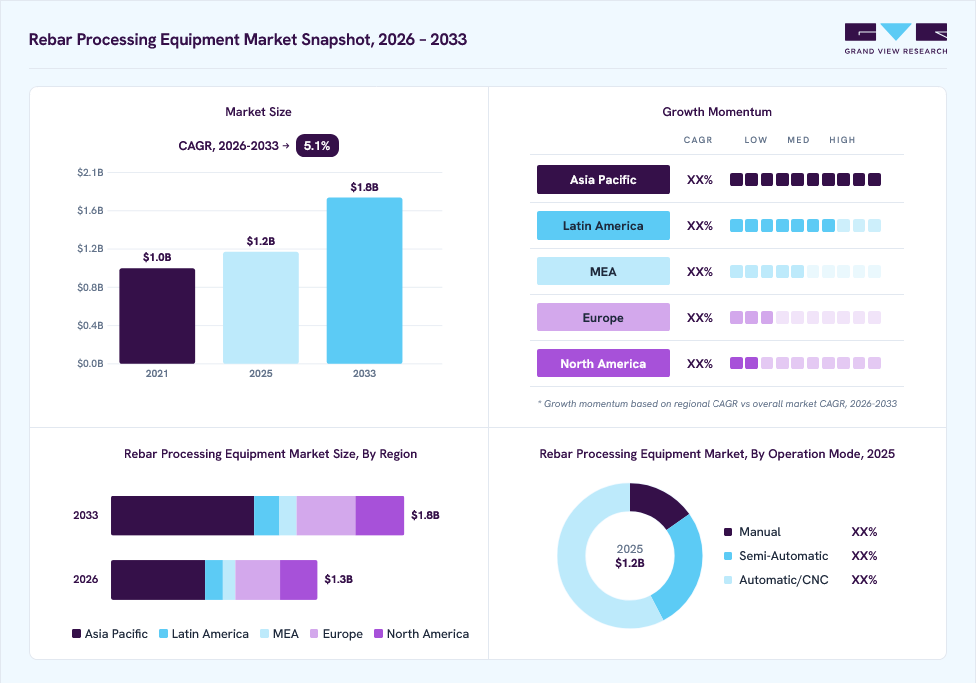
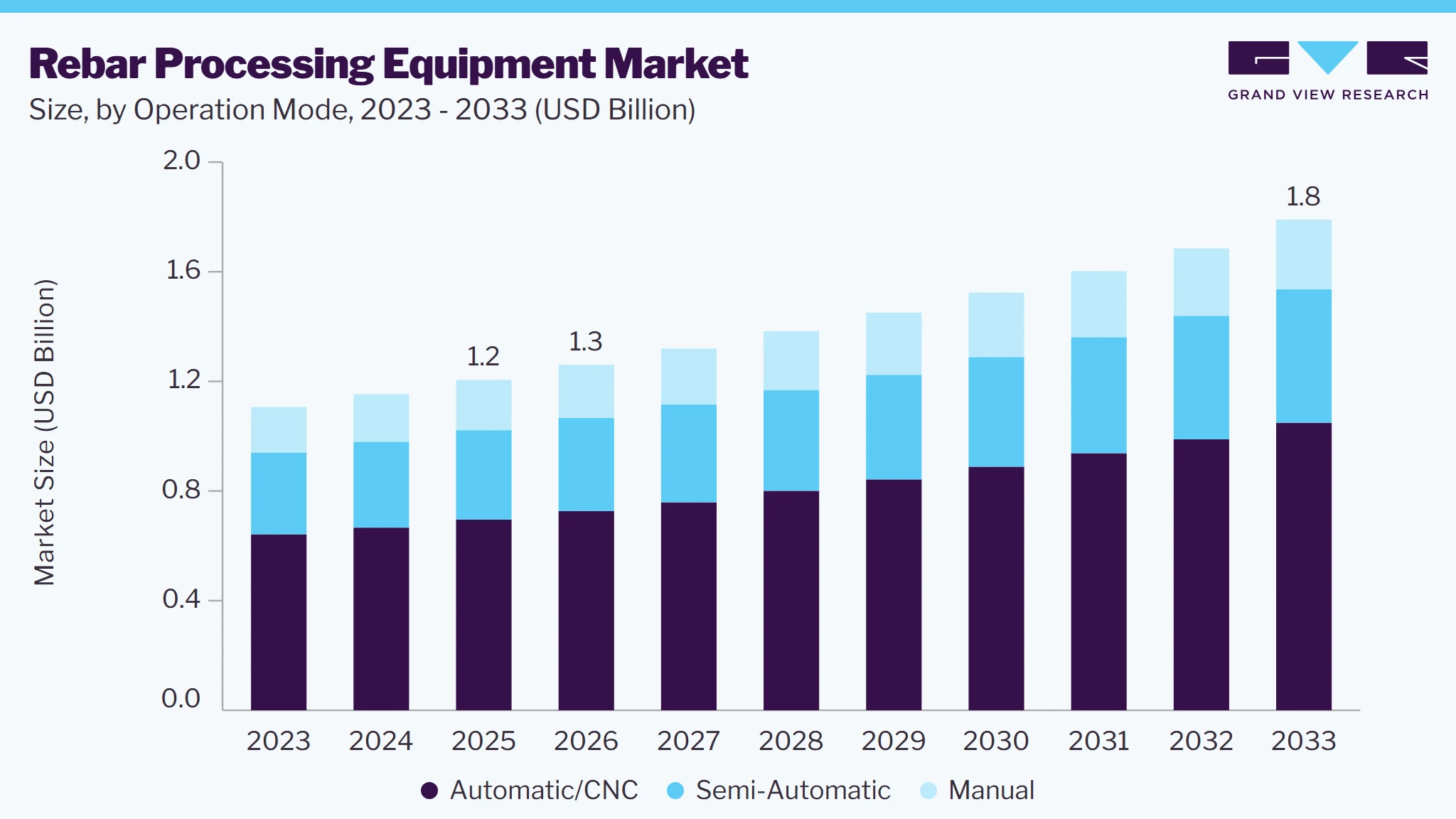
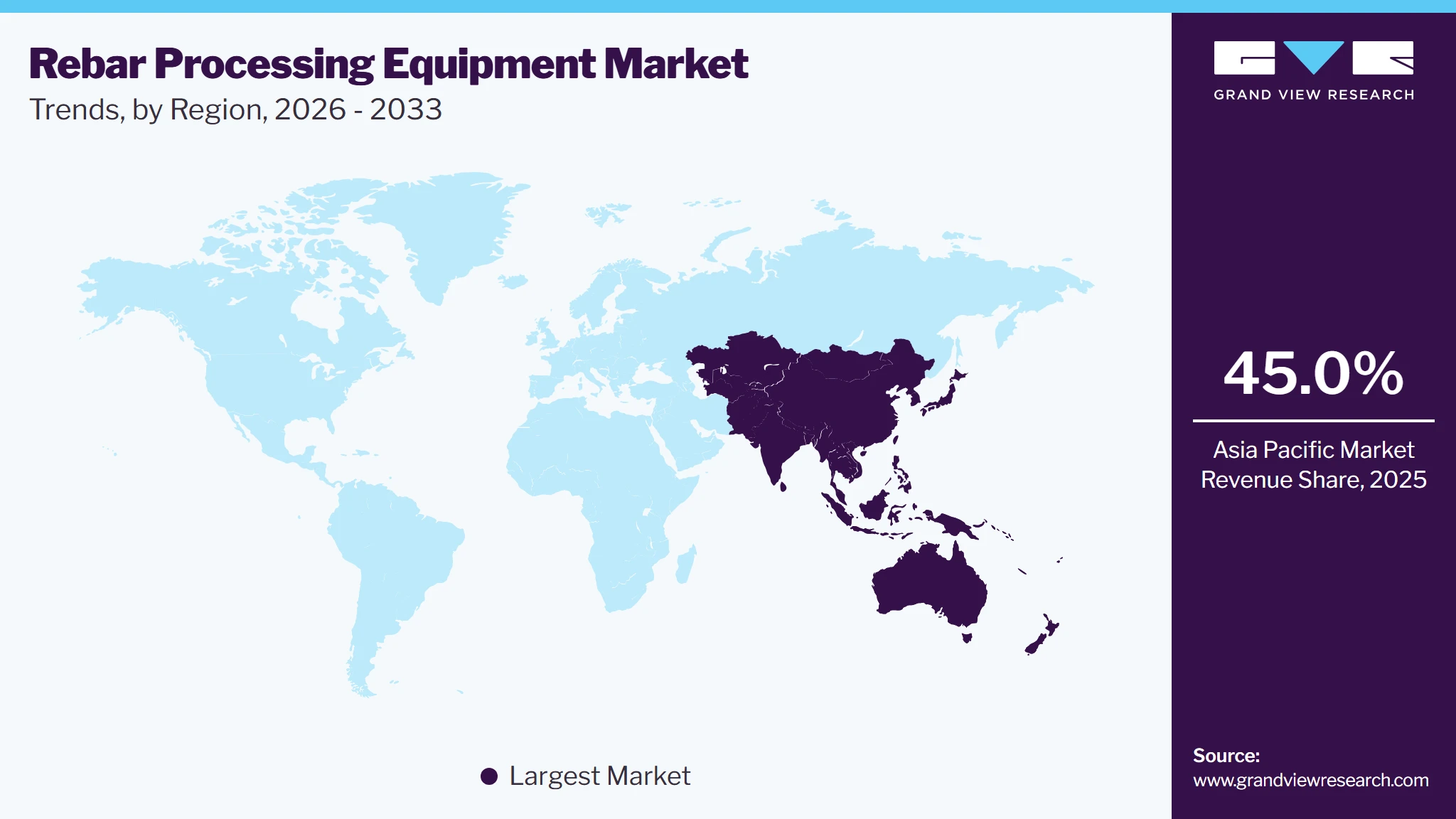
The global rebar processing equipment market size was valued at USD 1.2 billion in 2025 and is projected to grow from USD 1.3 billion in 2026 to USD 1.8 billion by 2033, at a CAGR of 5.1% from 2026 to 2033. Asia Pacific dominated the market with the largest revenue share of 45.0% in 2025. The market is driven by the expansion of infrastructure and building construction, particularly projects involving reinforced-concrete structures such as bridges, highways, railways, commercial buildings, and residential developments.
Key Market Trends & Insights
- By equipment type: The cutting/shearing equipment segment is projected to grow at 6.0% CAGR during the forecast period.
- By operation mode: The automatic/CNC segment dominated the market in 2025, accounting for 57.7% market share.
- By end use: The steel product/rebar fabricators segment is expected to grow at a CAGR of 5.4% from 2026 to 2033.
Regional Highlights
- Largest regional market: Asia Pacific (45.0% revenue share, 2025)
- By country: China held the largest share in the Asia Pacific region in 2025.
Market Size & Forecast
- Market Size in 2025: USD 1.2 Billion
- Estimated Market Size in 2026: USD 1.3 Billion
- Projected Market Size by 2033: USD 1.8 Billion
- CAGR (2026-2033): 5.1%
Large-scale projects require substantial quantities of accurately fabricated reinforcing bars, increasing the need for dedicated machinery capable of cutting, bending, straightening, stirrup forming, and related processing operations at fabrication facilities. In addition, the growing emphasis on labor productivity and fabrication accuracy is encouraging rebar processors to replace manual methods with CNC-controlled and automated equipment. Automated machines can improve dimensional precision, reduce material wastage, standardize repetitive bending and cutting operations, and increase fabrication output. These benefits are particularly relevant for contractors and rebar fabricators managing complex reinforcement schedules and high-volume orders.Market Dynamics
The market is influenced by changes in reinforcement fabrication practices, equipment replacement patterns, and the increasing requirement for processed reinforcement components. Demand encompasses machinery used for bar cutting, bending, straightening, decoiling, stirrup forming, and related processing activities. Market conditions, therefore, vary according to the type of reinforcement component being produced, fabrication method, equipment configuration, and investment cycle of rebar-processing facilities.
The use of cut, bent, and formed reinforcement components, prepared before delivery to construction sites, is driving demand for dedicated rebar processing machinery. Prefabrication enables reinforcement to be produced in specified lengths, shapes, and dimensions before installation, increasing the need for equipment capable of producing standardized reinforcement components at fabrication facilities. This trend is particularly relevant to projects involving repetitive reinforcement designs and extensive use of prefabricated rebar assemblies.
The relatively durable construction of rebar processing machinery can extend equipment service periods and defer replacement purchases. Fabricators may continue operating existing cutters, benders, straighteners, and stirrup machines as long as their processing capabilities remain suitable for current requirements. Consequently, replacement demand can be concentrated around equipment reaching the end of its usable life, changes in processing specifications, or requirements that existing machinery cannot meet.
Integrating multiple processing functions into a single production line enables equipment manufacturers to meet the evolving requirements of large-scale rebar fabrication facilities. Systems that combine decoiling, straightening, cutting, bending, and forming can reduce intermediate handling between processing stages and enable more continuous fabrication workflows. This provides scope for suppliers to expand from individual machines toward integrated processing solutions and capture higher-value equipment projects.
Market Concentration & Characteristics
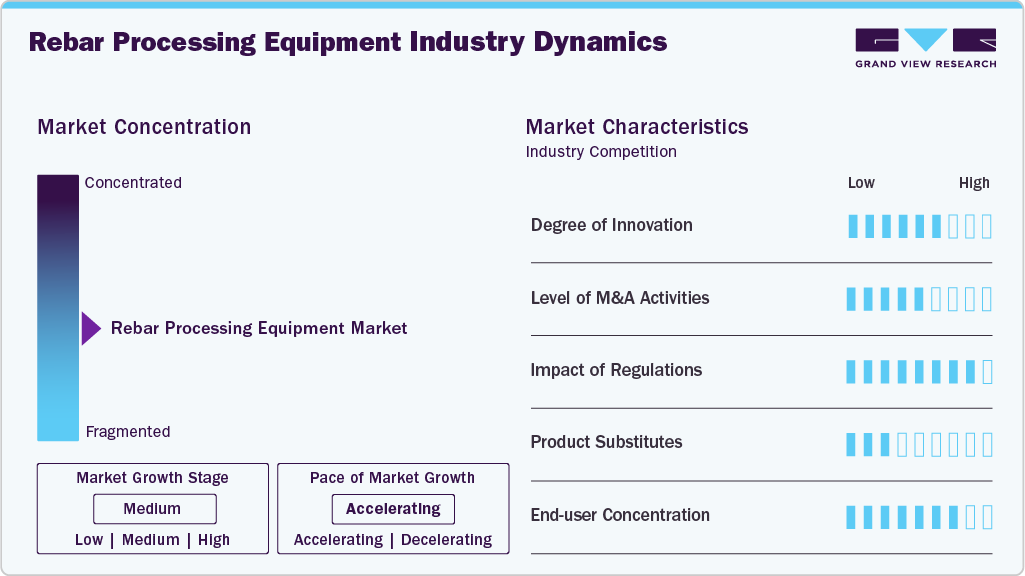
The rebar processing equipment industry exhibits a moderately fragmented competitive landscape, with international manufacturers and regional suppliers competing across equipment categories and levels of processing integration. Companies with broader portfolios participate across cutting, bending, straightening, stirrup forming, and automated processing systems, whereas specialized suppliers concentrate on individual processing functions. The competitive structure, therefore, varies by equipment category, degree of integration, and geographic presence.
Technology differentiation is an important characteristic of the market, with competition extending beyond basic machine functionality to automation, processing precision, throughput, bar-size compatibility, and programmable operation. CNC-based controls, automated material handling, multi-function processing, and integrated production lines differentiate higher-specification equipment from conventional standalone machines. These characteristics influence the suitability of equipment for different fabrication volumes and reinforcement-processing configurations.
From a market-structure perspective, demand is split between standalone equipment and integrated processing systems. Standalone cutters, benders, straighteners, and stirrup machines address individual fabrication requirements, while integrated systems combine multiple processing stages for higher-volume operations. Suppliers consequently compete on equipment performance, configuration flexibility, customization, installation, technical support, and after-sales service, with competitive positioning varying with the scope and sophistication of their product offerings.
Analyst Perspective
The rebar processing equipment market presents a diverse competitive environment shaped by differences in regional construction practices, fabrication models, and equipment investment patterns. Established manufacturers with extensive engineering capabilities compete alongside regional suppliers that address specific machine categories and price points. In the near to medium term, market positioning is likely to depend on manufacturers' ability to align equipment offerings with local fabrication practices, project specifications, and investment requirements, while maintaining reliable service and technical support. This creates scope for both established suppliers to deepen their market presence and specialized manufacturers to expand within targeted equipment and geographic segments.
Equipment Type Insights
The bending equipment segment accounted for the largest revenue share of 57.7% in 2025. Its substantial revenue contribution reflects the broad demand for bending operations in preparing reinforcement bars for specified structural configurations. Bending equipment is used across a range of applications involving shaped bars, stirrups, hooks, and other reinforcement geometries, underscoring its significant position within the equipment-type segment.
Cutting/shearing equipment is projected to register the fastest CAGR during the forecast period. These machines serve the fundamental requirement of reducing reinforcement bars to specified lengths before subsequent fabrication or construction activities. Demand for the segment is linked to the ongoing need for prepared reinforcement bars across various project specifications, while improvements in machine capacity, feeding mechanisms, and cutting configurations can further broaden their use in rebar-processing operations.
Operation Mode Insights
The automatic/CNC segment accounted for the largest revenue market share in 2025. Its position reflects the higher-value nature of computer-controlled equipment and its suitability for applications requiring programmed processing sequences, consistent machine operation, and precise execution of specified rebar configurations. These systems are particularly relevant to fabrication operations where repeatable production and controlled machine settings are important.
The semi-automatic segment is projected to grow at a CAGR of 5.2% during the forecast period. Its growth reflects demand for mechanized processing while retaining operator involvement in activities such as material handling, machine setup, and process adjustments. This operating configuration provides fabricators with greater mechanization than conventional manual equipment while avoiding the full investment and operational requirements associated with fully automated systems. The operation-based segmentation of the market also distinguishes semi-automatic and fully automatic equipment as separate categories.
End-use Insights
The construction & engineering contractors segment accounted for the largest revenue share of 48.4% in 2025. The segment’s substantial contribution is associated with the direct requirement for equipment across construction and infrastructure activities where reinforcement bars are prepared to project-specific lengths, shapes, and configurations. Contractors may use equipment for project-specific fabrication requirements and for dedicated reinforcement-processing operations. This end-user category is consistently identified as a distinct segment in market industry classifications.
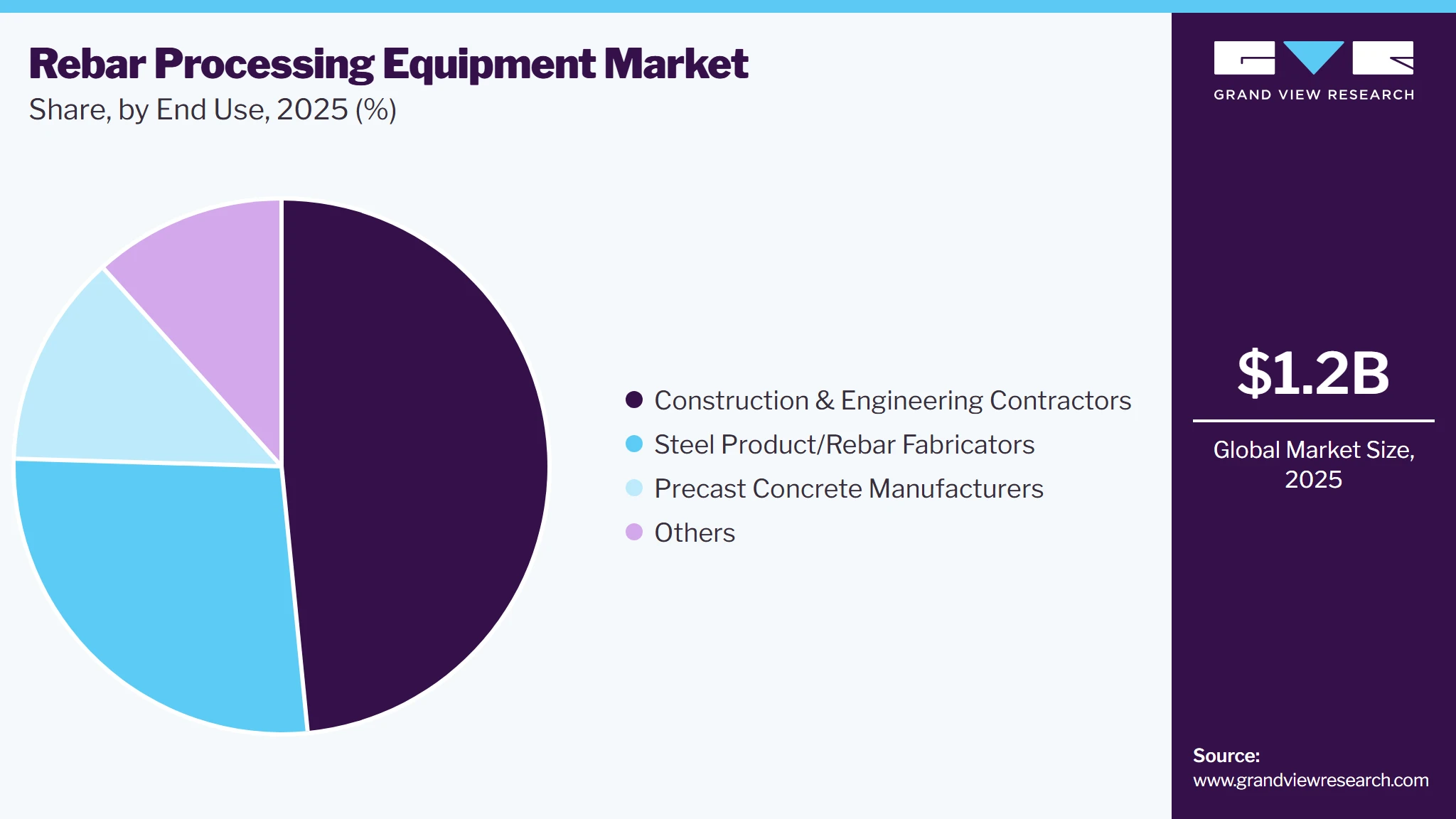
The steel product/rebar fabricators segment is projected to register the fastest CAGR during the forecast period. Its expansion is linked to the growing role of specialized steel manufacturers and rebar fabricators in converting reinforcing steel into processed components before delivery to construction sites. These facilities require dedicated machinery for cutting, bending, shearing, decoiling, and straightening, creating demand for equipment across different stages of reinforcement preparation. The segment is also explicitly recognized as a separate end-user category in current market research classifications.
Regional Insights
Asia Pacific accounted for the largest regional share of the rebar processing equipment market, with 45.0% of global revenue in 2025. The scale of construction activity influences the region’s market structure, the size of reinforcement steel fabrication operations, and varying levels of mechanization across countries. Demand is distributed between standalone and automated equipment, with purchasing requirements varying with fabrication capacity, processing volumes, and the degree of integration within rebar-processing facilities.
China Rebar Processing Equipment Market Trends
The rebar processing equipment market in China is projected to grow at a CAGR of 7.0% during the forecast period. Growth is associated with the country’s extensive construction and infrastructure base, substantial reinforcement steel processing activity, and established manufacturing ecosystem for metalworking and construction-related machinery. Demand spans bending, cutting, shearing, straightening, and automated rebar-processing equipment, with larger fabrication operations supporting the adoption of higher-capacity and integrated systems.
India rebar processing equipment marketalso presents a significant market within the Asia Pacific, with equipment demand influenced by infrastructure development, urban construction, and the expansion of organized reinforcement fabrication. The gradual shift toward dedicated rebar-processing facilities is increasing the requirements for machinery capable of producing reinforcement components to specified dimensions and configurations. This market includes opportunities across both semi-automatic equipment used by smaller fabricators and higher-capacity systems deployed in more structured fabrication operations.
North America Rebar Processing Equipment Market Trends
The rebar processing equipment market in North America is characterized by an established base of equipment, with market activity influenced by infrastructure investment, building construction, fabrication capacity, and the replacement of installed machinery. The region has a developed network of construction contractors and specialized rebar fabricators, resulting in demand for equipment across different stages of reinforcement preparation. Replacement and modernization requirements are particularly relevant where existing machinery reaches the end of its service life or no longer meets current fabrication specifications.
The U.S. rebar processing equipment marketis the principal equipment market in North America, with demand driven by transportation infrastructure, commercial buildings, residential construction, and industrial facilities. The scale and diversity of construction projects necessitate different equipment configurations, while established rebar fabrication operations create a recurring market for machinery replacement and capacity additions.
The rebar processing equipment market in Canadaoffers opportunities through infrastructure development, residential and commercial construction, and industrial projects. Equipment demand is driven by the requirements of regional rebar fabricators and contractors, with purchasing activity spanning individual bending and cutting machines, as well as equipment to expand existing processing capabilities.
Europe Rebar Processing Equipment Market Trends
The rebar processing equipment market in Europe is mature, characterized by an established installed base, developed reinforcement fabrication practices, and ongoing equipment modernization. Market opportunities are influenced by replacement cycles, renovation and infrastructure activity, and requirements for improved fabrication configurations. The presence of experienced rebar equipment manufacturers within the region also contributes to a competitive environment spanning individual machines, specialized equipment, and integrated processing systems.
Germany rebar processing equipment marketis supported by infrastructure construction, commercial development, industrial projects, and residential building activity. Its established fabrication and engineering ecosystem creates demand for rebar processing machinery across cutting, bending, straightening, and forming applications. Equipment replacement and modernization are important components of ongoing market activity.
The rebar processing equipment market in Franceoffers opportunities associated with infrastructure development, residential and commercial construction, and renovation projects. Demand is distributed among contractors and dedicated reinforcement fabricators, resulting in requirements for equipment with different processing capacities and configurations. The replacement of existing machinery and the expansion of fabrication capabilities further contribute to equipment demand.
Middle East & Africa Rebar Processing Equipment Market Trends
The rebar processing equipment market in MEA is developing, with demand driven by large-scale infrastructure programs, urban development, residential construction, and commercial projects. The regional market differs from mature equipment markets in that procurement can be closely linked to individual project requirements and to the development of local reinforcement fabrication capacity. This creates opportunities for both standalone machinery and higher-capacity equipment used in dedicated fabrication operations.
Saudi Arabia rebar processing equipment marketis an important market in the region, with extensive infrastructure, urban development, commercial construction, and industrial projects that generate demand for processed reinforcement steel. The development of construction-related fabrication capabilities creates opportunities for bar-cutting, bending, shearing, straightening, and stirrup-forming equipment, particularly for operations that serve large project requirements.
Latin America Rebar Processing Equipment Market Trends
The rebar processing equipment market in Latin America is project-oriented, with demand driven by infrastructure development, housing construction, commercial projects, and industrial building activity. Market requirements vary with the maturity of local reinforcement fabrication networks and the extent to which rebar preparation is performed in dedicated fabrication facilities. This creates demand for both individual processing machines and equipment for expanding existing fabrication capacity.
Brazil rebar processing equipment market is an important segment in Latin America, supported by infrastructure, residential, commercial, and industrial construction. Its established construction and steel-processing activities create applications for machinery used to cut, bend, shear, straighten, and form reinforcement steel. Equipment replacement and additions to fabrication capacity provide further opportunities as rebar-processing requirements vary across construction projects and fabrication facilities.
Key Rebar Processing Equipment Company Insights
Some of the key players operating in the market include Schnell S.p.A. and PEDAX GmbH, among others.
-
Schnell S.p.A. is an Italy-based manufacturer specializing in machinery and automated systems for reinforcement steel processing. Its portfolio includes equipment for rebar cutting, bending, straightening, stirrup forming, and bar shaping, as well as systems for producing reinforcement mesh and cages. The company also provides automated and robotic processing solutions that support continuous, high-volume rebar fabrication, positioning it across multiple stages of reinforcement steel production.
-
PEDAX GmbH is a Germany-based manufacturer specializing in reinforcement steel processing machinery. Its portfolio covers rebar cutting, bending, stirrup forming, coil straightening, and reinforcement mesh processing, as well as equipment for automated rebar fabrication. The company offers both individual processing machines and integrated systems, addressing requirements across rebar bending operations and higher-volume reinforcement fabrication facilities.
Key Rebar Processing Equipment Companies
The following key companies have been profiled for this study on the rebar processing equipment market:
-
Schnell S.p.A.
-
PEDAX GmbH
-
MEP Group
-
Progress Maschinen & Automation AG
-
EVG Entwicklungs- und Verwertungs-Gesellschaft m.b.H.
-
Eurobend GmbH
-
SIMPEDIL S.r.l.
-
TJK Machinery (Tianjin) Co., Ltd.
-
A.W.M. S.p.A.
-
Toyo Kensetsu Kohki Co., Ltd.
-
Gensco Equipment Inc.
-
Jaypee India Limited
-
KRB Machinery
-
Spartan Engineering Industries Pvt. Ltd.
-
Henan Sinch Machinery Co., Ltd.
Competitive Benchmarking
Category
Operating Strategies
Competitive Edge
Weakness
Established Players (e.g., Schnell S.p.A.; PEDAX GmbH; MEP Group; Progress Maschinen & Automation AG; EVG Entwicklungs- und Verwertungs-Gesellschaft m.b.H.; Eurobend GmbH; SIMPEDIL S.r.l.)
- Expand portfolios across rebar cutting, bending, straightening, stirrup forming, decoiling, and integrated processing lines.
- Improve machine automation, processing throughput, controls, and integration across multiple rebar fabrication stages.
- Broad equipment coverage enables suppliers to serve multiple rebar processing requirements through integrated or complementary machine solutions.
- Established engineering expertise supports high-volume fabrication applications and complex processing-line requirements.
- Higher capital requirements for advanced and integrated rebar processing systems can constrain adoption among smaller fabricators.
- Large processing lines may require greater installation space and more extensive commissioning than standalone machines.
Emerging & Regional Players (e.g., TJK Machinery (Tianjin) Co., Ltd.; A.W.M. S.p.A.; Toyo Kensetsu Kohki Co., Ltd.; Gensco Equipment Inc.; Jaypee India Limited; KRB Machinery; Spartan Engineering Industries Pvt. Ltd.; Henan Sinch Machinery Co., Ltd.)
- Focus on bar cutters, bar benders, stirrup benders, straightening, decoiling, and other standalone or semi-automated rebar processing machines.
- Emphasize cost-efficient designs and configurations tailored to specific bar sizes and fabrication requirements.
- Focused machine offerings allow customers to upgrade individual rebar processing stages without investing in complete automated lines.
- Flexible configurations can address varying production volumes and machine requirements across rebar fabrication facilities.
- Narrower integrated-line capabilities can limit participation in projects requiring end-to-end automated rebar processing.
- Smaller product portfolios may provide fewer options for customers seeking multiple processing functions from a single supplier.
Recent Developments
-
In June 2026, GUTE Machinery introduced the SGWZ16D CNC straight rebar bending machine, designed to process steel bars up to 16 mm in diameter. The machine incorporates an optimized feeding mechanism, continuous bar connection technology, and enhanced safety features to ensure precise, consistent rebar processing. The introduction strengthens the company’s portfolio of CNC-based rebar processing solutions and broadens its equipment offering for construction and reinforcement steel fabrication applications.
-
In February 2025, MEP, a Wise Equity portfolio company and an OEM in downstream rebar processing machinery, acquired a majority stake in Promostar, an Italian manufacturer specializing in upstream plants for the cold processing of steel wire and rods. By integrating Promostar's cold rolling, stretching, and respooling technologies with MEP's downstream cutting, bending, and stirrup-forming equipment, the unified entity creates a comprehensive, end-to-end machinery ecosystem for global steel mills, cut-and-bend facilities, and precast concrete producers.
Rebar Processing Equipment Market Report Scope
Report Attribute
Details
Market size in 2025
USD 1.2 billion
Estimated market size in 2026
USD 1.3 billion
Projected market size by 2033
USD 1.8 billion
Growth rate
CAGR of 5.1% from 2026 to 2033
Historical data
2021 - 2025
Forecast period
2026 - 2033
Quantitative units
Revenue in USD billion, and CAGR from 2026 to 2033
Report coverage
Revenue forecast, company market position analysis, competitive landscape, growth factors, and trends
Segments covered
Equipment type, operation mode, end-use, region
Regional scope
North America; Europe; Asia Pacific; Latin America; MEA
Country Scope
U.S.; Canada; Mexico; Germany; UK; Italy; Spain; France; China; Japan; India; Australia; South Korea; Brazil; Argentina; Saudi Arabia; UAE; South Africa
Key companies profiled
Schnell S.p.A.; PEDAX GmbH; MEP Group; Progress Maschinen & Automation AG; EVG Entwicklungs- und Verwertungs-Gesellschaft m.b.H.; Eurobend GmbH; SIMPEDIL S.r.l.; TJK Machinery (Tianjin) Co., Ltd.; A.W.M. S.p.A.; Toyo Kensetsu Kohki Co., Ltd.; Gensco Equipment Inc.; Jaypee India Limited; KRB Machinery; Spartan Engineering Industries Pvt. Ltd.; Henan Sinch Machinery Co., Ltd.
Customization scope
Free report customization (equivalent up to 8 analysts working days) with purchase. Addition or alteration to country, regional & segment scope.
Pricing and purchase options
Avail customized purchase options to meet your exact research needs. Explore purchase options
Global Rebar Processing Equipment Market Report Segmentation
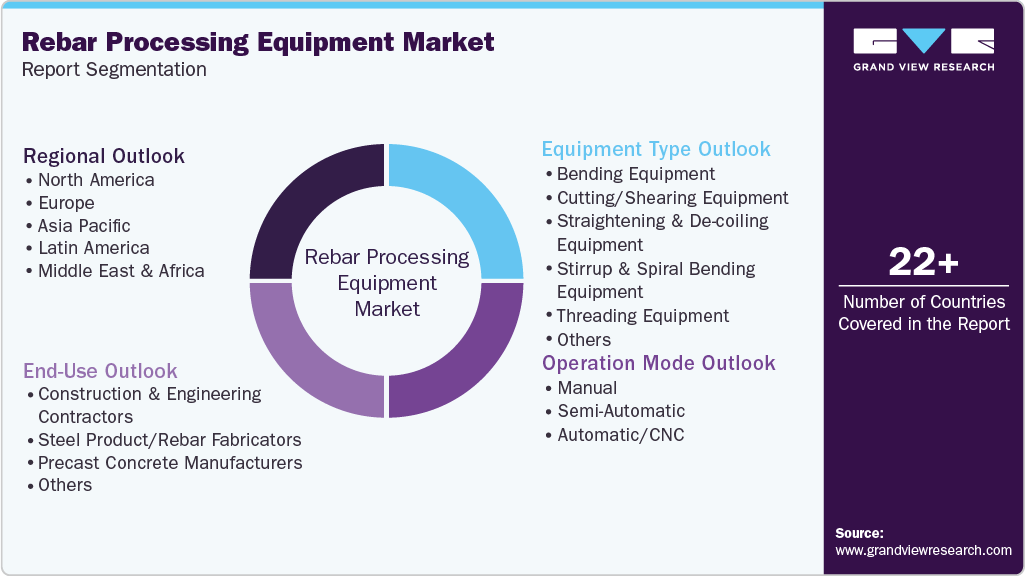
This report forecasts revenue growth at global, regional & country levels and provides an analysis of the industry trends in each of the sub-segments from 2021 to 2033. For this study, Grand View Research has segmented the global rebar processing equipment market based on equipment type, operation mode, end-use, and region:
-
Equipment Type Outlook (Revenue, USD Billion, 2021 - 2033)
-
Bending Equipment
-
Cutting/Shearing Equipment
-
Straightening & De-coiling Equipment
-
Stirrup & Spiral Bending Equipment
-
Threading Equipment
-
Others
-
-
Operation Mode Outlook (Revenue, USD Billion, 2021 - 2033)
-
Manual
-
Semi-Automatic
-
Automatic/CNC
-
-
End-use Outlook (Revenue, USD Billion, 2021 - 2033)
-
Construction & Engineering Contractors
-
Steel Product/Rebar Fabricators
-
Precast Concrete Manufacturers
-
Others
-
-
Regional Outlook (Revenue, USD Billion, 2021 - 2033)
-
North America
-
U.S.
-
Canada
-
Mexico
-
-
Europe
-
Germany
-
France
-
UK
-
Spain
-
Italy
-
-
Asia Pacific
-
China
-
India
-
Japan
-
South Korea
-
Australia
-
-
Latin America
-
Brazil
-
Argentina
-
-
Middle East & Africa
-
Saudi Arabia
-
UAE
-
South Africa
-
-
Research Methodology
The rebar processing equipment market figures in this report are based on a proven research process that combines executive interviews with secondary research from proprietary databases, company filings, and recognized regulatory and institutional sources. Market size is built through value-chain sizing-reconciling supply-side and demand-side estimates-and triangulated with bottom-up and top-down approaches. Every estimate passes multiple levels of expert validation before publication, with each rebar processing equipment segment quantified using the revenue-capture definitions in the table below.
Segment Definition
Equipment Type
Revenue Capture Definition
Bending Equipment
Revenue generated from the sale of rebar processing equipment for bending reinforcing steel bars into specified angles, radii, shapes, and configurations, including bar bending machines, stirrup benders, and related bending systems.
Cutting/Shearing Equipment
Revenue generated from the sale of rebar processing equipment for cutting and shearing reinforcing steel bars into specified lengths, including rebar cutting machines, bar shearing machines, and automated cutting systems.
Straightening & De-coiling Equipment
Revenue generated from the sale of rebar processing equipment for straightening and de-coiling reinforcing steel bars supplied in coils, including wire and bar straightening machines, de-coilers, and combined straightening and cutting systems.
Stirrup & Spiral Bending Equipment
Revenue generated from the sale of rebar processing equipment for producing stirrups, spirals, hoops, rings, and other shaped reinforcement components, including automatic stirrup bending machines and spiral bending machines.
Threading Equipment
Revenue generated from the sale of rebar processing equipment for threading or forming threaded ends on reinforcing steel bars, including rebar threading machines and equipment used for mechanical coupler and splice applications.
Others
Revenue generated from the sale of rebar processing equipment for other specialized rebar fabrication and processing operations, including rebar end-finishing equipment, rebar marking and measuring equipment, and other specialized processing systems.
Operation Mode
Revenue Capture Definition
Manual
Revenue generated from the sale of manually operated rebar processing equipment that requires direct operator involvement for material feeding, positioning, and processing.
Semi-Automatic
Revenue generated from the sale of semi-automatic rebar processing equipment that combines operator-controlled material handling or setup with automated processing functions such as cutting, bending, straightening, or forming.
Automatic/CNC
Revenue generated from the sale of fully automatic or CNC-controlled rebar processing equipment capable of automatically executing programmed cutting, bending, forming, threading, or other processing operations with limited operator intervention.
Others
Revenue generated from the sale of manually operated rebar processing equipment that requires direct operator involvement for material feeding, positioning, and processing.
End Use
Revenue Capture Definition
Construction & Engineering Contractors
Revenue generated from the sale of rebar processing equipment for construction and engineering contractors, including contractors involved in residential, commercial, industrial, infrastructure, and civil construction projects.
Steel Product/Rebar Fabricators
Revenue generated from the sale of rebar processing equipment for steel equipment type and rebar fabrication companies, including rebar cutting, bending, forming, threading, and prefabrication facilities supplying processed reinforcement steel to construction projects.
Precast Concrete Manufacturers
Revenue generated from the sale of rebar processing equipment for precast concrete manufacturers, including producers of precast beams, columns, panels, pipes, slabs, piles, and other reinforced or prestressed concrete equipment types.
Others
Revenue generated from the sale of rebar processing equipment for other end-use industries and users, including steel service centers and distributors, equipment rental and leasing companies, and steel producers
Estimation Model
Layer Name
Key Question
Description
Construction Activity Layer
What creates the underlying requirement for rebar processing?
Analyze residential, commercial, industrial, and infrastructure construction activity, reinforced concrete usage, construction project pipelines, and public and private investment across major markets. Assess construction intensity and rebar consumption patterns to establish the underlying volume of reinforcement steel requiring processing.
Rebar Fabrication Capacity Layer
Where is rebar processing activity concentrated?
Evaluate rebar fabrication plants, steel service centers, construction contractors, reinforcement prefabrication facilities, and captive processing operations. Examine installed processing capacity, facility additions, equipment type expansion, and modernization programs to identify locations and customer groups with recurring machinery requirements.
Technology & Equipment Adoption Layer
Which rebar processing technologies and configurations are being adopted?
Assess the adoption of cutting machines, bending machines, stirrup bending machines, straightening machines, and integrated automated processing lines. Compare equipment utilization based on bar diameter, processing volume, automation level, machine configuration, labor requirements, equipment type, and flexibility, and replacement cycles. Evaluate the shift from manual and standalone equipment toward automated and digitally controlled systems where applicable.
Revenue Conversion Layer
How is equipment demand converted into market revenue?
Estimate annual equipment shipments across equipment type types, applications, end uses, and geographic markets. Apply equipment-specific pricing benchmarks to shipment volumes to derive market revenue. Incorporate purchases associated with new fabrication facilities, capacity additions, equipment replacement, plant modernization, and upgrades to existing processing systems to capture the overall revenue opportunity.
Customization Table
Client Request
Customization Delivered
Value Adds
Competitive Benchmarking
A comparative analysis was conducted across key rebar processing equipment manufacturers, evaluating product portfolios, equipment types, processing ranges, cutting and bending capacities, automation levels, production throughput, machine configurations, control technologies, and service capabilities. Manufacturer offerings were assessed to identify differences in product breadth, technical capabilities, automation positioning, and application coverage.
The analysis enables clients to benchmark their offerings against competing equipment manufacturers, identify underserved equipment and capability areas, assess competitive positioning, and determine opportunities for portfolio enhancement and differentiation.
Regional Segmentation
Regional market analysis was conducted by mapping rebar processing equipment demand against construction activity, infrastructure development, rebar fabrication capacity, equipment replacement requirements, and adoption of automated processing systems. Regional markets were evaluated based on application mix, processing requirements, equipment adoption, and underlying construction and infrastructure activity.
The analysis provides a comparative view of regional market attractiveness, identifies differences in equipment requirements and adoption patterns, and supports prioritization of geographic markets based on demand potential and development conditions.
Opportunity Assessment
An opportunity analysis was conducted across rebar cutting, bending, straightening, and integrated processing equipment by examining equipment replacement cycles, fabrication facility expansion, automation adoption, processing capacity requirements, and demand for higher-equipment typeivity systems. Opportunities were assessed across equipment categories and end-use applications to identify areas with stronger commercial potential.
The assessment helps clients prioritize opportunities by equipment type and application, identify areas for equipment type and technology development, evaluate expansion potential, and allocate resources toward market segments offering stronger commercial prospects.
About the Author(s)
Advanced Interior Materials Research Team
Advanced Materials · Advanced Interior MaterialsThis report was authored by the advanced interior materials research team at Grand View Research - comprising two research analysts, one senior research analyst, and one industry expert - with specialized expertise in the advanced interior materials segment of the advanced materials industry. All findings are based on proprietary advanced materials databases, executive interviews, and regulatory analysis, subject to internal peer review prior to publication.
Last Updated:
Speak to Analyst


Customize this report to your needs — add regions, segments, or data points, with 20% free customization.
Or view our licence options:


ISO 9001:2015 & 27001:2022 Certified
We are GDPR and CCPA compliant! Your transaction & personal information is safe and secure. For more details, please read our privacy policy.


