
- Home
- »
- Plastics, Polymers & Resins
- »
-
Redispersible Polymer Powder Market Size Report, 2033GVR Report cover

Redispersible Polymer Powder Market (2026 - 2033)
Size, Share & Trends Analysis Report By Type (VAE (Vinyl Acetate Ethylene), VeoVA (Vinyl Ester of Versatic Acid), By End-use (Residential, Commercial, Industrial), By Application, By Region, And Segment Forecasts
Market Size, 2025
$800.7MMarket Estimate, 2026
$851.3MMarket Forecast, 2033
$1,519.6MCAGR, 2026–2033
8.6%Redispersible Polymer Powder Market Summary
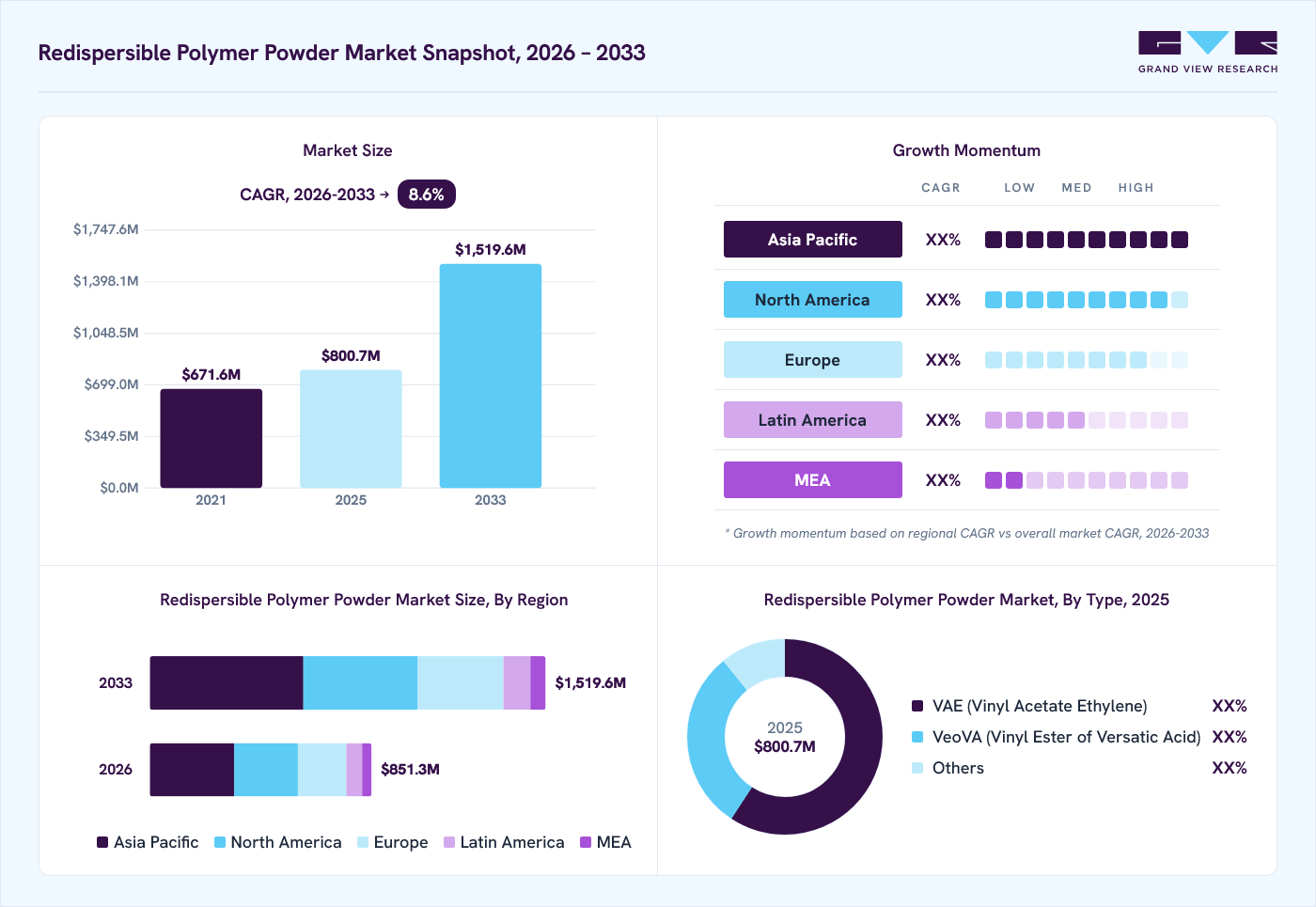
The global redispersible polymer powder market size was valued at USD 800.7 million in 2025 and is projected to grow from USD 851.3 million in 2026 to USD 1519.6 million by 2033, at a CAGR of 8.6% from 2026 to 2033 Asia Pacific dominated the global market, accounting for the largest revenue share of 38.01% in 2025. The construction industry's rapid growth, particularly in emerging economies, is a significant factor driving the redispersible polymer (RDP) powder industry.
 Source: Grand View Research, IR Documents, Primary Interviews, Paid DatabasesTo learn more about this report,
 Download Free Sample Report
 Key Market Trends & Insights
- By type: VAE segment led the market with the largest revenue share of 59.2% in 2025.
- By application: Insulation systems segment is expected to grow at the fastest CAGR of 9.6% from 2026 to 2033.
- By end use: Residential segment led the market with the largest revenue share of 57.5% in 2025.
Regional Highlights
- Largest regional market: Asia Pacific (38.01% revenue share, 2025)
- By country: The China redispersible polymer powder industry is a major contributor to the global market.
Market Size & Forecast
- Market size in 2025: USD 800.7 Million
- Estimated market size in 2026: USD 851.3 Million
- Projected market size by 2033: USD 1519.6 Million
- CAGR (2026-2033): 8.6%
Three ways to get this report
Buy it, customize it, or ask a question.Ask an Analyst
Analyst response in 1 business day
- AccessReport author, directly
- Reply timeWithin 1 working day
- No sales callDirect answer only
- FormatEmail reply
- CostFree, no cost
Get the Full Report
What the study covers
- FormatsPDF · Excel · Dashboard
- Timeline2026–2033 annual, 2025 base
- Coverage20+ countries, 5 regions
- Companies10+ key players profiled
Customize the Report
20% free customization
- IncludeCountries, segments, points
- TailorTo your product definition
- ExtendDeeper competitor detail
- OrA fully bespoke study
- Turnaround5–10 working days
RDP powder is widely used in cement-based products such as tile adhesives, plasters, and self-leveling compounds, enhancing their flexibility, water resistance, and adhesion. With increased urbanization and infrastructure development in regions like the Asia-Pacific, the demand for high-performance construction materials is soaring. For instance, China’s extensive infrastructure projects under initiatives like the Belt and Road Initiative are boosting the adoption of advanced construction chemicals, including RDP powders, to ensure quality and durability.
The rise in renovation and remodeling activities, particularly in developed markets like North America and Europe, is another critical driver. Consumers' growing preference for modern aesthetics and the need to upgrade aging infrastructure drive the demand for products such as waterproofing membranes, grouts, and renders, all of which benefit from RDP powders. For instance, the U.S. remodeling industry has seen steady growth driven by increased home improvement activity, further underscoring the need for high-quality polymer-modified construction materials.
 To learn more about this report, Download Free Sample Report
 RDP powders are increasingly being utilized beyond traditional construction applications, finding innovative uses in areas such as energy-efficient wall systems and precast concrete elements. The development of advanced building solutions, including thermal insulation systems, is creating new opportunities for RDP powders. These powders enhance the durability and energy performance of such systems, making them indispensable in modern building practices. Countries like India and Brazil, which are experiencing significant growth in affordable housing and urban infrastructure, are emerging as hotspots for these advanced applications.
Market Dynamics
The market for Redispersible Polymer (RDP) Powder is experiencing significant growth as the demand for dry-mix mortars, tile adhesives, wall putty, and repair compounds increases in both residential and infrastructure construction projects. RDP powders improve adhesion, flexibility, durability, and water resistance, making them vital components in contemporary construction recipes. The swift pace of urbanization and growing infrastructure investments, especially in developing countries, are also driving the rising demand for these products.
Moreover, the rising demand for ready-to-use construction materials and high-performance building solutions is driving market acceptance. Producers are increasingly developing sophisticated polymer formulations to align with evolving construction standards and application needs, further enhancing the potential for market growth.
The volatility in prices of petrochemical-derived raw materials remains a significant barrier for the RDP powder market. Changes in feedstock prices and disruptions in the supply chain directly influence production costs and pricing competitiveness. Additionally, the price-sensitive nature of construction markets and performance challenges under specific environmental conditions may hinder wider usage in budget-conscious applications.
Market Concentration & Characteristics
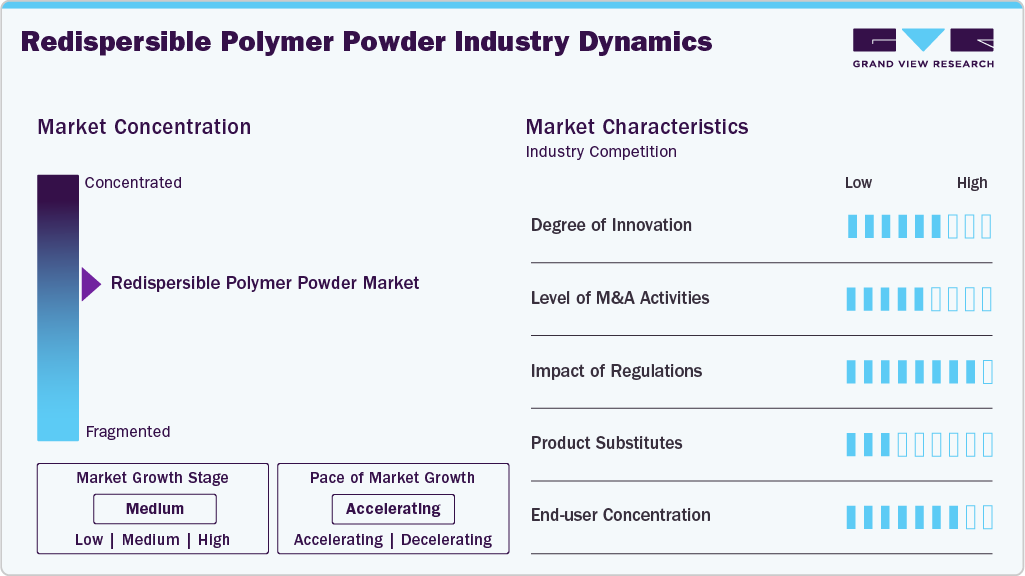
The market for redispersible polymer powder industry exhibits moderate to high levels of innovation, primarily driven by the need for optimized formulations and performance differentiation in construction applications such as EIFS, tile adhesives, and self-leveling screeds. Recent research and development efforts have concentrated on improving the dispersion of polymer particles, enhancing water retention, and reducing VOC emissions while still maintaining adhesion and durability. In addition, there is growing innovation in bio-based and sustainably sourced polymer chemistries, which aligns with the industry’s broader decarbonization goals.
Regulatory frameworks focused on environmental health and safety significantly impact the RPP landscape. Tighter emission regulations for construction chemicals in Europe and North America are compelling manufacturers to reformulate products toward low-VOC, low-hazard monomer systems, which increase compliance costs but also create higher barriers for less advanced producers. The Registration, Evaluation, Authorization and Restriction of Chemicals (REACH) requirements in the EU and similar chemical inventory obligations in APAC markets (such as China's IECSC) require more testing and documentation, thereby increasing the time it takes to bring products to market. At the same time, alternative products, such as liquid polymer binders, acrylic emulsions, and various dry-blend systems, create competitive pressure on traditional RPPs, especially when on-site handling simplicity is less crucial.
 To learn more about this report, Download Free Sample Report
 The adoption of RPP across end use sectors varies significantly by application and geographic location. The construction industry remains the leading sector, with substantial usage in tile adhesives, cement-based mortars, and external insulation finishing systems, thanks to RPP’s contribution to improved flexibility, adhesion, and freeze-thaw resistance. In the construction industry, uptake is greatest in urbanizing areas where building codes and performance specifications require enhanced polymer-modified systems. Conversely, industrial sectors such as specialty coatings, non-wovens, and maintenance compounds represent smaller yet consistently expanding segments of demand, influenced by specific performance needs.
Type Insights
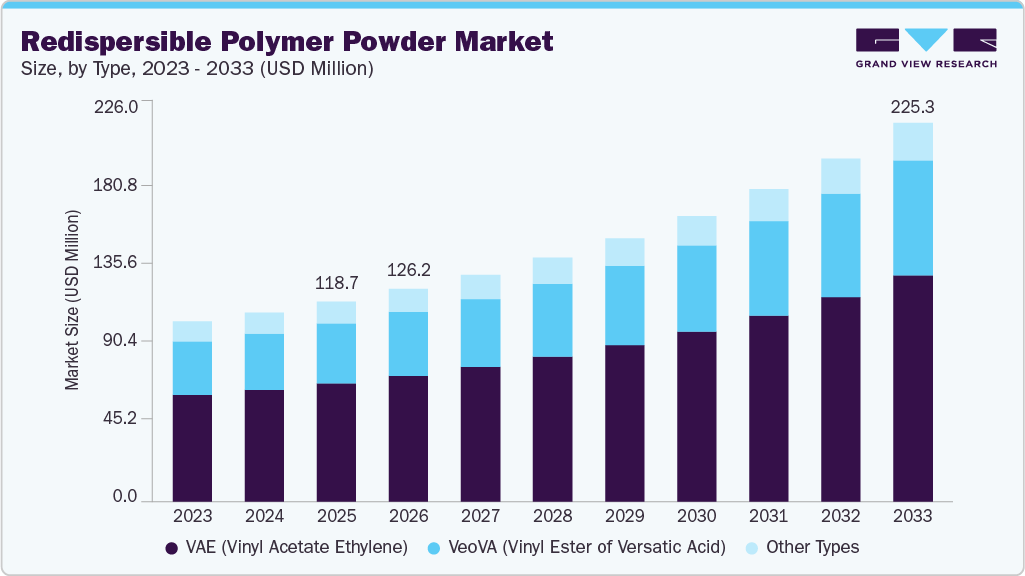
The VAE (Vinyl Acetate Ethylene) segment led the market with the largest revenue share of 59.18% in 2025. VAE-based redispersible polymer powders are widely used in construction applications due to their excellent adhesive strength, flexibility, and water resistance. They enhance the mechanical properties of cementitious and gypsum-based formulations, making them ideal for tile adhesives, self-leveling compounds, and exterior insulation and finishing systems (EIFS). VAE powders also exhibit superior compatibility with other additives and fillers, enabling easy integration into various construction materials.
VeoVA-based redispersible polymer powders are known for their superior hydrophobic properties and resistance to water and alkalis. These characteristics make them highly suitable for exterior applications such as façade renders, coatings, and waterproofing membranes. The growing focus on durability and weather-resistant construction solutions is driving the demand for VeoVA-based RDP powders.
End Use Insights
The residential segment led the market with the largest revenue share of 57.49% in 2025. This segment includes RDP powders used in construction activities such as residential buildings, apartments, and housing projects. These powders are widely used in applications such as tile adhesives, self-leveling compounds, repair mortars, and external thermal insulation systems (ETICS) to improve flexibility, bonding, and durability.
The commercial segment is expected to grow at the fastest CAGR of 8.9% during the forecast period. The commercial segment covers applications in offices, retail stores, shopping malls, hospitals, and educational institutions. Growth in commercial real estate investments, increased public infrastructure spending, and the expansion of urban commercial hubs are significant drivers of the commercial segment.
The industrial segment includes applications in factories, warehouses, and production facilities. RDP powders are employed in industrial construction for their ability to enhance the strength, chemical resistance, and thermal stability of construction materials. They are widely used in industrial flooring, concrete repair, and heavy-duty coatings. The rising demand for durable, low-maintenance industrial spaces, coupled with increased investment in manufacturing and logistics facilities, is driving the industrial segment.
Application Insights
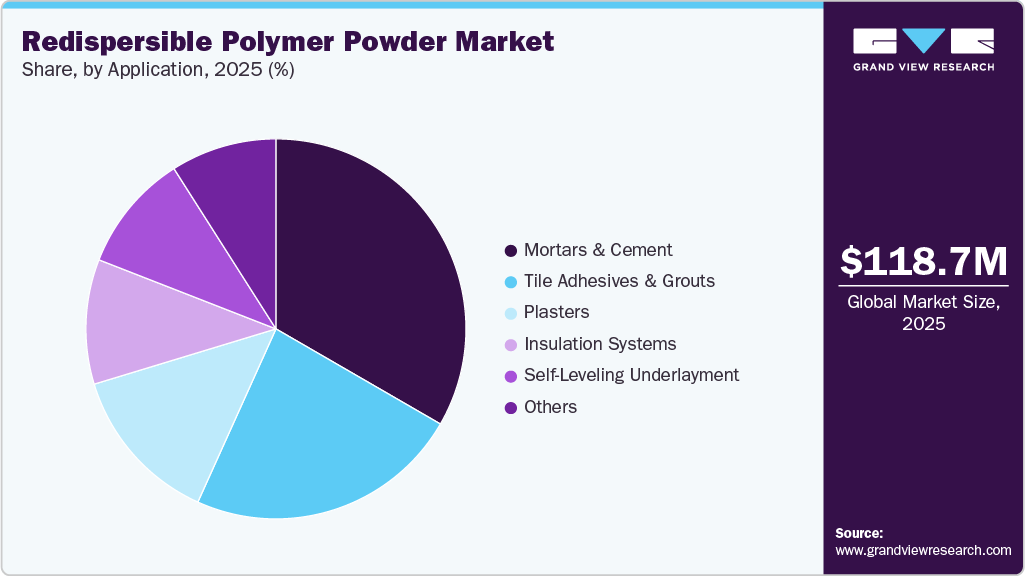
The mortars & cement segment led the market with the largest revenue share of 33.32% in 2025. Redispersible polymer (RDP) powders are extensively used in mortars and cement formulations to enhance workability, adhesion, and flexibility. They improve water retention, prevent cracking during drying, and enhance the binding of cement with aggregates. The growth of infrastructure development projects globally, especially in emerging economies, drives the demand for RDP powders in mortars and cement.
 To learn more about this report, Download Free Sample Report
 The insulation systems application segment is anticipated to grow at the fastest CAGR of 9.6% over the forecast period. RDP powders are critical in External Thermal Insulation Composite Systems (ETICS) and other insulation systems. RDP-modified insulation systems also exhibit superior mechanical properties, contributing to their longevity. Moreover, RDP powders play a vital role in tile adhesives and grouts by improving bonding strength, water resistance, and flexibility. The rising demand for aesthetically appealing interior and exterior tiling, driven by urbanization and remodeling trends, boosts the use of RDP powders in tile adhesives and grouts.
Regional Insights
The redispersible polymer powder market in North America is driving due to several key factors in its construction, infrastructure, and manufacturing ecosystem. The region's robust construction industry, characterized by significant infrastructure development, renovation projects, and advanced building technologies, creates a substantial demand for high-performance polymer powders.
U.S. Redispersible Polymer Powder Market Trends
The redispersible polymer powder market in the U.S. is primarily driven due to its robust construction and building materials industry. The country's significant infrastructure development, renovation projects, and advanced construction technologies have created a high demand for RDP powders. Moreover, the U.S. market benefits from a mature supply chain, advanced manufacturing infrastructure, and significant investment in green building technologies. These factors create a conducive ecosystem for RDP powder innovation and widespread adoption.
Asia Pacific Redispersible Polymer Powder Market Trends
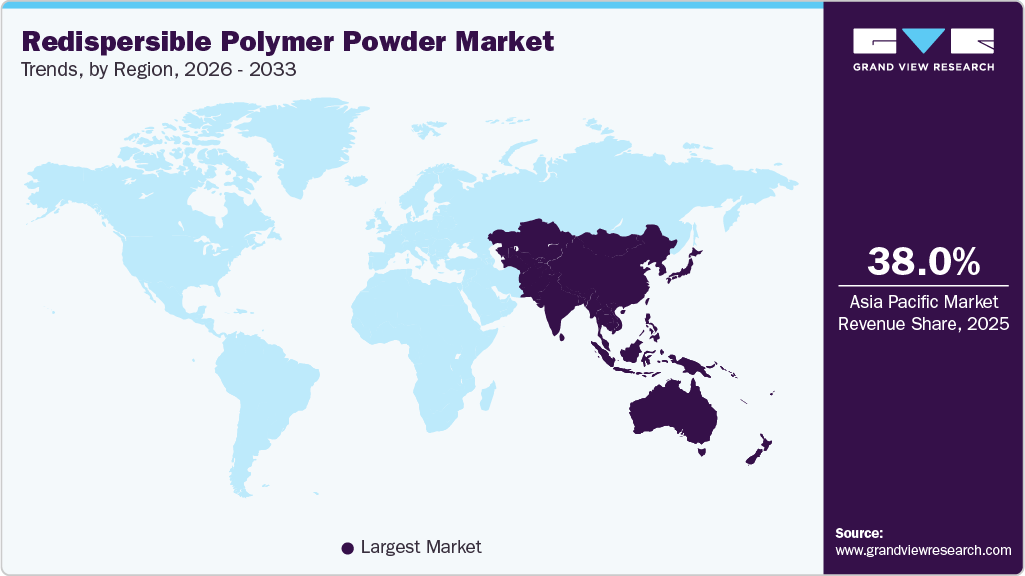
Asia Pacific dominated the global redispersible polymer powder market with the largest revenue share of 38.01% in 2025. The construction boom in the Asia Pacific, characterized by massive urban development projects, residential complexes, and infrastructure modernization, is creating substantial demand for RDP powder. These polymers enhance the performance of cement and mortar, improving properties such as adhesion, water resistance, and flexibility. For instance, in mega-projects such as China's Belt and Road Initiative and India's Smart Cities Mission, RDP powders are critical for developing high-performance construction materials that can withstand diverse environmental conditions.
 To learn more about this report, Download Free Sample Report
 The redispersible polymer powder market in China is primarily driven by its government policies and initiatives supporting infrastructure modernization, urbanization, and sustainable construction. The growing emphasis on energy-efficient buildings, earthquake-resistant structures, and improved construction materials has further accelerated the adoption of RDP powder across applications such as tile adhesives, wall putty, self-leveling compounds, and thermal insulation systems.
Europe Redispersible Polymer Powder Market Trends
The redispersible polymer powder market in Europe is driving the market through a combination of advanced manufacturing infrastructure, stringent construction quality regulations, and a robust construction industry. The region's sophisticated building technologies and strong emphasis on sustainable construction practices have positioned European manufacturers as leaders in developing high-performance RDP powders with enhanced properties, such as improved adhesion, water resistance, and durability.
The Germany redispersible polymer powder market is primarily driven by country's advanced chemical manufacturing capabilities, strong engineering expertise, and strategic focus on innovations in construction and industrial materials. Key factors include leading chemical companies such as BASF and Wacker Chemie AG developing high-performance polymer powders, extensive research investments in improving adhesion and durability, a robust export-oriented manufacturing ecosystem, and specialized RDP formulations that enhance cement-based products, tile adhesives, and protective coatings.
Key Redispersible Polymer Powder Company Insights
The redispersible polymer powder industry is highly competitive. Key players range from established packaging manufacturers to specialized firms focusing on sustainable materials, customized packaging solutions, and technology-enabled logistics. Companies are differentiating through innovations in lightweight, durable, and biodegradable materials, while addressing concerns such as protection during transit, environmental impact, and reducing packaging waste. Competitive pressures are intense, with firms striving for cost-efficiency and unique designs to enhance customer satisfaction and brand recognition.
Key Redispersible Polymer Powder Companies:
The following key companies have been profiled for this study on the redispersible polymer powder market.
- Wacker Chemie AG
- Dow
- BASF
- Celanese Corporation
- Acquos Pty Ltd
- Synthomer plc
- Ashland Global Holdings Inc.
- Japan Coating Resin Corporation
- Bosson (Beijing) Chemical Co., Ltd.
- Dairen Chemical Corporation
- Organik Kimya
Company Categorization
Operating Strategies
Competitive Edge
Weaknesses
Mature Players: Wacker Chemie AG; Dow; BASF; Celanese Corporation; Synthomer plc; Ashland Global Holdings Inc.; Dairen Chemical Corporation; Organik Kimya
- Focus on capacity expansion, advanced polymer formulation development, strategic partnerships with dry-mix mortar manufacturers, and regional manufacturing optimization to strengthen global market presence.
- Strong brand recognition, integrated raw material supply chains, broad customer networks, and high R&D capabilities enable sustained competitive leadership and pricing power.
- Large operational structures and higher production costs may reduce flexibility in highly price-sensitive regional markets, particularly against low-cost local manufacturers.
Emerging Players: Acquos Pty Ltd; Japan Coating Resin Corporation; Bosson (Beijing) Chemical Co., Ltd.
- Primarily focus on regional expansion, cost-competitive product offerings, customized customer solutions, and strengthening distribution partnerships within local construction markets.
- Higher operational flexibility, faster response to regional customer requirements, and competitive pricing strategies support their market growth in developing economies.
- Limited global reach, lower technological integration, and comparatively weaker R&D and financial capabilities restrict large-scale competition against multinational market leaders.
Recent Development
-
In March 2025, JSC Pigment officially commissioned a new production unit for redispersible polymer (RDP) powders at its industrial facility, located in Workshop No. 31. The facility will handle the full production process, including the synthesis of polyvinyl acetate dispersion and the drying of RDP powders, specifically for use in dry construction mixtures. This expansion is part of JSC Pigment’s broader import substitution strategy, aimed at enhancing domestic production capabilities and reducing reliance on imported construction materials.
-
In February 2025, Synthomer plc launched a new environmentally friendly redispersible polymer powder within its Revacryl product range. Tailored for low-VOC and sustainable building projects, this product offers improved workability and adhesion and aims to appeal to construction markets in Asia-Pacific and Europe.
Redispersible Polymer Powder Market Report Scope
Report Attribute
Details
Market size in 2025
USD 800.7 million
Estimated Market size in 2026
USD 851.3 million
Projected Market size by 2033
USD 1520.0 million
Growth rate
CAGR of 8.6% from 2026 to 2033
Base year for estimation
2025
Historical data
2021 - 2024
Forecast period
2026 - 2033
Quantitative units
Revenue in USD million/billion, Volume in Kilotons, and CAGR from 2026 to 2033
Report coverage
Revenue forecast, Volume forecast, competitive landscape, growth factors, and trends
Segments covered
Type, end use, application, region
Regional scope
North America; Europe; Asia Pacific; Central & South America; and Middle East & Africa
Country scope
U.S.; Canada; Mexico; Germany; France; UK; Italy; Spain; China; India; Japan; Australia; South Korea; Brazil; Argentina; South Africa; Saudi Arabia; UAE
Key companies profiled
Wacker Chemie AG; Dowl; BASF; Celanese Corporation; Acquos Pty Ltd; Synthomer plc; Ashland Global Holdings Inc.; Japan Coating Resin Corporation; Bosson (Beijing) Chemical Co., Ltd.; Dairen Chemical Corporation; Organik Kimya
Customization scope
Free report customization (equivalent up to 8 analyst’s working days) with purchase. Addition or alteration to country, regional, and segment scope.
Pricing and purchase options
Avail customized purchase options to meet your exact research needs. Explore purchase options
Global Redispersible Polymer Powder Market Report Segmentation
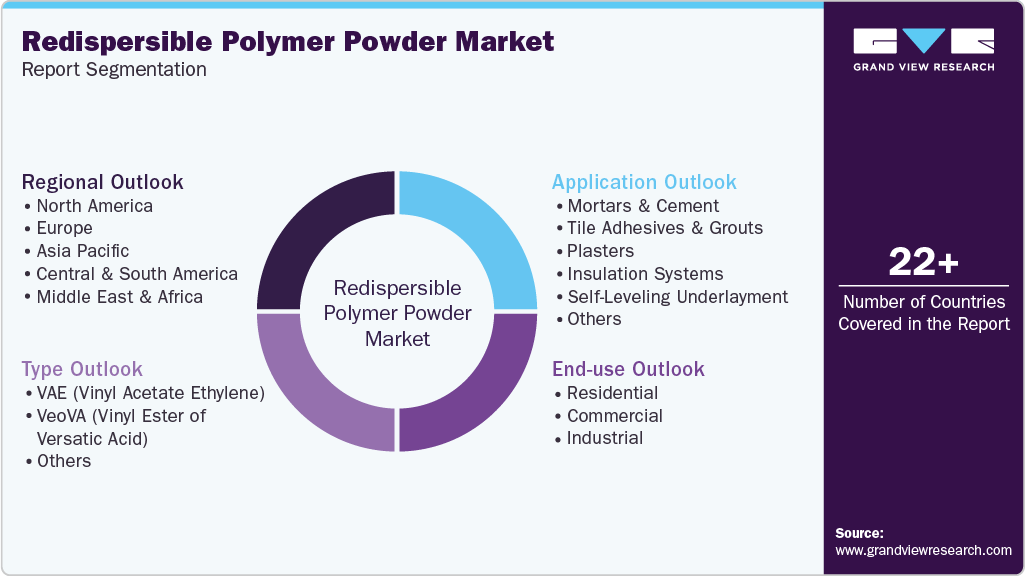
This report forecasts revenue growth at a global level and provides an analysis of the latest industry trends in each of the sub-segments from 2021 to 2033. For this study, Grand View Research has segmented the global redispersible polymer powder market report based on type, application, end use, and region:
 To learn more about this report, Download Free Sample Report
 -
Type Outlook (Volume, Kilotons; Revenue, USD Million, 2021 - 2033)
-
VAE (Vinyl Acetate Ethylene)
-
VeoVA (Vinyl Ester of Versatic Acid)
-
Others
-
-
End Use Outlook (Volume, Kilotons; Revenue, USD Million, 2021 - 2033)
-
Residential
-
Commercial
-
Industrial
-
-
Application Outlook (Volume, Kilotons; Revenue, USD Million, 2021 - 2033)
-
Mortars & Cement
-
Tile Adhesives & Grouts
-
Plasters
-
Insulation Systems
-
Self-Leveling Underlayment
-
Others
-
-
Region Outlook (Volume, Kilotons; Revenue, USD Million, 2021 - 2033)
-
North America
-
U.S.
-
Canada
-
Mexico
-
-
Europe
-
Germany
-
France
-
UK
-
Italy
-
Spain
-
-
Asia Pacific
-
China
-
India
-
Japan
-
Australia
-
South Korea
-
-
Central & South America
-
Brazil
-
Argentina
-
-
Middle East & Africa
-
South Africa
-
Saudi Arabia
-
UAE
-
-
Delivered Customizations
This report has been delivered with the following In-depth customizations
Client Request
Customization Delivered
Value Adds
Pricing Analysis
Comprehensive evaluation of pricing trends for Redispersible Polymer (RDP) Powder across different regions, grades, and applications, considering changes in raw material costs, implications of feedstock, analysis of profit margins, and the dynamics of supply and demand pricing. The analysis also examined past price variations and the prospective pricing outlook under different conditions in the construction market.
Support pricing strategy optimization and procurement planning. Improve visibility into cost drivers, regional pricing competitiveness, and margin pressure areas. Enable more accurate forecasting and contract negotiation capabilities.
Trade Assessment
Examination of worldwide and regional trade patterns for Redispersible Polymer (RDP) Powder, encompassing import and export trends, major exporting and importing nations, tariff frameworks, logistics factors, and supply chain interdependencies. Evaluation of changing trade paths and regional sourcing approaches within the construction chemicals sector.
Identify favorable sourcing regions and strategic trade corridors. Support supply chain diversification and regional expansion planning. Enable risk assessment related to tariffs, import dependency, and geopolitical trade disruptions.
Opportunity Assessment
Recognition of significant growth potential in dry-mix mortars, tile adhesives, repair compounds, and insulation systems, paired with the examination of developing construction markets, infrastructure funding, demand trends influenced by sustainability, and untapped opportunities for advanced polymer-modified formulations.
Support long-term growth strategy and market expansion planning. Identify untapped application areas and emerging revenue pockets. Enable proactive positioning in high-growth construction and infrastructure segments.
Frequently Asked Questions About This Report
The global redispersible polymer powder market size was valued at USD 800.7 million in 2025 and is estimated at USD 851.3 million for 2026.
The global redispersible polymer powder market is expected to grow at a CAGR of 8.6% from 2026 to 2033, reaching USD 1519.6 million by 2033.
Asia Pacific dominated with a 38.0% revenue share in 2025.
The VAE (vinyl acetate ethylene) segment led with a 59.2% revenue share in 2025.
The mortars & cement segment led with a 33.3% revenue share in 2025, while insulation systems is the fastest-growing application.
Key players include Wacker Chemie AG; Dowl; BASF; Celanese Corporation; Acquos Pty Ltd; Synthomer plc; Ashland Global Holdings Inc.; Japan Coating Resin Corporation; Bosson (Beijing) Chemical Co., Ltd.; Dairen Chemical Corporation; Organik Kimya.
The construction industry's rapid growth, particularly in emerging economies, is a significant driver for the redispersible polymer (RDP) powder market.
The residential segment emerged as the dominant end-use, with a 57.5% value share in 2025, owing to increasing government housing schemes and incentives for affordable housing.
About the Author(s)
Plastics, Polymers & Resins Research Team
Bulk Chemicals · Plastics, Polymers & ResinsThis report was authored by the plastics, polymers & resins research team at Grand View Research - comprising two research analysts, one senior research analyst, and one industry expert - with specialized expertise in the plastics, polymers & resins segment of the bulk chemicals industry. All findings are based on proprietary bulk chemicals databases, executive interviews, and regulatory analysis, subject to internal peer review prior to publication.
Last Updated:
Speak to Analyst

Customize this report to your needs - add regions, segments, or data points, with 20% free customization.
Or view our licence options:


ISO 9001:2015 & 27001:2022 Certified
We are GDPR and CCPA compliant! Your transaction & personal information is safe and secure. For more details, please read our privacy policy.


