
- Home
- »
- Advanced Interior Materials
- »
-
Refrigerated Air Dryer Market Size, Growth Report, 2026-2033GVR Report cover

Refrigerated Air Dryer Market (2026 - 2033)
Size, Share & Trends Analysis By Product (Cycling, Non-Cycling), By Application (Chemical, Paper, Food & Beverages, Pharmaceutical), By Region, And Segment Forecasts
Market Size, 2026
$1.9BMarket Estimate, 2026
$2.0BMarket Forecast, 2033
$3.2BCAGR, 2027–2033
6.7%Refrigerated Air Dryer Market Summary
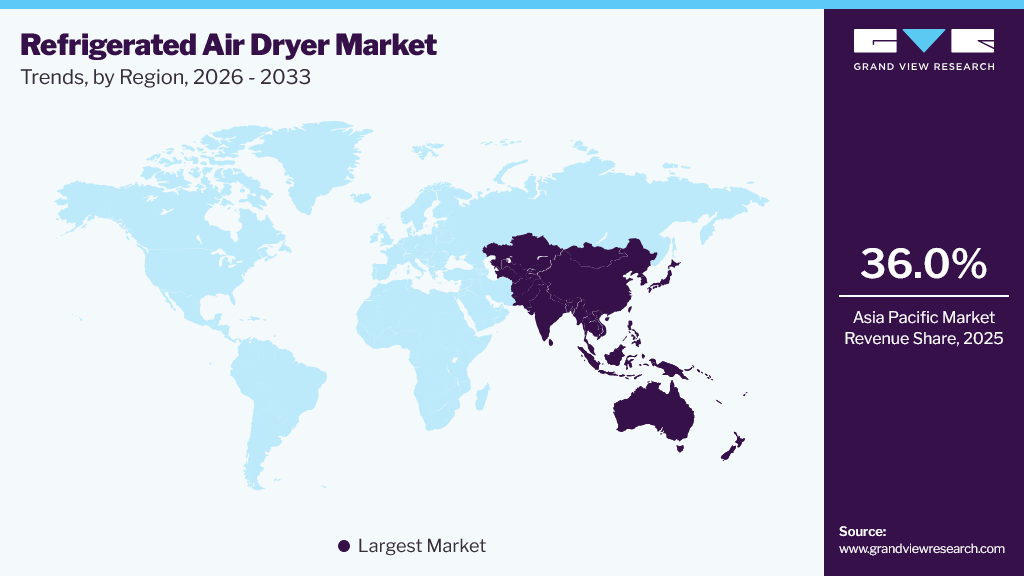
The global refrigerated air dryer market size was valued at USD 1.9 billion in 2025 and is projected to grow from USD 2.0 billion in 2026 to USD 3.2 billion by 2033, at a CAGR of 6.7% from 2026 to 2033. The Asia Pacific dominated the market, accounting for a revenue share of 36.0% in 2025. This can be attributed to the expansion of industries such as food, pharmaceuticals, and electronics, which adhere to strict regulations.
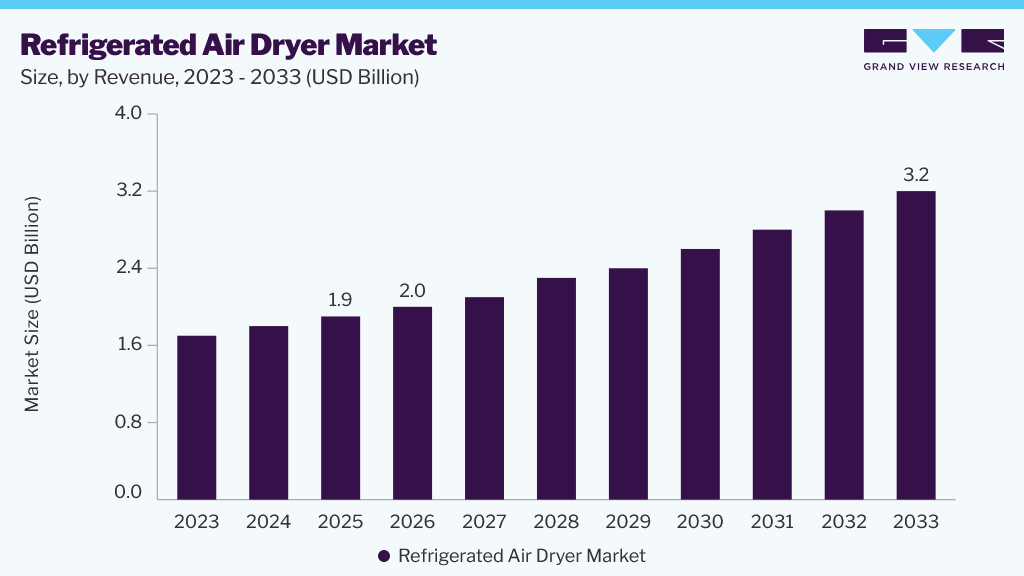 Source: Grand View Research, IR Documents, Primary Interviews, Paid DatabasesTo learn more about this report,
 Download Free Sample Report
Key Market Trends & Insights
- By product: The cycling refrigerated air dryers segment held the largest market share of approximately 49.0% in 2025.
- By application: The food and beverages industry segment held the largest market share of over 33.0% in 2025.
Regional Highlights
- Largest regional market: Asia Pacific (36.0% revenue share, 2025)
- Fastest-growing regional market: North America (highest CAGR, 2026-2033)
Market Size & Forecast
- Market size in 2025: USD 1.9 Billion
- Estimated market size in 2026: USD 2.0 Billion
- Projected market size by 2033: USD 3.2 Billion
- CAGR (2026-2033): 6.7%
Prism AI by Grand View Research Free to tryAsk a question about the refrigerated air dryer marketTry asking✓Every figure cited from GVR research Prefer the report? Download free sample →These industries require refrigerated air dryers to remove moisture that can lead to contamination and compromise product integrity. In addition, refrigerated air dryers are widely used for tasks such as powering pneumatic tools, operating machinery, and controlling processes, generating clean, high-pressure air. Furthermore, businesses are increasingly seeking energy-efficient solutions. Advanced technologies, including smart controls, sensors, and programmable settings in refrigerated air dryers, help maintain optimal moisture levels and reduce energy use. For instance, variable-speed compressors adjust their output based on demand, optimizing energy usage. In addition, dry air ensures consistent performance of pneumatic tools, valves, and actuators. It prevents rust and scale buildup in pipelines and minimizes the risk of malfunction.
Moreover, businesses are increasingly recognizing the need to minimize their environmental impact and conserve resources, turning to energy-efficient alternatives such as refrigerated air dryers. These dryers help industries reduce greenhouse gas emissions and operational costs by optimizing energy usage.
Analyst Perspective
The market is experiencing steady growth, driven by the increasing demand for high-quality compressed air across regulated industries such as food processing, pharmaceuticals, electronics, and manufacturing. However, with increasing automation in production processes and high-quality requirements, the need for efficient moisture-control systems becomes more pronounced. There is also an impact of current energy-efficiency trends in industry, leading to the widespread use of modern refrigerated air dryers with intelligent control and variable-speed operation. In addition, the growing importance of sustainability and efficiency in the industry is likely to contribute to market development.
Product Insights
Cycling refrigerated air dryers held a dominant share with approximately 49.0% of the market in 2025, owing to their ability to respond to variable air demand and energy-saving mechanisms. These dryers operate on the principle of thermal mass and dynamically adapt their refrigeration system output to match actual air demand. Industries are increasingly opting for these advanced thermal mass dryers with intelligent controls. These systems monitor airflow, temperature, and humidity, optimizing the drying process while minimizing energy waste. Several cycling dryer models also recover the generated heat during the cooling process, which can be repurposed for other applications within a particular industry. Thereby, this further enhances energy efficiency. For instance, thermal mass dryers support automotive production lines, where compressed air needs to be adjusted for specific tasks and to maintain compliance with air quality standards.
The non-cycling refrigerated air dryers experienced substantial growth, as they offer reliable operation and precise dew point control, making them ideal for industrial applications. Non-cycling refrigerated air dryers maintain a steady refrigeration cycle, regardless of fluctuations in air demand. Unlike their cycling counterparts, which adjust based on load, non-cycling dryers operate consistently, ensuring predictable performance. In addition, these dryers maintain a stable dew point, preventing excessive moisture in the compressed air, which is crucial for industries including electronics and manufacturing. For instance, in September 2025, a large smart electronics manufacturing facility deployed a compressed air system featuring a high-efficiency refrigerated air dryer capable of maintaining a stable +3°C pressure dew point for general pneumatic equipment and production processes. The project was designed to ensure consistent dry-air quality, protect sensitive manufacturing equipment from moisture-related issues, and maintain reliable operation across the facility. This real-world deployment highlights the growing preference for non-cycling refrigerated air-dryer technologies in industries such as electronics manufacturing, where stable dew-point performance and continuous operation are critical to product quality and process reliability.
Application Insights
The food and beverage industry accounted for over 33.0% of the global market share in 2025. The food and beverage industry heavily relies on compressed air for various processes, including packaging, bottling, and quality control. These air dryers play a crucial role in maintaining food quality and safety by eliminating moisture that could lead to bacterial growth or product spoilage. As food processors prioritize hygiene and product integrity, demand for these air dryers remains strong, driving market growth. Moreover, environmental and safety regulations mandate the use of dry air in this sector.
The pharmaceutical industry has emerged as the fastest-growing segment at a CAGR of approximately 7.0% in 2025. The industry’s growing emphasis on quality, energy efficiency, and expanding production drives the adoption of refrigerated air dryers. The sector demands high-quality compressed air to prevent contamination by removing moisture and impurities and ensuring product integrity. Refrigerated air dryers ensure consistent performance by preventing corrosion and equipment damage caused by moisture. In addition, they help maintain sterile conditions by eliminating moisture and contaminants from compressed air. Moreover, as stringent regulations govern air quality standards in these sectors, the adoption of refrigerated air dryers is projected to increase. For instance, in May 2025, the International Society for Pharmaceutical Engineering (ISPE) highlighted the growing importance of controlled compressed-air systems in pharmaceutical manufacturing as companies expand biologics and sterile drug production. ISPE emphasized that moisture-free compressed air is essential for preventing contamination, maintaining product quality, and meeting Good Manufacturing Practice (GMP) requirements. This trend is encouraging pharmaceutical manufacturers to invest in advanced refrigerated air dryers and air-treatment systems that ensure consistent air quality and regulatory compliance across production facilities.
Regional Insights
The Asia Pacific refrigerated air dryer market secured the dominant share in 2025. The region experienced significant growth primarily due to rapid industrialization and urbanization across countries such as China, India, and Southeast Asian nations. The industrial boom increased demand for advanced air dryers with digital controls and energy-saving technologies that help minimize consumption and optimize performance and operational costs. In addition, developing compact, high-performance dryers with enhanced reliability and lower maintenance requirements attracted a broad range of industrial applications. Furthermore, collaborations between air dryer manufacturers and end users facilitated the customization of solutions to meet specific industry needs, thereby driving market expansion.
 To learn more about this report, Download Free Sample Report
According to data published by the the Indian government in August 2025, the the country's manufacturing sector continued to record robust expansion, supported by significant investments in electronics, automotive, and industrial production facilities under government-led initiatives such as “Make in India.” As new factories and production lines were commissioned, demand for energy-efficient compressed air systems, including refrigerated air dryers with advanced monitoring and control technologies, increased to ensure reliable plant operations and lower operating costs. This industrial expansion highlights how rapid industrialization across the Asia Pacific is driving the adoption of high-performance air treatment solutions.
China Refrigerated Air Dryer Market Trends
The refrigerated air dryer market in China held approximately 17.5% of the Asia Pacific in 2025. The market expanded due to the need for high-quality, reliable compressed air to support production at scale. In addition, the country’s ongoing infrastructure projects, urbanization, and construction activities contributed to increased demand for refrigerated air dryers. These systems are essential for maintaining optimal air quality in industrial facilities, ensuring smooth operations, and preventing equipment damage.
Europe Refrigerated Air Dryer Market Trends
The refrigerated air dryer market in Europe experienced robust growth owing to the stringent regulatory environment across the region. European Union regulations on air quality and energy efficiency compelled industries to adopt advanced air-drying solutions to comply with these standards. This regulatory push was particularly significant in sectors such as food and beverage, pharmaceuticals, and electronics, as maintaining high air quality is crucial to prevent contamination. In addition, the growing awareness of the negative effects of moisture on compressed air systems, such as corrosion and reduced equipment lifespan, further fueled the demand for reliable air-drying solutions.
North America Refrigerated Air Dryer Market Trends
The refrigerated air dryer market in North America experienced notable growth owing to the resurgence of the manufacturing sector. This growth was further augmented by significant investments in infrastructure projects, which required reliable, efficient air-drying solutions to ensure optimal performance of pneumatic tools and machinery. In addition, the need for clean, dry compressed air in medical laboratories, hospitals, and pharmaceutical manufacturing facilities has heightened demand for advanced refrigerated air dryers. For instance, in March 2025, pharmaceutical manufacturer Johnson & Johnson announced plans to invest more than USD 55 billion in manufacturing, research, and technology facilities across the U.S. over the next four years. The investment includes the construction and expansion of advanced pharmaceutical production facilities that require high-quality, moisture-free compressed air to maintain sterile manufacturing environments, protect equipment, and comply with stringent regulatory standards. Such large-scale investments in pharmaceutical manufacturing are driving demand for advanced refrigerated air dryers and compressed air treatment systems throughout North America.
The U.S. refrigerated air dryer market was propelled by increased production activities across various industries, including automotive, aerospace, and electronics. The demand for reliable and efficient compressed air systems has surged further due to substantial investments in infrastructure projects that require high-quality air-drying solutions. Furthermore, U.S. industries increasingly prioritize energy-efficient technologies to reduce operational costs and meet environmental regulations by minimizing their carbon footprint. In addition, the integration of IoT-enabled features and digital controls enabled real-time monitoring and optimization of air dryer performance, enhancing operational efficiency and reducing downtime.
Key Refrigerated Air Dryer Company Insights
Some of the key companies, including Atlas Copco, Ingersoll Rand, and SPX FLOW, employed various strategies to strengthen their market operations and enhance their value chain systems. These companies focused on innovation, strategic partnerships, and sustainability initiatives to provide customized solutions for specific industry needs, further driving market growth.
- ANEST IWATA Corporation is a Japan-based manufacturer known for its cutting-edge technologies in air compressors, coating equipment, vacuum pumps, and liquid application systems.
- Atlas Copco Group is a leading manufacturer of compressors, vacuum solutions, generators, pumps, power tools, and assembly systems.
Key Refrigerated Air Dryer Companies
The following are the leading companies in the refrigerated air dryer market. These companies collectively hold the largest market share and dictate industry trends.
-
Anest Iwata Corporation
-
Atlas Copco Group
-
Beko Technologies
-
Donaldson Company
-
Eaton
-
Ingersoll Rand Inc.
-
Kaeser Compressors, Inc.
-
MTA
-
Parker Hannifin Corporation
-
SPX Corporation (DEltech)
-
Risheng
-
CompAir
-
Air-Vac Systems LLC.
Recent Developments
-
In June 2024, Atlas Copco Group announced the acquisition of AE Industrial Ltd., a company specializing in the sales, installation, and servicing of compressed air systems.
-
In Feb 2024, SPX Technologies announced its acquisition of Ingenia Technologies, which specializes in designing and manufacturing custom air-handling units. Their products are primarily applied in various sectors, including healthcare, pharmaceutical, education, food processing, and industrial markets.
Refrigerated Air Dryer Market Report Scope
Report Attribute
Details
Market size in 2025
USD 1.9 billion
Estimated market size in 2026
USD 2.0 billion
Projected market size by 2033
USD 3.2 billion
Growth rate
CAGR of 6.7% from 2026 to 2033
Base year estimation
2025
Historical data
2021 – 2024
Forecast period
2026 – 2033
Quantitative units
Revenue in USD billion, and CAGR from 2026 to 2033
Report coverage
Revenue forecast, company ranking, competitive landscape, growth factors, and trends
Segments covered
Product, application, region
Regional scope
North America; Europe; Asia Pacific; Latin America; MEA
Country scope
U.S.; Canada; Mexico; Germany; UK; France; Italy; Spain; China; Japan; India; South Korea; Brazil; Argentina; Saudi Arabia; UAE
Key companies profiled
Anest Iwata Corporation; Atlas Copco Group; Beko Technologies; Donaldson Company; Eaton; Ingersoll Rand Inc.; Kaeser Compressors, Inc.; MTA; Parker Hannifin Corporation; SPX Corporation (DEltech); Risheng; CompAir; Air-Vac Systems LLC.
Customization scope
Free report customization (equivalent up to 8 analysts working days) with purchase. Addition or alteration to country, regional & segment scope.
Pricing and purchase options
Avail of customized purchase options to meet your exact research needs. Explore purchase options
Global Refrigerated Air Dryer Market Report Segmentation
This report forecasts revenue growth at global, regional, and country levels and provides an analysis of the latest industry trends in each of the sub-segments from 2021 to 2033. For this study, Grand View Research has segmented the global refrigerated air dryer market report based on product, application, and region:
-
Product Outlook (Revenue, USD Billion, 2021 - 2033)
-
Cycling
-
Non-cycling
-
Others
-
-
Application Outlook (Revenue, USD Billion, 2021 - 2033)
-
Chemical
-
Paper
-
Food & beverages
-
Pharmaceutical
-
Healthcare
-
Others
-
-
Regional Outlook (Revenue, USD Billion, 2021 - 2033)
-
North America
-
U.S.
-
Canada
-
-
Europe
-
Germany
-
UK
-
France
-
Italy
-
Spain
-
-
Asia Pacific
-
China
-
Japan
-
India
-
South Korea
-
-
Latin America
-
Brazil
-
Mexico
-
-
Middle East and Africa (MEA)
-
UAE
-
Saudi Arabia
-
-
Frequently Asked Questions About This Report
The cycling refrigerated air dryers segment accounted for the largest revenue share of approximately 49.0% in 2025
The global refrigerated air dryer market size was valued at USD 1.9 billion in 2025 and is estimated at USD 2.0 billion in 2026.
Key players in the market include Anest Iwata Corporation, Atlas Copco Group, Beko Technologies, Donaldson Company, Eaton, Ingersoll Rand Inc., Kaeser Compressors, Inc., MTA, Parker Hannifin Corporation, SPX Corporation (DEltech), Risheng, CompAir, Air-Vac Systems LLC., and others.
The global refrigerated air dryer market is expected to grow at a CAGR of 6.7% from 2026 to 2033, reaching USD 3.2 billion
Asia Pacific dominated with a 37.0% revenue share in 2025.
About the Author(s)
Advanced Interior Materials Research Team
Advanced Materials · Advanced Interior MaterialsThis report was authored by the advanced interior materials research team at Grand View Research - comprising two research analysts, one senior research analyst, and one industry expert - with specialized expertise in the advanced interior materials segment of the advanced materials industry. All findings are based on proprietary advanced materials databases, executive interviews, and regulatory analysis, subject to internal peer review prior to publication.
Last Updated:
Speak to Analyst

Customize this report to your needs - add regions, segments, or data points, with 20% free customization.
Or view our licence options:


ISO 9001:2015 & 27001:2022 Certified
We are GDPR and CCPA compliant! Your transaction & personal information is safe and secure. For more details, please read our privacy policy.


