
- Home
- »
- Electronic Devices
- »
-
Refrigerated Display Cases Market, Industry Report, 2033GVR Report cover

Refrigerated Display Cases Market (2026 - 2033) Size, Share & Trends Analysis Report By Display Type (Open Display Cases, Glass Door Display Cases, Serve-Over Counters), By Type (Plug-In, Remote, Semi Plug-In), By Design, By End Use, And Segment Forecasts
Market Size, 2025
$13.2BMarket Estimate, 2026
$14.0BMarket Forecast, 2033
$23.4BCAGR, 2026–2033
7.4%Refrigerated Display Cases Market Summary
The global refrigerated display cases market size was valued at USD 13.2 billion in 2025 and is projected to grow from USD 14.0 billion in 2026 to USD 23.4 billion by 2033, at a CAGR of 7.4% from 2026 to 2033. North America held the dominating position in the global refrigerated display cases market with 32.2% share in 2025. The increasing global demand for fresh and perishable food products, particularly among urbanized, health-conscious populations, is driving the refrigerated display case market.
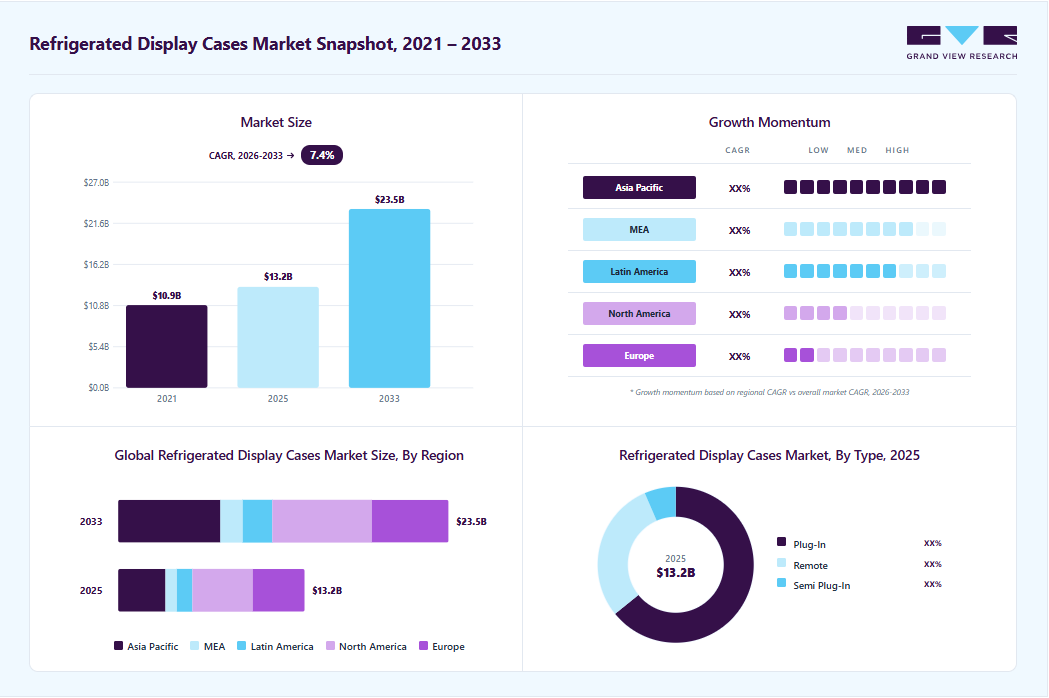 Source: Grand View Research, IR Documents, Primary Interviews, Paid DatabasesTo learn more about this report,
 Download Free Sample Report
 Key Market Trends & Insights
- By display type: the glass door display cases segment held the largest revenue share of 29.7% in 2025.
- By type: the plug-in segment held the largest revenue share in 2025.
- By design: the vertical segment held the largest revenue share in 2025.
Regional Highlights
- Largest regional market: North America (32.2% revenue share, 2025)
- Fastest-growing regional market: Asia-Pacific (highest CAGR, 2026-2033)
- By country: The U.S refrigerated display cases industry is a major contributor to the global market.
Market Size & Forecast
- Market size in 2025: USD 13.2 Billion
- Estimated market size in 2026: USD 14.0 Billion
- Projected market size by 2033: USD 23.4 Billion
- CAGR (2026-2033): 7.4%
Three ways to get this report
Buy it, customize it, or ask a question.Ask an Analyst
Analyst response in 1 business day
- AccessReport author, directly
- Reply timeWithin 1 working day
- No sales callDirect answer only
- FormatEmail reply
- CostFree, no cost
Get the Full Report
What the study covers
- FormatsPDF · Excel · Dashboard
- Timeline2026–2033 annual, 2025 base
- Coverage20+ countries, 5 regions
- Companies10+ key players profiled
Customize the Report
20% free customization
- IncludeCountries, segments, points
- TailorTo your product definition
- ExtendDeeper competitor detail
- OrA fully bespoke study
- Turnaround5–10 working days
The growth of e-commerce, grocery delivery, and omnichannel retail strategies is driving the market for refrigerated display cases. Many brick-and-mortar retailers are adopting micro-fulfillment and curbside pickup models that require compact, modular refrigerated cases to store online orders and maintain cold-chain standards. The need for flexibility, mobility, and digital integration in such setups is opening new avenues for innovation in the refrigerated display equipment landscape. As digital transformation accelerates across the retail and foodservice sectors, the integration of smart features and responsive design into refrigerated display cases will remain a key growth driver in the market.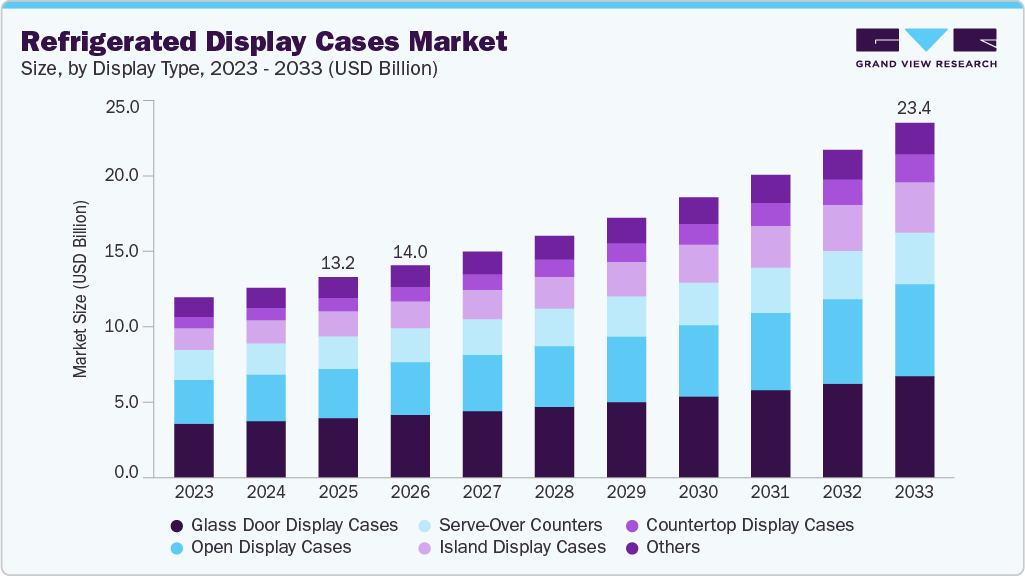 To learn more about this report, Download Free Sample Report
 The rapid growth of the hospitality and foodservice industry is driving the refrigerated display cases market growth. These businesses rely heavily on visually appealing refrigeration units to showcase desserts, beverages, salads, and ready-to-eat products. As competition intensifies in the foodservice space, establishments are investing in attractive, space-efficient refrigerated displays that preserve product freshness and enhance the customer’s buying experience. The growing trend of open kitchen formats and live counters in restaurants has further pushed the demand for customizable refrigerated cases that seamlessly integrate with interior décor while meeting hygiene and temperature control standards.
The expansion of organized retail chains, especially in emerging economies, is also playing a significant role in boosting the refrigerated display cases market. As global supermarket and hypermarket brands enter new markets and increase their store footprint, they are standardizing their infrastructure, including refrigeration systems, to ensure a uniform shopping experience across locations. These retailers prioritize energy-efficient and visually appealing display cases that help maximize product visibility while reducing operational costs. In addition, as consumers in these regions become more accustomed to modern retail formats, the demand for high-performance refrigerated units that align with evolving shopping habits continues to grow.
Moreover, seasonal demand cycles and promotional activities heavily influence the usage of refrigerated display cases, particularly in large retail stores. During holidays, festivals, or promotional campaigns, retailers often introduce seasonal food products that need temporary yet efficient refrigeration solutions. The availability of portable and plug-in refrigerated displays helps meet these fluctuating demands without requiring significant infrastructure changes, thereby adding flexibility to store operations. This dynamic use of refrigerated units encourages continued innovation in design, mobility, and energy use.
Furthermore, the increasing consumer preference for organic, premium, and artisanal food products is contributing to the rise in demand for the refrigerated display cases market. These high-value food categories often require specific temperature and humidity settings, encouraging retailers and specialty stores to adopt display cases that allow precise environmental control. As premium food segments continue to expand, so does the need for refrigeration solutions that ensure optimal storage without compromising on the visual appeal of the product, an essential factor for encouraging impulse purchases in retail environments.
Market Dynamics
The growth of organized retail and modern grocery formats is a major driver of the refrigerated display cases market, as modern retail chains depend heavily on structured, temperature-controlled merchandising systems to maintain product quality and enhance the customer experience. Organized retail formats such as supermarkets, hypermarkets, and convenience stores require consistent refrigeration solutions to display perishable goods, including dairy products, meat, seafood, frozen foods, and beverages. Unlike traditional retail shops, these modern formats prioritize standardized layouts, visual merchandising, and product accessibility, all of which depend on efficient refrigerated display systems. Refrigerated display cases not only preserve product freshness but also enhance product visibility, which directly influences consumer purchasing decisions. As organized retail expands globally, especially in urban and semi-urban regions, demand for advanced refrigeration infrastructure continues to rise steadily.
High initial installation and capital investment costs represent a significant restraint on the refrigerated display cases market, as modern refrigeration systems require substantial upfront expenditures on equipment, installation, and supporting infrastructure. Retailers, especially small and medium-sized grocery stores, often struggle to allocate large budgets for advanced refrigerated display units due to tight operating margins. These systems include compressors, cooling units, glass enclosures, temperature control systems, and energy-efficient components, all of which contribute to high acquisition costs. In addition, installation requires specialized technical expertise, proper store layout redesign, and electrical system upgrades, further increasing overall investment requirements. As a result, many smaller retailers delay or avoid upgrading to modern refrigeration systems. This high capital burden directly limits market penetration, particularly in cost-sensitive retail segments.
The adoption of smart and refrigerated display case systems is creating significant opportunities in the market as retailers increasingly shift toward connected, data-driven refrigeration infrastructure. IoT-enabled refrigerated display cases allow real-time monitoring of temperature, humidity, energy consumption, and equipment performance across retail environments. This connectivity helps retailers maintain optimal storage conditions for perishable goods while reducing the risk of spoilage and product loss. Smart systems can automatically alert store managers about temperature deviations or equipment failures, enabling faster corrective action. As retail chains expand and manage multiple outlets, centralized monitoring through IoT platforms becomes highly valuable. This increasing need for operational visibility and control is creating strong growth opportunities for smart refrigeration solutions.
Market Concentration & Characteristics
The industry is fragmented, with a mix of global commercial refrigeration manufacturers and regional equipment suppliers competing across retail, foodservice, and supermarket applications. Major companies such as Carrier Global and Daikin Industries maintain strong market positions due to extensive product portfolios, distribution networks, and energy-efficient refrigeration technologies. Entry barriers are moderate because of manufacturing intensity, regulatory compliance requirements, and the need for established service networks.
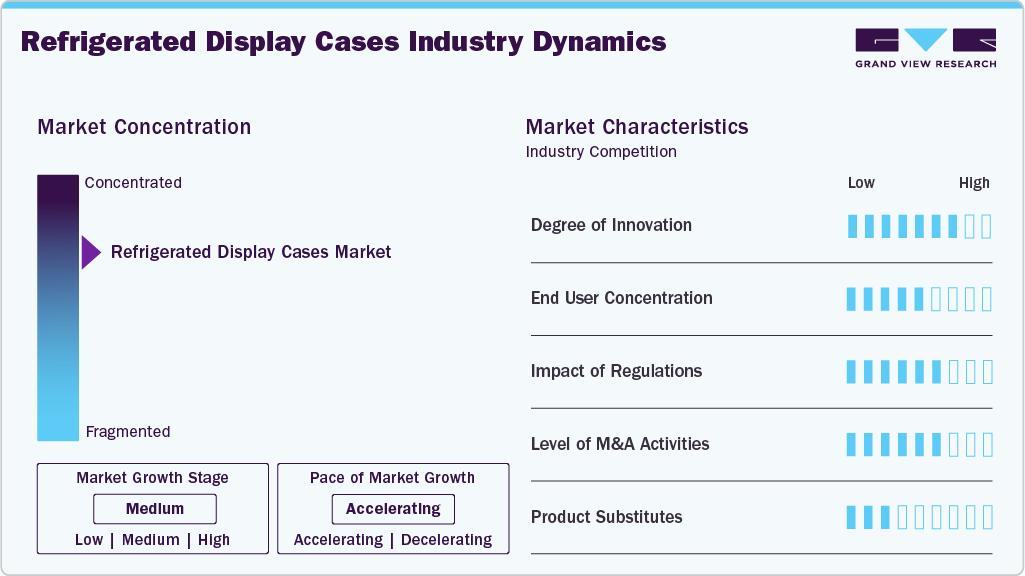 To learn more about this report, Download Free Sample Report
 The market is highly demand-driven by the expansion of supermarkets, convenience stores, food retail chains, and organized retail infrastructure. Increasing consumption of frozen, packaged, and ready-to-eat food products is accelerating the adoption of advanced refrigerated display solutions. Energy efficiency, temperature control, and environmentally friendly refrigerants are becoming major focus areas due to tightening sustainability regulations.
The industry is characterized by high operational and maintenance requirements, long replacement cycles, and strong dependence on retail infrastructure investments. Purchasing decisions are heavily influenced by energy consumption, storage capacity, product visibility, and lifecycle operating costs. Demand also varies by regional food retail development and the maturity of cold chain infrastructure.
Display Type Insights
The glass door display cases segment dominated the refrigerated display cases market in 2025. The increasing adoption of self-service retail formats is driving segment growth. As more stores adopt layouts that prioritize customer autonomy and convenience, the role of glass door cases becomes even more essential. They enable customers to browse and select products easily, encouraging higher impulse purchases without the need for staff intervention. This model aligns well with the ongoing shift in consumer behavior toward faster, more efficient shopping experiences, particularly in urban areas where foot traffic is high and quick decision-making is prioritized.
The countertop display cases segment is projected to be the fastest-growing segment from 2026 to 2033. The increasing number of specialty food stores and gourmet retailers is also contributing to the demand for these types of display cases. Businesses that focus on artisanal, niche, or premium food items often require refrigeration solutions that enhance the visual presentation of their products without overwhelming limited retail space. Countertop refrigerated display cases allow for elegant, well-lit displays that highlight product quality, freshness, and branding. This is especially valuable in establishments that prioritize aesthetic appeal as part of the overall customer experience.
Type Insights
The plug-in segment dominated the refrigerated display cases market in 2025. The rising adoption of plug-in units is increasing the demand for modular and scalable refrigeration solutions is driving the segment growth. As retail spaces continue to evolve, businesses are seeking display equipment that can support rapid changes in merchandising strategies. Plug-in refrigerated display cases offer exactly that mobility and flexibility, allowing operators to trial different product arrangements or reposition refrigeration zones without having to redesign the entire store infrastructure. This agility is especially crucial in fast-paced retail environments that rely on short-term promotional campaigns, limited-time offers, or pop-up store formats.
The semi plug-in segment is projected to be the fastest-growing segment from 2026 to 2033. The rising emphasis on reducing in-store heat load and air conditioning costs is driving market adoption. Traditional plug-in cases often discharge heat directly into the store, which can place additional demand on HVAC systems, especially in warm climates. Semi plug-in units solve this issue by redirecting the heat externally, creating a cooler and more energy-efficient store environment. This is particularly important for retailers operating multiple refrigeration units within confined spaces, where temperature control is critical for both product preservation and shopper comfort.
Design Insights
The vertical segment dominated the refrigerated display cases market in 2025. The increased penetration of modern retail infrastructure across emerging markets is accelerating the demand for vertical refrigerated display cases. As developing regions invest in large-format retail stores and chain-based convenience outlets, there is a growing need for high-capacity, visually appealing refrigeration units that can support diverse product categories. Vertical display cases fit these requirements well, making them an attractive solution for both established and emerging market players looking to improve merchandising effectiveness and customer satisfaction.
The hybrid segment is projected to be the fastest-growing segment from 2026 to 2033. The growing trend toward omnichannel retailing and micro-fulfillment centers is driving the refrigeration display cases market growth. Hybrid refrigerated display cases allow retailers to create dedicated zones for online order pickups, prepared foods, or promotional items within the same refrigeration footprint, supporting efficient store operations and enhanced customer service. This multifunctional capability is becoming increasingly important as grocers and food retailers look for innovative ways to serve both in-store and online customers within constrained urban spaces.
End Use Insights
The food service segment dominated the market in 2025. The rapid expansion of cafes, quick-service restaurants (QSRs), bakeries, and catering businesses drives the refrigerated display cases market growth. These establishments increasingly rely on visually appealing and energy-efficient refrigerated display cases to showcase perishable items like desserts, beverages, ready-to-eat meals, salads, and deli products. In the highly competitive food service industry, product visibility and presentation play a crucial role in influencing customer purchasing behavior. Modern refrigerated display cases preserve the freshness and safety of food items and enhance merchandising by offering sleek, well-lit, and transparent designs that attract consumers’ attention and stimulate impulse buying.
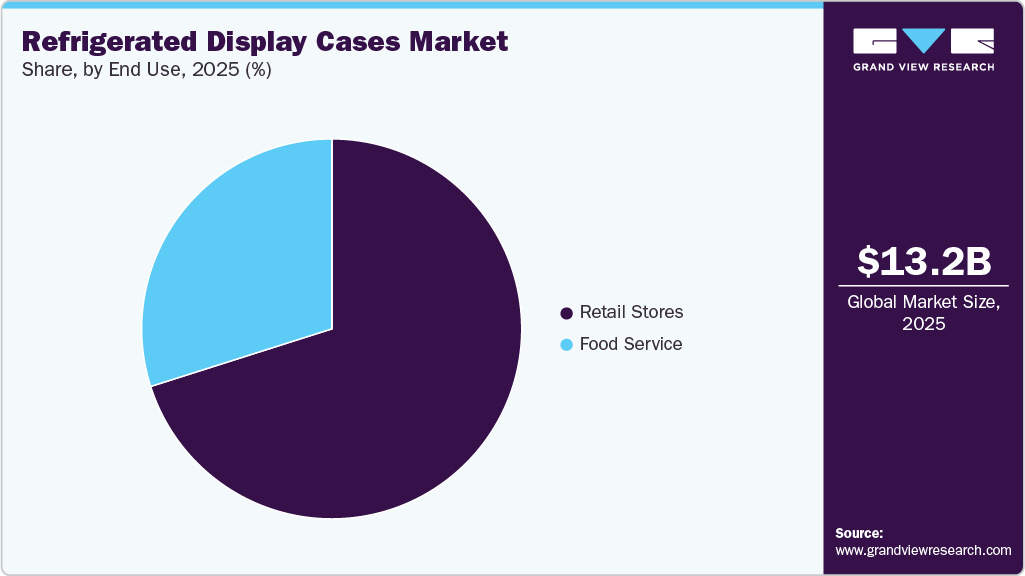 To learn more about this report, Download Free Sample Report
 The retail stores segment is projected to be the fastest-growing segment from 2026 to 2033. The rise of premium and gourmet food segments within retail stores is driving the demand for refrigerated display cases. High-end grocery retailers and specialty food stores are looking for refrigeration solutions that complement upscale store designs and enhance the visual merchandising of premium products such as artisanal cheeses, exotic fruits, gourmet desserts, and specialty meats. In these cases, the design of the refrigerated unit becomes just as important as its functionality. Units with frameless glass panels, custom finishes, and ambient lighting are being increasingly deployed to create an elevated shopping experience that appeals to discerning consumers.
Regional Insights
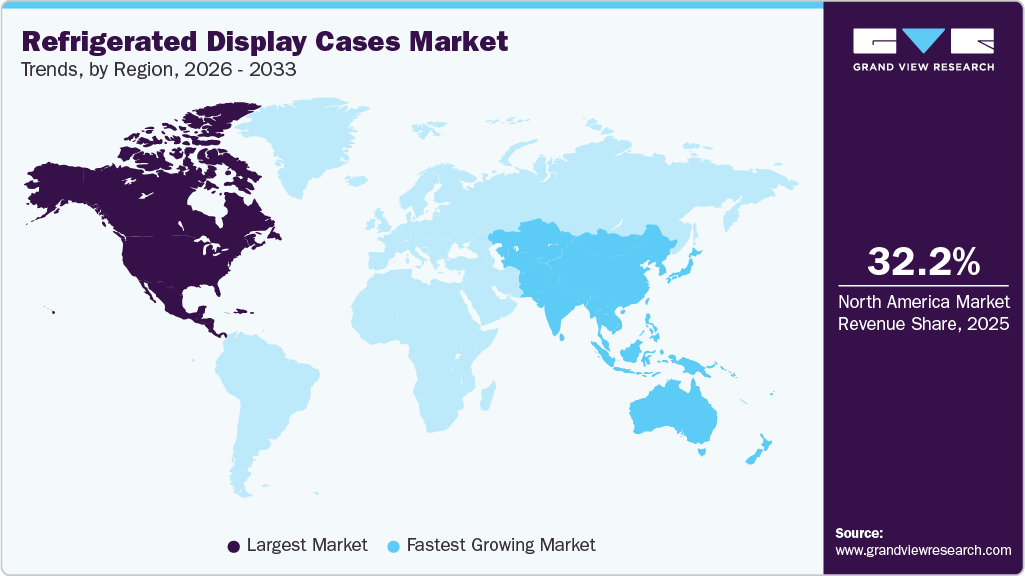
North America dominated the refrigerated display cases market with a market share of 32.2% in 2025. The surge in demand for digitalization and connectivity within the retail ecosystem is fueling the growth of the refrigerated display cases market. North American retailers are increasingly integrating Internet of Things (IoT) technologies into their refrigeration systems to enable remote monitoring, predictive maintenance, and real-time data analytics. These smart display cases can detect fluctuations in temperature, optimize defrost cycles, and alert operators of performance issues before they result in spoilage or system failure. This enhances food safety and reduces unplanned downtime and maintenance costs, making these systems highly attractive to operators aiming for long-term cost efficiency.
 To learn more about this report, Download Free Sample Report
 U.S. Refrigerated Display Cases Market Trends
The U.S. refrigerated display cases industry is projected to grow during the forecast period. The rise of e-commerce and the increasing integration of omnichannel retail strategies are also indirectly supporting the growth of refrigerated display cases in physical stores. As brick-and-mortar retailers in the U.S. seek to differentiate themselves from online competitors, they are investing in experiential retail strategies that emphasize product freshness, transparency, and interactive shopping. Refrigerated display cases serve as a key visual merchandising tool in this effort, allowing physical stores to showcase freshness and variety in ways that online platforms cannot. In particular, hybrid formats such as click-and-collect and curbside pickup rely heavily on in-store cold storage to fulfill online orders efficiently, further increasing the need for versatile and high-capacity refrigeration solutions.
Asia Pacific Refrigerated Display Cases Trends
The Asia Pacific refrigerated display cases industry is expected to be the fastest growing segment, with a CAGR of 10.1% over the forecast period. Tourism and hospitality growth in countries such as Thailand, Malaysia, and Indonesia is also contributing to increased demand for refrigerated display cases in hotels, resorts, airports, and fine-dining establishments. The food and beverage operations within these sectors rely on visually attractive and functionally reliable refrigeration units to display fresh offerings like desserts, salads, cold beverages, and seafood. As the hospitality sector modernizes and expands its offerings to cater to international guests, there is a parallel emphasis on hygiene, food safety, and high-end aesthetics, further boosting demand for technologically advanced and elegantly designed refrigerated display solutions.
The refrigerated display cases market in China is projected to grow during the forecast period. The booming e-commerce and quick commerce sectors in China are further contributing to market expansion. As online grocery platforms like Freshippo (Hema), JD Fresh, and Missfresh gain traction, brick-and-mortar outlets linked to these platforms are investing in sophisticated refrigerated display infrastructure to support hybrid models like online ordering with in-store pickup. Many of these stores are adopting energy-efficient plug-in and semi plug-in refrigerated units that offer flexibility in layout and scalability. This transformation of traditional grocery formats into tech-enabled new retail experiences is fueling the need for aesthetically modern and high-performing display refrigeration solutions.
Europe Refrigerated Display Cases Market Trends
The refrigerated display cases industry in Europe is expected to grow during the forecast period. The expansion of private-label products and fresh offerings by discount retailers is prompting significant investments in refrigeration infrastructure. Chains such as Lidl, Aldi, and Netto are increasing their focus on fresh produce, meat, and dairy, which require reliable and visually appealing display units. To compete effectively with traditional supermarkets, these retailers are upgrading their refrigeration technology to showcase product quality and meet increasingly strict regulatory requirements around food safety and energy efficiency. This has resulted in widespread retrofitting and replacement of older units with newer, more sustainable models.
The refrigerated display cases market in Germany is expected to grow during the forecast period. The rapid growth of organic food and plant-based alternatives in Germany has created a need for specialized refrigerated display zones within retail stores. These product categories often require different temperature and humidity conditions, pushing manufacturers and retailers to invest in display systems that offer flexible climate control and customization. The rise of vegan supermarkets and organic-focused chains is further expanding the application of niche refrigeration solutions designed to support unique storage needs while maintaining a clean and sustainable store image.
Key Refrigerated Display Cases Company Insights
Some of the key companies operating in the market, include HOSHIZAKI SOUTHEAST ASIA HOLDINGS PTE. LTD., and Epta Corporate, among others are some of the leading participants in the refrigerated display cases market.
-
HOSHIZAKI SOUTHEAST ASIA HOLDINGS PTE. LTD. is a Singapore‑based private company that specializes in the wholesale distribution of commercial food service equipment. Hoshizaki offers a sushi showcase line, featuring models such as HNC‑120BE‑L‑B, HNC‑120BE‑R‑B, among others. These sushi cases are specifically engineered for optimal temperature, humidity management, and food‑safe storage even during frequent access or high‑traffic use. They are favored in restaurants, grocery stores, and catering environments across Southeast Asia.
-
Epta Corporate is a global company specializing in commercial refrigeration, operating through a network of over 40 technical‑sales facilities. Its manufacturing footprint spans eleven plants across Italy, France, the UK, the U.S., Argentina, Turkey, China, and Thailand, supporting a worldwide presence in over 100 countries under brands such as Costan, Bonnet Névé, Eurocryor, Iarp, and Kysor Warren. Epta offers a wide portfolio of vertical, semi‑vertical, horizontal, and serve‑over display cabinets designed for food retail, convenience outlets, and HoReCa sectors.
Hussmann Corporation, and Hillphoenix are some of the emerging market participants in the refrigerated display cases market.
-
Hussmann Corporation specializes in refrigerated meat display cases. The company’s product portfolio in refrigerated display cases is broad and diverse, spanning self-contained merchandisers, open-air coolers, reach-in glass-door units, specialty merchandisers, and walk-in systems. Its self-contained microDS systems leverage propane (R‑290) and A2L refrigerants, significantly reducing environmental impact while enabling easy plug-and-play installation suitable for small and medium retail spaces. These models offer accessible maintenance, simplified electrical connections, and flexible merchandising layouts.
-
Hillphoenix is a premier provider of refrigeration and display case solutions for the food retail industry. Hillphoenix offerings range from self-service multi-deck cases to rear- or front-load single-deck units, island-style refrigerators, reach-in models, specialty formats, glass-door coolers, and walk-in systems. Its cases are engineered to support different temperature zones, medium, low, multi-temp, or dry. They are tailored for diverse departments such as produce, deli, bakery, dairy, frozen, beverages, prepared foods, seafood, and more.
Key Refrigerated Display Cases Companies:
The following key companies have been profiled for this study on the refrigerated display cases market.
- AJ Baker & Sons
- Bush Refrigeration
- Carrier Commercial Refrigeration Company
- Dauphinais
- Epta Corporate
- Everest Refrigeration
- H.A. Hammer, Inc.
- Hillphoenix
- HOSHIZAKI SOUTHEAST ASIA HOLDINGS PTE. LTD.
- Hussmann Corporation
- Neelands Group Ltd.
- The Vollrath Co., L.L.C.
- USR Brands
- VANROOY MACHINERY PTY LTD.
- Zero Zone, Inc.
Competitive Benchmarking
Operating Strategies
Competitive Edge
Weakness
Mature Players: AJ Baker & Sons; H.A. Hammer, Inc.; Hussmann Corporation; Carrier Commercial Refrigeration Company
- Mature players in the refrigerated display case market focus on energy-efficient, smart cooling systems. They invest in eco-friendly refrigerants and advanced temperature control technologies.
- Their solutions target supermarkets, hypermarkets, and foodservice chains. They also expand through strong partnerships with distributors and retailers.
- Mature players benefit from strong global distribution and service networks. Their products offer reliable cooling performance and long operational life.
- Advanced R&D supports energy savings and regulatory compliance. Strong relationships with large retail chains improve recurring demand.
- These players face high manufacturing and installation costs. Strict environmental regulations increase compliance expenses.
- Product customization for different retail formats can be complex. Slower product innovation may reduce flexibility in changing retail trends.
Emerging Players: Bush Refrigeration; Neelands Group Ltd.; USR Brands; Everest Refrigeration
- Emerging players focus on compact, energy-saving, and plug-in refrigeration systems. They target convenience stores, small retailers, and regional foodservice businesses.
- Many emphasize low-maintenance, easy-to-install product designs. Their strategy also includes affordable solutions for developing markets.
- Emerging players offer cost-effective, flexible refrigeration solutions. Their products are easier to install and operate for smaller businesses.
- Faster adaptation to changing retail store formats improves competitiveness. They also focus strongly on energy-efficient cooling technologies.
- Emerging players have limited global distribution and after-sales networks. Their product portfolios are smaller than those of established refrigeration companies.
- Lower brand recognition affects adoption by large retail chains. Limited financial resources may restrict large-scale expansion and R&D investment.
Recent Developments
-
In June 2025, Epta Corporate acquired Hauser GmbH, a move that will position the Epta Group as one of the most comprehensive and prominent players in the retail sector. This acquisition will also significantly strengthen Epta’s geographic footprint, particularly in Germany, Austria, Switzerland, Poland, the Czech Republic, Slovakia, Romania, Bulgaria, Hungary, and other Southeastern European countries, as well as the UK and France.
-
In June 2025, HOSHIZAKI SOUTHEAST ASIA HOLDINGS PTE. LTD. acquired Structural Concepts Corporation. With this addition, Hoshizaki’s U.S. group of manufacturers, which already includes Hoshizaki America, Lancer, and Jackson, will see a notable expansion in its product portfolio. This broader lineup is expected to enhance market reach, especially among convenience store clients, by leveraging shared sales channels across the group.
-
In June 2025, Epta Corporate launched UNIT, the first refrigerated display case designed entirely according to circular economy principles. This launch represents a significant step in commercial refrigeration, emphasizing sustainability and extending product lifecycles. UNIT features IoT-enabled remote monitoring and energy management, while its modular design allows for straightforward disassembly and repair. The system includes user-friendly components such as a cassette and handle mechanism for easy compressor access. Additionally, the use of fewer parts and multifunctional structural elements helps to minimize complexity.
Refrigerated Display Cases Market Report Scope
Report Attribute
Details
Market size in 2025
USD 13.2 billion
Estimated Market size in 2026
USD 14.0 billion
Projected Market size by 2033
USD 23.4 billion
Growth rate
CAGR of 7.4% from 2026 to 2033
Actual data
2021 - 2024
Base year
2025
Forecast period
2026 - 2033
Quantitative units
Revenue in USD Billion and CAGR from 2026 to 2033
Report coverage
Revenue forecast, company share, competitive landscape, growth factors, and trends
Segments covered
Display type, type, design, end use, region
Regional scope
North America; Europe; Asia Pacific; Latin America; Middle East & Africa
Country scope
U.S.; Canada; Mexico; UK; Germany; France; China; India; Japan; Australia; South Korea; Brazil; UAE; Saudi Arabia; South Africa
Key companies profiled
AJ Baker & Sons; Bush Refrigeration; Carrier Commercial Refrigeration Company; Dauphinais; Epta Corporate; Everest Refrigeration; H.A. Hammer, Inc.; Hillphoenix; HOSHIZAKI SOUTHEAST ASIA HOLDINGS PTE. LTD.; Hussmann Corporation; Neelands Group Ltd.; The Vollrath Co., L.L.C.; USR Brands; VANROOY MACHINERY PTY LTD.; Zero Zone, Inc.
Customization scope
Free report customization (equivalent to 8 analysts working days) with purchase. Addition or alteration to country, regional & segment scope.
Pricing and purchase options
Avail customized purchase options to meet your exact research needs. Explore purchase options
Global Refrigerated Display Cases Market Report Segmentation
This report forecasts revenue growth at global, regional, and country levels and provides an analysis of the latest industry trends in each of the sub-segments from 2021 to 2033. For this study, Grand View Research has segmented the refrigerated display cases market report based on display type, type, design, end use, and region.
-
Display Type Outlook (Revenue, USD Billion, 2021 - 2033)
-
Open Display Cases
-
Glass Door Display Cases
-
Serve-Over Counters
-
Countertop Display Cases
-
Island Display Cases
-
Others
-
-
Type Outlook (Revenue, USD Billion, 2021 - 2033)
-
Plug-In
-
Remote
-
Semi Plug-In
-
-
Design Outlook (Revenue, USD Billion, 2021 - 2033)
-
Vertical
-
Horizontal
-
Hybrid
-
-
End Use Outlook (Revenue, USD Billion, 2021 - 2033)
-
Food Service
-
Quick Service Restaurants
-
Hotels
-
Cafes
-
Bars and Lounges
-
Others
-
-
Retail Stores
-
Hypermarkets & Supermarkets
-
Convenience Stores
-
Gas Stations
-
Grocery Stores
-
Others
-
-
-
Regional Outlook (Revenue, USD Billion, 2021 - 2033)
-
North America
-
U.S.
-
Canada
-
Mexico
-
-
Europe
-
Germany
-
UK
-
France
-
-
Asia Pacific
-
China
-
India
-
Japan
-
South Korea
-
Australia
-
-
Latin America
-
Brazil
-
-
Middle East & Africa
-
UAE
-
Saudi Arabia
-
South Africa
-
-
Delivered Customizations
This report has been delivered with the following In-depth customizations
Client Request
Customization Delivered
Value Adds
Refrigerated Display Cases Market Opportunity Assessment for Commercial Refrigeration Manufacturer
- Analysis of demand across supermarkets, hypermarkets, convenience stores, and foodservice outlets for energy-efficient refrigerated display systems
- Evaluation of operational challenges including high energy consumption, temperature inconsistency, product spoilage, and limited store display optimization
- Assessment of customer preference for smart refrigeration systems with remote monitoring, LED lighting, and eco-friendly refrigerants
- Identified high-demand retail and foodservice segments investing in modern refrigeration infrastructure
- Supported positioning around energy efficiency, product freshness, and operational cost reduction
- Enabled prioritization of customers adopting sustainable and connected refrigeration technologies
Retail Refrigeration Optimization Strategy for Food Retail Chain
- Study of store requirements related to frozen food display, beverage cooling, dairy storage, and grab-and-go merchandising formats
- Identification of pain points, including maintenance downtime, inefficient cooling performance, and space constraints in retail layouts
- Evaluation of demand for plug-in, modular, and open-display refrigeration solutions with improved airflow and temperature control
- Improved in-store product visibility and customer shopping experience
- Reduced food wastage through enhanced cooling consistency and monitoring
- Increased operational efficiency with modular and low-maintenance refrigeration systems
Smart Refrigeration Commercialization Strategy for Cold Chain Technology Provider
- Analysis of IoT-enabled refrigeration solutions, including real-time temperature tracking, predictive maintenance, and energy optimization systems
- Evaluation of adoption barriers such as high installation costs, retrofitting complexity, and regulatory compliance requirements for refrigerants
- Assessment of customer demand for sustainable refrigeration systems supporting low-GWP refrigerants and energy-saving operations
- Enabled commercialization opportunities in connected and sustainable refrigeration systems
- Reduced maintenance costs through predictive monitoring and automated alerts
- Improved regulatory compliance and sustainability positioning with eco-friendly cooling technologies
Frequently Asked Questions About This Report
Asia Pacific is the fastest-growing region over the forecast period.
The glass door display cases segment held the largest revenue share of 29.7% in 2025, while countertop display cases is the fastest-growing segment.
The global refrigerated display cases market size was valued at USD 13.2 billion in 2025 and is expected to reach USD 14.0 billion in 2026.
The global refrigerated display cases market is expected to grow at a compound annual growth rate of 7.4% from 2026 to 2033 to reach USD 23.4 billion by 2033.
North America dominated with a 32.2% revenue share in 2025.
Key players include AJ Baker & Sons, Bush Refrigeration, Carrier Commercial Refrigeration Company, Dauphinais, Epta Corporate, Everest Refrigeration, H.A. Hammer, Inc., Hillphoenix, HOSHIZAKI SOUTHEAST ASIA HOLDINGS PTE. LTD., Hussmann Corporation, Neelands Group Ltd., The Vollrath Co., L.L.C., USR Brands, VANROOY MACHINERY PTY LTD., Zero Zone, Inc.
Factors such as the increasing global demand for fresh and perishable food products, particularly in urbanized and health-conscious populations and the growth of e-commerce, grocery delivery, and omnichannel retail strategies are the key factors driving the market growth.
Plug-in segment dominated the market in 2025, while semi plug-in segment is the fastest-growing type.
The vertical segment held the largest revenue share in 2025, while hybrid is the fastest-growing design.
About the Author(s)
Electronic Devices Research Team
Semiconductors & Electronics · Electronic DevicesThis report was authored by the electronic devices research team at Grand View Research - comprising two research analysts, one senior research analyst, and one industry expert - with specialized expertise in the electronic devices segment of the semiconductors & electronics industry. All findings are based on proprietary semiconductors & electronics databases, executive interviews, and regulatory analysis, subject to internal peer review prior to publication.
Last Updated:
Speak to Analyst

Customize this report to your needs - add regions, segments, or data points, with 20% free customization.
Or view our licence options:


ISO 9001:2015 & 27001:2022 Certified
We are GDPR and CCPA compliant! Your transaction & personal information is safe and secure. For more details, please read our privacy policy.


