
- Home
- »
- Homecare & Decor
- »
-
Religious Tourism Market Size And Share Report, 2026-2033GVR Report cover

Religious Tourism Market (2026 - 2033)
Size, Share & Trends Analysis Report By Type (Buddhism, Hinduism, Islam, Christianity, Jewish), By Age Group (Below 20 Years, 20 - 40 Years, 40 - 60 Years, 60 Years & Above), By Region, And Segment Forecasts
Market Size, 2025
$325.0BMarket Estimate, 2026
$370.8BMarket Forecast, 2033
$1,123.3BCAGR, 2026–2033
17.2%Religious Tourism Market Summary
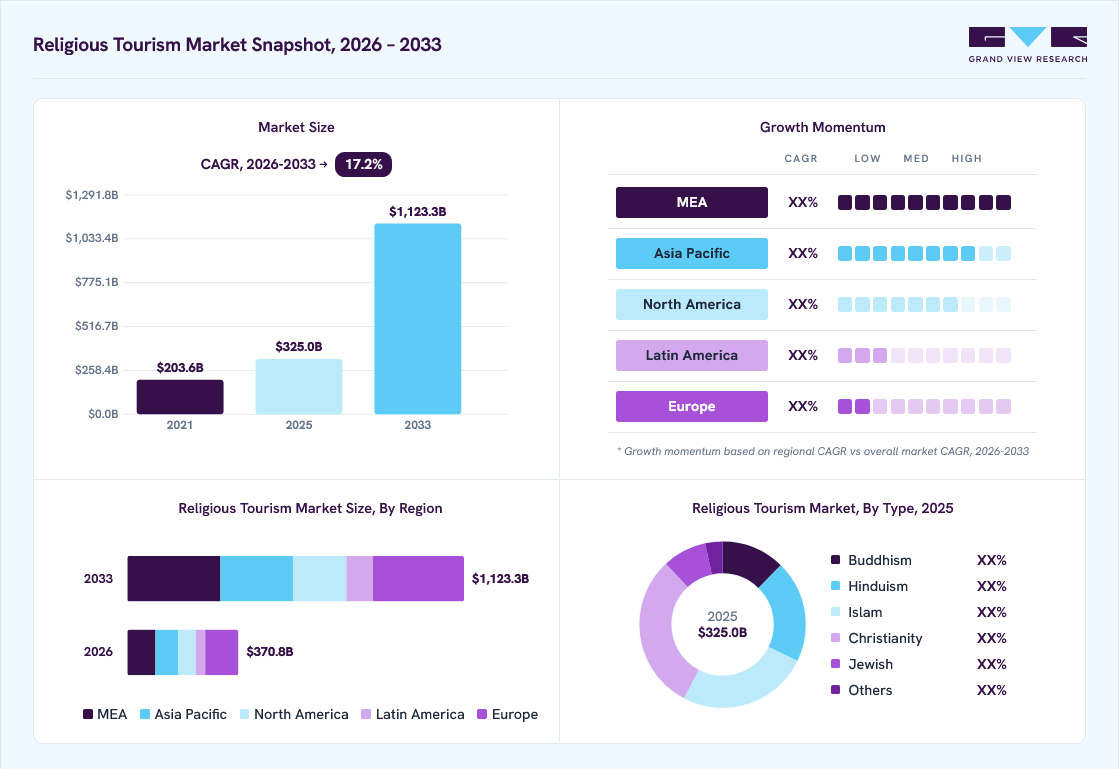
The global religious tourism market size was valued at USD 325.0 billion in 2025 and is projected to grow from USD 370.8 billion in 2026 to USD 1,123.3 billion by 2033, at a CAGR of 17.2% from 2026 to 2033. Europe dominated the market, accounting for a revenue share of 30.3% in 2025. Cultural and spiritual interests drive the demand for religious tourism by attracting travelers who seek deeper connections with their faith, heritage, and history.
 Source: Grand View Research, IR Documents, Primary Interviews, Paid DatabasesTo learn more about this report,
 Download Free Sample Report
Key Market Trends & Insights
- By type: Christianity type segment dominated the market, with a revenue share of 30.3% in 2025.
- By age group: 40-60 years segment held the largest market share of 34.4% in 2025.
Regional Highlights
- Largest regional market: Europe (30.3% revenue share, 2025)
- By country: The U.S. held the largest market share in 2025.
Market Size & Forecast
- Market size in 2025: USD 325.0 Billion
- Estimated market size in 2026: USD 370.8 Billion
- Projected market size by 2033: USD 1,123.3 Billion
- CAGR (2026-2033): 17.2%
Three ways to get this report
Buy it, customize it, or ask a question.Ask an Analyst
Analyst response in 1 business day
- AccessReport author, directly
- Reply timeWithin 1 working day
- No sales callDirect answer only
- FormatEmail reply
- CostFree, no cost
Get the Full Report
What the study covers
- FormatsPDF · Excel · Dashboard
- Timeline2026–2033 annual, 2025 base
- Coverage20+ countries, 5 regions
- Companies10+ key players profiled
Customize the Report
20% free customization
- IncludeCountries, segments, points
- TailorTo your product definition
- ExtendDeeper competitor detail
- OrA fully bespoke study
- Turnaround5–10 working days
Many religious sites are rich in cultural significance, offering unique experiences that blend religious practices with historical and architectural importance. People visit these locations for spiritual growth and also to learn about the local traditions and customs associated with their faith. This blend of cultural exploration and spiritual fulfillment makes religious tourism appealing to a broad audience, increasing demand for travel to sacred sites globally.Traditional pilgrimages to sacred locations, such as Mecca for Hajj or Vatican City for Catholic pilgrimages, significantly drive the market by creating consistent and large-scale travel patterns. These pilgrimages are often mandatory or deeply encouraged within various religions, leading millions of adherents to participate annually. As these journeys are essential spiritual practices, they create sustained demand for transportation, accommodation, and related services. Additionally, the significance of these sacred locations ensures repeated visitors and continued market growth, with travel agencies and governments investing in infrastructure to cater to this steady influx of pilgrims.
 To learn more about this report, Download Free Sample Report
Moreover, government initiatives and infrastructure development drive the demand for religious tourism by improving accessibility, comfort, and safety for visitors to religious sites. Many governments recognize the economic and cultural value of religious tourism and invest in building better transportation networks, lodging facilities, and visitor amenities around key pilgrimage destinations. They also promote these sites through marketing campaigns, offering visa incentives or organizing events to attract more tourists. By making religious sites more accessible and enhancing the overall travel experience, these initiatives encourage both domestic and international visitors, boosting demand for religious tourism.
Additionally, seasonal pilgrimages and festivals like Easter, Ramadan, and Kumbh Mela drive the demand for religious tourism by creating concentrated periods of high travel activity. These events attract millions of devotees who travel to participate in communal worship, rituals, or religious ceremonies. The unique spiritual and cultural significance of these festivals compels many to travel from across the world to sacred locations, often boosting local economies through spending on accommodations, food, and transportation. Additionally, the cyclical nature of these events ensures repeat travel, with many planning trips annually or seasonally, further contributing to the steady demand for religious tourism.
Market Dynamics
Religious tourism continues to gain momentum as travelers increasingly seek faith-based, spiritual, and cultural experiences through pilgrimages, visits to sacred sites, participation in religious festivals, and heritage exploration. These journeys provide opportunities for spiritual fulfillment, community engagement, cultural immersion, and personal reflection while supporting local economies and preserving religious traditions. Growing government investments in tourism infrastructure, improved accessibility to pilgrimage destinations, and the rising popularity of experiential travel are encouraging greater participation across age groups. In addition, the integration of digital booking platforms, guided pilgrimage packages, and destination-focused tourism initiatives is enhancing convenience for travelers. The increasing interest in spiritual wellness, combined with the expansion of domestic and international pilgrimage travel, is expected to continue driving growth in the religious tourism market.
The increasing number of individuals participating in pilgrimages, religious festivals, and faith-based travel is a major factor driving the growth of the religious tourism market. Rising spiritual awareness, greater interest in cultural and religious heritage, and the desire for meaningful travel experiences are encouraging travellers to visit sacred destinations across the world. Improved transportation infrastructure, enhanced accommodation facilities, and government-led tourism development programs have further increased accessibility to major pilgrimage sites.
Large-scale religious gatherings such as Hajj and Umrah in Saudi Arabia, Kumbh Mela and Char Dham Yatra in India, and Christian pilgrimages to destinations such as Vatican City, Jerusalem, and Lourdes continue to attract millions of visitors annually. In addition, the growing middle-class population and expansion of organized pilgrimage tour packages are making religious travel more accessible to a broader consumer base. The rising integration of digital booking platforms, mobile travel services, and guided religious tours is further enhancing traveler convenience. As a result, the increasing participation in domestic and international faith-based tourism is expected to remain a key driver supporting the long-term expansion of the religious tourism market.
Geopolitical uncertainties, stringent travel regulations, and accessibility challenges remain key restraints for the religious tourism market. Religious travel often involves cross-border movement to pilgrimage destinations, making the industry highly sensitive to visa restrictions, political instability, security concerns, and changes in international travel policies. In several regions, religious sites are in areas affected by geopolitical tensions, which can discourage visitors and disrupt tourism flows.
In addition, overcrowding at major pilgrimage destinations, limited accommodation capacity during peak seasons, and inadequate transportation infrastructure in developing regions can negatively impact traveller experiences. Health emergencies, natural disasters, and disease outbreaks may also lead to temporary travel restrictions and event cancellations, significantly affecting pilgrimage volumes. Furthermore, rising travel costs, including airfare, lodging, and tour expenses, can limit participation among budget-conscious travellers. These factors may reduce visitor confidence, constrain international pilgrimage activity, and create operational challenges for tourism providers, thereby moderating the growth potential of the religious tourism market.
The increasing adoption of digital technologies and smart tourism solutions is creating significant growth opportunities in the religious tourism market. Travelers are increasingly seeking seamless and personalized pilgrimage experiences that offer convenient trip planning, real-time information, digital navigation, multilingual guidance, and customized religious itineraries. Tourism operators, destination authorities, and religious organizations are leveraging mobile applications, artificial intelligence (AI), virtual tours, and digital booking platforms to enhance visitor engagement and improve travel experiences.
The rapid growth of smartphone usage and online travel services is further supporting this opportunity by enabling pilgrims to access accommodation bookings, transportation services, crowd management updates, and destination information through a single platform. In addition, governments and tourism authorities across major pilgrimage destinations are investing in smart infrastructure, digital visitor management systems, and technology-enabled services to accommodate growing visitor volumes. The integration of AI-powered travel assistance, virtual reality-based heritage experiences, and personalized pilgrimage packages is expected to improve accessibility, increase traveller satisfaction, and attract younger demographics. These advancements are anticipated to strengthen destination competitiveness and accelerate the long-term growth of the religious tourism market.
Analyst Perspective
The religious tourism market benefits from a unique combination of resilient demand drivers, deep-rooted faith traditions, growing interest in spiritual wellness, and government investment in pilgrimage infrastructure. Religious journeys are often motivated by lifelong beliefs and recurring rituals, supporting consistent visitor flows. The key competitive advantage will belong to operators that seamlessly integrate pilgrimage services, cultural experiences, accommodation, transportation, and digital travel management into a unified offering, transforming one-time pilgrimages into repeat faith-based travel and long-term customer engagement.
Type Insights
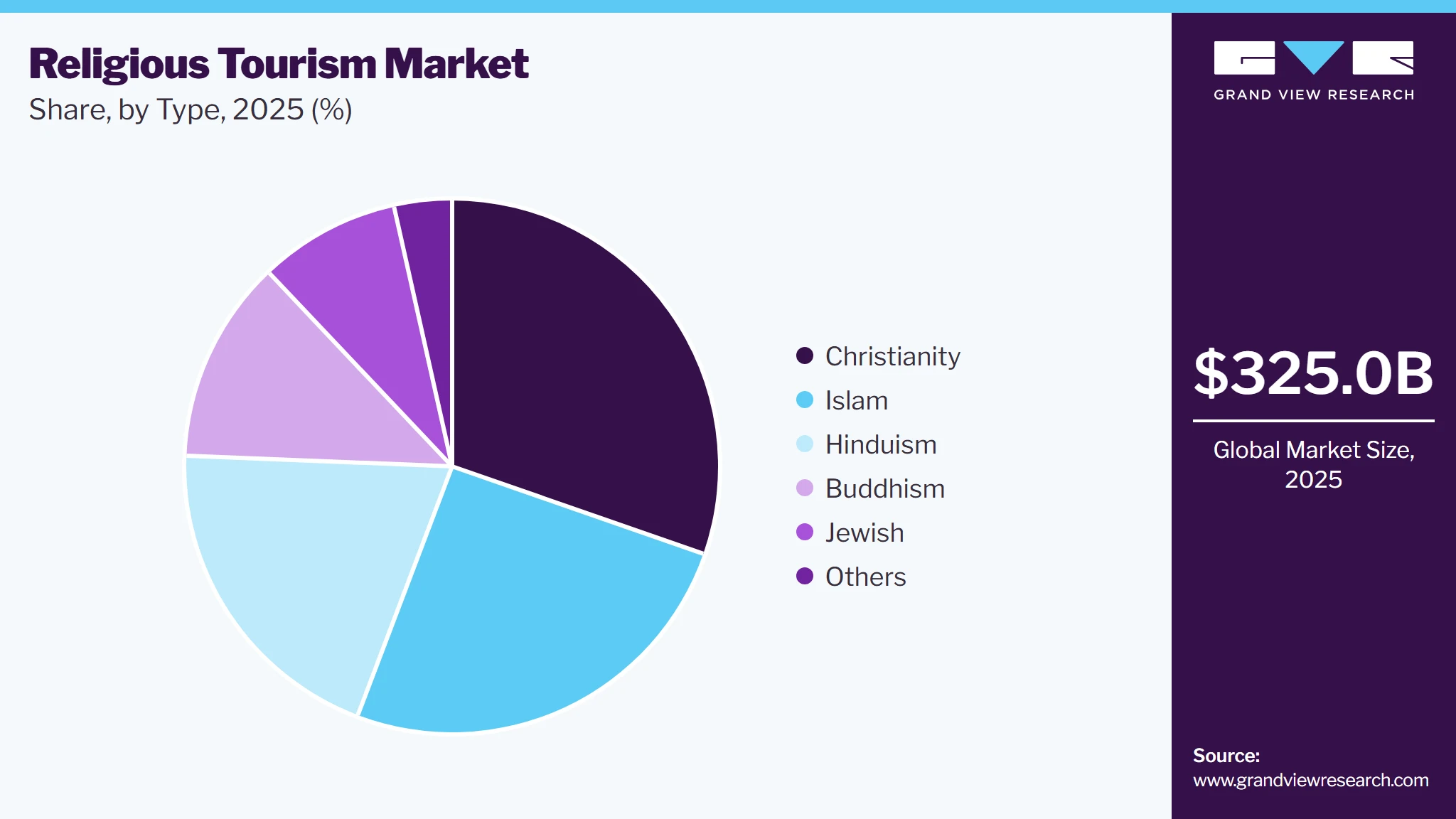
Based on type, the Christianity type segment led the market with the largest revenue share of 30.3% in 2025, and Islam is expected to grow at the fastest CAGR over the forecast period. Destinations such as the Vatican, Jerusalem, and Lourdes attract millions of Christian tourists annually, seeking to experience their faith’s historical and spiritual landmarks. Key religious events like Easter and Christmas further increase travel surges, with devotees attending services, festivals, and religious ceremonies. Additionally, Christian educational tours and retreats aimed at deepening faith and religious understanding contribute to sustained demand, supported by organized travel packages and church-led initiatives promoting faith-based travel experiences.
 To learn more about this report, Download Free Sample Report
The demand for Islamic religious tourism is expected to grow at the highest CAGR of 16.8% from 2024 to 2030. The demand for religious tourism within Islam is primarily driven by the pilgrimage of Hajj to Mecca, a key pillar of Islam, which every Muslim is required to undertake at least once in their lifetime if financially and physically able. Additionally, the Umrah pilgrimage, which can be performed at any time of the year, contributes to sustained travel flows. The spiritual significance of these pilgrimages, coupled with growing populations and increasing disposable income in many Islamic countries, further fuels the market.
Age Group Insights
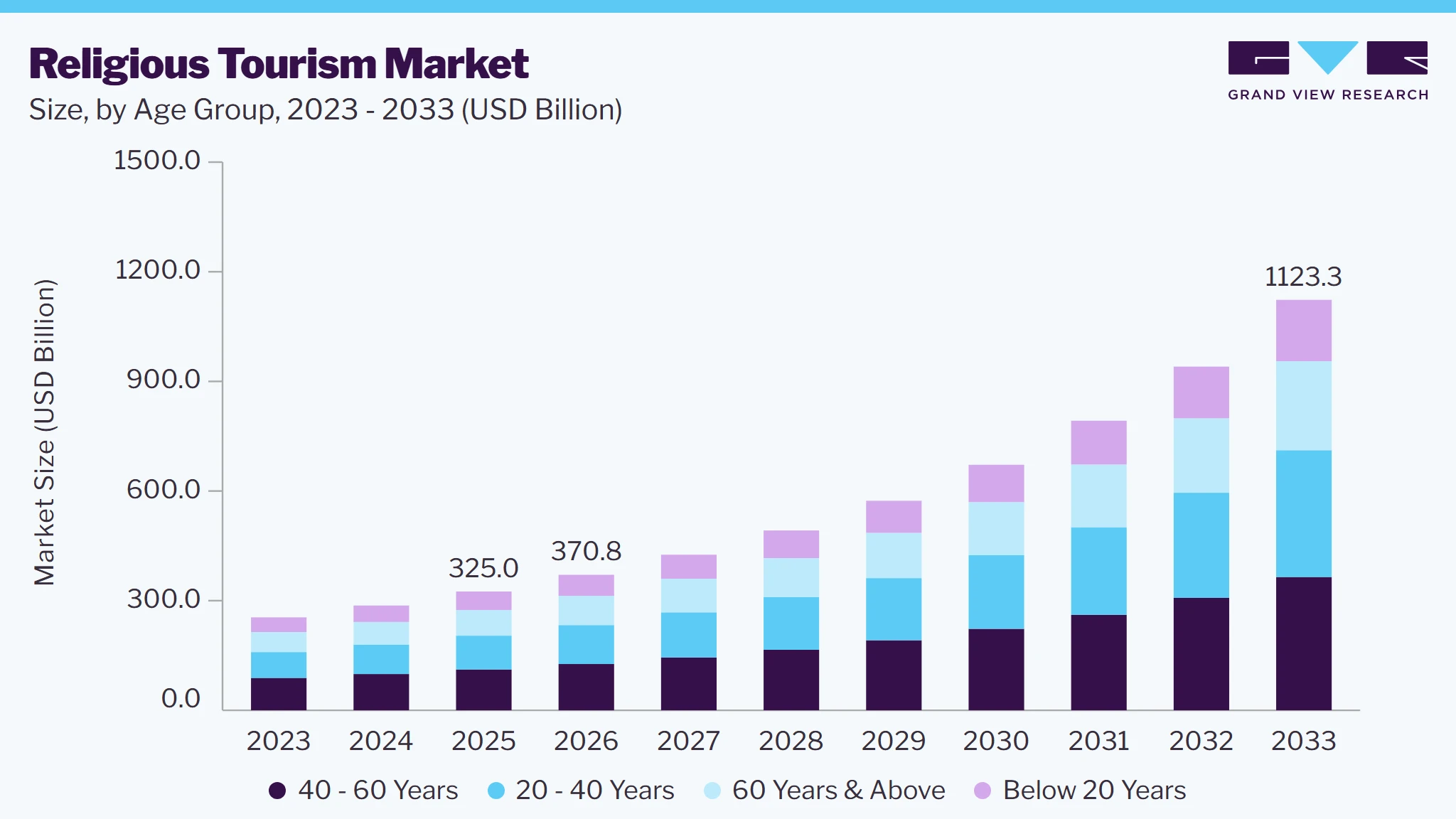
Based on age group, the age group 40-60 years segment led the market with the largest revenue share of 34.4% in 2025. The demand for religious tourism among this age group is driven by a combination of spiritual fulfillment, personal reflection, and cultural exploration. Individuals in this age range often seek deeper connections with their faith as they approach midlife, valuing meaningful travel experiences that offer both spiritual enrichment and a sense of purpose. Additionally, this demographic typically has more financial stability and disposable income, allowing for more frequent and extended trips to sacred sites. Enhanced by a desire to participate in significant religious events or rituals, this group contributes to a steady demand for religious tourism services tailored to their needs and interests.
Religious tourism among the 20 - 40 years age group is expected to grow at a CAGR of 16.5% from 2024 to 2030. This age group is increasingly interested in immersive travel experiences that offer both personal growth and connection to cultural heritage. Social media and digital platforms play a significant role, as young adults share their travel experiences, inspire peers, and create trends around religious destinations. Additionally, this demographic often seeks meaningful travel experiences that align with their values and offer a sense of community, further fueling interest in religious tourism. The accessibility of affordable travel options and the desire for experiential learning also contribute to the rise in this market segment.
Regional Insights
North America religious tourism market accounted for a revenue share of around 15% in 2023. North America hosts a range of religious sites and events that attract both domestic and international visitors, including significant Christian pilgrimage destinations and historical places of worship. The region’s diverse religious landscape creates opportunities for varied religious tourism experiences, from exploring historical churches and temples to participating in large-scale religious festivals. Additionally, increasing interest in spiritual and wellness travel, coupled with strong infrastructure and accessibility, further enhances the appeal of religious tourism in North America.
U.S. Religious Tourism Market Trends
The religious tourism market in the U.S. accounted for a largest revenue share in 2025. Major factors include the prominence of pilgrimage destinations such as the National Shrine of the Immaculate Conception, Martin Luther King Jr. National Historic Site, and various historic churches and temples across the country. The diverse religious landscape in the U.S. attracts visitors from various faith backgrounds seeking to explore significant sites and participate in religious events. Additionally, the growing trend of experiential travel and the increasing interest in spiritual and cultural enrichment contribute to the demand for religious tourism. Government and local initiatives to promote these sites further enhance their appeal, driving continued growth in the market.
Europe Religious Tourism Market Trends
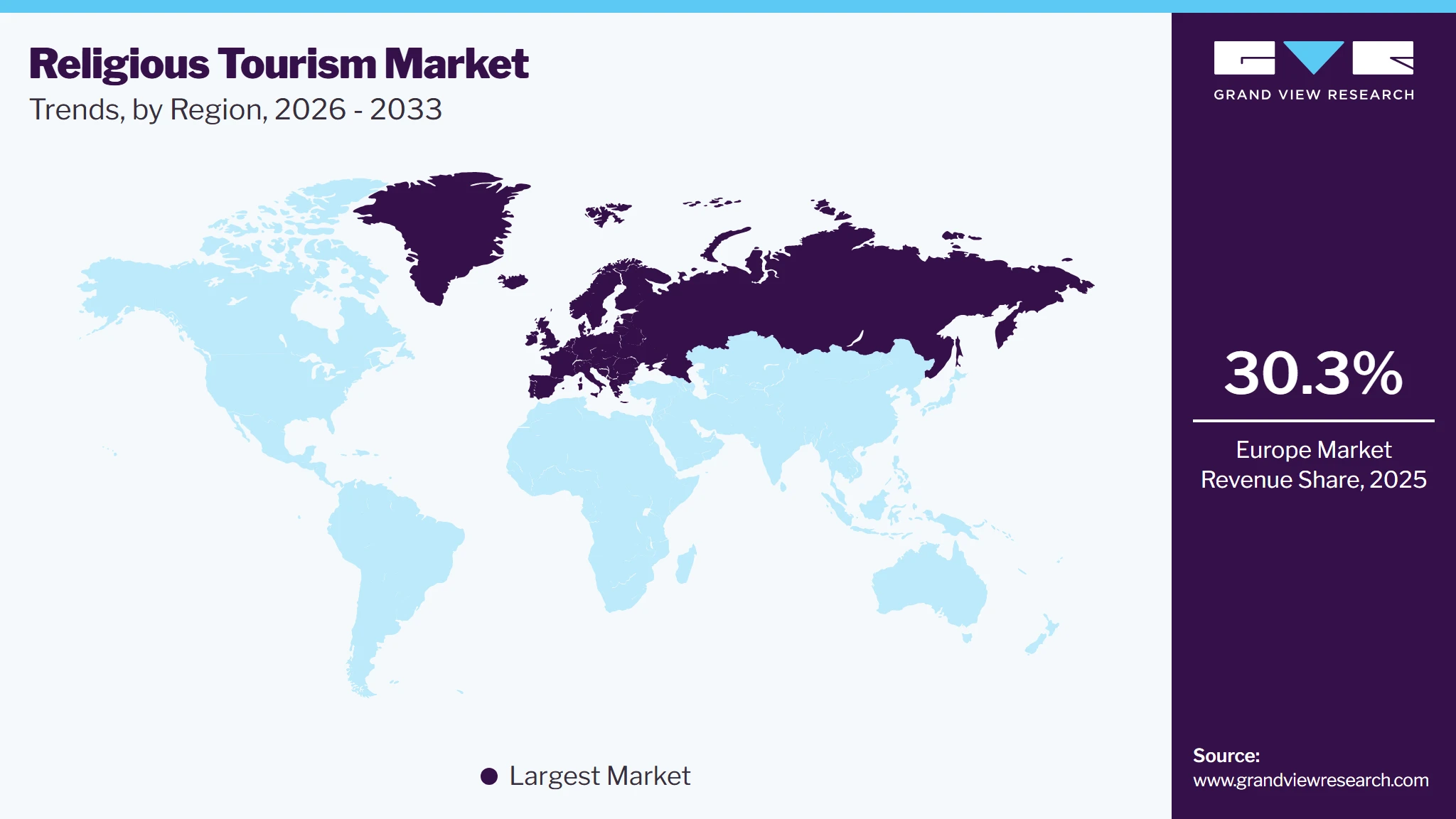
Europe dominated the religious tourism market with the largest revenue share of 30.3% in 2025. The market in Europe is fueled by the continent's rich historical and spiritual heritage, with numerous iconic pilgrimage sites and religious landmarks drawing millions of visitors annually. Key destinations include the Vatican City, which attracts Catholic pilgrims from around the world, and other significant sites such as Santiago de Compostela in Spain and Lourdes in France. Europe's well-developed transportation infrastructure, diverse accommodation options, and cultural attractions complement these spiritual journeys, making it a highly accessible region for religious tourism. Additionally, European governments and religious organizations actively promote these sites, enhancing their visibility and appeal to both traditional pilgrims and those seeking cultural and historical experiences.
 To learn more about this report, Download Free Sample Report
Asia Pacific Religious Tourism Market Trends
The religious tourism market in Asia Pacific accounted for a revenue share of around 20% of global revenue in 2023. The regional market is driven by the rich cultural and spiritual diversity inherent to the area, with numerous significant religious sites and festivals attracting both domestic and international visitors. Major pilgrimage destinations, such as India’s Kumbh Mela, Thailand’s Buddhist temples, and Japan’s Shinto shrines, draw large crowds annually. Additionally, the region’s growing middle class, increased disposable income, and improved infrastructure support ease of travel, further boosting religious tourism. Government initiatives and local community efforts to promote and preserve these sacred sites also play a crucial role in enhancing the appeal and accessibility of religious tourism throughout the region.
Key Religious Tourism Company Insights
The religious tourism market is characterized by a diverse array of players, including government tourism boards, religious organizations, and private travel agencies, all vying to attract pilgrims and spiritual travelers. Key competitors often differentiate themselves through specialized travel packages, tailored experiences, and partnerships with local religious institutions to offer unique access to sacred sites and events. Major players invest in marketing campaigns, enhance infrastructure, and leverage digital platforms to reach a global audience. Additionally, the market is influenced by local and regional competitors who offer distinct cultural and spiritual experiences, contributing to a dynamic and competitive environment as each entity seeks to capture a share of this niche but growing segment.
Key Religious Tourism Companies
The following key companies have been profiled for this study on the religious tourism market.
-
Trafalgar Tours
-
Catholic Travel Centre
-
Expedia, Inc.
-
G Adventures
-
Globus
-
TourRadar
-
Kesari
-
Insight Vacations
-
Rick Steves' Europe, Inc.
-
ACE CULTURAL TOURS
Competitive Benchmarking
Category
Operating Strategies
Competitive Edge
Weakness
Established Players (Expedia, Inc., Trafalgar Tours, Globus, TourRadar, Insight Vacations)
- Expand integrated travel ecosystems through partnerships with airlines, hotels, destination management companies, and religious institutions. Invest in digital booking platforms, multilingual customer support, and customized pilgrimage packages. Strengthen presence across major pilgrimage destinations through strategic collaborations with tourism boards and local operators.
- Strong brand recognition, extensive global distribution networks, and large customer bases. Broad portfolio of religious, cultural, and heritage tourism offerings across multiple destinations. Advanced digital capabilities, operational scale, and established supplier relationships that enable seamless travel experiences.
- Higher operational costs due to extensive global operations and destination management requirements. Greater exposure to geopolitical instability, travel restrictions, and fluctuations in international tourism demand. Slower adaptability in addressing highly specialized faith-specific travel requirements compared to niche operators.
Emerging Players (Catholic Travel Center, G Adventures, Kesari, Rick Steves' Europe, Inc., ACE Cultural Tours)
- Focus on niche pilgrimage segments, faith-based travel experiences, and culturally immersive religious tours. Leverage direct-to-consumer marketing, social media engagement, and community-based partnerships to attract travelers. Develop customized itineraries, small-group tours, and destination-specific pilgrimage packages tailored to religious communities.
- Faster service innovation and the ability to address specialized religious tourism needs. Strong destination expertise, personalized customer engagement, and authentic local experiences. Greater flexibility in designing customized itineraries and responding to changing traveler preferences.
- Limited financial resources and smaller marketing budgets compared to global travel companies. Lower economies of scale and dependence on seasonal pilgrimage traffic. Limited international reach and higher vulnerability to disruptions affecting specific religious destinations.
Recent Developments
-
In August 2024, Trafalgar committed to responsible tourism through its initiative "Greening the World One Trip at a Time." Trafalgar made significant strides in integrating sustainable practices across its travel operations, including reducing carbon emissions and supporting environmental conservation projects. The company has implemented eco-friendly measures such as energy-efficient accommodations and waste reduction strategies, aiming to minimize its environmental footprint while promoting responsible travel. This initiative reflects Trafalgar's broader strategy to address environmental challenges and encourage more sustainable travel practices within the industry
Religious Tourism Market Report Scope
Report Attribute
Details
Market value in 2025
USD 325.0 billion
Estimated market size in 2026
USD 370.8 billion
Projected market size by 2033
USD 1,123.3 billion
Growth rate
CAGR of 17.2% from 2026 to 2033
Base year for estimation
2025
Historical data
2021 - 2024
Forecast period
2026 - 2033
Quantitative units
Revenue in USD million/billion and CAGR from 2026 to 2033
Report coverage
Revenue forecast, company ranking, competitive landscape, growth factors, and trends
Segments covered
Type, age group, region
Regional scope
North America; Europe; Asia Pacific; Central & South America; Middle East & Africa
Country scope
U.S, Canada, Mexico, U.K., Germany, France, Italy, Spain, Japan, China, India, Brazil, Argentina, Saudi Arabia, and South Africa
Key companies profiled
Trafalgar Tours; Catholic Travel Centre; Expedia, Inc.; G Adventures; Globus; TourRadar; Kesari; Insight Vacations; Rick Steves' Europe, Inc.; ACE CULTURAL TOURS
Customization scope
Free report customization (equivalent up to 8 analysts' working days) with purchase. Addition or alteration to country, regional & segment scope.
Pricing and purchase options
Avail customized purchase options to meet your exact research needs. Explore purchase options
Global Religious Tourism Market Report Segmentation
This report forecasts revenue growth at the global, regional, and country levels and provides an analysis of the latest industry trends and opportunities in each of the sub-segments from 2021 to 2033. For this study, Grand View Research has segmented the global religious tourism market report on the basis of type, age group, and region.
 To learn more about this report, Download Free Sample Report
-
Type Outlook (Revenue, USD Billion, 2021 - 2033)
-
Buddhism
-
Hinduism
-
Islam
-
Christianity
-
Jewish
-
Others
-
-
Age Group Outlook (Revenue, USD Billion, 2021 - 2033)
-
Below 20 Years
-
20 - 40 Years
-
40 - 60 Years
-
60 Years & Above
-
-
Regional Outlook (Revenue, USD Billion, 2021 - 2033)
-
North America
-
U.S.
-
Canada
-
Mexico
-
-
Europe
-
UK
-
Germany
-
France
-
Italy
-
Spain
-
-
Asia Pacific
-
China
-
Japan
-
India
-
-
Central & South America
-
Brazil
-
Argentina
-
-
Middle East & Africa
-
South Africa
-
Saudi Arabia
-
-
Research Methodology
The religious tourism market figures in this report are based on a proven research process that combines executive interviews with secondary research from proprietary databases, company filings, and recognized regulatory and institutional sources. Market size is built through value-chain sizing - reconciling supply-side and demand-side estimates - and triangulated with bottom-up and top-down approaches. Every estimate passes multiple levels of expert validation before publication, with each religious yourism segment quantified using the revenue-capture definitions in the table below.
Segment Definition
Segment - Type
Revenue capture definition
Buddhism
This segment covers the revenues generated through the religious tourism market associated with Buddhist pilgrimage, spiritual retreats, temple visits, meditation tourism, and travel to sacred Buddhist sites. It includes expenditures on transportation, accommodation, guided tours, religious ceremonies, and cultural experiences at destinations such as monasteries, stupas, temples, and heritage sites significant to Buddhist traditions.
Hinduism
This segment covers the revenues generated through the religious tourism market associated with Hindu pilgrimages, temple visits, spiritual journeys, and participation in religious festivals and rituals. It includes travel-related spending on transportation, lodging, tour services, donations, and religious activities at sacred destinations such as temples, river ghats, pilgrimage circuits, and sites of religious significance within Hindu traditions.
Islam
This segment covers the revenues generated through the religious tourism market associated with Islamic pilgrimage and faith-based travel, including Hajj, Umrah, mosque visits, and participation in religious events. It includes expenditures on transportation, accommodation, pilgrimage packages, guided services, and other travel-related activities undertaken by Muslim travelers visiting destinations of religious importance.
Christianity
This segment covers the revenues generated through the religious tourism market associated with Christian pilgrimages, visits to churches, cathedrals, shrines, monasteries, and participation in religious festivals and faith-based events. It includes spending on travel, accommodation, guided tours, religious ceremonies, and cultural heritage experiences at destinations significant to Christian history and beliefs.
Jewish
This segment covers the revenues generated through the religious tourism market associated with Jewish pilgrimage, heritage travel, visits to synagogues, historical religious sites, and participation in religious observances and cultural events. It includes expenditures on transportation, accommodation, guided tours, educational programs, and other travel services connected to destinations of significance within Judaism.
Others
This segment covers the revenues generated through the religious tourism market associated with faith-based travel related to religions and spiritual traditions not categorized under Buddhism, Hinduism, Islam, Christianity, or Judaism. It includes pilgrimages, religious gatherings, cultural heritage visits, spiritual retreats, and travel to sacred sites associated with indigenous, Sikh, Jain, and other religious or spiritual communities.
Estimation Model
Religious Population Layer
Travel Accessibility Layer
Pilgrimage Participation Layer
Tourism Revenue Layer
Who belongs to a faith group?
Who can travel to religious destinations?
Who actively participates in religious travel?
How much revenue is generated?
Identify the population affiliated with major religions, including Christianity, Islam, Hinduism, Buddhism, Judaism, and other faiths across key countries. This establishes the total potential religious traveler base.
Apply country-level income, transportation accessibility, passport ownership, visa access, and tourism infrastructure indicators to determine the travel-capable religious population.
Apply pilgrimage participation rates, religious festival attendance rates, domestic and international travel frequency, and organized tour adoption rates to derive active religious tourists.
Multiply religious tourists by average trip expenditure covering transportation, accommodation, food & beverages, guided tours, donations, and retail purchases to estimate total religious tourism revenue.
Delivered Customizations
This report has been delivered with the following In-depth customizations
Client Request
Customization Delivered
Value Adds
Hindu, Buddhist, Jewish & Other Faith-Based Travel Assessment
Evaluated tourism trends across Hindu, Buddhist, Jewish, and other religious travel segments, including temple and monastery visits, spiritual retreats, religious festivals, cultural heritage tourism, destination infrastructure development, and international visitor flows.
Provides insights into emerging pilgrimage destinations, underserved travel markets, and investment opportunities across diverse faith-based tourism ecosystems.
Digital Religious Tourism & Smart Pilgrimage Services Analysis
Examined adoption of online booking platforms, virtual pilgrimage experiences, mobile travel applications, multilingual guide services, and digital visitor management solutions across religious destinations.
Helps organizations understand technology adoption trends, improve traveler engagement, and capitalize on emerging digital transformation opportunities within religious tourism.
Regional Religious Tourism Growth Opportunity Assessment
Evaluated demand across North America, Europe, Asia Pacific, Central & South America, and Middle East & Africa, covering visitor flows, pilgrimage destinations, government support programs, and tourism infrastructure investments.
Supports market entry and expansion strategies by identifying high-growth regions, competitive dynamics, and country-level revenue opportunities.
Frequently Asked Questions About This Report
The global religious tourism market size was valued at USD 325.0 billion in 2025 and is estimated at USD 370.8 billion for 2026.
The global religious tourism market is expected to grow at a CAGR of 17.2% from 2026 to 2033, reaching USD 1,123.3 billion by 2033.
Europe dominated the religious tourism market with a share of around 30.3% in 2025.
Key players in the religious tourism market are Trafalgar Tours; Catholic Travel Centre; Expedia, Inc.; G Adventures; Globus; TourRadar; Kesari; Insight Vacations; Rick Steves' Europe, Inc.; and ACE CULTURAL TOURS.
Key factors that are driving the religious tourism market growth include increasing interest in spiritual experiences, the preservation of religious heritage sites, improved accessibility and infrastructure, and the desire for cultural exploration and personal reflection.
The 40- 60 age group dominated the religious tourism market with a share of around 34.4% in 2025.The demand for religious tourism among this age group is driven by a combination of spiritual fulfillment, personal reflection, and cultural exploration.
Christianity dominated the religious tourism market with a share of around 30.3% in 2025 while islamic religious tourism segment is expected to be the fastest-growing market.
About the Author(s)
Homecare & Decor Research Team
Consumer Goods · Homecare & DecorThis report was authored by the homecare & decor research team at Grand View Research - comprising two research analysts, one senior research analyst, and one industry expert - with specialized expertise in the homecare & decor segment of the consumer goods industry. All findings are based on proprietary consumer goods databases, executive interviews, and regulatory analysis, subject to internal peer review prior to publication.
Last Updated:
Speak to Analyst

Customize this report to your needs - add regions, segments, or data points, with 20% free customization.
Or view our licence options:


ISO 9001:2015 & 27001:2022 Certified
We are GDPR and CCPA compliant! Your transaction & personal information is safe and secure. For more details, please read our privacy policy.


