
- Home
- »
- Electronic & Electrical
- »
-
Residential Boiler Market Size & Share Report, 2026-2033GVR Report cover

Residential Boiler Market (2026 - 2033)
Size, Share & Trends Analysis Report By Type (Combi Boilers, Conventional Boilers), By Fuel Type (Gas Boilers, Electric Boilers), By Technology, By Installation Type, By Property Type, By Application, By Capacity, and Segment Forecasts
Market Size, 2025
$12.3BMarket Estimate, 2026
$13.1BMarket Forecast, 2033
$20.5BCAGR, 2026–2033
6.7%Residential Boiler Market Summary
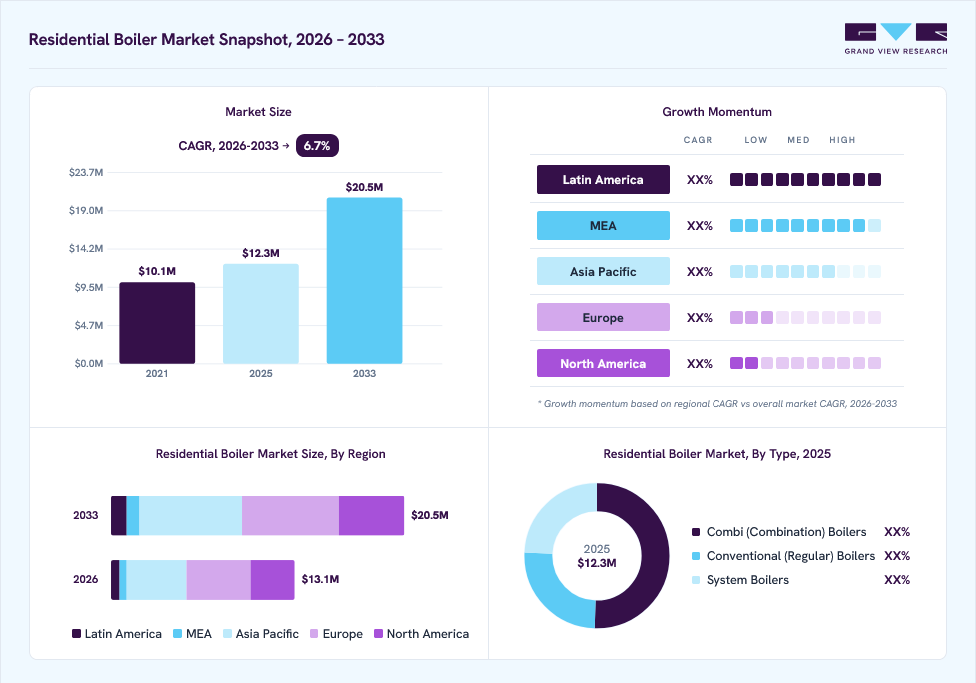
The global residential boiler market size was valued at USD 12.3 billion in 2025 and is projected to grow from USD 13.1 billion in 2026 to USD 20.5 billion by 2033, at a CAGR of 6.7% from 2026 to 2033. The market in Europe dominated with a revenue share of 34.9% in 2025. Market expansion is being driven by the replacement of aging heating systems, stricter energy-efficiency requirements, increasing adoption of high-efficiency condensing technologies, and continued demand for integrated space-heating and domestic hot-water systems.
 Source: Grand View Research, IR Documents, Primary Interviews, Paid DatabasesTo learn more about this report,
 Download Free Sample Report
Key Market Trends & Insights
- By type: Combi (combination) boilers held the largest market share of 50.1% in 2025
- By fuel type: Gas boilers held the largest revenue share of 81.0% in 2025
- By technology: Condensing boilers held the largest revenue share of 74.4% in 2025
- By installation type: Wall-mounted boilers held the largest revenue share of 68.3% in 2025
- By property type: Single-family homes held the largest revenue share of 68.1% in 2025
- By application: Space heating + domestic hot water held the largest revenue share of 54.1% in 2025
- By capacity: 20-30 kW boilers held the largest revenue share of 39.1% in 2025
Regional Highlights
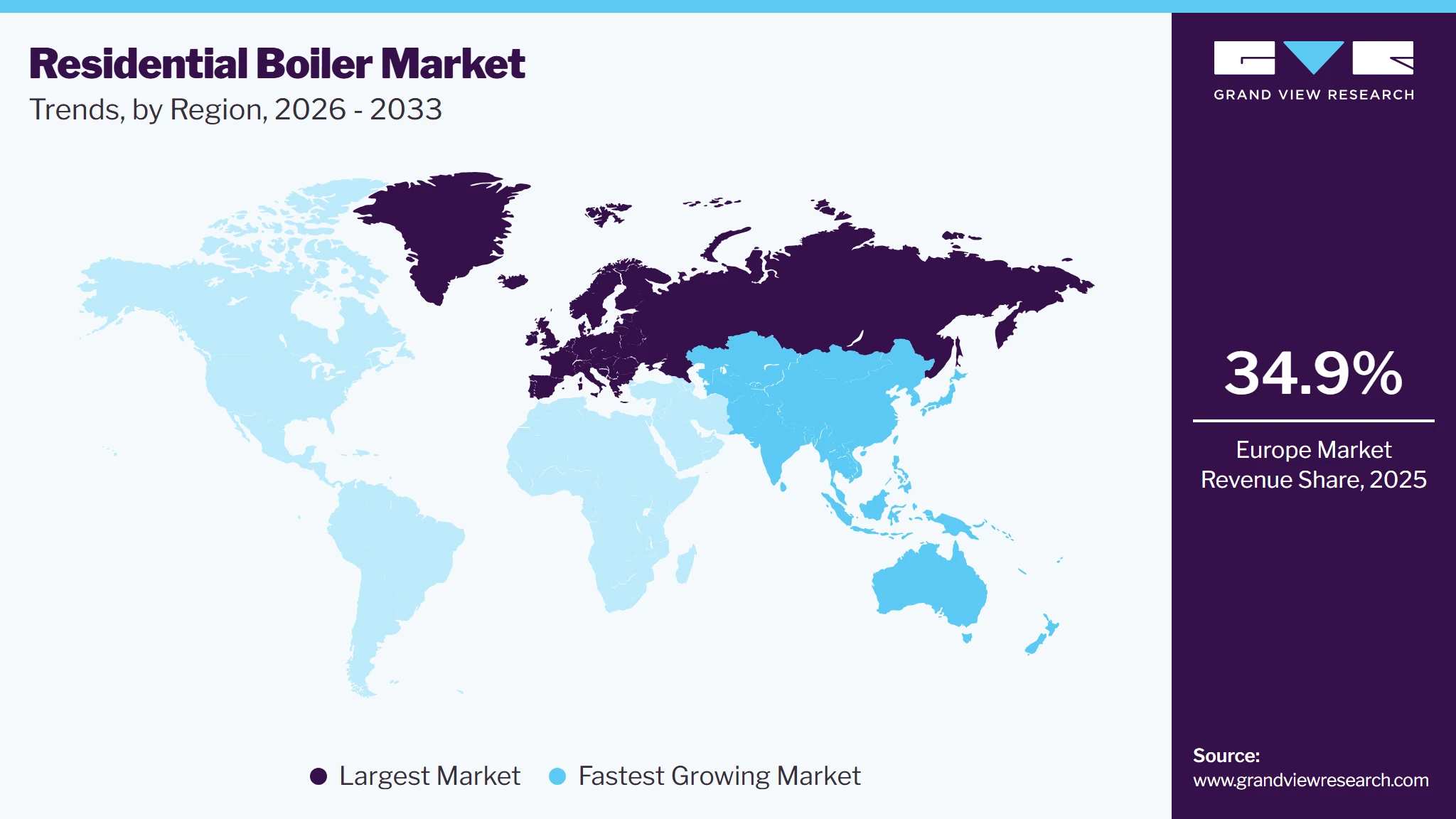
- Largest regional market: Europe (34.9% revenue share, 2025)
- Fastest-growing regional market: Asia Pacific (fastest CAGR, 2026-2033)
- By country: Germany held the largest revenue share of Europe in 2025
Market Size & Forecast
- Market Size in 2025: USD 12.3 Billion
- Estimated Market Size by 2026: USD 13.1 Billion
- Projected Market Size by 2033: USD 20.5 Billion
- CAGR (2026-2033): 6.7%
Prism AI by Grand View Research Free to tryAsk a question about the residential boiler marketTry asking✓Every figure cited from GVR research Prefer the report? Download free sample →
Europe represents the largest regional market, supported by its extensive residential heating infrastructure, established boiler replacement cycle, and strong emphasis on energy efficiency, while Asia Pacific represents the fastest-expanding major regional market as residential construction, household incomes, and demand for reliable heating systems increase. The market is also undergoing a technology transition, with manufacturers increasingly shifting toward condensing, electric, wall-mounted, and lower-capacity systems that offer improved energy efficiency, reduced installation footprint, and compatibility with evolving low-carbon heating strategies.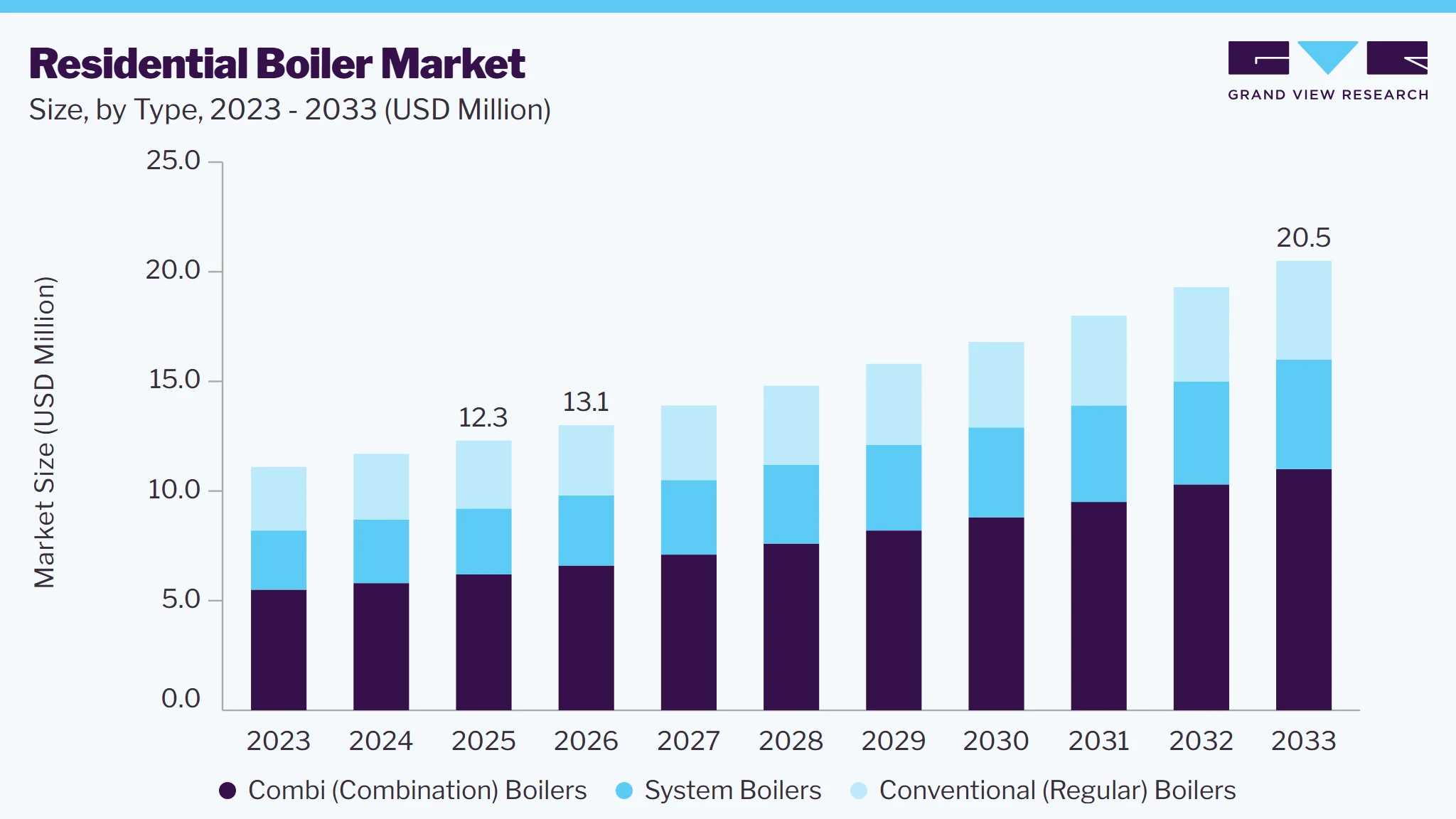 To learn more about this report, Download Free Sample Report
The global residential boiler industry is increasingly shaped by energy efficiency, replacement demand, and tightening building performance requirements, particularly in mature heating markets in Europe. The European Commission estimates that central hydronic heating systems supplied around 40% of EU27 space-heating demand in 2020, while the average efficiency of boilers sold that year was approximately 82% versus 64% for the installed boiler stock, highlighting a substantial efficiency gap and long-term replacement opportunity. The Commission also estimates that Ecodesign and Energy Labeling measures for central-heating boilers could deliver 306 TWh of primary-energy savings by 2030 and reduce consumer expenditure by around €14 billion. This is accelerating the adoption of condensing boilers, advanced modulation, improved heat exchangers, and intelligent controls, with companies such as Viessmann, Vaillant, Bosch Home Comfort, Baxi, and Ariston increasingly positioning high-efficiency systems around lifetime operating economics rather than upfront purchase price.
Technology differentiation is shifting toward connected and integrated heating systems. Manufacturers are incorporating smart thermostats, weather compensation, remote monitoring, diagnostics, and automated scheduling to improve real-world system performance and simplify ownership. For example, Bosch Home Comfort's Greenstar platform combines condensing technology with modulation and connected controls, while Vaillant's senso ecosystem and Viessmann's ViCare platform provide digital monitoring and control capabilities for compatible heating systems. This transition is strategically important because field performance can differ materially from laboratory ratings; European Commission-supported research has shown that seasonal efficiencies measured in real installations can be 15-20% below those achieved under optimized demonstration conditions, making system design, installation quality, and controls increasingly important. Consequently, premiumization is moving beyond boiler hardware toward measurable benefits such as lower fuel consumption, remote diagnostics, maintenance visibility, and optimized heating schedules.
Electrification and the transition toward lower-carbon residential heating are creating a structural competitive challenge for conventional gas boilers. While gas remains deeply embedded in existing residential heating infrastructure, manufacturers are expanding into heat pumps, electric heating, hybrid systems, and broader home-energy solutions. Vaillant and Viessmann, for instance, have expanded their portfolios beyond gas boilers to include heat pumps and connected energy management systems, while Bosch Home Comfort operates across boilers, heat pumps, water heating, and smart controls. This diversification allows manufacturers to participate in multiple technology pathways as household heating systems evolve. At the same time, compact wall-mounted and combi configurations remain commercially important in apartments and space-constrained homes, with Worcester Bosch, Baxi, Vaillant, and Ariston offering compact systems that integrate space heating and domestic hot water.
Competitive advantage is consequently shifting from standalone equipment toward complete heating ecosystems and service capabilities. The large installed base of aging boilers creates recurring replacement demand, making installer relationships, spare parts availability, warranty coverage, technical training, and after-sales support important purchase considerations alongside efficiency and price. Manufacturers such as BDR Thermea, Bosch Home Comfort, Vaillant, Viessmann, Ariston, and Rinnai are therefore competing across product efficiency, installation flexibility, digital controls, emissions performance, and service networks. The strategic direction is toward boilers that can operate within a broader residential energy system, enabling manufacturers to retain customers as homes increasingly adopt connected controls, renewable electricity, heat pumps, thermal storage, and other lower-carbon technologies.
Market Dynamics
Replacement demand remains a fundamental driver for residential boilers because a large installed base of older heating systems continues to operate below the efficiency levels of newer equipment. The European Commission reports that 101 million central hydronic space heaters were in use across the EU27 in 2020, with 77% using gas, 14% oil, and 6.5% electric heat pumps. Importantly, average efficiency was only 64% for boilers in use, compared with 82% for boilers sold in 2020, creating a substantial efficiency gap that supports replacement activity. The Commission also estimates that Ecodesign and Energy Labelling measures generated 136 TWh of primary-energy savings in 2020, projected to reach 306 TWh by 2030.
This replacement cycle encourages manufacturers to compete around efficiency, modulation, and intelligent controls rather than basic heat generation. For instance, Vaillant markets its ecoTEC range alongside smart controls and hybrid heat-pump systems, while Bosch Home Comfort and Viessmann increasingly position condensing boilers as components within broader residential energy systems. The opportunity is particularly relevant in renovation-heavy markets where homeowners can upgrade the boiler without completely replacing the existing hydronic heating infrastructure. Consequently, boiler demand is being supported not only by new residential construction but also by replacement of inefficient installed equipment, especially where households are seeking lower energy consumption without undertaking a complete heating-system conversion.
The residential boiler industry faces structural pressure from the accelerating shift toward electric heating, particularly heat pumps. The IEA estimates that a heat pump can use three to five times less energy than an efficient gas boiler for delivering the same heating service, strengthening the economic and environmental case for electrification where electricity and installation conditions are favorable. The competitive pressure is already visible in major heating markets. In the UK, for example, only 13% of new homes completed in 2024 had a heat pump, but 71% still used fossil-fuel boilers, illustrating both the continued strength of boilers and the direction of new-building policy. Meanwhile, the IEA reports that heat pumps installed across Europe, Japan, and China avoided approximately 53 billion cubic meters of natural-gas consumption for building heating in 2025. Governments are consequently tightening building-efficiency requirements, providing incentives for low-carbon heating, and encouraging electrification. For boiler manufacturers, this creates pressure to reduce emissions, improve seasonal efficiency, and develop hybrid or hydrogen-ready solutions rather than relying solely on conventional gas-fired systems.
The shift toward electrification creates an important opportunity for manufacturers to integrate boilers with heat pumps, thermal storage, solar technologies, and smart controls rather than treating electrification solely as a substitute for boiler demand. The European Commission explicitly recognizes hybrid packages combining conventional boilers and heat pumps, along with temperature controls and solar assistance, within its heating-efficiency framework. This creates a practical route for homeowners who want to reduce fossil-fuel consumption but cannot economically replace their entire heating infrastructure at once.
Vaillant provides a clear industry example through its hybrid solution combining an aroTHERM plus air-source heat pump, ecoTEC plus boiler, smart-home controls, internet gateway, and hot-water cylinder. Its control system can automatically determine whether the heat pump or boiler should provide heating, while the boiler can handle peak demand. Vaillant also states that its hybrid configurations can subsequently incorporate heat pumps or solar thermal systems, thereby making existing boiler installations renewable-ready. This model creates a broader opportunity for companies such as Bosch Home Comfort, Viessmann, Baxi, and Vaillant to monetize the transition through integrated heating packages, connected thermostats, remote diagnostics, and energy-management software. Rather than competing solely on boiler efficiency, manufacturers can increasingly compete on whole-home heating optimization, helping preserve the role of boilers in residential heating while progressively reducing their fuel consumption.
Consumer Insights
 To learn more about this report, Download Free Sample Report
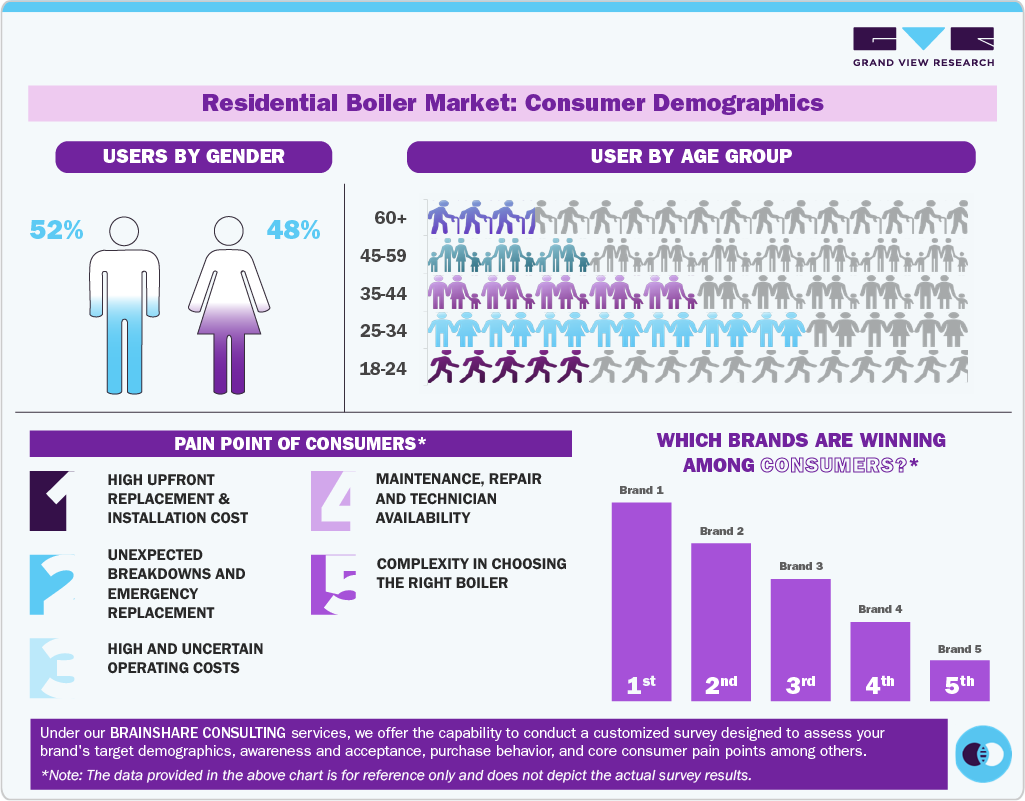
Consumer behavior in the global residential boiler market is becoming more value- and application-driven, with buyers balancing heating requirements, household size, installation constraints, energy consumption, reliability, and long-term ownership costs. However, boiler purchases remain strongly replacement-led: a 2025 Which? study of 938 UK homeowners with heating systems aged 8+ years found that 75% were not prepared for replacement, while only 6% had researched heating systems in preparation for a future replacement.
-
Household requirements and system suitability remain key purchase filters: Consumers increasingly evaluate boiler configuration according to property size, number of occupants, hot-water demand, and available installation space. Combi boilers are generally suited to households seeking integrated heating and hot water without a separate cylinder, whereas system and conventional boilers may be considered for higher hot-water demand. The replacement journey is often urgent: 39% of homeowners who had not planned experienced an emergency replacement, compared with 19% among those who had planned, reinforcing the importance of rapid product availability and appropriate system sizing.
-
Reliability and serviceability strongly influence perceived value: Consumers increasingly view a boiler as a long-term reliability investment rather than simply a heating appliance. Which?'s 2025 survey covered 10,064 boiler owners, including 7,000 gas-boiler owners and 1,791 electric-boiler owners, and also collected assessments from 225 heating engineers. Reliability accounts for 40% of Which?'s overall boiler assessment, with customer satisfaction and engineer assessment also incorporated. This underscores the importance of brands such as Worcester Bosch, Vaillant, Viessmann, Baxi, and Ideal differentiating themselves through reliability, warranty, parts availability, and service support.
-
Energy efficiency is increasingly evaluated through running costs: Consumers are becoming more attentive to the relationship between boiler efficiency and household energy expenditure. However, the information gap remains significant: only 35% of customers surveyed felt adequately informed about energy-saving options. This creates an opportunity for manufacturers to make efficiency easier to understand through seasonal efficiency ratings, modulation, smart controls, and clear operating-cost information. For example, Vaillant's ecoTEC, Viessmann's Vitodens, and Worcester Bosch's Greenstar ranges position condensing efficiency alongside heating controls and system optimization.
-
Consumers research options, but installers remain highly influential: Boiler purchases involve technical decisions that many homeowners cannot make independently. Which? found that 35% of homeowners who had recently upgraded their heating system sought advice from heating engineers, while 25% consulted friends and family. Importantly, consumers who researched their options were substantially more receptive to alternative technologies: 35% of researched consumers considered a heat pump, compared with 15% of homeowners overall who said they would consider one if their gas boiler failed. This reinforces the importance of installer networks and technical recommendations for manufacturers.
-
Gas familiarity continues to shape technology preference: Despite increasing awareness of electrification, consumers remain strongly attached to conventional gas heating. 76% of homeowners with older heating systems said they would replace a failed gas boiler with another gas boiler, compared with only 15% considering a heat pump. However, information can materially alter behavior: among homeowners who researched new heating systems and encountered information about heat pumps, consideration increased to 85%. This suggests that education, installer guidance, and transparent comparisons can be critical to shifting consumers toward electric and hybrid heating solutions.
-
Maintenance and after-sales economics influence ownership satisfaction: Consumer evaluation continues after installation, particularly around servicing, repair costs, and warranty protection. In Which?'s 2025 research, 60% of homeowners reported servicing their boiler annually, 31% less frequently, and 7% never did. The average cost of a one-off boiler service was approximately £79, while consumers reported an average repair cost of £156 following a service when a repair was required. Consequently, consumers increasingly value dependable after-sales service, accessible spare parts, warranty coverage, and straightforward maintenance alongside the initial boiler price.
Overall, the residential boiler consumer is shifting from a mindset of replacing a broken boiler toward choosing the most reliable and efficient heating solution for their home. Reliability, installer recommendation, energy efficiency, brand trust, availability of service and parts, and long-term operating economics are becoming interconnected purchase criteria. This favors manufacturers that can combine high-efficiency boilers with strong installer ecosystems, connected controls, proactive maintenance, warranties, and pathways toward hybrid or electrified heating rather than competing solely on boiler specifications.
Analyst Perspective
The global residential boiler market is shifting from conventional heating replacement toward high-efficiency, low-emission systems, with condensing boilers gaining share as energy-efficiency regulations tighten across Europe and other mature markets. Gas remains dominant, but electrification is creating pressure on traditional gas and oil boilers, particularly in new residential construction. Combi boilers continue to benefit from space-saving installation and integrated domestic hot-water functionality, especially in Europe. Meanwhile, replacement demand in aging housing stock remains a major revenue pool, favoring established brands with strong installer networks and after-sales support. Competition is increasingly centered on efficiency ratings, hydrogen-ready compatibility, smart controls, and hybrid heating integration rather than boiler hardware alone.
Type Insights
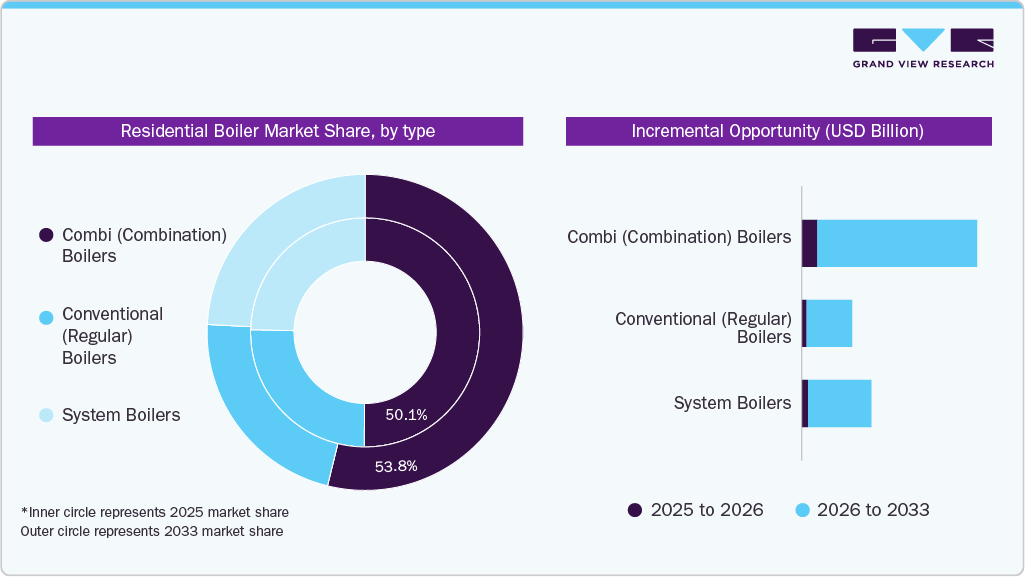
The combi (combination) boilers segment dominated the residential boiler industry, accounting for the largest revenue share of 50.1% in 2025, establishing them as the dominant boiler type globally. Their leadership is primarily attributable to their ability to provide both space heating and domestic hot water from a single compact appliance. This eliminates the need for a separate hot-water cylinder in many residential installations, reducing equipment footprint and installation complexity. The format is particularly attractive in apartments, smaller homes, and urban properties where available utility space is limited. The strong position of combi boilers is also reinforced by manufacturers such as Bosch, Vaillant, BDR Thermea, Ariston, and Navien, which offer increasingly efficient condensing combi systems with smart controls, modulation, remote monitoring, and improved hot-water performance. Their broad availability across mass-market and premium price points further supports their position.
 To learn more about this report, Download Free Sample Report
The combi boilers segment is also projected to grow at the fastest CAGR of 7.6% from 2026 to 2033. The growth of the segment is supported by continued preference for space-efficient heating equipment, particularly in urban housing and apartment construction. Consumers replacing older conventional systems increasingly have the opportunity to consolidate heating and hot-water equipment into a single appliance. The transition toward condensing technology is also enhancing the appeal of newer combi platforms, as manufacturers can combine high seasonal efficiency with compact form factors. However, system and conventional boilers will continue to retain important positions in larger homes and properties with high simultaneous hot-water demand, where stored hot water can provide performance advantages.
Fuel Type Insights
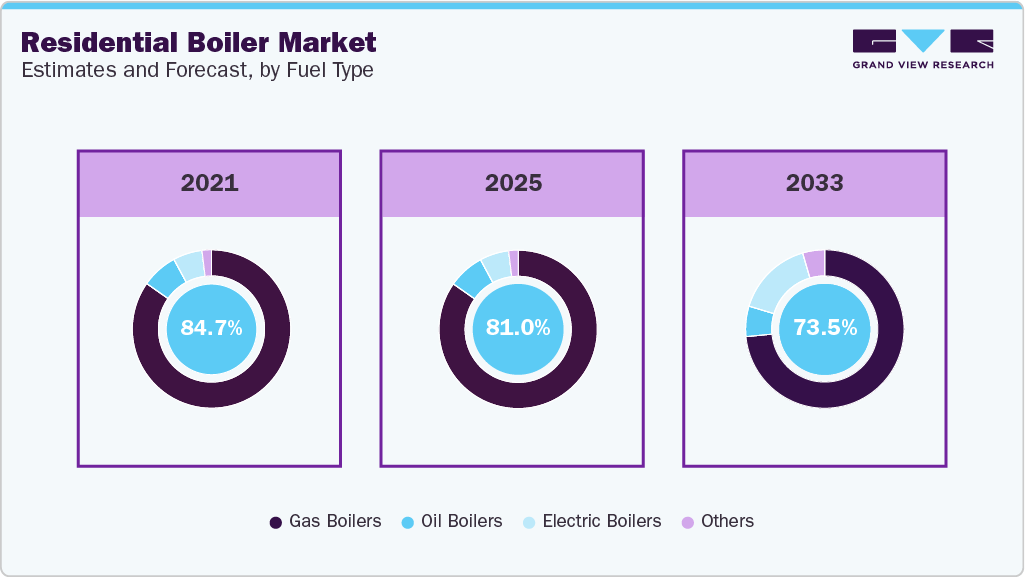
The gas boilers segment dominated the residential boiler market, accounting for the largest revenue share of 81.0% in 2025, remaining the dominant fuel category. Their leadership reflects the extensive installed base of natural-gas heating systems, particularly across Europe, North America, and parts of Asia. Gas infrastructure, established installer networks, consumer familiarity, and relatively high heating output have historically made gas boilers the default choice for residential central-heating applications. The installed-base effect is particularly significant because a large proportion of boiler purchases globally are replacement purchases rather than first-time installations. Consequently, households with existing gas connections often replace aging gas boilers with newer, higher-efficiency condensing models rather than immediately changing the entire heating system.
 To learn more about this report, Download Free Sample Report
The electric boilers segment is projected to grow at the fastest CAGR of 13.8% from 2026 to 2033, substantially above the overall market growth rate. Their expansion is being driven by building electrification, decarbonization policies, avoidance of on-site combustion, and the increasing availability of renewable electricity. Electric boilers are particularly relevant for properties without gas connections and in markets where governments or utilities discourage new fossil-fuel heating installations. They also provide a complementary solution for hybrid heating configurations and can be integrated with renewable-energy systems. Nevertheless, electricity prices, grid capacity, and the comparatively high operating cost of direct electric resistance heating in some markets remain constraints. Therefore, electric boilers are expected to gain share rapidly while gas remains the largest installed-base technology over the forecast period.
Technology Insights
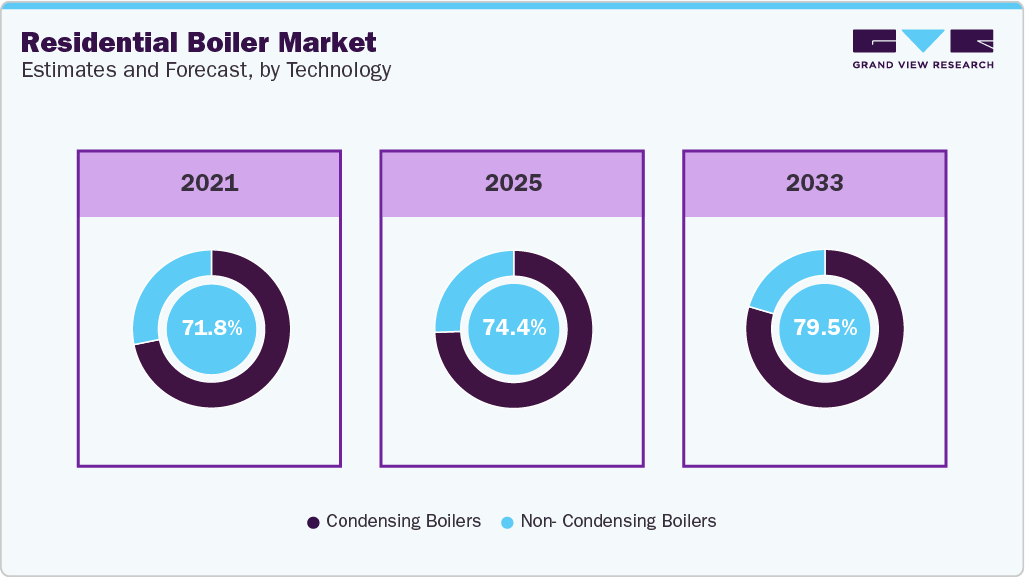
The condensing boilers segment dominated the residential boiler industry, accounting for the largest revenue share of 74.4% in 2025, making high-efficiency condensing technology the mainstream configuration in the market. Condensing systems recover additional heat from flue gases that would otherwise be lost, allowing them to achieve substantially higher seasonal efficiency than older non-condensing designs when properly installed and operated at suitable return-water temperatures. Their adoption has been reinforced by tightening energy-efficiency standards, building regulations, and emissions requirements, as well as the replacement of aging non-condensing equipment.
 To learn more about this report, Download Free Sample Report
The condensing boilers segment is projected to grow at a 7.5% CAGR during the forecast period, making it one of the fastest-growing technology categories and the clear market leader. Growth will be sustained by the replacement of aging non-condensing units, stricter efficiency requirements, and consumer interest in reducing household energy consumption. Technology is also increasingly integrated with smart thermostats, weather-compensation controls, modulating burners, and connected-home platforms, improving system-level efficiency. Non-condensing boilers are expected to remain relevant primarily in replacement markets where existing infrastructure, installation constraints, or lower upfront costs make complete system modernization less attractive.
Installation Type Insights
Wall-mounted boilers accounted for the largest revenue share of 68.3% in 2025, reflecting the industry's strong shift toward compact heating equipment. Wall-mounted systems are particularly well-suited to apartments, townhouses, smaller single-family homes, and urban properties where floor space is limited. Their compact footprint allows installation in kitchens, utility rooms, bathrooms, closets, and other confined areas, while modern lightweight designs simplify transportation and installation. The category also overlaps strongly with the industry's fastest-growing product architectures, particularly condensing and combi boilers. Manufacturers have continued to reduce product dimensions while increasing output, improving modulation, and adding smart controls, thereby enabling higher performance from relatively compact appliances.
Wall-mounted boilers are projected to register the fastest growth, at 7.6% CAGR during 2026-2033. Growth is supported by urbanization, apartment construction, replacement of bulky legacy systems, and consumer preference for space-efficient equipment. The format is particularly advantageous when replacing older floor-standing boilers because it can free up valuable utility room or storage space. Increasing availability of wall-mounted electric and gas condensing systems further expands the addressable market. Floor-standing boilers will remain important for larger homes requiring higher outputs, properties with existing large-scale heating infrastructure, and applications in which system components, such as larger cylinders or thermal stores, are installed alongside the boiler.
Property Type Insights
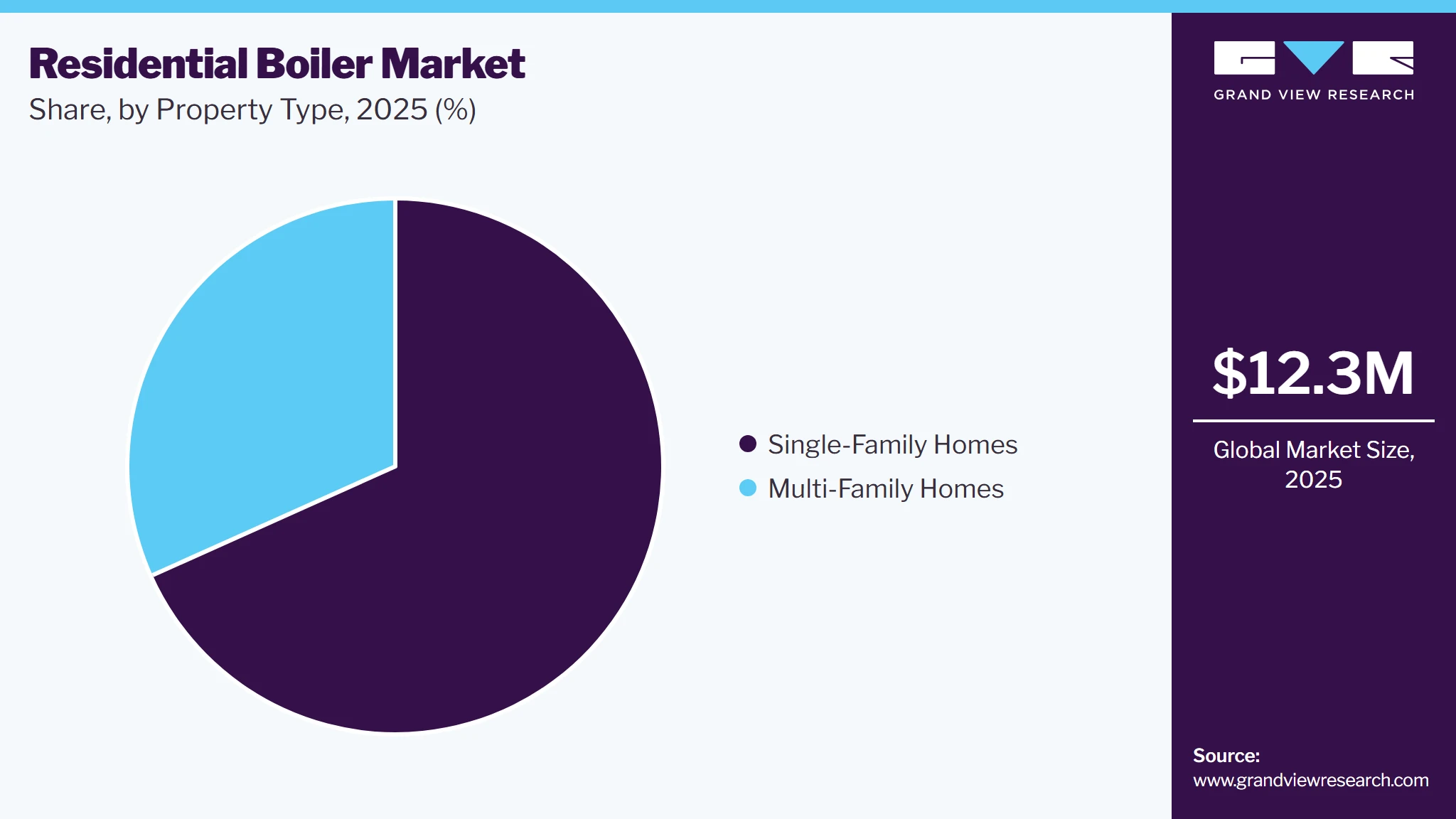
The single-family homes segment dominated the residential boiler industry, accounting for the largest revenue share of 68.1% in 2025, making them the primary property type for boiler demand. Their leadership reflects the large installed base of detached and semi-detached homes with individually controlled heating systems. Single-family properties also tend to have higher heating loads than apartments and, therefore, commonly require dedicated boilers capable of serving both space heating and domestic hot water. Replacement activity is particularly important because boilers in these properties are often replaced when they reach the end of their operating life, creating a recurring equipment market independent of new-home construction.
 To learn more about this report, Download Free Sample Report
The multi-family homes segment is projected to grow at the fastest CAGR of 7.7% CAGR over the forecast period. Increasing urbanization, apartment construction, housing densification, and the renovation of multi-unit residential buildings are driving demand for compact, high-efficiency heating equipment. Multi-family properties can also generate significant replacement volumes, as a single building renovation may involve multiple boiler installations. The shift toward wall-mounted, combi, condensing, and increasing electric systems is particularly relevant in apartments because these products reduce equipment footprint and can simplify installation. In some markets, centralized heating systems remain dominant in multi-family buildings, so the pace of growth will vary depending on whether individual or central boiler configurations are used.
Application Insights
The space heating + domestic hot water segment dominated the residential boiler market, accounting for the largest revenue share of 54.1% in 2025, making combined heating and hot-water applications the dominant use case for residential boilers. The segment benefits directly from the multifunctionality of modern combi and system boilers, which enable households to meet two major thermal energy requirements through a coordinated heating system. Consumers generally prefer solutions that reduce equipment complexity and maximize usable household space, particularly in apartments and smaller urban homes. The segment also has a strong replacement-market foundation because households replacing older heating systems increasingly evaluate the total heating and hot-water solution rather than purchasing a boiler solely for space heating.
The space heating + domestic hot water segment is also projected to grow at the fastest CAGR of 8.2% during the forecast period. The segment’s growth is closely aligned with the increasing penetration of combi boilers and integrated high-efficiency heating systems. New residential construction and renovation projects increasingly favor compact systems that meet multiple household needs, while consumers are placing greater emphasis on energy efficiency and controllability.
Capacity Insights
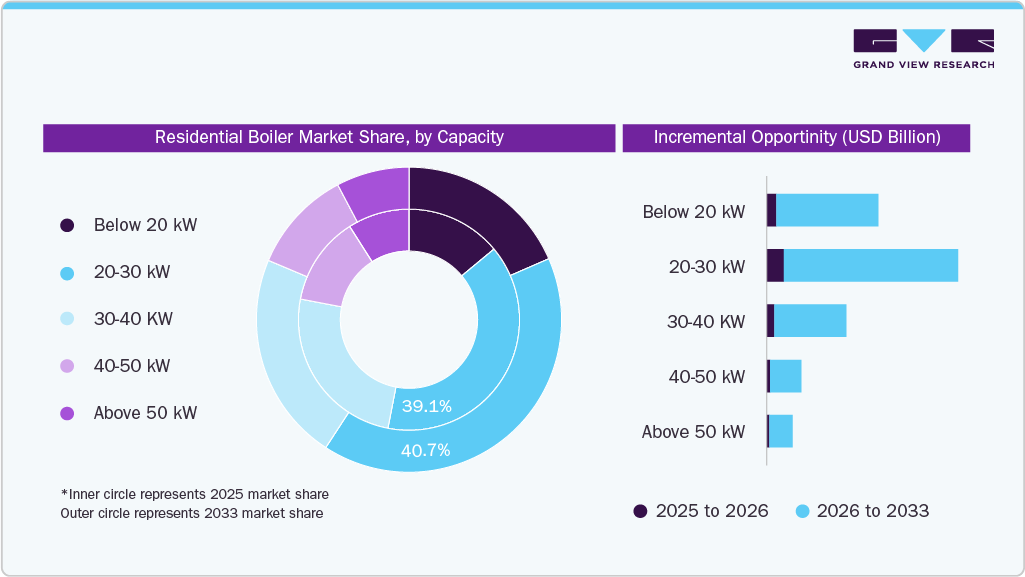
The 20-30 kW boilers segment accounted for the largest revenue share of 39.1% in 2025, making it the core capacity range in the global residential boiler market. This range provides a practical balance between heating output, equipment size, installation requirements, and household demand. It is suitable for a broad portion of single-family homes, apartments, and smaller multi-family properties, allowing manufacturers to target a large addressable customer base without requiring oversized equipment. The segment also aligns well with the industry's strong penetration of combi boilers, where adequate instantaneous hot-water performance is an important purchasing consideration. Its broad applicability enables manufacturers to offer multiple efficiency levels, fuel configurations, and smart-control packages within the same capacity range.
 To learn more about this report, Download Free Sample Report
The below 20 kW boilers segment is projected to grow at the fastest CAGR of 10.4% over the forecast period. The strongest growth driver is the increasing need for compact heating systems in smaller homes, apartments, highly insulated new-build properties, and warmer-climate residential markets. Improvements in building insulation and energy-efficient construction can reduce peak heating requirements, allowing households to meet thermal demand with smaller boilers. Lower-capacity systems can also reduce equipment size and, where correctly matched to the building load, avoid unnecessary oversizing and cycling losses. The segment's growth is therefore closely connected to energy-efficient construction, urban housing, and the industry's transition toward smaller, modulating heating systems. Larger 40 kW-plus systems will remain important for larger detached homes, high domestic hot water demand, and properties with greater heating loads.
Regional Insights
Europe Residential Boiler Market Trends
Europe dominated the global residential boiler industry in 2025, accounting for 34.9% of global revenue and approximately USD 4.3 billion. The region is expected to remain one of the largest markets through 2033, although its share is projected to gradually decline to 33.1% as the Asia Pacific continues to grow. Demand is primarily supported by Europe's large installed base of residential heating systems, cold-climate requirements, replacement demand, and increasing emphasis on energy efficiency. The replacement cycle is particularly important because a substantial portion of residential heating systems across major European countries is aging, encouraging households to replace conventional systems with high-efficiency condensing boilers, system boilers, and increasingly low-carbon heating technologies. Germany, the UK, Italy, France, and Central and Northern European countries remain important demand centers. Product selection is increasingly influenced by seasonal efficiency, operating cost, compatibility with existing heating infrastructure, compact installation, smart controls, and compliance with tightening emissions requirements.
 To learn more about this report, Download Free Sample Report
The Germany residential boiler market was the largest in Europe, accounting for an estimated revenue share of 28.4% in 2025. Demand is supported by a large installed base, replacement of aging heating equipment, strong consumer awareness of energy efficiency, and widespread hydronic heating infrastructure. Gas condensing boilers remain important in replacement applications, while hybrid and renewable-compatible heating systems are gaining relevance. Consumers increasingly prioritize seasonal efficiency, operating costs, reliability, compact installation, smart controls, and integration with broader residential energy-management systems.
The residential boiler market in the UK accounted for an estimated 22.4% share of Europe in 2025, equivalent to approximately USD 0.96 billion. The country's extensive installed base of gas-fired central-heating systems creates a substantial recurring replacement market. Combi boilers remain particularly important because of their compact configuration and ability to provide both space heating and domestic hot water. Purchase decisions increasingly reflect energy efficiency, reliability, installation cost, running costs, smart thermostatic controls, and evolving low-carbon heating requirements. The UK market is therefore primarily replacement-driven, with upgrading of older systems providing a major demand opportunity.
Asia Pacific Residential Boiler Market Trends
The Asia Pacific residential boiler industry accounted for a revenue share of 32.2% in 2025, reaching approximately USD 4.0 billion, making it the second-largest regional market. However, it is the fastest-growing major region, with the market projected to increase to approximately USD 7.2 billion by 2033 and its global share rising to 35.1%. Growth is supported by residential construction, urbanization, rising household incomes, expansion of district and individual heating systems, and demand for reliable space heating in colder markets. China, Japan, South Korea, and selected markets in Central Asia represent important demand centers. Unlike mature European markets, new installations contribute more significantly to regional growth, particularly in newly constructed apartments, villas, and higher-income urban housing. Condensing technology, compact wall-mounted systems, low-temperature operation, and smart heating controls are gaining importance as consumers and developers increasingly prioritize energy performance.
The China residential boiler market accounted for an estimated 25.7% share of Asia Pacific in 2025, representing approximately USD 1.03 billion. Demand is concentrated in northern and colder regions where individual residential heating systems are required, with urban households increasingly adopting compact wall-mounted gas boilers. Residential construction, replacement of older equipment, and growing awareness of energy consumption support market development. Condensing boilers are gaining traction as households seek lower operating costs, while smart controls, remote monitoring, compact designs, and compatibility with hydronic underfloor heating are becoming increasingly important in premium residential applications.
The residential boiler market in Japan represented an estimated 18.5% share of Asia Pacific in 2025. The market is mature and predominantly replacement-driven, with consumers placing strong emphasis on compactness, reliability, energy efficiency, safety, and long operating life. Demand is closely linked to domestic hot-water requirements and residential heating, making integrated high-efficiency systems particularly relevant. Aging household equipment and demand for energy-saving technologies provide a stable replacement opportunity, while smart controls and compact heating and hot-water solutions support premiumization.
North America Residential Boiler Market Trends
The North America residential boiler industry accounted for 24.0% of global revenue share in 2025, equivalent to approximately USD 3.0 billion. The region ranked third globally and is expected to reach around USD 4.6 billion by 2033, while its global share declines to approximately 22.3%. The market is supported by a substantial installed base of hydronic heating systems, particularly in colder parts of the U.S. and Canada, as well as replacement demand from aging residential heating equipment. High-efficiency gas boilers, condensing systems, and systems that integrate with smart thermostats and home energy management platforms are gaining traction. Compared with Europe, the market has a relatively stronger emphasis on replacement of aging equipment, installation flexibility, reliability, and whole-home heating performance.
U.S. Residential Boiler Market Trends
The U.S. residential boiler industry accounted for an estimated 82.2% revenue share of North America in 2025, equivalent to approximately USD 2.4 billion. Demand is concentrated in the Northeast and Midwest, where hydronic heating has a substantial installed base and longer heating seasons create stronger boiler requirements. Replacement of aging gas and oil-fired systems remains a major demand driver. Homeowners increasingly evaluate seasonal efficiency, heating capacity, operating costs, installation requirements, smart thermostats, zoning, and compatibility with existing hydronic systems when replacing boilers.
The Canada residential boiler market represented an estimated 13.4% share of North America in 2025, and is expected to grow at the fastest CAGR of 6.9% over the forecast period. The market benefits from long heating seasons and strong requirements for whole-home heating, particularly in colder provinces. Replacement of aging heating equipment is a key source of demand, while high-efficiency condensing boilers are increasingly attractive for homeowners seeking lower fuel consumption without replacing existing hydronic distribution systems. Reliability in low temperatures, energy efficiency, zoning, and smart controls are important purchase considerations.
Central & South America Residential Boiler Market Trends
Central & South America accounted for 4.9% revenue share of the global residential boiler industry in 2025, reaching approximately USD 0.6 billion. Brazil represented an estimated 58.2% of the regional market, followed by Argentina, Chile, Colombia, and other markets. Residential boiler penetration remains structurally lower than in Europe and North America because large portions of the region have limited space-heating requirements. Demand is consequently concentrated in colder southern markets, higher-altitude locations, affluent households, luxury residential projects, and properties requiring centralized heating or hot-water systems.
Middle East & Africa Residential Boiler Market Trends
The Middle East & Africa residential boiler industry accounted for 4.1% revenue share in 2025, reaching approximately USD 0.5 billion. The UAE accounted for an estimated 42.2% of the regional market, followed by South Africa and other Gulf, North African, and African markets. Conventional space-heating demand is geographically limited, but premium residential construction, domestic hot-water applications, hospitality properties, and colder/high-altitude markets provide opportunities. The market is therefore more concentrated in premium and specialized applications than in mass residential heating.
Key Companies & Market Share Insights
The global residential boiler market is moderately fragmented, with competition led by established European heating-system manufacturers and strong North American and Asian players. Companies compete primarily through condensing technology, heating efficiency, product reliability, installation flexibility, smart controls, low-emission operation, fuel compatibility, and installer/dealer networks. Europe has a particularly strong competitive base, with Bosch, Viessmann, Vaillant, BDR Thermea, Ariston, and Ferroli maintaining broad residential heating portfolios, while Navien, A. O. Smith, Carrier, Weil-McLain, Lochinvar, and Rinnai have stronger positions in North America.
-
Leading Global Residential Boiler Manufacturers: Robert Bosch GmbH, Viessmann Group, Vaillant Group, BDR Thermea Group, and Ariston Group form an important global competitive group. Their portfolios span wall-hung and floor-standing boilers, combi systems, condensing technologies, hot-water systems, heat pumps, and hybrid heating solutions. BDR Thermea, for example, operates multiple regional heating brands and sells products in more than 100 countries, while Vaillant maintains a strong portfolio of condensing boilers, including the ecoTEC range.
-
Bosch & Viessmann - Strong European Technology Positions: Bosch competes through its Bosch and Buderus heating brands, offering high-efficiency residential boilers alongside heat pumps, hybrid systems, digital controls, and connected heating solutions. Viessmann similarly emphasizes high-efficiency condensing technology, integrated heating systems, digital controls, and renewable-energy compatibility. Their strength is particularly relevant in European replacement and modernization markets, where homeowners increasingly replace older heating systems with higher-efficiency equipment.
-
Vaillant & BDR Thermea - Broad Installer and Brand Ecosystems: Vaillant differentiates through condensing technology, system efficiency, German engineering, and products designed for replacement, modernization, and new-build applications. BDR Thermea competes through a portfolio of regional brands and a broad product offering spanning residential boilers, heat pumps, solar thermal systems, and connected services. This multi-brand approach enables the company to address different national heating preferences and installer networks rather than relying on a single brand.
-
North American Technology-Focused Players: Navien, Inc., A. O. Smith Corporation, Carrier Corporation, Weil-McLain, Lochinvar, and Rinnai Corporation represent important competitive forces in North America. The regional market has a large installed base of hydronic heating systems, creating recurring replacement demand as older boilers are upgraded to condensing and higher-efficiency models.
-
Regional & Specialist Manufacturers: Companies including Hoval Group, Ideal Heating, Fondital, Unical, U.S. Boiler Company, Burnham Holdings, Laars Heating Systems, and NTI Boilers strengthen competition at the regional level. These companies often compete through specialized product ranges, contractor relationships, localized technical support, and products tailored to specific fuel types or installation requirements.
-
Condensing Technology as a Major Competitive Battleground: Condensing boilers have become a central area of product differentiation. Manufacturers are competing to increase thermal efficiency by recovering heat from flue gases, while simultaneously reducing emissions and improving modulation. Navien's residential condensing boilers, for instance, use stainless-steel heat exchangers to recover additional heat, while Vaillant positions its ecoTEC portfolio around high-efficiency condensing technology.
-
Smart Controls and Connected Heating: Competition is increasingly moving beyond the boiler itself toward connected heating ecosystems. Bosch, Vaillant, Viessmann, BDR Thermea, Ariston, and other major manufacturers are integrating digital controls, remote monitoring, automated diagnostics, and connectivity with broader home-energy systems. This allows manufacturers to compete on the total heating management experience, rather than only on boiler efficiency or purchase price.
-
Hybrid & Low-Carbon Heating Solutions: Established boiler manufacturers are increasingly positioning boilers alongside heat pumps, solar thermal systems, and other renewable technologies rather than treating them as standalone products. BDR Thermea, for example, maintains portfolios spanning residential boilers, heat pumps, solar thermal, and connected services, while Vaillant explicitly markets heating solutions covering boilers, heat pumps, and renewable technologies. This broad system capability is becoming an important competitive advantage as households transition toward lower-carbon heating.
-
Installer and Service Networks as a Competitive Moat: Residential boilers require professional sizing, installation, commissioning, servicing, and replacement of components. Consequently, manufacturers with established relationships with heating engineers, plumbing contractors, distributors, and authorized service providers have a structural advantage. Navien's installer-finder and technical-support infrastructure illustrates how manufacturers increasingly use installer ecosystems as part of their competitive proposition.
-
Replacement Demand Supports Established Brands: Mature markets in Europe and North America have substantial installed bases of older boilers, making replacement and modernization an important source of demand. Vaillant explicitly positions its heating systems for replacement and modernization projects, while the broader industry is increasingly focused on replacing conventional systems with high-efficiency condensing, hybrid, and connected solutions.
-
Competition is Shifting from Product Sales to Complete Heating Systems: The leading companies increasingly compete as home-heating solution providers rather than standalone boiler manufacturers. Bosch, Vaillant, Viessmann, BDR Thermea, Ariston, and other major players are expanding across boilers, heat pumps, controls, hot-water systems, and connected services. This broad portfolio allows them to retain customers during technology transitions and capture a larger share of the residential heating system value chain.
Key Residential Boiler Company Insights
The market remains competitive because global leaders face strong regional specialists and North American manufacturers in their respective core markets. European companies retain significant strength in condensing technology, system efficiency, and renewable integration, while North American players such as Navien, Weil-McLain, Lochinvar, and U.S. Boiler have strong positions in hydronic heating and contractor-led channels. In the future, energy efficiency, condensing technology, smart controls, hybrid compatibility, installer networks, product reliability, and after-sales support will remain the principal areas of differentiation.
 To learn more about this report, Download Free Sample Report
Key Residential Boiler Companies
The following key companies have been profiled for this study on the residential boiler market.
-
Robert Bosch GmbH
-
Vaillant Group
-
BDR Thermea Group
-
Ariston Group
-
A. O. Smith Corporation
-
Navien, Inc.
-
Ferroli S.p.A.
-
Weil-McLain
-
Carrier Corporation
-
Daikin Industries Ltd.
Competitive Benchmarking
Category
Operating Strategies
Competitive Edge
Weakness
Established Global Players (Robert Bosch GmbH; Vaillant Group; BDR Thermea Group; Ariston Group; Carrier Corporation; Daikin Industries, Ltd.)
- Expand residential boiler portfolios across combi, conventional, and system boilers, with increasing emphasis on condensing and high-efficiency technologies. Strengthen distribution through HVAC dealers, installers, distributors, home-improvement channels, and established service networks. Invest in energy-efficient products, smart controls, hybrid heating systems, and lower-emission technologies to address tightening efficiency and decarbonization requirements across major markets.
- Strong global brand recognition, broad residential heating portfolios, extensive installer and distributor networks, and established after-sales/service infrastructure. Significant R&D capabilities and manufacturing scale support product innovation, regulatory compliance, and competitive pricing. Geographic diversification also reduces dependence on individual residential heating markets.
- Large organizational structures can result in slower product development and decision-making compared with specialized regional competitors. Exposure to fluctuations in steel, copper, aluminum, electronic components, and energy-related input costs can pressure margins. Established portfolios also face technology-transition risks as markets increasingly shift toward heat pumps and hybrid heating solutions.
Specialized & Regional Boiler Manufacturers (A. O. Smith Corporation; Navien, Inc.; Ferroli S.p.A.; Weil-McLain)
- Focus on residential and light-commercial heating applications with targeted portfolios covering high-efficiency gas, combi, system, and conventional boilers. Strengthen relationships with plumbing/HVAC contractors, wholesalers, distributors, and installers while expanding region-specific product offerings. Invest in condensing technology, integrated controls, compact designs, and high-efficiency systems to compete in markets with stringent energy standards.
- Strong expertise in specific boiler and water-heating technologies, established contractor relationships, and deeper knowledge of regional installation requirements. More focused product portfolios can enable faster response to changing customer needs and greater specialization in selected residential heating segments.
- Comparatively narrower geographic reach and distribution networks than the largest multinational HVAC groups. Higher dependence on specific regional markets, fuel technologies, and contractor channels can increase exposure to changes in building regulations, heating preferences, and technology substitution. Smaller scale may also limit R&D and marketing investments relative to global diversified competitors.
Recent Developments
-
In July 2026, Ariston Group completed the acquisition of 100% of Riello Group from Carrier Global. Riello brings established brands, including Riello and Beretta, along with combustion and climate-comfort technologies. The transaction strengthens Ariston's position across heating and combustion technologies and expands its product and brand portfolio. The acquisition is strategically relevant to the residential boiler market because Riello has an established presence in wall-hung and condensing boiler systems.
-
In June 2026, BDR Thermea opened a new manufacturing facility in Vranov nad Topľou, Slovakia. The facility strengthens the company's European manufacturing footprint and is intended to support the production and growth of sustainable heating solutions. The investment highlights the continued importance of localized European manufacturing as boiler manufacturers transition toward higher-efficiency and lower-emission heating technologies.
-
In July 2025, Bosch completed its acquisition of Johnson Controls' residential and light-commercial HVAC business and the Johnson Controls-Hitachi Air Conditioning joint venture. The transaction was Bosch's largest acquisition and significantly expanded Bosch Home Comfort's presence in North America and Asia. Bosch's Home Comfort business increased to more than 25,000 employees and more than EUR 8 billion in sales, while the expanded portfolio combines heating technologies with broader residential HVAC capabilities.
-
In July 2025, Rheem launched its FT Series of super-high-efficiency condensing boilers. The new range offers up to 95% AFUE, an ultra-low-NOx burner, a full-color touchscreen, four-zone control capability, and a compact design. Rheem stated that the technology can reduce NOx emissions by up to 75% compared with minimum-efficiency boilers, highlighting the industry's shift toward higher-efficiency and lower-emission residential heating equipment.
-
In November 2025, Rheem expanded the FT Series with a new combi boiler. The FT Series Combi Boiler combines space heating and domestic hot water production in a compact system, offering up to 95% AFUE, a stainless-steel fire-tube heat exchanger, a modulating gas burner, an integrated pump, and support for up to four heating zones. The launch strengthens Rheem's presence in the residential combi-boiler segment, particularly for homes requiring both heating and hot-water functionality.
-
In February 2025, Viessmann Climate Solutions UK launched the Vitodens 025-W compact combi boiler. The wall-mounted gas-condensing boiler was introduced with 24 kW and 28 kW output options and was designed for new-build and modernization applications where installation space is limited. Its compact dimensions, low operating noise, and extended heat-exchanger warranty demonstrate the industry's focus on making installation and replacement of older residential systems easier.
-
In 2025, Ariston expanded its residential boiler portfolio in China through the Alteas and Clas One models under its Ariston brand. The company completed its Cozy series following the earlier Cares One launch, adding models with features such as the Zero Cold Water function and customizable comfort-management settings. The development demonstrates increasing localization of high-efficiency residential boiler portfolios for Asian markets.
-
In October 2025, Ariston Group agreed to acquire a new manufacturing facility in Telangana, India, to strengthen its local Racold business. The 23,100-square-meter facility has an annual production capacity of approximately 500,000 units and is dedicated to electric storage water heaters. Although primarily focused on water heating rather than boilers, the investment strengthens Ariston's local manufacturing and distribution platform for residential thermal-comfort products in India.
Residential Boiler Market Report Scope
Report Attribute
Details
Market size in 2025
USD 12.3 billion
Estimated market size in 2026
USD 13.1 billion
Projected market size by 2033
USD 20.5 billion
Growth rate
CAGR of 6.7% from 2026 to 2033
Base year
2025
Actuals
2021 - 2024
Forecast period
2026 - 2033
Quantitative units
Revenue in USD billion and CAGR from 2026 to 2033
Report coverage
Revenue forecast, company ranking, competitive landscape, growth factors, and trends
Segments covered
Type, fuel type, technology, installation type, property type, application, capacity, and region
Regional scope
North America; Europe; Asia Pacific; Central & South America; Middle East & Africa
Country scope
U.S.; Canada; Mexico, UK; Germany; France; Italy; Spain; China; India; Japan; Australia & New Zealand; South Korea; Brazil; South Africa
Key companies profiled
Robert Bosch GmbH; Vaillant Group; BDR Thermea Group; Ariston Group; A. O. Smith Corporation; Navien, Inc.; Ferroli S.p.A.; Weil-McLain; Carrier Corporation; Daikin Industries, Ltd.
Customization scope
Free report customization (equivalent up to 8 analysts’ working days) with purchase. Addition or alteration to country, regional & segment scope.
Pricing and purchase options
Avail customized purchase options to meet your exact research needs. Explore purchase options
Global Residential Boiler Market Report Segmentation
This report forecasts revenue growth at the global, regional & country levels and analyzes the latest trends and opportunities in each sub-segment from 2021 to 2033. For this study, Grand View Research has segmented the residential boiler market based on type, fuel type, technology, installation type, property type, application, capacity, and region:
-
Type Outlook (Revenue, USD Billion, 2021 - 2033)
-
Combi (Combination) Boilers
-
Conventional (Regular) Boilers
-
System Boilers
-
-
Fuel Type Outlook (Revenue, USD Billion, 2021 - 2033)
-
Gas Boilers
-
Oil Boilers
-
Electric Boilers
-
Others
-
-
Technology Outlook (Revenue, USD Billion, 2021 - 2033)
-
Condensing Boilers
-
Non-Condensing Boilers
-
-
Installation Type Outlook (Revenue, USD Billion, 2021 - 2033)
-
Wall-Mounted
-
Floor-Standing
-
-
Property Type Outlook (Revenue, USD Billion, 2021 - 2033)
-
Single-Family Homes
-
Multi-Family Homes
-
-
Application Outlook (Revenue, USD Billion, 2021 - 2033)
-
Space Heating
-
Domestic Hot Water
-
Space Heating + Domestic Hot Water
-
-
Capacity Outlook (Revenue, USD Billion, 2021 - 2033)
-
Below 20 kW
-
20-30 kW
-
30-40 kW
-
40-50 kW
-
Above 50 kW
-
-
Regional Outlook (Revenue, USD Billion; 2021 - 2033)
-
North America
-
U.S.
-
Canada
-
Mexico
-
-
Europe
-
Germany
-
UK
-
France
-
Italy
-
Spain
-
-
Asia Pacific
-
China
-
India
-
Japan
-
Australia & New Zealand
-
South Korea
-
-
Central & South America
-
Brazil
-
-
Middle East & Africa
-
South Africa
-
-
Research Methodology
The residential boiler market figures in this report are based on a proven research process that combines executive interviews with secondary research from proprietary databases, company filings, and recognized regulatory and institutional sources. Market size is built through value-chain sizing-reconciling supply-side and demand-side estimates-and triangulated with bottom-up and top-down approaches. Every estimate passes multiple levels of expert validation before publication, with each residential boiler segment quantified using the revenue-capture definitions in the table below.
Segment Definition
Type
Revenue capture definition
Combi (Combination) Boilers
Covers residential combination boilers that integrate space-heating and domestic hot-water functions within a single unit. Includes gas, oil, and electric combi configurations where applicable, across wall-mounted and floor-standing installations. Covers condensing and non-condensing models designed for single-family and multi-family residential properties.
Conventional (Regular) Boilers
Covers residential conventional or regular boilers that provide space heating through a boiler and typically require separate components for domestic hot-water storage. Includes gas, oil, and other applicable fuel configurations, covering condensing and non-condensing units installed in residential properties.
System Boilers
Covers residential system boilers incorporating major heating-system components within the boiler unit and operating with separate domestic hot water storage where applicable. Includes gas, oil, and other relevant fuel types, covering condensing and non-condensing configurations across wall-mounted and floor-standing residential installations.
Fuel Type
Revenue capture definition
Gas Boilers
Covers residential boilers using natural gas, liquefied petroleum gas, and other gaseous fuels as their primary energy source. Includes combi, conventional, and system boilers across condensing and non-condensing technologies, covering wall-mounted and floor-standing installations serving single-family and multi-family residential properties.
Oil Boilers
Covers residential boilers using heating oil and other liquid petroleum-based fuels as the primary energy source. Includes combi, conventional, and system configurations where commercially available, covering condensing and non-condensing technologies, wall-mounted and floor-standing units, and installations across single-family and multi-family residential properties.
Electric Boilers
Covers residential boilers using electricity as the primary energy source for heating water and delivering space-heating or domestic hot-water functions. Includes electric combi, conventional, and system configurations where applicable, across wall-mounted and floor-standing installations serving single-family and multi-family residential properties.
Others
Covers residential boiler systems using fuel sources other than gas, oil, or electricity, including biomass, solid fuels, and other commercially deployed energy sources. Includes applicable boiler configurations, technologies, installation formats, capacities, and residential applications across single-family and multi-family properties.
Technology
Revenue capture definition
Condensing Boilers
Covers residential boilers designed to recover heat from combustion gases through condensation, including high-efficiency condensing configurations. Includes gas, oil, and other applicable fuel types across combi, conventional, and system boilers. Covers wall-mounted and floor-standing units serving residential space heating and domestic hot water requirements.
Non-Condensing Boilers
Covers residential boilers that discharge combustion gases without intentionally recovering latent heat through condensation. Includes gas, oil, and other applicable fuel types across combi, conventional, and system configurations. Covers wall-mounted and floor-standing installations used for residential space heating, domestic hot water, or combined applications.
Installation Type
Revenue capture definition
Wall-Mounted
Covers residential boilers designed for direct wall installation or for suitable vertical mounting surfaces. Includes combi, conventional, and system boilers across gas, oil, electric, and other applicable fuels, covering condensing and non-condensing technologies installed in single-family and multi-family residential properties.
Floor-Standing
Covers residential boilers designed for installation directly on floors or dedicated supporting bases. Includes combi, conventional, and system configurations across gas, oil, electric, and other applicable fuels, covering condensing and non-condensing technologies used in single-family and multi-family residential properties.
Property Type
Revenue capture definition
Single-Family Homes
Covers residential boilers installed in detached, semi-detached, and other single-family housing structures serving one household or dwelling. Includes boilers used for space heating, domestic hot water, or combined functions, across relevant fuel types, technologies, installation formats, capacities, and boiler configurations.
Multi-Family Homes
Covers residential boilers installed in buildings containing multiple independent residential dwelling units, including apartments, condominiums, and similar housing structures. Includes individual and shared boiler installations serving space heating, domestic hot water, or combined requirements across applicable fuel types, technologies, configurations, and capacities.
Application
Revenue capture definition
Space Heating
Covers residential boilers primarily used to provide space heating through hydronic radiators, underfloor heating, baseboards, fan coils, and other water-based distribution systems. Includes boilers serving single-family and multi-family properties across relevant types, fuels, technologies, installation formats, and capacity ranges.
Domestic Hot Water
Covers residential boilers used primarily to produce domestic hot water for household activities, including bathing, washing, cleaning, and other sanitary requirements. Includes direct and indirect hot-water production configurations across relevant boiler types, fuel sources, technologies, installation formats, capacities, and residential properties.
Space Heating + Domestic Hot Water
Covers residential boilers configured to provide both space heating and domestic hot water within the same residential heating system. Includes combination and integrated configurations, as well as systems using separate storage or connected components, across applicable fuels, technologies, installation types, capacities, and property types.
Capacity
Revenue capture definition
Below 20 kW
Covers residential boilers with rated thermal output below 20 kW, including units designed for smaller heating loads and domestic hot water requirements. Includes applicable combi, conventional, and system configurations across fuel types, condensing technologies, installation formats, residential property types, and relevant application combinations.
20-30 kW
Covers residential boilers with rated thermal output from 20 kW through 30 kW. Includes combi, conventional, and system boilers across gas, oil, electric, and other applicable fuels, covering condensing and non-condensing technologies, wall-mounted and floor-standing installations, and residential heating or hot-water applications.
30-40 kW
Covers residential boilers with rated thermal output above 30 kW and up to 40 kW. Includes relevant boiler types, fuel sources, condensing and non-condensing technologies, and wall-mounted or floor-standing configurations used across single-family and multi-family properties for space heating, domestic hot water, or both.
40-50 kW
Covers residential boilers with rated thermal output above 40 kW and up to 50 kW. Includes applicable combi, conventional, and system configurations across relevant fuels and technologies, covering wall-mounted and floor-standing installations serving larger residential heating and domestic hot water requirements across applicable property types.
Above 50 kW
Covers residential boilers with rated thermal output exceeding 50 kW, including higher-capacity units installed in larger homes and multi-family residential properties. Includes applicable boiler types, fuel sources, condensing and non-condensing technologies, installation formats, and configurations serving space heating, domestic hot water, or combined requirements.
Estimation Model
Layer Name
Key Question
Description
Residential Heating Requirement Layer
Which households require space or water heating?
Residential building stock, household count, climate conditions, space-heating requirements, and existing heating-system mix establish the population of homes with potential boiler demand. The addressable base is concentrated in colder regions, where space heating represents a major household energy requirement. Around 40% of households globally require space heating during at least part of the year.
Boiler Addressable Stock Layer
Which heated homes use boilers as their heating technology?
Existing boiler penetration, hydronic/radiator heating infrastructure, fuel availability, residential construction characteristics, and heating-system configuration define the housing stock that can support residential boilers. New housing additions and existing boiler-equipped homes represent distinct demand pools.
New Installation & Replacement Layer
How many residential boilers are purchased each year?
New residential construction, boiler replacement cycles, renovation activity, system failures, efficiency upgrades, and fuel/technology switching determine annual equipment demand. Replacement is particularly important in mature boiler markets because the installed stock creates recurring demand independent of new-home construction.
Monetisation Layer
How much revenue is generated?
Annual unit demand is valued using product-specific ASPs across combi, conventional/regular, and system boilers, differentiated by gas, oil, electric, and other fuel technologies and by condensing versus non-condensing configurations. Manufacturer revenue, distributor pricing, import values, and regional price benchmarks provide validation for the resulting market value.
Delivered Customizations
This report has been delivered with the following In-depth customizations
Client Request
Customization Delivered
Value Adds
Cross-Segmentation Analysis of Boiler Configuration, Fuel, Capacity & Residential Property
Detailed cross-segmentation of Combi, Conventional, and System boilers across gas, oil, electric, and other fuels, further mapped against capacity bands (<20 kW, 20-30 kW, 30-40 kW, 40-50 kW, >50 kW) and single-family vs. multi-family homes. The analysis also links boiler configuration with application-space heating, domestic hot water, and combined heating + hot water-across major climate and housing markets.
Identifies the specific combinations driving demand rather than treating each segment independently. For example, compact combi systems can be assessed against smaller single-family homes and combined heating/DHW requirements, while higher-capacity systems or conventional configurations can be mapped to larger homes and multi-family properties. This also provides a practical basis for manufacturers to prioritize capacity ranges and configurations by housing archetype.
Boiler Technology Transition & Efficiency Opportunity Mapping
Analysis of condensing vs. non-condensing boilers by fuel type, application, capacity, installation type, and region, supplemented by an assessment of efficiency regulations, energy-label requirements, replacement economics, and the availability of high-efficiency alternatives. In Europe, for example, central-heating boilers are subject to Ecodesign and energy-labeling measures, while the U.S. has been moving toward greater emphasis on efficient electrification.
Quantifies the opportunity created by the replacement of older, less-efficient installed equipment with high-efficiency systems. It also distinguishes regulatory-driven replacement demand from normal replacement and new-build demand. This is particularly relevant as building-efficiency policies tighten and consumers increasingly compare lifetime operating costs rather than only upfront equipment prices.
Boiler vs. Heat Pump Replacement & Electrification Opportunity Assessment
Dedicated analysis of where residential boilers are most exposed to substitution by air-source and hydronic heat pumps, considering climate, energy prices, existing hydronic heating infrastructure, building type, heating load, and installation economics. The analysis can benchmark boiler and heat-pump economics at the country level and identify markets where boilers are likely to remain important for longer.
Provides a more strategic view of the boiler market by separating replacement demand that remains with boilers from demand vulnerable to electrification. This is increasingly important: IEA data show that heat pumps supplied around 12% of global building space-heating needs in 2024, while in 2025, European heat-pump sales increased 11%; in Germany, heat pumps outsold gas boilers for the first time.
Frequently Asked Questions About This Report
The global residential boiler market size was valued at USD 12.3 billion in 2025 and is estimated at USD 13.1 billion for 2026.
The global residential boiler market is expected to grow at a CAGR of 6.7% from 2026 to 2033, reaching USD 20.5 billion by 2033.
Europe dominated the market with a 34.9% revenue share in 2025.
Key factors include increasing residential heating demand, replacement of aging heating systems, growing adoption of energy-efficient condensing boilers, rising demand for compact wall-mounted systems, increasing electrification of residential heating, and growing demand for integrated space heating and domestic hot water solutions.
Key players include Daikin, A. O. Smith, Mitsubishi Power, Weil-McLain, Vaillant, Forbes Marshall, General Electric, Thermax, Ariston Thermo, and BDR Thermea.
Asia Pacific is the fastest-growing regional market, with a projected 7.8% CAGR from 2026 to 2033.
The gas boilers segment dominated the market with an 81.0% revenue share in 2025, while electric boilers are projected to be the fastest-growing fuel type segment, with a 13.8% CAGR from 2026 to 2033.
Condensing boilers dominated the market with a 74.4% revenue share in 2025 and are projected to grow at a 7.5% CAGR from 2026 to 2033.
The 20–30 kW segment led with a 39.1% revenue share in 2025, while the below 20 kW segment is the fastest-growing.
The Combi (Combination) Boilers segment led the market with a 50.1% revenue share in 2025 and is also projected to be the fastest-growing boiler type segment, with a 7.6% CAGR from 2026 to 2033.
About the Author(s)
Electronic & Electrical Research Team
Consumer Goods · Electronic & ElectricalThis report was authored by the electronic & electrical research team at Grand View Research - comprising two research analysts, one senior research analyst, and one industry expert - with specialized expertise in the electronic & electrical segment of the consumer goods industry. All findings are based on proprietary consumer goods databases, executive interviews, and regulatory analysis, subject to internal peer review prior to publication.
Last Updated:
Speak to Analyst

Customize this report to your needs - add regions, segments, or data points, with 20% free customization.
Or view our licence options:


ISO 9001:2015 & 27001:2022 Certified
We are GDPR and CCPA compliant! Your transaction & personal information is safe and secure. For more details, please read our privacy policy.


