
- Home
- »
- Organic Chemicals
- »
-
Rust Remover Market Size, Share & Growth Report, 2033GVR Report cover

Rust Remover Market (2026 - 2033) Size, Share & Trends Analysis Report By Type (Acid-Based Rust Removers, Neutral pH/Chelate-Based Rust Removers), By End-use (Automotive, Construction, Marine, Industrial Machinery & Equipment, Household), By Region, And Segment Forecasts
Market Size, 2025
$658.9MMarket Estimate, 2026
$691.5MMarket Forecast, 2033
$998.6MCAGR, 2026–2033
5.4%Rust Remover Market Summary
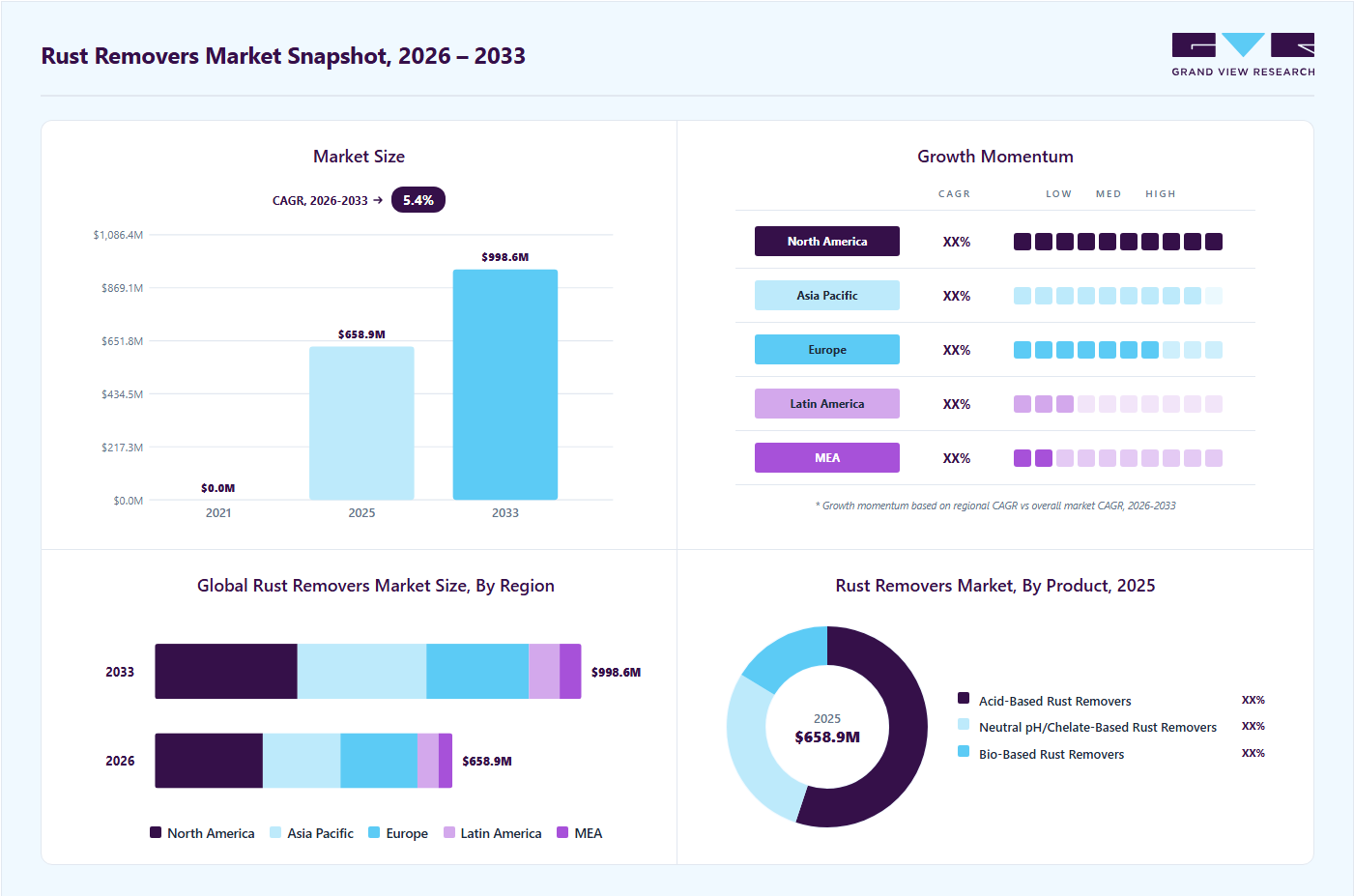
The global rust remover market size was valued at USD 658.9 million in 2025 and is projected to grow from USD 691.5 million in 2026 to USD 998.6 million in 2033, at a CAGR of 5.4% from 2026 to 2033. North America led the global market with the largest revenue share of 36.3% in 2025. The growth is driven by increasing investments in infrastructure development, industrial maintenance, and asset preservation across key end-use sectors.
 Source: Grand View Research, IR Documents, Primary Interviews, Paid DatabasesTo learn more about this report,
 Download Free Sample Report
 Key Market Trends & Insights
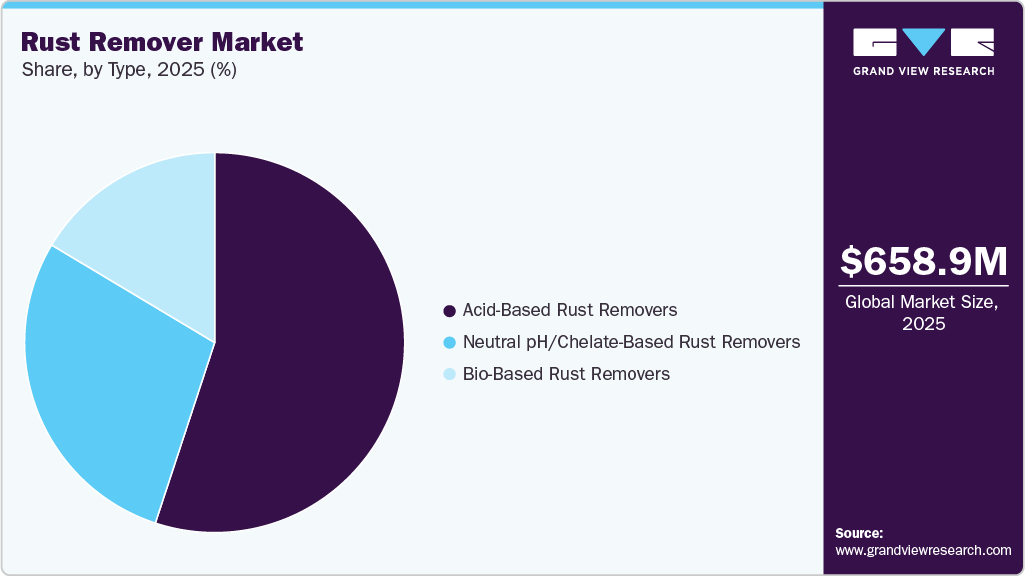
- By type: Acid-based rust removers dominated the market, holding a share of 55.0% in 2025.
- By end use: Industrial machinery & equipment dominated the market, with a share of 25.1% in 2025.
Regional Highlights
- Largest regional market: North America (36.3% revenue share, 2025)
- Fastest-growing regional market: Asia Pacific (highest CAGR, 2026-2033)
- The U.S. dominates the North American market due to strong spending on infrastructure, industry, and transportation maintenance.
Market Size & Forecast
- 2025 Market Size: USD 658.9 Million
- 2026 Market Size: USD 691.5 Million
- 2033 Projected Market Size: USD 998.6 Million
- CAGR (2026-2033): 5.4%
Three ways to get this report
Buy it, customize it, or ask a question.Ask an Analyst
A direct answer, usually in 1 working day
- AccessReport author, directly
- Reply timeWithin 1 working day
- No sales callDirect answer only
- FormatEmail reply
- CostFree, no cost
Get the Full Report
What the study covers
- FormatsPDF · Excel · Dashboard
- Timeline2026–2033 annual, 2025 base
- Coverage20+ countries, 5 regions
- Companies10+ key players profiled
Customize the Report
20% free customization
- IncludeCountries, segments, points
- TailorTo your product definition
- ExtendDeeper competitor detail
- OrA fully bespoke study
- Turnaround5–10 working days
Rising awareness of corrosion-related economic losses, coupled with the growing demand for effective metal restoration and preventive maintenance solutions across the automotive, manufacturing, marine, and construction industries, is expected to support market expansion. The growth is primarily driven by increasing maintenance and asset preservation activities across industrial, automotive, marine, construction, and manufacturing sectors. Rising investments in infrastructure development and industrial equipment are creating sustained demand for effective corrosion management solutions that can extend asset lifespan and reduce replacement costs. The growing awareness regarding preventive maintenance practices, coupled with stringent quality and safety standards for metal components, is encouraging end-users to adopt specialized products. The expanding automotive aftermarket and the need to maintain aging machinery and equipment further support market growth.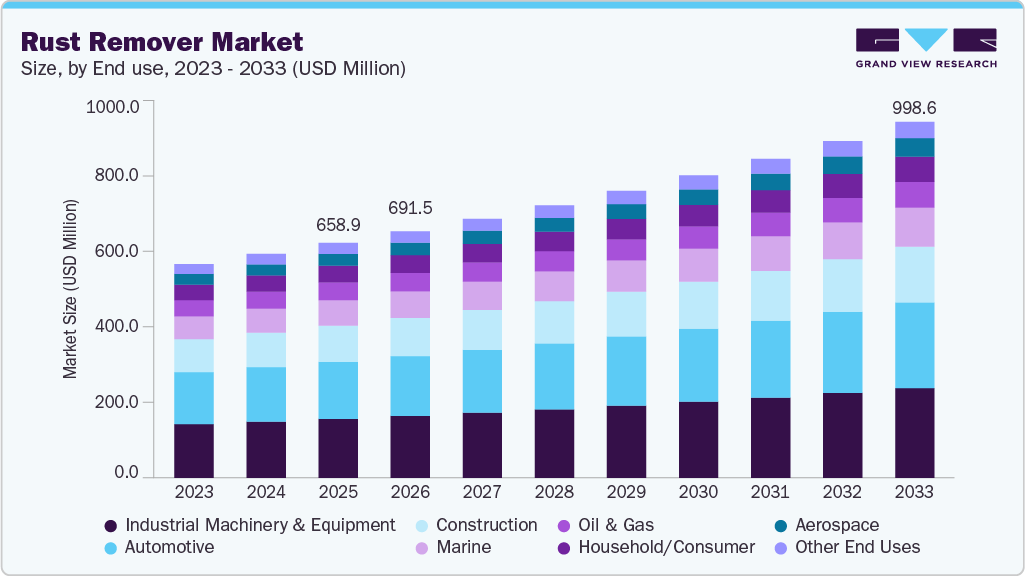 To learn more about this report, Download Free Sample Report
 Manufacturers can also capitalize on growing demand from emerging economies, where rapid industrialization, urbanization, and infrastructure expansion increase the need for metal maintenance solutions. The advancements in chemical technologies that enable faster, non-toxic, and surface-safe rust removal are expected to create new avenues for product differentiation. The rising adoption of e-commerce channels and direct-to-consumer sales platforms also presents opportunities for market participants to expand their reach and strengthen customer engagement across residential and industrial end-use segments.
Market Dynamics
The increasing focus on extending the operational life of machinery, equipment, vehicles, and infrastructure is a major driver. Industries are prioritizing preventive maintenance strategies to minimize downtime, improve operational efficiency, and reduce capital expenditure associated with asset replacement. As corrosion continues to pose significant economic and safety risks, the adoption of effective rust removal solutions is becoming an integral part of maintenance programs across manufacturing, construction, marine, and automotive sectors.
The market faces challenges from stringent environmental regulations governing the use, storage, and disposal of chemical-based rust removal products. Several conventional formulations contain ingredients that may pose environmental or occupational safety concerns, leading to increased compliance requirements for manufacturers. These regulatory pressures can elevate production costs and limit the use of certain chemical compounds. As a result, companies are required to invest in product reformulation and sustainable alternatives, which may impact profit margins and market competitiveness.
Market Concentration & Characteristics
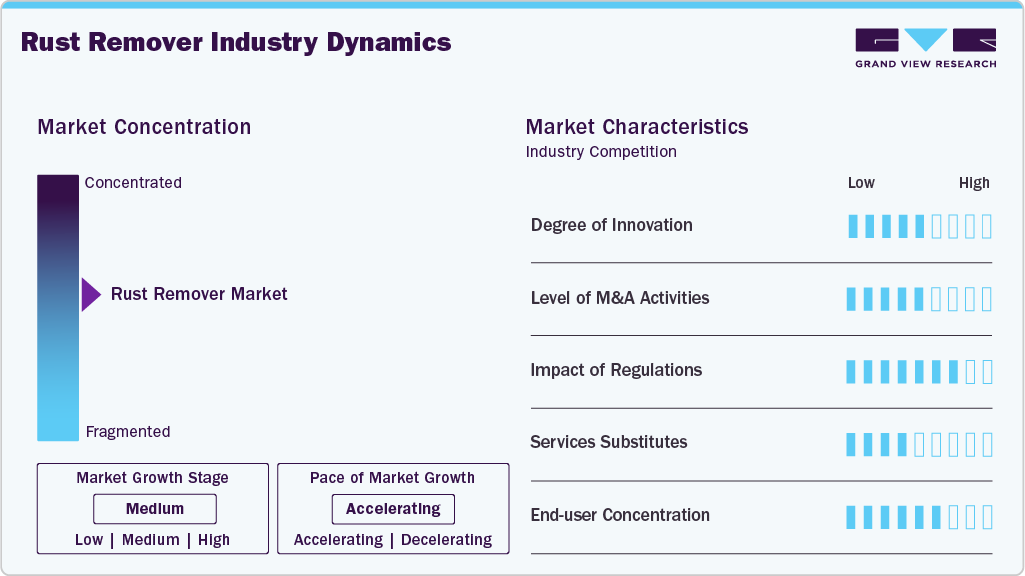
The rust removers market is characterized by a moderately fragmented competitive landscape, with the presence of both multinational corporations and specialized corrosion-control solution providers. Leading companies such as The 3M Company, Henkel Adhesives, AkzoNobel, and The Sherwin-Williams Company leverage their extensive distribution networks, strong brand recognition, and research capabilities to maintain a competitive advantage. These players focus on developing high-performance rust removal and corrosion protection solutions that cater to industrial, automotive, marine, and infrastructure applications.
 To learn more about this report, Download Free Sample Report
 Competition is increasingly centered on product innovation, sustainability, and regulatory compliance. Manufacturers are investing in environmentally responsible formulations with reduced toxicity and improved biodegradability to address evolving customer preferences and environmental standards. Strategic initiatives such as new product launches, portfolio expansion, partnerships with industrial distributors, and geographic expansion are commonly adopted to strengthen market presence. Specialized companies, including NCH Corporation, Zerust, INVEX GmbH, and Rustx.net, compete by offering application-specific solutions and technical expertise tailored to niche end-use industries. As end users increasingly seek cost-effective and sustainable corrosion management solutions, competition is expected to intensify through technological advancements, product differentiation, and value-added service offerings.
Type Insights
The acid-based segment led the rust removers industry, accounting for the largest revenue share of 55.0% in 2025, driven by its high effectiveness in dissolving heavy rust, scale, and oxidation from metal surfaces. These products are widely used across industrial maintenance, automotive restoration, marine equipment, and manufacturing applications where rapid and thorough rust removal is critical. Their ability to restore corroded components efficiently while reducing maintenance downtime has contributed to their widespread adoption across end-use industries.
 To learn more about this report, Download Free Sample Report
 The bio-based segment is expected to grow at the fastest CAGR of 6.8% from 2026 to 2033, supported by increasing demand for environmentally sustainable maintenance solutions. Growing regulatory scrutiny surrounding hazardous chemicals and rising corporate sustainability initiatives are encouraging the adoption of biodegradable and low-toxicity formulations. Continuous advancements in green chemistry are further enhancing the performance of bio-based products, making them increasingly attractive across industrial and commercial applications.
End Use Insights
The industrial machinery and equipment segment dominated the rust removers market, accounting for the largest revenue share of 25.1% in 2025, due to the critical need for corrosion control and preventive maintenance in manufacturing and processing facilities. Frequent exposure to moisture, chemicals, and harsh operating conditions makes machinery highly susceptible to rust, necessitating regular maintenance. The growing focus on maximizing equipment lifespan, minimizing operational disruptions, and reducing replacement costs continues to drive demand for rust removal solutions in this segment.
The aerospace segment is expected to grow at a CAGR of 5.8% from 2026 to 2033, driven by stringent safety requirements and the need to maintain the structural integrity of aircraft components. Rust and corrosion management are essential for ensuring operational reliability, regulatory compliance, and extended service life of critical parts. Increasing investments in aircraft maintenance, repair, and overhaul (MRO) activities, along with the expansion of commercial and defense aviation fleets, are expected to sustain demand for advanced rust removal products in the aerospace industry.
Regional Insights
The North America rust removers market held the largest revenue share of 36.3% in 2025, driven by the region's well-established industrial base, extensive infrastructure assets, and strong emphasis on preventive maintenance practices. High demand from the automotive, aerospace, manufacturing, and construction sectors, coupled with stringent safety and quality standards, continues to support the adoption of advanced management solutions. The presence of major participants and ongoing investments in industrial asset preservation reinforce regional market leadership.
 To learn more about this report, Download Free Sample Report
 U.S. Rust Remover Market Trends
The U.S. is the largest market in North America, supported by significant spending on infrastructure maintenance, industrial operations, and maintenance of transportation equipment. The country's large manufacturing sector, expanding aerospace industry, and growing automotive aftermarket create sustained demand for rust removal products. The increasing focus on extending equipment lifespan and reducing maintenance costs is driving the adoption of specialized corrosion control solutions.
Asia Pacific Rust Remover Market Trends
The growth of the Asia Pacific rust removers industry is supported by rapid industrialization, urbanization, and infrastructure development across major economies. Expanding manufacturing activities, growing automotive production, and increasing investments in construction projects are generating substantial demand for rust removal and metal maintenance solutions. The region's strong industrial growth trajectory is expected to continue supporting market expansion over the forecast period.
The China rust removers market remains a key contributor to Asia Pacific, driven by its extensive manufacturing ecosystem and large-scale infrastructure development. The country's strong presence in automotive production, heavy machinery manufacturing, and industrial processing industries creates consistent demand for corrosion prevention and maintenance products. Government investments in infrastructure modernization and industrial efficiency initiatives further support market growth.
Europe Rust Remover Market Trends
The growth of the Europe rust removers industry is driven by the region's mature industrial sector and stringent environmental and safety regulations. Demand is supported by the presence of advanced automotive, aerospace, marine, and manufacturing industries that require regular corrosion management and maintenance solutions. The increasing adoption of sustainable, environmentally friendly rust removal formulations is also contributing to market development across the region.
The Germany rust removers marketis one of the leaders in Europe, supported by its strong industrial manufacturing base and advanced engineering sectors. The country's well-established automotive, machinery, aerospace, and metal processing industries generate consistent demand for corrosion control and maintenance solutions to enhance equipment reliability and operational efficiency. Germany's stringent environmental regulations and emphasis on sustainable industrial practices are encouraging the adoption of high-performance and environmentally friendly products. Continued investments in industrial modernization, infrastructure maintenance, and advanced manufacturing technologies are expected to support long-term market growth.
Middle East & Africa Rust Remover Market Trends
The Middle East & Africa rust removers industry is experiencing growth driven by increased investments in industrial infrastructure, energy projects, and transportation networks. Demand for rust removers is particularly strong in the oil & gas, marine, construction, and mining sectors, where equipment is frequently exposed to harsh environmental conditions. Growing awareness regarding asset preservation and operational efficiency is further supporting market adoption.
Latin America Rust Remover Market Trends
The growth of the Latin America rust removers industry is supported by infrastructure development activities and growth in industrial manufacturing sectors. Countries across the region are increasingly investing in equipment maintenance and corrosion control measures to improve asset performance and reduce operational costs. The expansion of the automotive, mining, and construction industries is expected to create additional opportunities for rust remover manufacturers in the coming years.
Key Rust Remover Company Insights
Companies operating in the rust removers market are increasingly focusing on product innovation, sustainable formulations, and advanced corrosion-control technologies to strengthen their competitive positioning. Market participants are also pursuing strategic acquisitions, distribution partnerships, and geographic expansion initiatives to enhance market reach and diversify their customer base. The investments in research and development are enabling manufacturers to introduce high-performance, environmentally compliant solutions that address evolving industrial and consumer requirements.
-
Henkel Adhesives is one of the leading participants, supported by its strong expertise in industrial adhesives, surface treatment technologies, and metal protection solutions. The company serves a diverse range of industries, including automotive, manufacturing, aerospace, electronics, and heavy equipment, where corrosion prevention and metal maintenance are critical operational requirements. Through its Bonderite product portfolio, Henkel offers advanced cleaning, pretreatment, and corrosion-protection solutions designed to improve asset durability, enhance production efficiency, and reduce maintenance costs. The company places significant emphasis on research and development, enabling it to introduce innovative and environmentally responsible formulations that align with evolving regulatory requirements. Its extensive global manufacturing footprint and distribution network allow it to serve customers across both developed and emerging markets.
-
Reckitt Benckiser Group is a well-established consumer goods company with a strong presence in household cleaning, maintenance, and hygiene products, making it a notable participant in the rust removers industry. The company's extensive portfolio of cleaning and surface care solutions enables it to address consumer demand for effective rust removal and metal maintenance products across residential and light commercial applications. Reckitt benefits from globally recognized brands, a broad retail distribution network, and a significant presence in both developed and emerging economies. Its strong marketing capabilities and customer-focused product development strategy help the company maintain brand loyalty and market visibility. The company continuously invests in product innovation to enhance performance, ease of use, and environmental sustainability while meeting evolving consumer preferences.
Key Rust Remover Companies
The following key companies have been profiled for this study on the rust removers market.
-
Rustx.net
-
Luberall Industries
-
NCH Corporation
-
INVEX GmbH
-
AtecoTobler AG
-
Reckitt Benckiser Group
-
Henkel Adhesives
-
AkzoNobel
-
The 3M Company
-
The Sherwin-Williams Company
-
Zerust
Competitive Benchmarking
Operating Strategies
Competitive Edge
Weakness
Mature Players: Reckitt Benckiser Group; Henkel Adhesives; AkzoNobel; The 3M Company; The Sherwin-Williams Company; NCH Corporation, Zerust
- Focus on portfolio diversification by offering rust removers alongside coatings, adhesives, lubricants, and corrosion protection solutions.
- Emphasize global expansion, strategic partnerships, and continuous R&D investments to strengthen market leadership.
- Benefit from strong brand recognition, extensive distribution networks, and long-standing customer relationships across multiple industries.
- Possess greater financial resources to support innovation, regulatory compliance, and large-scale marketing initiatives.
- Large organizational structures may result in slower decision-making and reduced agility in responding to niche market opportunities.
- Higher operational and compliance costs can impact profitability, particularly in highly competitive segments.
Emerging Players: Rustx.net; Luberall Industries; INVEX GmbH; AtecoTobler AG
- Concentrate on specialized applications and niche customer requirements through targeted product development.
- Utilize flexible operating models and customized solutions to address specific regional and industry demands.
- Offer higher responsiveness to changing customer needs and emerging market trends.
- Differentiate through technical expertise, specialized formulations, and personalized customer support.
- Limited geographic reach and lower brand visibility can restrict market penetration and customer acquisition.
- Smaller financial resources may constrain investments in research, product development, and distribution expansion.
Recent Developments
-
In July 2024, Henkel Adhesives launched Bonderite M CR 1405, an advanced metal passivation and pretreatment technology that integrates several processing stages into a single treatment step. This innovation is designed to enhance operational productivity while promoting more sustainable, efficient metal treatment.
-
In March 2025, The Sherwin-Williams Company broadened its corrosion protection offerings with the introduction of its Global Core coatings portfolio, featuring zinc primers, epoxy primers, and urethane topcoats developed for infrastructure, manufacturing, and industrial asset protection applications.
Rust Remover Market Report Scope
Report Attribute
Details
Market size in 2025
USD 658.9 million
Estimated Market size in 2026
USD 691.5 million
Projected Market size by 2033
USD 998.6 million
Growth rate
CAGR of 5.4% from 2026 to 2033
Base year for estimation
2025
Historical data
2021 - 2024
Forecast period
2026 - 2033
Quantitative units
Volume in kilotons, revenue in USD million, and CAGR from 2026 to 2033
Report coverage
Revenue forecast, volume forecast, company ranking, competitive landscape, growth factors, and trends
Segments covered
Type, end use, region
Regional scope
North America; Europe; Asia Pacific; Middle East & Africa; Latin America
Country scope
U.S.; Canada; Mexico; Germany; UK; France; Italy; Spain; China; India; Japan; South Korea; Brazil; Argentina; South Africa; Saudi Arabia
Key companies profiled
Rustx.net; Luberall Industries; NCH Corporation; INVEX GmbH; AtecoTbler AG; Reckitt Benckiser Group; Henkel Adhesives; AkzoNobel; The 3M Company; The Sherwin-Williams Company; Zerust
Customization scope
Free report customization (equivalent up to 8 analysts’ working days) with purchase. Addition or alteration to country, regional & segment scope.
Pricing and purchase options
Avail customized purchase options to meet your exact research needs. Explore purchase options
Global Rust Remover Market Report Segmentation
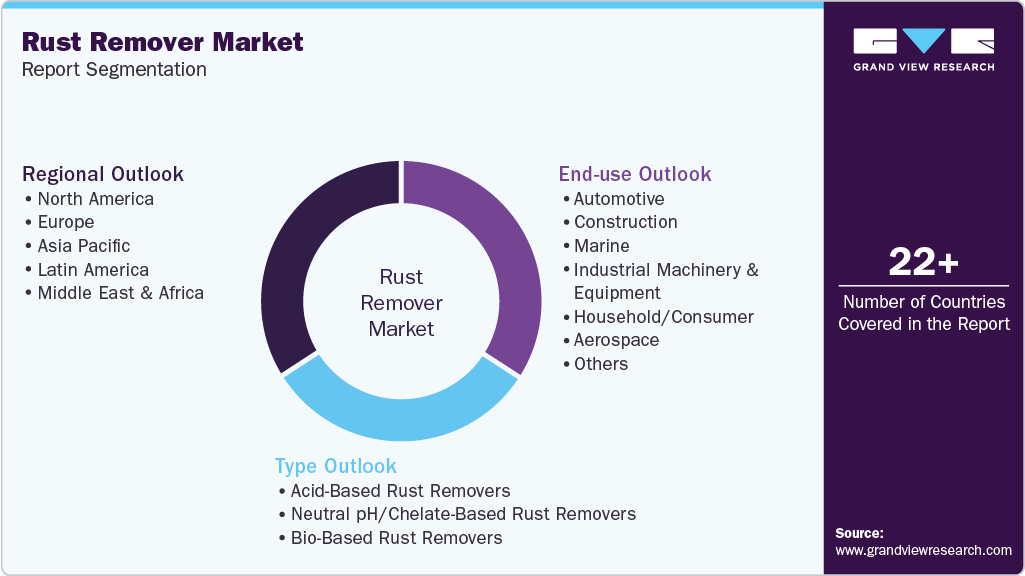
This report forecasts volume & revenue growth at the global, regional, and country levels and provides an analysis of the latest industry trends in each of the sub-segments from 2021 to 2033. For this study, Grand View Research has segmented the global rust remover market report based on type, end-use, and region:
 To learn more about this report, Download Free Sample Report
 -
Type Outlook (Volume, Kilotons; Revenue, USD Million, 2021 - 2033)
-
Acid-Based Rust Removers
-
Neutral pH/Chelate-Based Rust Removers
-
Bio-Based Rust Removers
-
-
End Use Outlook (Volume, Kilotons; Revenue, USD Million, 2021 - 2033)
-
Automotive
-
Construction
-
Marine
-
Industrial Machinery & Equipment
-
Household/Consumer
-
Aerospace
-
Oil & Gas
-
Other End Uses
-
-
Regional Outlook (Volume, Kilotons; Revenue, USD Million, 2021 - 2033)
-
North America
-
U.S.
-
Canada
-
Mexico
-
-
Europe
-
Germany
-
UK
-
France
-
Italy
-
Spain
-
-
Asia Pacific
-
China
-
India
-
Japan
-
South Korea
-
-
Middle East & Africa
-
Saudi Arabia
-
South Africa
-
-
Latin America
-
Brazil
-
Argentina
-
-
Delivered Customizations
This report has been delivered with the following In-depth customizations
Client Request
Customization Delivered
Value Adds
Distributor & Channel Partner Analysis
Identification and evaluation of regional distributors, industrial maintenance suppliers, MRO (Maintenance, Repair & Operations) providers, automotive aftermarket distributors, hardware retail channels, e-commerce platforms, and corrosion control solution providers across key countries. The assessment includes analysis of distribution networks, channel partnerships, product accessibility, regional sales strategies, and end-user procurement patterns across industrial, automotive, marine, construction, and consumer segments
Help strengthen regional distribution strategies, channel partner identification, and market penetration initiatives. Support evaluation of distributor capabilities, expansion opportunities, aftermarket sales development, and optimization of go-to-market strategies across key end-use industries and geographies
Regional Segmentation
Detailed regional assessment of rust remover demand across North America, Europe, Asia Pacific, Latin America, and Middle East & Africa, including country-level analysis of industrial maintenance activities, automotive fleet size, infrastructure development, marine maintenance demand, manufacturing output, and corrosion management practices. The study further evaluates regional production presence, import-export dependency, regulatory landscape, and growth outlook across automotive, industrial machinery, construction, marine, aerospace, and oil & gas applications
Enable identification of high-growth regional markets and emerging demand centers for rust removal products. Support strategic expansion, regional sales prioritization, distributor planning, and investment decision-making through enhanced understanding of industrial maintenance requirements, infrastructure spending, and corrosion management trends across geographies
Pricing Analysis
Detailed assessment of historical and current rust remover pricing trends across major regions, product types, and end-use applications. The analysis includes raw material price movements for acids, chelating agents, surfactants, solvents, specialty additives, and bio-based ingredients, along with manufacturing costs, packaging costs, regulatory compliance expenses, distribution margins, and regional supply-demand dynamics impacting pricing trends
Enable improved procurement and pricing strategy development through visibility into raw material volatility, manufacturing cost structures, and regional pricing variations. Support margin optimization, supplier negotiations, competitive benchmarking, and forecasting of future pricing trends across acid-based, neutral pH, and bio-based rust remover product categories
Frequently Asked Questions About This Report
The global rust remover market size was estimated at USD 658.9 million in 2025 and is expected to reach USD 691.5 million in 2026.
The global rust remover market is expected to grow at a compound annual growth rate of 5.4% from 2026 to 2033 to reach USD 998.6 million in 2033.
The growth of the global rust removers market is driven by increasing investments in infrastructure development, industrial maintenance, and asset preservation across key end-use sectors.
North America held the largest revenue share of 36.3% in 2025, driven by the region's well-established industrial base, extensive infrastructure assets, and strong emphasis on preventive maintenance practices
Some key players operating in the rust remover market include Rustx.net; Luberall Industries; NCH Corporation; INVEX GmbH; AtecoTbler AG; Reckitt Benckiser Group; Henkel Adhesives; AkzoNobel; The 3M Company; The Sherwin-Williams Company; Zerust.
About the Author(s)
Organic Chemicals Research Team
Bulk Chemicals · Organic ChemicalsThis report was authored by the organic chemicals research team at Grand View Research - comprising two research analysts, one senior research analyst, and one industry expert - with specialized expertise in the organic chemicals segment of the bulk chemicals industry. All findings are based on proprietary bulk chemicals databases, executive interviews, and regulatory analysis, subject to internal peer review prior to publication.
Last Updated:
Speak to Analyst

Customize this report to your needs - add regions, segments, or data points, with 20% free customization.
Or view our licence options:


ISO 9001:2015 & 27001:2022 Certified
We are GDPR and CCPA compliant! Your transaction & personal information is safe and secure. For more details, please read our privacy policy.


