
- Home
- »
- Advanced Interior Materials
- »
-
Self Compacting Concrete Market Size Report 2025-2030GVR Report cover
![Self Compacting Concrete Market (2025 - 2030)Report]()
Self Compacting Concrete Market (2025 - 2030)
Size, Share & Trends Analysis Report By Type (Powder, Viscosity, Combination), By End-use (Oil & gas, Infrastructure, Building & Construction), By Region, And Segment Forecasts
Market Size, 2024
$13.4BMarket Estimate, 2026
$14.9BMarket Forecast, 2030
$18.5BCAGR, 2025–2030
4.7%Self Compacting Concrete Market Summary
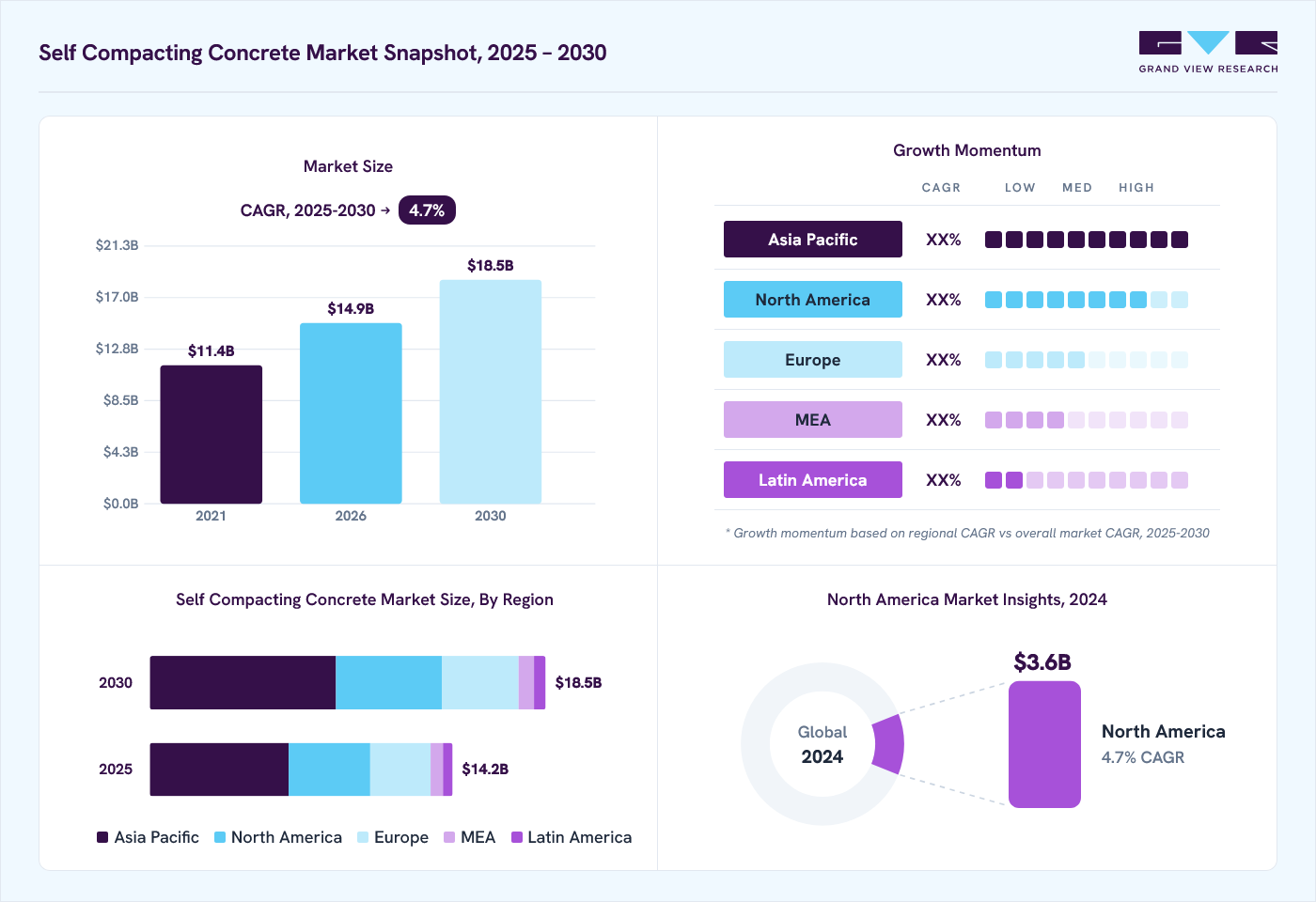
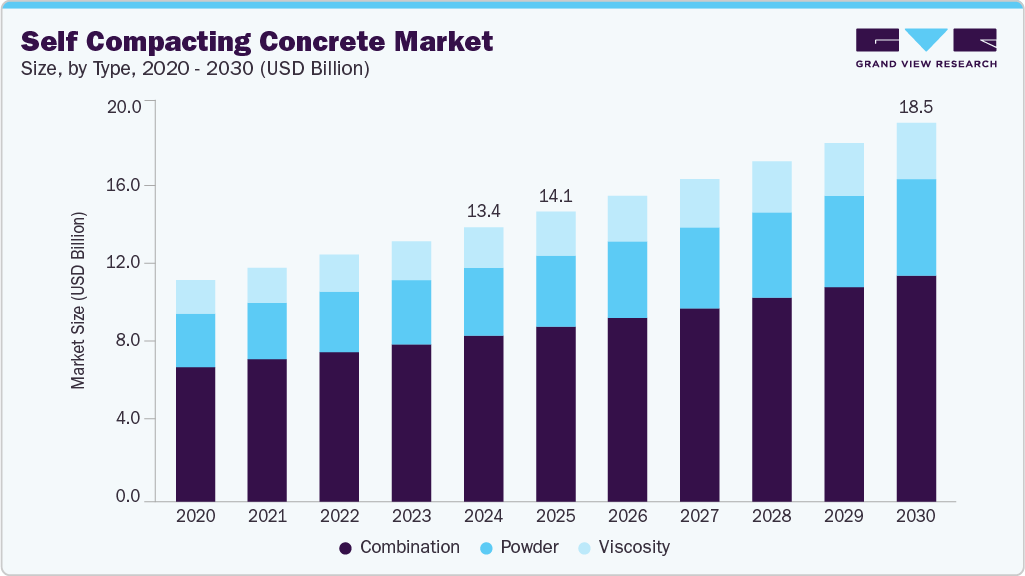
The global self compacting concrete market size was valued at USD 13.4 billion in 2024 and is projected to grow from USD 14.9 billion in 2026 to USD 18.5 billion by 2030, at a CAGR of 4.7% from 2025 to 2030. Asia Pacific dominated the market, accounting for a revenue share of 45.8% in 2024. The increasing demand for self-compacting concrete (SCC) is attributed to its remarkable workability and ease of use.
Key Market Trends & Insights
- The US, being a hub for innovation and environmental awareness, has seen an increasing adoption of SCC as a responsible choice for construction projects.
- By type, the combination type segment accounted for the largest share of 60.4% in 2024.
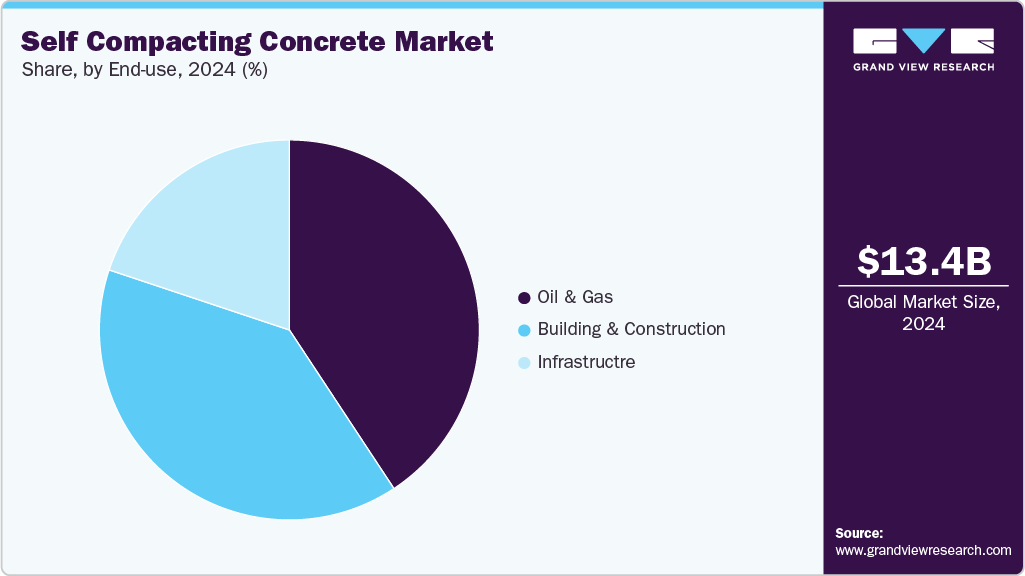
- By end-use, the oil & gas end use segment held the largest market share in 2024.
Market Size & Forecast
- 2024 Market Size: USD 13.4 Billion
- 2030 Projected Market Size: USD 18.5 Billion
- CAGR (2025-2030): 4.7%
- Asia Pacific: Largest market in 2024
SCC possesses the unique ability to flow under its weight, effortlessly filling formworks and encapsulating reinforcement without the need for mechanical vibration. With the rapid expansion of urban infrastructure across the world and advancements in building and construction materials, the demand for self-compacting concrete is expected to grow considerably.Self compacting concrete (SCC) is gaining significant traction in the global construction industry due to its exceptional ability to flow and fill intricate spaces, including densely reinforced areas. This characteristic makes it particularly advantageous for executing complex structural projects and architectural designs that would be challenging with conventional concrete. The growing adoption of SCC is further fueled by the implementation of stringent building codes and energy efficiency standards aimed at reducing carbon footprints and promoting sustainable development. Additionally, various incentives such as tax benefits, subsidies, and grants are being offered worldwide to encourage the use of sustainable construction materials like SCC.
Another significant factor driving the demand for self-compacting concrete (SCC) is its contribution to enhanced construction quality and durability. The uniformity and density achieved with SCC result in higher-quality finished structures with improved strength and longevity. The elimination of mechanical vibration ensures a superior surface finish and reduces the potential for defects and weak points in the concrete, which can compromise structural integrity over time. This level of quality assurance is particularly critical in infrastructure projects such as bridges, tunnels, and high-rise buildings, where safety and durability are paramount.
Market Concentration & Characteristics
The self compacting concrete market growth is medium; however, the pace of market growth is accelerating. The market is characterized by a moderately high degree of innovation, with continuous advancements in material science, digital technologies, and sustainable practices. These innovations are enhancing the performance, efficiency, and environmental impact of SCC, positioning it as a preferred choice in modern construction.
The self compacting concrete market is also characterized by a moderate level of merger and acquisition (M&A) activity among leading players. This activity is driven by strategic efforts by leading companies to enhance their market presence, expand product portfolios, and capitalize on growth opportunities in emerging regions.These strategic moves are expected to drive growth and innovation in the SCC market, positioning companies to better meet the evolving demands of the global construction industry.
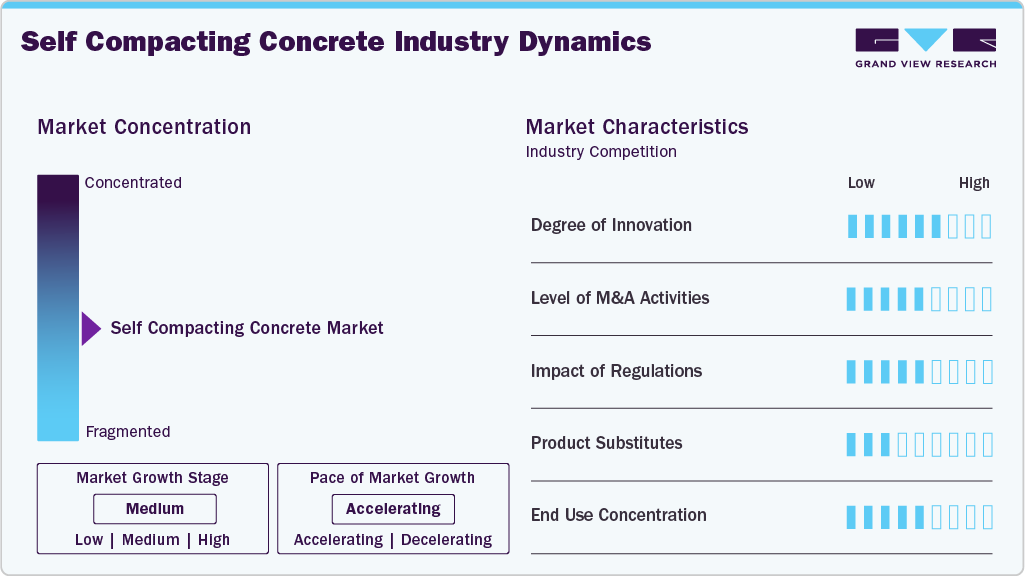
The level of product substitutes in the self-compacting concrete market is low.The unique combination of high fluidity, self-leveling ability, and reduced need for mechanical vibration makes self-compacting concrete a preferred choice for applications requiring intricate formwork, densely reinforced structures, and high-quality surface finishes. While alternatives exist, they often cannot fully replicate the comprehensive benefits offered by SCC, resulting in a low threat of substitutes in the market.
Type Insights
The combination type segment accounted for the largest share of 60.4% in 2024. Combination-type self-compacting concrete integrates the advantages of both viscosity-modifying admixture (VMA)-based and powder-type SCC. Incorporating VMAs enhances the concrete's flowability and stability, while the addition of fine powders improves cohesion and resistance to segregation. This dual approach enables combination-type SCC to achieve superior performance characteristics, making it highly suitable for a wide range of End Uses. Its versatility allows effective use in complex and densely reinforced structures, as well as in projects requiring high aesthetic quality and durability.
The powder type segment is expected to grow at the fastest CAGR over the forecast period. Various cementitious materials, such as Portland cement, fly ash, slag, and other supplementary cementitious materials (SCMs), are incorporated into self-compacting concrete formulations. The selection and proportion of these materials significantly influence the concrete's compressive strength, durability, and environmental impact. For instance, incorporating fly ash or slag can enhance long-term strength and reduce the heat of hydration, leading to more durable concrete with fewer thermal cracks, thereby extending the structure's lifespan.
End-use Insights
The oil & gas end use segment held the largest market share in 2024. This segment is also expected to register the fastest CAGR over the forecast period. The oil and gas sector often entails the construction of facilities and infrastructure in intricate and demanding environments, such as offshore platforms, refineries, and storage tanks. These structures necessitate materials that guarantee exceptional durability and reliability under severe conditions, including exposure to corrosive chemicals, extreme temperatures, and high-pressure environments. Self compacting concrete is ideal for such end uses due to its ability to provide a dense, homogeneous mix with minimal voids, ensuring the creation of structures capable of withstanding these demanding environments.
The demand for self compacting concrete in construction is driven by its exceptional properties that align with the needs of modern building projects. A key factor is SCC's superior workability; it flows under its weight to fill formwork, even in areas with dense reinforcement, eliminating the need for mechanical vibration. This capability significantly reduces labor costs and construction time, enhancing efficiency and cost-effectiveness in the construction sector.
Regional Insights
The self compacting concrete market in North America is experiencing significant growth, driven by several key factors. Ongoing investments in modernizing infrastructure, including roads, bridges, and tunnels, are increasing the demand for materials, including SCC, that offer enhanced durability and reduced construction timelines. Additionally, the construction sector's emphasis on reducing carbon footprints and adopting sustainable practices has led to increased adoption of SCC, which requires less energy and water during production and generates less waste.
U.S. Self Compacting Concrete Market Insights
The US, being a hub for innovation and environmental awareness, has seen an increasing adoption of SCC as a responsible choice for construction projects. Furthermore, advancements in concrete technology have improved SCC formulations, enhancing its workability, strength, and durability, thereby broadening its End Use across various construction projects.
Asia Pacific Self Compacting Concrete Market Trends
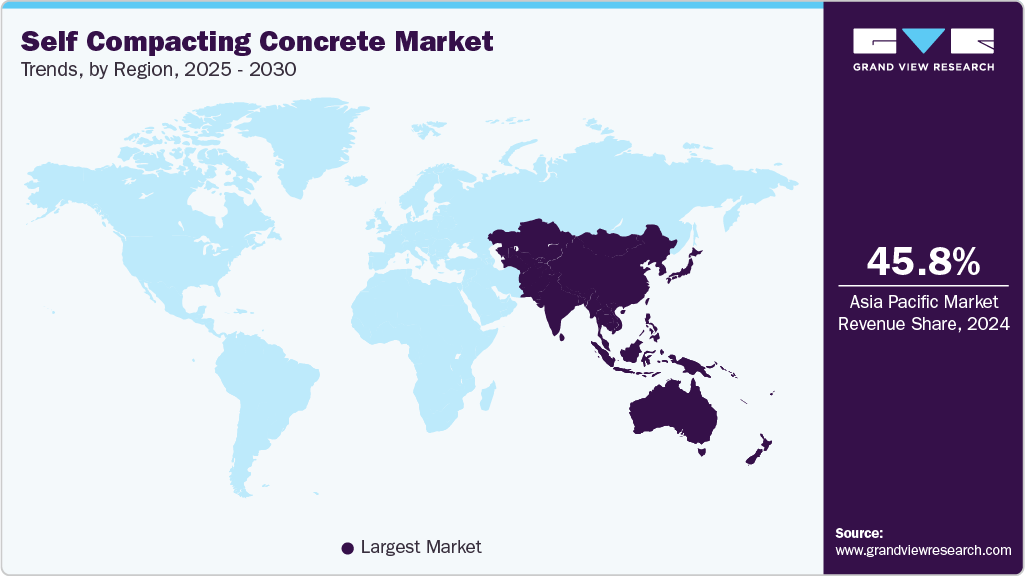
Asia Pacific dominated the global self compacting concrete market with the largest revenue share of 45.8% in 2024. Asia Pacific is also expected to register the fastest CAGR over the forecast period. Asia Pacific is experiencing rapid urbanization and infrastructure development to accommodate growing populations and economic activities.
Self compacting concrete is particularly well-suited for large-scale infrastructure projects due to its ability to enhance construction productivity and ensure high-quality outcomes. The material’s ability to flow and self-leveling properties make it ideal for constructing complex and large-scale projects efficiently, addressing the demands of urban expansion and modernization.
Key Self Compacting Concrete Company Insights
Some of the key companies in the self compacting concrete market include BASF SE, CEMEX S.A.B. de C.V, ACC Limited, SIKA AG, LafargeHolcim and others. Organizations have been tactically implementing various expansion plans such as mergers and acquisitions, strengthening of online presence, production enhancement and new product launches to gain a competitive advantage.
-
BASF SE operates through six key business segments: chemicals, materials, industrial solutions, surface technologies, nutrition & care, and agricultural solutions. These segments are structured to address specific market needs and challenges, enabling BASF SE to implement its corporate strategy effectively. It is a global leader in construction chemicals, plays a pivotal role in the self compacting concrete market through its innovative product offerings under the Master Builders Solutions brand.
-
CEMEX S.A.B. de C.V., a leading global building materials company engaged in manufacturing and distribution of self compacting concrete, ready-mix concrete, cement, and other aggregates in almost 50 countries across the world. Their extensive global presence and diverse product offerings position them as a significant player in the self-compacting concrete market.
Key Self Compacting Concrete Companies:
The following are the leading companies in the self compacting concrete market. These companies collectively hold the largest market share and dictate industry trends.
- BASF SE
- CEMEX S.A.B. de C.V
- ACC Limited
- SIKA AG
- LafargeHolcim
- Kilsaran
- HEIDELBERGCEMENT AG
- Tarmac
- Unibeton Ready Mix
- Ultratech Concrete
- Ambuja Cements Ltd.
Recent Developments
-
In April 2024, Kilsaran introduced two Volvo FM electric concrete trucks—the first of their kind in Ireland and the UK. These zero-emission vehicles, based in Ringsend, Dublin, are equipped with five batteries each and offer a range of approximately 300 kilometers per charge, depending on the load. The initiative aims to reduce noise pollution and carbon emissions in urban areas.
-
In August 2024, Kilsaran, a leading Irish construction materials company, received approval from the Competition and Consumer Protection Commission (CCPC) to acquire Kilmurray Precast Concrete Limited, based in Derryarkin, Co. Offaly. This acquisition includes Kilmurray’s sand and gravel pit, chip-processing plant, stock, vehicles, plant, supply and sale contracts, interest in leased assets, goodwill, and two small freehold properties.
-
In January 2024, ACC Limited, a subsidiary of Ambuja Cements within the Adani Group, completed the acquisition of the remaining 55% equity stake in Asian Concretes and Cements Pvt Ltd (ACCPL). This strategic move enhances ACC's cement production capacity by 2.8 million tons per annum, elevating its total capacity to 38.6 million tons per annum. When combined with Ambuja Cements, the Adani Group's consolidated cement capacity reaches 76.1 million tons per annum.
Self Compacting Concrete Market Report Scope
Report Attribute
Details
Market size in 2024
USD 13.4 billion
Estimated market size in 2026
USD 14.9 billion
Projected market size by 2030
USD 18.5 billion
Growth Rate
CAGR of 4.7% from 2025 to 2030
Base year for estimation
2024
Historical data
2018 - 2023
Forecast period
2025 - 2030
Quantitative units
Revenue in USD million/billion and CAGR from 2025 to 2030
Report coverage
Revenue forecast, company ranking, competitive landscape, growth factors, and trends
Segments covered
Type, end-use, region
Regional scope
North America; Europe; Asia Pacific; Central & South America; Middle East & Africa
Country scope
U.S.; Canada; Mexico; Germany; UK; France; Italy; Spain; China; Japan; India; South Korea; Brazil; Saudi Arabia
Key companies profiled
BASF SE; CEMEX S.A.B. de C.V; ACC Limited; SIKA AG; LafargeHolcim; Kilsaran; HEIDELBERGCEMENT AG; Tarmac; Unibeton Ready Mix; Ultratech Concrete; Fletcher Building
Customization scope
Free report customization (equivalent up to 8 analysts working days) with purchase. Addition or alteration to country, regional & segment scope.
Pricing and purchase options
Avail customized purchase options to meet your exact research needs. Explore purchase options
Global Self Compacting Concrete Market Report Segmentation
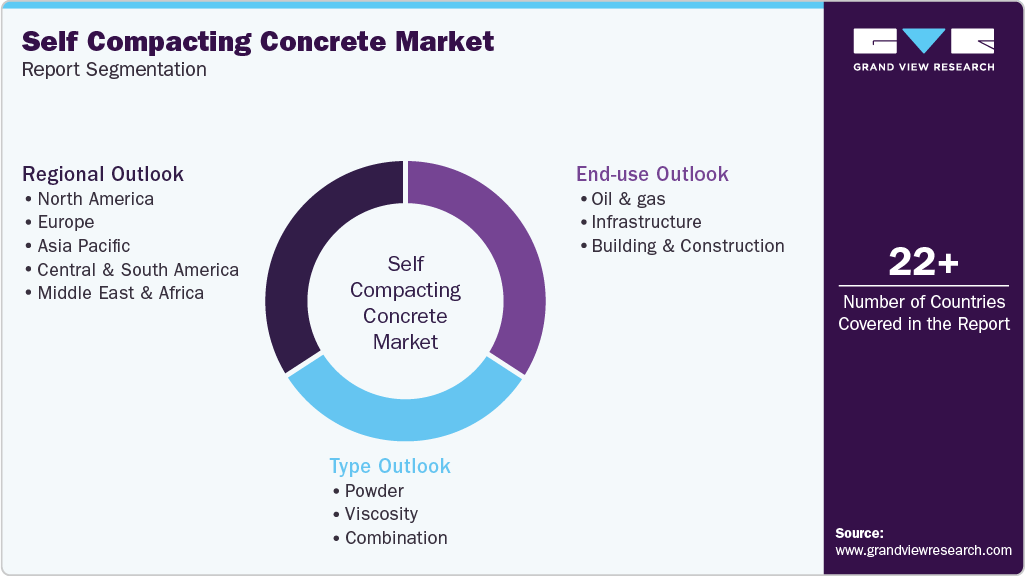
This report forecasts revenue growth at global, regional, and country levels and provides an analysis of the latest industry trends in each of the sub-segments from 2018 to 2030. For this study, Grand View Research has segmented the global self compacting concrete market report based on type, end-use, and region:
-
Type Outlook (Revenue, USD Million, 2018 - 2030)
-
Powder
-
Viscosity
-
Combination
-
-
End-use Outlook (Revenue, USD Million, 2018 - 2030)
-
Oil & gas
-
Infrastructure
-
Building & Construction
-
-
Regional Outlook (Revenue, USD Million, 2018 - 2030)
-
North America
-
U.S.
-
Canada
-
Mexico
-
-
Europe
-
Germany
-
UK
-
France
-
Italy
-
Spain
-
-
Asia Pacific
-
China
-
India
-
Japan
-
South Korea
-
-
Central & South America
-
Brazil
-
-
Middle East & Africa
-
Saudi Arabia
-
-
Frequently Asked Questions About This Report
The global self compacting concrete market size was valued at USD 13.4 billion in 2024 and is estimated at USD 14.9 billion for 2026.
The global self compacting concrete market is expected to grow at a CAGR of 4.7% from 2025 to 2030, reaching USD 18.5 billion by 2030.
Asia Pacific dominated with a revenue share of 45.8% in 2024.
Some of the key players operating in the self compacting concrete market include BASF SE, CEMEX S.A.B. de C.V, ACC Limited, SIKA AG, LafargeHolcim, Kilsaran, HEIDELBERGCEMENT AG, Tarmac, Unibeton Ready Mix, Ultratech Concrete, Fletcher Building
The key factor that is driving the self compacting concrete includes the rising construction activities in the developing countries around the world.
About the Author(s)
Advanced Interior Materials Research Team
Advanced Materials · Advanced Interior MaterialsThis report was authored by the advanced interior materials research team at Grand View Research - comprising two research analysts, one senior research analyst, and one industry expert - with specialized expertise in the advanced interior materials segment of the advanced materials industry. All findings are based on proprietary advanced materials databases, executive interviews, and regulatory analysis, subject to internal peer review prior to publication.
Last Updated:
Speak to Analyst

Customize this report to your needs — add regions, segments, or data points, with 20% free customization.
Or view our licence options:


ISO 9001:2015 & 27001:2022 Certified
We are GDPR and CCPA compliant! Your transaction & personal information is safe and secure. For more details, please read our privacy policy.












