
- Home
- »
- Automotive & Transportation
- »
-
Semiconductor Logistics Market Size Report, 2026-2033GVR Report cover

Semiconductor Logistics Market (2026 - 2033)
Size, Share & Trends Analysis By Product (Packaging Materials, Wafers), By Mode of Operation (Cold-Chain, Non Cold-Chain), By Service, By Destination, By Region, And Segment Forecasts
Market Size, 2025
$74.2BMarket Estimate, 2026
$79.3BMarket Forecast, 2033
$149.7BCAGR, 2026–2033
9.5%Semiconductor Logistics Market Summary
The global semiconductor logistics market size was valued at USD 74.2 billion in 2025 and is projected to grow from USD 79.3 billion in 2026 to USD 149.7 billion by 2033, growing at a CAGR of 9.5% from 2026 to 2033. Asia Pacific dominated the semiconductor logistics market with the largest revenue share of 42.5% in 2025. The increasing demand for semiconductor chips across AI, automotive, consumer electronics, and data center applications is driving market growth.
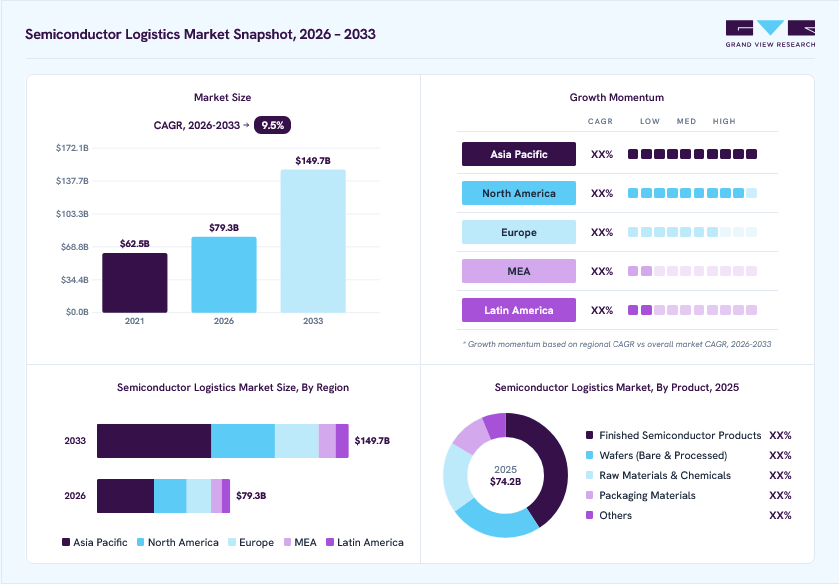 Source: Grand View Research, IR Documents, Primary Interviews, Paid DatabasesTo learn more about this report,
 Download Free Sample Report
 Key Market Trends & Insights
- By product: Finished semiconductor products segment led the market and accounted for 40.8% of the global revenue in 2025
- By service: Transportation services segment led the market, accounting for 54.7% of global revenue in 2025.
- By mode of operation: Non cold-chain logistics mode of operation segment accounted for the largest share of global revenue in 2025.
- By destinations: International segment accounted for the largest market revenue share in 2025.
Regional Highlights
- Largest regional market: Asia Pacific (42.5% revenue share, 2025)
- By country: China held the largest market share in 2025
Market Size & Forecast
- Market size in 2025: USD 74.2 Billion
- Estimated market size in 2026: USD 79.3 Billion
- Projected market size by 2033: USD 149.7 Billion
- CAGR (2026-2033): 9.5%
Three ways to get this report
Buy it, customize it, or ask a question.Ask an Analyst
A direct answer, usually in 1 working day
- AccessReport author, directly
- Reply timeWithin 1 working day
- No sales callDirect answer only
- FormatEmail reply
- CostFree, no cost
Get the Full Report
What the study covers
- FormatsPDF · Excel · Dashboard
- Timeline2026–2033 annual, 2025 base
- Coverage20+ countries, 5 regions
- Companies10+ key players profiled
Customize the Report
20% free customization
- IncludeCountries, segments, points
- TailorTo your product definition
- ExtendDeeper competitor detail
- OrA fully bespoke study
- Turnaround5–10 working days
The increasing adoption of Outsourced Semiconductor Assembly and Test Services (OSAT) is supporting market growth. Semiconductor companies are increasingly outsourcing chip packaging and testing to specialized providers. Wafer fabrication, packaging, and testing are often performed in different countries. As a result, semiconductor wafers and chips are transported between fabrication plants and OSAT facilities across global supply chains. This increases cross-border shipments of high-value semiconductor products. Moreover, demand for secure, time-sensitive, and high-precision semiconductor logistics services continues to grow.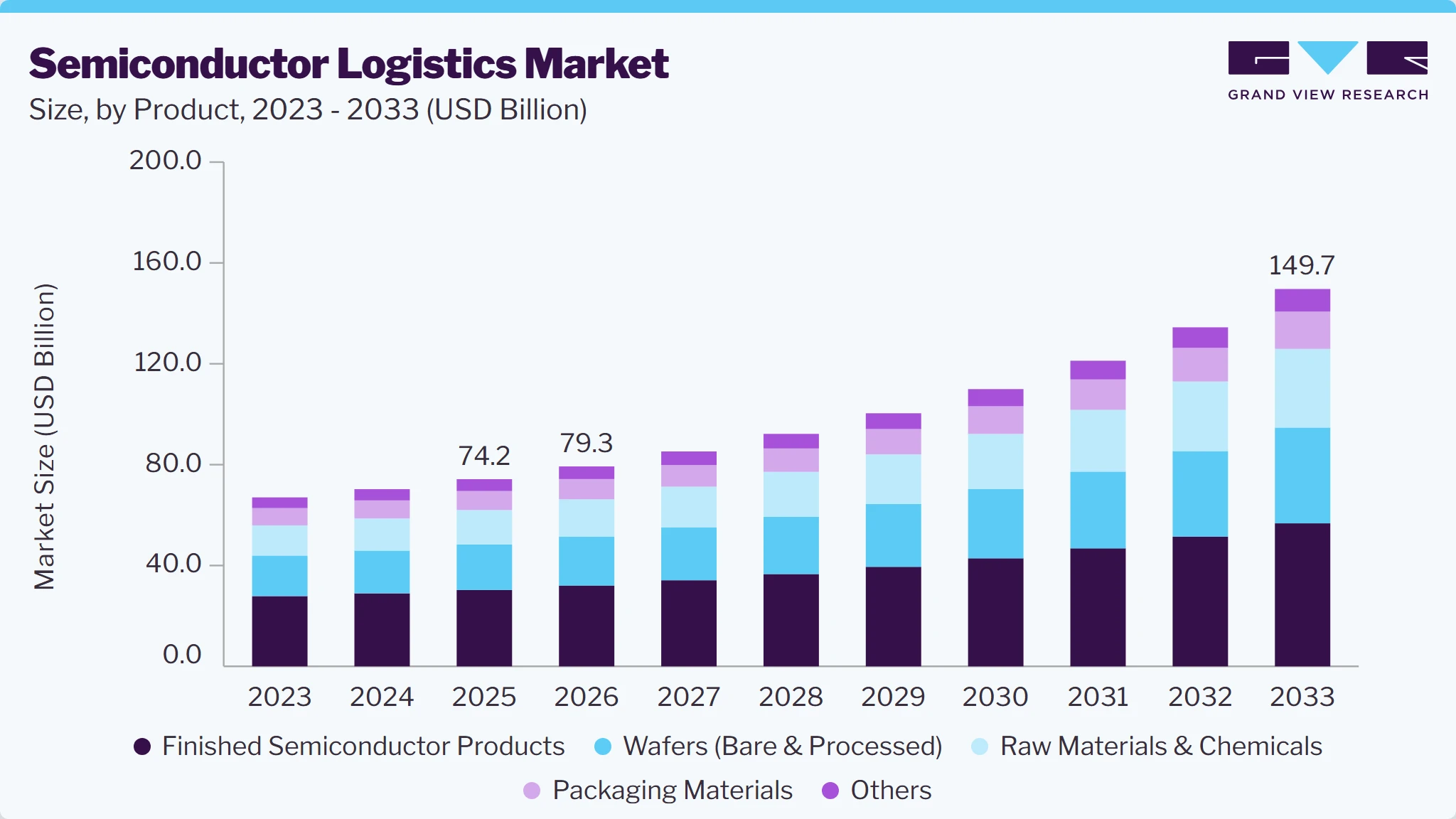 To learn more about this report, Download Free Sample Report
 The adoption of RFID and IoT technologies is enhancing the efficiency of semiconductor logistics. These technologies enable real-time tracking of semiconductor shipments and monitor critical transport conditions. This improves shipment visibility and product traceability. It also reduces transportation risks and operational delays. Moreover, demand for smart logistics solutions in the semiconductor industry continues to increase.
The regulatory landscape plays a critical role in semiconductor logistics. Semiconductor logistics is governed by regulatory requirements for the movement of dual-use goods across international borders. Accurate shipping documentation, receiver screening, compliance checks, and local permit requirements are essential to avoid customs holds and shipment delays. Adherence to customs regulations and proper data entry help ensure timely customs clearance and the uninterrupted movement of semiconductor shipments across global supply chains.
The market faces challenges due to complex global supply chains. Packaging materials and semiconductor components are transported across multiple locations worldwide, where even small inefficiencies can create costly delays. These disruptions can increase logistics costs and reduce overall supply chain efficiency. To address these challenges, companies are adopting collapsible and reusable packaging systems that reduce empty backhauls, simplify logistics operations, and improve transportation efficiency.
Market Dynamics
The increasing adoption of global semiconductor manufacturing capacity is driving market growth. Rising investments in semiconductor fabrication plants, assembly and testing facilities, and advanced packaging centers are driving demand for semiconductor logistics. Government initiatives and growing chip demand from AI, automotive, consumer electronics, telecommunications, and industrial sectors are increasing the movement of raw materials, wafers, manufacturing equipment, and finished semiconductor products across global supply chains. As semiconductor production expands worldwide, the need for specialized logistics services is growing. Logistics providers offer contamination-controlled transportation, ESD-safe handling, secure warehousing, real-time tracking, and multimodal transportation to ensure the safe and timely delivery of sensitive semiconductor products. These capabilities improve supply chain efficiency and support the continued market growth.
High operational complexity and stringent handling requirements are restraining market growth. Semiconductor products require specialized logistics due to their sensitivity to electrostatic discharge (ESD), vibration, moisture, contamination, and temperature changes. Maintaining controlled transportation and storage environments requires specialized packaging, environmental monitoring, secure transport, and trained personnel, significantly increasing logistics costs. These high operational costs particularly affect smaller manufacturers, emerging logistics providers, and developing regions with limited specialized infrastructure. As a result, logistics services remain concentrated in major semiconductor manufacturing hubs, limiting market expansion and creating barriers for new entrants.
The rapid adoption of advanced packaging technologies, OSAT services, heterogeneous integration, and chiplet manufacturing is creating new opportunities for semiconductor logistics providers. These processes involve frequent cross-border movement of wafers, components, and finished products between fabrication, assembly, testing, and packaging facilities, increasing the need for specialized logistics services. Logistics providers offering secure transportation, semiconductor-certified warehousing, real-time tracking, inventory management, and integrated freight solutions are well-positioned to benefit from this trend. As semiconductor manufacturing expands globally, demand for specialized transportation, warehousing, value-added logistics, and consulting services is expected to grow steadily.
Market Concentration & Characteristics
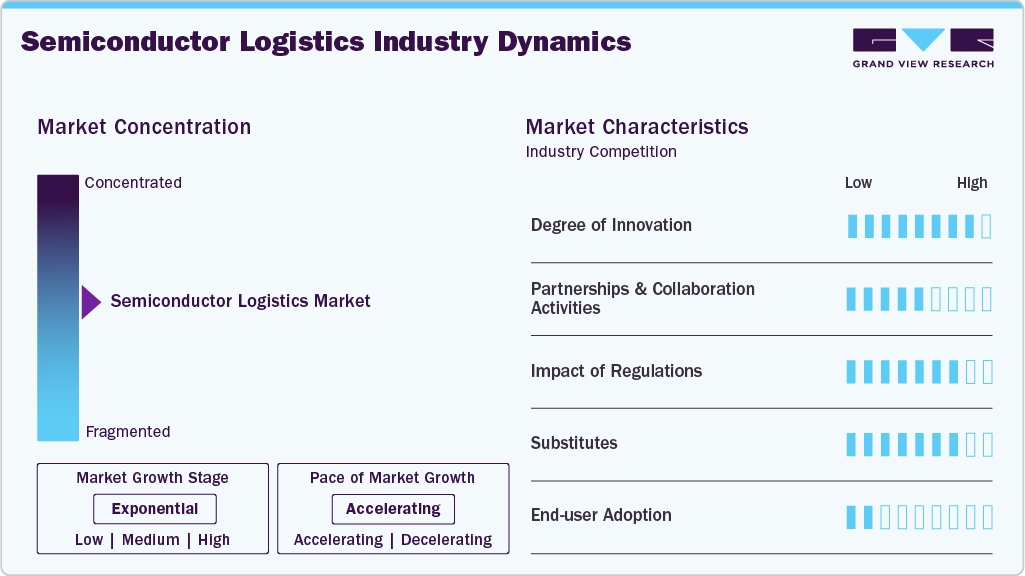
The semiconductor logistics industry is fragmented due to the presence of numerous global logistics providers, freight forwarding companies, and specialized supply chain service providers offering transportation, warehousing, customs brokerage, and value-added logistics services for semiconductor manufacturers. Companies are focusing on expanding semiconductor-certified logistics facilities, strengthening multimodal transportation networks, and investing in digital supply chain visibility, real-time tracking, and secure handling solutions. As semiconductor manufacturing expands across multiple regions, logistics providers continue to compete through specialized capabilities, global network coverage, and integrated supply chain solutions rather than market concentration.
 To learn more about this report, Download Free Sample Report
 Fragmentation is further supported by specialized logistics companies such as Dimerco, Omni Logistics, and NNR Global Logistics, which offer customized semiconductor logistics services to regional manufacturing hubs. At the same time, major global providers, including Kuehne+Nagel, NIPPON EXPRESS HOLDINGS, DSV, and FedEx, are expanding semiconductor-focused logistics capabilities through investments in dedicated infrastructure, digital logistics platforms, and strategic partnerships. Market participants primarily compete based on service reliability, regulatory compliance, shipment visibility, contamination-controlled handling, and global transportation capabilities, maintaining the fragmented nature of the market.
Analyst Perspective
The semiconductor logistics market is entering a period of sustained expansion driven by increasing semiconductor manufacturing investments, regional supply chain diversification, and growing demand for advanced electronic devices. Digital freight visibility, AI-enabled logistics optimization, warehouse automation, and predictive supply chain analytics are transforming logistics operations while improving shipment security and operational efficiency. Future investments are expected to focus on semiconductor-certified logistics infrastructure, multimodal transportation capabilities, and integrated digital supply chain platforms. Competition is increasingly shifting toward providers capable of delivering specialized handling expertise, global network coverage, regulatory compliance, and end-to-end supply chain visibility for high-value semiconductor products
Product Insights
The finished semiconductor products accounted for the largest segment in 2025, at 40.8%. The segment's dominance reflects the growing consumption of packaged semiconductor devices across AI, automotive electronics, consumer electronics, data centers, and industrial automation applications. As production volumes of integrated circuits, processors, memory chips, sensors, and power semiconductors continue to increase, manufacturers require secure and efficient logistics networks to distribute these high-value products worldwide. Specialized packaging, real-time shipment tracking, and contamination-controlled transportation help protect product quality while ensuring timely deliveries across global supply chains.
The raw materials and chemicals product segment is projected to grow at the fastest CAGR over the forecast period. The expansion of semiconductor fabrication capacity and the increasing production of advanced chips are generating higher demand for silicon wafers, specialty gases, photoresists, and process chemicals. Since these materials require controlled storage, secure transportation, and strict handling procedures, logistics providers are expanding specialized capabilities to support uninterrupted manufacturing operations. The growing complexity of semiconductor fabrication processes is further strengthening demand for reliable logistics solutions throughout the supply chain.
Service Insights
The transportation services segment led the market and accounted for the global revenue in 2025. The transportation services segment is further classified into road, ocean, air, and rail. These services involve safely moving semiconductor materials, wafers, equipment, and finished chips from manufacturers to customers using road, air, ocean, or rail transport. Specialized handling is required to protect sensitive semiconductor products from damage, contamination, and environmental changes. Transportation providers use secure packaging, real-time tracking, and controlled handling procedures to maintain product quality throughout the shipment process. These solutions help semiconductor manufacturers ensure timely delivery, reduce supply chain disruptions, and maintain production continuity.
Value-added logistics services is projected to grow at the fastest CAGR over the forecast period. These services include specialized packaging, labeling, inspection, kitting, repackaging, and secure handling activities required for semiconductor products. Value-added logistics services help maintain product safety and meet strict industry quality requirements. These solutions ensure that sensitive semiconductor components are prepared in accordance with customer specifications and regulatory standards. Such services improve supply chain efficiency, reduce handling risks, and support the reliable movement of high-value semiconductor products.
Mode of Operation Insights
The non cold-chain logistics segment accounted for the largest share of global revenue in 2025. This dominance can be attributed to the higher volume of semiconductor products that do not require temperature-controlled handling, such as finished semiconductor devices, packaged integrated circuits, electronic components, and manufacturing equipment. Unlike cold-chain logistics, which require specialized temperature monitoring, controlled environments, and additional handling infrastructure for sensitive materials such as semiconductor chemicals and gases, non-cold-chain logistics involve broader applicability and lower operational complexity, making it a preferred option for a large portion of the semiconductor supply chain.
The cold-chain logistics segment is projected to grow at the fastest CAGR over the forecast period. The increasing use of temperature-sensitive semiconductor materials, including specialty chemicals, process gases, and advanced manufacturing consumables, is accelerating demand for temperature-controlled transportation and storage solutions. Maintaining stable environmental conditions throughout the logistics process is essential to preserving material quality and ensuring manufacturing reliability. As semiconductor fabrication technologies become more advanced and investments in next-generation chip production continue to rise, logistics providers are expanding cold-chain infrastructure, monitoring systems, and specialized transportation capabilities to meet evolving industry requirements.
Destination Insights
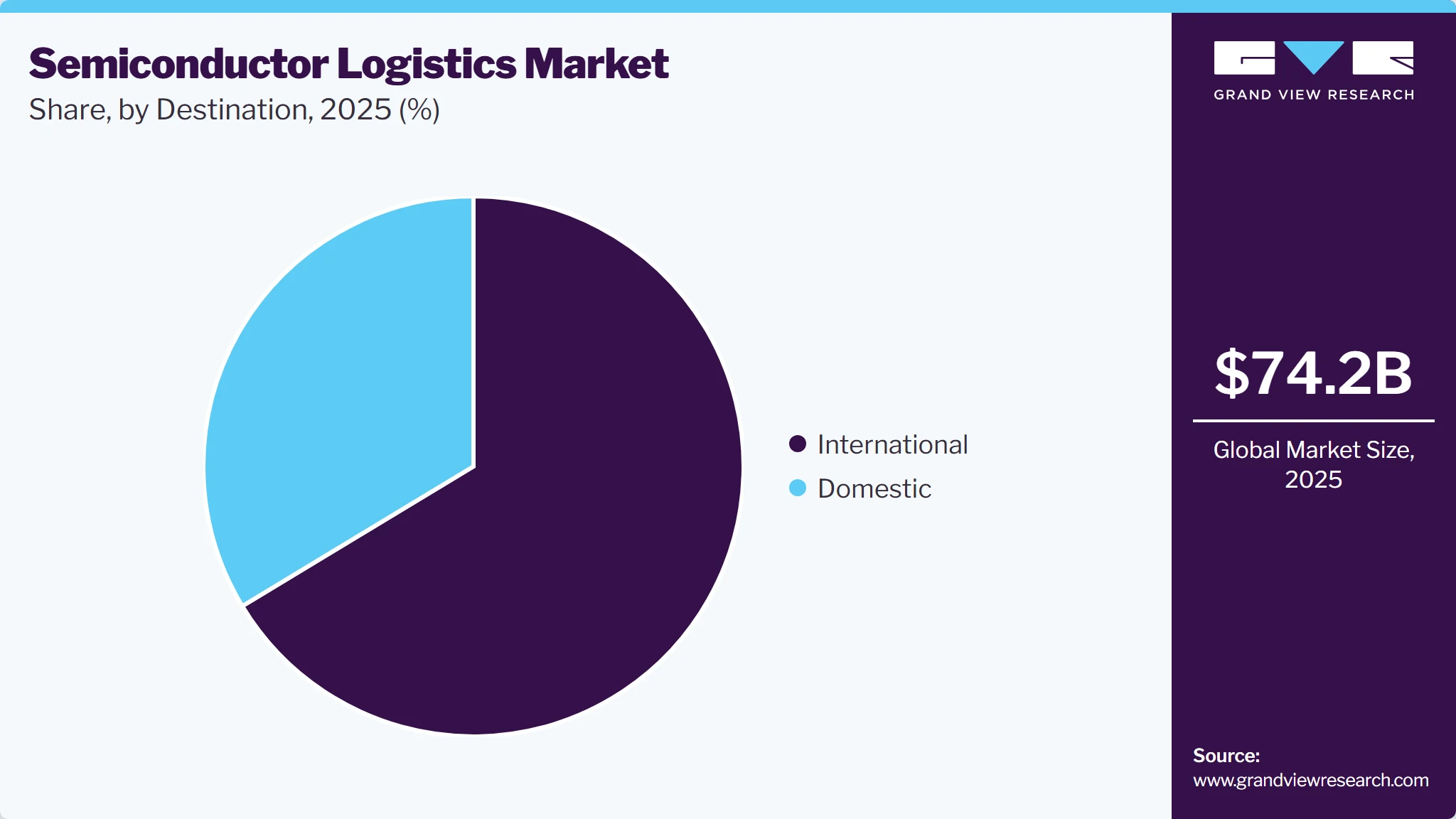
International accounted for the largest market revenue share in 2025. The segment continues to dominate as semiconductor manufacturing remains highly globalized, with fabrication, assembly, packaging, testing, and final distribution often occurring across multiple countries. This extensive cross-border movement of semiconductor materials, wafers, components, and finished products is increasing the need for international freight forwarding, customs brokerage, and secure transportation services. As manufacturers diversify production networks to improve supply chain resilience, demand for specialized international logistics solutions continues to expand.
 To learn more about this report, Download Free Sample Report
 The domestic segment is projected to grow at the fastest CAGR over the forecast period. Rising investments in local semiconductor fabrication plants, assembly and testing facilities, and supporting supply chain infrastructure are increasing the movement of semiconductor products within individual countries. Government initiatives aimed at strengthening domestic chip production and reducing dependence on imported semiconductors are further supporting this trend. Moreover, demand for domestic transportation, warehousing, inventory management, and secure handling services is expected to increase steadily.
Regional Insights
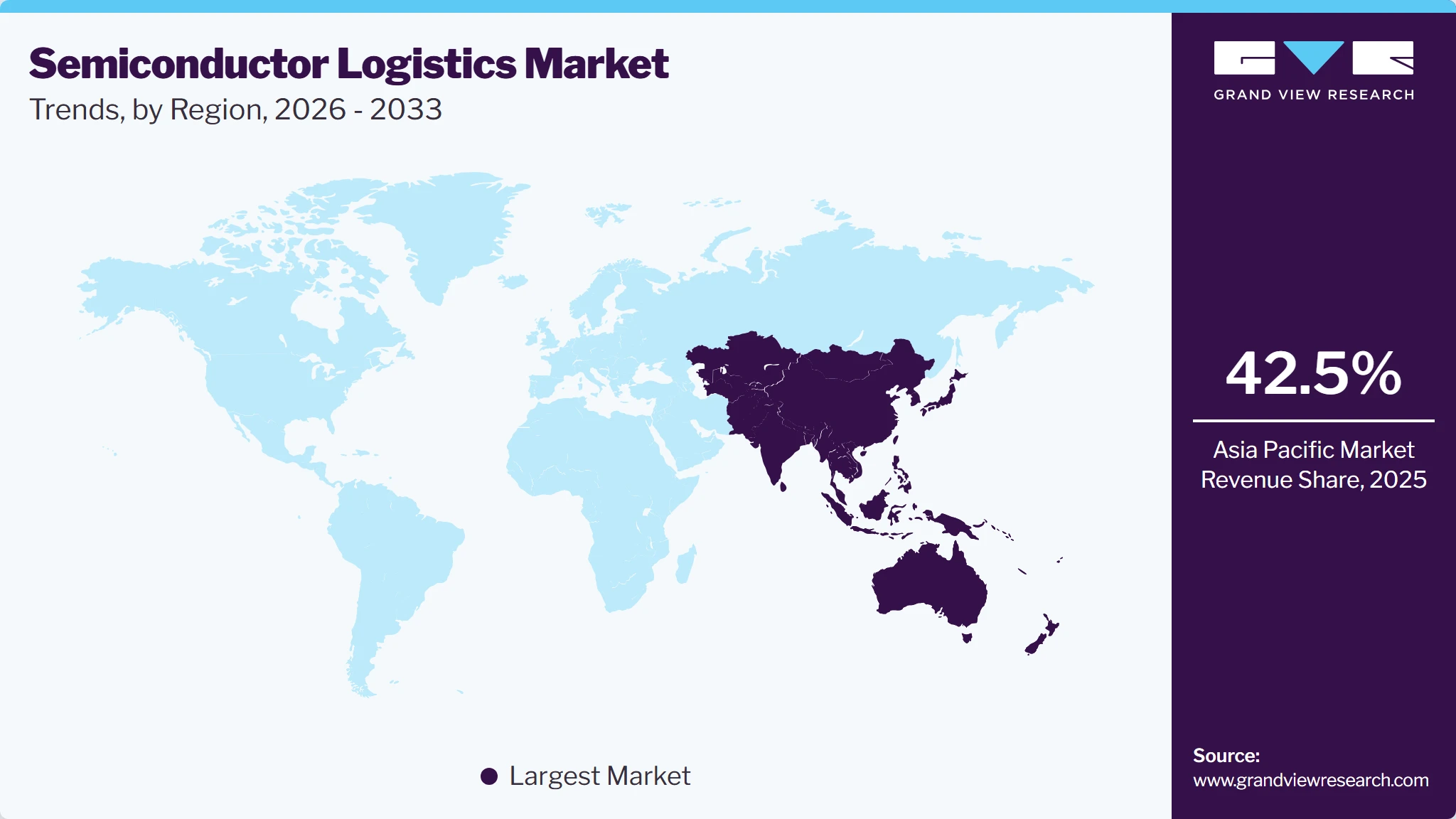
The Asia Pacific semiconductor logistics market led the global market, accounting for 42.5% of global revenue in 2025, and is expected to register the fastest growth from 2026 to 2033, driven by the strong concentration of semiconductor manufacturing facilities across Taiwan, China, South Korea, Japan, and Singapore. The region's high semiconductor production volumes, robust export activity, established logistics infrastructure, and ongoing investments in fabrication, assembly, testing, and advanced packaging facilities continue to drive demand for specialized semiconductor logistics services.
 To learn more about this report, Download Free Sample Report
 China Semiconductor Logistics Market Trends
The semiconductor logistics market in China held a dominant share in the Asia Pacific. China is investing in specialized semiconductor logistics infrastructure, including bonded warehouses and multimodal transportation networks, to support its expanding chip manufacturing industry. These investments improve the efficient, secure, and timely movement of semiconductor materials, wafers, and finished chips across the supply chain.
Japan semiconductor logistics marketis expected to grow at a significant CAGR over the forecast period. Japan is expanding its semiconductor logistics network by increasing specialized warehousing, transportation, and distribution services near major chip manufacturing hubs. This expansion supports the safe and timely movement of semiconductor materials, manufacturing equipment, and finished chips, strengthening the country's semiconductor supply chain.
North America Semiconductor Logistics Market Trends
The semiconductor logistics market in North America led the global market, accounting for 24.4% of global revenue in 2025, supported by expanding chip manufacturing, reshoring initiatives, and advanced supply chain infrastructure. Growing demand from AI, data centers, and defense electronics is increasing the need for secure, compliant, and efficient logistics services across the region.
The U.S. semiconductor logistics market is expected to grow significantly from 2026 to 2033. The U.S. market’s growth is supported by the rapid adoption of AI, advanced computing, and defense technologies is increasing semiconductor production in the U.S. This is driving the need for reliable logistics services to transport high-value semiconductor components and finished chips.
Europe Semiconductor Logistics Market Trends
The semiconductor logistics market in Europe is poised for significant growth from 2026 to 2033. supported by rising semiconductor demand across automotive electronics, industrial automation, renewable energy, telecommunications, and advanced manufacturing industries. The increasing movement of wafers, semiconductor components, manufacturing equipment, and finished products between production facilities is strengthening demand for reliable transportation, warehousing, and distribution services.
The UK semiconductor logistics market is gaining momentum with the adoption of AI-enabled and digital logistics platforms that improve supply chain visibility and operational efficiency. These technologies enhance real-time shipment tracking, inventory management, customs compliance, and route optimization, enabling the secure and timely movement of high-value semiconductor products throughout domestic and international supply chains.
The semiconductor logistics market in Germany held a substantial share in Europe. The country's well-established semiconductor manufacturing ecosystem and advanced industrial base continue to support demand for specialized logistics services. Manufacturers increasingly rely on secure transportation, cleanroom-compatible handling, and controlled storage solutions to protect sensitive semiconductor materials and finished products while maintaining production efficiency across the supply chain.
Key Semiconductor Logistics Company Insights
Key market players are expanding specialized logistics infrastructure, digital tracking solutions, and secure handling capabilities. Companies are focusing on improving shipment reliability and supporting the growing demand for semiconductor manufacturing and distribution.
-
DSV is a global transport and logistics company providing integrated supply chain solutions across air, sea, road, rail, and contract logistics. The company’s strategy focuses on ensuring efficient and reliable supply chains through operational excellence, digitalization, standardization, and continuous optimization of its global network. Its service portfolio includes freight forwarding, contract logistics, warehousing, and customized supply chain solutions tailored to diverse industries.
-
CEVA Logistics is a global third-party logistics provider and a fully owned subsidiary of the CMA CGM Group. Its strategy focuses on end-to-end supply chain management, digital transformation, and sustainable logistics practices. The company offers freight management and contract logistics to connect people, products, and providers across global supply chains. It serves key industries, including consumer & retail, automotive & industrial, and aerospace, leveraging its global network and operational flexibility to deliver customized logistics solutions.
Key Semiconductor Logistics Companies
The following key companies have been profiled for this study on the semiconductor logistics market
-
Kuehne+Nagel
-
NIPPON EXPRESS HOLDINGS
-
DSV
-
Yusen Logistics Global Management Co., Ltd.
-
FedEx
-
CEVA Logistics
-
Omni Logistics
-
Dimerco
-
NNR GLOBAL LOGISTICS
-
CCS Express
Company Categorization
Operating Strategies
Competitive Edge
Weaknesses
Mature Players: Kuehne+Nagel, NIPPON EXPRESS HOLDINGS, DSV
Mature players in the market are focusing on operating extensive global logistics networks to serve major semiconductor manufacturing regions. Their strategies focus on digital visibility platforms and specialized handling infrastructure to improve shipment reliability and efficiency.
Mature players gain a competitive advantage through global presence, and comprehensive service portfolios enable end-to-end semiconductor logistics solutions. Strong industry experience and advanced logistics technologies support secure, time-critical semiconductor transportation.
These companies often face challenges related to high infrastructure and operational costs, which increase overall business expenses. Dependence on global semiconductor production and international trade cycles exposes them to market fluctuations.
Emerging Players: Yusen Logistics Global Management Co., Ltd, Omni Logistics
Emerging players in the market are focusing on regional semiconductor clusters with customized logistics services. Their strategies emphasize building strategic partnerships to expand capabilities and address niche customer requirements.
Emerging players gain market traction through greater flexibility, enabling quicker responses to specialized customer needs. Strong regional expertise helps deliver tailored semiconductor logistics solutions.
Emerging players face limitations due to a narrow global network, which restricts their participation in large multinational logistics contracts. Smaller financial and infrastructure resourc
Recent Developments
-
In March 2025, Kuehne+Nagel opened a new road logistics facility in Laredo, Texas (U.S.-Mexico border) to strengthen cross-border logistics, customs brokerage, and near-shoring supply chains. The expansion supports high-tech manufacturers, including semiconductor companies, by enabling faster and more resilient transportation of electronic components and manufacturing equipment.
-
In July 2026, CMA CGM Group acquired FedEx Supply Chain to expand CEVA Logistics' contract logistics operations in North America. The acquisition strengthens CEVA's warehousing, transportation, and end-to-end supply chain capabilities, enhancing its support for high-value industries, including the semiconductor sector.
Semiconductor Logistics Market Report Scope
Report Attribute
Details
Market size in 2025
USD 74.2 billion
Estimated market size in 2026
USD 79.3 billion
Projected market size by 2033
USD 149.7 billion
Growth rate
CAGR of 9.5% from 2026 to 2033
Historical data
2021 - 2025
Forecast period
2026 - 2033
Quantitative units
Revenue in USD billion and CAGR from 2026 to 2033
Report coverage
Revenue forecast, company ranking, competitive landscape, growth factors, and trends
Segments covered
Product, service, mode of operation, destination, region
Regional scope
North America; Europe; Asia Pacific; Latin America; MEA
Country scope
U.S.; Canada; Mexico; Germany; UK; France; China; Japan; India; South Korea; Australia; Brazil; KSA; UAE; South Africa
Key companies profiled
Kuehne+Nagel; NIPPON EXPRESS HOLDINGS; DSV.; Yusen Logistics Global Management Co., Ltd.; FedEx; CEVA Logistics; Omni Logistics; Dimerco; NNR GLOBAL LOGISTICS; CCS Express
Customization scope
Free report customization (equivalent up to 8 analysts working days) with purchase. Addition or alteration to country, regional & segment scope.
Pricing and purchase options
Avail customized purchase options to meet your exact research needs. Explore purchase options
Global Semiconductor Logistics Market Report Segmentation
The report forecasts revenue growth at global, regional, and country levels and provides an analysis of the latest industry trends in each of the sub-segments from 2021 to 2033. For this study, Grand View Research has segmented the global semiconductor logistics market based on product, service, mode of operation, destination, and region:
-
Product Outlook (Revenue, USD Billion, 2021 - 2033)
-
Raw Materials and Chemicals
-
Wafers (Bare and Processed)
-
Finished Semiconductor Products
-
Packaging Materials
-
Others
-
-
Service Outlook (Revenue, USD Billion, 2021 - 2033)
-
Transportation Services
-
Road
-
Ocean
-
Air
-
Rail
-
-
Warehousing and Distribution Services
-
Freight Forwarding Services
-
Inventory Management Services
-
Value Added Logistics Service
-
Integration & Consulting Services
-
-
Mode of Operation Outlook (Revenue, USD Billion, 2021 - 2033)
-
Cold-Chain Logistics
-
Non Cold-Chain Logistics
-
-
Destination Outlook (Revenue, USD Billion, 2021 - 2033)
-
Domestic
-
International
-
-
Regional Outlook (Revenue, USD Billion, 2021 - 2033)
-
North America
-
U.S.
-
Canada
-
Mexico
-
-
Europe
-
Germany
-
UK
-
France
-
-
Asia Pacific
-
China
-
India
-
Japan
-
South Korea
-
Australia
-
-
Latin America
-
Brazil
-
-
Middle East & Africa (MEA)
-
UAE
-
Kingdom of Saudi Arabia (KSA)
-
South Africa
-
-
Research Methodology
The semiconductor logistics market figures in this report are based on a proven research process that combines executive interviews with secondary research from proprietary databases, company filings, and recognized regulatory and institutional sources. Market size is built through value-chain sizing—reconciling supply-side and demand-side estimates—and triangulated with bottom-up and top-down approaches. Every estimate passes multiple levels of expert validation before publication, with each semiconductor logistics segment quantified using the revenue-capture definitions in the table below.
Segment Definition
Segment - Product
Revenue capture definition
Finished Semiconductor Products
The segment revenue is generated from logistics services for transporting, storing, and handling semiconductor raw materials, specialty chemicals, gases, photoresists, and other manufacturing inputs.
Wafers (Bare & Processed)
The segment's revenue is generated from the transportation, storage, and secure handling of bare and processed silicon wafers throughout semiconductor fabrication, testing, and packaging.
Raw Materials & Chemicals
The segment's revenue is generated from logistics services for the transportation, warehousing, and distribution of finished semiconductor products, including integrated circuits, processors, memory chips, sensors, and power semiconductors.
Packaging Materials
The segment revenue is generated from transporting, storing, and distributing semiconductor packaging materials, including trays, reels, tapes, carriers, and protective packaging components.
Others
The segment revenue is generated from logistics services for transporting and storing photomasks, reticles, specialty consumables, quartz components, and other semiconductor manufacturing accessories.
Segment - Service
Revenue capture definition
Transportation Services
The segment revenue is generated from transporting semiconductor materials, wafers, equipment, and finished semiconductor products through transportation networks. The segment includes transportation services such as road, ocean, air, and rail.
- Road: The segment revenue generated from domestic and regional road transportation of semiconductor products between manufacturing facilities, warehouses, airports, ports, and customers.
- Ocean: The segment revenue generated from international ocean freight services used for transporting semiconductor materials, equipment, packaging materials, and finished products via container shipping.
- Air: The segment revenue is generated from time-sensitive air freight services for transporting high-value semiconductor wafers, chips, components, and manufacturing materials.
- Rail: The segment revenue generated from rail transportation services is used for moving semiconductor manufacturing equipment, raw materials, packaging materials, and intermodal freight.
Warehousing & Distribution Services
The segment revenue is generated from semiconductor warehousing, inventory storage, order fulfillment, cross-docking, and distribution activities conducted in secure and controlled facilities.
Freight Forwarding Services
The segment revenue is generated from freight forwarding activities, including shipment planning, carrier coordination, customs clearance, documentation, and multimodal transportation management.
Inventory Management Services
The segment revenue is generated from inventory monitoring, stock control, warehouse management, replenishment planning, and inventory optimization services for semiconductor products.
Value-Added Logistics Services
The segment revenue is generated from specialized packaging, labeling, inspection, kitting, repackaging, quality checks, reverse logistics, and other value-added semiconductor handling services.
Integration & Consulting Services
The segment revenue is generated from supply chain consulting, logistics network design, digital logistics integration, warehouse optimization, compliance advisory, and process improvement services.
Segment - Mode of Operation
Revenue capture definition
Non Cold-Chain Logistics
The segment revenue is generated from temperature-controlled transportation, storage, monitoring, and handling of temperature-sensitive semiconductor materials, including specialty chemicals, gases, and manufacturing consumables.
Cold-Chain Logistics
The segment revenue is generated from the transportation, warehousing, distribution, and handling of semiconductor products that do not require temperature-controlled environments, including wafers, finished semiconductor devices, packaging materials, and manufacturing equipment.
Segment - Destination
Revenue capture definition
International
The segment revenue is generated from cross-border transportation, customs clearance, freight forwarding, warehousing, and distribution of semiconductor materials, components, equipment, and finished products across international supply chains.
Domestic
The segment revenue is generated from the transportation, warehousing, distribution, freight forwarding, and inventory management of semiconductor materials, wafers, equipment, and finished products within the same country.
Estimation Model
Layer Name
Key Question
Description
Semiconductor Manufacturing Activity
Where is semiconductor production occurring and how much logistics demand is generated?
This layer evaluates global semiconductor fabrication, assembly, testing, and packaging capacity across major manufacturing regions. It assesses wafer production volumes, fab investments, OSAT activities, and semiconductor trade flows. These production activities establish the base demand for specialized semiconductor logistics services.
Logistics Service Demand
Which logistics services are required throughout the semiconductor supply chain?
This layer estimates demand for transportation, warehousing, freight forwarding, inventory management, and value-added logistics based on semiconductor production volumes. It considers shipment frequency, handling complexity, transportation mode selection, and inventory movement across manufacturing stages. Demand is segmented according to semiconductor product characteristics and supply chain requirements.
Service Revenue Assessment
How is logistics revenue generated across service categories?
This layer measures revenue generated from domestic and international transportation, specialized warehousing, customs brokerage, consulting, inventory management, and semiconductor-specific logistics solutions. Revenue estimation incorporates shipment value, logistics intensity, handling requirements, and premium services associated with semiconductor transportation.
Market Validation and Competitive Benchmarking
How is the market validated and benchmarked across regions and participants?
This layer validates market estimates using semiconductor production statistics, international trade volumes, logistics infrastructure capacity, company financial disclosures, and industry shipment trends. Competitive benchmarking evaluates market share, service capabilities, geographic reach, technology adoption, and strategic positioning of semiconductor logistics providers operating across global supply chains.
Delivered Customization
This report has been delivered with the following In-depth customizations
Client Request
Customization Delivered
Value Adds
Regional Semiconductor Logistics Market Opportunity Assessment
- Country/region-wise market sizing and forecasts
- Analysis of demand, adoption trends, and regulatory landscape
- Identification of high-growth regions and investment hotspots
- Identified region-specific growth opportunities
- Supported expansion and go-to-market strategy
- Enabled informed regional investment decisions
Cross-Segmentation Analysis for the Semiconductor Logistics Market
- Criss-cross market analysis by service, mode of operation, destination, and product
- Demand and adoption assessment across key segments
- Segment attractiveness and growth potential benchmarking
- Identified high-potential market segments
- Supported targeted product positioning and marketing strategy
- Improved customer and segment prioritization
Competitive Benchmarking and Strategic Positioning in the Semiconductor Logistics Market
- Benchmarking of key competitors across products, pricing, partnerships, and innovation
- Comparative assessment of market share, capabilities, and strategies
- Analysis of competitive strengths, gaps, and differentiation areas
- Identified competitive white spaces and growth gaps
- Supported strategic positioning and differentiation
- Enabled data-driven competitive strategy development
Frequently Asked Questions About This Report
The global semiconductor logistics market size was estimated at USD 74.2 billion in 2025 and is expected to reach USD 79.3 billion in 2026.
Asia Pacific market led the global market and accounted for 42.5% of the global revenue in 2025 and is expected to register the highest growth from 2026 to 2033, driven by the strong concentration of semiconductor manufacturing facilities across Taiwan, China, South Korea, Japan, and Singapore.
The increasing demand for semiconductor chips across AI, automotive, consumer electronics, and data center applications is driving the growth of the semiconductor logistics market.
Some key players operating in the semiconductor logistics market include Kuehne+Nagel, NIPPON EXPRESS HOLDINGS, DSV., Yusen Logistics Global Management Co., Ltd., FedEx., CEVA Logistics, Omni Logistics, Dimerco, NNR GLOBAL LOGISTICS, and CCS Express
The non cold-chain logistics segment dominated the semiconductor logistics market in 2025, with a 75.1% share, while cold-chain logistics is expected to register the highest growth from 2026 to 2033.
The global semiconductor logistics market is expected to grow at a compound annual growth rate of 9.5% from 2026 to 2033, reaching USD 149.7 billion by 2033.
The international segment dominated the semiconductor logistics market in 2025, with a 66.3% share, while domestic is expected to register the highest growth from 2026 to 2033.
The transportation services segment dominated the semiconductor logistics market in 2025, with a 54.8% share, while value-added logistics services is expected to register the highest growth from 2026 to 2033.
The finished semiconductor products segment dominated the target market with a 40.8% revenue share in 2025. The segment's dominance reflects the growing consumption of packaged semiconductor devices across artificial intelligence (AI), automotive electronics, consumer electronics, data centers, and industrial automation applications.
About the Author(s)
Automotive & Transportation Research Team
Technology · Automotive & TransportationThis report was authored by the automotive & transportation research team at Grand View Research - comprising two research analysts, one senior research analyst, and one industry expert - with specialized expertise in the automotive & transportation segment of the technology industry. All findings are based on proprietary technology databases, executive interviews, and regulatory analysis, subject to internal peer review prior to publication.
Last Updated:
Speak to Analyst

Customize this report to your needs - add regions, segments, or data points, with 20% free customization.
Or view our licence options:


ISO 9001:2015 & 27001:2022 Certified
We are GDPR and CCPA compliant! Your transaction & personal information is safe and secure. For more details, please read our privacy policy.


