
- Home
- »
- Automotive & Transportation
- »
-
Shipbuilding Market Size, Share & Trends Report, 2026-2035GVR Report cover

Shipbuilding Market (2026 - 2035)
Size, Share & Trends Analysis Report By Application (Commercial Shipping, Defense), By Vessel Type (Cargo Ship, Tanker, Passenger Ship), By Material (Steel, Aluminum, Composite, Fiberglass, Wood), By Region, And Segment Forecasts
Market Size, 2025
$166.2BMarket Estimate, 2026
$175.2BMarket Forecast, 2035
$290.2BCAGR, 2026–2035
5.7%Shipbuilding Market Summary
The global shipbuilding market was valued at USD 166.2 billion in 2025 and is projected to grow from USD 175.2 billion in 2026 to USD 290.2 billion in 2035, at a CAGR of 5.7% from 2026 to 2035. Asia Pacific dominated the market, accounting for a revenue share of 75.0% in 2025. The shipbuilding market is experiencing sustained growth, driven by the expansion of global maritime trade, increasing demand for energy-efficient vessels, and rising investments in fleet modernization to comply with evolving environmental and safety regulations.
Key Market Trends & Insights
- By application: The commercial segment held the largest market share of over 70.0% in 2025.
- By vessel type: The cargo ship segment held the largest market share of around 48.0% in 2025
- By material: The steel segment held the largest market share of around 90.0% in 2025
- By vessel type: The cargo ships segment accounted for the largest revenue share of over 48.0% in 2025.
Regional Highlights
- Largest regional market: Asia Pacific (75.0% revenue share, 2025)
Market Size & Forecast
- Market size in 2025: USD 166.2 Billion
- Estimated market size in 2026: USD 175.7 Billion
- Projected market size by 2035: USD 290.2 Billion
- CAGR (2026-2035): 5.7%
GVR research-powered AIAsk Prism AI about the shipbuilding marketGet cited answers from GVR research on market growth, segments, regulations and forecasts.Start with✓ Source-linked answers ✓ Market-specific context ✓ Traceable figuresExplore Prism AI ↗
The increase in the carriage of containers, dry bulk cargo, LNG, and crude oil via seaborne transport has prompted shipping organizations to construct technologically advanced ships that are more fuel-efficient and have lower operational costs. Moreover, increased procurement of naval equipment, energy exploration operations, and aging fleet replacement are providing ample business opportunities to the shipbuilders in both the commercial and defense industries. The use of digital technologies in shipbuilding and the application of automation and robotics in ship construction are improving process efficiency.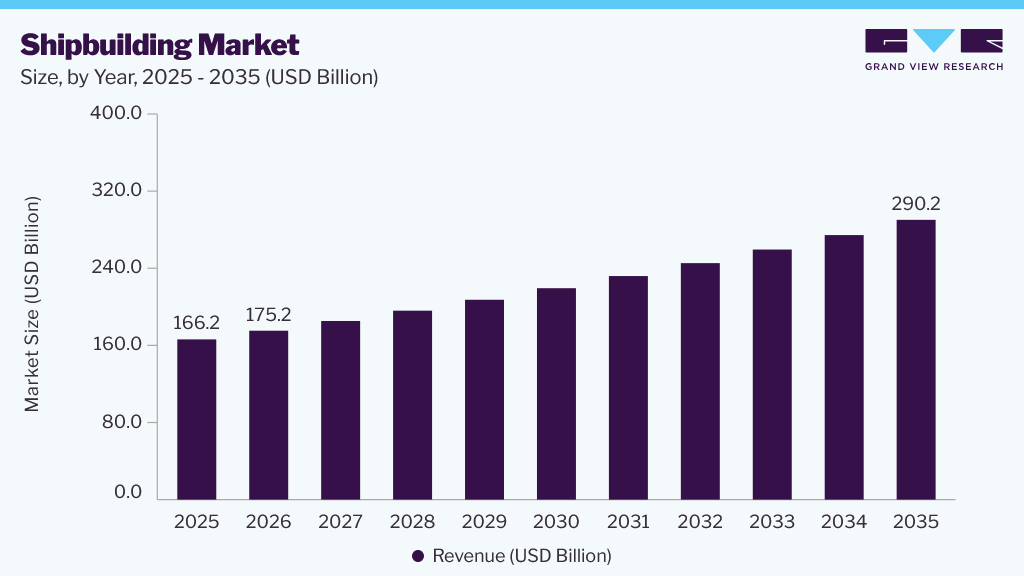 Source: Grand View Research, IR Documents, Primary Interviews, Paid DatabasesTo learn more about this report,
 Download Free Sample Report
The market is also being influenced by the international maritime industry's shift towards decarbonization and sustainable shipping. An increasing number of shipyards are designing ships with capabilities for LNG, methanol, ammonia, hydrogen, and battery power to meet ever-increasing emission norms and ship owners' sustainability goals. Advancements in technologies associated with maritime operations and ship performance also contribute to the growth of this market. Increasing trade activities, inclination among shipping businesses and fleet operators to explore underserved shipping routes, and growing demand for maritime logistics solutions are likely to generate novel growth opportunities for this industry in coming years.
Analyst Perspective
The global shipbuilding market is witnessing steady growth, supported by rising global seaborne trade, fleet renewal initiatives, and the maritime industry's transition toward low-carbon operations. Trends within the industry show that ship owners are now increasingly buying ships that can run on LNG, methanol, ammonia, and hydrogen in order to adapt to emerging environmental laws and gain efficiency in operations. Production capacities are also expected to increase for shipyards as they become more advanced using automation and intelligent manufacturing. Increased naval modernization activities and offshore energy projects may also contribute to the growth of this industry. The Asia Pacific region is expected to be the center of manufacturing activities in the future, and technology advancements are considered critical in shaping the further course of the market.
Application Insights
The commercial segment held the largest market share, at over 70.0%, in 2025. The segment's dominance is driven by increasing global trade, rising demand for containerized cargo transportation, and ongoing fleet modernization initiatives. Ship-owners are increasingly investing in fuel-efficient, digitally enabled, and alternative-fuel vessels to improve operational efficiency and comply with evolving environmental regulations. Moreover, expanding port infrastructure and growing international trade continue to support demand for commercial shipbuilding. For instance, in January 2025, the Ministry of Ports, Shipping and Waterways, Government of India, announced investments of nearly USD 5.9 billion for capacity expansion at Kandla Port, including a USD 3.1 billion investment for a mega shipbuilding facility and the remaining for a cargo terminal, which is set to add 135 MTPA of cargo-handling capacity. The integrated investment in port infrastructure and shipbuilding is expected to strengthen maritime trade and improve logistics efficiency over the coming years. The newly developed facility for shipbuilding, once completed, is expected to hold the capacity to produce nearly 32 new ships, while repairing over 50 ships. Such developments are likely to support market growth in the forecast period.
The defense segment is expected to register the fastest growth over the forecast period. Growth is fueled by rising defense expenditures, naval fleet modernization programs, and increasing investments in advanced warships, submarines, and autonomous maritime platforms. Additionally, the adoption of smart naval technologies, next-generation propulsion systems, and indigenous shipbuilding initiatives is expected to accelerate the construction of technologically advanced defense vessels, supporting segment growth throughout the forecast period.
Vessel Type Insights
The cargo ships segment accounted for the largest market share in the shipbuilding market in 2025. The segment's dominance is driven by the continuous growth of global trade activities, increasing demand for containerized and bulk cargo transportation, and rising investments in fleet expansion and modernization. Shipowners are increasingly procuring fuel-efficient, digitally connected, and alternative-fuel-powered cargo vessels to improve operational efficiency, reduce emissions, and comply with evolving international maritime regulations. Furthermore, expanding global logistics networks and port infrastructure continue to support sustained demand for new cargo ship construction. For instance, in May 2025, the Ministry of Ports, Shipping and Waterways, Government of India, announced that the country's major ports handled approximately 855 million tonnes of cargo during FY 2024–25, representing a 4.3% year-on-year increase from 819 million tonnes in FY 2023–24. The ministry also highlighted continued investments in port modernization, operational efficiency, and port-led industrialization to accommodate rising trade volumes. These developments underscore how expanding logistics networks and port infrastructure are supporting sustained demand for new cargo ship construction to facilitate growing global maritime trade.
The tanker segment is expected to register the fastest growth in the shipbuilding market over the forecast period. The growth is primarily attributed to increasing global demand for crude oil, refined petroleum products, LNG, and other liquefied gases, coupled with rising investments in energy transportation infrastructure. Shipowners are increasingly ordering next-generation tankers equipped with advanced propulsion systems, dual-fuel engines, and energy-efficient designs to meet stringent environmental standards and enhance operational performance. Additionally, the expansion of LNG trade and the replacement of aging tanker fleets are expected to accelerate demand for modern tankers throughout the forecast period.
Material Insights
The steel segment accounted for the largest market share in the shipbuilding market in 2025. The segment's dominance is primarily attributed to its exceptional structural strength, durability, and cost-effectiveness, making it the preferred material for constructing cargo ships, tankers, bulk carriers, container vessels, and naval ships. Steel provides high load-bearing capacity, excellent impact resistance, and long service life, enabling vessels to withstand harsh marine environments and heavy operational demands. Furthermore, continuous advancements in high-strength, lightweight, and corrosion-resistant steel grades are enhancing vessel performance, reducing maintenance costs, and improving fuel efficiency, thereby reinforcing the segment's leading position in the global shipbuilding market. For instance, in March 2025, SSAB introduced its high-strength Strenx Weathering steel portfolio, offering yield strengths of up to 960 MPa while combining superior corrosion resistance with lightweight structural performance. The advanced steel is designed to reduce structural weight significantly while improving load-bearing capacity, and lowering maintenance and repainting requirements through enhanced corrosion protection. Such advancements in high-strength and corrosion-resistant steel grades are supporting improved vessel performance, reduced lifecycle costs, and greater fuel efficiency in shipbuilding applications.
The aluminum segment is expected to register the fastest growth over the forecast period. The growth is driven by increasing demand for lightweight, fuel-efficient, and environmentally sustainable vessels across commercial and defense applications. Aluminum offers superior corrosion resistance, lower structural weight, and improved design flexibility, enabling higher vessel speeds, reduced fuel consumption, and lower lifecycle maintenance costs. It is increasingly being adopted in high-speed ferries, patrol boats, offshore support vessels, and naval craft where weight reduction and operational efficiency are critical. In addition, growing investments in green shipbuilding technologies and energy-efficient vessel designs are expected to further accelerate the adoption of aluminum across the global shipbuilding market throughout the forecast period.
Regional Insights
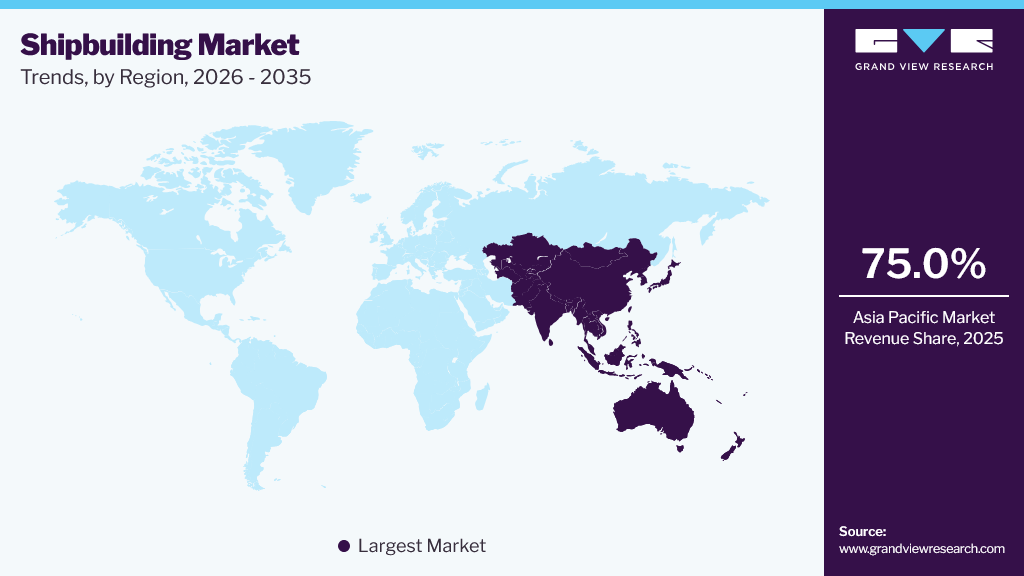
The Asia Pacific shipbuilding market dominated the global industry, accounting for over 75.0% of global revenue in 2025. The region's dominance is primarily driven by expanding shipbuilding capacity, increasing global ship orders, and the rapid growth of international maritime trade. Countries such as China, South Korea, Japan, and India are investing heavily in advanced shipyard infrastructure, smart manufacturing technologies, and environmentally sustainable vessel construction to strengthen their global competitiveness.
 To learn more about this report, Download Free Sample Report
Furthermore, supportive government initiatives, rising exports of commercial vessels, growing demand for LNG- and alternative-fuel-powered ships, and continuous investments in port infrastructure are expected to accelerate the growth of the Asia Pacific shipbuilding market throughout the forecast period. For instance, in January 2025, the Ministry of Oceans and Fisheries (MOF) of the Republic of Korea announced its 2025 Key Policy Implementation Plan, which includes measures to strengthen the country's competitiveness in the industry by expanding the deployment of eco-friendly ships, enhancing smart port infrastructure, and improving maritime logistics capabilities.
Key Shipbuilding Market Company Insights
The shipbuilding market is characterized by the presence of global, regional, and niche solution providers competing through technological innovation, strategic partnerships, acquisitions, and product portfolio expansion. For instance, in December 2024, Hanwha Group announced the successful completion of its acquisition of Philly Shipyard through Hanwha Ocean and Hanwha Systems. The acquisition significantly expanded Hanwha's global shipbuilding footprint and strengthened its capabilities in shipbuilding within the U.S.
Key Shipbuilding Companies
The following key companies have been profiled for this study on the shipbuilding market:
-
China State Shipbuilding Corporation Limited
-
HD Hyundai Heavy Industries Co., Ltd.
-
Hanwha Ocean Co., Ltd.
-
Samsung Heavy Industries Co., Ltd.
-
Mitsubishi Heavy Industries, Ltd.
-
Kawasaki Heavy Industries, Ltd.
-
Imabari Shipbuilding Co., Ltd.
-
Namura Shipbuilding Co., Ltd.
-
Fincantieri S.p.A.
-
Navantia, S.A., S.M.E.
Recent Developments
- In March 2025, HD Hyundai announced an expanded collaboration with Palantir Technologies to accelerate the development of its Future of Shipyard (FOS) initiative. The partnership leverages artificial intelligence, digital twins, and data analytics to build an intelligent autonomous shipyard by 2030.
- In April 2025, FSG Shipyard officially became part of the Heinrich Rönner Group, marking a significant strategic move to strengthen its shipbuilding capabilities and expand its presence in the European maritime industry. The integration is expected to enhance ship design, construction, and manufacturing capacity while supporting investments in advanced shipbuilding technologies and production efficiency.
Shipbuilding Market Report Scope
Report Attribute
Details
Market size in 2025
USD 166.2 billion
Estimated market size in 2026
USD 175.7 billion
Projected market size by 2035
USD 290.6 billion
Growth rate
CAGR of 5.7% from 2026 to 2035
Base year for estimation
2025
Actual data
2021 – 2024
Forecast period
2026 – 2035
Quantitative units
Revenue in USD billion, and CAGR from 2026 to 2035
Report coverage
Revenue forecast, company ranking, competitive landscape, growth factors, and trends
Segments covered
Application, vessel type, material, technology, end-use, region
Regional Scope
North America; Europe; Asia Pacific; Central & South America; Middle East & Africa
Country Scope
U.S.; Canada; Mexico; UK; Germany; France; Spain; Italy; China; Japan; India; Australia; South Korea; Brazil; Argentina; South Africa; Saudi Arabia; UAE
Key companies profiled
China State Shipbuilding Corporation Limited; HD Hyundai Heavy Industries Co., Ltd.; Hanwha Ocean Co., Ltd.; Samsung Heavy Industries Co., Ltd.; Mitsubishi Heavy Industries, Ltd.; Kawasaki Heavy Industries, Ltd.; Imabari Shipbuilding Co., Ltd.; Namura Shipbuilding Co., Ltd.; Fincantieri S.p.A.; Navantia, S.A., S.M.E.
Customization scope
Free report customization (equivalent to 8 analyst working days) with purchase. Addition or alteration to country, regional & segment scope.
Pricing and purchase options
Avail of customized purchase options to meet your exact research needs. Explore purchase options
Global Shipbuilding Market Report Segmentation
This report forecasts revenue growth at the global, regional, and country levels and provides an analysis of the latest industry trends and opportunities across each sub-segment from 2021 to 2035. For the purpose of this study, Grand View Research has segmented the global shipbuilding market report based on application, vessel type, material, technology, end use, and region:
-
Application Outlook (Revenue, USD Billion, 2021 - 2035)
-
Commercial Shipping
-
Defense
-
-
Vessel Type Outlook (Revenue, USD Billion, 2021 - 2035)
-
Cargo Ship
-
Tanker
-
Passenger Ship
-
Fishing Vessel
-
Others
-
-
Material Outlook (Revenue, USD Billion, 2021 - 2035)
-
Steel
-
Aluminum
-
Composite
-
Others
-
-
Regional Outlook (Revenue, USD Billion, 2021 - 2035)
-
North America
-
U.S.
-
Canada
-
Mexico
-
-
Europe
-
UK
-
Germany
-
France
-
Italy
-
Spain
-
-
Asia Pacific
-
China
-
Japan
-
India
-
Australia
-
South Korea
-
-
Central & South America
-
Brazil
-
Argentina
-
-
Middle East and Africa (MEA)
-
South Africa
-
Saudi Arabia
-
UAE
-
-
Frequently Asked Questions About This Report
The global shipbuilding market size was valued at USD 166.2 billion in 2025 and is estimated at USD 175.7 billion for 2026.
The global shipbuilding market is expected to grow at a CAGR of 5.7% from 2026 to 2035, reaching USD 290.2 billion by 2035.
Asia Pacific dominated with over 75.0% revenue share in 2025.
The commercial segment accounted for the largest revenue share of over 70.0% in 2025.
Key players in the market include China State Shipbuilding Corporation Limited, HD Hyundai Heavy Industries Co., Ltd., Hanwha Ocean Co., Ltd., Samsung Heavy Industries Co., Ltd., Mitsubishi Heavy Industries, Ltd., Kawasaki Heavy Industries, Ltd., Imabari Shipbuilding Co., Ltd., Namura Shipbuilding Co., Ltd., Fincantieri S.p.A., Navantia, S.A., S.M.E., and others.
About the Author(s)
Automotive & Transportation Research Team
Technology · Automotive & TransportationThis report was authored by the automotive & transportation research team at Grand View Research - comprising two research analysts, one senior research analyst, and one industry expert - with specialized expertise in the automotive & transportation segment of the technology industry. All findings are based on proprietary technology databases, executive interviews, and regulatory analysis, subject to internal peer review prior to publication.
Last Updated:
Speak to Analyst

Customize this report to your needs - add regions, segments, or data points, with 20% free customization.
Or view our licence options:


ISO 9001:2015 & 27001:2022 Certified
We are GDPR and CCPA compliant! Your transaction & personal information is safe and secure. For more details, please read our privacy policy.


