
- Home
- »
- Plastics, Polymers & Resins
- »
-
Silicone Ear Tips Market Size & Share Report, 2026-2033GVR Report cover

Silicone Ear Tips Market (2026 - 2033)
Size, Shae & Trends Analysis Report Market By Silicone Type (Standard Silicone, Soft/low-durometer Silicone, Medical-grade Silicone, LSR/high-performance Silicone, Antimicrobial/hypoallergenic Silicone), By End Use, By Region, And Segment Forecasts
Market Size, 2025
$61.1MMarket Estimate, 2026
$65.4MMarket Forecast, 2033
$107.5MCAGR, 2026–2033
7.3%Silicone Ear Tips Market Summary
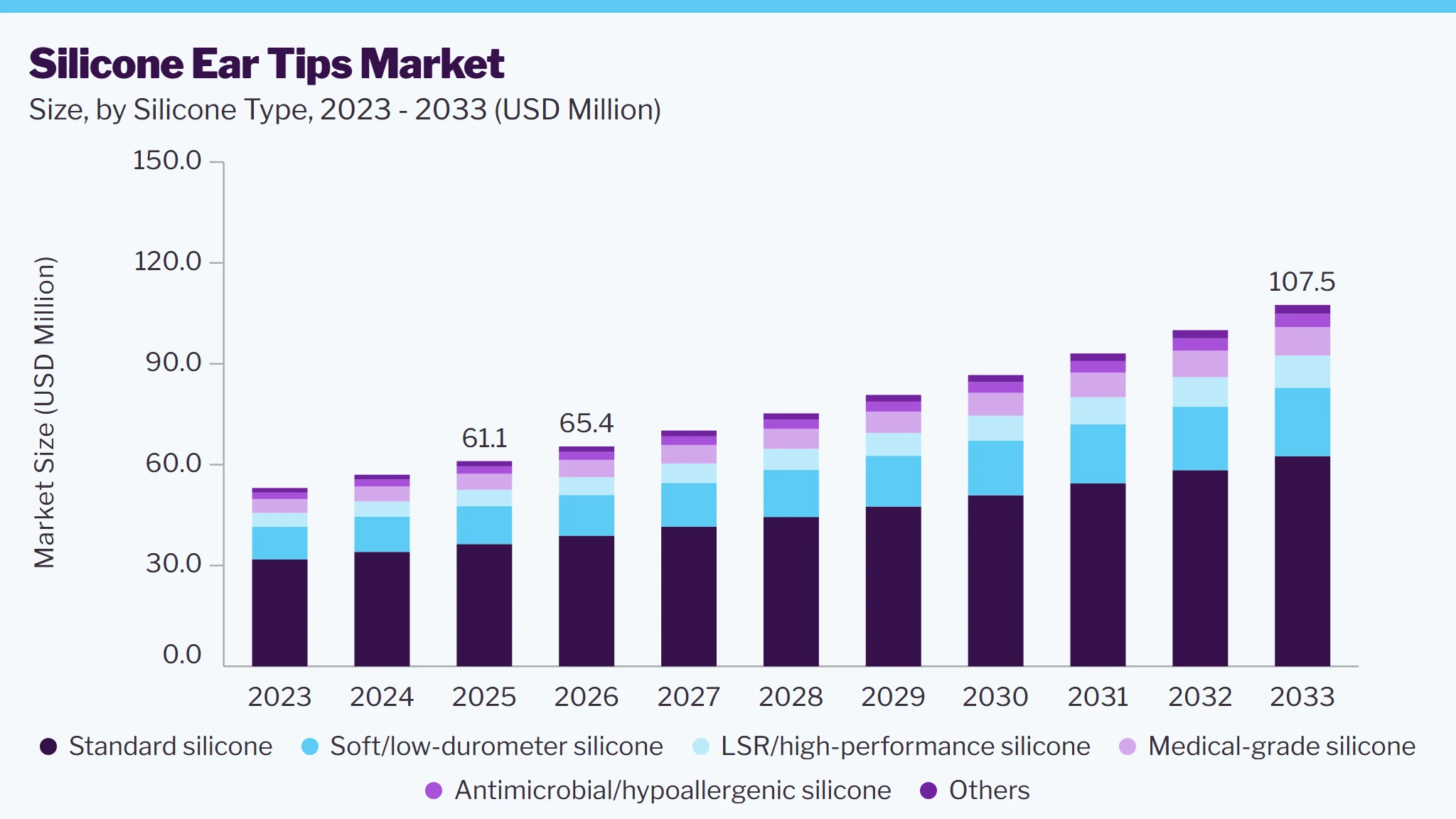
The global silicone ear tips market size was valued at USD 61.1 million in 2025 and is projected to grow from USD 65.4 million in 2026 to USD 107.5 million by 2033, at a CAGR of 7.3% from 2026 to 2033. Asia Pacific dominated the market, accounting for a revenue share of 56.1% in 2025. The industry is driven by rising demand for true wireless stereo (TWS) earbuds, in-ear headphones, and noise-canceling audio devices. Increasing consumer preference for comfortable, durable, reusable, and easy-to-clean accessories supports adoption. Growing usage of fitness audio and replacement demand for worn or damaged ear tips further contribute to market growth.
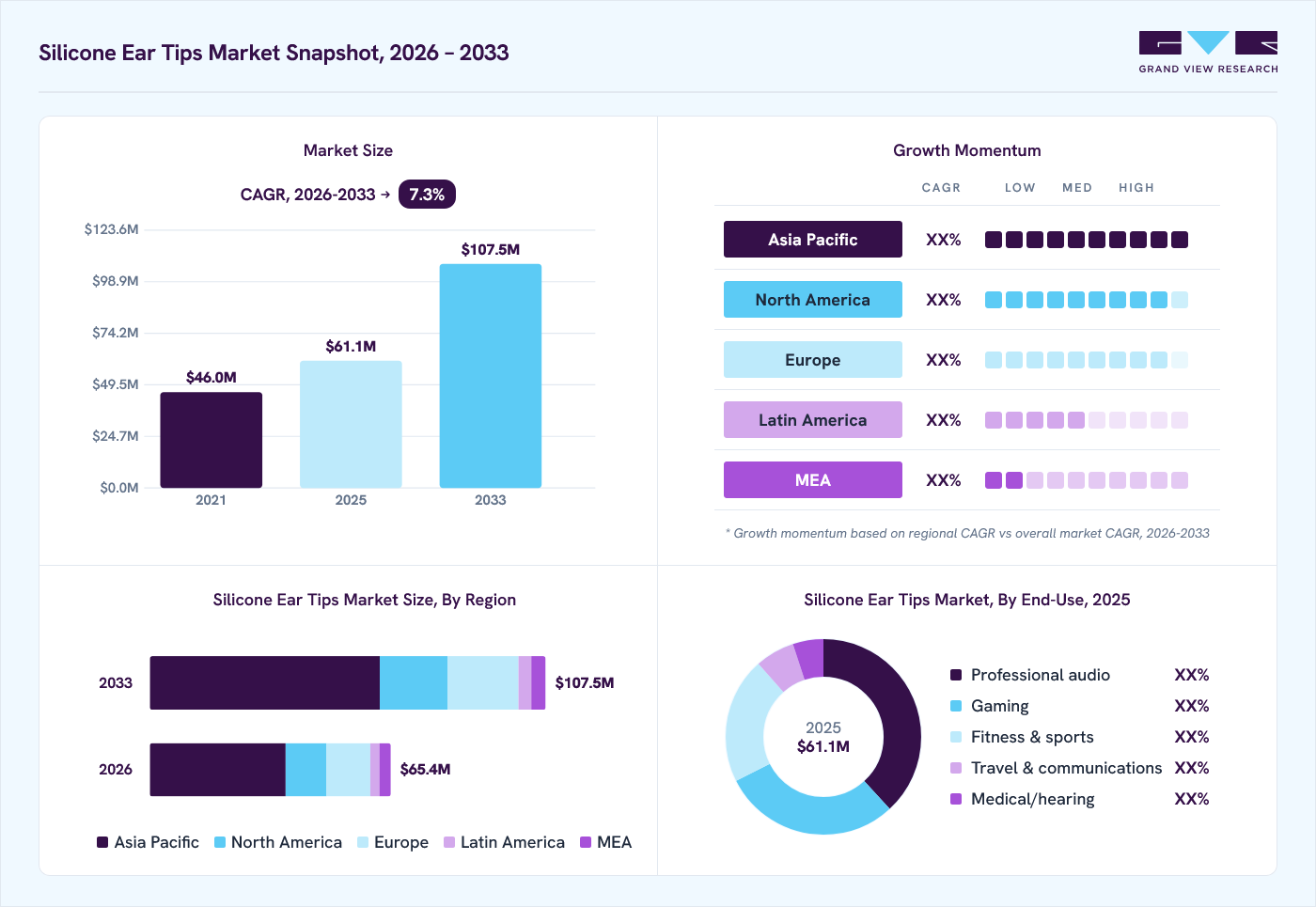 Source: Grand View Research, IR Documents, Primary Interviews, Paid DatabasesTo learn more about this report,
 Download Free Sample Report
 Key Market Trends & Insights
- By silicone type: The standard silicone dominated with 59.6% market share in 2025.
- By end use: The gaming segment is expected to grow at an 8.8% CAGR in revenue from 2026 to 2033.
Regional Highlights
- Largest regional market: Asia Pacific (56.1% revenue share, 2025)
- By country: China held the largest market share in 2025
Market Size & Forecast
- Market Size in 2025: USD 61.1 Million
- Estimated market size in 2026: USD 65.4 Million
- Projected Market Size by 2033: USD 107.5 Million
- CAGR (2026 - 2033): 7.3%
Three ways to get this report
Buy it, customize it, or ask a question.Ask an Analyst
Analyst response in 1 business day
- AccessReport author, directly
- Reply timeWithin 1 working day
- No sales callDirect answer only
- FormatEmail reply
- CostFree, no cost
Get the Full Report
What the study covers
- FormatsPDF · Excel · Dashboard
- Timeline2026–2033 annual, 2025 base
- Coverage20+ countries, 5 regions
- Companies10+ key players profiled
Customize the Report
20% free customization
- IncludeCountries, segments, points
- TailorTo your product definition
- ExtendDeeper competitor detail
- OrA fully bespoke study
- Turnaround5–10 working days
The silicone ear tips market is shifting toward ergonomic designs that improve comfort, acoustic sealing, and stability during prolonged use. Manufacturers are developing softer silicone formulations, optimized flange geometries, and model-specific fittings to address differences in ear canal anatomy. These improvements support better bass reproduction and passive noise isolation while reducing discomfort during extended listening. Premium audio devices are also encouraging greater material and design differentiation, making fit performance an important consideration in ear tip development.
 To learn more about this report, Download Free Sample Report
 Market Dynamics
The growing adoption of true wireless stereo (TWS) earbuds, wired earphones, and in-ear monitors is increasing demand for silicone ear tips. These components improve wearing comfort, maintain a secure fit, and support sound quality by limiting sound leakage. As consumers spend more time using personal audio devices, manufacturers are focusing on ear tips that provide better fit, durability, and comfort during extended listening sessions.
The expansion of music streaming, mobile gaming, video consumption, and remote communication is further supporting demand for in-ear audio products. Silicone ear tips are widely used in these devices because they are flexible, reusable, and easy to clean. The increasing use of earbuds during travel, exercise, and daily activities also drives demand for different sizes and replacement products, supporting sales through original equipment manufacturers and aftermarket channels.
The silicone ear tips market faces pricing pressure from low-cost manufacturers and unbranded replacement products. Basic silicone tips can be difficult to differentiate when consumers prioritize affordability over material quality or acoustic performance. Compatibility requirements further complicate production because earbud models differ in nozzle dimensions, attachment mechanisms, and tip geometry. Manufacturers must manage multiple sizes, molds, and product variants, increasing inventory and tooling costs. These factors can limit margins, particularly for suppliers competing in high-volume, price-sensitive aftermarket segments.
The after market presents opportunities for manufacturers to develop silicone ear tips compatible with specific earbud models, premium in-ear monitors, and specialized listening requirements. Products featuring improved acoustic sealing, softer materials, enhanced retention, and precise fit can differentiate suppliers beyond price competition. Direct-to-consumer sales and online marketplaces also enable smaller manufacturers to reach users seeking replacement accessories. Additional opportunities exist in customized sizing, multi-pack formats, and specialized formulations for users requiring greater comfort during prolonged listening.
Market Concentration & Characteristics
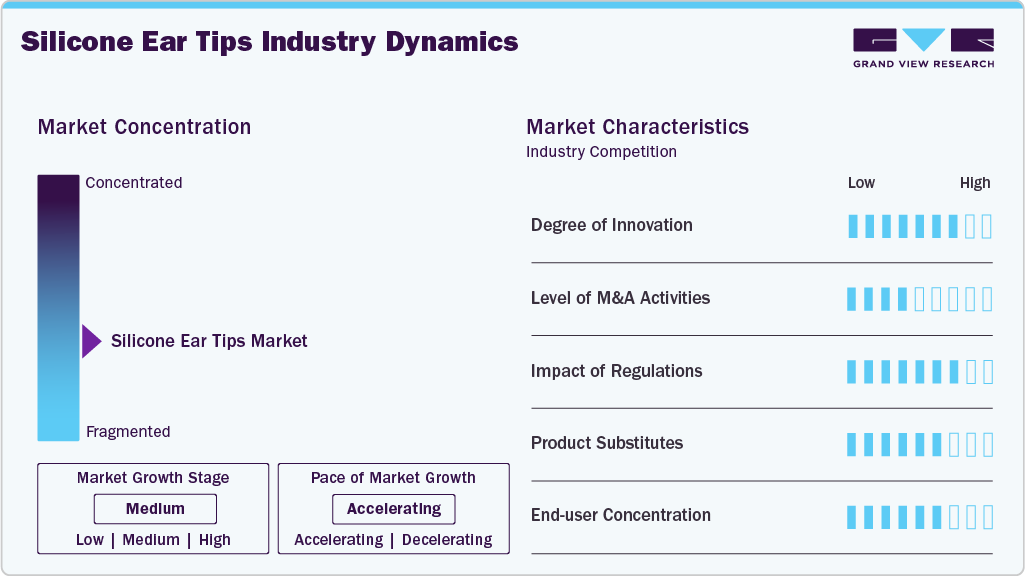
The market growth stage is medium, and growth is accelerating. The market exhibits fragmentation, with key players dominating the industry landscape. Major companies such as SpinFit, AZLA, final Inc., JVC, DUNU, Moondrop, Kiwi Ears, and others play a significant role in shaping the market dynamics. These leading players often drive innovation in the market by introducing new products, technologies, and materials to meet the industry's evolving demands.
Innovation in the silicone ear tips market is primarily focused on improving fit, acoustic performance, material consistency, and compatibility with different earphone designs. Manufacturers are refining flange geometry, silicone softness, surface texture, and nozzle attachment structures to improve retention and reduce sound leakage. Premium audio products are also supporting demand for model-specific tips and advanced ergonomic designs. However, innovation remains largely incremental, as suppliers compete through product differentiation, manufacturing precision, and user comfort rather than fundamental changes in material technology.
 To learn more about this report, Download Free Sample Report
 Regulatory requirements influence silicone ear tip manufacturing through chemical safety, material quality, and consumer product compliance. In the European Union, REACH governs the management and restriction of hazardous chemical substances, requiring suppliers to assess relevant material compositions and supply-chain risks. For products marketed as medical or hearing-care accessories, additional biocompatibility assessment may apply depending on intended use and regulatory classification. These requirements increase testing, documentation, and supplier qualification costs, while encouraging consistent material sourcing and traceability.
Analyst Perspective
The silicone ear tips market is expected to transition from volume-led growth toward value-driven differentiation over the next 5-10 years, supported by expanding TWS earbud adoption, premium audio devices, gaming, professional audio, and hearing-assistance applications. Standard silicone will retain a strong position in cost-sensitive segments, while soft, low-durometer, precision-molded LSR, and application-specific designs will create opportunities for higher-value products. Customer requirements will increasingly emphasize personalized fit, acoustic sealing, long-wear comfort, secure retention, durability, and compatibility across device models. Material consistency, manufacturing precision, proprietary designs, intellectual property, and strong OEM relationships will differentiate leading suppliers.
Silicone Type Insights
The standard silicone dominated the market across silicone type segmentation in terms of revenue, accounting for 59.6% market share in 2025, and is forecast to grow at a 7.0% CAGR from 2026 to 2033. Standard silicone ear tips benefit from their suitability for mass-market audio devices, where manufacturers prioritize affordability, comfort, and consistent production quality. Their relatively straightforward molding processes support high-volume manufacturing for entry-level and mid-range earbuds, wired earphones, and replacement accessories. Standardized sizes and familiar attachment designs also simplify product integration and aftermarket distribution. As consumers replace worn tips or seek improved fit for existing devices, standard silicone remains commercially attractive because it balances functional performance with accessible pricing and broad application potential.
The LSR/high-performance silicone segment is expected to expand at an 8.7% CAGR in the silicone ear tips market over the forecast period. Liquid silicone rubber (LSR) and high-performance silicone grades offer opportunities in premium earphones requiring precise geometry, consistent elasticity, and reliable performance during prolonged use. Their suitability for precision molding supports the production of complex tip profiles and integrated retention features. This is relevant to audio products where fit stability influences passive noise isolation and sound reproduction. Gaming-focused in-ear products also demonstrate the use of LSR in ear tips and ear fins to improve comfort and retention. These performance requirements support demand for specialized silicone formulations.
End Use Insights
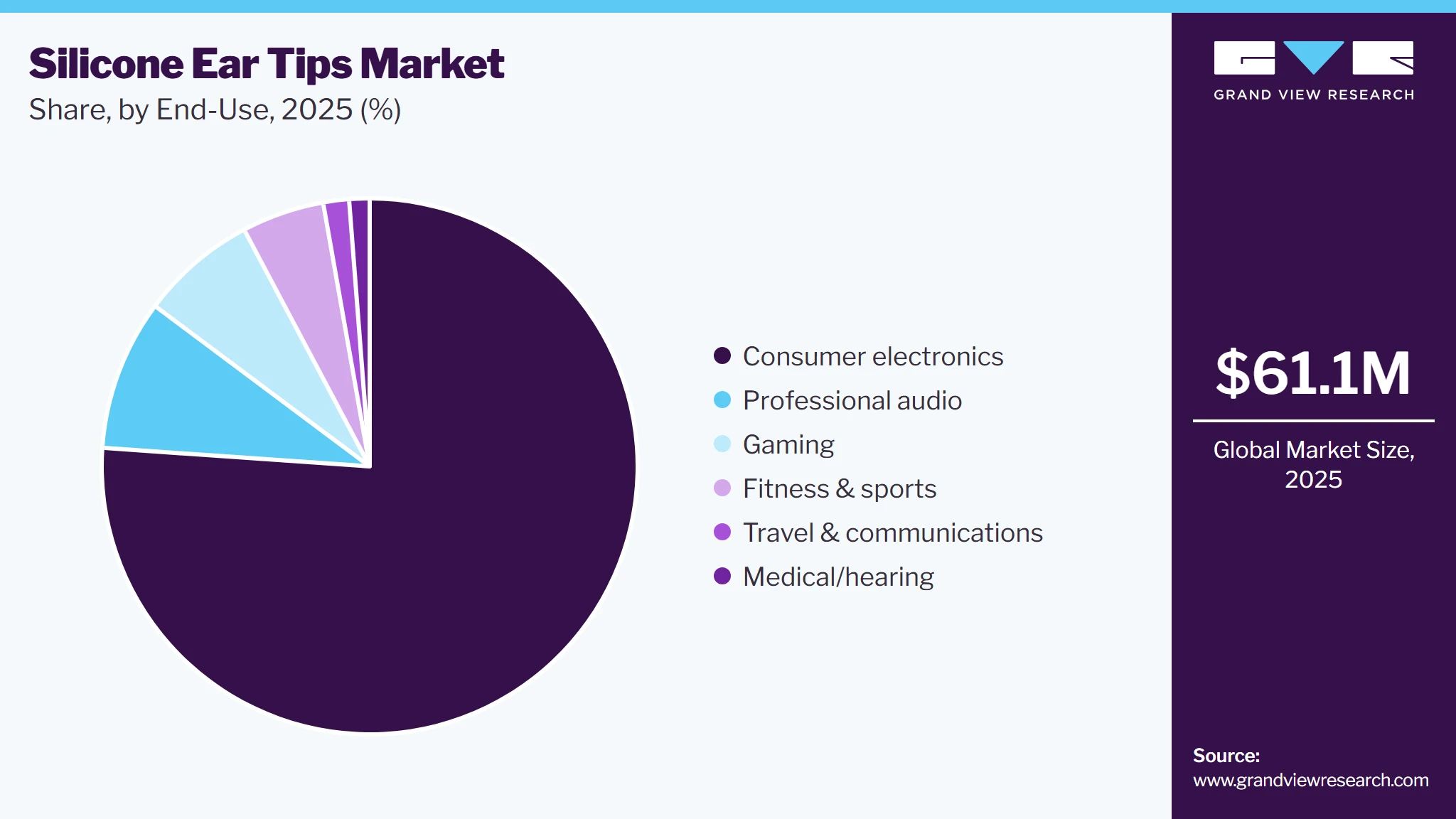
The consumer electronics segment led the market by end use, accounting for 76.1% of revenue in 2025, and is projected to grow at a 7.2% CAGR from 2026 to 2033. Consumer electronics demand is supported by the integration of in-ear audio devices into everyday communication, entertainment, and mobile computing. Silicone ear tips remain important for compatible earbuds because correct sizing helps maintain comfort, reduce sound leakage, and support effective noise cancellation.
 To learn more about this report, Download Free Sample Report
 The gaming segment is expected to grow at the fastest CAGR of 8.8% over the forecast period. Gaming creates a distinct demand for silicone ear tips that remain secure during prolonged sessions and frequent head movements. In-ear gaming devices must deliver clear positional audio, consistent sound isolation, and comfortable wear without the bulk of over-ear headsets. Silicone tips with retention fins, ergonomic angles, and multiple sizing options can help maintain a stable fit during competitive and mobile gaming. Multiplatform gaming also supports demand across smartphones, consoles, and PCs. These requirements create opportunities for specialized tip designs that combine comfort, acoustic consistency, and secure positioning.
Regional Insights
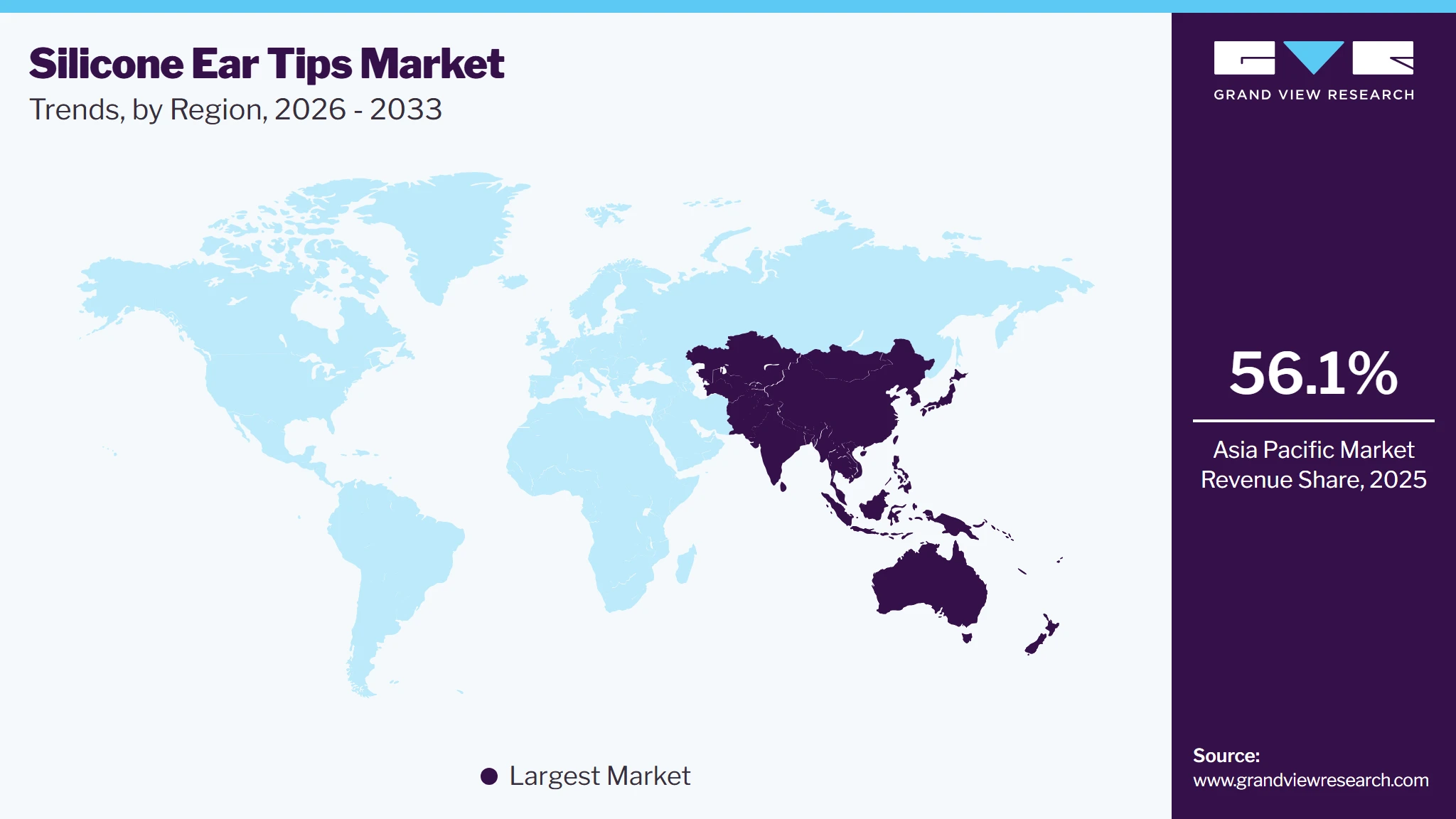
The Asia Pacific silicone ear tips industry held the largest revenue share of 56.1% in 2025. The region is expected to grow at a CAGR of 7.8% over the forecast period. Across Asia Pacific, silicone ear-tip demand benefits from the region's dual role as a major consumer-electronics production base and a large market for personal audio. Local OEM/ODM networks enable suppliers to integrate molded components near earbud assembly, manage tooling costs and respond quickly to model refreshes. Demand spans affordable earbuds sold through online channels as well as premium noise-canceling and gaming devices. High production volumes support standard tips, while product differentiation creates space for precision-molded variants and multipacks. In September 2025, OPPO India placed its Enco Buds 3 Pro on sale, targeting multitaskers, gamers and audio consumers with long battery life and IP55 resistance. The launch reinforced competition in India's affordable true wireless stereo segment, an important demand category for cost-effective earbud components.
 To learn more about this report, Download Free Sample Report
 The silicone ear tips industry in China is shaped by intensive domestic earbud development, frequent product refreshes and competition across premium, mid-range and entry-level categories. Brands increasingly bundle advanced noise cancellation, high-resolution audio and AI-linked functions, which raises expectations for stable acoustic sealing without sacrificing long-term comfort. Domestic electronics and molding supply chains allow fast iteration of tip geometry and cost-efficient production. This supports both original-equipment orders and a broad aftermarket for model-specific silicone tips in different sizes. In November 2025, Huawei opened pre-orders for FreeBuds Pro 5 in China, featuring four sizes of silicone ear tips. The design drew on analysis of more than 10,000 ear samples and validation across more than 1,000 earbud models, underscoring the role of fit engineering in premium audio products.
North America Silicone Ear Tips Market Trends
The silicone ear tips industry in North America benefits from a mature premium personal-audio market, where earbuds are widely used for commuting, remote work, fitness, travel and entertainment. Active noise cancellation relies partly on an effective ear-canal seal, keeping tip fit and sizing commercially relevant as audio processing advances. Multi-size packs accommodate differences in ear anatomy, while replacement purchases address wear, loss and hygiene needs. Established online retail and branded accessory channels provide practical routes for silicone ear tips to reach premium-device owners and aftermarket buyers.
U.S. Silicone Ear Tips Market Trends
The silicone ear tips industry in the U.S. extends beyond entertainment into specialty hearing enhancement, industrial work, outdoor recreation and shooting sports. These applications require tips to balance secure retention and comfort with the intended level of noise attenuation or environmental awareness. Silicone remains commercially relevant because it is reusable and can be cleaned between uses. Multi-material kits that combine silicone and foam allow users to adjust fit and performance for different tasks, widening demand beyond conventional replacement accessories for consumer earbuds. In March 2026, AXIL Brands announced the CRX, an in-ear hearing-protection and audio product with customizable fit. Its planned retail package included two pairs of silicone tips and three pairs of foam tips, extending tip applications into fitness, outdoor work and hearing-enhancement use cases.
Europe Silicone Ear Tips Market Trends
The silicone ear tips industry in Europe is supported by consumers' focus on sound performance, comfort during extended wear and accessories that preserve device usability. Silicone tips fit replacement needs because they are washable, available in multiple sizes and straightforward to stock. A mix of premium wireless earbuds and USB-C wired earphones broadens the addressable product base. Model-specific nozzle designs make compatibility an important purchase criterion, while suppliers with consistent materials, labeling and traceable sourcing are better placed to serve organized retail and specialty audio channels.
Latin America Silicone Ear Tips Market Trends
The silicone ear tips industry in Latin America is likely to be concentrated in affordable TWS devices and value-oriented accessory purchases, where upfront price remains a key consideration. Earbuds with entry-level active noise cancellation and smartphone integration can attract consumers upgrading from wired earphones or replacing low-cost devices. Standard silicone tips offer a low-cost, reusable component and are practical for multi-size bundles. Regional distributors, mobile phone retailers, and e-commerce platforms can expand access to compatible replacement packs, particularly where official accessories are less readily available outside major urban markets. In August 2025, Samsung announced Galaxy Buds Core for Latin American markets, positioning the wireless earbuds as an accessible option with active noise cancellation, Galaxy AI features and an ergonomic design. The launch expanded the regional choice of feature-rich, lower-priced personal audio products.
Middle East and Africa Silicone Ear Tips Market Trends
The silicone ear tips industry in the Middle East and Africa is witnessing the purchasing patterns diverge between higher-spending Gulf markets and more price-sensitive African markets. Premium users value secure-fit earbuds for travel, commuting and fitness, while affordability and compatibility shape demand elsewhere. Silicone tips support this range because they are washable, reusable and supplied in multiple sizes. Dust, heat, sweat, and frequent daily use can increase the need for cleaning and replacement, creating opportunities for multi-pair packs and distribution through local electronics retailers. In February 2025, Sony Middle East and Africa launched the LinkBuds series at a Dubai fitness event, emphasizing secure fit, adjustable comfort and stability during active use. The product was promoted through a local fitness partnership and sold through the UAE online store and selected retailers, reinforcing regional promotion of fit-led in-ear audio.
Key Silicone Ear Tips Company Insights
Some of the key players operating in the market include SpinFit and AZLA
-
SpinFit has established a specialized position in the silicone ear tips market through its patented rotating-stem design, which supports improved fit, comfort, and ear-canal alignment. Its portfolio includes W1, OMNI, NEO, and SuperFine tips designed for different earphone configurations, including products compatible with Apple, Samsung, Sony, and Sennheiser devices. Cross-brand compatibility and specialized designs strengthen its aftermarket presence and differentiate the company from suppliers focused primarily on standard replacement tips.
-
AZLA differentiates itself through its extensive SednaEarfit portfolio, which includes MAX, Crystal, XELASTEC II, Mithryl, and other product families. Its range addresses varied requirements for softness, retention, acoustic sealing, and compatibility with TWS earbuds and conventional in-ear monitors. Model-specific products for AirPods Pro, Galaxy Buds, and Bose earbuds support premium aftermarket positioning. Multiple sizes, material options, and dedicated replacement products enable AZLA to compete through fit engineering rather than price alone.
DUNU and MOONDROP are some of the emerging participants in the silicone ear tips market.
-
DUNU is expanding its presence in the market by commercializing accessories developed alongside its in-ear monitors. Its S&S and Candy eartips are available separately, with multiple sizing options that address different fitting requirements. This approach creates additional revenue opportunities beyond complete earphone sales and enables consumers to upgrade existing devices. However, its visible standalone assortment remains narrower than those of dedicated ear-tip specialists, leaving room to expand compatibility and aftermarket distribution.
-
MOONDROP participates in the silicone ear tips market through accessories integrated into its broad in-ear monitor portfolio. Its products include conventional silicone tips and proprietary Spring Tips, often supplied in multiple sizes to accommodate different users. This product integration enables the company to develop tailored solutions that address earphone acoustics and ergonomics. Its established audio product ecosystem provides a foundation for expansion, although a broader standalone replacement-tip portfolio could improve its visibility and competitiveness within the specialist aftermarket.
Key Silicone Ear Tips Companies
The following key companies have been profiled for this study on the silicone ear tips market.
-
SpinFit
-
AZLA
-
final Inc.
-
JVC
-
DUNU
-
Moondrop
-
Kiwi Ears
-
Sennheiser
-
Shure
-
Etymotic Research
Company Categorization
Operating Strategies
Competitive Edge
Weakness
Mature Players: SpinFit, AZLA, final Inc., JVC, Sennheiser, Shure, Etymotic Research
- Expand silicone ear tip portfolios through multiple sizes, specialized geometries, material variations, and model-specific designs for wired earphones, TWS earbuds, and professional in-ear monitors.
- Strengthen aftermarket sales through direct online stores, audio retailers, replacement accessory channels, and compatibility with products from multiple audio device manufacturers.
- Invest in ergonomic engineering, acoustic sealing, material durability, and precision molding to address demand for comfortable extended wear, improved sound isolation, and reliable product fit.
- Established product portfolios and brand recognition support consumer confidence in fit, comfort, and acoustic performance.
- Specialized designs, including rotating-stem structures, multi-flange profiles, and proprietary silicone formulations, enable differentiation across consumer and professional audio applications.
- Established distribution networks, product compatibility knowledge, and relationships with audio consumers and professional users support aftermarket sales and recurring replacement demand.
- Competition from low-cost replacement tips and unbranded products creates pricing pressure, particularly in standard silicone categories.
- Compatibility differences across earphone nozzles, attachment mechanisms, and ear canal shapes increase product development, tooling, inventory, and quality-control requirements.
- Dependence on the installed base of compatible audio devices and limited standalone accessory revenue disclosure can constrain market expansion assessment and investment visibility.
Emerging Players: DUNU, MOONDROP, Kiwi Ears
- Expand standalone silicone ear tip offerings alongside in-ear monitors, including proprietary designs, multiple sizing options, and specialized profiles for different listening requirements.
- Increase aftermarket reach through e-commerce platforms, specialist audio retailers, international distributors, and cross-brand compatibility with third-party earphones.
- Develop differentiated tip geometries and material options that improve retention, comfort, acoustic sealing, and compatibility while leveraging existing audio product development capabilities.
- Integration with in-ear monitor development allows ear tip designs to be evaluated alongside acoustic tuning, nozzle geometry, and overall wearing comfort.
- Focused product portfolios and direct engagement with enthusiast audio communities support faster feedback on fit, sound characteristics, and product usability.
- Existing earphone portfolios and specialist retail networks provide opportunities to bundle accessories, cross-sell replacement tips, and build aftermarket recognition.
- Narrower standalone ear tip portfolios and lower visibility in the replacement accessory market can limit brand recognition beyond existing audio customers.
- Smaller product ranges and distribution networks may restrict access to broad consumer electronics channels and reduce economies of scale in manufacturing.
- Competition from established specialists and inexpensive generic alternatives creates pressure to demonstrate measurable improvements in fit, durability, and acoustic performance.
Recent Developments
-
In June 2026, AZLA launched the SednaEarfit max for AirPods Pro 3, made with 100% medical-grade silicone and offered in six sizes. Its integrated adapter, variable-thickness structure, and redesigned filter target improved fit, retention, comfort, and acoustic performance.
-
In October 2025, AZLA announced SednaEarfit mithryl, a hybrid ear tip combining premium liquid silicone rubber (LSR) with a surgical stainless-steel acoustic core. The design targets improved sound characteristics, reduced wearing pressure, secure fit, and durability, illustrating differentiation through material and structural engineering.
Silicone Ear Tips Market Report Scope
Report Attribute
Details
Market size in 2025
USD 61.1 million
Estimated market size in 2026
USD 65.4 million
Projected market size by 2033
USD 107.5 million
Growth rate
CAGR of 7.3% from 2026 to 2033
Historical data
2021 - 2025
Forecast period
2026 - 2033
Quantitative units
Revenue in USD million, volume in Kilotons, and CAGR from 2026 to 2033
Report coverage
Revenue & volume forecast, competitive landscape, growth factors, and trends
Segments covered
Silicone type, end use, region
Regional scope
North America; Europe; Asia Pacific; Latin America; Middle East & Africa
Country Scope
U.S.; Canada; Mexico; Germany; UK; France; Italy; Spain; China; India; Japan; South Korea; Australia; Brazil; Argentina; Saudi Arabia; UAE; South Africa
Key companies profiled
SpinFit; AZLA; final Inc.; JVC; DUNU; Moondrop; Kiwi Ears; Sennheiser; Shure; Etymotic Research
Customization scope
Free report customization (equivalent to up to 8 analyst working days) with purchase. Addition or alteration to country, regional & segment scope
Pricing and purchase options
Avail customized purchase options to meet your exact research needs. Explore purchase options
Global Silicone Ear Tips Market Report Segmentation
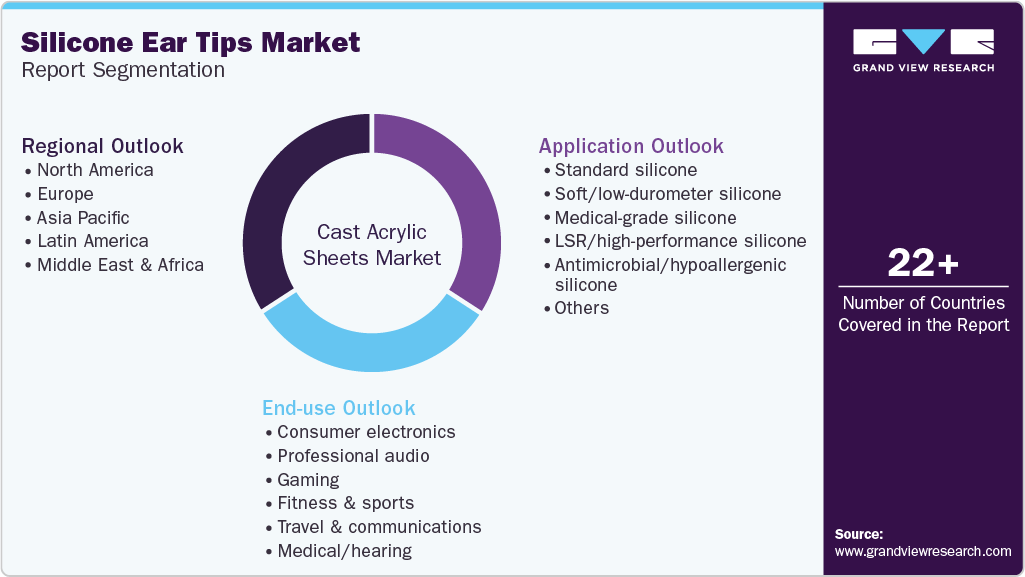
This report forecasts revenue growth at the global, regional, and country levels and provides an analysis of the latest industry trends across sub-segments from 2021 to 2033. For this study, Grand View Research has segmented the global silicone ear tips market report based on silicone type, end use, and region:
 To learn more about this report, Download Free Sample Report
 -
Silicone Type Outlook (Volume, Kilotons; Revenue, USD Million, 2021 - 2033)
-
Standard silicone
-
Soft/low-durometer silicone
-
Medical-grade silicone
-
LSR/high-performance silicone
-
Antimicrobial/hypoallergenic silicone
-
Others
-
-
End Use Outlook (Volume, Kilotons; Revenue, USD Million, 2021 - 2033)
-
Consumer electronics
-
Professional audio
-
Gaming
-
Fitness & sports
-
Travel & communications
-
Medical/hearing
-
-
Regional Outlook (Volume, Kilotons; Revenue, USD Million, 2021 - 2033)
-
North America
-
U.S.
-
Canada
-
Mexico
-
-
Europe
-
Germany
-
UK
-
France
-
Italy
-
Spain
-
-
Asia Pacific
-
China
-
India
-
Japan
-
South Korea
-
Australia
-
-
Latin America
-
Brazil
-
Argentina
-
-
Middle East & Africa
-
Saudi Arabia
-
UAE
-
South Africa
-
-
Research Methodology
The silicone ear tips marketfigures in this report are based on a proven research process that combines executive interviews with secondary research from proprietary databases, company filings, and recognized regulatory and institutional sources. Market size is built through value-chain sizing-reconciling supply-side and demand-side estimates-and triangulated with bottom-up and top-down approaches. Every estimate passes multiple levels of expert validation before publication, with eachsilicone ear tipssegment quantified using the revenue-capture definitions in the table below.
Segment Definition
Segment - Silicone Type
Revenue capture definition
Standard silicone
Revenue is captured through standard silicone ear tips manufactured for wired earphones, true wireless stereo (TWS) earbuds, and other in-ear audio devices. Products include single-flange and multi-size replacement tips supplied with audio devices or sold through aftermarket channels. Manufacturers evaluate silicone based on flexibility, tear resistance, dimensional consistency, surface finish, and molding quality. Broad device compatibility, economical production, and recurring replacement demand support segment development across mass-market and mid-range audio products.
Soft/low-durometer silicone
Revenue is generated through softer, lower-durometer silicone ear tips designed to improve comfort, reduce pressure within the ear canal, and maintain a secure acoustic seal during extended listening. Manufacturers assess softness, elasticity, compression recovery, skin-contact comfort, tear resistance, and fit retention. These products are particularly relevant for users experiencing discomfort from firmer materials or wearing earphones for prolonged periods. Growing demand for comfortable TWS earbuds, premium in-ear monitors, and extended-use audio accessories supports adoption of softer silicone formulations.
Medical-grade silicone
Revenue is captured through ear tips manufactured using silicone grades selected for controlled material quality and suitability for specified skin-contact applications. Products may serve specialized hearing devices, selected clinical audio equipment, and applications requiring documented material properties. Manufacturers evaluate biocompatibility evidence where applicable, chemical composition, extractables, surface quality, durability, and manufacturing consistency. Regulatory requirements depend on the intended use and product classification. Demand is influenced by hearing-care applications, material safety expectations, and the need for reliable, reusable components in specialized ear-worn devices.
LSR/high-performance silicone
Revenue is generated through liquid silicone rubber (LSR) and other high-performance silicone ear tips produced using precision molding processes. These products support complex geometries, thin-walled structures, consistent dimensions, and controlled elasticity for premium earbuds and in-ear monitors. Manufacturers assess tensile strength, tear resistance, compression recovery, dimensional accuracy, surface finish, and production repeatability. Precision manufacturing can improve fit consistency and reduce component variation. Demand is supported by premium audio devices, specialized ear-tip designs, and requirements for reliable acoustic sealing, durability, and consistent performance across production volumes.
Antimicrobial/hypoallergenic silicone
Revenue is captured through silicone ear tips formulated or treated to address specific hygiene, skin-tolerance, or microbial-control requirements. Products may incorporate validated antimicrobial technologies or material formulations designed to reduce exposure to selected potential irritants. Manufacturers assess skin compatibility, additive stability, cleaning resistance, durability, and the effectiveness of any substantiated antimicrobial claims. These ear tips can target frequent-use earbuds, shared audio equipment, and specialized hearing accessories. Demand depends on consumer hygiene preferences, evidence supporting product claims, and the ability to maintain comfort and material performance during repeated use.
Others
Revenue is generated through specialized silicone ear tips featuring customized geometries, reinforced structures, textured surfaces, multi-flange configurations, or proprietary material formulations. These products address specific requirements for ear-canal fit, retention, sound isolation, and compatibility with different earphone nozzle designs. Manufacturers evaluate elasticity, dimensional stability, acoustic sealing, surface properties, and compatibility with intended devices. Customization and specialized molding can support premium pricing, although tooling requirements and limited compatibility may increase costs. Continued product differentiation across audio categories creates opportunities for niche and application-specific silicone ear-tip designs.
Segment - End Use
Revenue capture definition
Consumer electronics
Revenue is captured through silicone ear tips supplied with TWS earbuds, wired earphones, and other consumer audio devices, as well as replacement tips sold through retail and online channels. Demand is influenced by earbud shipments, installed device bases, product upgrades, and replacement frequency. Manufacturers prioritize comfort, acoustic sealing, fit retention, durability, and compatibility with different earphone models. Standard and soft silicone products serve mass-market demand, while precision-molded and proprietary designs target premium devices. Growth in personal audio usage and demand for improved listening comfort support segment development.
Professional audio
Revenue is generated through silicone ear tips used in in-ear monitors, stage monitoring systems, broadcast equipment, and professional audio accessories. Musicians, sound engineers, and production personnel require reliable fit, sound isolation, and stable positioning during extended sessions or physical movement. Manufacturers assess acoustic sealing, retention, dimensional consistency, durability, and compatibility with monitor nozzles. Multiple sizes and specialized geometries help accommodate differences in ear-canal shape. Demand is supported by live performances, studio production, touring activities, and the use of in-ear monitoring systems in professional sound environments.
Gaming
Revenue is captured through silicone ear tips used in gaming earphones, gaming-oriented TWS devices, and wired in-ear audio accessories. Users prioritize stable positioning, comfort during extended sessions, passive noise isolation, and consistent audio transmission for voice communication and gameplay. Manufacturers evaluate fit retention, pressure distribution, acoustic sealing, durability, and compatibility with gaming headsets and earphones. Soft silicone and specialized tip geometries can address prolonged wear and movement-related discomfort. Demand is influenced by gaming participation, mobile gaming, competitive gaming, and the adoption of compact in-ear audio devices for personal and multiplayer use.
Fitness & sports
Revenue is generated through silicone ear tips designed for earphones used during running, gym workouts, cycling, and other physical activities. Products prioritize secure retention, sweat resistance, flexibility, and comfort during repetitive movement. Manufacturers assess tear resistance, material stability, fit consistency, and compatibility with sports-oriented earbuds. Specialized shapes and retention features can help reduce slippage, while suitable surface designs may improve positioning during exercise. Demand is supported by wearable audio adoption, fitness participation, and increasing use of wireless earbuds for training and outdoor activities. Replacements also contribute to revenue as tips become worn or damaged.
Travel & communications
Revenue is captured through silicone ear tips used in earphones for commuting, air travel, mobile calls, remote work, and everyday communication. Products support a comfortable fit, passive noise reduction, clear audio transmission, and extended wear across changing environments. Manufacturers assess sealing performance, pressure distribution, durability, and compatibility with communication devices and consumer earphones. Multiple tip sizes can improve fit across users, while softer formulations may support prolonged use. Demand is influenced by mobile communication, hybrid work, frequent travel, and the use of in-ear devices for calls, entertainment, and voice-based applications.
Medical/hearing
Revenue is generated through silicone ear tips and related ear-contact components used in hearing aids, personal sound amplification products, selected clinical audio devices, and hearing-assistance accessories. Products must meet application-specific requirements for fit, comfort, retention, cleaning, and material compatibility. Manufacturers assess dimensional accuracy, skin-contact suitability, durability, and compatibility with the intended device. Some applications require documented biocompatibility testing or additional regulatory qualification, depending on intended use and jurisdiction. Demand is influenced by hearing-care needs, device replacement cycles, and the adoption of compact hearing technologies. Specialized designs can address individual fitting requirements and prolonged daily wear.
Estimation Model
Layer Name
Key Question
Description
Top-Down Silicone Ear Tips Demand Assessment Layer
What defines overall market demand?
Establishes global demand for silicone ear tips across consumer electronics, professional audio, gaming, fitness, travel, communications, and medical or hearing applications. The layer assesses earphone and earbud shipments, installed device bases, replacement frequency, silicone consumption, product specifications, and demand for original-equipment and aftermarket ear tips.
End Use Demand Validation Layer
Where is demand concentrated?
Maps silicone ear tips demand across consumer electronics, professional audio, gaming, fitness & sports, travel & communications, and medical/hearing applications. Demand is validated through audio-device adoption, user preferences, comfort and fit requirements, acoustic performance, product replacement cycles, manufacturer specifications, and distribution-channel activity.
Consumption-to-Revenue Conversion Layer
How is demand monetized?
Converts silicone ear tips consumption into market revenue based on silicone type, material grade, product design, manufacturing process, unit volumes, average selling prices, and distribution margins. The analysis distinguishes standard, soft, medical-grade, LSR/high-performance, antimicrobial, and other specialized silicone ear tips, while accounting for premiums associated with precision molding, proprietary designs, enhanced comfort, and specialized applications.
Regional Demand Verification Layer
Where is demand validated?
Validates demand across North America, Europe, Asia Pacific, Latin America, and Middle East & Africa. The analysis considers earphone and TWS earbud adoption, consumer spending, audio-device manufacturing, aftermarket availability, e-commerce penetration, regional production capabilities, import dependence, distribution networks, and demand for premium and replacement silicone ear tips.
Delivered Customizations
This report has been delivered with the following In-depth customizations
Client Request
Customization Delivered
Value Adds
Regional Segmentation
Assessed the silicone ear tips market across North America, the U.S., Asia Pacific, China, Europe, Latin America, and the Middle East & Africa, considering audio device adoption, regional manufacturing capabilities, consumer preferences, distribution networks, and recent industry developments.
Identifies regional demand differences, priority markets, manufacturing hubs, and potential expansion opportunities for silicone ear tip suppliers.
Competitive Benchmarking
Benchmarked mature players, including SpinFit, AZLA, final Inc., JVC, Sennheiser, Shure, and Etymotic Research, against emerging players, including DUNU, MOONDROP, and Kiwi Ears. Assessed product portfolios, specialized designs, geographical presence, aftermarket reach, and competitive positioning.
Clarifies competitive strengths, product differentiation, portfolio gaps, and potential areas for expansion in branded and replacement ear tip markets.
Trade Assessment
Assessed the role of international sourcing, contract manufacturing, OEM supply, import dependence, distribution partnerships, and cross-border e-commerce in the silicone ear tips supply chain. Considered the importance of customs classification, shipping costs, tariffs, and product compliance requirements.
Helps identify sourcing opportunities, supply chain dependencies, landed-cost considerations, and potential risks affecting international market access.
About the Author(s)
Plastics, Polymers & Resins Research Team
Bulk Chemicals · Plastics, Polymers & ResinsThis report was authored by the plastics, polymers & resins research team at Grand View Research - comprising two research analysts, one senior research analyst, and one industry expert - with specialized expertise in the plastics, polymers & resins segment of the bulk chemicals industry. All findings are based on proprietary bulk chemicals databases, executive interviews, and regulatory analysis, subject to internal peer review prior to publication.
Last Updated:
Speak to Analyst

Customize this report to your needs - add regions, segments, or data points, with 20% free customization.
Or view our licence options:


ISO 9001:2015 & 27001:2022 Certified
We are GDPR and CCPA compliant! Your transaction & personal information is safe and secure. For more details, please read our privacy policy.


