
- Home
- »
- Plastics, Polymers & Resins
- »
-
Silicone Sealants Market Size And Share Report, 2026-2033GVR Report cover
![Silicone Sealants Market (2026 - 2033)Report]()
Silicone Sealants Market (2026 - 2033)
Size, Share & Trends Analysis Report By Technology, By Application (Construction, Insulating Glass, Automotive, Others), By Region (North America, Europe, APAC, Latin America, MEA), And Segment Forecasts
Market Size, 2025
$4.5BMarket Estimate, 2026
$4.8BMarket Forecast, 2033
$7.3BCAGR, 2026–2033
6.2%Silicone Sealants Market Summary
The global silicone sealants market size was valued at USD 4.5 billion in 2025 and is projected to grow from USD 4.8 billion in 2026 to USD 7.3 billion by 2033, growing at a CAGR of 6.2% from 2026 to 2033. Asia Pacific dominated the market, accounting for a revenue share of 52.1% in 2025. This growth is attributed to the expanding construction industry, significantly boosting demand for durable, weather-resistant sealants in various applications, including windows and doors.

Key Market Trends & Insights
- By technology: Room temperature vulcanizing (RTV) segment dominated the market, with a revenue share of 64.8% in 2025.
- By application: Construction segment held the largest market share of 60.7% in 2025.
Regional Highlights
- Largest regional market: Asia Pacific (52.1% revenue share, 2025)
- By country: China held the largest market share in 2025.
Market Size & Forecast
- Market size in 2025: USD 4.5 Billion
- Estimated market size in 2026: USD 4.8 Billion
- Projected market size by 2033: USD 7.3 Billion
- CAGR (2026-2033): 6.2%
This growth is attributed to the expanding construction industry, significantly boosting demand for durable, weather-resistant sealants in various applications, including windows and doors. The versatility of silicone sealants in the automotive and electronics sectors contributes to market expansion. Moreover, technological advancements have led to high-performance formulations that meet evolving industry needs while increasing awareness of sustainable practices, further enhancing their appeal.Silicone sealants are widely used in construction for applications such as expanding joints, panel sealing, and protection against environmental factors. These materials, which are adhesive and typically found in a liquid or gel-like form, require curing to achieve optimal bonding strength. Unlike conventional adhesives, silicone maintains flexibility and integrity across extreme temperatures and offers strong resistance to moisture, corrosion, and various chemicals.

Moreover, the increasing environmental concerns associated with synthetic sealants and adhesives are significantly influencing the growth of the silicone sealant market. This has led to a shift towards more sustainable options, with manufacturers focusing on creating bio-based silicone sealant alternatives. These eco-friendly sealants possess excellent mechanical and chemical properties and serve many applications while being environmentally safe.
Silicone rubber sealants are particularly favored in HVAC systems due to their strength, ability to absorb shrinkage and cracks in vehicles, and effectiveness in maintaining interior cleanliness and thermal insulation. Advanced HVAC systems are implemented in residential and commercial buildings to ensure optimal indoor air quality. Consequently, growth in construction activities is expected to drive demand for HVAC systems, further boosting the industry’s expansion.
Market Dynamics
The silicone sealants market is experiencing steady growth, driven by increasing construction activity, expanding infrastructure development, and rising demand from the automotive, electronics, and industrial manufacturing sectors. Stringent building performance standards and the growing preference for durable, weather-resistant, and energy-efficient sealing materials are supporting product adoption across residential and commercial applications. Technological advancements in low-VOC, high-performance, and specialty silicone formulations are further strengthening market opportunities.
Rapid growth in residential, commercial, and industrial construction activities is supporting the demand for silicone sealants across global markets. These sealants are widely used for glazing, façade systems, expansion joints, sanitary applications, roofing, and weatherproofing due to their excellent adhesion, flexibility, UV resistance, and long-term durability. Increasing investments in urban infrastructure, green buildings, and renovation projects are further expanding product adoption across both new construction and maintenance applications.
More stringent building performance requirements related to energy efficiency, moisture protection, and structural durability are encouraging the use of high-performance sealing materials. Silicone sealants provide reliable performance under varying environmental conditions while reducing maintenance requirements over the service life of buildings. Continuous product innovation, including low-VOC and specialty silicone formulations, is further strengthening their use in modern construction and infrastructure projects.
Fluctuations in the prices of key silicone raw materials, particularly siloxanes and silicone metal, present a significant challenge for the silicone sealants market. Variations in raw material availability, energy costs, and supply chain disruptions can increase manufacturing expenses and reduce pricing stability, making it difficult for producers to maintain consistent profit margins.
The impact is particularly evident in cost-sensitive construction and industrial applications, where higher product prices may encourage buyers to consider lower-cost alternative sealing materials. As a result, manufacturers often face pressure to optimize procurement strategies, improve production efficiency, and balance product performance with cost competitiveness.
The growing emphasis on energy-efficient buildings and sustainable construction practices is creating significant opportunities for the silicone sealants market. Increasing implementation of green building standards and stricter building performance regulations are driving demand for high-performance sealants that enhance air and water tightness, improve thermal insulation, and extend the service life of building envelopes.
Rising investments in smart buildings, infrastructure modernization, and renovation of aging commercial and residential structures are expanding the application scope of advanced silicone sealants. Manufacturers are also introducing low-VOC and environmentally compliant formulations to meet evolving regulatory requirements and sustainability objectives, creating new avenues for market growth across developed and emerging economies.
Analyst Perspective
The silicone sealants market is expected to maintain steady growth, supported by increasing construction and infrastructure investments, expanding automotive production, and rising demand for durable, weather-resistant sealing solutions across industrial applications. Market participants are prioritizing product innovation, including low-VOC and high-performance formulations, to address evolving regulatory requirements and sustainability objectives. Companies with strong manufacturing capabilities, diversified distribution networks, and application-specific product portfolios are expected to strengthen their competitive position as demand for advanced sealing technologies continues to expand across both developed and emerging markets.
Technology Insights
By technology, room temperature vulcanizing (RTV) segment held a dominant position, contributing 64.8% of total revenue in 2025 driven by the expanding construction industry's demand for resilient, weather-resistant sealants for applications such as sealing joints and weatherproofing buildings. In addition, RTV sealants are favored for their flexibility and ability to accommodate significant joint movement. The automotive sector's increasing need for lightweight and efficient materials also propels RTV sealant adoption. Further, environmental concerns also encourage the shift towards sustainable sealant solutions, boosting market demand for eco-friendly RTV products.
Thermoset or heat-cured silicone sealants are expected to grow at a CAGR of 6.6% over the forecast period attributed to the increasing demand for durable and high-performance materials in construction and automotive applications, as these sealants offer superior adhesion and resistance to extreme circumstances. In addition, advancements in formulation technology enhance their properties, making them suitable for a wider range of uses. Furthermore, the shift towards sustainable building practices and the need for environmentally friendly solutions further boost the adoption of thermoset silicone sealants across numerous industries.
Application Insights
Construction segment accounted for the largest revenue of 60.7% in 2025 attributed to the growing construction and real estate sectors increasing the demand for effective sealing solutions to prevent water leakage and air infiltration in buildings. In addition, the push for energy efficiency in buildings necessitates using silicone sealants to minimize air leaks, while their durability and weather resistance make them ideal for various environmental conditions.

Insulating glass is expected to grow significantly over the forecast period driven by the increasing demand for energy-efficient buildings, which has led to a rise in the use of insulating glass. This requires effective sealing solutions to enhance thermal performance and reduce energy loss. In addition, the construction industry's focus on sustainability and regulatory requirements for energy efficiency further propel this demand. The superior properties of silicone sealants, such as weather resistance and durability, make them ideal for insulating glass applications in both residential and commercial projects.
Regional Insights
Asia Pacific dominated the silicone sealants market with the highest revenue share of 52.1% in 2025 driven by rapid urbanization and significant investments in infrastructure development. In addition, countries such as China and India are experiencing a construction boom, which increases the demand for silicone sealants used in building applications. Furthermore, the region's expanding industrial base and rising disposable incomes lead to greater adoption of advanced materials. The need for durable and efficient sealing solutions further fuels market growth, positioning Asia Pacific as a key player in the global silicone sealants industry.

China Silicone Sealants Market Trends
China dominated the Asia Pacific silicone sealants market in 2025 attributed to the country's robust construction sector and increasing industrial activities. In addition, the government's focus on sustainable development and infrastructure projects has increased the demand for high-performance sealants that meet stringent environmental regulations. Furthermore, technological advancements enable manufacturers to produce innovative products catering to diverse applications, including automotive and electronics. This combination of regulatory support and technological progress is propelling the growth of silicone sealants in China.
Latin America Silicone Sealants Market Trends
The silicone sealants market in Latin America is expected to grow at a CAGR of 6.4% over the forecast period driven by the booming construction industry, fueled by urbanization and substantial infrastructure development projects in countries such as Brazil and Mexico. As these nations invest heavily in residential and commercial buildings, the demand for durable sealing solutions rises. In addition, increasing awareness of energy-efficient building practices enhances the adoption of silicone sealants. Furthermore, the region's industrialization and automotive production are also pivotal, as manufacturers seek advanced materials to meet global standards, thereby propelling market expansion across various sectors in Latin America.
North America Silicone Sealants Market Trends
The North America silicone sealants market is expected to grow significantly over the forecast period attributed to rising consumer awareness about safety and energy efficiency in construction. In addition, the increasing use of silicone sealants in insulating glass applications and their role in enhancing fire safety measures significantly contribute to market expansion. Furthermore, the growth of the electronics and consumer goods sectors drives demand for specialized silicone products, thus reinforcing North America's position as a prominent market for silicone sealants.
The silicone sealants market in the U.S. is expected to grow substantially due to the increasing demand for silicone sealants in the construction sector. The country's commitment to sustainable building practices and the growing awareness of fire safety measures drive the adoption of silicone sealants. The expanding electronics and consumer goods industries further contribute to the market's expansion as the demand for specialized silicone products rises.
Europe Silicone Sealants Market Trends
The Europe silicone sealants market is expected to experience significant growth driven by the automotive and medical equipment industries. The region's stringent emissions regulations push manufacturers to innovate and develop eco-friendly products. Furthermore, the rising demand for lightweight materials in automotive applications is further boosting the adoption of silicone sealants. As European countries continue to invest in advanced manufacturing technologies, the market for silicone sealants is expected to expand significantly over the coming years.
Key Silicone Sealants Company Insights
Some key silicone sealants market companies include Dow, Shin-Etsu Chemical Company, Wacker Chemie AG, and others. Companies in the global silicone sealants market adopt several strategies to gain a competitive advantage. Key approaches include product innovation and customization to meet industry needs and enhance performance characteristics such as adhesion and flexibility. Vertical integration is also a prominent strategy, allowing manufacturers to control raw material supply and mitigate price fluctuations.
-
Dow offers diverse silicone adhesives and sealants. The company manufactures over 7,000 products, including high-performance sealants in construction, automotive, electronics, and general industries. Dow's silicone solutions are renowned for their durability, weather resistance, and thermal stability, catering to various applications that require reliable sealing and bonding.
-
Shin-Etsu Chemical Company specializes in producing high-quality silicone products for various industries. The company manufactures various silicone sealants, adhesives, and coatings for construction, automotive, electronics, and healthcare applications. Shin-Etsu is recognized for its advanced silicone formulations that offer exceptional performance characteristics such as flexibility, durability, and resistance to environmental factors.
Key Silicone Sealants Companies:
The following key companies have been profiled for this study on the silicone sealants market.
-
Dow
-
Shin-Etsu Chemical Company
-
Wacker Chemie AG
-
3M
-
Tremco Incorporated
-
Bostik
-
Sika AG
-
Henkel Corporation
-
Huntsman International LLC
-
H.B. Fuller
-
Mapei
Competitive Benchmarking
Category
Operating Strategies
Competitive Edge
Weakness
Established Players (Dow, Shin-Etsu Chemical Company, Wacker Chemie AG, 3M, Sika AG, Henkel Corporation, H.B. Fuller, Mapei)
- Expand production capacity to strengthen regional supply.
- Invest in R&D to develop low-VOC, high-performance, and specialty silicone sealants.
- Strengthen distribution through global dealer and contractor networks.
- Focus on strategic acquisitions and partnerships to broaden product portfolios.
- Provide customized sealant solutions for construction, automotive, electronics, and industrial customers.
- Strong global brand recognition and customer loyalty.
- Extensive manufacturing footprint and supply chain capabilities.
- Broad product portfolio addressing multiple end-use industries.
- High investment capacity for innovation and regulatory compliance.
- Long-standing relationships with OEMs, contractors, and distributors.
- Operating and manufacturing costs higher than regional competitors.
- Exposure to fluctuations in silicone raw material prices.
- Slower commercialization due to complex approval and product qualification processes.
- Greater dependence on mature markets with relatively slower growth.
Emerging Players (Tremco Incorporated, Bostik, Huntsman International LLC)
- Focus on niche and application-specific silicone sealant solutions.
- Expand presence in high-growth construction and industrial markets.
- Develop value-added products tailored to regional customer requirements.
- Strengthen channel partnerships and technical support services.
- Increase investments in sustainable and energy-efficient product offerings.
- Greater operational flexibility in responding to changing customer needs.
- Strong expertise in selected application segments.
- Ability to introduce specialized formulations for targeted industries.
- Faster decision-making and product adaptation for regional markets.
- Smaller global manufacturing footprint compared to market leaders.
- Lower brand recognition in certain international markets.
- More limited financial resources for large-scale capacity expansion and R&D.
- Higher dependence on regional demand and distribution partnerships.
Recent Developments
-
In March 2023, Dow announced the launch of its DOWSIL PV Product Line, expanding its silicone-based sealants and adhesives specifically for photovoltaic (PV) module assembly. This new line includes six products designed for applications such as frame sealing and junction box bonding, supporting the growing demand for renewable energy solutions. Dow's innovations aim to enhance sustainability and performance in solar energy applications, aligning with the company's commitment to climate goals and local sourcing capabilities to meet evolving market needs.
-
In March 2023, Huntsman Corporation successfully launched three innovative products at the European Coatings Show (ECS), held in Nuremberg, Germany, from March 28 to 30, 2023. Among the highlights was the POLYRESYST IC6005, an intumescent polyurethane coating designed for the construction industry. It offers passive fire protection with enhanced durability and low VOC levels. Furthermore, Huntsman introduced a new high molecular weight mono-polyether amine, JEFFAMINE M-3085. The event gave attendees valuable insights into these advancements and their applications across various sectors.
Silicone Sealants Market Report Scope
Report Attribute
Details
Market size in 2025
USD 4.5 billion
Estimated market size in 2026
USD 4.8 billion
Projected market size by 2033
USD 7.3 billion
Growth rate
CAGR of 6.2% from 2026 to 2033
Base year for estimation
2025
Historical data
2021 - 2024
Forecast period
2026 - 2033
Quantitative units
Revenue in USD billion and CAGR from 2026 to 2033
Report coverage
Revenue forecast, company ranking, competitive landscape, growth factors, and trends
Segments covered
Technology, application region
Regional scope
North America; Europe; Asia Pacific; Latin America; MEA
Country scope
U.S., Canada, Mexico, Germany, UK, France, Italy, Spain, China, Japan, India, Brazil, South Africa
Key companies profiled
Dow; Shin-Etsu Chemical Company; Wacker Chemie AG; 3M; Tremco Incorporated; Bostik; Sika AG; Henkel Corporation; Huntsman International LLC; H.B. Fuller; Mapei
Customization scope
Free report customization (equivalent up to 8 analysts' working days) with purchase. Addition or alteration to country, regional & segment scope.
Pricing and purchase options
Avail customized purchase options to meet your exact research needs. Explore purchase options
Global Silicone Sealants Market Report Segmentation
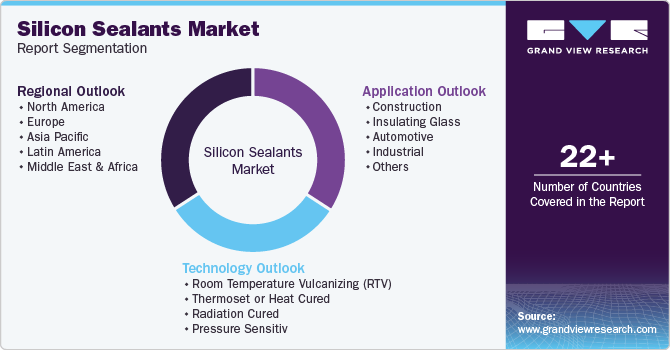
This report forecasts revenue growth at global, regional, and country levels and analyzes the latest industry trends in each of the sub-segments from 2021 to 2033. For this study, Grand View Research has segmented the global silicone sealants market report based on technology, application, and region.
-
Technology Outlook (Volume, Kilotons; Revenue, USD Million, 2021 - 2033)
-
Room Temperature Vulcanizing (RTV)
-
Thermoset or Heat Cured
-
Radiation Cured
-
Pressure Sensitive
-
-
Application Outlook (Volume, Kilotons; Revenue, USD Million, 2021 - 2033)
-
Construction
-
Insulating Glass
-
Automotive
-
Industrial
-
Others
-
-
Regional Outlook (Volume, Kilotons; Revenue, USD Million, 2021 - 2033)
-
North America
-
U.S.
-
Canada
-
Mexico
-
-
Europe
-
Germany
-
UK
-
-
Asia Pacific
-
China
-
Japan
-
India
-
-
Latin America
-
Brazil
-
-
Middle East and Africa (MEA)
-
South Africa
-
-
Research Methodology
The silicone sealants market figures in this report are based on a proven research process that combines executive interviews with secondary research from proprietary databases, company filings, and recognized regulatory and institutional sources. Market size is built through value-chain sizing - reconciling supply-side and demand-side estimates - and triangulated with bottom-up and top-down approaches. Every estimate passes multiple levels of expert validation before publication, with each silicone sealants segment quantified using the revenue-capture definitions in the table below.
Segment Definition
Segment - Product
Revenue capture definition
Room Temperature Vulcanizing (RTV)
Revenue is generated from silicone sealants that cure at ambient temperature through moisture or catalyst-based reactions without requiring external heat. These products are widely used in construction, automotive, electronics, and general industrial sealing applications.
Thermoset or Heat Cured
This segment captures revenue from silicone sealants that require elevated temperatures to achieve permanent cross-linking and enhanced mechanical properties. They are primarily utilized in automotive manufacturing, electronics assembly, and industrial production processes requiring high thermal stability.
Radiation Cured
Revenue includes silicone sealants cured using ultraviolet (UV) or electron beam (EB) radiation to achieve rapid curing and high production efficiency. These products are adopted in precision manufacturing applications where fast processing and consistent performance are essential.
Pressure Sensitive
This segment represents revenue from pressure-sensitive silicone sealants that form an effective bond with light pressure without the need for heat or chemical curing. They are commonly used in specialty tapes, medical products, electronics, and industrial bonding applications.
Segment - Application
Revenue capture definition
Construction
Revenue is generated from silicone sealants used in glazing, façade systems, expansion joints, roofing, sanitary installations, and weatherproofing applications across residential, commercial, and infrastructure projects. Demand is supported by their durability, flexibility, and resistance to environmental conditions.
Insulating Glass
This segment captures revenue from silicone sealants used in insulating glass units (IGUs) to provide structural bonding and long-term sealing performance. These products help improve energy efficiency by preventing moisture ingress and maintaining thermal insulation.
Automotive
Revenue includes silicone sealants used for bonding, gasketing, weather sealing, and vibration resistance in vehicle manufacturing and aftermarket maintenance. Their ability to withstand high temperatures, chemicals, and mechanical stress supports broad automotive adoption.
Industrial
This segment represents revenue from silicone sealants used in equipment manufacturing, electrical components, machinery, and other industrial assembly applications. Demand is driven by the need for reliable sealing, insulation, and protection under demanding operating conditions.
Others
Revenue includes silicone sealants used in aerospace, marine, healthcare, electronics, consumer goods, and other specialized applications not covered under the primary segments. Growth is supported by increasing demand for high-performance sealing solutions across diverse end-use industries.
Estimation Model
Layer Name
Key Question
Description
Regional Market Assessment
Which regions contribute the highest demand?
Evaluates market size across North America, Europe, Asia Pacific, Latin America, and the Middle East & Africa based on construction activity, industrial production, and manufacturing demand.
Application Analysis
Which application areas account for the largest market share?
Assesses consumption across construction, insulating glass, automotive, industrial, and other applications based on installation volumes and replacement demand.
Pricing & Revenue Analysis
How is market revenue derived?
Estimates revenue by combining regional product consumption with average selling prices while considering product grades, technology types, and application-specific pricing variations.
Raw Material Assessment
What is the availability and pricing trend of key raw materials?
Analyzes the supply and pricing of silicone polymers, siloxanes, fillers, curing agents, and additives used in silicone sealant manufacturing.
Delivered Customizations
This report has been delivered with the following In-depth customizations
Client Request
Customization Delivered
Value Adds
Regional Segmentation
A comprehensive regional assessment of the silicone sealants market was conducted across North America, Europe, Asia Pacific, Latin America, and Middle East & Africa. The study evaluated country-level demand for RTV, thermoset, radiation-cured, and pressure-sensitive silicone sealants while examining consumption across construction, insulating glass, automotive, industrial, and other applications. Regional manufacturing capacity, infrastructure activity, and industrial production trends were also assessed.
Provides deeper visibility into regional demand trends and country-level growth opportunities. Supports market expansion planning, production allocation, and prioritization of high-potential geographic markets.
Competitive Benchmarking
Leading silicone sealant manufacturers were benchmarked based on product portfolio, technology capabilities, manufacturing footprint, innovation initiatives, distribution strength, sustainability focus, and penetration across construction, automotive, and industrial applications. Strategic developments and product differentiation were also evaluated.
Helps identify competitive strengths, technology leadership, and market positioning gaps. Facilitates strategic planning, partnership evaluation, and competitive differentiation initiatives.
Opportunity Assessment
Growth opportunities were assessed across energy-efficient buildings, insulating glass systems, electric vehicle manufacturing, industrial automation, and sustainable construction applications. The analysis also examined increasing demand for durable, weather-resistant, and low-emission silicone sealant technologies across high-performance applications.
Enables identification of emerging growth segments and long-term investment opportunities. Supports innovation planning, product development, and strategic expansion across high-value end-use industries.
Frequently Asked Questions About This Report
The global silicone sealants market size was estimated at USD 4.5 billion in 2025 and is expected to reach USD 4.8 billion in 2026.
The global silicone sealants market is expected to grow at a compound annual growth rate of 6.2% from 2026 to 2033 to reach USD 7.3 billion by 2033.
Some key players operating in the silicone sealants market include Dow, Wacker Chemie Ag, the 3M Company, H.B. Fuller, Bostik, Sika AG, and Henkel Corporation.
Key factors that are driving the market growth include increasing demand is owing to the superior chemical & physical properties of the product such as resistance to chemicals, high & low temperatures, and weathering; along with durability and strength.
Room temperature vulcanizing (RTV) held a dominant position, contributing 64.8% of total revenue in 2025.
Asia Pacific dominated the silicon sealants market with the highest revenue share of 52.1% in 2025.
Construction dominated the silicone sealants market with a share of 60.7% in 2025 while insulating glass is second fastest growing market.
About the Author(s)
Plastics, Polymers & Resins Research Team
Bulk Chemicals · Plastics, Polymers & ResinsThis report was authored by the plastics, polymers & resins research team at Grand View Research - comprising two research analysts, one senior research analyst, and one industry expert - with specialized expertise in the plastics, polymers & resins segment of the bulk chemicals industry. All findings are based on proprietary bulk chemicals databases, executive interviews, and regulatory analysis, subject to internal peer review prior to publication.
Last Updated:
Speak to Analyst


Customize this report to your needs — add regions, segments, or data points, with 20% free customization.
Or view our licence options:


ISO 9001:2015 & 27001:2022 Certified
We are GDPR and CCPA compliant! Your transaction & personal information is safe and secure. For more details, please read our privacy policy.


