
- Home
- »
- Clothing, Footwear & Accessories
- »
-
Sneakers Market Size, Share And Trends Report, 2026-2033GVR Report cover

Sneakers Market (2026 - 2033)
Size, Share & Trends Analysis Report By Product Type (Low-top, Mid-top, High-top), By End User (Men, Women, Kids), By Distribution Channel (Department Store, Specialty Stores, Online), By Region, Segment Forecasts
Market Size, 2025
$104.5BMarket Estimate, 2026
$110.0BMarket Forecast, 2033
$137.6BCAGR, 2026–2033
3.2%Sneakers Market Summary
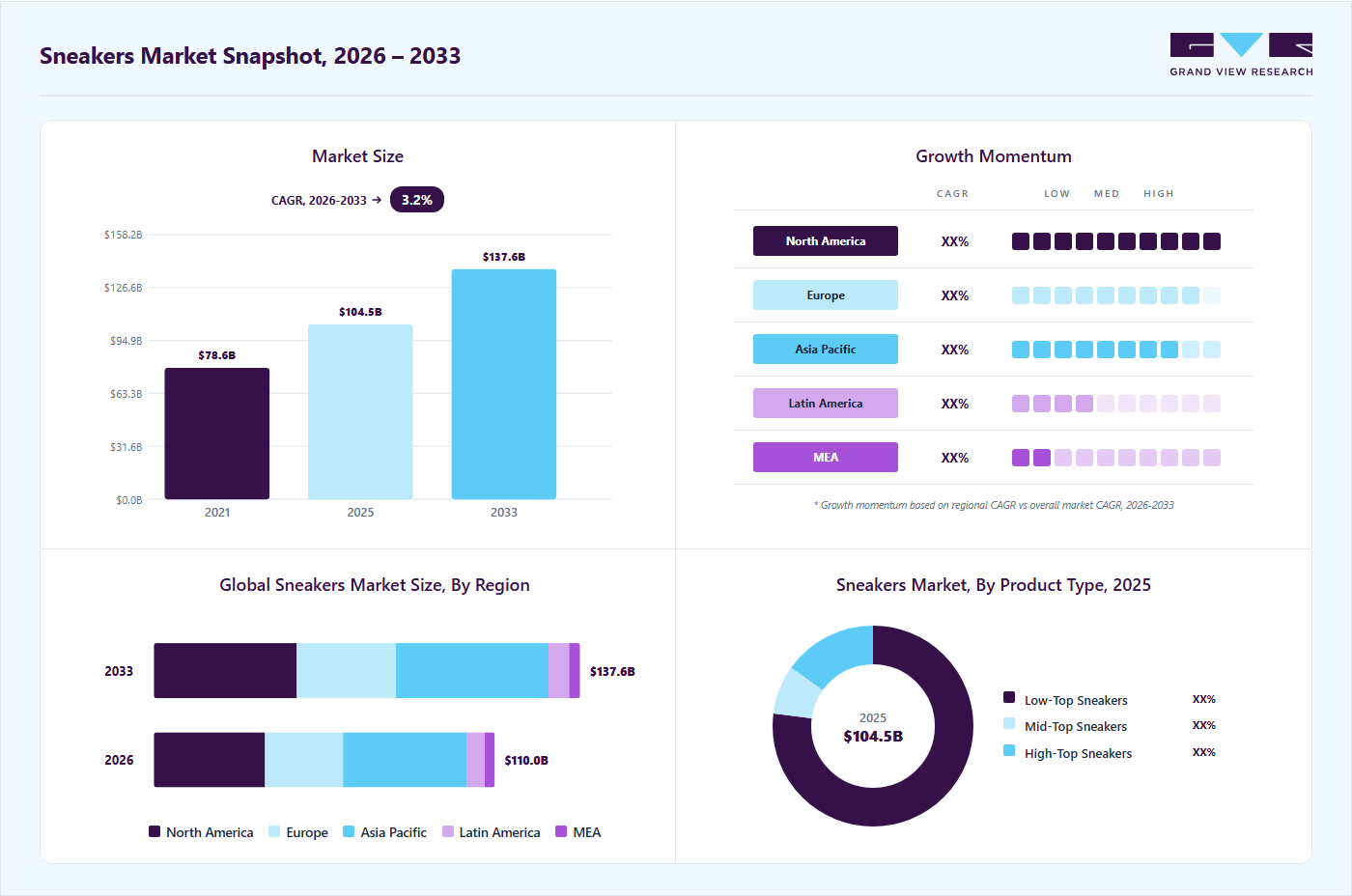
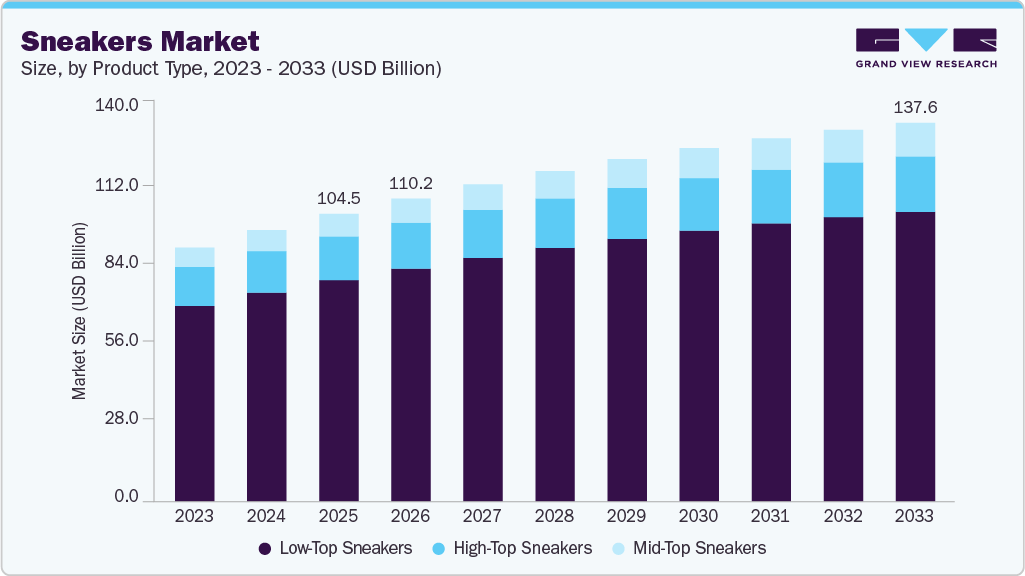
The global sneakers market size was valued at USD 104.5 billion in 2025 and is projected to grow from USD 110.0 billion in 2026 to USD 137.6 billion in 2033, at a CAGR of 3.2% from 2026 to 2033. Asia Pacific dominated the global market with the largest revenue share of 36.3% in 2025. Consumers are gravitating toward premium sneakers that combine recognizable brand equity with comfort-led design, driving strong demand for limited-edition releases, designer collaborations, and elevated “street-luxury” silhouettes.
 Source: Grand View Research, IR Documents, Primary Interviews, Paid DatabasesTo learn more about this report,
 Download Free Sample Report
 Key Market Trends & Insights
- By product type: Low-top sneakers segment accounted for the largest revenue share of 76.9% in 2025.
- By end user: Men accounted for the largest revenue share of 55.1% in 2025.
- By distribution channel: Sales of sneakers through department stores accounted for the largest revenue share of 33.9% in 2025.
Regional Highlights
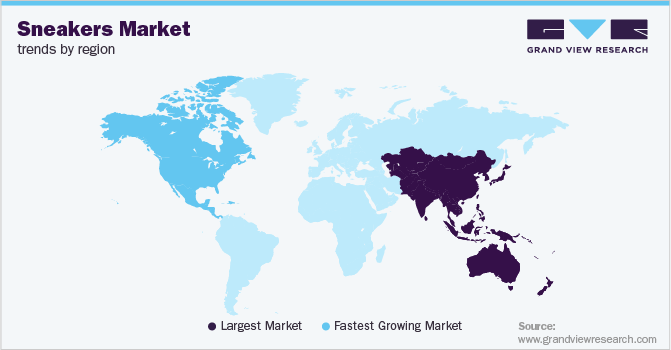
- Largest regional market: Asia Pacific (36.3% revenue share, 2025)
- Fastest-growing regional market: North America (highest CAGR, 2026-2033)
- By country: The China held the largest market share in 2025.
Market Size & Forecast
- Market size in 2025: USD 104.5 Billion
- Estimated market size in 2026: USD 110.0 Billion
- Projected market size by 2033: USD 137.6 Billion
- CAGR (2026-2033): 3.2%
Three ways to get this report
Buy it, customize it, or ask a question.Ask an Analyst
Analyst response in 1 business day
- AccessReport author, directly
- Reply timeWithin 1 working day
- No sales callDirect answer only
- FormatEmail reply
- CostFree, no cost
Get the Full Report
What the study covers
- FormatsPDF · Excel · Dashboard
- Timeline2026–2033 annual, 2025 base
- Coverage20+ countries, 5 regions
- Companies10+ key players profiled
Customize the Report
20% free customization
- IncludeCountries, segments, points
- TailorTo your product definition
- ExtendDeeper competitor detail
- OrA fully bespoke study
- Turnaround5–10 working days
Sneakers have become central to identity-driven consumption, especially among younger buyers aged 18-35, where purchase decisions are shaped by brand storytelling, cultural relevance, and social visibility. At the same time, the market is expanding beyond fashion-only demand into everyday multi-purpose use, as hybrid lifestyles and the casualization of dress norms make sneakers the default footwear choice for commuting, work, travel, and social settings.Consumers are increasingly drawn to shoes that offer running-grade foam comfort, arch support, and lightweight engineering, even in non-sport contexts. Brands have responded by scaling innovation platforms such as responsive midsoles, engineered knit uppers, and stability-focused sole geometries into broader lifestyle collections. As a result, sneakers are no longer cleanly segmented into sports versus casual; instead, the strongest demand is concentrated in crossover products that can transition between gym activity, work routine, and weekend wear.
 To learn more about this report, Download Free Sample Report
 Brands are accelerating the use of recycled polyester yarns, bio-based foams, water-reducing dye systems, and modular construction approaches that extend product life. Lightweighting is another major direction, as consumers increasingly evaluate sneakers by fatigue reduction, ventilation, and long-wear comfort rather than appearance alone. Advanced sole bonding, improved abrasion-resistant rubber compounds, and more durable cushioning retention are becoming critical differentiators, especially in mid-range models where buyers expect performance to last beyond short-term use.
For instance, in June 2025, On introduced its latest trail running innovation with the launch of the Ultra Collection, expanding its performance offering for ultra-distance athletes and dedicated trail runners. The Cloudultra Pro is designed to enhance running economy, energy return, and long-distance comfort through a dual-layer Helion HF hyper foam midsole and Speedboard propulsion technology, alongside advanced Missiongrip traction refined using detailed outsole engineering and field testing. The Cloudultra 3, arriving July 3, builds on the brand’s elite ultra-trail design approach, with high-energy resilience and cushioning aimed at making endurance trail performance more accessible to a broader runner base.
Retail strategies in the sneakers market continue to evolve through tighter control of brand ecosystems and faster launch velocity. Direct-to-consumer channels, limited-edition drops, and brand-owned apps are increasingly shaping how demand is created and converted. At the same time, specialty sneaker retailers remain important for community-led discovery and premium positioning.
For instance, in March 2025, Shoe Zone launched a new mobile app as part of its wider omnichannel strategy, designed to make it easier for customers to shop across digital and physical channels. Developed in partnership with mobile specialists Swipe & Tap, the revamped platform introduces features such as a wishlist, an interactive returns portal, and product filtering tools similar to those on the retailer’s website, helping shoppers browse promotions and styles more efficiently. The app also fully integrates Shoe Zone’s express delivery option, offering free next-day delivery with no minimum spend.
Consumers today often treat sneaker purchases as high-consideration decisions, influenced by wear-test content, comfort comparisons, and real-world durability feedback rather than store display alone. With sneakers positioned at the intersection of sport, fashion, comfort engineering, and cultural identity, the category remains one of the most commercially resilient and innovation-intensive segments in global consumer goods.
Market Dynamics
Sustainable and circular sneaker demand is becoming a key driver for the global sneakers market, as environmental responsibility is increasingly influencing purchase decisions and product expectations. An IBM consumer study found that over 70% of consumers are willing to pay a premium for sustainable products, highlighting the strong willingness to shift toward eco-conscious footwear choices. This is accelerating the adoption of recycled polyester uppers, bio-based foams, and circular production models, where brands increasingly implement take-back programs to refurbish, reuse, or recycle worn sneakers.
Rising counterfeit sneaker penetration across online marketplaces is emerging as a significant restraint in the global sneakers industry, as it undermines brand trust, reduces legitimate sales, and increases consumer hesitation in online purchasing. Sneakers remain one of the most counterfeited fashion categories, with academic research indicating that they are among the most targeted products for online counterfeiting, with some studies suggesting they face up to three times higher fraud risk compared to other fashion goods.
This issue is further amplified by large-scale marketplace exposure, where counterfeit listings continue to proliferate despite enforcement efforts, leading to substantial product verification losses, such as StockX rejecting around USD 74 million worth of suspected counterfeit goods in a single year in 2025. As a result, increased fraud exposure to digital resale and e-commerce platforms is weakening consumer confidence and creating friction in the growth of premium and limited-edition sneaker segments.
Consumer Insights
Consumer demand is being shaped strongly by brand familiarity and performance perception, with buyers gravitating toward labels that signal both style credibility and technical comfort. A UBS global consumer survey cited by WWD in January 2026 highlighted the continued dominance of major athletic players, showing Adidas leading consumer preference in athletic apparel at 62%, ahead of Nike at 53%, while Puma ranks at 16%. This concentration reflects how sneaker purchasing is heavily anchored around a small set of globally recognized brands that influence category momentum through scale, innovation, and cultural visibility.
 To learn more about this report, Download Free Sample Report
 Product expectations within the sneaker market are rising beyond aesthetics, with consumers increasingly prioritizing wear performance, cushioning responsiveness, durability, and long-term comfort. Leading brands continue to strengthen loyalty through proprietary midsole technologies, lightweight engineered uppers, and constant refresh cycles across running, training, and lifestyle silhouettes. Brands like Nike, Adidas, Puma, and New Balance remain central to the global consumer consideration set, reinforcing how the sneaker market is structurally brand-driven, where trust in fit consistency and perceived innovation play a decisive role in repeat purchases.
Product Type Insights
The low-top sneakers led the sneakers industry, accounting for the largest global revenue share of 76.9% in 2025. Low-top sneakers are a popular category of casual footwear that blends style, comfort, and versatility. Some of the brands that cater to low-top sneakers include Nike, Puma, Tommy Hilfiger, and Skechers. Chunky soles on low-top sneakers are among the most popular styles in the product. The trend of chunky soles, popularized by high-fashion and athletic brands, extended to low-top sneakers as well. Some brands incorporated exaggerated, thick soles into their designs, creating a bold, fashion-forward aesthetic.
 To learn more about this report, Download Free Sample Report
 Mid-top sneakers are projected to grow at a CAGR of 4.9% from 2026 to 2033. Increasing awareness of health and fitness has driven demand for mid-top sneakers, particularly in emerging markets. Originally designed for sports like tennis and basketball, mid-top sneakers are now also a popular choice among skaters. Innovative product launches, along with the high level of comfort provided by mid-top sneakers, are likely to increase demand over the forecast period.
End User Insights
Men’s sneakers accounted for a 55.1% global revenue share of the sneakers industry in 2025, supported by strong demand for casual, lifestyle, and performance-driven designs. Sneakers have become a core wardrobe category for men, driven by their ability to transition from everyday wear to workplace settings with relaxed dress codes, travel, and fitness activities. Low-top sneakers remain one of the most widely adopted formats due to their versatility and comfort, with leading brands such as Nike, Puma, Tommy Hilfiger, and Skechers offering extensive assortments across price tiers.
 To learn more about this report, Download Free Sample Report
 The women’s sneakers segment is projected to grow at a CAGR of 3.6% from 2026 to 2033. Brands such as Converse, Reebok, Sketchers, and Adidas offer extensive selections of sneakers tailored to women's tastes. These shoes tend to embrace a mix of casual chic, athleisure, and fashion-forward designs. Popular styles include sleek, minimalist sneakers, platform sneakers, and retro-inspired models. Women also tend to gravitate toward sneakers that range from neutral tones to vibrant and pastel shades. Online retailers like ASOS, Nike, and Zalando offer a wide array of women's sneakers, providing a convenient shopping experience with frequent sales and discounts.
Distribution Channel Insights
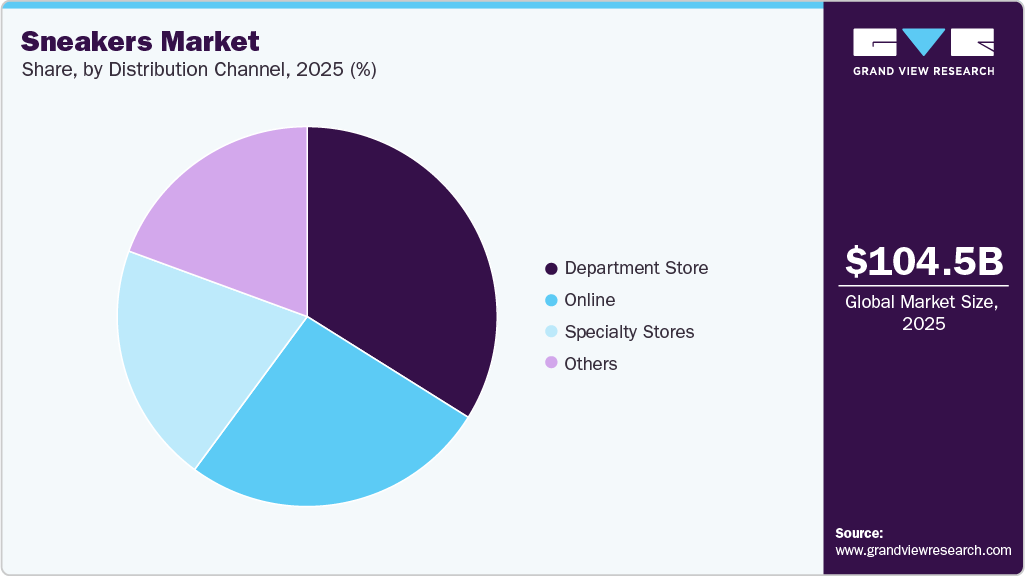
Sales of sneakers through department stores accounted for a share of around 33.9% of the global revenue in 2025. Department stores remain a preferred channel for sneaker purchases as shoppers can physically evaluate fit, cushioning, material quality, and overall comfort before buying, an important factor for footwear intended for everyday and active use. The presence of dedicated footwear sections, seasonal assortments, and frequent promotional campaigns further supports strong sales volumes. Shoppers often use these outlets to compare lifestyle, performance, and fashion-forward sneaker options side by side, increasing purchase confidence.
 To learn more about this report, Download Free Sample Report
 Sales of sneakers through online channel is projected to grow at a CAGR of 3.8% from 2026 to 2033, supported by rising digital adoption, mobile-first shopping behavior, and expanding e-commerce infrastructure. Consumers increasingly prefer buying sneakers online because it allows them the browse a wide assortment of brands, styles, and price points without visiting physical stores.
Regional Insights
North America Sneakers Market Trends
The sneakers industry in North America is projected to grow at a CAGR of 3.7% from 2026 to 2033, driven by a deeply established sneaker culture across the U.S. and Canada. Consumers in the region actively follow brand drops, athlete-linked signature lines, and streetwear collaborations, making sneakers a key form of style expression and cultural identity rather than just functional footwear. Demand is particularly strong for lifestyle silhouettes, basketball-inspired models, and premium athleisure sneakers that align with casual dressing norms and everyday mobility needs. In addition, North America has a mature distribution landscape, with a strong presence of brand-owned stores, major footwear chains, resale platforms, and digitally driven e-commerce ecosystems that accelerate product reach.
U.S. Sneakers Market Trends
The sneakers industry in the U.S. is projected to grow at a CAGR of 3.7% from 2026 to 2033, supported by the country’s highly developed sneaker ecosystem, including specialty sneaker retailers, brand flagship stores, and a strong direct-to-consumer online presence. Exclusive product drops, membership-based launches, and collaborations with designers and athletes continue to stimulate repeat buying and collector interest. In addition, increasing demand for comfort-driven innovations, such as responsive cushioning, lightweight knit uppers, and supportive soles, is shaping product development.
The sneakers market in Canada is projected to grow at a CAGR of 4.1% from 2026 to 2033.Canadian consumers increasingly seek sneakers that balance comfort, durability, and modern styling, driving strong uptake across casual, athleisure, and performance categories. Sneakers are widely adopted not only for fitness and sports participation but also for daily commuting and lifestyle use, reflecting the country’s preference for practical yet fashion-aligned footwear. The increasing focus on health and wellness is also accelerating interest in ergonomic footwear with cushioning, stability, and breathable materials.
Europe Sneakers Market Trends
The sneakers industry in Europe is projected to grow at a CAGR of 3.5% from 2026 to 2033. Demand remains high for versatile lifestyle sneakers, premium casual designs, and retro-inspired silhouettes, supported by frequent seasonal product refreshes from brands such as Adidas, Puma, Nike, and New Balance. The region also benefits from high adoption of mid-priced and premium sneakers, as European consumers prioritize comfort, durability, and design quality over low-cost options.
The sneakers market in the UK is projected to grow at a CAGR of 4.2% from 2026 to 2033. Consumers in the UK are showing a stronger preference for sneakers that combine durability, comfort, and modern styling, leading to higher demand for well-cushioned lifestyle and athleisure designs across multiple price tiers. As purchasing power improves, shoppers are more willing to invest in branded sneakers that offer long-term wear value and versatility for commuting, casual use, and light fitness activities.
The Germany sneakers market is projected to grow at a CAGR of 3.4% from 2026 to 2033. Fashion trends play a crucial role in shaping the market in Germany. As a country with a strong fashion industry and a population that prides itself on individual style, there is a constant demand for innovative designs and trendy styles. This includes everything from casual sneakers to formal dress shoes, with consumers seeking sneakers that reflect their personal taste and complements their wardrobe.
Asia Pacific Sneakers Market Trends
The sneakers industry in Asia Pacific accounted for a global revenue share of 36.3% in 2025. Countries such as China, India, Japan, and South Korea are seeing rising purchases of lifestyle and athleisure sneakers as casual footwear becomes the default choice for daily wear. Growth is supported by higher disposable incomes, frequent new product launches by global brands like Nike, Adidas, and Puma, and the strong influence of streetwear culture across the region.
 To learn more about this report, Download Free Sample Report
 The sneakers market in China accounted for a share of 54.4% of the regional revenue in 2025. China benefits from extensive production capacity, well-established supply chains, and large-scale infrastructure that support high-volume sneaker manufacturing at competitive costs. This strong industrial ecosystem enables both domestic brands and global players to scale production efficiently and respond quickly to changing consumer demand. Rising sneaker consumption within China, supported by urban youth culture and growing lifestyle adoption, further strengthens the domestic market.
The India sneakers market is projected to grow at a CAGR of 4.1% from 2026 to 2033. Growing exposure to global fashion and streetwear trends through social media and international brands has accelerated demand for contemporary sneaker styles, limited-edition drops, and athleisure-inspired pieces. In addition, expanding availability through organized retail and e-commerce platforms is improving access across tier I and tier II cities, reinforcing India’s position as a fast-evolving and high-potential market.
Central and South America Sneakers Market Trends
The sneakers industry in Central and South America is projected to grow at a CAGR of 1.8% from 2026 to 2033, supported by improving retail infrastructure and wider availability of sneakers across urban centers. Expansion of shopping malls, multi-brand footwear stores, and organized retail networks is strengthening consumer access to both international and local sneaker brands. At the same time, the steady rise of e-commerce platforms is enabling shoppers to browse a broader range of styles and price points, particularly in markets such as Brazil, Mexico, and Colombia.
Middle East & Africa Sneakers Market Trends
The sneakers industry in the Middle East & Africa is projected to grow at a CAGR of 1.3% from 2026 to 2033. Sneaker consumption in the region is shaped by warm weather, lifestyle preferences for lightweight, breathable footwear, and the expanding presence of both international and regional brands. Global players such as Skechers USA, Inc., ASICS Corp., and Nike Inc. continue to strengthen market penetration through affordable, climate-appropriate product ranges, while local manufacturers contribute to broader availability. Sneakers are widely available in shopping malls, multi-brand retailers, and increasingly through online platforms, supporting accessibility across key markets in the Gulf region and South Africa.
Key Sneakers Company Insights
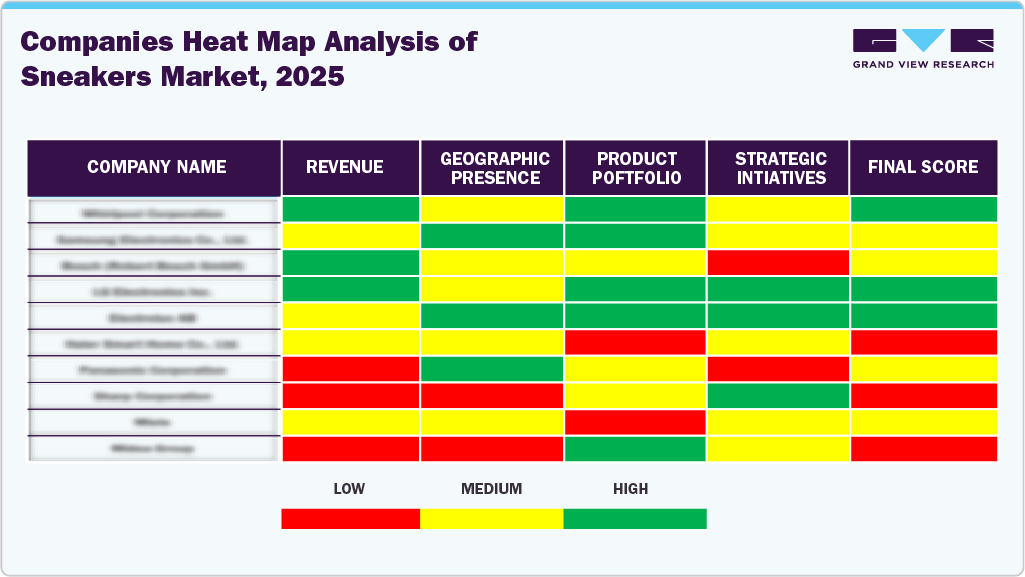
The global sneaker market is highly competitive, shaped by major international sportswear brands alongside smaller regional and niche players. Leading companies are continuously innovating through performance-driven designs, lifestyle-oriented collections, sustainability initiatives, and limited-edition releases to strengthen brand differentiation and consumer loyalty. In parallel, collaborations with athletes, celebrities, and designers, along with direct-to-consumer and digital commerce expansion, are key strategies driving growth and market relevance.
-
Nike Inc. is a global leader in athletic footwear and apparel, leveraging its strong brand equity, extensive athlete endorsements, and innovation pipeline to maintain its dominant market position. The company’s sneaker portfolio spans performance running, basketball, training, and lifestyle segments, supported by flagship technologies such as Air Max and Flyknit. In 2025, Nike’s footwear division remained a primary revenue driver, supported by sustained demand for lifestyle sneakers and strong digital sales growth. The company’s focus on innovation, customization platforms, and direct-to-consumer channels contributed to steady overall revenue expansion.
-
Adidas AG is a major global sportswear company recognized for its performance and lifestyle sneaker offerings, including iconic product lines such as Originals and Boost-based footwear. The company focuses on combining athletic functionality with fashion-forward design, often strengthened through collaborations with designers, musicians, and sports teams. In 2025, Adidas experienced growth driven by strong demand in lifestyle sneakers and performance categories, alongside continued momentum in key markets. Its revenue performance was supported by strategic product innovation, sustainability-focused materials, and expansion of its direct-to-consumer business.
 To learn more about this report, Download Free Sample Report
Key Sneakers Companies:
The following key companies have been profiled for this study on the sneakers market.
-
Nike Inc.
-
Adidas AG
-
New Balance Athletics, Inc.
-
ASICS Corp.
-
Kering SA
-
Skechers USA, Inc.
-
Under Armour Inc.
-
VF Corp.
-
Puma SE
-
Relaxo Footwears Ltd.
Recent Developments
-
In September 2025, Under Armour expanded its partnership with regenerative fashion brand UNLESS by introducing three new plant-based, zero-plastic lifestyle sneaker styles. The launch marks the first time UNLESS footwear will be available through Under Armour’s platform, reflecting a broader push toward circular design in an industry still heavily dependent on synthetic materials. The new sneakers are designed to decompose naturally at the end of their life, offering an alternative to conventional footwear that often relies on plastics and petrochemicals.
-
In January 2025, ASICS and Toyoda Gosei launched a new sustainable sneaker initiative that uses recycled materials from automotive airbag production. The collaboration focuses on repurposing waste airbag fabric into durable footwear components, supporting circular manufacturing and reducing industrial material disposal. The new sneakers reflect both companies’ efforts to strengthen environmentally responsible product development by combining ASICS’ footwear expertise with Toyoda Gosei’s advanced materials and recycling capabilities.
Sneakers Market Report Scope
Report Attribute
Details
Market size in 2025
USD 104.5billion
Estimated Market size in 2026
USD 110.0 billion
Projected Market size by 2033
USD 137.6 billion
Growth rate
CAGR of 3.2% from 2026 to 2033
Actuals
2021 - 2025
Forecast period
2026 - 2033
Quantitative units
Revenue in USD million/billion and CAGR from 2026 to 2033
Report coverage
Revenue forecast, company ranking, competitive landscape, growth factors, and trends
Segments covered
Product type, end user, distribution channel, region
Regional scope
North America; Europe; Asia Pacific; Central & South America; Middle East & Africa
Country scope
U.S.; Canada; Mexico; Germany; UK; France; Italy; Spain: China; Japan; India; South Korea; Australia & New Zealand; Brazil; South Africa
Key companies profiled
Nike Inc.; Adidas AG; New Balance Athletics, Inc.; ASICS Corp.; Kering SA; Skechers USA, Inc.; Under Armour Inc.; VF Corp.; Puma SE; Relaxo Footwears Limited
Customization scope
Free report customization (equivalent up to 8 analysts’ working days) with purchase. Addition or alteration to country, regional & segment scope.
Pricing and purchase options
Avail customized purchase options to meet your exact research needs. Explore purchase options
Global Sneakers Market Report Segmentation
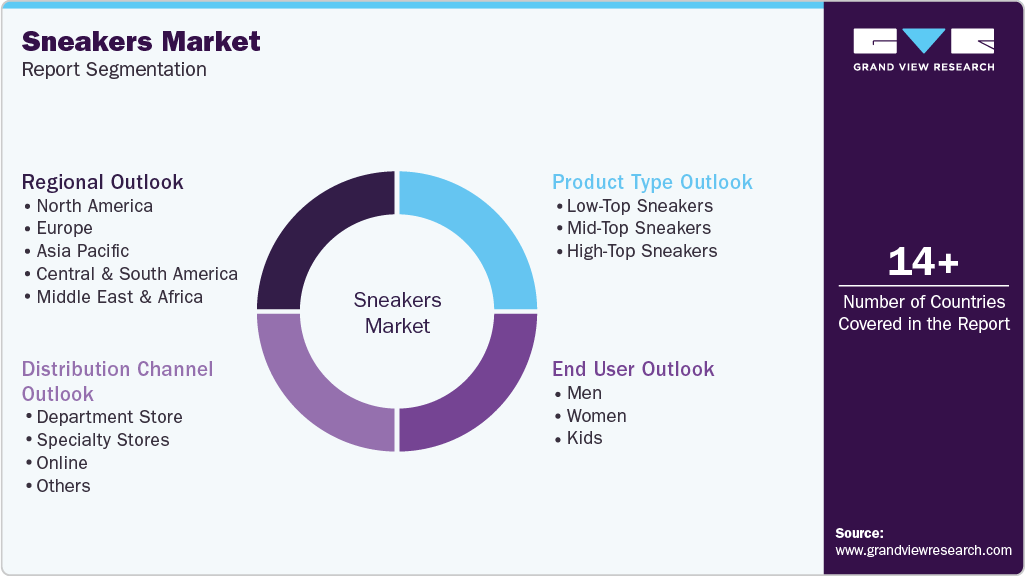
This report forecasts revenue growth at the global, regional & country levels and provides an analysis of the latest trends and opportunities in each of the sub-segments from 2021 to 2033. For this study, Grand View Research has segmented the sneakers market report based on product type, end user, distribution channel, and region:
 To learn more about this report, Download Free Sample Report
 -
Product Type Outlook (Revenue, USD Million/Billion, 2021 - 2033)
-
Low-Top Sneakers
-
Mid-Top Sneakers
-
High-Top Sneakers
-
-
End User Outlook (Revenue, USD Million/Billion, 2021 - 2033)
-
Men
-
Women
-
Kids
-
-
Distribution Channel Outlook (Revenue, USD Million/Billion, 2021 - 2033)
-
Department Store
-
Specialty Stores
-
Online
-
Others
-
-
Regional Outlook (Revenue, USD Million/Billion, 2021 - 2033)
-
North America
-
U.S.
-
Canada
-
Mexico
-
-
Europe
-
Germany
-
UK
-
France
-
Italy
-
Spain
-
-
Asia Pacific
-
China
-
Japan
-
India
-
South Korea
-
Australia & New Zealand
-
-
Central & South America
-
Brazil
-
-
Middle East & Africa
-
South Africa
-
-
Delivered Customizations
This report has been delivered with the following In-depth customizations
CLIENT REQUEST
CUSTOMIZATION DELIVERED
VALUE ADDS
U.S. Sneaker Culture, Consumer Base & Retail Landscape Assessment
Developed a tailored assessment of the U.S. sneakers market, including analysis of the growing sneakerhead population, cultural influence of sneaker communities, and the role of key retailers and distribution channels (e.g., specialty sneaker stores, brand-owned DTC platforms, and online marketplaces) in shaping demand. The study evaluated drop-driven scarcity models, retailer-led hype creation strategies, and consumer participation trends across demographics. It further analyzed regional demand concentration, purchasing behavior, and the influence of digital platforms and social communities on sneaker culture evolution.
Enables stakeholders to understand demand creation driven by sneaker culture, quantify the influence of sneakerhead communities on product success, assess retailer strategies in driving hype and engagement, and optimize product launch and channel strategies to maximize sell-through and brand positioning in the U.S. market.
Material Innovation & High-Performance Sneaker Engineering Analysis
Delivered a customized evaluation of advanced material and performance technology integration in the sneakers market, including adoption of energy-return foams, carbon-fiber plate structures, recycled polymer uppers, and bio-based sustainable textiles across performance and lifestyle footwear categories. The assessment also examined innovation pipelines, R&D intensity across key brands, commercialization timelines for next-generation cushioning and durability technologies.
Provides actionable insights into product differentiation strategies, technology-led premiumization opportunities, and innovation-driven competitive positioning, helping clients align R&D investments with evolving consumer expectations for comfort, sustainability, and performance enhancement.
Drop Culture Economics & Limited Release Distribution Strategy Study
Conducted a focused assessment of sneaker distribution evolution driven by drop culture mechanisms, including time-bound releases, raffle-based purchasing systems, influencer-led product seeding, and direct-to-consumer exclusivity strategies across major global brands. The study also analyzed geographic segmentation of release availability, digital queuing systems, and demand-supply manipulation tactics influencing consumer urgency and sell-out velocity.
Supports strategic planning for sneaker brands and retailers by quantifying the impact of scarcity-driven marketing models, identifying optimal release strategies for maximizing sell-through efficiency, evaluating consumer engagement mechanisms, and strengthening launch execution frameworks in highly competitive footwear markets.
Frequently Asked Questions About This Report
The global sneakers market size was estimated at USD 104.5 billion in 2025 and is expected to reach USD 110.0 billion in 2026.
The global sneakers market is expected to grow at a compound annual growth rate (CAGR) of 3.2% from 2026 to 2033 to reach USD 137.6 billion by 2033.
The North America is the fastest-growing region over the forecast period.
The Asia Pacific sneakers market dominated with a share of 36.3% in 2025.
Some of the key companies include Nike Inc., Adidas AG, New Balance Athletics, Inc., ASICS Corp, Kering SA, Skechers USA, Inc., Under Armour Inc., VF Corporation, Puma SE, and Relaxo Footwears Limited.
The proliferation of online platforms across the globe acts as one of the major factors driving the growth of the sneakers market. The growing inclination towards fashionable, branded, and high-fashion sneakers among all age groups and the increase in disposable income growing the requirement for more comfortable as well as innovative sneakers accelerate the market growth.
Low-top sneakers accounted for a revenue share of 76.9% in 2025, driven by their versatility, lightweight comfort, everyday wearability, and strong consumer preference for casual and athleisure footwear styles.
Sales of sneakers through department stores accounted for the largest revenue share of 33.9% in 2025.
Men accounted for the largest revenue share of 55.1% in 2025.
About the Author(s)
Clothing, Footwear & Accessories Research Team
Consumer Goods · Clothing, Footwear & AccessoriesThis report was authored by the clothing, footwear & accessories research team at Grand View Research - comprising two research analysts, one senior research analyst, and one industry expert - with specialized expertise in the clothing, footwear & accessories segment of the consumer goods industry. All findings are based on proprietary consumer goods databases, executive interviews, and regulatory analysis, subject to internal peer review prior to publication.
Last Updated:
Speak to Analyst

Customize this report to your needs - add regions, segments, or data points, with 20% free customization.
Or view our licence options:


ISO 9001:2015 & 27001:2022 Certified
We are GDPR and CCPA compliant! Your transaction & personal information is safe and secure. For more details, please read our privacy policy.


