
- Home
- »
- Organic Chemicals
- »
-
Sodium Silicate Market Size And Share Report, 2026-2033GVR Report cover

Sodium Silicate Market (2026 - 2033)
Size, Share & Trends Analysis Report By Application (Catalysts, Pulp & Paper, Food & Healthcare, Detergents, Elastomers), By Region (North America, Europe, Asia Pacific, Latin America), And Segment Forecasts
Market Size, 2025
$7.8BMarket Estimate, 2026
$8.1BMarket Forecast, 2033
$10.4BCAGR, 2026–2033
3.7%Sodium Silicate Market Summary
The global sodium silicate market size was valued at USD 7.8 billion in 2025 and is projected to grow from 8.1 billion in 2026 to USD 10.4 billion by 2033, at a CAGR of 3.7% from 2026 to 2033. Asia Pacific held the largest revenue share of 47.2% in the global market in 2025. The market is driven by its increasing use in detergents and household cleaning products. Its water-softening and stabilizing properties improve product efficiency and quality, supporting manufacturers in meeting rising consumer demand across both emerging and mature markets.
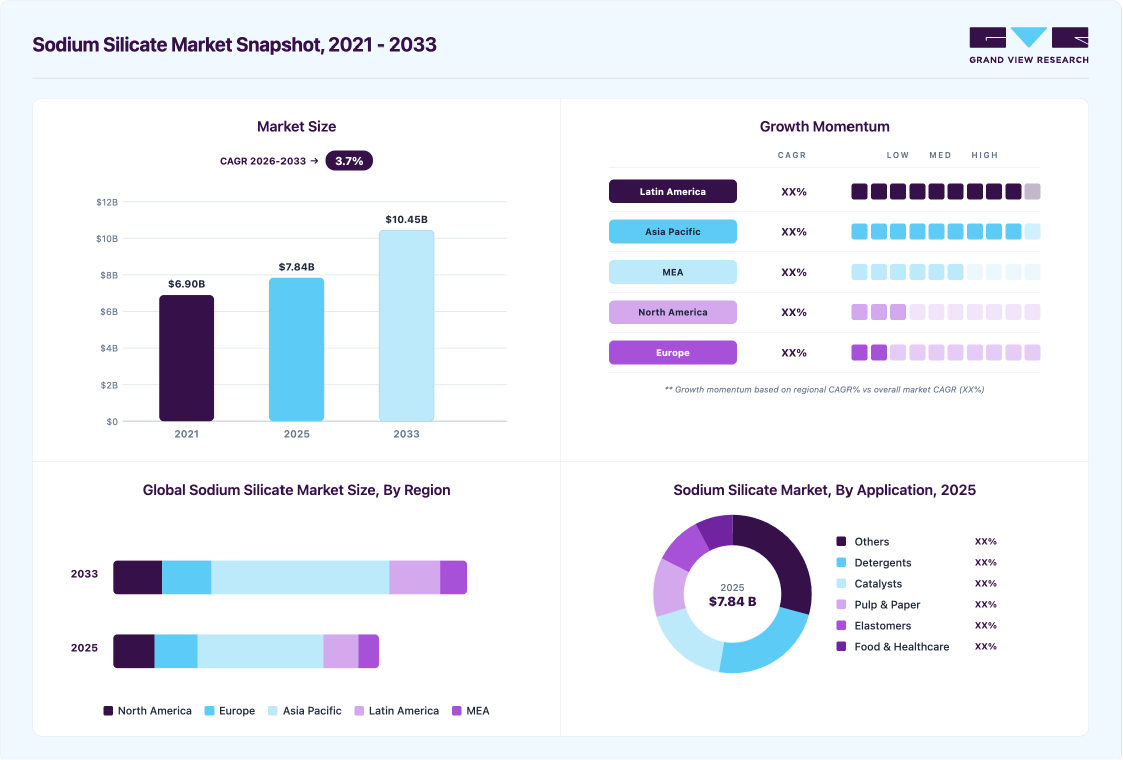 Source: Grand View Research, IR Documents, Primary Interviews, Paid DatabasesTo learn more about this report,
 Download Free Sample Report
 Key Market Trends & Insights
- By application: Detergents segment held the largest revenue share of 23.5% in 2025.
- By appplication: Elastomers segment is expected to be the fastest-growing application segment during the forecast period.
- By country: India sodium silicate market is expected to grow at the fastest CAGR of 5.0% from 2026 to 2033.
Regional Highlights
- Largest regional market: Asia Pacific (47.2% revenue share, 2025)
- Fastest-growing country market: India (CAGR 5.0%, 2026-2033)
Market Size & Forecast
- Market size in 2025: USD 7.8 Billion
- Estimated market size in 2026: USD 8.1 Billion
- Projected market size by 2033: USD 10.4 Billion
- CAGR (2026-2033): 3.7%
Three ways to get this report
Buy it, customize it, or ask a question.Ask an Analyst
Analyst response in 1 business day
- AccessReport author, directly
- Reply timeWithin 1 working day
- No sales callDirect answer only
- FormatEmail reply
- CostFree, no cost
Get the Full Report
What the study covers
- FormatsPDF · Excel · Dashboard
- Timeline2026–2033 annual, 2025 base
- Coverage20+ countries, 5 regions
- Companies10+ key players profiled
Customize the Report
20% free customization
- IncludeCountries, segments, points
- TailorTo your product definition
- ExtendDeeper competitor detail
- OrA fully bespoke study
- Turnaround5–10 working days
Rising adoption of sodium silicate in construction, automotive, and water treatment sectors is further propelling market growth. Its binding, sealing, and corrosion-resistant properties, combined with expanding industrial infrastructure and stricter sustainability regulations, are reinforcing its strategic importance as a versatile industrial material.
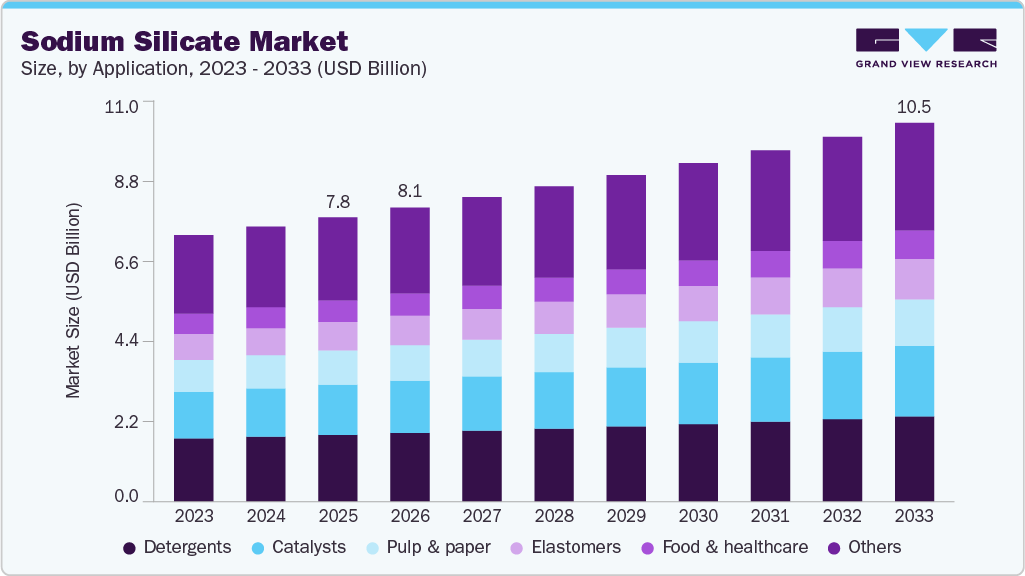 To learn more about this report, Download Free Sample Report
 Rapid industrialization and urbanization in emerging economies are creating significant growth opportunities for the Sodium Silicate market. Increasing construction activities, expanding automotive production, and rising household consumption of detergents are driving demand. Companies that strategically expand their presence in these high-growth regions can capitalize on the growing requirement for versatile and sustainable raw materials.
Market Dynamics
Sodium silicate is a key source of reactive silica, with high demand across numerous applications, including detergents, rubber, food & beverage, and paper & pulp. Increasing demand for various sodium silicate-derived products, including precipitated silica, zeolites, and silica gels, is expected to have a positive impact on the industry growth.
Soluble sodium silicate solutions can be modified using various techniques such as acid addition and ion exchange to form silica sols, silica gels, and precipitated silica. Precipitated silica is the most important product derived from sodium silicate and has high demand in the rubber, oral care, food & beverage, and healthcare industries.
Sodium silicate can cause severe irritation of the respiratory tract when inhaled, while large amounts can permanently damage the lungs. The symptoms when inhaled include a burning sensation in the chest and throat, headache, and difficulty in breathing.
If swallowed, sodium silicate can burn the entire digestive system, leading to diarrhea, vomiting, and nausea. Its exposure to the skin causes pain, itching, and severe redness. Intense burning and pain in the eyes, and damage to eye tissues, can occur if its fumes come into contact with the eyes. These factors increase the manufacturing and handling costs of the product significantly. The harmful effects of sodium silicate on human health have compelled manufacturers to invest heavily in product handling measures. This factor is expected to pose a challenge to manufacturers, distributors, and end users, restraining the overall market over the forecast period.
Market Concentration & Characteristics
The sodium silicate market is moderately fragmented, with a mix of global and regional players competing across industrial and consumer segments. Leading manufacturers focus on product differentiation, quality standards, and strategic distribution networks to maintain market share, while smaller players target niche applications and regional demand.
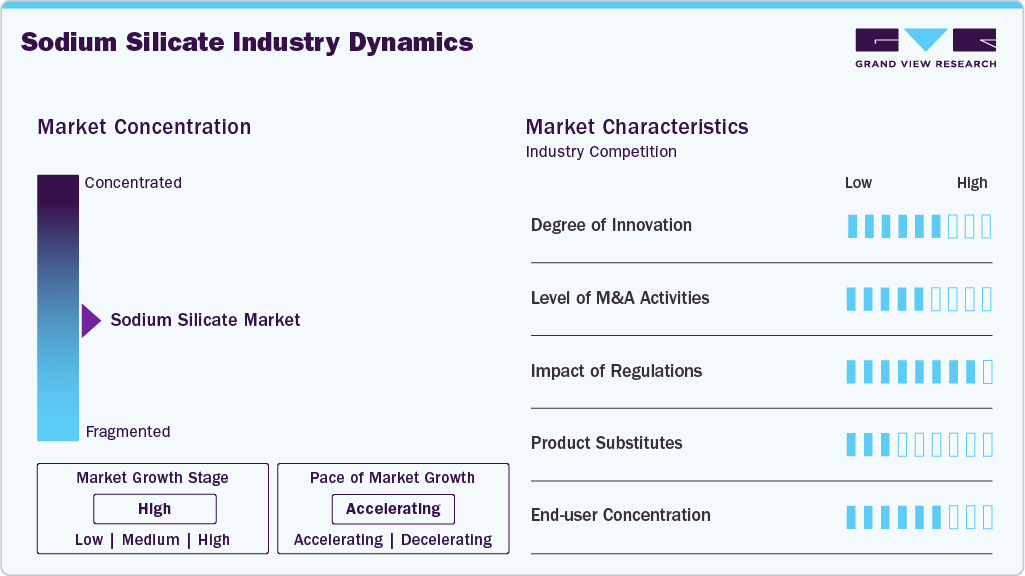 To learn more about this report, Download Free Sample Report
 Market characteristics are defined by steady demand from industrial sectors such as construction, automotive, water treatment, and detergents. Growth is driven by the material’s versatility, cost-effectiveness, and regulatory compliance, while regional market dynamics and end-use industry expansion shape competitive strategies and investment priorities.
Application Insights
The detergents in application segment dominated the market with a revenue share of over 23.5% in 2025, as sodium silicate enhances cleaning efficiency, stabilizes formulations, and softens water. Rising consumer demand for high-performance household and industrial cleaning products is reinforcing its widespread adoption.
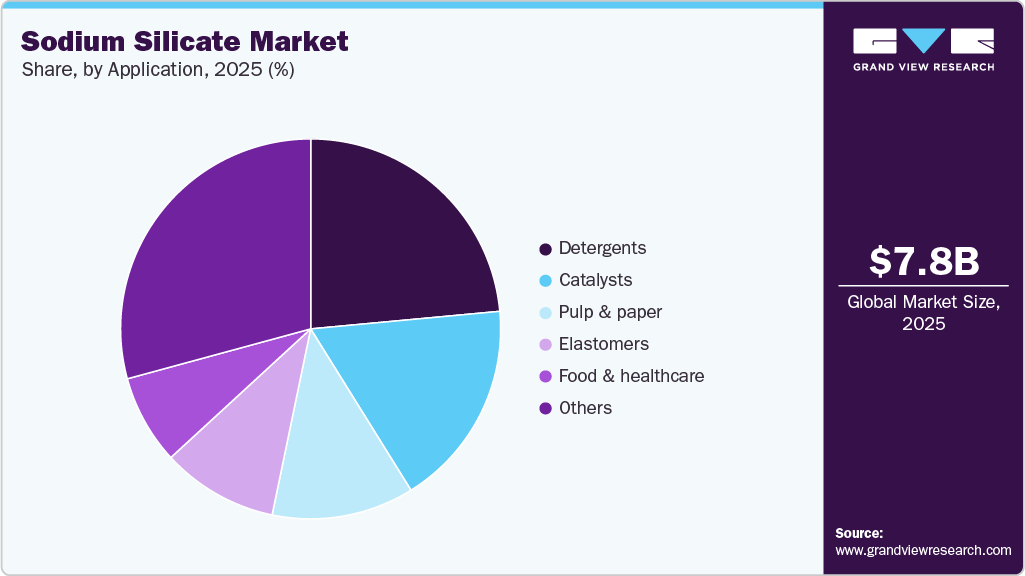 To learn more about this report, Download Free Sample Report
 The elastomers segment is fastest growing segment with a CAGR of 4.7%, in terms of revenue, during forecast period, due to sodium silicate’s role as a binder and strengthening agent in rubber and silicone products. Expansion in automotive, industrial, and construction applications is driving increased incorporation in elastomer-based solutions.
Regional Insights
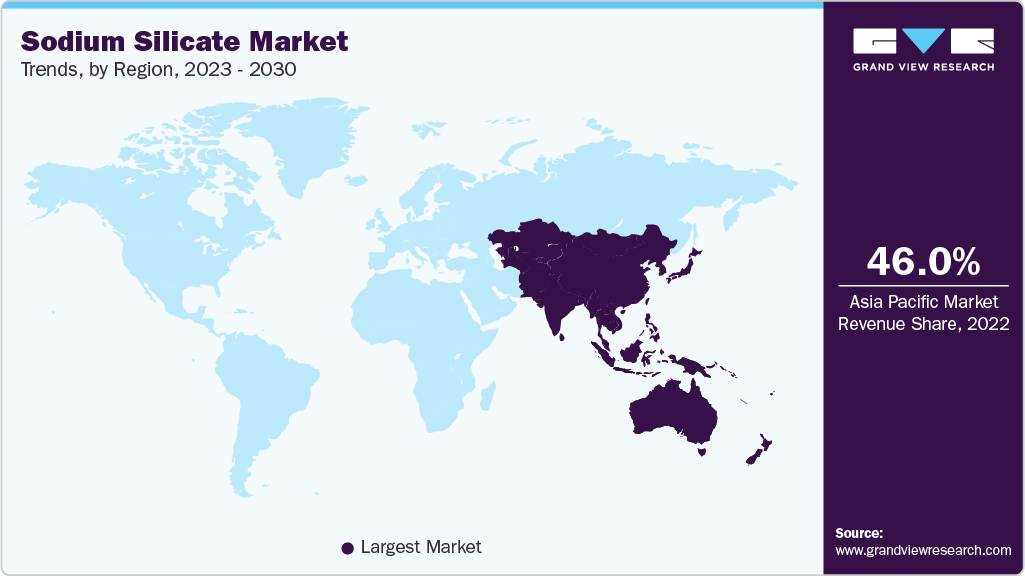
Asia Pacific is the leading sodium silicate market accounting for a revenue share of over 47.2% in 2025. driven by strong demand from detergents, construction, and industrial manufacturing sectors. Rapid urbanization, expanding infrastructure projects, and large-scale industrial production, particularly in emerging economies, continue to support high consumption levels across the region.
 To learn more about this report, Download Free Sample Report
 China Sodium Silicate Market Trends
China remains a key growth driver due to its large-scale manufacturing base and high consumption of detergents, construction materials, and industrial chemicals. Strong domestic production capacity and ongoing infrastructure development continue to position China as a major contributor to global demand.
North America Sodium Silicate Market Trends
The North American market is driven by steady demand from water treatment, detergents, and industrial applications. Stringent quality standards, coupled with ongoing investments in infrastructure maintenance and sustainable manufacturing practices, are sustaining consistent sodium silicate consumption.
The U.S. market is driven by sustained demand from detergents, water treatment, and specialty industrial applications. Focus on product quality, regulatory compliance, and replacement demand across mature industries is supporting stable sodium silicate consumption.
Europe Sodium Silicate Market Trends
Growth in Europe is supported by its well-established industrial base and increasing focus on environmentally compliant materials. Demand from construction, automotive, and cleaning product manufacturers, aligned with strict regulatory frameworks, is reinforcing market stability across the region.
The sodium silicate market in Germany is driven by strong demand from construction, automotive, and industrial manufacturing sectors. A well-established industrial base, combined with stringent quality and environmental standards, supports consistent adoption of sodium silicate in high-performance and compliant applications.
Latin America Sodium Silicate Market Trends
The sodium silicate market in Latin America is driven by gradual industrial expansion and rising construction activities. Increasing adoption in detergents and water treatment applications, particularly in developing economies, is contributing to steady market growth.
Middle East & Africa Sodium Silicate Market Trends
Market growth in the Middle East & Africa is supported by infrastructure development and expanding industrial activities. Rising investments in construction, water treatment, and basic manufacturing are creating new demand opportunities for sodium silicate across the region.
Key Sodium Silicate Company Insights
Sodium silicate market is dominated by Solvay S.A. and PQ Corporation, supported by strong production capabilities, diversified portfolios, and established global distribution networks.
-
Solvay S.A. maintains a strong position in the Sodium Silicate market through its diversified chemical portfolio and global manufacturing presence. The company’s focus on consistent quality and application-driven solutions supports demand across detergents, construction, and industrial segments.
-
PQ Corporation is a key player in the Sodium Silicate market, leveraging its specialization in silicates and advanced production capabilities. Its strong customer relationships and focus on performance-oriented products reinforce its leadership across industrial and cleaning applications.
-
In December 2025, Unison Metals Limited announced a ₹30-crore investment to set up a new sodium silicate manufacturing unit in Ahmedabad, strengthening its specialty chemicals portfolio and expanding capacity to meet growing demand from detergents and industrial applications.
Key Sodium Silicate Companies:
The following key companies have been profiled for this study on the sodium silicate market.
- Solvay S.A
- PQ Corporation
- Evonik Industries AG
- CIECH Group
- BASF SE
- PPG Industries, Inc
- W.R. Grace & Company
- Tokuyama Corporation
- Sinchem Silica Gel Co, Ltd.
- Shangyu Huachang Industrial Co., Ltd.
- hijiazhuang Shuanglian Chemical Industry Co. Ltd
- Nippon Chemical Industrial Co., Ltd.
- Huber Engineered Materials
- IQE Group
- Occidental Petroleum Corporation
Competitive Benchmarking
Operating Strategies
Competitive Edge
Weaknesses
Mature Players: PQ Corporation; Solvay S.A.; Evonik Industries AG; Tokuyama Corporation; CIECH Group; W. R. Grace & Company
- These companies are focusing on expanding specialty and industrial-grade sodium silicate applications across detergents, catalysts, silica derivatives, construction chemicals, pulp & paper, and water treatment sectors.
- Major players are investing in manufacturing optimization, sustainability initiatives, and specialty silicate technologies to strengthen value-added product portfolios.
- Companies are also expanding regional distribution capabilities and strengthening long-term relationships with industrial customers and downstream silica users.
- Large players possess established manufacturing infrastructure, strong technical expertise, and diversified specialty chemical portfolios.
- Strong brand recognition and long-standing relationships with detergent, catalyst, and construction chemical manufacturers support stable market positioning.
- Advanced R&D capabilities and integrated silica derivative operations provide competitive advantages in specialty applications.
- Energy-intensive production processes expose manufacturers to volatility in fuel and electricity costs.
- Large organizational structures may reduce responsiveness toward highly customized or small-volume regional requirements.
- Mature players face increasing environmental compliance and decarbonization pressures in Europe and North America.
Emerging Players: GHCL Limited; Shangyu Huachang; Magna Chemicals; J.M. Huber Corporation
- Emerging players are focusing on regional market expansion, cost-competitive sodium silicate production, and strengthening local supply capabilities for detergent, water treatment, and construction applications.
- Companies are increasingly emphasizing direct customer engagement, distributor partnerships, and niche industrial applications to improve regional penetration.
- Several players are also targeting downstream silicate and specialty chemical opportunities to enhance profitability.
- Flexible operating structures allow faster response to regional customer requirements and pricing-sensitive markets.
- Strong regional presence and localized supply chains support competitiveness in domestic markets.
- Lower operational complexity enables better adaptability in emerging industrial applications.
- Limited global distribution reach and smaller production capacities may restrict participation in large international supply contracts.
- Lower R&D spending and narrower specialty product portfolios may limit competitiveness in advanced silica and catalyst applications.
- Dependence on regional industrial demand may affect long-term scalability and export competitiveness.
Sodium Silicate Market Report Scope
Report Attribute
Details
Market size value in 2025
USD 7.8 billion
Estimated Market size in 2026
USD 8.1 bllion
Projected Market size by 2033
USD 10.4 billion
Growth rate
CAGR of 3.7% from 2026 to 2033
Base year for estimation
2025
Historical data
2018 - 2024
Forecast period
2026 - 2033
Quantitative units
Revenue in USD million/billion, volume in kilo tons and CAGR from 2026 to 2033
Report coverage
Revenue forecast, company ranking, competitive landscape, growth factors, and trends
Segments covered
Application, region
Regional scope
North America; Europe; Asia Pacific; Latin America; Middle East & Africa
Country scope
U.S.; Canada; Mexico; Germany; UK; France; Italy; Spain; Netherlands; Russia; Switzerland; China; India; Japan; South Korea; Australia; Thailand; Indonesia; Singapore; New Zealand; Philippines; Brazil; Argentina; Chile; UAE; Saudi Arabia; South Africa; Egypt; Iran
Key companies profiled
Solvay S.A; PQ Corporation; Evonik Industries AG; CIECH Group; BASF SE; PPG Industries, Inc; W.R. Grace & Company; Tokuyama Corporation; Sinchem Silica Gel Co, Ltd.; Shangyu Huachang Industrial Co., Ltd.; hijiazhuang Shuanglian Chemical Industry Co. Ltd; Nippon Chemical Industrial Co., Ltd.; Huber Engineered Materials; IQE Group; Occidental Petroleum Corporation
Customization scope
Free report customization (equivalent up to 8 analysts working days) with purchase. Addition or alteration to country, regional & segment scope.
Pricing and purchase options
Avail customized purchase options to meet your exact research needs. Explore purchase options
Global Sodium Silicate Market Report Segmentation
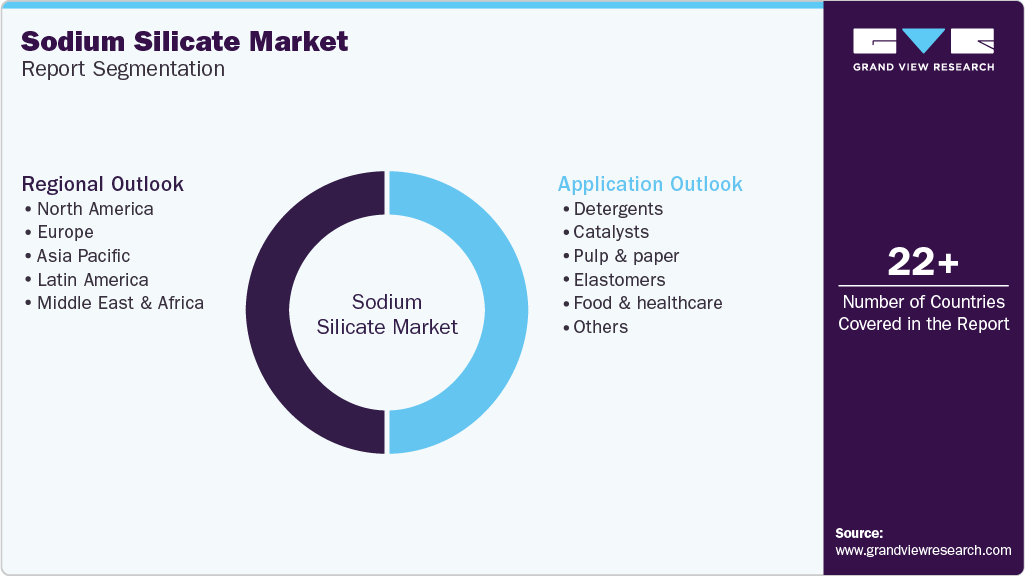
This report forecasts revenue growth at global, regional, and country levels and provides an analysis on the latest industry trends in each of the sub-segments from 2018 to 2033. For the purpose of this study, Grand View Research has segmented the global sodium silicate market report on the basis of application and region:
 To learn more about this report, Download Free Sample Report
 -
Application Outlook (Volume, KiloTons; Revenue, USD Million, 2018 - 2033)
-
Detergents
-
Catalysts
-
Pulp & paper
-
Elastomers
-
Food & healthcare
-
Others
-
-
Regional Outlook (Volume, KiloTons; Revenue, USD Million, 2018 - 2033)
-
North America
-
U.S.
-
Canada
-
Mexico
-
-
Europe
-
Germany
-
UK
-
Switzerland
-
France
-
Italy
-
Spain
-
Netherlands
-
Russia
-
-
Asia Pacific
-
China
-
India
-
Japan
-
South Korea
-
Australia
-
Thailand
-
Indonesia
-
Singapore
-
New Zealand
-
Philippines
-
-
Latin America
-
Brazil
-
Argentina
-
Chile
-
-
Middle East & Africa
-
UAE
-
Saudi Arabia
-
South Africa
-
Egypt
-
Iran
-
-
Delivered Customizations
This report has been delivered with the following In-depth customizations
Client Request
Customization Delivered
Value Adds
Trade Analysis
Detailed assessment of global sodium silicate trade flows using relevant HS code mapping, including export-import analysis, regional supply concentration, major producing countries, trade balance evaluation, and downstream demand linkage across detergents, construction chemicals, pulp & paper, water treatment, and silica applications. The study also evaluates logistics dynamics, the impact of energy costs, and regional trade competitiveness.
Provide visibility into supply dependency, export competitiveness, and regional sourcing dynamics. Support procurement optimization, capacity expansion planning, and identification of low-cost manufacturing and supply hubs.
Regional Segmentation
Comprehensive regional breakdown of sodium silicate consumption across North America, Europe, Asia Pacific, Latin America, and the Middle East & Africa, with country-level assessment of industrial demand trends, detergent production, construction activity, water treatment investments, and silica derivative consumption patterns.
Enable identification of the most attractive regional demand centers and industrial growth markets. Support regional expansion, distributor alignment, and long-term market prioritization strategies.
Competitive Benchmarking
Comparative evaluation of sodium silicate manufacturers based on production capacity, product portfolio, regional presence, downstream integration into silica derivatives, pricing competitiveness, sustainability initiatives, and industrial application focus. The analysis further includes vendor landscape mapping and strategic positioning across commodity and specialty silicate segments.
Support benchmarking against leading global and regional participants while identifying competitive gaps and partnership opportunities. Enable better understanding of manufacturing scale advantages, regional competitiveness, and strategic market positioning.
Frequently Asked Questions About This Report
Asia Pacific is the leading sodium silicate market accounting for a revenue share of over 47.2% in 2025. driven by strong demand from detergents, construction, and industrial manufacturing sectors. Rapid urbanization, expanding infrastructure projects, and large-scale industrial production, particularly in emerging economies, continue to support high consumption levels across the region.
Some key players operating in the sodium silicate market include Solvay S.A, PQ Corporation, Evonik Industries AG, CIECH Group, BASF SE, PPG Industries, Inc, W.R. Grace & Company, Tokuyama Corporation, Sinchem Silica Gel Co, Ltd., Shangyu Huachang Industrial Co., Ltd., hijiazhuang Shuanglian Chemical Industry Co. Ltd, Nippon Chemical Industrial Co., Ltd., Huber Engineered Materials, IQE Group, Occidental Petroleum Corporation.
The global sodium silicate market size was estimated at USD 7.8 billion in 2025 and is expected to reach USD 8.1 billion in 2026.
The global sodium silicate market is expected to grow at a compound annual growth rate of 3.7% from 2026 to 2033 to reach USD 10.4 billion by 2033.
The market is driven by its increasing use in detergents and household cleaning products. Its water-softening and stabilizing properties improve product efficiency and quality, supporting manufacturers in meeting rising consumer demand across both emerging and mature markets.
India is expected to be the fastest-growing market with a CAGR of 5.0% from 2026 to 2033.
The detergents segment led the market with a 23.5% revenue share in 2025, while elastomers is the fastest-growing application segment.
About the Author(s)
Organic Chemicals Research Team
Bulk Chemicals · Organic ChemicalsThis report was authored by the organic chemicals research team at Grand View Research - comprising two research analysts, one senior research analyst, and one industry expert - with specialized expertise in the organic chemicals segment of the bulk chemicals industry. All findings are based on proprietary bulk chemicals databases, executive interviews, and regulatory analysis, subject to internal peer review prior to publication.
Last Updated:
Speak to Analyst

Customize this report to your needs - add regions, segments, or data points, with 20% free customization.
Or view our licence options:


ISO 9001:2015 & 27001:2022 Certified
We are GDPR and CCPA compliant! Your transaction & personal information is safe and secure. For more details, please read our privacy policy.


