
- Home
- »
- Advanced Interior Materials
- »
-
South Korea Aerospace & Defense Test Equipment Market Report, 2033GVR Report cover

South Korea Aerospace & Defense Test Equipment Market (2026 - 2033)
Size, Share & Trends Analysis Report, By Product (Flight Test, Telemetry & Data Acquisition Equipment, Avionics & Electronic Test Equipment), By End Use (Aircraft & Avionics, Defense Systems), And Segment Forecasts
Market Size, 2025
$126.9MMarket Estimate, 2026
$135.1MMarket Forecast, 2033
$225.2MCAGR, 2026–2033
7.6%South Korea Aerospace & Defense Test Equipment Market Summary
The South Korea aerospace & defense test equipment market size was valued at USD 126.9 million in 2025 and is projected to grow from USD 135.1 million in 2026 to USD 225.2 million by 2033, at a CAGR of 7.6% from 2026 to 2033. The market is driven by rising investments in defense modernization, indigenous aerospace development, and advanced military technologies. The development of fighter aircraft, missile systems, unmanned aerial vehicles, and space platforms is increasing demand for specialized testing equipment to validate system performance, reliability, and compliance with defense specifications. Growing integration of advanced avionics, electronic systems, and propulsion technologies is further strengthening demand for flight testing, telemetry, data acquisition, and automated test solutions.
Key Market Trends & Insights
- By product: Avionics & electronic test equipment segment accounted for the largest revenue share in 2025, representing 21.9% of total market revenue.
- By end use: UAVs / unmanned systems segment is projected to register the fastest CAGR of 10.1% over the forecast period.
Market Size & Forecast
- Market Size in 2025: USD 126.9 Million
- Estimated market size in 2026: USD 135.1 million
- Projected Market Size by 2033: USD 225.2 Million
- CAGR (2026-2033): 7.6%
Three ways to get this report
Buy it, customize it, or ask a question.Ask an Analyst
Analyst response in 1 business day
- AccessReport author, directly
- Reply timeWithin 1 working day
- No sales callDirect answer only
- FormatEmail reply
- CostFree, no cost
Get the Full Report
What the study covers
- FormatsPDF · Excel · Dashboard
- Timeline2026–2033 annual, 2025 base
- Coverage20+ countries, 5 regions
- Companies10+ key players profiled
Customize the Report
20% free customization
- IncludeCountries, segments, points
- TailorTo your product definition
- ExtendDeeper competitor detail
- OrA fully bespoke study
- Turnaround5–10 working days
Additionally, the growing complexity of aerospace and defense platforms is increasing the need for integrated testing across electronic, mechanical, and software subsystems. The development of next-generation aircraft, autonomous platforms, and satellite systems requires precise evaluation of avionics, communication interfaces, structural integrity, and environmental performance.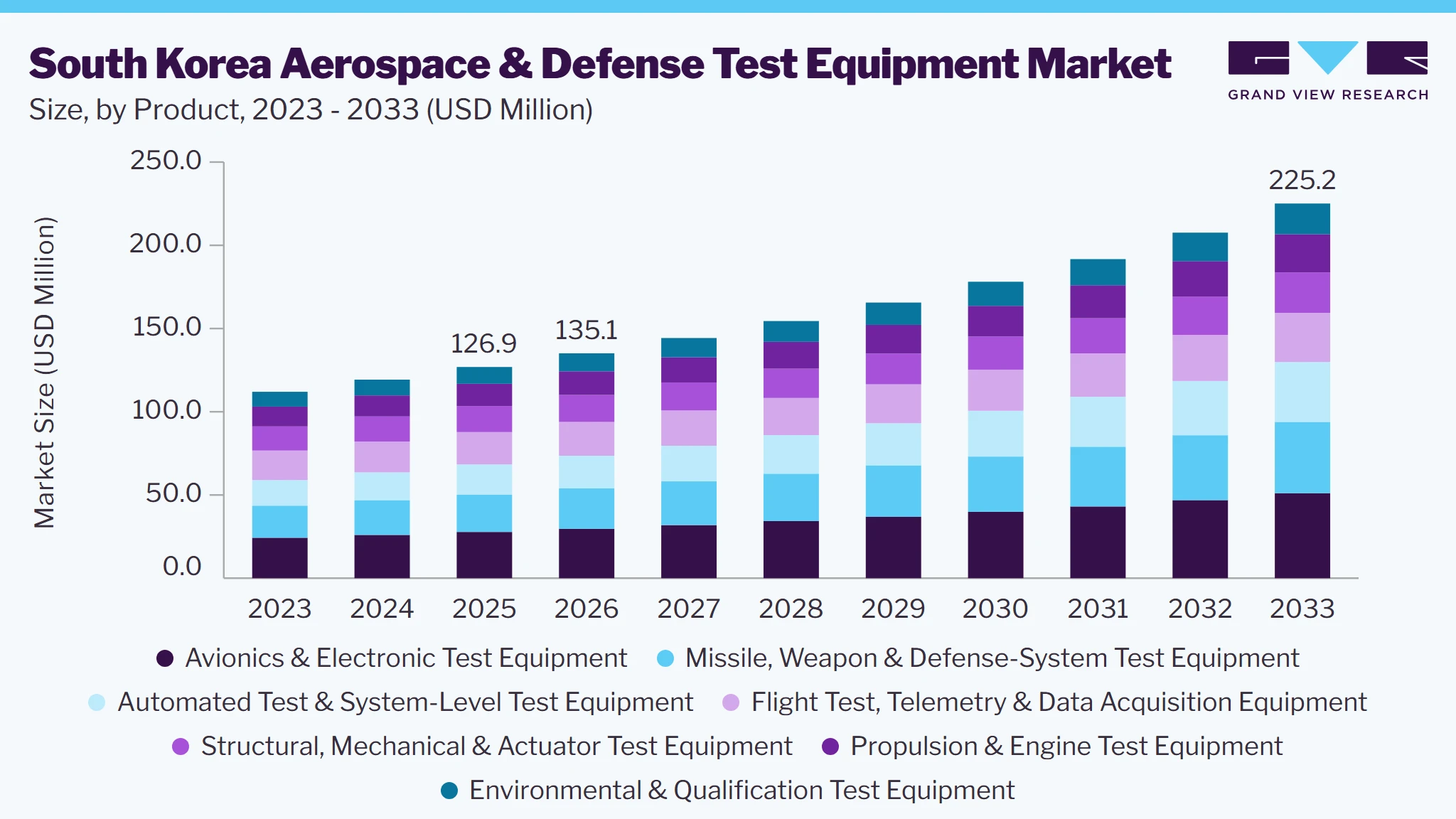 Source: Grand View Research, IR Documents, Primary Interviews, Paid DatabasesTo learn more about this report,
 Download Free Sample Report
These requirements are creating opportunities for suppliers of automated test systems, measurement instruments, and data acquisition equipment that support system qualification and domestic aerospace and defense development.
Market Dynamics
The South Korea aerospace & defense test equipment market is shaped by domestic defense procurement, indigenous aerospace development, and the increasing technical sophistication of military platforms. Demand patterns reflect the testing requirements for aircraft, missile systems, unmanned platforms, and space technologies, as well as stringent performance verification and qualification protocols. Market development is further influenced by the capital intensity of testing infrastructure, specialized engineering requirements, and the integration of advanced measurement and data analysis technologies across aerospace and defense applications.
South Korea’s emphasis on strengthening domestic defense production and aerospace engineering capabilities is generating demand for specialized test and evaluation equipment. Indigenous aircraft development, missile system production, and unmanned platform programs require comprehensive assessment of component performance, system functionality, and operational reliability. These activities necessitate specialized instrumentation, telemetry systems, electronic test equipment, and integrated measurement solutions throughout development and qualification stages.
The procurement and deployment of aerospace and defense testing equipment involve substantial capital commitments for specialized instruments, system integration, calibration, and maintenance. Stringent qualification protocols and application-specific performance requirements can extend procurement cycles, delaying equipment deployment and commercial returns. These constraints may be particularly pronounced for smaller suppliers seeking to establish credibility in technically demanding applications, where compliance verification and demonstrated equipment reliability are prerequisites for adoption.
The increasing complexity of avionics, electronic warfare systems, autonomous platforms, and interconnected defense subsystems creates opportunities for digitally integrated testing solutions. Automated test platforms that combine synchronized data acquisition, programmable measurement functions, and software-based analysis can facilitate the evaluation of multiple system parameters within a unified testing architecture.
Market Concentration & Characteristics
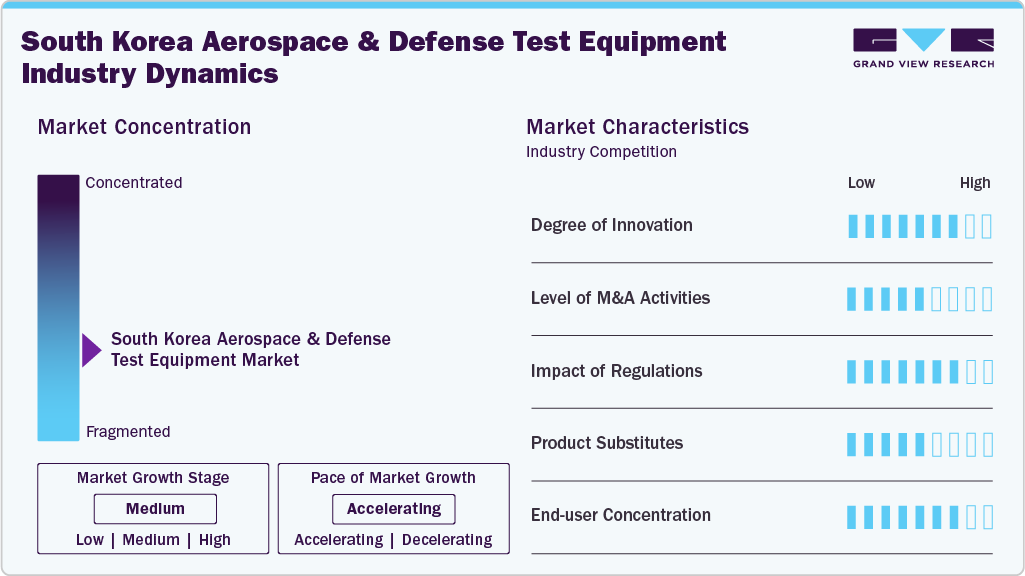
The South Korea aerospace & defense test equipment market exhibits a moderately concentrated competitive structure, comprising established defense electronics manufacturers, specialized testing equipment providers, and international instrumentation suppliers. Competition varies across flight testing, avionics evaluation, missile and defense-system testing, propulsion assessment, and automated test solutions. Domestic defense development programs and relationships with aerospace manufacturers influence supplier positioning, while specialized companies compete through technical expertise and application-specific testing capabilities.
 To learn more about this report, Download Free Sample Report
Product portfolios differ in measurement accuracy, system configuration, data acquisition capabilities, testing capacity, and compatibility with aerospace and defense platforms. Automated test systems, telemetry equipment, electronic measurement instruments, and structural evaluation solutions address distinct validation requirements. Manufacturers differentiate through system integration, configurable testing architectures, calibration precision, and compatibility with existing test infrastructure.
Market characteristics reflect South Korea’s defense modernization priorities and the development of indigenous aircraft, unmanned systems, missile technologies, and space platforms. Procurement decisions are shaped by technical compliance, equipment reliability, qualification requirements, lifecycle support, and integration complexity. High engineering costs and lengthy evaluation procedures create barriers to entry, while established technical relationships and the ability to meet program-specific specifications influence competitive positioning.
Analyst Perspective
The South Korea aerospace & defense test equipment market is characterized by specialized procurement requirements, stringent validation protocols, and close alignment with the country’s indigenous aerospace and defense development programs. Demand is shaped by investments in military aircraft, missile systems, unmanned platforms, and space technologies, each requiring application-specific testing capabilities throughout development, integration, and qualification. Competitive positioning depends on measurement accuracy, interoperability with complex platforms, compliance with military specifications, and the ability to deliver customized testing architectures. Domestic defense manufacturers and specialized technology providers occupy distinct roles across this landscape, supplying integrated test systems, electronic instrumentation, and subsystem-level verification solutions.
Product Insights
The avionics & electronic test equipment segment accounted for the largest revenue share of the South Korea aerospace & defense test equipment market. Its leading position reflects the extensive verification requirements associated with aircraft electronics, navigation systems, communication equipment, and mission-critical defense electronics. Increasing system complexity and stringent performance specifications sustain demand for precision measurement and functional validation capabilities.
The automated test & system-level test equipment segment is projected to register the fastest CAGR of 9.1% over the forecast period. The growing integration of hardware, software, and electronic subsystems across modern defense platforms is increasing the need for coordinated testing procedures. Automated solutions facilitate repeatable test execution, synchronized data acquisition, and integrated performance assessment, supporting their adoption across aerospace and defense development programs.
End Use Insights
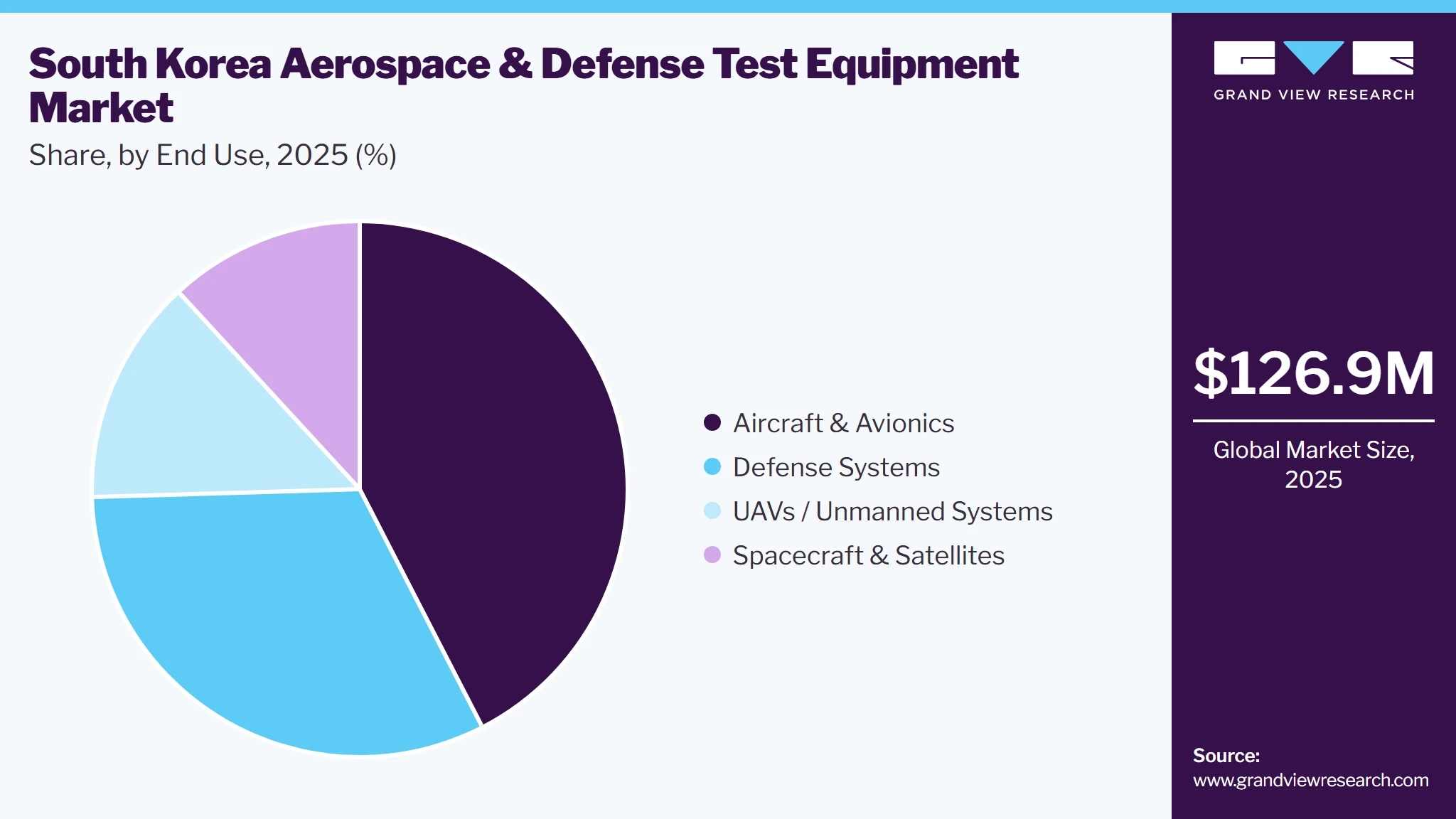
The aircraft & avionics segment accounted for the largest revenue share of 42.4% in 2025. The segment's position reflects the extensive testing requirements associated with aircraft development, avionics integration, flight-control systems, navigation equipment, and onboard communication technologies. Aircraft qualification involves comprehensive assessments of electronic functionality, structural performance, and component reliability under specified operating conditions.
 To learn more about this report, Download Free Sample Report
The UAVs / unmanned systems segment is projected to register the fastest growth over the forecast period. Expanding defense applications in surveillance, reconnaissance, intelligence gathering, and autonomous operations are increasing the need to validate flight-control systems, navigation accuracy, communication links, and onboard sensors. The integration of autonomous functions and interconnected electronic components introduces additional testing requirements related to system interoperability, operational stability, and performance under varying environmental conditions.
Key South Korea Aerospace & Defense Test Equipment Market Company Insights
Some of the key players operating in the market include Hanwha Systems, Intersoft Electronics NV, Ascential Technologies, and REALTIMEWAVE Co., Ltd.
-
Hanwha Systems is a South Korea-based defense electronics and information technology company with capabilities spanning surveillance and reconnaissance, command and control, avionics, and satellite-related technologies. Its portfolio supports the development and integration of mission-critical electronic systems for military and aerospace applications. The company’s expertise in defense electronics and complex system integration positions it within the broader aerospace and defense testing ecosystem, particularly where electronic subsystem validation and platform-level performance assessment are required.
-
Intersoft Electronics NV is a Belgium-based technology company specializing in radar test and measurement systems, radar signal simulation, and electronic warfare-related testing solutions. Its portfolio includes specialized equipment for evaluating radar performance and supporting the development, verification, and maintenance of radar systems. The company’s expertise in radar instrumentation and simulation addresses the testing requirements of defense electronics and surveillance technologies, particularly applications requiring controlled signal generation, measurement precision, and system performance analysis.
Key South Korea Aerospace & Defense Test Equipment Market Companies
-
Hanwha Systems
-
Intersoft Electronics NV
-
Ascential Technologies
-
KYUNG SUNG MACHINERY TECHNOLOGY CP., LTD
-
REALTIMEWAVE Co., Ltd.
-
FLEXSYSTEM
-
Aviosys Technologies Co., Ltd
-
CAPHMICRO Inc.
-
JLABS. INC.
-
kistler group
Competitive Benchmarking
Category
Operating Strategies
Competitive Edge
Weakness
Established Players (e.g., Hanwha Systems; Intersoft Electronics NV; Kistler Group; FLEXSYSTEM)
- Diversify testing capabilities across defense electronics, flight-test instrumentation, telemetry, propulsion evaluation, and precision measurement to address requirements across aerospace and military platforms.
- Strengthen engineering competencies, system integration, and technical collaborations to meet stringent testing and qualification specifications.
- Specialized expertise in defense electronics, instrumentation, measurement technologies, and aerospace testing supports technically demanding applications.
- Experience in complex testing environments and established industry relationships can facilitate integration into customer-specific testing programs.
- Substantial research and development expenditure and rigorous qualification procedures can increase operating costs and prolong product commercialization.
- Complex integration requirements and application-specific customization necessitate sustained investment in engineering and technical support.
Emerging & Regional Players (e.g., Ascential Technologies; KYUNG SUNG MACHINERY TECHNOLOGY CO., LTD.; REALTIMEWAVE Co., Ltd.; Aviosys Technologies Co., Ltd.; CAPHMICRO Inc.; JLABS, Inc.)
- Concentrate on specialized testing applications, including automated validation, data acquisition, electronic instrumentation, and component-level evaluation.
- Develop configurable solutions and pursue technical collaborations with aerospace manufacturers, defense contractors, and research organizations to address defined program requirements.
- Application-oriented engineering and configurable testing architectures enable alignment with specialized technical specifications.
- Focused product development and flexible solution configuration can support responsiveness to customer-specific testing requirements.
- Constraints in portfolio diversification, resource availability, and international distribution may restrict access to large-scale procurement programs.
- Lengthy qualification processes, project-dependent demand, and the need to establish technical credibility can impede commercial expansion.
Recent Developments:
-
In April 2025, REALTIMEWAVE announced an AI-based platform for aerospace system-integration testing that incorporates automated test-data processing, scenario comparison and classification, and AI-based anomaly detection. The platform supports Hardware-in-the-Loop (HILS) and Software-in-the-Loop (SILS) testing, enabling engineers to examine system behavior across simulated operating conditions and identify deviations during validation.
-
In September 2026, Kistler Group introduced KiBox Lab, an integrated multi-channel charge amplification and data acquisition system engineered for high-precision dynamic measurement applications. The platform incorporates 16 configurable input channels, low-noise signal conditioning, and sampling rates of up to 2.5 MSps per channel, enabling the capture of transient measurement signals with high fidelity.
South Korea Aerospace & Defense Test Equipment Market Report Scope
Report Attribute
Details
Market size in 2025
USD 126.9 million
Estimated market size in 2026
USD 135.1 million
Projected market size by 2033
USD 225.2 million
Growth rate
CAGR of 7.6% from 2026 to 2033
Base year for estimation
2025
Historical data
2021 - 2024
Forecast period
2026 - 2033
Quantitative units
Revenue in USD million and CAGR from 2026 to 2033
Report coverage
Revenue forecast, company market position analysis, competitive landscape, growth factors, and trends
Segments covered
Product, end use
Key companies profiled
Hanwha Systems; Intersoft Electronics NV ; Ascential Technologies; KYUNG SUNG MACHINERY TECHNOLOGY CP., LTD; REALTIMEWAVE Co., Ltd. ; FLEXSYSTEM; Aviosys Technologies Co., Ltd; CAPHMICRO Inc.; JLABS. INC.; kistler group
Customization scope
Free report customization (equivalent up to 8 analysts working days) with purchase. Addition or alteration to segment scope.
Pricing and purchase options
Avail customized purchase options to meet your exact research needs. Explore purchase options
South Korea Aerospace & Defense Test Equipment Market Report Segmentation
This report forecasts revenue growth at country levels and provides an analysis of the latest industry trends in each of the sub-segments from 2021 to 2033. For this study, Grand View Research has segmented the South Korea aerospace & defense test equipment market based on product and end use.
-
Product Outlook (Revenue, USD Million, 2021 - 2033)
-
Flight Test, Telemetry & Data Acquisition Equipment
-
Avionics & Electronic Test Equipment
-
Missile, Weapon & Defense-System Test Equipment
-
Structural, Mechanical & Actuator Test Equipment
-
Propulsion & Engine Test Equipment
-
Environmental & Qualification Test Equipment
-
Automated Test & System-Level Test Equipment
-
-
End Use Outlook (Revenue, USD Million, 2021 - 2033)
-
Aircraft & Avionics
-
Defense Systems
-
UAVs / Unmanned Systems
-
Spacecraft & Satellites
-
Research Methodology
The South Korea aerospace & defense test equipment market figures in this report are based on a proven research process that combines executive interviews with secondary research from proprietary databases, company filings, and recognized regulatory and institutional sources. Market size is built through value-chain sizing—reconciling supply-side and demand-side estimates—and triangulated with bottom-up and top-down approaches. Every estimate passes multiple levels of expert validation before publication, with each South Korea test and evaluation equipment segment for aerospace & defense quantified using the revenue-capture definitions in the table below.
Segment Definition
Product
Revenue Capture Definition
Flight Test, Telemetry & Data Acquisition Equipment
Revenue generated from the sale of flight test instrumentation, telemetry systems, and data acquisition equipment for measuring and recording flight-test parameters.
Avionics & Electronic Test Equipment
Revenue generated from the sale of avionics testers, electronic measurement instruments, and communication and navigation system testing equipment.
Missile, Weapon & Defense-System Test Equipment
Revenue generated from the sale of missile, weapon, guidance, and defense-system testing equipment for performance verification and functional assessment.
Structural, Mechanical & Actuator Test Equipment
Revenue generated from the sale of structural testing systems, mechanical test instruments, and actuator testing equipment for component integrity and performance evaluation.
Propulsion & Engine Test Equipment
Revenue generated from the sale of propulsion test systems, engine test stands, and associated instrumentation for evaluating engine performance and operating parameters.
Environmental & Qualification Test Equipment
Revenue generated from the sale of environmental test chambers, vibration and shock testing systems, and qualification equipment for assessing equipment durability under specified conditions.
Automated Test & System-Level Test Equipment
Revenue generated from the sale of automated test platforms, integrated test benches, and system-level testing equipment for verifying subsystem and system performance.
End Use
Revenue Capture Definition
Aircraft & Avionics
Revenue generated from the sale of test and evaluation equipment for aircraft structures, flight controls, avionics, navigation, and communication systems.
Defense Systems
Revenue generated from the sale of test and evaluation equipment for military platforms, weapons, missiles, radar, and electronic defense systems.
UAVs / Unmanned Systems
Revenue generated from the sale of test and evaluation equipment for unmanned aircraft, flight control systems, navigation, communication links, and onboard subsystems.
Spacecraft & Satellites
Revenue generated from the sale of test and evaluation equipment for spacecraft and satellite components, avionics, propulsion systems, and environmental qualification.
Estimation Model
Layer No.
Layer Name
Key Question
Description
01
End-Use Demand Assessment Layer
Which aerospace and defense applications generate demand for test and evaluation equipment?
Examines demand across aircraft and avionics, defense systems, UAVs and unmanned systems, and spacecraft and satellites. The assessment considers domestic platform development, production and integration programs, maintenance activities, and equipment qualification requirements that necessitate specialized testing capabilities.
02
Testing Requirements & Equipment Specification Layer
What technical requirements determine the selection of test and evaluation equipment?
Evaluates testing requirements across flight instrumentation, telemetry, avionics, weapon systems, structural components, propulsion systems, and environmental qualification. The analysis considers platform specifications, measurement precision, testing protocols, subsystem complexity, and system-level verification requirements in determining equipment needs.
03
Equipment Procurement, Adoption & Replacement Layer
How are test systems adopted, upgraded, and replaced across aerospace and defense programs?
Assesses procurement patterns for specialized and automated testing equipment, considering installed testing infrastructure, technological obsolescence, equipment utilization, calibration requirements, modernization programs, and replacement cycles. The analysis also examines the adoption of integrated testing platforms to address evolving system complexity and qualification standards.
04
Revenue & Market Estimation Layer
What is the revenue generated by test and evaluation equipment across the South Korean aerospace and defense industry?
Quantifies market revenue by product and end use using supplier-level sales, equipment procurement volumes, average selling prices, and replacement demand. Market estimates are developed through top-down and bottom-up approaches, with historical trend assessment, data triangulation, and primary research validation to establish market size and forecast growth.
Delivered Customizations
This report has been delivered with the following In-depth customizations
CLIENT REQUEST
CUSTOMIZATION DELIVERED
VALUE ADDS
Competitive Benchmarking
Conducted a structured assessment of manufacturers and suppliers operating in the South Korea test and evaluation equipment for aerospace and defense market. The evaluation covered product portfolios, technical capabilities, equipment specifications, system integration competencies, and strategic developments across flight testing, avionics, weapon systems, propulsion, environmental qualification, and automated testing.
Established a comparative view of supplier capabilities and competitive differentiation, supporting portfolio evaluation, competitor positioning, and strategic decision-making.
Regional Segmentation
Developed a detailed market assessment across seven product categories and four end-use segments: aircraft and avionics, defense systems, UAVs and unmanned systems, and spacecraft and satellites. The analysis examined domestic aerospace and defense programs, procurement requirements, testing infrastructure, and platform-specific validation needs.
Provided segment-level insights into demand distribution and procurement priorities, enabling informed market prioritization, customer segmentation, and commercial planning.
Opportunity Assessment
Evaluated prospective opportunities arising from defense modernization, indigenous platform development, unmanned systems, and space programs. The assessment examined requirements for advanced instrumentation, integrated test systems, automated verification platforms, and modernization of existing testing infrastructure.
Identified potential areas for revenue generation and technology investment, supporting product portfolio planning, market-entry assessments, and long-term expansion strategies within South Korea’s aerospace and defense testing ecosystem.
Frequently Asked Questions About This Report
Growing demand for integrated and automated testing solutions, digital instrumentation, synchronized data acquisition, programmable measurement functions, and software-based analysis is creating opportunities for suppliers of advanced test and evaluation systems.
The South Korea aerospace & defense test equipment market is expected to grow at a CAGR of 7.6% from 2026 to 2033, reaching USD 225.2 million by 2033.
Avionics & electronic test equipment dominated the product type segment with a revenue share of 21.9% in 2025, supported by increasing testing requirements for aircraft electronics, navigation systems, communication equipment, and mission-critical defense electronics.
Automated test & system-level test equipment is projected to register the fastest CAGR of 9.1% during the forecast period, driven by the increasing integration of hardware, software, and electronic subsystems across modern aerospace and defense platforms.
Aircraft & avionics dominated the end-use segment with a revenue share of 42.4% in 2025, reflecting extensive testing requirements associated with aircraft development, avionics integration, flight-control systems, navigation equipment, and onboard communication technologies.
UAVs / unmanned systems are projected to register the fastest CAGR of 10.1% during the forecast period, driven by expanding defense applications in surveillance, reconnaissance, intelligence gathering, and autonomous operations.
Key players include Hanwha Systems, Intersoft Electronics NV, Ascential Technologies, KYUNG SUNG MACHINERY TECHNOLOGY CP., LTD, REALTIMEWAVE Co., Ltd., FLEXSYSTEM, Aviosys Technologies Co., Ltd., CAPHMICRO Inc., JLABS. INC., and kistler group.
The market is driven by the expansion of indigenous aerospace and defense manufacturing, increasing investment in aerospace and space programs, defense modernization, development of aircraft and missile systems, growth of unmanned platforms, and increasing demand for specialized testing and evaluation equipment.
The South Korea aerospace & defense test equipment market size was valued at USD 126.9 million in 2025 and is estimated at USD 135.1 million for 2026.
About the Author(s)
Advanced Interior Materials Research Team
Advanced Materials · Advanced Interior MaterialsThis report was authored by the advanced interior materials research team at Grand View Research - comprising two research analysts, one senior research analyst, and one industry expert - with specialized expertise in the advanced interior materials segment of the advanced materials industry. All findings are based on proprietary advanced materials databases, executive interviews, and regulatory analysis, subject to internal peer review prior to publication.
Last Updated:
Speak to Analyst

Customize this report to your needs - add regions, segments, or data points, with 20% free customization.
Or view our licence options:


ISO 9001:2015 & 27001:2022 Certified
We are GDPR and CCPA compliant! Your transaction & personal information is safe and secure. For more details, please read our privacy policy.


