
- Home
- »
- Next Generation Technologies
- »
-
Space Camera Market Size And Share Report, 2026-2033GVR Report cover

Space Camera Market (2026 - 2033)
Size, Share & Trends Analysis Report By Application, By Type (Satellite Cameras, CubeSat Cameras, Onboard Spacecraft Cameras), By Technology (Electro-Optical (EO), Infrared (IR)), By End Use, By Region, And Segment Forecasts
Market Size, 2025
$3.0BMarket Estimate, 2026
$3.4BMarket Forecast, 2033
$10.2BCAGR, 2026–2033
16.8%Space Camera Market Summary
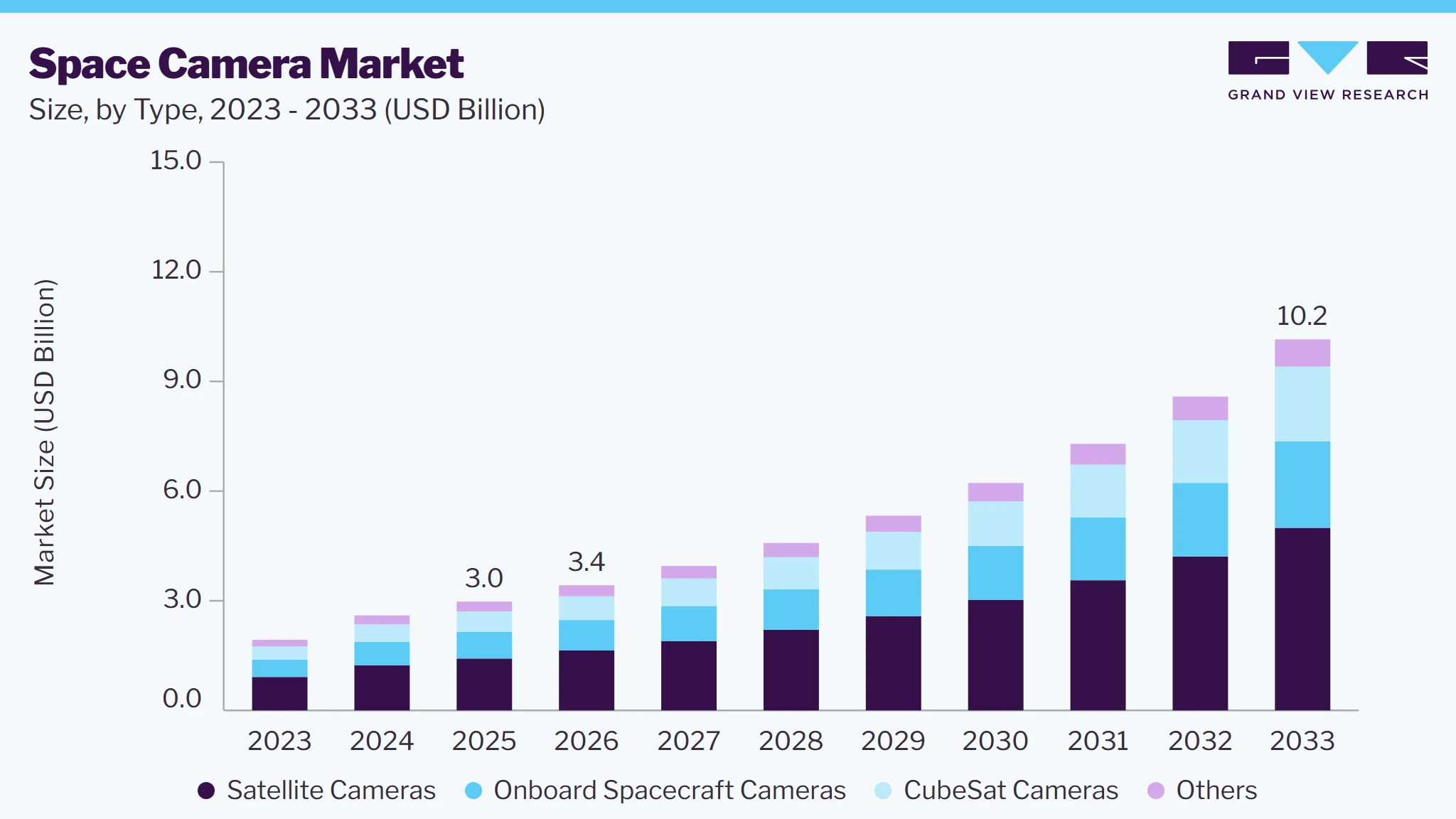
The global space camera market size was valued at USD 3.0 billion in 2025 and is projected to grow from USD 3.4 billion in 2026 to USD 10.2 billion by 2033, at a CAGR of 16.8% from 2026 to 2033. North America dominated the market, accounting for a revenue share of 40.6% in 2025. The space camera market is driven by rising satellite launches, increasing investments in Earth observation and deep-space exploration missions, and growing demand for high-resolution space imaging technologies.
 Source: Grand View Research, IR Documents, Primary Interviews, Paid DatabasesTo learn more about this report,
 Download Free Sample Report
Key Market Trends & Insights
- By application: Earth observation and remote sensing segment dominated the market, with a share of 34.5% in 2025.
- By type: Satellite cameras segment accounted for the largest market share of 47.7% in 2025.
- By technology: Electro-optical (EO) cameras segment dominated the market with a revenue share of 41.1% in 2025.
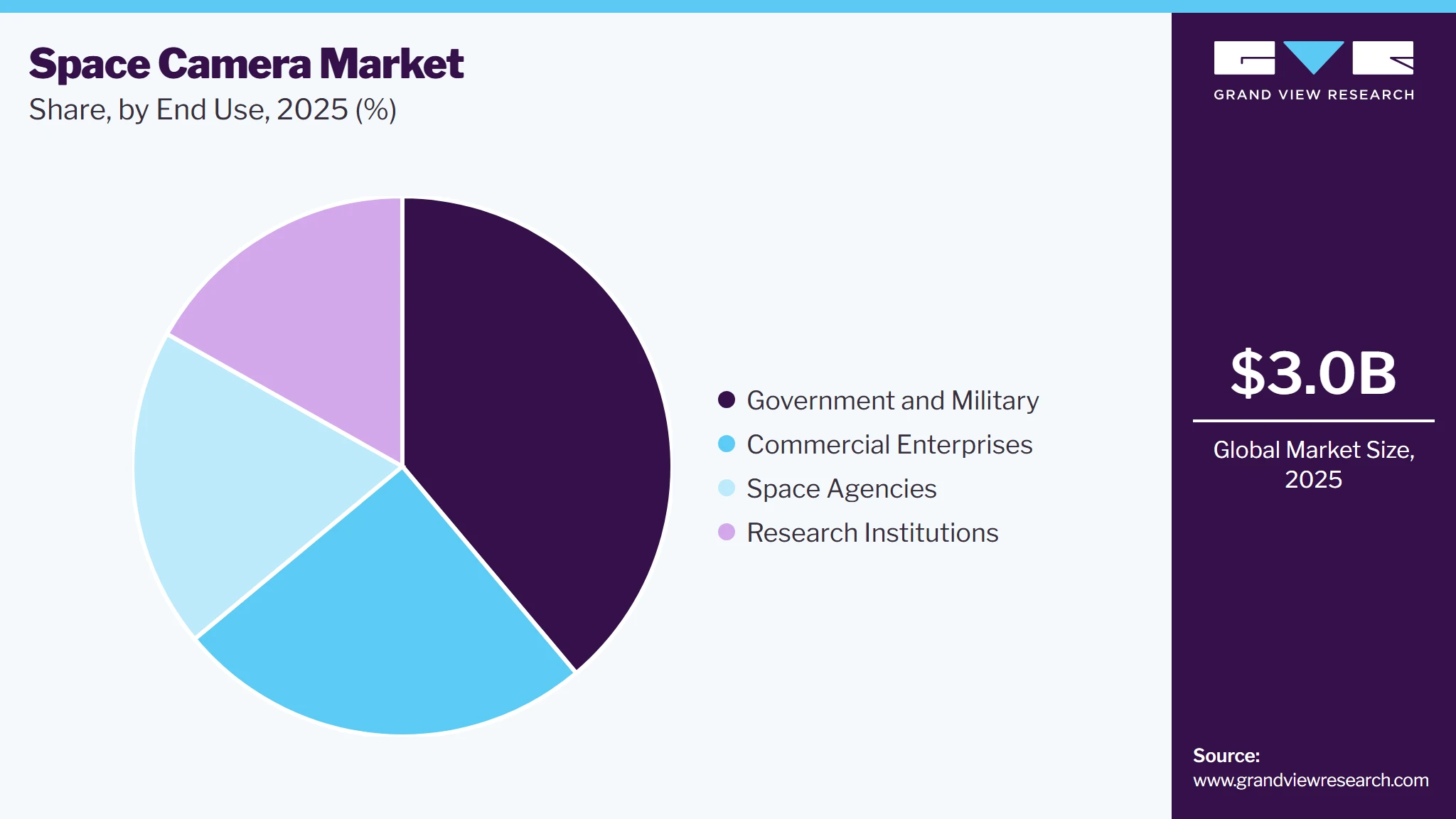
- By end use: Government and military segment accounted for the largest market share of 38.9% in 2025.
Regional Highlights
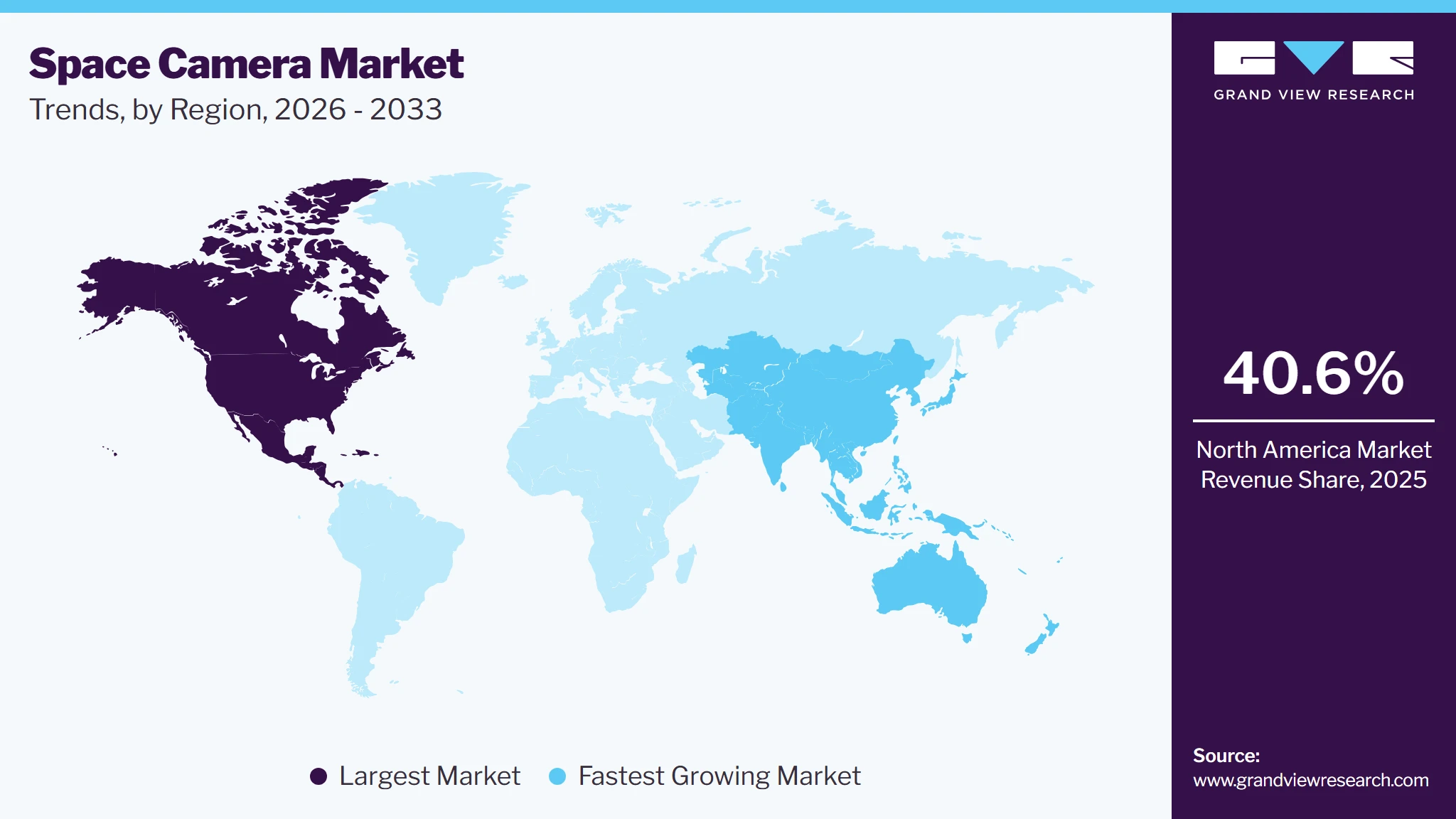
- Largest regional market: North America (40.6% revenue share in 2025)
- Fastest growing regional market: Asia Pacific (highest CAGR, 2026-2033)
- By Country: The U.S. held the largest market share in 2025.
Market Size & Forecast
- Market size in 2025: USD 3.0 Billion
- Estimated market size in 2026: USD 3.4 Billion
- Projected market size by 2033: USD 10.2 Billion
- CAGR (2026-2033): 16.8%
Prism AI by Grand View Research Free to tryAsk a question about the space camera marketTry asking✓Every figure cited from GVR research Prefer the report? Download free sample →
The expanding deployment of space cameras across commercial satellites, defense reconnaissance platforms, planetary missions, and CubeSats enhances imaging accuracy, supports scientific research, improves situational awareness, and enables advanced remote sensing capabilities, thereby accelerating market adoption. The rising demand for high-resolution imaging across sectors such as scientific research, defense, and commercial applications is a key factor fueling expansion. Governments and private space companies, including NASA, ESA, and SpaceX, are investing in next-generation imaging technologies to enhance planetary exploration, space station monitoring, and satellite-based data analytics.In addition, the rapid deployment of small satellites and CubeSats has accelerated the need for lightweight, high-performance cameras equipped with advanced sensors, enabling real-time imaging and improved operational efficiency in space.
 To learn more about this report, Download Free Sample Report
The space camera industry plays a crucial role in advancing human and robotic exploration beyond Earth. High-resolution space cameras are essential for capturing images of distant celestial bodies, studying exoplanets, and supporting lunar and Martian missions. As space exploration accelerates, the demand for advanced imaging systems capable of withstanding harsh environments continues to grow. Future missions to the Moon, Mars, and beyond will rely on cutting-edge space cameras to deliver valuable scientific data, highlighting the ongoing innovation in space imaging technologies.
The rising interest in space tourism and lunar missions is also driving the development of ultra-durable, radiation-resistant imaging systems. Emerging technologies, such as AI-powered image processing and real-time data transmission, are transforming the industry by improving accuracy and operational efficiency. As competition among space-tech companies intensifies, advancements in sensor technology, miniaturization, and cost-effective production will continue to shape market growth through 2030.
Beyond exploration, the defense and intelligence sectors are increasingly utilizing high-resolution space cameras for surveillance and reconnaissance. These imaging systems are being deployed to monitor geopolitical activities, enhance border security, and enable early threat detection. Governments and military organizations are heavily investing in advanced imaging satellites to bolster national security, making real-time intelligence gathering through space cameras a critical asset. This trend is expected to drive further R&D in space-based surveillance technologies.
The adoption of 3D imaging and LiDAR technologies is also expanding within the space camera industry. These innovations enable accurate topographic mapping, asteroid surface analysis, and spacecraft navigation. 3D imaging systems provide essential depth perception for autonomous landing and rover missions, while LiDAR-equipped space cameras offer precise distance measurement and terrain mapping capabilities. As these technologies continue to evolve, they are becoming indispensable for scientific research and planetary reconnaissance.
One of the most critical challenges in space camera design is radiation resistance. Prolonged exposure to cosmic radiation can degrade camera sensors and reduce image quality. To address this, manufacturers are developing radiation-hardened sensors and advanced shielding techniques to enhance camera durability. These innovations are crucial for long-duration missions, including Mars exploration and deep-space probes, ensuring sustained performance in extreme space environments.
The industry is also embracing artificial intelligence (AI) to enhance image processing and data analysis. AI-powered space cameras can autonomously detect anomalies, identify objects, and filter out redundant data before transmission, significantly reducing bandwidth usage and improving real-time decision-making. These AI-driven analytics are particularly valuable for deep-space exploration and military surveillance, optimizing the efficiency and functionality of space imaging systems.
Market Dynamics
The space camera market is witnessing steady growth, driven by increasing deployment of satellite constellations, rising investments in next-generation space imaging payloads, and expanding government and commercial space missions. Growing demand for high-resolution optical imaging, space-based surveillance, planetary exploration, and climate monitoring is accelerating the adoption of advanced space camera systems across satellites, spacecraft, and lunar missions. Continuous advancements in radiation-hardened sensors, lightweight optics, onboard image processing, hyperspectral imaging, and autonomous imaging technologies are improving mission performance, data quality, and operational reliability, creating significant long-term opportunities for the global space camera market.
The increasing deployment of earth observation satellite constellations by government agencies, defense organizations, and commercial operators is significantly driving demand for advanced space cameras. Operators require high-resolution optical payloads capable of delivering frequent, accurate, and wide-area imagery for applications such as environmental monitoring, border surveillance, disaster assessment, agricultural analysis, and urban planning. This expanding constellation ecosystem is accelerating procurement of compact, lightweight, and high-performance imaging systems.
The emergence of small satellites and CubeSats has further strengthened the demand for space-qualified cameras that offer superior image quality while meeting strict size, weight, and power requirements. Manufacturers are introducing radiation-resistant sensors, advanced optical assemblies, and onboard image-processing capabilities to improve imaging performance throughout extended missions. These technological developments enable satellite operators to deliver faster data acquisition, improved revisit rates, and enhanced mission reliability across diverse orbital environments.
Space cameras must operate reliably under extreme radiation, vacuum, thermal cycling, and vibration conditions, making qualification and validation processes highly complex. Every imaging system undergoes extensive environmental testing and certification before launch, increasing development timelines and engineering complexity. These stringent performance requirements create significant barriers for new manufacturers and delay the commercialization of innovative imaging technologies.
The use of specialized radiation-hardened components, precision optical assemblies, and space-grade electronics substantially increases manufacturing costs compared with terrestrial imaging systems. In addition, limited launch opportunities and the inability to repair hardware after deployment require exceptionally high reliability standards. These factors elevate development risks, extend product qualification cycles, and restrict rapid technology adoption within commercial and scientific space missions.
Increasing investments in lunar exploration, Mars missions, asteroid studies, and space observatories are creating new opportunities for advanced space camera technologies. Scientific missions require imaging systems capable of operating over extended durations while capturing highly detailed surface features, geological formations, atmospheric phenomena, and celestial observations. Demand is rising for cameras that combine exceptional image resolution with long-term operational stability in harsh deep-space environments.
Advancements in hyperspectral imaging, ultra-sensitive detectors, autonomous image processing, and lightweight optical systems are enabling next-generation scientific payloads for exploration missions. Public space agencies and private exploration companies are expanding collaboration to develop sophisticated spacecraft carrying specialized imaging instruments. These initiatives are increasing demand for innovative camera platforms capable of supporting navigation, scientific discovery, terrain mapping, and autonomous mission operations beyond Earth orbit.
Market Concentration & Characteristics
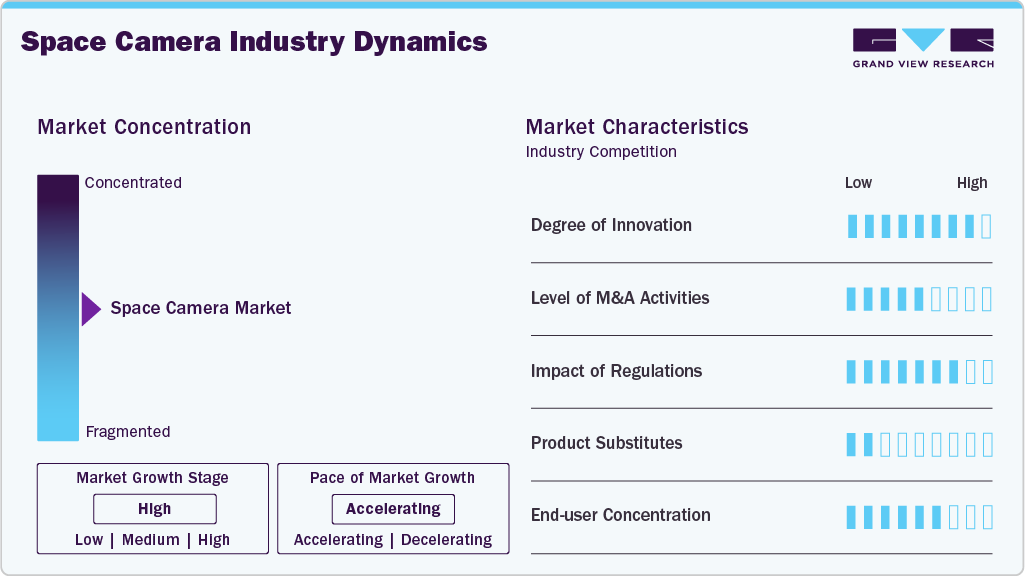
The space camera market is moderately concentrated, with established aerospace imaging manufacturers, satellite payload developers, optical system providers, sensor technology companies, and space electronics suppliers competing across Earth observation, scientific research, defense reconnaissance, planetary exploration, navigation, and commercial satellite applications. Increasing investments in satellite constellations, national space programs, and commercial space infrastructure are supporting market expansion. Companies are strengthening their competitive positions through strategic partnerships, payload integration agreements, optical technology advancements, and continuous investments in miniaturized imaging payloads, adaptive optics, radiation-tolerant electronics, edge-based image processing, and ultra-high-resolution imaging systems.
 To learn more about this report, Download Free Sample Report
The market is characterized by a high degree of innovation, supported by continuous advancements in space-qualified optics, high-dynamic-range imaging sensors, multispectral and hyperspectral imaging, autonomous image acquisition, onboard data compression, and precision calibration technologies. Merger and acquisition activity remains moderate as companies expand satellite payload capabilities and strengthen their space imaging portfolios. Regulatory impact is significant due to stringent launch qualification standards, export control regulations, and satellite imaging policies governing space missions. The threat of substitutes remains low because airborne, terrestrial, and drone-based imaging systems cannot deliver the persistent global coverage, orbital perspective, and long-duration observation capabilities provided by space cameras.
Analyst Perspective
The space camera market is positioned for sustained advancement as satellite imaging becomes increasingly critical for Earth observation, defense surveillance, scientific research, and deep-space exploration. Continuous innovation in radiation-hardened sensors, intelligent onboard image processing, adaptive optical systems, precision calibration, and lightweight imaging payloads is improving image quality, mission reliability, and operational efficiency. Growing collaboration between government space agencies, commercial satellite operators, and private aerospace companies is accelerating the deployment of advanced imaging technologies across diverse orbital missions. The continued expansion of commercial space activities and data-centric mission requirements will reinforce the strategic importance of space cameras in scientific research, environmental monitoring, defense surveillance, and advanced satellite operations, strengthening the market's long-term outlook.
Application Insights
Based on application, the earth observation and remote sensing segment led the market with the largest revenue share of 34.5% in 2025 and is expected to grow at the highest CAGR over the forecast period, driven by the growing need for high-precision satellite imagery across multiple industries. Governments, defense organizations, and private enterprises are increasingly utilizing satellite-based imaging for applications such as environmental monitoring, disaster response, agricultural planning, and urban development. Advances in hyperspectral and multispectral imaging, along with AI-driven analytics, are enhancing data accuracy and usability. In addition, real-time Earth observation solutions are being explored to improve climate tracking, security operations, and resource management. The future of this segment is expected to be shaped by expanding small satellite constellations, ensuring continuous global coverage and faster data transmission for real-time decision-making.
The space tourism and entertainment segment is projected to grow at a CAGR of 17.1% from 2025 to 2030, driven by increasing interest in commercial space travel and luxury orbital experiences. The development of space hotels and entertainment hubs is gaining momentum, with projects like Orbital Assembly Corporation’s Voyager Station aiming to offer premium accommodation in low Earth orbit (LEO). These initiatives are supported by advancements in space station technology and modular habitat construction, making sustained human presence in space more feasible. Companies are also exploring zero-gravity sports, live performances, and immersive cinematic experiences as potential attractions. The long-term vision for space tourism includes extended stays, scientific research opportunities, and commercial filming ventures, paving the way for a new era of entertainment beyond Earth.
Type Insights
Based on type, the satellite cameras segment dominated the market with the largest revenue share of 47.7% in 2025, driven by advancements in imaging technologies beyond traditional electro-optical sensors. The adoption of multispectral and hyperspectral imaging is expanding, offering enhanced capabilities for applications in agriculture, forestry, and mineral exploration. These technologies enable precise analysis of vegetation health and resource deposits, while hyperspectral cameras can identify materials based on their unique spectral signatures, making them valuable for defense and security applications. Several startups and space agencies are actively working on miniaturizing hyperspectral sensors for integration into small satellites and CubeSats. As technology matures and costs decline, multispectral and hyperspectral imaging will become increasingly accessible to commercial users, further driving adoption.
The CubeSat cameras segment is expected to witness the fastest CAGR from 2025 to 2030, fueled by their affordability and ease of deployment for Earth observation. Governments, research institutions, and private enterprises are leveraging CubeSat cameras for climate monitoring, disaster response, and agricultural assessments. The ability to deploy CubeSat constellations provides frequent revisits over target areas, enhancing data collection and enabling real-time analytics. This trend is accelerating investments in miniaturized, high-resolution imaging technologies, strengthening the role of small satellite platforms in Earth observation and remote sensing applications.
Technology Insights
Based on technology, the Electro-Optical (EO) cameras segment accounted for the largest market share of 41.1% in 2025, driven by increasing demand for high-resolution imaging in environmental monitoring, disaster response, and urban planning. Governments and commercial enterprises are investing in satellites equipped with advanced EO sensors to capture detailed images of Earth's surface. Higher spatial resolution and enhanced image processing capabilities are enabling more precise analysis and decision-making. This trend is fueling technological advancements in sensor miniaturization and AI-powered onboard image enhancement, improving both efficiency and performance.
The hyperspectral cameras segment is expected to experience the fastest CAGR from 2025 to 2030, as these cameras become integral to defense and security applications, including surveillance, target detection, and threat identification. Their ability to detect concealed objects and distinguish materials based on unique spectral signatures significantly enhances reconnaissance and intelligence operations. Defense agencies are increasingly integrating hyperspectral sensors into satellites, UAVs, and ground-based systems to improve situational awareness. As geopolitical tensions escalate, investments in hyperspectral imaging for defense applications continue to rise, reinforcing its role in next-generation security and surveillance technologies.
End Use Insights
Based on end use, the government and military segment dominated the market with a revenue share of 38.9% in 2025, driven by the growing adoption of AI-driven analytics in satellite imaging. Machine learning algorithms are being utilized for automated target detection, pattern recognition, and anomaly identification, significantly reducing the time required for intelligence analysis. These advancements enhance military decision-making capabilities by providing real-time, data-driven insights. The integration of AI with high-resolution cameras is expected to further improve the accuracy and efficiency of space-based defense operations, reinforcing its critical role in national security strategies.
 To learn more about this report, Download Free Sample Report
The commercial enterprises segment is projected to register the fastest CAGR from 2025 to 2030, fueled by the increasing integration of space-based imaging with Internet of Things (IoT) networks. This convergence enables real-time data collection across industries such as transportation, maritime, and smart cities, enhancing monitoring capabilities for remote locations, disaster response, and infrastructure development. Telecommunications firms are collaborating with satellite imaging providers to expand network coverage and optimize infrastructure management. As IoT adoption accelerates, commercial enterprises are increasingly leveraging satellite-based visual data to enhance operational efficiency and strategic planning.
Regional Insights
North America dominated the space camera market with the largest revenue share of 40.6% in 2025. This share is attributed to the region’s advancements in space-based imaging, driven by strong investments from both government and private sectors. The demand for high-resolution Earth observation, defense surveillance, and space tourism imaging is fueling growth in satellite and onboard spacecraft cameras. Companies in the U.S. and Canada are collaborating with space agencies and commercial enterprises to develop AI-powered imaging solutions for enhanced data analysis.
 To learn more about this report, Download Free Sample Report
U.S. Space Camera Trends
The space camera market in the U.S. held the largest share in the North America region in 2025. The U.S. remains a dominant player, with NASA, the Department of Defense, and private companies investing in advanced imaging technologies. AI and machine learning integration in satellite imaging is improving real-time data processing and decision-making. The increasing deployment of CubeSats and small satellites with high-resolution cameras is expanding the accessibility of space-based imaging solutions.
Europe Space Camera Market Trends
The Europe space camera industry was identified as a lucrative region in 2024. Europe is heavily investing in space imaging for climate monitoring, disaster management, and infrastructure planning. The European Space Agency (ESA) and private companies are developing next-generation optical and hyperspectral cameras for enhanced remote sensing. Collaborative initiatives between governments and commercial enterprises are fostering innovation in satellite imaging technologies.
The UK space camera industry is emerging as a hub for small satellite imaging, with companies focusing on CubeSats and microsatellites for commercial and defense applications. The country is investing in hyperspectral and multispectral imaging to support agriculture, environmental monitoring, and maritime security. Government funding and private-sector partnerships are accelerating the deployment of advanced space cameras.
The space camera industry in Germany is at the forefront of hyperspectral and infrared space imaging, with applications in climate research, defense, and industrial monitoring. German aerospace firms are developing cutting-edge imaging systems for satellites and deep-space exploration. Government-backed research programs are driving innovations in high-resolution space cameras for scientific and commercial use.
Asia-Pacific Space Camera Market Trends
The Asia Pacific space camera industry is expected to grow at the fastest CAGR from 2026 to 2033. Asia Pacific is witnessing rapid growth in space-based imaging, fueled by increasing investments from both government and private sectors. Countries like China, Japan, and India are expanding their satellite imaging capabilities for Earth observation, disaster response, and environmental monitoring. The rise of commercial space companies in the region is boosting demand for CubeSat and onboard spacecraft cameras.
China space camera industry is developing advanced high-resolution and hyperspectral imaging systems for military, commercial, and scientific applications. The country’s aggressive space exploration initiatives, including lunar and deep-space missions, are driving demand for sophisticated space cameras. Chinese space agencies and private firms are collaborating on AI-driven imaging technologies to enhance data analytics and remote sensing capabilities.
The space camera industry in Japan is focusing on AI-driven space imaging solutions to improve satellite data analysis and automation. The country is investing in lightweight, high-resolution cameras for commercial and scientific missions, including space tourism. Collaborations between Japanese space agencies and private technology firms are driving advancements in satellite imaging and onboard spacecraft cameras.
Key Space Camera Company Insights
Some of the key players operating in the market include Canon and Nikon.
-
Canon has a strong presence in space imaging, supplying high-resolution cameras for Earth observation and deep-space missions. The company has collaborated with JAXA and NASA, contributing imaging technology to various satellite and space probe missions. Its advanced optical sensors are known for durability and precision, essential for capturing celestial events. Canon continues to refine its space-grade imaging solutions, leveraging its expertise in sensor miniaturization and AI-enhanced image processing.
-
Nikon has played a key role in space imaging, with its cameras used on the International Space Station (ISS) and in lunar missions. The deployment of the Nikon Z 9 on the ISS in 2024 highlights its growing influence in space photography. Through its Space Act Agreement with NASA, Nikon is developing a modified version of the Z 9 for the Artemis III lunar mission. The company’s advancements in high-resolution, radiation-resistant imaging technology solidify its reputation in space exploration.
KAIROSPACE Co., Ltd. and Micro-Cameras & Space Exploration are some of the emerging participants in the space camera industry.
-
Micro-Cameras & Space Exploration focuses on compact, high-performance cameras for deep-space and planetary exploration. The company has contributed imaging systems to ESA’s Mars and asteroid missions, emphasizing miniaturization and rugged design. Its space-grade cameras are designed to withstand harsh radiation and extreme temperature variations in deep space. With growing interest in interplanetary exploration, Micro-Cameras & Space Exploration is positioned as a key player in next-generation space imaging.
-
KAIROSPACE Co., Ltd. is an emerging player developing innovative optical systems for space applications. The company specializes in high-durability imaging solutions for satellite-based Earth monitoring and astronomical research. Its recent advancements in AI-driven image enhancement have improved data quality for remote sensing applications. KAIROSPACE is expanding its presence through partnerships with aerospace agencies and commercial satellite operators.
Key Space Camera Companies
The following key companies have been profiled for this study on the space camera market.
-
Canon
-
Hasselblad
-
Leica
-
Nikon
-
Micro-Cameras & Space Exploration
-
Malin Space Science Systems
-
Dragonfly Aerospace
-
Sode
-
Pentax
-
KAIROSPACE Co., Ltd.
Competitive Benchmarking
Category
Operating Strategies
Competitive Edge
Weakness
Established Players (Canon, Hasselblad, Nikon)
- Focus on developing space-qualified imaging payloads through partnerships with satellite manufacturers and space agencies.
- Invest heavily in advanced optics, radiation-hardened sensors, autonomous imaging, and onboard processing technologies.
- Strong heritage in aerospace engineering with proven flight-qualified imaging systems across multiple space missions.
- Extensive manufacturing capabilities, global customer relationships, and compliance with stringent space qualification standards.
- Long product development cycles increase commercialization timelines for next-generation space imaging technologies.
- Heavy dependence on government contracts limits flexibility in rapidly expanding commercial space opportunities.
Emerging Players (KAIROSPACE Co., Ltd. and Micro-Cameras & Space Exploration)
- Focus on developing compact imaging payloads for CubeSats through collaborations within the commercial space ecosystem.
- Invest in miniaturized optics, AI-enabled imaging, and cost-efficient satellite camera technologies.
- Agile product development enables rapid customization to meet small-satellite and commercial mission requirements.
- Strong innovation capabilities support lightweight, high-performance imaging solutions with competitive development costs.
- Limited flight heritage reduces customer confidence for critical government and deep-space mission contracts.
- Constrained financial resources restrict manufacturing scale and long-term investment in advanced imaging technologies.
Recent Developments
-
In January 2025, Canadensys Aerospace announced the launch of its lunar-hardened camera aboard the Firefly Blue Ghost Mission 1. This mission is designed to monitor the Honeybee Robotics Lunar PlanetVac system, which collects lunar regolith samples for analysis. The deployment of this camera underscores Canadensys Aerospace’s commitment to developing robust imaging solutions for lunar exploration.
-
In February 2024, Nikon entered into a Space Act Agreement with NASA to support the Artemis III mission, scheduled for September 2026. As part of this collaboration, the Nikon Z 9 will be integrated into NASA’s Handheld Universal Lunar Camera (HULC) system. Nikon engineers are working closely with NASA to modify the camera’s circuitry and firmware, ensuring it can withstand the Moon’s extreme environmental conditions, including temperature fluctuations and cosmic radiation.
-
In January 2024, Nikon’s flagship mirrorless camera, the Z 9, was deployed to the International Space Station (ISS) to assist NASA astronauts in capturing high-quality images of Earth and space. This deployment included multiple Z 9 camera bodies and a selection of NIKKOR Z lenses, replacing the previously used Nikon D6 and D5 DSLR cameras. Notably, the Z 9 cameras remained physically unmodified, demonstrating their durability and suitability for the challenging conditions of space.
Space Camera Market Report Scope
Report Attribute
Details
Market size in 2025
USD 3.0 billion
Estimated market size in 2026
USD 3.4 billion
Projected market size by 2033
USD 10.2 billion
Growth rate
CAGR of 16.8% from 2026 to 2033
Base year for estimation
2025
Historical data
2021 - 2024
Forecast period
2026 - 2033
Quantitative units
Revenue in USD million/billion, and CAGR from 2026 to 2033
Report coverage
Revenue forecast, company ranking, competitive landscape, growth factors, and trends
Segments covered
Application, type, technology, end use, region
Regional scope
North America; Europe; Asia Pacific; Latin America; MEA
Country scope
U.S.; Canada; Mexico; U.K.; Germany; France; China; Japan; India; South Korea; Australia; Brazil; Saudi Arabia; UAE; South Africa
Key companies profiled
Canon, Hasselblad, Leica, Nikon, Micro-Cameras & Space Exploration, Malin Space Science Systems, Dragonfly Aerospace, Sode, Pentax, KAIROSPACE Co., Ltd.
Customization scope
Free report customization (equivalent up to 8 analysts' working days) with purchase. Addition or alteration to country, regional & segment scope.
Pricing and purchase options
Avail customized purchase options to meet your exact research needs. Explore purchase options
Global Space Camera Market Report Segmentation
This report forecasts revenue growth at the regional and country levels and provides an analysis of the latest industry trends and opportunities in each of the sub-segments from 2021 to 2033. For this study, Grand View Research has segmented the global space camera market report based on application, type, technology, end use, and region:
-
Application Outlook (Revenue, USD Million, 2021 - 2033)
-
Space Exploration
-
Earth Observation and Remote Sensing
-
Astronomy and Cosmic Studies
-
Space Tourism and Entertainment
-
Others
-
-
Type Outlook (Revenue, USD Million, 2021 - 2033)
-
Satellite Cameras
-
CubeSat Cameras
-
Onboard Spacecraft Cameras
-
Others
-
-
Technology Outlook (Revenue, USD Million, 2021 - 2033)
-
Electro-Optical (EO) Cameras
-
Infrared (IR) Cameras
-
Multispectral Cameras
-
Hyperspectral Cameras
-
Others
-
-
End Use Outlook (Revenue, USD Million, 2021 - 2033)
-
Government and Military
-
Commercial Enterprises
-
Space Agencies
-
Research Institutions
-
-
Regional Outlook (Revenue, USD Million, 2021 - 2033)
-
North America
-
U.S.
-
Canada
-
Mexico
-
-
Europe
-
Germany
-
UK
-
France
-
-
Asia Pacific
-
China
-
Japan
-
India
-
South Korea
-
Australia
-
-
Latin America
-
Brazil
-
-
Middle East and Africa
-
Saudi Arabia
-
UAE
-
South Africa
-
-
Research Methodology
The space camera market figures in this report are based on a proven research process that combines executive interviews with secondary research from proprietary databases, company filings, and recognized regulatory and institutional sources. Market size is built through value-chain sizing - reconciling supply-side and demand-side estimates - and triangulated with bottom-up and top-down approaches. Every estimate passes multiple levels of expert validation before publication, with each space camera segment quantified using the revenue-capture definitions in the table below.
Segment Definition
Segment - Application
Revenue capture definition
Space Exploration
Revenue is generated through space camera systems supporting lunar missions, planetary exploration, asteroid reconnaissance, spacecraft navigation, and surface imaging. This segment is driven by expanding deep-space exploration programs, increasing interplanetary missions, and growing investments in advanced scientific imaging technologies.
Earth Observation
and Remote Sensing
Revenue is generated through space cameras supporting environmental monitoring, precision agriculture, disaster management, climate observation, infrastructure mapping, and border surveillance. This segment is driven by rising satellite deployments, increasing demand for geospatial intelligence, and continuous expansion of commercial Earth observation services.
Astronomy and
Cosmic Studies
Revenue is captured through space imaging systems supporting celestial observation, exoplanet detection, deep-space astronomy, solar monitoring, and astrophysical research. This segment is fueled by increasing investments in space observatories, scientific discovery missions, and next-generation astronomical imaging technologies.
Space Tourism and Entertainment
Revenue is generated through space cameras supporting onboard imaging, live broadcasting, passenger experiences, and commercial spaceflight documentation. This segment is driven by the emergence of private human spaceflight programs, growing investments in commercial space tourism, and increasing demand for immersive visual experiences.
Others
Revenue is captured through space camera applications supporting in-orbit servicing, satellite inspection, debris monitoring, space situational awareness, and technology demonstration missions. This segment is supported by expanding orbital infrastructure, satellite lifecycle management, and space traffic monitoring initiatives.
Segment - Type
Revenue capture definition
Satellite Cameras
Revenue is generated through high-performance camera payloads integrated into communication, navigation, Earth observation, weather, and defense satellites. This segment is driven by rising satellite launches, increasing demand for high-resolution imaging, and expanding global satellite constellations.
CubeSat Cameras
Revenue is captured through compact imaging systems designed for CubeSats supporting Earth imaging, technology validation, scientific research, and educational missions. This segment is propelled by the growing adoption of small satellites, lower launch costs, and rapid advancements in miniaturized imaging technologies.
Onboard Spacecraft Cameras
Revenue is generated through onboard camera systems supporting spacecraft docking, navigation, proximity operations, mission monitoring, and robotic exploration. This segment is driven by increasing spacecraft complexity, autonomous mission requirements, and expanding orbital servicing activities.
Others
Revenue is captured through specialized imaging systems deployed on space stations, planetary landers, orbital platforms, and experimental spacecraft. This segment is supported by diversified space missions, technology demonstration programs, and next-generation exploration initiatives.
Segment - Technology
Revenue capture definition
Electro-Optical (EO) Cameras
Revenue is generated through electro-optical cameras providing high-resolution visible-light imaging for Earth observation, surveillance, scientific research, and satellite missions. This segment is driven by increasing demand for precise optical imaging and continuous advancements in sensor technologies.
Infrared (IR) Cameras
Revenue is captured through infrared imaging systems supporting thermal monitoring, environmental observation, defense surveillance, wildfire detection, and planetary exploration. This segment is fueled by growing demand for all-weather imaging and enhanced thermal sensing capabilities.
Multispectral Cameras
Revenue is generated through multispectral cameras supporting agricultural monitoring, vegetation analysis, mineral exploration, environmental assessment, and land-use mapping. This segment is driven by expanding remote sensing applications and increasing demand for advanced spectral analysis.
Hyperspectral Cameras
Revenue is captured through hyperspectral imaging systems enabling material identification, atmospheric studies, precision resource mapping, and scientific research. This segment is propelled by continuous advancements in spectral imaging and rising adoption across environmental and defense applications.
Others
Revenue is generated through advanced imaging technologies including ultraviolet, low-light, event-based, and specialized scientific cameras supporting unique space missions. This segment is supported by increasing mission diversity and continuous innovation in space imaging payloads.
Segment - End Use
Revenue capture definition
Government and Military
Revenue is generated through space camera systems supporting national security, intelligence gathering, border surveillance, reconnaissance, missile monitoring, and strategic defense missions. This segment is driven by rising defense budgets, expanding space security initiatives, and increasing investments in sovereign satellite capabilities.
Commercial Enterprises
Revenue is captured through space cameras supporting commercial Earth observation, satellite imagery services, telecommunications, infrastructure monitoring, insurance analytics, and resource management. This segment is fueled by growing private space investments and increasing commercialization of satellite-based imaging services.
Space Agencies
Revenue is generated through advanced space camera systems supporting planetary exploration, scientific missions, space telescopes, astronaut operations, and technology demonstration programs. This segment is driven by increasing government-funded exploration initiatives and long-term investments in space science.
Research Institutions
Revenue is captured through space imaging technologies supporting astronomical research, climate studies, Earth sciences, space technology development, and academic research programs. This segment is supported by expanding international scientific collaborations and growing investments in space research infrastructure.
Estimation Model
Layer Name
Key Question
Description
Enterprise Adoption Layer
Who are the potential adopters?
Identifies the primary organizations adopting space camera systems, including government space agencies, defense organizations, commercial satellite operators, Earth observation service providers, space exploration companies, universities, and aerospace manufacturers seeking high-resolution imaging, scientific research, surveillance, navigation, environmental monitoring, and planetary exploration capabilities.
Technology Enablement Layer
Who can deploy space camera systems?
Deployment depends on the availability of space-qualified optical systems, radiation-hardened image sensors, advanced onboard image processing, satellite payload integration capabilities, precision optics, spacecraft power systems, communication infrastructure, launch services, and engineering expertise supporting reliable imaging performance in harsh space environments.
Application Layer
Where are space camera systems actively utilized?
Space camera systems are deployed across Earth observation satellites, deep-space exploration missions, planetary rovers, scientific observatories, defense reconnaissance satellites, weather monitoring platforms, space situational awareness programs, orbital inspection missions, satellite navigation systems, and technology demonstration spacecraft supporting imaging, monitoring, mapping, and scientific discovery.
Revenue Generation Layer
How is revenue generated?
Revenue is generated through sales of space-qualified camera payloads, optical imaging systems, satellite integration services, customized imaging solutions, engineering and testing services, mission support contracts, technology licensing, component supply, and long-term agreements for satellite imaging missions and space exploration programs.
Delivered Customizations
This report has been delivered with the following In-depth customizations
Client Request
Customization Delivered
Value Adds
Satellite Imaging Payload Performance Assessment
Conducted detailed assessment of satellite imaging payloads across Earth observation, defense, scientific, and commercial missions, evaluating optical resolution, sensor technologies, onboard image processing, radiation tolerance, and payload integration to benchmark imaging performance.
Improves payload selection, enhances imaging performance, supports mission planning, and strengthens investment decisions.
Space Camera Technology Benchmarking & Mission Suitability Analysis
Evaluated space camera technologies across electro-optical, infrared, multispectral, and hyperspectral platforms, assessing mission suitability, optical architectures, detector performance, calibration methods, and environmental durability for diverse orbital and deep-space applications.
Enhances technology selection, improves mission reliability, supports product differentiation, and optimizes deployment strategies.
Satellite Constellation Imaging Strategy & Earth Observation Assessment
Assessed deployment of space camera systems across satellite constellations supporting environmental monitoring, geospatial intelligence, disaster management, climate observation, and infrastructure mapping, integrating onboard analytics and high-resolution imaging capabilities for operational efficiency.
Improves observation capabilities, strengthens operational efficiency, enables informed planning, and supports long-term mission success.
Frequently Asked Questions About This Report
North America dominated with a 40.6% revenue share in 2025.
Some key players operating in the space camera market include Canon, Hasselblad, Leica, Nikon, Micro-Cameras & Space Exploration, Malin Space Science Systems, Dragonfly Aerospace, Sode, Pentax, KAIROSPACE Co., Ltd.
Asia Pacific is the fastest-growing region over the forecast period.
Earth observation and remote sensing segment led the market with the largest revenue share of 34.5% in 2025 and is expected to grow at the highest CAGR over the forecast period, driven by the growing need for high-precision satellite imagery across multiple industries.
The satellite cameras segment dominated the market with a share of 47.7% in 2025 while CubeSat cameras segment is expected to be the fastest-growing market.
The government and military segment accounted for the largest share, with 38.9% of revenue in 2025 and commercial enterprises segment is second fastest growing market
The global space camera market size was valued at USD 3.0 billion in 2025 and is estimated at USD 3.4 billion in 2026.
The global space camera market is expected to grow at a CAGR of 16.8% from 2026 to 2033, reaching USD 10.2 billion by 2033.
Key factors that are driving the market growth include increasing space exploration missions, technological advancements in camera sensors, and rising demand for Earth observation.
About the Author(s)
Next Generation Technologies Research Team
Technology · Next Generation TechnologiesThis report was authored by the next generation technologies research team at Grand View Research - comprising two research analysts, one senior research analyst, and one industry expert - with specialized expertise in the next generation technologies segment of the technology industry. All findings are based on proprietary technology databases, executive interviews, and regulatory analysis, subject to internal peer review prior to publication.
Last Updated:
Speak to Analyst

Customize this report to your needs - add regions, segments, or data points, with 20% free customization.
Or view our licence options:


ISO 9001:2015 & 27001:2022 Certified
We are GDPR and CCPA compliant! Your transaction & personal information is safe and secure. For more details, please read our privacy policy.


