
- Home
- »
- Next Generation Technologies
- »
-
Space Militarization Market Size & Share Report, 2026-2033GVR Report cover
![Space Militarization Market (2026 - 2033)Report]()
Space Militarization Market (2026 - 2033)
Size, Share & Trends Analysis Report By Solution (Space-Based, Ground-Based & Services), By Application (Intelligence, Surveillance & Reconnaissance (ISR), Satellite Communication (SATCOM)), By End Use, By Region, And Segment Forecasts
Market Size, 2025
$62.2BMarket Estimate, 2026
$66.8BMarket Forecast, 2033
$113.5BCAGR, 2026–2033
7.9%Space Militarization Market Summary
The global space militarization market size was valued at USD 62.2 billion in 2025 and is projected to grow from USD 66.8 billion in 2026 to USD 113.5 billion by 2033, at a CAGR of 7.9% from 2026 to 2033. North America dominated the market, accounting for a revenue share of 39.1% in 2025. The market is driven by the presence of the world's largest defense budget, extensive investments in military satellite programs, advanced space defense capabilities, and the strong presence of leading aerospace and defense companies, supported by initiatives from the U.S. Space Force and continuous space modernization programs.
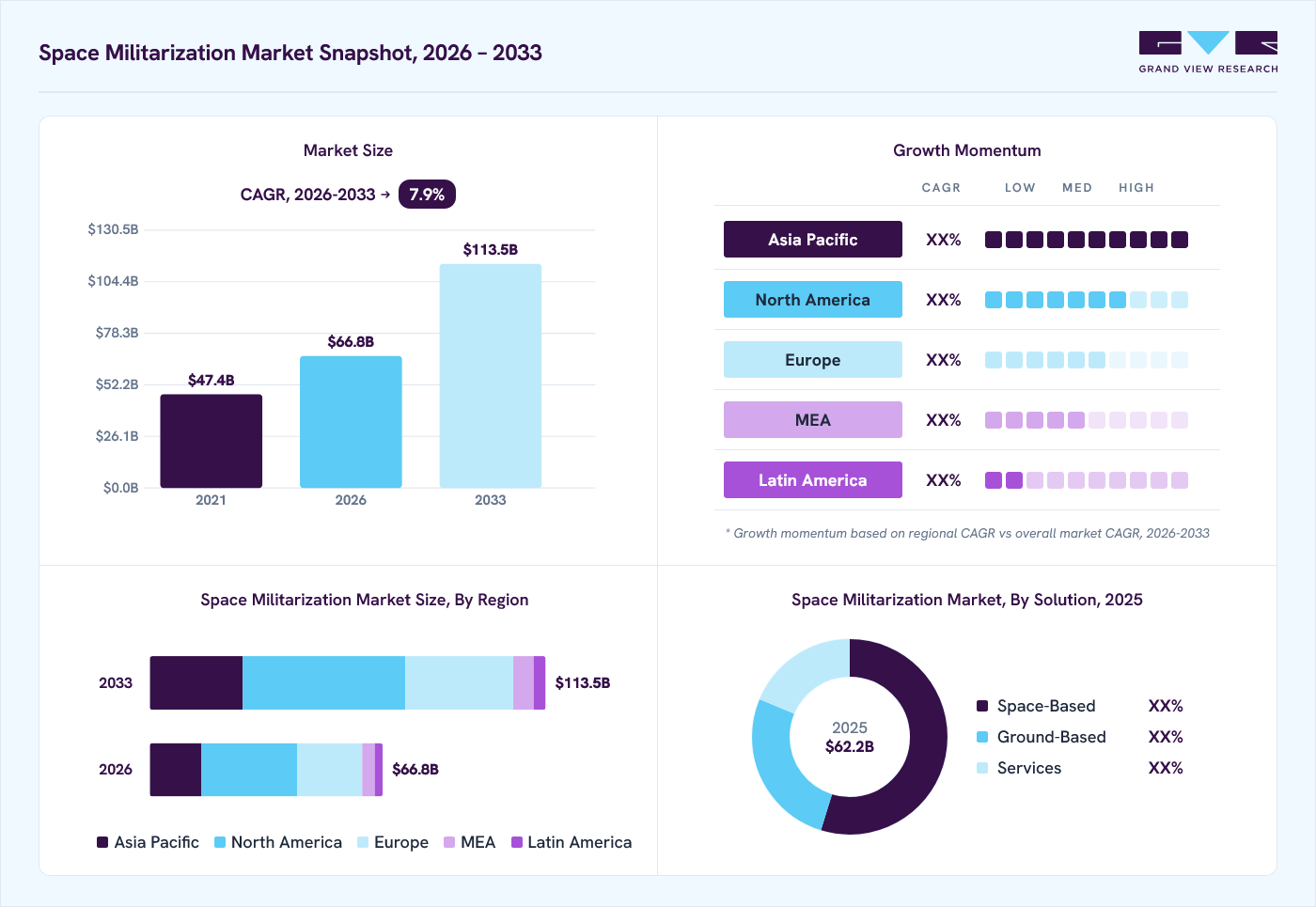
Key Market Trends & Insights
- By solution: The space-based segment held the largest revenue share of over 58% in 2025.
- By application: The Intelligence, Surveillance & Reconnaissance (ISR) segment held the largest revenue share of over 37% in 2025.
- By end use: Government Space Agencies are expected to grow at the fastest CAGR of over 8% from 2026 to 2033.
Regional Highlights
- Largest regional market: North America (39.1% revenue share, 2025)
- Fastest-growing regional market: Asia Pacific (highest CAGR, 2026-2033)
- By country: The U.S. held the largest market share in 2025.
Market Size & Forecast
- Market size in 2025: USD 62.2 Billion
- Estimated market size in 2026: USD 66.8 Billion
- Projected market size by 2033: USD 113.5 Billion
- CAGR (2026-2033): 7.9%
The demand for space militarization technologies is increasing as governments and defense organizations strengthen their space-based defense capabilities to address evolving security challenges. Military agencies are investing in advanced satellites, secure satellite communication systems, intelligence, surveillance, and reconnaissance (ISR) Solutions, missile warning systems, and space situational awareness (SSA) solutions to enhance real-time intelligence, strategic communication, navigation, and threat detection.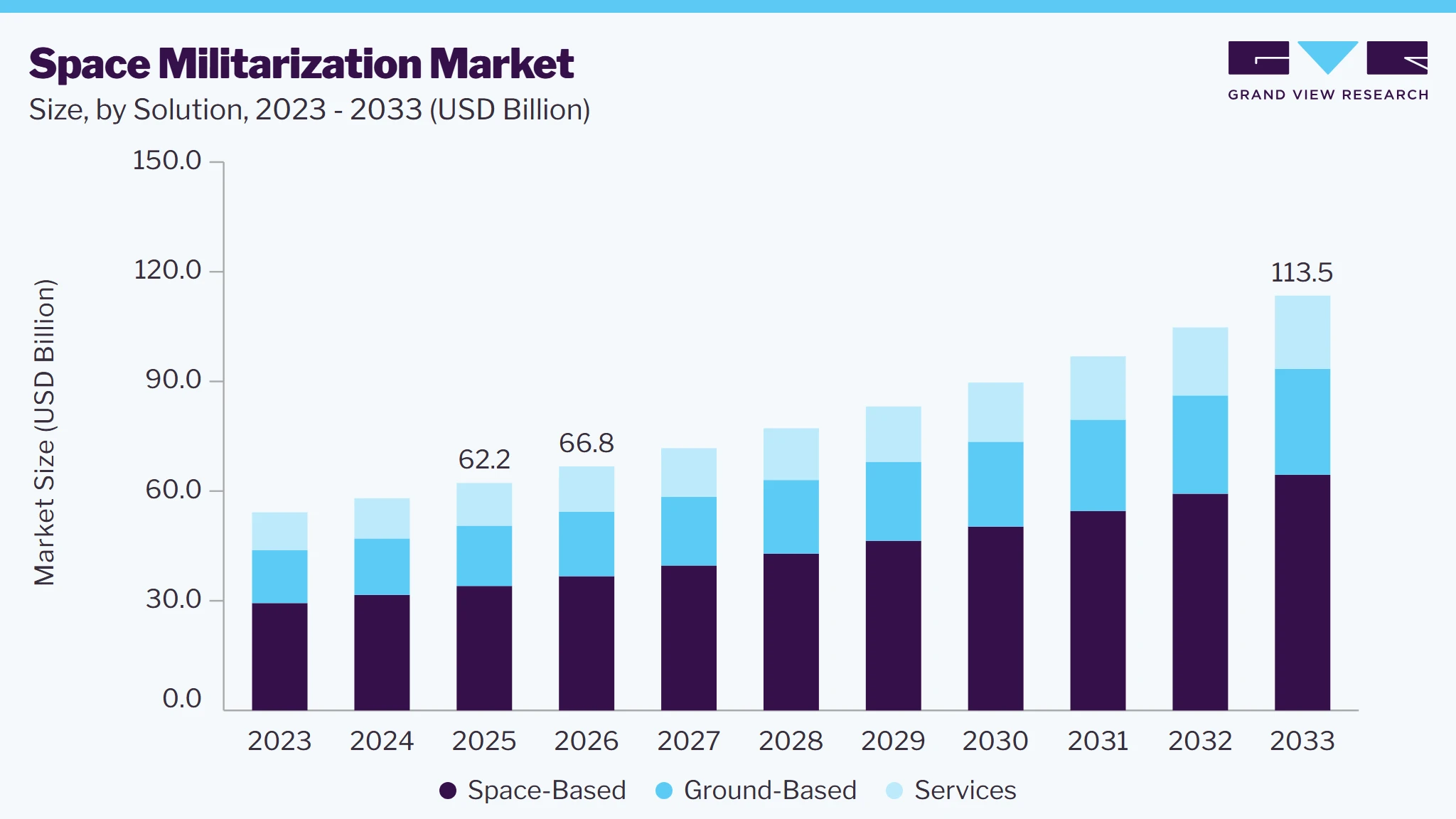
Additionally, the growing focus on protecting critical space assets, countering anti-satellite (ASAT) threats, and establishing dedicated military space commands is accelerating investments in resilient space infrastructure. Continuous advancements in satellite technologies, autonomous space systems, artificial intelligence, and secure command-and-control capabilities are further improving the effectiveness, reliability, and operational readiness of military space operations.
Market Dynamics
The Space Militarization Market is experiencing significant growth, driven by rising geopolitical tensions, increasing defense budgets, and the growing recognition of space as a critical domain for national security. Governments worldwide are accelerating investments in military satellites, intelligence, surveillance and reconnaissance (ISR) systems, secure satellite communications (SATCOM), missile warning and tracking systems, navigation capabilities, and space situational awareness (SSA) to strengthen defense readiness and protect strategic space assets. Advancements in artificial intelligence, autonomous space systems, satellite miniaturization, and resilient space architectures are enhancing the operational effectiveness of military space missions. However, high development costs, stringent regulatory requirements, and the complexity of integrating advanced space defense technologies remain key challenges. At the same time, increasing investments in next-generation military satellite constellations, space defense modernization programs, and international defense collaborations are creating substantial growth opportunities for market participants.
The Space Militarization Market is primarily driven by the increasing investments in military space programs aimed at enhancing national security and strategic defense capabilities. Governments are expanding the deployment of military satellites for secure communications, intelligence gathering, early missile warning, navigation, and surveillance to strengthen operational effectiveness across land, air, sea, cyber, and space domains. The establishment of dedicated space defense commands and the growing importance of multi-domain military operations are further accelerating investments in advanced space-based defense infrastructure.
The increasing need to safeguard critical space assets against evolving threats, including anti-satellite (ASAT) weapons, electronic warfare, and cyberattacks, is driving demand for resilient satellite architectures, space situational awareness systems, and secure command-and-control networks. Continuous advancements in satellite technologies, artificial intelligence, autonomous mission systems, and space-based sensing capabilities are further supporting the expansion of military space programs worldwide.
Despite strong growth prospects, the Space Militarization Market faces challenges related to the high costs of developing, deploying, and maintaining advanced military space systems. Military satellites, launch infrastructure, secure communication networks, missile warning systems, and space surveillance technologies require substantial capital investments, long development cycles, and highly specialized engineering expertise, limiting rapid deployment.
In addition, integrating space-based assets with existing defense command networks while ensuring cybersecurity, interoperability, resilience, and uninterrupted operations presents significant technical challenges. The increasing sophistication of space threats, stringent regulatory requirements, export controls, and dependence on advanced aerospace components further increase development complexity and operational costs.
The growing focus on modernizing military space capabilities is creating significant opportunities for the space militarization market. Governments are investing in next-generation satellite constellations, resilient space architectures, space situational awareness Solutions, on-orbit servicing technologies, and autonomous space systems to improve operational resilience and mission effectiveness. The increasing adoption of artificial intelligence, advanced analytics, digital engineering, and secure space communication technologies is enabling faster decision-making, improved threat detection, and enhanced mission coordination.
Furthermore, rising international collaborations, defense modernization initiatives, and increasing investments in sovereign space capabilities are expected to accelerate the deployment of advanced military space systems, creating long-term growth opportunities for technology providers, satellite manufacturers, launch service providers, and defense contractors.
Market Concentration & Characteristics
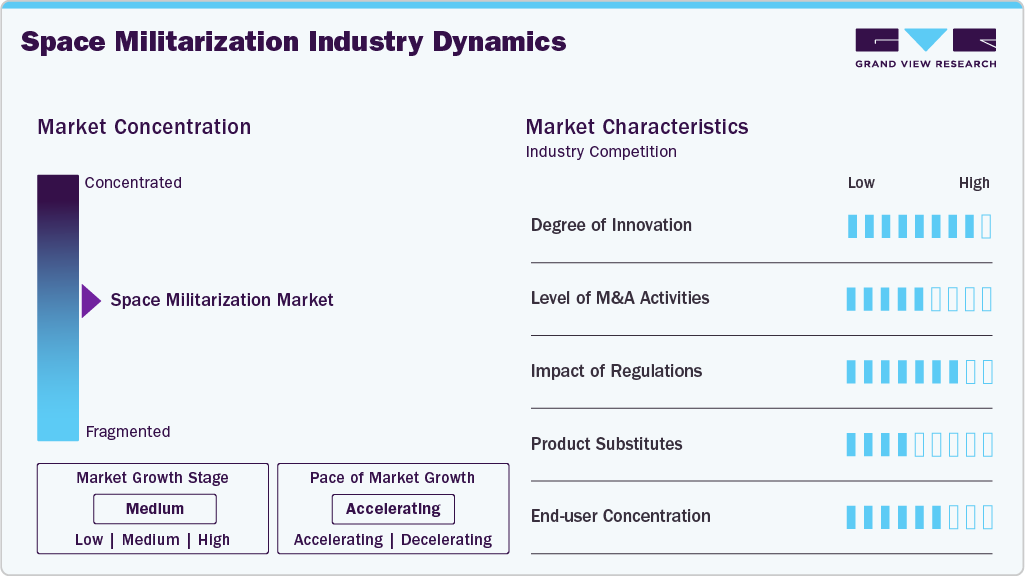
The Space Militarization Market is moderately concentrated, with competition dominated by leading aerospace and defense companies, satellite manufacturers, launch service providers, and defense technology firms. The market is characterized by continuous advancements in military satellite systems, intelligence, surveillance and reconnaissance (ISR) capabilities, secure satellite communications (SATCOM), missile warning technologies, and space situational awareness (SSA) solutions. High capital requirements, stringent government regulations, long procurement cycles, and extensive research and development investments create significant barriers to entry, enabling established defense contractors to maintain a strong competitive position through technological expertise, government contracts, and long-term defense partnerships.
Major players such as Lockheed Martin, Northrop Grumman, RTX Corporation, Boeing, L3Harris Technologies, Airbus Defence and Space, Thales Group, BAE Systems, Leonardo S.p.A., and Maxar Technologies are strengthening their market presence by investing in next-generation military satellites, resilient space architectures, secure communication networks, missile defense systems, and autonomous space technologies. These companies are focused on enhancing satellite resilience, expanding space situational awareness capabilities, integrating artificial intelligence into military space operations, and developing advanced command-and-control systems. As governments continue to prioritize defense modernization and strengthen sovereign space capabilities, the market is expected to see increased investment, strategic collaboration, and sustained technological innovation.
Analyst Perspective
Driven by escalating geopolitical tensions and rising defense budgets, the Space Militarization Market is expanding rapidly as space becomes a vital security domain. Governments are investing heavily in military satellites, secure SATCOM, ISR systems, and missile tracking to safeguard space assets and strengthen defense readiness. Growth is bolstered by dedicated space commands and advancements in AI, autonomous systems, and resilient satellite architectures. While high costs, long procurement cycles, complex regulations, and evolving orbital threats pose challenges, the long-term trajectory for the market remains exceptionally strong.
Solution Insights
The Space-Based segment dominates the space militarization market with a market share of over 58.0% in 2025 due to its critical role in enabling military communications, intelligence, surveillance and reconnaissance (ISR), missile early warning, navigation, and space situational awareness (SSA). Space-based assets, including military satellites and orbital defense Solutions, are extensively deployed by defense organizations to support real-time battlefield intelligence, secure communications, strategic monitoring, and global operational coordination.
The Ground-Based segment is expected to witness significant growth during the forecast period due to increasing investments in space command and control infrastructure, satellite ground stations, launch facilities, and space surveillance networks. Governments and defense organizations are strengthening ground-based capabilities to support secure satellite communications, mission planning, telemetry, tracking, and command (TT&C), and real-time monitoring of space assets.
Application Insights
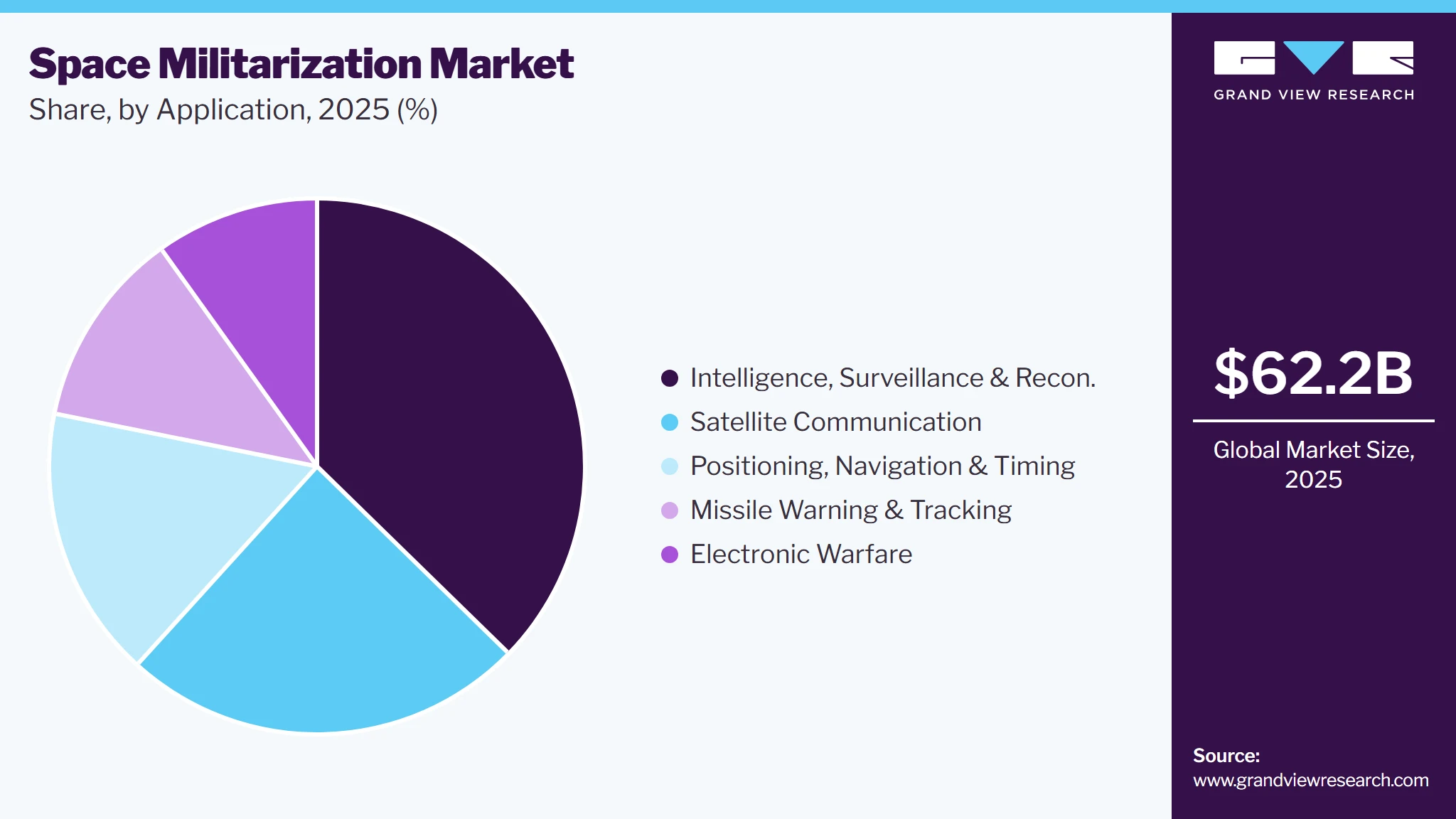
The Intelligence, Surveillance & Reconnaissance (ISR) segment dominates the space militarization market, with a market share of over 37.0% in 2025, owing to its critical role in providing real-time intelligence, persistent surveillance, and strategic reconnaissance for defense and national security operations. Defense organizations increasingly rely on space-based ISR satellites to monitor military activities, track potential threats, support border and maritime surveillance, and enhance battlefield awareness across multiple operational domains
The Positioning, Navigation & Timing (PNT) segment is expected to register a significant CAGR during the forecast period, driven by the increasing reliance on precise positioning, navigation, and synchronized timing in modern military operations. Defense organizations are expanding the use of space-based PNT systems to support precision-guided weapons, unmanned aerial vehicles (UAVs), autonomous military Solutions, naval operations, secure communications, and battlefield coordination. The growing emphasis on resilient satellite navigation systems, anti-jamming and anti-spoofing technologies, and sovereign navigation capabilities is further driving growth in the segment.
The Positioning, Navigation & Timing (PNT) segment is expected to witness significant growth during the forecast period due to the increasing reliance of modern defense forces on precise navigation, synchronized timing, and accurate positioning for military operations. Space-based PNT systems support precision-guided weapons, troop navigation, autonomous military Solutions, unmanned aerial vehicles (UAVs), naval operations, and secure battlefield communications
End Use Insights
The Military & Defense segment dominates the space militarization market with a market share of over 72.0% in 2025 due to increasing investments in military satellites, intelligence, surveillance, and reconnaissance (ISR) systems, secure satellite communications, missile warning capabilities, and space situational awareness (SSA) technologies. Defense organizations worldwide are prioritizing the modernization of space-based assets to enhance strategic intelligence, strengthen multi-domain operations, improve missile defense, and protect critical national security infrastructure. The establishment of dedicated space defense commands, rising geopolitical tensions, and growing defense budgets are further accelerating the adoption of advanced military space systems.
The Government space agencies segment is expected to grow significantly during the forecast period, driven by increasing investments in sovereign space capabilities, national security initiatives, and defense-oriented space programs. Governments are expanding funding for military satellite development, space situational awareness (SSA), missile warning systems, and secure satellite communication networks to strengthen strategic defense and protect critical space assets.
Regional Insights
North America dominates the space militarization market with a market share of over 39.1% in 2025 due to substantial defense spending, the presence of advanced military space programs, and continuous investments in satellite-based defense capabilities. The region, led by the United States, is home to major organizations such as the U.S. Space Force, Space Systems Command, and the National Reconnaissance Office (NRO), which drive the deployment of military satellites, intelligence, surveillance, and reconnaissance (ISR) systems, secure satellite communications, missile warning systems, and space situational awareness (SSA) capabilities.

U.S. Space Militarization Market Trends
The U.S. dominates the North America space militarization market due to its substantial defense budget, advanced military space capabilities, and continuous investments in national security programs. The country leads the deployment of military satellites for intelligence, surveillance, and reconnaissance (ISR), secure satellite communications, missile warning, navigation, and space situational awareness (SSA). The presence of organizations such as the U.S. Space Force, Space Systems Command (SSC), and the National Reconnaissance Office (NRO), along with leading defense contractors, accelerates the development of next-generation military space technologies.
Europe Militarization Market Trends
The Europe space militarization market is witnessing steady growth due to increasing defense modernization initiatives, rising investments in sovereign space capabilities, and growing emphasis on strengthening regional security. European countries are expanding investments in military satellites, secure satellite communications, intelligence, surveillance and reconnaissance (ISR), and space situational awareness (SSA) systems to enhance defense readiness and protect critical space assets.
The UK space militarization market is experiencing steady growth, driven by increasing investments in sovereign space capabilities, defense modernization, and the expansion of military space programs. The country is strengthening its space-based intelligence, surveillance, and reconnaissance (ISR), secure satellite communications (SATCOM), and space domain awareness capabilities to support national security and allied operations. Continued investments through the UK Space Command and collaborations with NATO partners are accelerating the development of resilient military space infrastructure.
The Germany space militarization market is expanding due to rising defense spending, growing focus on space security, and increasing investments in satellite-based defense capabilities. The country is enhancing its military satellite communications, Earth observation, intelligence, surveillance and reconnaissance (ISR), and space situational awareness (SSA) systems to improve operational readiness and strategic autonomy. Germany's emphasis on strengthening European defense cooperation and developing resilient space infrastructure is further supporting the growth of its military space capabilities.
Asia Pacific Space Militarization Market Trends
The Asia-Pacific space militarization market is witnessing the fastest growth due to rising defense budgets, increasing geopolitical tensions, and expanding investments in sovereign military space capabilities across countries such as China, India, Japan, South Korea, and Australia. Governments in the region are accelerating the deployment of military satellites, intelligence, surveillance, and reconnaissance (ISR) systems, secure satellite communications, missile warning technologies, and space situational awareness (SSA) capabilities to strengthen national security and strategic deterrence.
The China space militarization market is witnessing rapid growth, driven by substantial government investments, accelerated military modernization, and the expansion of indigenous space defense capabilities. The country is strengthening its military satellite constellations, intelligence, surveillance and reconnaissance (ISR), secure satellite communications (SATCOM), missile warning and tracking systems, and space situational awareness (SSA) capabilities to enhance strategic deterrence and operational readiness. Continuous investments in reusable launch technologies, counter-space capabilities, and integrated space defense infrastructure are further supporting the growth of China's military space ecosystem.
The Japan space militarization market is expanding steadily due to increasing defense budgets, evolving regional security concerns, and growing investments in resilient space capabilities. The country is enhancing its military satellite communications, intelligence, surveillance and reconnaissance (ISR), positioning, navigation and timing (PNT), and space situational awareness (SSA) systems to improve national defense and strengthen allied operations. Japan's focus on expanding the role of the Japan Air Self-Defense Force's Space Operations Group, along with increased collaboration with the United States and other strategic partners, is accelerating the development of advanced military space capabilities.
Key Space Militarization Company Insights
The space militarization market features several key players that significantly shape its global landscape through advanced military satellites, intelligence, surveillance, and reconnaissance (ISR) systems, secure satellite communications, missile warning technologies, space situational awareness (SSA), and integrated space defense solutions.
-
Lockheed Martin is one of the leading providers of military satellite systems and integrated space defense solutions. The company focuses on developing advanced missile warning satellites, secure communication systems, space-based ISR capabilities, and resilient space architectures to support national security and defense modernization programs.
-
Northrop Grumman is a global provider of military space technologies, specializing in satellite manufacturing, missile defense systems, strategic surveillance, and space situational awareness capabilities. The company leverages advanced space technologies and autonomous systems to enhance operational readiness and mission effectiveness across defense applications.
Key Space Militarization Companies
The following key companies have been profiled for this study on the space militarization market.
-
Lockheed Martin Corporation
-
Northrop Grumman Corporation
-
RTX Corporation
-
The Boeing Company
-
L3Harris Technologies
-
Airbus Defence and Space
-
Thales Group
-
BAE Systems plc
-
Leonardo S.p.A.
-
Maxar Technologies
Competitive Benchmarking
Operating Strategies
Competitive Edge
Weaknesses
Mature Players: Lockheed Martin, Northrop Grumman, RTX Corporation, Boeing, L3Harris Technologies, Airbus Defence and Space, Thales Group, BAE Systems
- Expand military space capabilities through long-term government contracts, defense modernization programs, and investments in military satellites, missile warning systems, secure satellite communications, and ISR technologies.
- Strong global defense presence, established government relationships, and diversified aerospace and defense portfolios enable large-scale program execution.
- Heavy dependence on government procurement cycles and defense budgets can delay contract execution and revenue realization.
Emerging Players: Leonardo S.p.A., Maxar Technologies
- Focus on specialized military satellite solutions, high-resolution geospatial intelligence, Earth observation, and advanced space-based surveillance capabilities.
- Strong capabilities in satellite imaging, geospatial intelligence, and specialized defense technologies enable differentiation in niche military space applications.
- Smaller global defense footprint compared with established prime contractors may limit participation in large-scale military space programs.
Recent Development
-
In May 2026, Lockheed Martin was selected by the U.S. Space Force's Space Systems Command to develop capabilities for the Space-Based Interceptor (SBI) program, supporting the next generation of layered missile defense. The program focuses on advancing space-based interceptors to strengthen homeland defense against ballistic and hypersonic missile threats while enhancing the resilience of future military space architectures
-
In May 2026, Northrop Grumman secured a USD 398 million contract from the U.S. Space Force's Space Systems Command to develop the Enhanced Protected Tactical Satellite Communications Prototype (Enhanced PTS-P). The program focuses on delivering jam-resistant military satellite communications for operations in highly contested environments by incorporating advanced antennas, protected tactical waveforms, and space-based processing technologies.
Space Militarization Market Report Scope
Report Attribute
Details
Market size in 2025
USD 62.2 billion
Estimated market size in 2026
USD 66.8 billion
Projected market size by 2033
USD 113.5 billion
Growth rate
CAGR of 7.9% from 2026 to 2033
Actual data
2021 - 2025
Forecast period
2026- 2033
Quantitative units
Revenue in USD Million/Billion and CAGR from 2026 to 2033
Report coverage
Revenue forecast, company ranking, competitive landscape, growth factors, and trends
Segments covered
Solution, Application, End Use & Region
Regional scope
North America; Europe; Asia Pacific; Latin America; MEA
Country scope
U.S.; Canada; Mexico; Germany; UK; France; China; India; Japan; Australia; South Korea; Brazil; UAE; South Africa; KSA
Key companies profiled
Lockheed Martin Corporation; Northrop Grumman Corporation; RTX Corporation; The Boeing Company; L3Harris Technologies, Inc.; Airbus Defence and Space; Thales Group; BAE Systems plc; Leonardo S.p.A.; Maxar Technologies Inc.
Customization scope
Free report customization (equivalent up to 8 analysts working days) with purchase. Addition or alteration to country, regional & segment scope.
Pricing and purchase options
Avail customized purchase options to meet your exact research needs. Explore purchase options
Global Space Militarization Market Report Segmentation
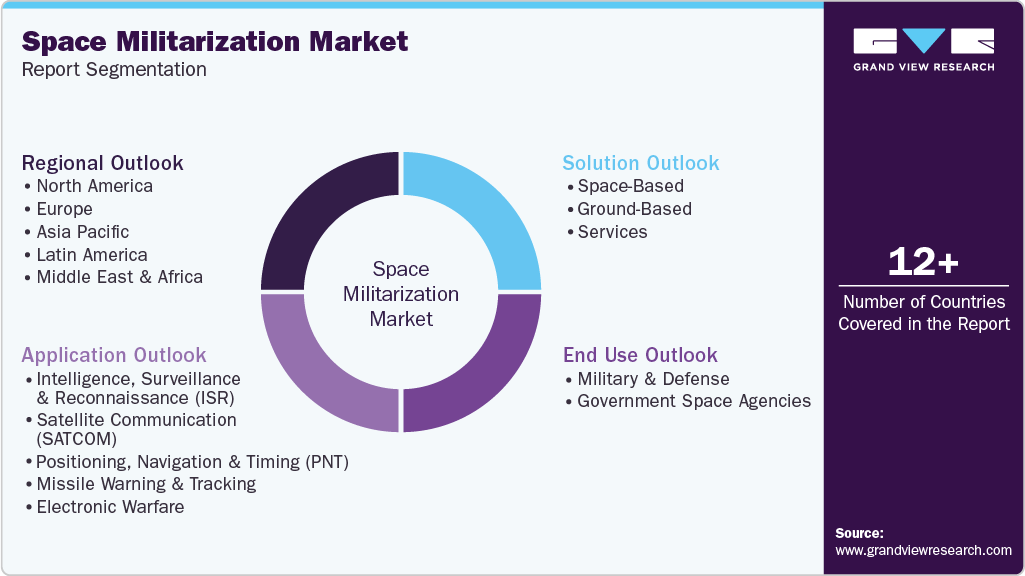
This report forecasts revenue growth at global, regional, and country levels and provides an analysis of the latest industry trends in each of the sub-segments from 2021 to 2033. For this study, Grand View Research has segmented the global space militarization market report based on solution, applications, end use and region:
-
Solution Outlook (Revenue, USD Million, 2021 - 2033)
-
Space-Based
-
Satellites
-
Orbital Solutions
-
Space Stations
-
-
Ground-Based
-
Ground Stations
-
Control Centers
-
Launch Facilities
-
-
Services
-
-
Application Outlook (Revenue, USD Million, 2021 - 2033)
-
Intelligence, Surveillance & Reconnaissance (ISR)
-
Satellite Communication (SATCOM)
-
Positioning, Navigation & Timing (PNT)
-
Missile Warning & Tracking
-
Electronic Warfare
-
-
End Use Outlook (Revenue, USD Million, 2021 - 2033)
-
Military & Defense
-
Government Space Agencies
-
-
Regional Outlook (Revenue, USD Million, 2021 - 2033)
-
North America
-
U.S.
-
Canada
-
Mexico
-
-
Europe
-
UK
-
Germany
-
France
-
-
Asia Pacific
-
China
-
Japan
-
India
-
Australia
-
South Korea
-
-
Latin America
-
Brazil
-
-
Middle East and Africa (MEA)
-
KSA
-
UAE
-
South Africa
-
-
Research Methodology
The space militarization market figures in this report are based on a proven research process that combines executive interviews with secondary research from proprietary databases, company filings, and recognized regulatory and institutional sources. Market size is built through value-chain sizing-reconciling supply-side and demand-side estimates-and triangulated with bottom-up and top-down approaches. Every estimate passes multiple levels of expert validation before publication, with each space militarization segment quantified using the revenue-capture definitions in the table below.
Segment Definition
Segment - Solution
Revenue capture definition
Space-Based
Revenue in this segment is generated through the development, deployment, and operation of military space assets that support national defense and security missions. These assets include military satellites, orbital Solutions, and space-based sensors used by defense organizations for intelligence, surveillance, and reconnaissance (ISR), secure satellite communications, missile warning, positioning, navigation and timing (PNT), and space situational awareness (SSA)
Ground-Based
Revenue in this segment is generated through the deployment and operation of ground-based infrastructure that supports military space operations. These systems include ground stations, mission control and command centers, telemetry, tracking and command (TT&C) facilities, launch infrastructure, and space surveillance systems used by defense organizations to monitor, control, and manage military satellites and other space assets.
Services
Revenue in this segment is generated through specialized services that support the deployment, operation, maintenance, and security of military space assets. These services include satellite launch services, mission operations, satellite operations and maintenance (O&M), system integration, space situational awareness (SSA) services, cybersecurity, data processing and analytics, and technical support. They enable defense organizations to ensure the reliability, resilience, and continuous performance of military space systems while enhancing mission readiness and operational effectiveness.
Segment - Application
Revenue capture definition
Intelligence, Surveillance & Reconnaissance (ISR)
Revenue in this segment is generated through space-based capabilities that collect, monitor, and analyze strategic intelligence to support defense and national security operations. This includes reconnaissance satellites, electro-optical and radar imaging systems, signals intelligence (SIGINT), electronic intelligence (ELINT), and real-time data analytics that provide battlefield awareness, target identification, threat detection, border monitoring, and mission planning.
Satellite Communication (SATCOM)
Revenue in this segment is generated through space-based communication systems that provide secure, reliable, and resilient connectivity for military and defense operations. This includes military communication satellites, secure communication payloads, satellite terminals, encrypted data transmission, tactical communication networks, and beyond-line-of-sight (BLOS) communication capabilities.
Positioning, Navigation & Timing (PNT)
Revenue in this segment is generated through space-based navigation and timing systems that provide precise positioning, navigation, and synchronized timing for military operations. This includes military navigation satellites, secure PNT services, anti-jamming and anti-spoofing technologies, precision timing systems, and navigation support for aircraft, naval vessels, ground forces, missiles, and unmanned systems.
Missile Warning & Tracking
Revenue in this segment is generated through space-based systems designed to detect, track, and monitor ballistic, hypersonic, and cruise missile launches in real time. This includes early warning satellites, infrared (IR) sensors, missile tracking payloads, space-based radar systems, and integrated command and control networks that provide continuous threat detection and trajectory analysis.
Electronic Warfare
Revenue in this segment is generated through space-based systems that support the detection, disruption, protection, and exploitation of the electromagnetic spectrum for military operations. This includes electronic intelligence (ELINT) satellites, signal monitoring systems, electronic support measures (ESM), electronic attack capabilities, anti-jamming technologies, and spectrum management solutions
Segment - End Use
Revenue capture definition
Military & Defense
Revenue in this segment is generated through the procurement, deployment, and operation of military space systems by armed forces and defense organizations. These systems include military satellites, intelligence, surveillance and reconnaissance (ISR) Solutions, secure satellite communication (SATCOM) systems, missile warning and tracking satellites, positioning, navigation and timing (PNT) capabilities, and space situational awareness (SSA) solutions
Government Space Agencies
Revenue in this segment is generated through investments by national space agencies in the development, deployment, and operation of space systems that support defense, security, and strategic government missions. This includes military and dual-use satellites, launch services, space exploration infrastructure, space situational awareness (SSA) systems, satellite communications, Earth observation, and research and development initiatives.
Estimation Model
Layer Name
Key Question
Description
Addressable Defense & Government Space Investment Base Layer
Which organizations invest in military space capabilities?
Identify the global addressable base of defense ministries, armed forces, government space agencies, intelligence organizations, and allied defense programs investing in military satellites, missile warning systems, secure communications, space situational awareness (SSA), and other space defense capabilities.
Military Space Capability Adoption Layer
Which organizations are deploying military space systems?
Apply adoption rates across defense organizations and government space agencies based on the deployment of military satellites, ISR Solutions, SATCOM systems, PNT capabilities, missile warning and tracking systems, electronic warfare payloads, and space surveillance infrastructure.
Space System Deployment & Utilization Layer
How extensively are military space systems deployed?
Estimate market demand based on the number of operational military satellites, launch programs, orbital Solutions, ground stations, command and control centers, space surveillance assets, and modernization or replacement programs supporting defense space operations worldwide.
Revenue Generation Layer
How much revenue is generated?
Estimate market revenue by combining expenditures on military satellite manufacturing, launch services, ground infrastructure, mission operations, satellite communications, system integration, maintenance and support services, cybersecurity, and other value-added space defense solutions across military and government organizations.
Delivered Customizations
This report has been delivered with the following In-depth customizations
Client Request
Customization Delivered
Value Adds
Space Militarization Market Entry and Growth Strategy for a Defense Contractor or Space Technology Provider
Analysis of demand for military satellites, ISR, SATCOM, missile warning & tracking, PNT, and SSA capabilities across defense organizations and government space agencies.
Benchmarking of leading defense contractors, military satellite programs, launch capabilities, and space defense modernization strategies.
Identified high-growth defense programs and regional investment opportunities.
Supported market entry, strategic positioning, partnership development, and long-term growth planning.
Next-Generation Military Space Technology Assessment for a Defense or Aerospace Company
Assessment of emerging technologies including AI-enabled ISR, resilient satellite constellations, electronic warfare, autonomous space systems, secure SATCOM, and space situational awareness solutions.
Analysis of technology maturity, procurement priorities, and future military space capability requirements.
Identified high-value technology investment opportunities and capability gaps.
Supported product development, innovation roadmaps, and long-term defense technology strategies.
Military Satellite and Space Defense Capability Expansion Strategy for a Government Agency or Defense Organization
Analysis of investments in military satellite constellations, secure communications, missile defense, launch infrastructure, and ground control systems across major defense markets.
Assessment of deployment priorities, modernization programs, and sovereign space capability development strategies.
Identified high-growth investment areas and defense modernization opportunities.
Supported strategic planning, infrastructure investment decisions, and national space security capability development.
About the Author(s)
Next Generation Technologies Research Team
Technology · Next Generation TechnologiesThis report was authored by the next generation technologies research team at Grand View Research - comprising two research analysts, one senior research analyst, and one industry expert - with specialized expertise in the next generation technologies segment of the technology industry. All findings are based on proprietary technology databases, executive interviews, and regulatory analysis, subject to internal peer review prior to publication.
Last Updated:
Speak to Analyst


Customize this report to your needs — add regions, segments, or data points, with 20% free customization.
Or view our licence options:


ISO 9001:2015 & 27001:2022 Certified
We are GDPR and CCPA compliant! Your transaction & personal information is safe and secure. For more details, please read our privacy policy.


