
- Home
- »
- Advanced Interior Materials
- »
-
Spill Containment Systems Market Size Report, 2026-2033GVR Report cover
![Spill Containment Systems Market (2026 - 2033)Report]()
Spill Containment Systems Market (2026 - 2033)
Size, Share & Trends Analysis Report By Product (S Spill Containment Berms & Bunds, Spill Containment Pallets), By Material (Polyethylene/HDPE, Steel, Polypropylene), By End Use, By Region, And Segment Forecasts
Market Size, 2025
$1.0BMarket Estimate, 2026
$1.1BMarket Forecast, 2033
$2.0BCAGR, 2026–2033
8.4%Spill Containment Systems Market Summary
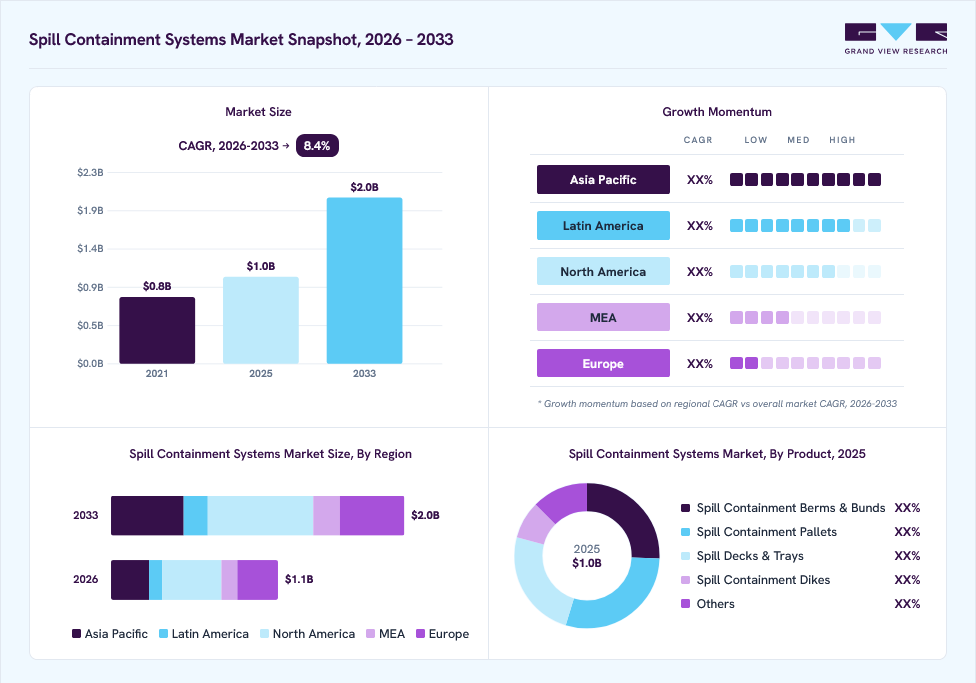
The global spill containment systems market size was valued at USD 1.0 billion in 2025 and is projected to grow from USD 1.1 billion in 2026 to USD 2.0 billion by 2033, at a CAGR of 8.4% from 2026 to 2033. North America dominated the market, accounting for the largest revenue share of 35.3% in 2025. The global market is expected to grow primarily due to increasing focus on preventing hazardous material releases and complying with stringent environmental and workplace safety regulations.
Key Market Trends & Insights
- By product: The spill containment pallets segment led the market with the largest revenue share of 29.1% in 2025.
- By material: The polyethylene/HDPE segment led the market with the largest revenue share of 42.3% in 2025.
- By end use: The warehousing & logistics segment is expected to grow at 8.9% CAGR during the forecast period.
Regional Highlights
- Largest regional market: North America (35.3% revenue share, 2025)
- Fastest-growing regional market: Asia Pacific (highest CAGR, 2026-2033)
- By country: The U.S. held the largest market share in 2025.
Market Size & Forecast
- Market size in 2025: USD 1.0 Billion
- Estimated market size in 2026: USD 1.1 Billion
- Projected market size by 2033: USD 2.0 Billion
- CAGR (2026-2033): 8.4%
Manufacturing, chemical processing, oil and gas, pharmaceuticals, and warehousing facilities are adopting spill containment solutions to minimize risks associated with accidental leaks of chemicals, oils, fuels, and other liquids. Stricter secondary containment requirements are driving demand for spill containment systems as industries must prevent leaked chemicals, oils, fuels, and other hazardous liquids from reaching soil, drainage systems, or surrounding areas.
Regulations increasingly require facilities to provide containment around storage tanks, drums, and industrial equipment, encouraging businesses to install compliant containment solutions and reduce environmental and operational risks.
Market Dynamics
The increasing storage and handling of chemicals, fuels, oils, and other hazardous liquids across industrial facilities is driving demand for spill containment systems. As organizations expand storage capacity, the risk of accidental leaks and spills increases, creating a greater need for secondary containment around tanks, drums, containers, and processing equipment. Industries are therefore adopting containment solutions to protect workers, prevent environmental contamination, and reduce operational disruptions caused by accidental liquid releases.
High initial investment and maintenance costs can restrain the adoption of spill containment systems, particularly among small and medium-sized industrial facilities. Permanent containment structures, specialized materials, installation, inspection, and periodic replacement can increase overall expenditure. Facilities handling multiple types of hazardous liquids may also require different containment solutions, adding to procurement costs. Price sensitivity can therefore encourage some organizations to rely on basic or temporary measures, limiting the penetration of advanced spill containment systems in cost-sensitive applications.
The expansion of chemical processing, manufacturing, oil and gas, pharmaceutical, and logistics facilities creates opportunities for spill containment system providers. New industrial facilities require containment infrastructure during the construction and operational stages to manage storage, handling, and transportation risks. Increasing investment in hazardous material storage capacity can further increase demand for tanks, drums, and equipment containment solutions. Portable and modular systems also provide opportunities in facilities requiring flexible protection during maintenance, temporary operations, and emergency spill response.
Market Concentration & Characteristics
The spill containment systems industry is fragmented, with numerous manufacturers and suppliers offering products across different applications, materials, capacities, and configurations. Competition includes established industrial safety companies, specialized containment manufacturers, and regional suppliers serving local industries. Market participants differentiate through product customization, regulatory compliance, durability, deployment flexibility, and application-specific designs.
Manufacturers are developing lightweight containment solutions, reusable systems, improved sealing mechanisms, and chemical resistant materials to address diverse industrial requirements. Innovation is also directed toward modular designs and solutions that simplify storage and transportation. These developments help organizations improve spill response efficiency while reducing maintenance and replacement requirements.
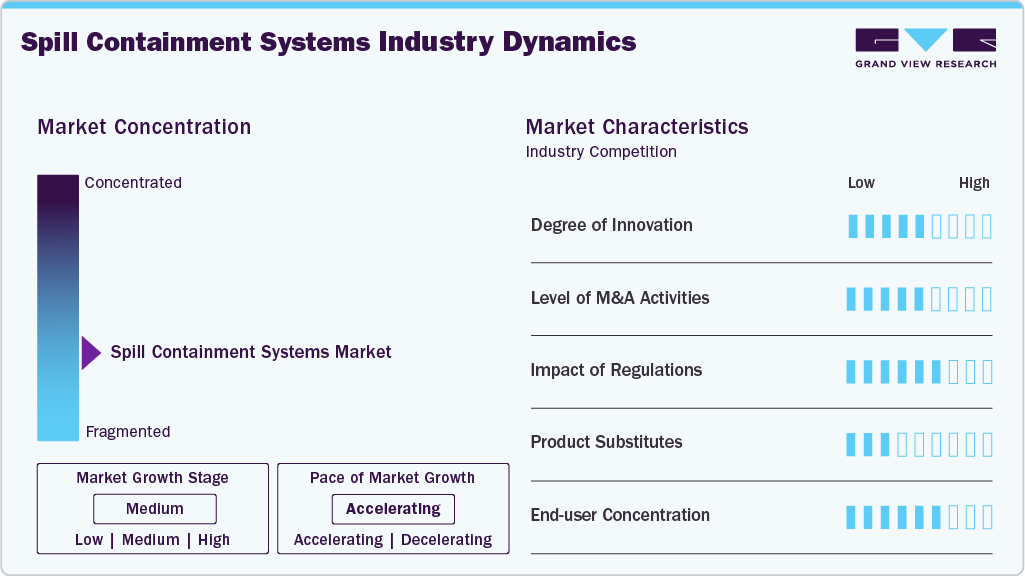
Regulations are significantly shaping the market by requiring industries to control and prevent the release of hazardous liquids into the environment. Environmental protection and workplace safety requirements encourage facilities to implement secondary containment around tanks, drums, and equipment. Compliance requirements are increasing demand for reliable containment products and influencing product design, material selection, capacity, and installation practices across industries handling chemicals, fuels, oils, and other hazardous substances.
Analyst Perspective
The market for spill containment systems is influenced by increasing requirements for hazardous liquid storage, environmental protection, workplace safety, and secondary containment across industrial facilities. Oil and gas, chemical and petrochemical, manufacturing, pharmaceutical, transportation, and logistics industries use spill containment systems around tanks, drums, equipment, and storage areas. Adoption of portable containment dikes, spill containment pallets, berms, and trays is also increasing due to their flexibility and rapid deployment. Asia Pacific and Latin America are emerging as high-growth regions, supported by industrial expansion, increasing chemical and petrochemical activities, and development of storage and manufacturing facilities.
Product Insights
The spill containment pallets segment led the market in 2025 as industries increasingly store drums, containers, and other liquid-filled vessels requiring secondary containment. Their integrated sump design helps collect leaked liquids and prevent contamination of floors and surrounding areas. Demand is supported by chemical, manufacturing, oil and gas, and logistics facilities seeking practical containment solutions that simplify spill management and regulatory compliance.
The spill containment dikes segment is expected to grow at 9.5% CAGR during the forecast period due to demand for flexible containment around tanks, equipment, vehicles, and larger storage areas. Dikes can be rapidly deployed and configured according to site requirements, making them suitable for temporary and permanent applications. Their portability and adaptability support adoption in industrial maintenance, transportation, emergency response, and hazardous liquid handling activities.
Material Insights
The polyethylene/HDPE segment dominated the market in 2025 due to its chemical resistance, durability, lightweight characteristics, and suitability for handling oils, fuels, and various chemicals. These properties make polyethylene/high-density polyethylene suitable for spill containment pallets, trays, and other secondary containment products. Increasing industrial storage and transportation of hazardous liquids is expected to support demand for durable polyethylene/high-density polyethylene containment solutions.
The polypropylene segment is expected to grow at 9.2% CAGR during forecast period as industries require containment materials capable of withstanding exposure to various chemicals and demanding operating environments. Polypropylene offers good chemical resistance, low moisture absorption, and relatively low weight, supporting its use in containment pallets, trays, and related products. Growing chemical processing, manufacturing, pharmaceutical, and industrial storage activities are expected to contribute to segment expansion.
End Use Insights
The oil & gas segment led the market in 2025 holding 25.2% market share as exploration, production, refining, storage, and transportation activities require effective measures for containing accidental releases of crude oil, fuels, and other petroleum products. Spill containment systems help protect soil and water resources while reducing workplace hazards and operational disruptions. Increasing storage infrastructure and environmental compliance requirements are expected to support adoption across oil and gas facilities.
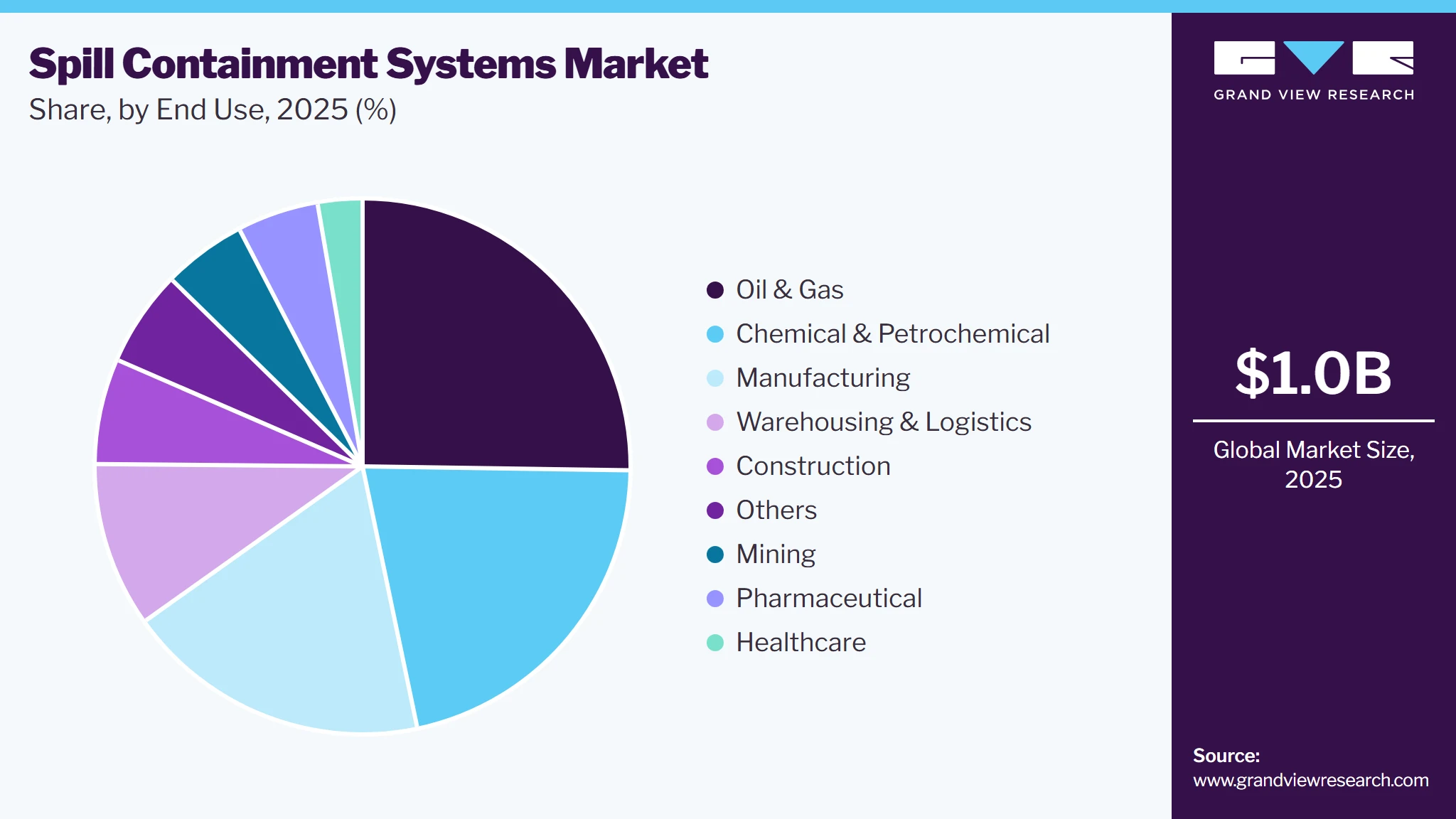 The chemical & petrochemical segment is expected to grow due to the extensive handling and storage of corrosive, toxic, and flammable liquids. Chemical processing and petrochemical facilities require secondary containment around tanks, drums, pipelines, and equipment to prevent accidental releases. Increasing chemical production capacity, stricter environmental requirements, and greater emphasis on workplace safety are expected to encourage investment in spill containment systems across these facilities.
Regional Insights
North America Spill Containment Systems Market Trends
North America spill containment systems industry dominated the global market with a revenue share of 35.3% in 2025, owing to its extensive oil and gas infrastructure. The region has numerous refineries, storage terminals, pipelines, and distribution facilities where accidental releases can create environmental and operational risks. The replacement of aging infrastructure and increasing requirements for secondary containment around petroleum storage assets are expected to encourage demand for spill containment pallets, dikes, berms, and related products.

U.S. Spill Containment Systems Market Trends
The U.S. spill containment systems industry is expected to remain the biggest market in North America region, supported by the large-scale chemical manufacturing industry. Chemical facilities handle substantial volumes of corrosive, toxic, and flammable liquids, increasing the requirement for secondary containment. Federal environmental requirements governing the prevention and control of oil and hazardous substance releases encourage facilities to install containment systems around storage and handling areas, supporting consistent demand across chemical processing and industrial facilities.
Asia Pacific Spill Containment Systems Market Trends
Asia Pacific spill containment systems industry is expected to grow fastest at 9.7% CAGR during the forecast period, due to rapid expansion of chemical and petrochemical production. New processing facilities and storage infrastructure increase the volume of hazardous liquids handled across the region. As industrial capacity expands, companies are incorporating containment measures around tanks, drums, and equipment to manage leakage risks. This expansion of industrial infrastructure is expected to create sustained demand for spill containment systems.
China spill containment systems industry is expected to experience significant growth as its chemical industry continues expanding. Large chemical production clusters and petrochemical facilities handle substantial quantities of hazardous liquids, creating requirements for secondary containment. The development and modernization of chemical industrial parks are increasing the number of facilities requiring containment infrastructure. Demand is therefore expected to rise for pallets, dikes, and other systems used around storage and processing areas.
India spill containment systems industry is expected to grow with the expansion of pharmaceutical manufacturing. Pharmaceutical facilities use solvents, chemicals, oils, and other liquids during production and storage, creating requirements for controlled containment. The development of new manufacturing facilities and increasing emphasis on environmental and workplace safety are encouraging companies to incorporate spill prevention measures into industrial operations, supporting demand for containment products across pharmaceutical production sites.
Europe Spill Containment Systems Market Trends
Europe spill containment systems industry is expected to grow as industrial facilities increasingly strengthen measures for preventing hazardous liquid releases. The region's established chemical and pharmaceutical industries generate demand for containment products around liquid storage and processing areas. Environmental regulations requiring organizations to control pollution and prevent contamination are encouraging investment in secondary containment infrastructure, particularly where facilities handle chemicals, oils, and other substances capable of affecting soil and water resources.
Germany spill containment systems industry is expected to benefit from its large chemical manufacturing base. Chemical production facilities require containment around tanks, drums, and processing equipment to manage accidental releases of hazardous substances. The country's strict environmental protection requirements further encourage companies to implement measures that prevent hazardous liquids from entering surrounding land and water systems, supporting demand for durable containment pallets, trays, and dikes.
UK spill containment systems industry is expected to experience growth driven by its substantial petroleum storage and distribution infrastructure. Fuel terminals, warehouses, and industrial facilities require containment systems to manage accidental releases during storage, loading, and handling operations. Environmental permitting and pollution-control requirements encourage operators to maintain appropriate containment measures, supporting demand for products capable of containing oils, fuels, and other liquids within designated areas.
Middle East & Africa Spill Containment Systems Market Trends
The Middle East & Africa spill containment systems industry growth is driven by the expansion of petroleum storage and transportation infrastructure. Storage terminals, refineries, and fuel distribution facilities handle large quantities of petroleum products, increasing the consequences of accidental releases. Development of additional storage capacity and modernization of existing facilities are creating requirements for secondary containment around tanks and loading areas, supporting demand for spill containment systems across petroleum-related operations.
Saudi Arabia spill containment systems industry is expected to see strong demand due to expansion of its petrochemical manufacturing capacity. Petrochemical facilities handle large volumes of fuels, chemical feedstocks, and processed products, requiring containment around tanks and processing equipment. Development of additional petrochemical production and storage infrastructure is increasing the need for systems that can contain accidental releases, creating opportunities for containment pallets, dikes, berms, and other industrial solutions.
Latin America Spill Containment Systems Market Trends
Latin America spill containment systems industry is expected to grow significantly during the forecast period. Increasing mining activities, particularly where operations involve fuels, oils, and chemical processing materials, is driving the market. Mining sites require containment around fuel storage, maintenance areas, and equipment to prevent accidental releases from affecting surrounding land and water. Expansion of mining infrastructure and greater emphasis on environmental management are expected to increase the adoption of portable and permanent spill containment systems.
Brazil spill containment systems industry is expected to support regional market growth through expansion of its oil production and related infrastructure. Offshore and onshore operations, petroleum storage, transportation, and processing require containment measures to manage potential releases of crude oil and petroleum products. Investment in production and storage infrastructure increases the number of facilities requiring spill prevention equipment, supporting demand for containment systems designed for tanks, equipment, maintenance areas, and emergency response.
Key Spill Containment Systems Company Insights
Some of the key players operating in the market include UltraTech International, Inc., Justrite Manufacturing Company LLC, New Pig Corporation, Eagle Manufacturing Company, among others.
-
UltraTech International, Inc. develops and supplies environmental containment and spill prevention products for industrial and commercial applications. Its portfolio includes spill containment pallets, spill berms, spill decks, secondary containment systems, drum management products, and liquid storage solutions. The company serves industries such as oil and gas, chemical processing, manufacturing, transportation, and environmental management.
-
Justrite Manufacturing Company LLC manufactures safety and environmental products used for handling, storing, and containing hazardous materials. Its product portfolio includes spill containment pallets, safety cabinets, drum handling products, hazardous material storage solutions, and spill control equipment. The company serves industrial, manufacturing, laboratory, chemical, and commercial applications.
Key Spill Containment Systems Companies:
The following key companies have been profiled for this study on the spill containment systems market.
-
UltraTech International, Inc.
-
Justrite Manufacturing Company LLC
-
New Pig Corporation
-
Eagle Manufacturing Company
-
Brady Corporation
-
Interstate Products
-
Dura Products, Inc.
-
Absorbents International
-
SafeRack
-
Chemtex
-
Basic Concepts, Inc.
-
FSI, Inc.
-
AIRE Industrial
-
Spill Station Australia
-
Polystar Technologies, LLC
Company Categorization
Operating Strategies
Competitive Edge
Weaknesses
Mature Players: UltraTech International, Inc., Justrite Manufacturing Company LLC, New Pig Corporation, Eagle Manufacturing Company, Brady Corporation, SafeRack, Basic Concepts, Inc., FSI, Inc.
- Mature players focus on broad product portfolios, established distribution networks, regulatory compliance, and relationships with industrial customers.
- They invest in product development, manufacturing capacity, and geographic expansion while offering multiple containment configurations and materials.
- Mature players benefit from strong brand recognition, extensive distribution infrastructure, manufacturing experience, and established industrial relationships.
- Their ability to provide comprehensive spill containment portfolios, customized solutions, technical support, and products meeting applicable safety requirements provides an advantage when serving large chemical, oil and gas, manufacturing, and transportation customers.
- These players can face higher operating costs because of extensive manufacturing, distribution, and organizational structures. Broad product portfolios may also increase operational complexity.
- Their larger scale can make rapid customization or response to niche customer requirements more difficult compared with smaller specialized manufacturers offering focused and flexible containment solutions.
Emerging Players: Interstate Products, Dura Products, Inc., Absorbents International, Chemtex, AIRE Industrial, Spill Station Australia, Polystar Technologies, LLC.
- These players generally focus on specialized containment products, application-specific designs, competitive pricing, and flexible customer service.
- They target underserved industrial applications and regional markets while developing lightweight, portable, reusable, or modular solutions.
- Emerging players can compete through product customization, faster decision-making, specialized solutions, and competitive pricing.
- Their smaller operating structures allow them to respond quickly to customer requirements and develop products for specific applications.
- These players typically have limited manufacturing capacity, distribution coverage, financial resources, and established customer relationships compared with larger competitors.
- Lower brand recognition can create challenges when targeting large industrial customers with strict supplier requirements.
Recent Developments:
-
In March 2026, Justrite Safety Group launched MightyBerm Polyethylene Berms as economical spill containment solutions for temporary, one-time, or limited-use applications. The portable and disposable berms are designed to contain hazardous liquids during field operations while supporting compliance with Environmental Protection Agency and Spill Prevention, Control, and Countermeasure requirements.
-
In January 2025, Justrite Safety Group acquired Global Spill and Safety in January 2025, an Australian manufacturer and distributor of industrial safety solutions. The acquisition expanded Justrite’s product portfolio and strengthened its presence in the Asia-Pacific region.
Spill Containment Systems Market Report Scope
Report Attribute
Details
Market size in 2026
USD 1.0 billion
Market size in 2026
USD 1.1 billion
Revenue forecast in 2033
USD 2.0 billion
Growth rate
CAGR of 8.4% from 2026 to 2033
Base year for estimation
2025
Historical data
2021-2024
Forecast period
2026 - 2033
Quantitative units
Revenue in USD billion and CAGR from 2026 to 2033
Report coverage
Revenue forecast, company market position analysis, competitive landscape, growth factors, and trends
Segments covered
Product, material, end use, and region
Regional scope
North America; Europe; Asia Pacific; Latin America; Middle East & Africa
Country Scope
U.S.; Canada; Mexico; Germany; UK; Italy; Spain; France; China; Japan; India; Australia; South Korea; Brazil; Argentina; Saudi Arabia; UAE; South Africa
Key companies profiled
UltraTech International, Inc.; Justrite Manufacturing Company LLC; New Pig Corporation; Eagle Manufacturing Company; Brady Corporation; Interstate Products; Dura Products, Inc.; Absorbents International; SafeRack; Chemtex; Basic Concepts, Inc.; FSI, Inc.; AIRE Industrial; Spill Station Australia; Polystar Technologies, LLC
Customization scope
Free report customization (equivalent up to 8 analysts working days) with purchase. Addition or alteration to country, regional & segment scope.
Pricing and purchase options
Avail customized purchase options to meet your exact research needs. Explore purchase options
Global Spill Containment Systems Market Report Segmentation
This report forecasts revenue growth at global, regional & country levels and provides an analysis on the industry trends in each of the sub-segments from 2021 to 2033. For this study, Grand View Research has segmented the spill containment systems market report based on product, material, end use, and region:

-
Product Outlook (Revenue, USD Billion, 2021 - 2033)
-
Spill Containment Berms & Bunds
-
Spill Containment Pallets
-
Spill Decks & Trays
-
Spill Containment Dikes
-
Others
-
-
Material Outlook (Revenue, USD Billion, 2021 - 2033)
-
Polyethylene/HDPE
-
Steel
-
Polypropylene
-
Other
-
-
End Use Outlook (Revenue, USD Billion, 2021 - 2033)
-
Mining
-
Manufacturing
-
Chemical & Petrochemical
-
Warehousing & Logistics
-
Oil & Gas
-
Construction
-
Pharmaceutical
-
Healthcare
-
Others
-
-
Regional Outlook (Revenue, USD Billion, 2021 - 2033)
-
North America
-
U.S.
-
Canada
-
Mexico
-
-
Europe
-
Germany
-
France
-
UK
-
Spain
-
Italy
-
-
Asia Pacific
-
China
-
India
-
Japan
-
South Korea
-
Australia
-
-
Latin America
-
Brazil
-
Argentina
-
-
Middle East & Africa
-
Saudi Arabia
-
UAE
-
South Africa
-
-
Research Methodology
The spill containment systems market figures in this report are based on a proven research process that combines executive interviews with secondary research from proprietary databases, company filings, and recognized regulatory and institutional sources. Market size is built through value-chain sizing—reconciling supply-side and demand-side estimates—and triangulated with bottom-up and top-down approaches. Every estimate passes multiple levels of expert validation before publication, with each spill containment systems segment quantified using the revenue-capture definitions in the table below.
Segment Definition
Segment - Product
Revenue Capture Definition
Spill Containment Berms & Bunds
Revenue is captured through sales of flexible and rigid berms and bunds deployed around storage areas, equipment, vehicles, and temporary work zones.
Spill Containment Pallets
Revenue is generated through pallet sales designed to provide secondary containment for drums, containers, and other liquid-storage vessels.
Spill Decks & Trays
Revenue is captured from deck and tray systems installed beneath containers or equipment to collect and isolate leaked liquids.
Spill Containment Dikes
Revenue is generated through portable and fixed dike solutions that form containment barriers around tanks, equipment, and operational areas.
Others
Revenue encompasses sales of additional containment products, accessories, and systems outside the specifically defined berm, pallet, deck, tray, and dike categories.
Segment -Material
Revenue Capture Definition
Polyethylene/HDPE
Revenue is captured from containment products manufactured using polyethylene or high-density polyethylene, including pallets, trays, berms, and other molded solutions.
Steel
Revenue is generated through sales of steel containment structures and equipment designed for demanding industrial environments and heavier liquid-storage applications.
Polypropylene
Revenue is captured through polypropylene-based containment products, particularly solutions requiring resistance to chemicals, moisture, and industrial operating conditions.
Other
Revenue includes containment solutions manufactured from alternative materials, including specialized polymers, composites, and other material types outside the defined categories.
Segment -
End Use
Revenue Capture Definition
Oil & Gas
Revenue is generated through supplying containment solutions to exploration, production, refining, storage, and petroleum distribution operations.
Chemical & Petrochemical
Revenue is captured from containment products purchased by facilities processing, storing, and transferring chemicals, solvents, petrochemical feedstocks, and related liquids.
Manufacturing
Revenue is derived through industrial facilities purchasing containment systems for production equipment, liquid storage, maintenance, and material-handling activities.
Warehousing & Logistics
Revenue is generated from systems supplied to warehouses, distribution centers, and logistics operations managing liquid containers and transportation activities.
Construction
Revenue is captured through containment solutions used at construction sites for equipment fueling, maintenance, temporary storage, and spill response.
Mining
Revenue is obtained from containment products deployed around mining equipment, fuel storage areas, maintenance zones, and liquid-handling operations.
Pharmaceutical
Revenue is generated from containment systems purchased by pharmaceutical manufacturing and storage facilities handling solvents, chemicals, oils, and process liquids.
Healthcare
Revenue is captured through products supplied to healthcare facilities for appropriate liquid storage, handling, maintenance, and spill management requirements.
Others
Revenue comprises sales to industries outside the specified end-use categories, including institutional, agricultural, utility, and specialized industrial applications.
Estimation Model
Layer No.
Layer Name
Key Question
Description
01
Industrial Activity & Hazardous Liquid Handling Layer
Which industries generate demand for spill containment systems?
The estimation begins by evaluating industrial activities involving the storage, handling, transfer, and transportation of oils, chemicals, fuels, and other liquids across oil and gas, chemical and petrochemical, manufacturing, warehousing and logistics, construction, mining, pharmaceutical, healthcare, and other end-use industries.
02
Product & Material Layer
Which containment products and materials determine market demand?
This layer refines demand by assessing spill containment berms and bunds, spill containment pallets, spill decks and trays, spill containment dikes, and other products across polyethylene/high-density polyethylene, steel, polypropylene, and other materials.
03
End-Use & Deployment Layer
What determines spill containment system utilization and deployment?
Market demand is estimated through deployment across oil and gas, chemical and petrochemical, manufacturing, warehousing and logistics, construction, mining, pharmaceutical, healthcare, and other industries. Storage infrastructure, hazardous liquid handling requirements, facility expansion, equipment maintenance, spill prevention practices, environmental requirements, and replacement cycles influence new installations and replacement demand for containment systems.
04
Revenue Layer
How is total market revenue calculated?
Revenue is estimated by aggregating spending on spill containment systems across products, materials, end-use industries, and regional markets. New installations and replacement demand are assessed using product volumes, average selling prices, containment capacities, material specifications, application requirements, and purchasing activity to validate the overall market size.
Delivered Customizations
This report has been delivered with the following In-depth customizations
Client Request
Customization Delivered
Value Adds
Regional Segmentation
Detailed regional analysis was conducted across North America, Europe, Asia Pacific, Latin America, and the Middle East & Africa, including country-level assessment for key markets such as the U.S., Germany, China, India, Brazil, and Saudi Arabia. The study evaluated oil and gas activities, chemical and petrochemical production, manufacturing, hazardous liquid storage, environmental regulations, workplace safety requirements, and industrial infrastructure influencing spill containment systems demand.
Helped identify regional differences in spill containment adoption, country-specific demand patterns, and markets with increasing secondary containment requirements. The analysis also supported assessment of industrial expansion, hazardous material storage infrastructure, environmental regulations, and spill prevention requirements across major markets.
Competitive benchmarking
CComprehensive benchmarking was carried out for major spill containment systems market participants based on product portfolios, containment products, materials, containment capacity, portability, durability, chemical resistance, customization capabilities, industry coverage, manufacturing capabilities, geographic presence, distribution networks, and aftermarket services.
Assisted clients in understanding competitor positioning, product differentiation, material capabilities, application coverage, geographic presence, distribution strategies, and product development activities within the spill containment systems market.
Opportunity assessment
In-depth opportunity assessment was conducted by analyzing oil and gas, chemical and petrochemical, manufacturing, pharmaceutical, transportation, logistics, and other industries handling hazardous liquids. The study evaluated opportunities related to spill containment pallets, spill containment dikes, berms, portable containment systems, polyethylene/high-density polyethylene products, polypropylene solutions, and replacement of existing containment infrastructure.
Enabled clients to identify markets with increasing spill containment requirements and evaluate opportunities across products, materials, end-use industries, and geographic markets. The analysis also highlighted opportunities associated with industrial expansion, hazardous material storage, environmental compliance, and increasing adoption of portable containment solutions.
Frequently Asked Questions About This Report
The global spill containment systems market size was valued at USD 1.0 billion in 2025 and is expected to reach USD 1.1 billion in 2026.
The spill containment systems market, in terms of revenue, is expected to grow at a compound annual growth rate of 8.4% from 2026 to 2033 to reach USD 2.0 billion by 2033.
The oil & gas segment led the market and accounted for 25.2% market revenue share in 2025.
The spill containment pallets segment led the market and accounted for 29.1% market revenue share in 2025.
The polyethylene/HDPE segment led the market and accounted for 42.3% market revenue share in 2025.
Key factors driving the spill containment systems market include stricter environmental and workplace safety regulations, expansion of oil and gas and chemical industries, increasing hazardous liquid storage, growing industrialization, rising emphasis on pollution prevention, replacement of aging containment infrastructure, and increasing adoption of portable and reusable containment solutions for maintenance and emergency spill response.
The North America region led the market and accounted for 35.3% of the global market revenue share in 2025.
The Asia Pacific region is expected to grow at 9.7% CAGR during forecast period.
Some of the key players operating in the spill containment systems include UltraTech International, Inc., Justrite Manufacturing Company LLC, New Pig Corporation, Eagle Manufacturing Company, Brady Corporation, Interstate Products, Dura Products, Inc., Absorbents International, SafeRack, Chemtex, Basic Concepts, Inc., FSI, Inc., AIRE Industrial, Spill Station Australia, Polystar Technologies, LLC.
About the Author(s)
Advanced Interior Materials Research Team
Advanced Materials · Advanced Interior MaterialsThis report was authored by the advanced interior materials research team at Grand View Research - comprising two research analysts, one senior research analyst, and one industry expert - with specialized expertise in the advanced interior materials segment of the advanced materials industry. All findings are based on proprietary advanced materials databases, executive interviews, and regulatory analysis, subject to internal peer review prior to publication.
Last Updated:
Speak to Analyst


Customize this report to your needs — add regions, segments, or data points, with 20% free customization.
Or view our licence options:


ISO 9001:2015 & 27001:2022 Certified
We are GDPR and CCPA compliant! Your transaction & personal information is safe and secure. For more details, please read our privacy policy.


