
- Home
- »
- Clothing, Footwear & Accessories
- »
-
Sports Eyewear Market Size And Share Report, 2026-2033GVR Report cover

Sports Eyewear Market (2026 - 2033)
Size, Share & Trends Analysis Report By Product (Sunglasses, Goggles), By Sports Type (Water, Winter), By End Use, By Price Tier, By Distribution Channel, By Region, And Segment Forecasts
Market Size, 2025
$9.7BMarket Estimate, 2026
$10.4BMarket Forecast, 2033
$16.6BCAGR, 2026–2033
6.9%Sports Eyewear Market Summary
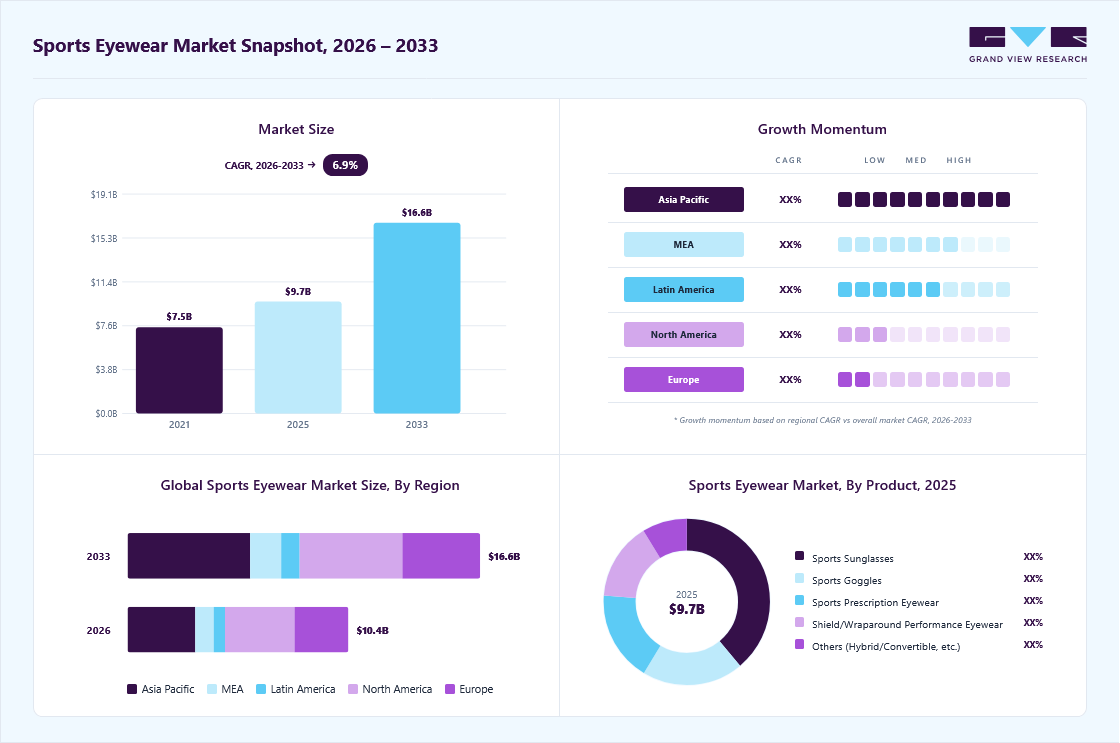
The global sports eyewear market size was valued at USD 9.7 billion in 2025 and is projected to grow from USD 10.4 billion in 2026 to USD 16.6 billion by 2033, at a CAGR of 6.9% from 2026 to 2033. The market in North America dominated with a revenue share of 31.8% in 2025. Rising participation in fitness activities and outdoor sports is significantly driving demand in the global sports eyewear industry.
 Source: Grand View Research, IR Documents, Primary Interviews, Paid DatabasesTo learn more about this report,
 Download Free Sample Report
 Key Market Trends & Insights
- By product: Sports sunglasses segment held the largest market share of 38.8% in 2025.
- By sports type: Outdoor land sports eyewear segment held the largest market share of 37.8% in 2025.
- By end use: Men’s segment held the largest market share of 53.7% in 2025.
- By price tier: Mid-range sports eyewear segment held the largest market share of 36.7% in 2025.
Regional Highlights
- Largest regional market: North America (31.8% revenue share, 2025)
- Fastest-growing regional market: Asia Pacific (highest CAGR, 2026-2033)
- By country: U.S. held the largest market share in 2025
Market Size & Forecast
- Market size in 2025: USD 9.7 Billion
- Estimated market size in 2026: USD 10.4 Billion
- Projected market size by 2033: USD 16.6 Billion
- CAGR (2026-2033): 6.9%
Three ways to get this report
Buy it, customize it, or ask a question.Ask an Analyst
Analyst response in 1 business day
- AccessReport author, directly
- Reply timeWithin 1 working day
- No sales callDirect answer only
- FormatEmail reply
- CostFree, no cost
Get the Full Report
What the study covers
- FormatsPDF · Excel · Dashboard
- Timeline2026–2033 annual, 2025 base
- Coverage20+ countries, 5 regions
- Companies10+ key players profiled
Customize the Report
20% free customization
- IncludeCountries, segments, points
- TailorTo your product definition
- ExtendDeeper competitor detail
- OrA fully bespoke study
- Turnaround5–10 working days
Consumers are engaging in activities such as cycling, running, trekking, and water sports as part of a broader shift toward active lifestyles and preventive health. This surge in participation is further reinforced by the rapid growth of organized fitness events, where participation is shifting from individual routines to community-driven formats. For instance, according to The Guardian, participation in hybrid fitness competitions such as Hyrox increased from 175,000 participants in 2023-2024 to over 650,000 in 2025, highlighting the scale at which structured fitness events are expanding globally. This transition toward high-intensity, group-based fitness experiences is creating consistent demand for specialized eyewear that enhances comfort, durability, and visual clarity during dynamic movement. Sports eyewear is no longer limited to professional athletes; it is increasingly adopted by recreational users seeking better performance and protection during daily workouts. As fitness culture continues to expand across urban and semi-urban populations, the need for sport-specific eyewear designed for different environmental conditions and activity types is strengthening market growth.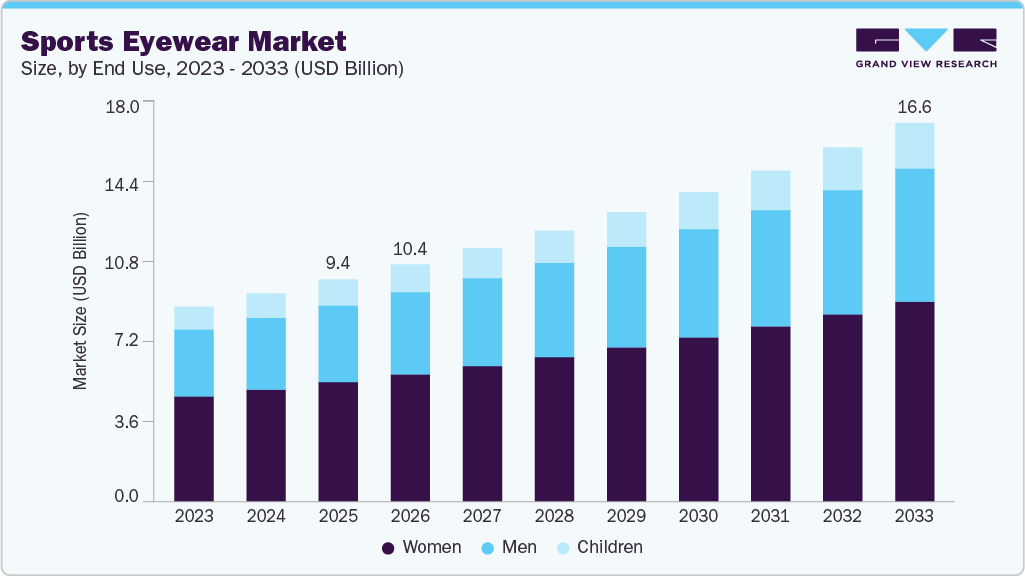 To learn more about this report, Download Free Sample Report
 Growing awareness of eye protection and UV safety is also playing a critical role in shaping consumer purchasing decisions. Consumers are becoming more informed about the long-term impact of UV exposure, glare, dust, and environmental pollutants on eye health, particularly during outdoor activities. This awareness is driving demand for sports eyewear equipped with UV400 protection, polarized lenses, and impact-resistant materials that safeguard vision without compromising comfort. Parents are also increasingly investing in protective eyewear for children participating in outdoor sports, further expanding the consumer base. As eye health becomes an integral part of overall wellness, sports eyewear is being positioned not just as an accessory but as essential protective gear.
Demand for performance-enhancing vision solutions is further accelerating product innovation within the sports eyewear market. Consumers are actively seeking eyewear that improves visual precision, contrast sensitivity, and depth perception across different terrains and lighting conditions. Tinted lenses for cycling, anti-fog coatings for winter sports, and interchangeable lens systems for multi-sport usage are gaining strong traction. Athletes and enthusiasts alike are prioritizing products that reduce eye strain and enhance reaction time, particularly in fast-paced sports environments. This shift toward performance-oriented eyewear is encouraging manufacturers to design highly specialized products tailored to specific sports categories and user needs.
Technological advancements in lenses and frame materials are significantly influencing product development and differentiation. Manufacturers are increasingly integrating innovations such as photochromic lenses that adapt to changing light conditions, lightweight yet durable frame materials like TR90 and carbon fiber, and advanced ventilation systems to prevent fogging. Precision-engineered designs that offer better grip, ergonomic fit, and impact resistance are enhancing user experience across both professional and recreational segments. For instance, in November 2025, Optimax Eyewear Group launched FORK, a new sunglasses brand inspired by nightlife and club culture, featuring unisex frames with light-tinted lenses designed for both day and low-light use. The collection includes multiple styles and color variations, combining premium materials with reflective coatings to balance visibility, comfort, and bold aesthetics. Supported by a digital-first rollout across platforms like TikTok and Instagram, the launch reflects the company’s strategy to expand into fashion-forward segments and attract younger consumers seeking culturally driven, statement eyewear. These advancements are enabling brands to deliver high-performance eyewear that balances functionality, comfort, and aesthetics, supporting premiumization across the market.
The growth of e-commerce and direct-to-consumer (DTC) channels is also transforming how sports eyewear is marketed and sold. Online platforms are providing consumers with access to a wider range of products, detailed specifications, and customer reviews, enabling more informed purchasing decisions. Brands are increasingly leveraging their own DTC websites to offer customized products, virtual try-on tools, and personalized recommendations, enhancing consumer engagement. Social media and influencer-driven marketing are further accelerating product visibility, particularly among younger consumers. As digital retail continues to expand, it is reducing dependency on traditional retail channels and enabling brands to build stronger, more direct relationships with their customers, thereby supporting sustained market growth.
Brand Market Share Insights
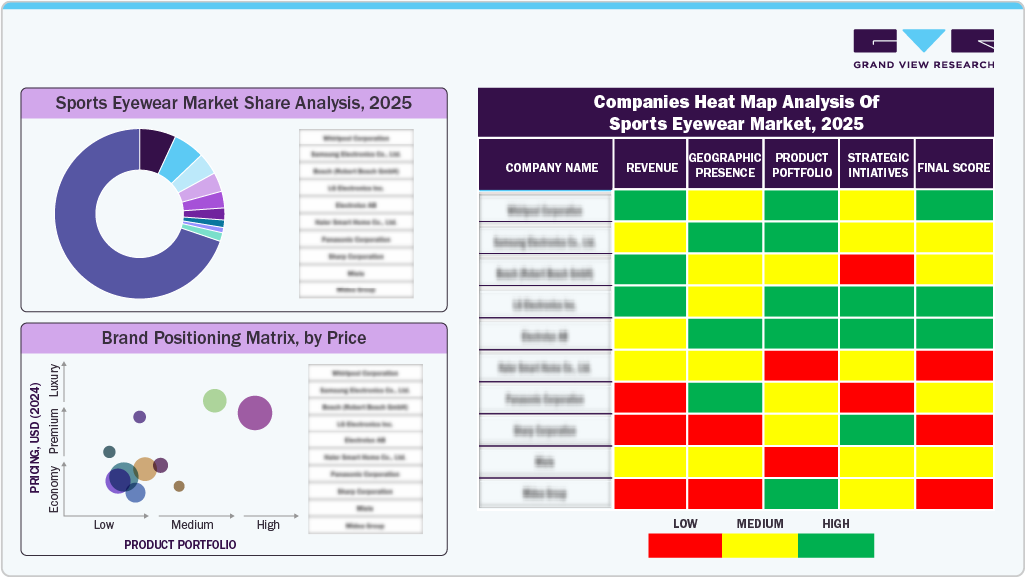
The global sports eyewear industry is highly competitive, driven by a mix of established multinational eyewear manufacturers and emerging performance-focused brands. Leading players such as EssilorLuxottica, Nike, Inc., Adidas AG, Safilo Group, and Kering Eyewear maintain strong market positions through extensive product portfolios, global distribution networks, and continuous innovation in lens and frame technologies.
 To learn more about this report, Download Free Sample Report
 These companies are increasingly investing in advanced features such as polarized and photochromic lenses, anti-fog coatings, and lightweight, impact-resistant materials to enhance performance across different sports environments. At the same time, emerging brands such as Goodr and Blenders Eyewear are gaining traction by offering affordable, design-driven products targeted at younger and recreational users. The rapid expansion of e-commerce and direct-to-consumer channels is further intensifying competition, enabling brands to reach wider audiences, accelerate product launches, and strengthen direct consumer engagement through digital platforms.
Consumer Insights
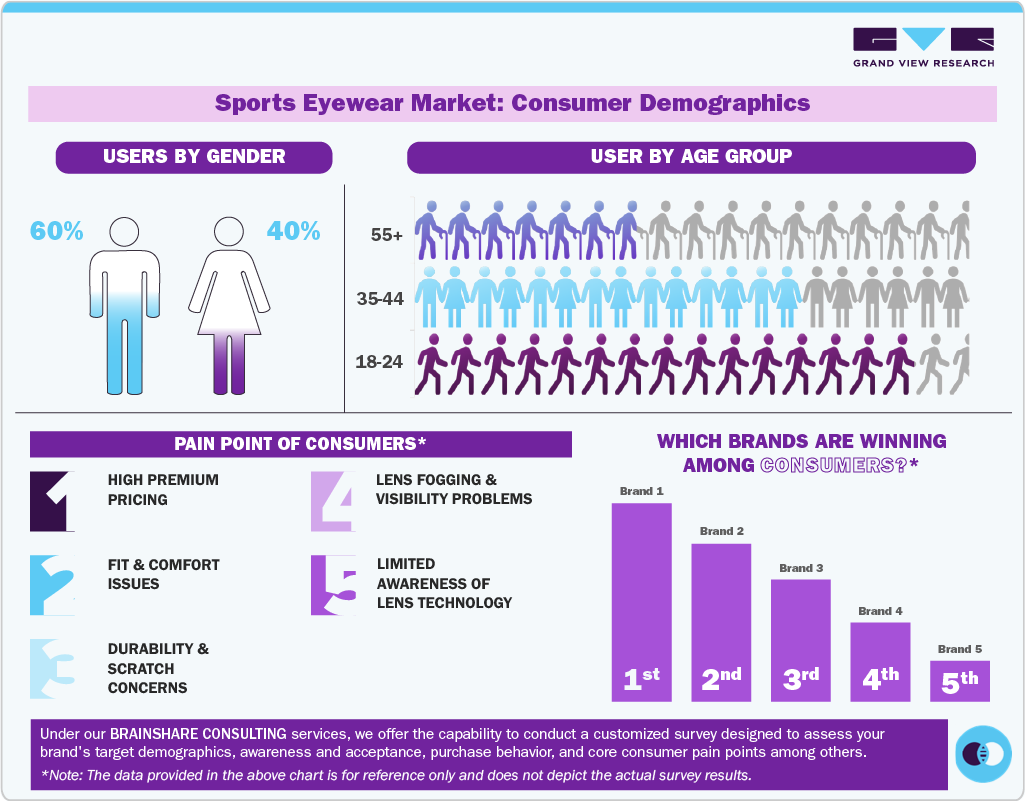
Consumer demand in the industry is driven by a blend of performance needs and lifestyle preferences, with a growing emphasis on style-function integration. Buyers are no longer selecting eyewear solely for protection; they are seeking products that align with their personal identity and can transition seamlessly between sports and casual use. This has led to rising demand for versatile designs that combine athletic performance with everyday wearability. In addition, brand perception, design aesthetics, and color customization are influencing purchase decisions, particularly among younger consumers. Mid-range and premium buyers are also showing a willingness to invest in products that offer a balance of durability, comfort, and modern styling, reflecting a shift toward eyewear as both functional gear and fashion accessory.
 To learn more about this report, Download Free Sample Report
 At the same time, convenience, accessibility, and post-purchase experience are becoming critical factors in consumer decision-making. Shoppers increasingly prefer brands that offer easy online purchasing, flexible return policies, and customization options such as prescription sports lenses or adjustable fits. Digital-first discovery, supported by platforms like Instagram, is accelerating impulse purchases and brand switching, especially when combined with limited-edition drops or influencer-led promotions. Consumers are also paying closer attention to product reviews, warranty offerings, and after-sales service, indicating a more informed and value-conscious approach. This evolving behavior highlights a shift toward convenience-driven, experience-focused purchasing, which continues to influence product positioning and brand strategies in the industry.
Product Insights
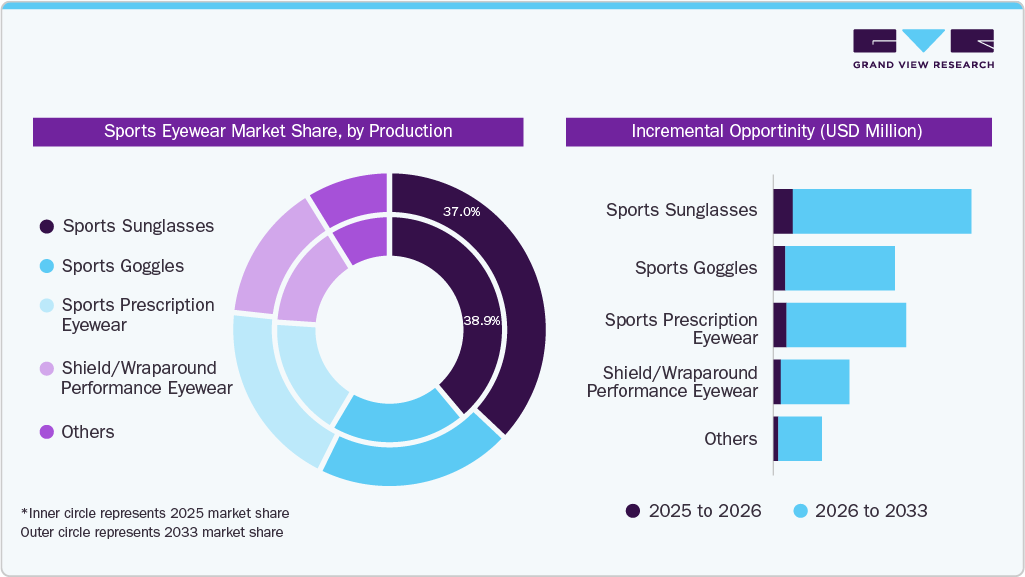
Sports sunglasses accounted for the largest market share of 38.8% in 2025, driven by strong consumer demand for versatile eye protection during outdoor sports and fitness activities. These products combine essential features such as UV protection, glare reduction, and enhanced visual clarity, making them suitable for a wide range of activities, including cycling, running, and hiking. Their lightweight design, ease of use, and ability to perform across varying light conditions without requiring adjustments have made them a preferred choice among both recreational and performance-focused users. In addition, continuous advancements in polarized lenses, UV400 protection, impact-resistant materials, and ergonomic frame designs are further strengthening their adoption.
 To learn more about this report, Download Free Sample Report
 The sports prescription eyewear segment is anticipated to grow at a CAGR of 8.3% from 2026 to 2033, driven by the increasing need for vision correction among consumers actively participating in sports and outdoor activities. As more individuals require prescription lenses while engaging in fitness routines such as cycling, running, and racquet sports, demand is rising for eyewear that combines clear vision with performance-oriented features. These products integrate prescription accuracy with benefits such as UV protection, impact resistance, and anti-glare coatings, making them suitable for dynamic and outdoor environments. In addition, advancements in lens customization, including wraparound prescription designs and lightweight, ergonomic frames, are enhancing comfort and usability.
Sports Type Insights
The outdoor land sports eyewear accounted for 37.8% of the market in 2025, driven by its widespread use across activities such as cycling, running, trekking, and field sports that require consistent visual clarity and eye protection. These products offer a balanced combination of durability, comfort, and performance, making them suitable for regular use across varying outdoor conditions. Consumers commonly prefer this category due to features such as UV protection, glare reduction, and impact resistance, which help manage exposure to sunlight, dust, and wind while maintaining clear vision during movement. In addition, outdoor land sports eyewear is available in versatile formats, including wraparound sunglasses, interchangeable lens systems, and lightweight performance frames, allowing users to adapt to different terrains and lighting conditions.
The adventure & extreme sports eyewear market is expected to grow at a CAGR of 8.2% from 2026 to 2033, driven by increasing participation in high-intensity activities such as mountain biking, rock climbing, skiing, and water sports that require advanced eye protection and performance reliability. These products are specifically engineered to withstand harsh environmental conditions, including high impact, strong UV exposure, wind, and debris, which strengthens consumer preference for specialized eyewear in this segment. They are commonly positioned as high-performance solutions for demanding sports environments, offering superior durability, enhanced grip, and secure fit compared with standard sports eyewear. In addition, expanding availability through specialty sports retailers, brand-owned outlets, and e-commerce platforms is improving consumer access to premium, sport-specific eyewear.
End Use Insights
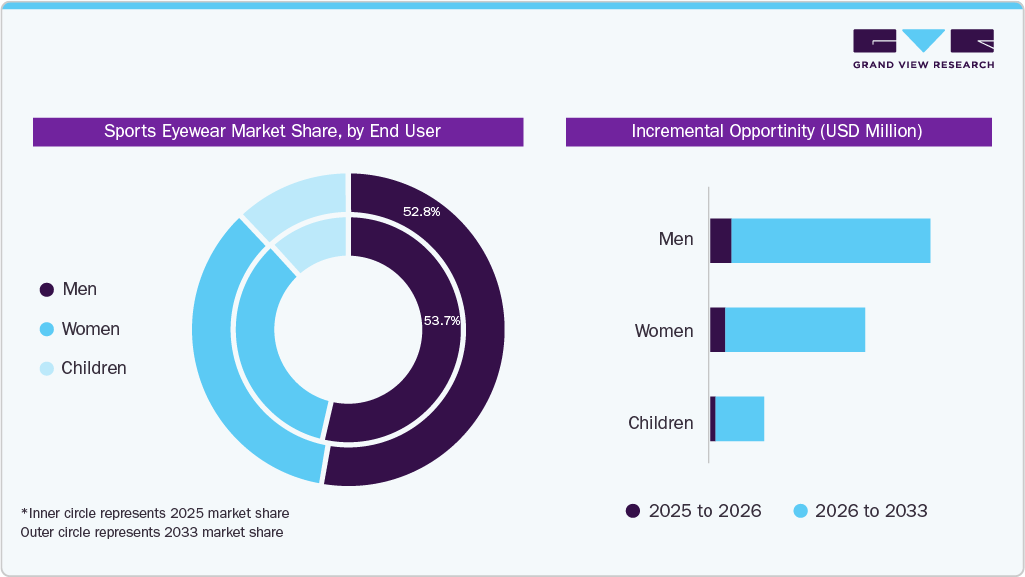
The men’s segment accounted for a market share of 53.7% in 2025, supported by high participation rates of men in outdoor sports, fitness activities, and competitive events such as cycling, running, and adventure sports. Male consumers typically prioritize functionality, durability, and performance-driven features when selecting sports eyewear, leading to strong adoption of products that offer UV protection, impact resistance, and enhanced visual clarity. In addition, many men prefer versatile eyewear that can be used across multiple activities, increasing demand for designs that combine comfort with rugged performance.
 To learn more about this report, Download Free Sample Report
 The women’s segment is expected to grow at a CAGR of 7.2% from 2026 to 2033. Women are seeking eyewear that offers better nose bridge support, reduced slippage, and all-day wearability during low- and high-intensity activities. In addition, there is a growing preference for lightweight, non-bulky designs that integrate seamlessly into athleisure and travel lifestyles, enabling usage beyond core sports settings. The expansion of women-focused product lines by leading brands, along with increased availability of prescription-compatible sports eyewear, is also improving accessibility and adoption.
Price Tier Insights
Mid-range sports eyewear accounted for 36.7% of the market in 2025, driven by strong demand for products that balance performance features with affordability. Consumers in this segment typically seek reliable eyewear that offers essential functionalities such as UV protection, glare reduction, and durable frame construction without the higher price associated with premium brands. This category appeals to a broad base of recreational users and regular fitness participants who require dependable performance for activities such as running, cycling, and gym workouts while maintaining cost efficiency. In addition, mid-range products often incorporate selective advanced features such as polarized lenses and lightweight materials, making them suitable for multi-activity use.
The premium & luxury sports eyewear market is expected to grow at a CAGR of 7.3% from 2026 to 2033, driven by rising consumer preference for high-performance products that combine advanced lens technology with superior materials and brand positioning. Buyers in this segment are increasingly investing in eyewear that offers enhanced optical precision, features such as photochromic and polarized lenses, and premium frame materials like carbon fiber and titanium for improved durability and comfort. In addition, demand is being supported by design-led innovation, limited-edition collections, and brand collaborations that appeal to consumers seeking both performance and exclusivity.
Distribution Channel Insights
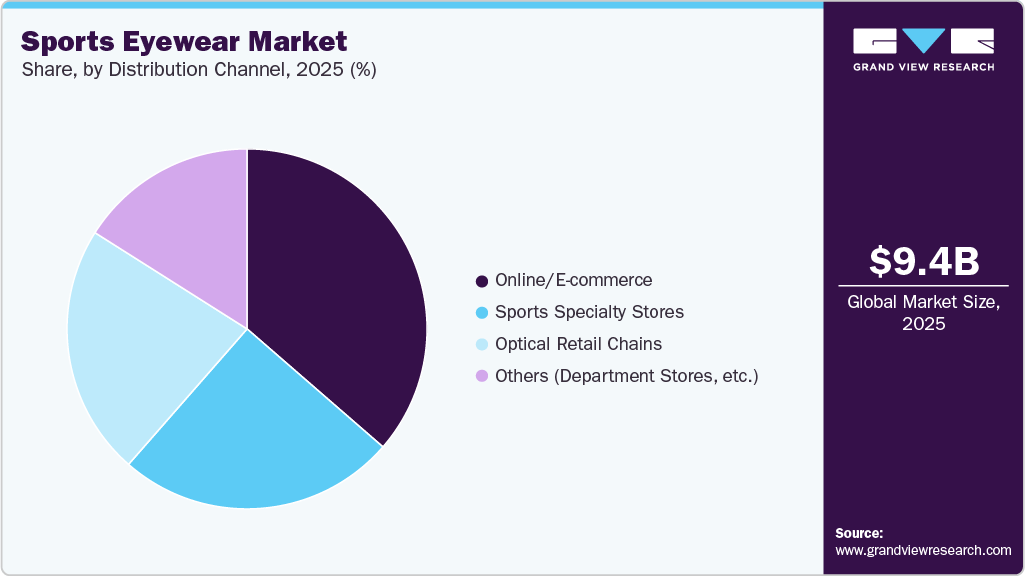
The sale of sports eyewear through online/e-commerce channels accounted for 36.3% in 2025, driven by the growing preference among consumers to purchase performance gear through digital platforms that offer convenience, wider product selection, and easy price comparison. Online channels provide access to a diverse range of sports eyewear, including polarized sunglasses, prescription sports frames, and sport-specific designs from both global brands and emerging players. Detailed product specifications, customer reviews, and visual demonstrations available on e-commerce platforms enable consumers to evaluate factors such as lens technology, fit, and durability before making a purchase. In addition, features such as virtual try-on tools, easy return policies, and doorstep delivery are improving the overall buying experience.
 To learn more about this report, Download Free Sample Report
 The sale of sports eyewear through sports specialty stores is expected to grow at a CAGR of 5.6% from 2026 to 2033, supported by the increasing consumer preference for purchasing performance gear from expert-led retail environments that offer product authenticity and professional guidance. These stores are widely regarded as reliable destinations for sport-specific eyewear, where trained staff assist consumers in selecting products based on activity type, fit, and performance requirements. Shoppers benefit from the ability to physically try products, assess comfort, and evaluate lens clarity and frame stability before purchase, which is particularly important for high-performance use. In addition, sports specialty retailers are expanding their assortments with premium brands, advanced lens technologies, and customized solutions such as prescription sports eyewear, making it easier for consumers to access specialized products.
Regional Insights
The North America sports eyewear market accounted for the largest share of 31.7% in 2025. The North American industry is driven by high participation in outdoor sports, fitness activities, and organized sporting events across the U.S. and Canada. The region benefits from a well-established sports culture supported by running events, cycling communities, and adventure sports, which consistently drives demand for performance-oriented eyewear. Consumers in North America also show strong awareness of eye protection, particularly against UV exposure and glare, leading to higher adoption of advanced products with polarized lenses and impact-resistant materials. In addition, the presence of leading eyewear manufacturers and sports brands, along with continuous product innovation in lens technology and frame design, is strengthening market growth.
U.S. Sports Eyewear Market Trends
The sports eyewear industry in the U.S. accounted for a revenue share of around 81.6% of the North America market in 2025. The U.S. market is driven by strong participation in fitness activities, organized sports, and outdoor recreation such as running, cycling, and adventure sports. Consumers in the U.S. place high importance on performance, durability, and eye protection, leading to increased adoption of products featuring polarized lenses, UV400 protection, and impact-resistant frames. The market is further supported by continuous innovation from leading brands, along with a well-established retail ecosystem that includes specialty sports stores, optical chains, and advanced e-commerce platforms.
Mexico sports eyewear industry is expected to grow at a CAGR of 7.2% from 2026 to 2033. The Mexican market is driven by rising participation in outdoor sports and recreational activities such as running, cycling, football, and beach sports, particularly across urban and coastal regions. Increasing awareness of eye protection against strong sunlight, glare, and dust is encouraging consumers to adopt performance-oriented eyewear with features such as UV400 protection and polarized lenses. In addition, improving purchasing power and expanding access to both international and regional brands are supporting wider product adoption.
Europe Sports Eyewear Market Trends
The sports eyewear market in Europe accounted for the revenue share of 24.7% in 2025, driven by strong participation in outdoor and seasonal sports such as cycling, skiing, running, and trekking across key countries including Germany, France, Italy, Spain, and the United Kingdom. Consumers in the region place high importance on optical precision, durability, and certified eye protection, which is driving the adoption of advanced lens technologies such as polarized and photochromic lenses. The market is further supported by well-developed sports infrastructure, strong cycling and winter sports culture, and strict regulatory standards related to UV protection. In addition, the presence of established eyewear manufacturers, along with wide availability through specialty sports retailers, optical chains, and growing e-commerce platforms, continues to strengthen product accessibility.
Germany sports eyewear industry accounted for a revenue share of around 20.7% on the Europe market in 2025. The German market is driven by strong participation in outdoor and endurance sports such as cycling, running, hiking, and winter sports. The country’s well-developed cycling infrastructure and active outdoor culture consistently support demand for performance-oriented eyewear. Consumers in Germany prioritize precision, durability, and high-quality engineering, leading to increased adoption of products featuring advanced lens technologies such as polarized and photochromic lenses. In addition, rising awareness of eye protection against UV exposure and environmental conditions is encouraging regular use across both recreational and professional activities.
The sports eyewear industry in Spain is expected to grow at a CAGR of 5.6% from 2026 to 2033. The Spanish market is driven by strong participation in outdoor activities such as cycling, running, beach sports, and hiking, supported by the country’s warm climate and tourism-driven lifestyle. High levels of sun exposure are increasing awareness of eye protection, encouraging consumers to adopt sports eyewear with UV protection and glare-reducing lenses. In addition, the growing fitness culture and rising number of amateur sports events are supporting regular usage of performance eyewear.
Asia Pacific Sports Eyewear Market Trends
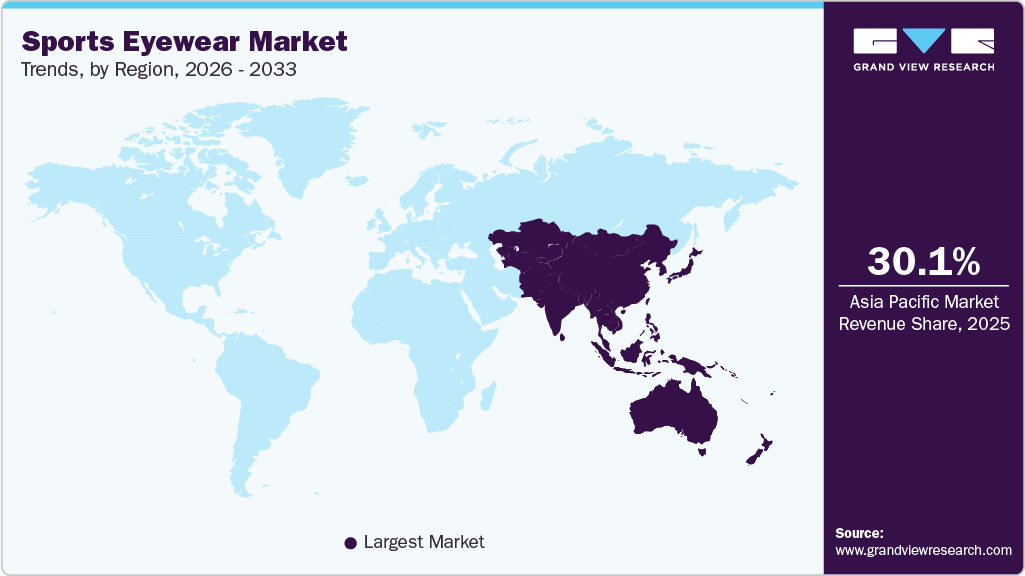
The sports eyewear industry in Asia Pacific is expected to grow at a CAGR of 8.8% from 2026 to 2033. The Asia Pacific sports eyewear market is driven by rapid urbanization and rising participation in fitness activities, outdoor sports, and recreational events across countries such as China, India, Japan, and Australia. Increasing health awareness and a shift toward active lifestyles are encouraging consumers to invest in performance-oriented eyewear that offers protection against strong sunlight, dust, and environmental conditions. In addition, growing disposable incomes and expanding middle-class populations are supporting higher adoption of branded and technologically advanced products. The rapid expansion of e-commerce platforms and digital retail channels is further improving accessibility, while the influence of social media and fitness communities is accelerating product awareness, collectively supporting strong market growth across the region.
 To learn more about this report, Download Free Sample Report
 China sports eyewear industry accounted for a revenue share of around 15.9% on the Asia Pacific market in 2025. The China sports eyewear market is driven by rapid growth in fitness participation and outdoor activities such as running, cycling, and hiking among urban consumers. Increasing health awareness and government-led fitness initiatives are encouraging active lifestyles, which is boosting demand for performance-oriented eyewear. In addition, high exposure to pollution, dust, and strong sunlight in many cities is increasing the need for protective eyewear that enhances visibility while safeguarding eye health.
The sports eyewear industry in India is expected to grow at a CAGR of 11.2% from 2026 to 2033. The Indian market is driven by the rapid expansion of fitness culture and increasing participation in outdoor activities such as running, cycling, cricket, and trekking across urban and semi-urban regions. Rising awareness of eye protection against strong sunlight, dust, and pollution, common across many Indian cities, is encouraging consumers to adopt sports eyewear with UV protection and glare-reducing lenses. In addition, the growing popularity of amateur sporting events, marathons, and cycling communities is supporting consistent product usage among younger consumers. The market is also benefiting from increasing affordability through domestic brands, expansion of e-commerce platforms, and strong digital influence, where consumers actively explore performance-oriented products before purchase.
Central & South America Sports Eyewear Market Trends
The sports eyewear industry in Central & South America is expected to grow at a CAGR of 7.2% from 2026 to 2033. The Central & South America sports eyewear market is driven by rising participation in outdoor sports and recreational activities such as football, cycling, running, and beach sports across countries, including Brazil, Mexico, and Chile. High levels of sun exposure across the region are increasing awareness of eye protection, encouraging consumers to adopt sports eyewear with UV protection and glare-reducing lenses. In addition, growing urban fitness culture and increasing involvement in amateur sports events are supporting regular use of performance eyewear among younger populations.
Middle East & Africa Sports Eyewear Market Trends
The sports eyewear industry in the Middle East & Africa is expected to grow at a CAGR of 7.7% from 2026 to 2033. The Middle East & African sports eyewear market is supported by the rising popularity of motorsports, desert rallies, and off-road activities that require specialized eyewear for high-speed and high-dust environments, particularly in countries such as the UAE and Saudi Arabia. In addition, increasing investments in large-scale sporting events and infrastructure, including international tournaments and regional leagues, are encouraging greater consumer engagement in sports and related gear. The market is also benefiting from a growing expatriate population that brings diverse sports preferences and higher spending on premium sports accessories.
Key Sports Eyewear Companies Insights
Key players operating in the sports eyewear market are undertaking various initiatives to strengthen their presence and increase the reach of their products and services. Strategies such as expansion activities and partnerships are key in propelling the market growth.
Key Sports Eyewear Companies:
The following key companies have been profiled for this study on the sports eyewear market.
- EssilorLuxottica
- Safilo Group S.p.A.
- Luxottica Group S.p.A.
- Nike, Inc.
- Adidas AG
- Under Armour, Inc.
- Oakley, Inc.
- Rudy Project S.p.A.
- Bolle Brands
- Smith Optics
Recent Developments
-
In March 2026, TITE Eyewear officially launched its performance-focused eyewear designed specifically for golf, following its debut at the PGA Show. The collection features patent-pending lens technology engineered to enhance contrast, depth perception, and visibility of course details such as contours and breaks, helping players improve on-course decision-making. Developed with input from professional players and caddies, the eyewear also emphasizes lightweight comfort, secure fit, and UV protection, positioning it as a performance tool rather than just sun protection for golfers.
-
In December 2025, Innovative Eyewear Inc. introduced new Reebok-branded smart eyewear designed specifically for gym and indoor sports use. The launch includes updated versions of its Octane and Nitrous frames with light-adaptive lenses suited for both indoor and hybrid environments, along with an upgraded audio system delivering enhanced sound performance. The collection also features an accessory to improve audio clarity in noisy settings, reflecting the company’s focus on expanding smart eyewear applications for active lifestyles such as weight training, CrossFit, and indoor court sports.
Sports Eyewear Market Report Scope
Report Attribute
Details
Market size in 2025
USD 9.4 billion
Estimated Market size in 2026
USD 10.4 billion
Projected Market size by 2033
USD 16.6 billion
Growth rate
CAGR of 6.9% from 2026 to 2033
Base year for estimation
2025
Historical data
2021 - 2025
Forecast period
2026 - 2033
Quantitative units
Revenue in USD million/billion and CAGR from 2026 to 2033
Report coverage
Revenue forecast, company ranking, competitive landscape, growth factors, and trends
Segments covered
Product, sports type, end use, price tier, distribution channel, region
Regional scope
North America; Europe; Asia Pacific; Central & South America; Middle East & Africa
Country scope
U.S.; Canada; Mexico; Germany; U.K.; France; Italy; Spain; China; India; Japan; Australia & New Zealand; South Korea; Brazil; Argentina; South Africa; Saudi Arabia; UAE
Key companies profiled
EssilorLuxottica; Safilo Group S.p.A.; Luxottica Group S.p.A.; Nike, Inc.; Adidas AG; Under Armour, Inc.; Oakley, Inc.; Rudy Project S.p.A.; Bolle Brands; Smith Optics
Customization scope
Free report customization (equivalent up to 8 analysts working days) with purchase. Addition or alteration to country, regional & segment scope.
Pricing and purchase options
Avail customized purchase options to meet your exact research needs. Explore purchase options Global Sports Eyewear Market Report Segmentation
This report forecasts revenue growth at global, regional & country levels and provides an analysis of the latest trends and opportunities in each of the sub-segment from 2021 to 2033. For this study, Grand View Research has segmented the global sports eyewear market report on the basis of product, sports type, end use, price tier, distribution channel, and region:
-
Product Outlook (Revenue, USD Million, 2021 - 2033)
-
Sports Sunglasses
-
Sports Goggles
-
Sports Prescription Eyewear
-
Shield/Wraparound Performance Eyewear
-
Others (Hybrid/Convertible, etc.)
-
-
Sports Type Outlook (Revenue, USD Million, 2021 - 2033)
-
Outdoor Land Sports
-
Water Sports
-
Winter Sports
-
Adventure & Extreme Sports
-
Others (Court Sports, etc.)
-
-
End User Outlook (Revenue, USD Million, 2021 - 2033)
-
Men
-
Women
-
Children
-
-
Price Tier Outlook (Revenue, USD Million, 2021 - 2033)
-
Mass
-
Mid-range
-
Premium & Luxury
-
-
Distribution Channel Outlook (Revenue, USD Million, 2021 - 2033)
-
Optical Retail Chains
-
Sports Specialty Stores
-
Online/E-commerce
-
Others (Department Stores, etc.)
-
-
Regional Outlook (Revenue, USD Million, 2021 - 2033)
-
North America
-
U.S.
-
Canada
-
Mexico
-
-
Europe
-
Germany
-
UK
-
France
-
Italy
-
Spain
-
-
Asia Pacific
-
China
-
India
-
Japan
-
Australia & New Zealand
-
South Korea
-
-
Central & South America
-
Brazil
-
Argentina
-
-
Middle East & Africa
-
South Africa
-
Saudi Arabia
-
UAE
-
-
Frequently Asked Questions About This Report
Key factors that are driving the market growth include the rising number of national and international sports events, and the rising demand for fashionable sunglasses.
Outdoor land sports eyewear segment led with a 37.8% revenue share in 2025.
Men’s segment held the largest revenue share 53.7% in 2025.
Mid-range sports eyewear segment held the largest share (over 36.7%) in 2025.
Online/e-commerce channels segment led with a 36.3% revenue share in 2025.
The global sports eyewear market is expected to grow at a CAGR of 6.9% from 2026 to 2033 to reach USD 16.6 billion by 2033.
The North American sports eyewear market accounted for the largest share of 31.7% in 2025.
Some key players operating in the sports eyewear market include EssilorLuxottica; Safilo Group S.p.A.; Luxottica Group S.p.A.; Nike, Inc.; Adidas AG; Under Armour, Inc.; Oakley, Inc.; Rudy Project S.p.A.; Bolle Brands; Smith Optics
The global sports eyewear market size was valued at USD 9.7 billion in 2025 and is expected to reach USD 10.4 billion in 2026.
About the Author(s)
Clothing, Footwear & Accessories Research Team
Consumer Goods · Clothing, Footwear & AccessoriesThis report was authored by the clothing, footwear & accessories research team at Grand View Research - comprising two research analysts, one senior research analyst, and one industry expert - with specialized expertise in the clothing, footwear & accessories segment of the consumer goods industry. All findings are based on proprietary consumer goods databases, executive interviews, and regulatory analysis, subject to internal peer review prior to publication.
Last Updated:
Speak to Analyst

Customize this report to your needs - add regions, segments, or data points, with 20% free customization.
Or view our licence options:


ISO 9001:2015 & 27001:2022 Certified
We are GDPR and CCPA compliant! Your transaction & personal information is safe and secure. For more details, please read our privacy policy.


