
- Home
- »
- Homecare & Decor
- »
-
Sports Tourism Market Size Report, 2026-2033GVR Report cover

Sports Tourism Market (2026 - 2033)
Size, Share & Trends Analysis Report By Sports Type (Soccer/Football, Cricket, Basketball, Tennis), By Tourism Type (Active, Passive, Nostalgia), By Region, And Segment Forecasts
Market Size, 2025
$803.9BMarket Estimate, 2026
$927.9BMarket Forecast, 2033
$2,776.7BCAGR, 2026–2033
17.0%Sports Tourism Market Summary
The global sports tourism market size was valued at USD 803.9 billion in 2025 and is projected to grow from USD 927.9 billion in 2026 to USD 2,776.7 billion by 2033, at a CAGR of 17.0% from 2026 to 2033. The market in Europe dominated with a revenue share of 38.0% in 2025. The global market is expanding rapidly due to the increasing consumer shift toward experiential and activity-based travel.
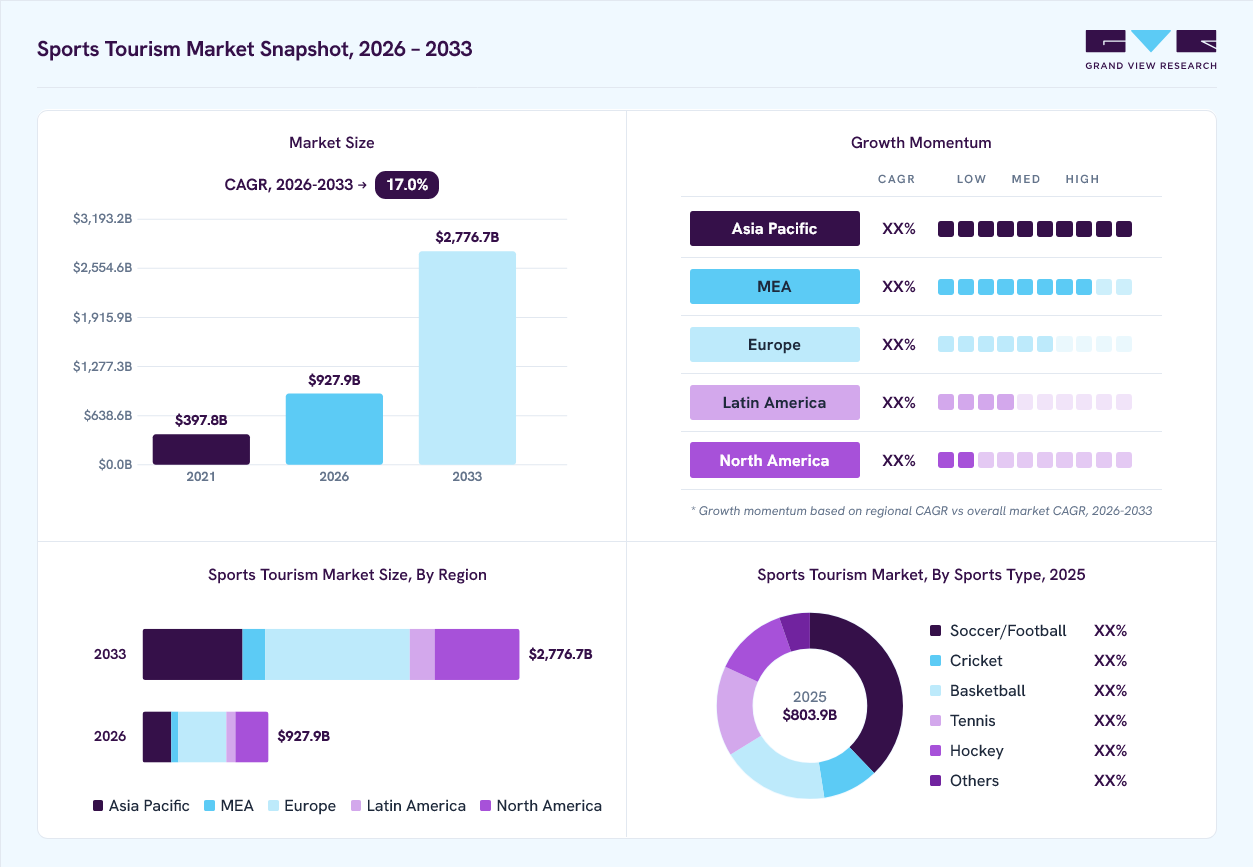 Source: Grand View Research, IR Documents, Primary Interviews, Paid DatabasesTo learn more about this report,
 Download Free Sample Report
Key Market Trends & Insights
- By tourism type: Passive tourism segment held the largest market share of 43.2% in 2025.
- By sports type: Soccer/football segment held the largest market share of 37.8% in 2025.
Regional Highlights
- Largest regional market: Europe (38.0% revenue share, 2025)
- By country: UK held the largest market share in 2025
Market Size & Forecast
- Market size in 2025: USD 803.9 Billion
- Estimated market size in 2026: USD 927.9 Billion
- Projected market size by 2033: USD 2,776.7 Billion
- CAGR (2026-2033): 17.0%
Three ways to get this report
Buy it, customize it, or ask a question.Ask an Analyst
Analyst response in 1 business day
- AccessReport author, directly
- Reply timeWithin 1 working day
- No sales callDirect answer only
- FormatEmail reply
- CostFree, no cost
Get the Full Report
What the study covers
- FormatsPDF · Excel · Dashboard
- Timeline2026–2033 annual, 2025 base
- Coverage20+ countries, 5 regions
- Companies10+ key players profiled
Customize the Report
20% free customization
- IncludeCountries, segments, points
- TailorTo your product definition
- ExtendDeeper competitor detail
- OrA fully bespoke study
- Turnaround5–10 working days
Unlike traditional sightseeing, sports tourism offers a blend of entertainment, emotional engagement, and immersive experiences that appeal strongly to today’s travelers. The growing desire for authentic, memorable activities, whether attending mega-events such as the FIFA World Cup or participating in marathons, cycling tours, and adventure sports, has positioned sports tourism as a preferred travel category across age groups. To learn more about this report, Download Free Sample Report
Sports tourism is also benefiting from the globalization of sports content and the proliferation of digital platforms. Live-streaming, social media, and global broadcasting rights have allowed fans to follow teams across borders and cultivate deeper emotional connections with international sporting events. This digital engagement often converts into actual travel, with fans seeking in-person attendance at major games or travelling abroad to explore their favorite teams’ home venues. Similarly, the professionalization and commercialization of sports leagues, combined with high production values, celebrity-driven promotions, and immersive fan events, have significantly increased the attractiveness of sports-related travel.
As consumers increasingly adopt wellness-oriented lifestyles, they are seeking travel options that integrate physical activity, such as hiking, cycling, running events, golf tourism, surf camps, and winter sports. This has broadened the definition of sports tourism from passive spectating to active participation. Younger travelers-particularly Millennials and Gen Z-are driving this shift, as they prioritize travel that combines sport, adventure, and social connection.
Growing government financing and initiatives to promote sports tourism, along with an increase in the number of young players, are expected to have a significant impact on the sector globally, providing tour operators with an opportunity to tap into new markets. It is also projected that more government support for the sector will accelerate expansion. Various governments are promoting sports holiday destinations to domestic and international tourists to boost their foreign exchange revenues by fostering the expansion of the sports tourism industry.
Market Dynamics
The sports tourism market is witnessing vigorous growth driven by increasing consumer willingness to travel to participate in and attend sporting events, ranging from international tournaments and motorsport races to marathons and adventure sports competitions. Rising investments in sports infrastructure, the expansion of multi-city event hosting models, and growing demand for experiential travel are supporting market expansion. Furthermore, the increasing popularity of amateur participation events, sports-themed travel packages, and destination marketing initiatives aimed at attracting high-spending spectators, coupled with improved air connectivity and digital ticketing platforms, is expected to continue driving growth in the global sports tourism market.
The increasing commercialization of VIP hospitality and access-driven experiences is emerging as a major driver for the sports tourism market. Consumers are no longer satisfied with simply attending matches; they are seeking all-inclusive packages that include premium seating, athlete meet-and-greets, behind-the-scenes access, exclusive events, and luxury accommodations. This trend is broadening sports tourism beyond ticket sales and transforming it into a high-value experiential segment. The penetration of premium offerings is attracting affluent travelers, encouraging repeat visits, and increasing average spending per trip.
In May 2026, India's TCM Sports launched TCM Sports LIST, a luxury hospitality platform offering curated experiences around marquee events such as Wimbledon, including official Center Court seats and interactions with former champion Pat Cash, highlighting the growing importance of experiential sports tourism.
The growing concentration of demand around globally recognized tournaments and championships is creating a significant restraint for the sports tourism market. Limited accommodation capacity, dynamic airline pricing, ticket scarcity, and inflated hospitality costs during major events are raising the total cost of travel and reducing accessibility for middle-income consumers. Host cities frequently experience congestion and supply shortages, leading to diminished visitor experiences and shorter booking windows. In addition, concerns regarding overtourism and local infrastructure strain are prompting some destinations to impose stricter regulations on short-term rentals and visitor flows, creating operational challenges for tour operators and limiting the scalability of event-driven sports tourism.
The development of sports-themed cruises and destination-based multi-event itineraries represents a notable opportunity for the sports tourism market. Travel companies are increasingly combining access to several sporting events with luxury accommodations, networking experiences, and curated entertainment to attract high-spending travelers. These integrated offerings are extending customer stays and increasing per-trip expenditure beyond traditional event attendance. In parallel, sports enthusiasts are increasingly interested in combining tournaments across multiple cities or countries into a single travel experience. This shift is encouraging operators to create bundled packages around Formula 1, tennis Grand Slams, golf majors, and international football competitions, opening new avenues for diversifying revenue and premiumizing sports tourism.
Analyst Perspective
The sports tourism market is benefiting from the increasing premiumization of fan experiences, rising international mobility, and the growing willingness of consumers to allocate discretionary spending toward event-centric travel. The segment's most durable competitive advantage, however, is likely to accrue to operators that integrate ticketing, hospitality, accommodation, local experiences, and exclusive access into a unified offering spanning multiple sports and destinations. As sports tourism evolves beyond single-event attendance, companies that can create year-round engagement through recurring tournaments, loyalty programs, and curated travel packages can convert episodic trips into long-term customer relationships. This shift is expected to enhance traveler spending per visit and enable market participants to capture the pricing premium associated with immersive, access-driven experiences and destination loyalty.
Consumer Insights
 To learn more about this report, Download Free Sample Report
Consumer interest in sports tourism has expanded significantly in recent years, driven by a shift toward experience-led travel and an increasing desire for active, meaningful, and socially engaging leisure activities. Modern travelers, particularly Millennials and Gen Z, exhibit a clear preference for experiential travel over passive sightseeing. Sporting events offer a uniquely immersive experience that combines entertainment, cultural exposure, and community engagement. This trend is further amplified by the growing focus on health, fitness, and wellness, prompting consumers to pursue trips that involve physical activity, such as marathons, cycling tours, golf holidays, and adventure-sport itineraries. The integration of travel, sport, and lifestyle has therefore positioned sports tourism as a rapidly expanding segment of the global tourism industry.
 To learn more about this report, Download Free Sample Report
 To learn more about this report, Download Free Sample Report
 To learn more about this report, Download Free Sample Report
The rising global interest in a diverse range of sports can be attributed to several structural and behavioral factors. Digital globalization has played a central role: streaming platforms, short-form video content, and global broadcasting rights have exposed consumers to multiple international sports beyond their domestic or traditional preferences. As a result, sports such as basketball, Formula 1, tennis, mixed martial arts, and even niche adventure sports have gained substantial traction in markets where they previously had limited visibility. Social media has further deepened engagement, allowing fans to follow athletes closely, participate in interactive fan communities, and remain connected to major tournaments in real time.
Digital media and fan-engagement platforms have also heightened interest in sports, as streaming services and social media enable consumers to follow teams worldwide, participate in online fan communities, and ultimately develop aspirations to attend major events in person. Younger consumers are also demonstrating higher awareness of sustainability and inclusivity, favoring destinations and sporting organizations that invest in environmentally responsible infrastructure and promote gender-equal participation.
Sports Type Insights
Based on sports type, the soccer/football segment led the market with the largest revenue share of 37.8% in 2025. The demand for sports tourism in soccer is rising rapidly as fans increasingly seek immersive, experience-driven travel tied to major matches, iconic stadiums, and international tournaments. Global football leagues such as the Premier League, La Liga, and Serie A have built strong international fanbases through digital content and broadcasting, motivating supporters to travel for live match experiences. Mega-events like the FIFA World Cup, UEFA Champions League, and regional cups also attract tourists who want the excitement, atmosphere, and cultural connection that only in-stadium experiences can offer. Additionally, rising disposable incomes, easier international travel, and the growth of club merchandise tours, training-camp visits, and fan festivals are further fueling this surge in football-based sports tourism.
 To learn more about this report, Download Free Sample Report
The cricket segment is projected to register a CAGR of 18.6% from 2026 to 2033. The demand for sports tourism in cricket is growing as fans increasingly seek immersive, live match experiences rather than watching games remotely. Major tournaments, such as the ICC World Cup, IPL, Ashes, and franchise leagues across the UAE, the U.S., and South Africa, have transformed cricket into a global spectacle, attracting travelers from multiple countries. Additionally, the rise of star players, social media engagement, and the desire to combine leisure travel with high-energy sporting events are making cricket-driven tourism one of the fastest-growing segments in global sports travel.
Tourism Type Insights
Based on tourism type, the passive tourism segment led the market with the largest revenue share of 43.2% in 2025, as consumers increasingly seek memorable, experience-driven leisure activities, such as attending major sporting events, rather than participating in them. Global tournaments, iconic stadium experiences, and high-profile leagues have become cultural attractions, supported by rising disposable incomes, improved international connectivity, and strong social media influence. Fans now view live sports as a premium entertainment experience that combines travel, hospitality, and social engagement, driving higher spending on tickets, tours, and event-linked tourism packages.
 To learn more about this report, Download Free Sample Report
The active segment is estimated to grow at a CAGR of 17.1% over the forecast period. Travelers today prefer engaging, goal-oriented activities, such as hiking, skiing, cycling, marathon events, and water sports, over traditional sightseeing because these experiences offer both physical challenges and emotional fulfillment. Rising health consciousness, the influence of social media, and the appeal of nature-based destinations are further driving participation. Additionally, higher disposable incomes and the expansion of professional and amateur sporting events worldwide have made active sports travel more accessible, motivating people to plan trips around their favorite sports and outdoor activities.
Regional Insights
The North America sports tourism market is expected to grow at a CAGR of 14.4% from 2026 to 2033. Younger travelers, in particular, are seeking immersive, high-energy experiences rather than traditional sightseeing, while families view sports events as memorable, multi-day travel opportunities. The growth of mega-events, improved stadium infrastructure, and the expansion of women’s sports leagues are also boosting inbound and domestic travel. Additionally, higher disposable incomes and the rise of packaged sports travel, including VIP hospitality, fan zones, and event-linked holidays, are making sports tourism more accessible and aspirational across the region.
U.S. Sports Tourism Market Trends
The sports tourism market in the U.S. held the largest share in the North America region in 2025. Consumers increasingly seek experience-driven travel, combining major sporting events with leisure, entertainment, and lifestyle activities. Large-scale events, such as the Super Bowl, NBA games, Formula 1 races, college tournaments, and marathon weekends, are drawing both domestic and international travelers who value the excitement, community atmosphere, and cultural appeal that surround sports. Additionally, the growth of youth sports, rising participation in adventure and endurance activities, and the expansion of world-class stadiums and sports entertainment districts have made sports-related travel more accessible and desirable.
Europe Sports Tourism Market Trends
Europe dominated the sports tourism market with the largest revenue share of 38.0% in 2025, owing to the rising interest in attending major international events, increasing participation in adventure and fitness activities, and Europe’s strong infrastructure for hosting tournaments, marathons, cycling tours, and winter sports. Travelers are seeking experiential holidays, and sports-centered trips offer a mix of competition, entertainment, and cultural exploration. Additionally, the surge in disposable incomes, strong promotion by European tourism boards, and the popularity of iconic clubs and events such as football leagues, Formula 1, and ski championships are driving more tourists to plan trips around sports experiences.
 To learn more about this report, Download Free Sample Report
Asia Pacific Sports Tourism Market Trends
The Asia Pacific sports tourism industry is expected to grow at a CAGR of 19.5% from 2026 to 2033. The demand for sports tourism is growing rapidly in Asia Pacific, driven by rising disposable incomes, increasing interest in fitness and adventure activities, and substantial government investment in hosting global sporting events. Countries like Japan, Singapore, Australia, and China are actively promoting marathon events, Formula 1 races, cricket leagues, and Olympic-level tournaments, attracting both regional and international travelers. Additionally, younger consumers are prioritizing experiential travel over traditional sightseeing, driving demand for activity-based trips such as trekking, surfing, diving, and stadium tourism.
Key Sports Tourism Company Insights
The presence of a mix of established players and emerging entrants characterizes the sports tourism market. Leading companies are increasingly prioritizing sports-focused travel due to rising consumer demand, while expanding and diversifying their service portfolios to strengthen competitiveness and retain market share.
-
In July 2025, Saudi, Welcome to Arabia partnered with the Esports World Cup Foundation for the 2025 Esports World Cup in Riyadh, promoting Saudi Arabia’s culture and tourism through curated fan experiences and expanded programming. The event, running from July 7 to August 24, 2025, features 25 tournaments with over 2,000 elite players from more than 100 countries and offers the largest prize pool in esports history, exceeding $70 million. Forty percent of ticket sales so far are to international fans, highlighting Saudi Arabia’s growing profile in global sports tourism and live entertainment.
-
In September 2025, Sports ETA announced a partnership with RCX Sports to expand access and opportunities in youth sports. RCX Sports, the official youth sports operator for several major professional leagues, will collaborate with Sports ETA at upcoming events to support community engagement and enhance youth programming nationwide. The partnership aims to reach more kids and create inclusive, high-quality sports experiences across the country.
 To learn more about this report, Download Free Sample Report
Key Sports Tourism Companies:
The following key companies have been profiled for this study on the sports tourism market.
-
BAC Sports
-
Inspiresport
-
Gulliver's Sports Travel Ltd
-
Dream Team Sports Tour
-
Navigo Sports Tour, LLC
-
Allsports Travel
-
Australian Sports Tours
-
Premium Sport Tours
-
La Vacanza Travel
-
XL Sports Tours
Competitive Benchmarking
Category
Operating Strategies
Competitive Edge
Weakness
Established Players (BAC Sports; Inspiresport; Gulliver's Sports Travel Ltd; Dream Team Sports Tour; Navigo Sports Tour, LLC)
- Expand through international partnerships, customized tour packages, digital booking platforms, event-based offerings, and group travel services targeting schools, clubs, and sports enthusiasts.
- Strong industry relationships, extensive destination networks, established reputations, and comprehensive travel management capabilities support customer retention and repeat bookings.
- Dependence on event schedules, economic conditions, and fluctuations in travel demand, along with rising operating costs and intense competition, may constrain profitability.
Emerging Players (Allsports Travel; Australian Sports Tours; Premium Sport Tours; La Vacanza Travel; XL Sports Tours)
- Focus on niche sports experiences, personalized itineraries, digital marketing, and flexible packages to attract specialized traveler segments and expand market presence.
- Agility in service innovation, targeted offerings, and strong customer engagement enable rapid adaptation to evolving preferences and trends in sports tourism.
- Limited brand recognition, smaller operational scale, and dependence on regional markets may restrict expansion and increase competitive pressures from larger providers.
Sports Tourism Market Report Scope
Report Attribute
Details
Market size in 2025
USD 803.9 billion
Estimated market size in 2026
USD 927.9 billion
Projected market size by 2033
USD 2,776.7 billion
Growth rate
CAGR of 17.0% from 2026 to 2033
Base year for estimation
2025
Historical data
2021 - 2024
Forecast period
2026 - 2033
Quantitative units
Revenue in USD million/billion and CAGR from 2026 to 2033
Report coverage
Revenue forecast, company ranking, competitive landscape, growth factors, and trends
Segments covered
Sports type, tourism type, region
Regional scope
North America; Europe; Asia Pacific; Latin America; MEA
Country scope
U.S.; Canada; Mexico; Germany; UK; France; Italy; Spain; China; Japan; India; Australia; South Korea; Brazil; South Africa
Key companies profiled
BAC Sports; Inspiresport; Gulliver's Sports Travel Ltd; Dream Team Sports Tour; Navigo Sports Tour, LLC; Allsports Travel; Australian Sports Tours; Premium Sport Tours; La Vacanza Travel; XL Sports Tours
Customization scope
Free report customization (equivalent to up to 8 analysts' working days) with purchase. Addition or alteration to country, regional & segment scope.
Pricing and purchase options
Avail customized purchase options to meet your exact research needs. Explore purchase options
Global Sports Tourism Market Report Segmentation
This report forecasts revenue growth at the global, regional & country levels and provides an analysis of the latest trends and opportunities in each of the sub-segments from 2021 to 2033. For this study, Grand View Research has segmented the sports tourism market report based on sports type, tourism type, and region:
 To learn more about this report, Download Free Sample Report
-
Sports Type Outlook (USD Million; 2021 - 2033)
-
Soccer
-
Cricket
-
Basketball
-
Tennis
-
Hockey
-
Others
-
-
Tourism Type Outlook (USD Million; 2021 - 2033)
-
Active
-
Passive
-
Nostalgia
-
-
Regional Outlook (USD Million; 2021 - 2033)
-
North America
-
U.S.
-
Canada
-
Mexico
-
-
Europe
-
UK
-
Germany
-
France
-
Italy
-
Spain
-
-
Asia Pacific
-
China
-
India
-
Japan
-
South Korea
-
Australia
-
-
Central & South America
-
Brazil
-
-
Middle East & Africa (MEA)
-
South Africa
-
-
Research Methodology
The sports tourism market figures in this report are based on a proven research process that combines executive interviews with secondary research from proprietary databases, company filings, and recognized regulatory and institutional sources. Market size is built through value-chain sizing - reconciling supply-side and demand-side estimates - and triangulated with bottom-up and top-down approaches. Every estimate passes multiple levels of expert validation before publication, with each sports tourism segment quantified using the revenue-capture definitions in the table below.
Segment Definition
Segment - Tourism Type
Revenue capture definition
Active
Revenue is generated from sports tourism experiences involving direct participation in sporting and recreational activities, including amateur competitions, adventure sports, fitness events, and training camps. The segment encompasses domestic and international trips where travelers actively engage in sports, with spending on travel arrangements, accommodation, participation fees, and associated tourism services included.
Passive
As the largest tourism type segment, revenue is generated from sports tourism experiences centered on attending and viewing sporting events as spectators. The segment includes travel for professional leagues, tournaments, championships, and other live sporting events, with expenditures on tickets, hospitality packages, accommodation, transportation, and related tourism services.
Nostalgia
Revenue is generated from sports tourism experiences driven by interest in sports heritage, history, and iconic sporting destinations. The segment encompasses visits to stadium tours, sports museums, halls of fame, memorial sites, and locations associated with renowned athletes and historic events, with spending on admission fees, guided experiences, accommodation, and related tourism services included.
Estimation Model
Layer Name
Key Question
Description
Sports Travel Audience Base Layer
Who has the potential to participate in sports tourism?
Identify international spectators, amateur athletes, club supporters, wellness travelers, and families traveling for tournaments, leagues, and marquee sporting events.
Travel Spending Capacity Layer
Who can afford sports tourism experiences?
Segment affluent fans, corporate groups, youth sports families, and high-spending travelers purchasing event tickets, accommodation, and premium experiences.
Participation & Attendance Layer
Who actively engages in sports tourism?
Target repeat event attendees, destination marathon runners, golf travelers, ski enthusiasts, and fans combining competitions with leisure and cultural experiences.
Revenue Generation Layer
How much revenue is generated?
Estimate revenue from ticketing, hospitality packages, accommodation, local spending, merchandise purchases, and recurring travel linked to annual sporting events.
Delivered Customizations
This report has been delivered with the following In-depth customizations
Client Request
Customization Delivered
Value Adds
Sports Event Infrastructure, Venue Ecosystem & Destination Readiness Analysis for Sports Tourism
Comprehensive assessment of sports venue infrastructure, transportation connectivity, accommodation capacity, and destination readiness across key sports tourism hubs. Evaluation of stadiums, training facilities, fan zones, accessibility standards, and public-private partnerships supporting major sporting events. Analysis of host city capabilities and infrastructure investments associated with international and regional tournaments.
Identify high-potential destination markets and infrastructure gaps. Support investment prioritization and event-hosting strategies. Enable benchmarking of destination competitiveness and long-term tourism development opportunities.
Digital Engagement, Fan Experience & Travel Technology Analysis for Sports Tourism
In-depth evaluation of digital ticketing platforms, mobile applications, fan engagement technologies, loyalty programs, and immersive experiences including AR/VR and smart stadium solutions. Assessment of integrated travel packages, personalized itinerary solutions, social media engagement strategies, and real-time customer interaction capabilities adopted by leading sports tourism operators and event organizers.
Identify opportunities to enhance visitor experience and customer retention. Support digital transformation and experience-led differentiation strategies. Enable prioritization of technology investments that maximize fan engagement and spending.
Sustainability, Economic Impact & Legacy Assessment for Sports Tourism
Detailed analysis of sustainable event management practices, carbon reduction initiatives, local community engagement programs, and economic legacy frameworks associated with sports tourism activities. Assessment of environmental certifications, waste management practices, responsible travel initiatives, and post-event utilization of infrastructure assets. Evaluation of economic spillover effects across hospitality, retail, and transportation sectors.
Identify ESG-driven growth opportunities and regulatory risk exposure. Support sustainable destination positioning and responsible tourism strategies. Enable benchmarking of economic impact and development of long-term legacy programs that maximize community and stakeholder value.
Frequently Asked Questions About This Report
Key factors include the increase in sports events worldwide, and involvement by the government to develop the infrastructure.
Some of the key players operating in the sports tourism market include BAC Sports; Inspiresport; Gulliver's Sports Travel Ltd; Dream Team Sports Tour; Navigo Sports Tour, LLC; Allsports Travel; Australian Sports Tours; Premium Sport Tours; La Vacanza Travel; XL Sports Tours.
The soccer/football segment accounted for a revenue share of 37.8% in 2025.
Europe dominated with a 38.0% revenue share in 2025.
The U.S. dominated the North America market with a 54.6% revenue share in 2025.
The global sports tourism market size was valued at USD 803.9 billion in 2025 and is estimated at USD 927.9 billion for 2026.
The global sports tourism market is expected to grow at a CAGR of 17.0% from 2026 to 2033, reaching USD 2,776.7 billion by 2033.
The passive tourism segment led with a 43.2% revenue share in 2025.
About the Author(s)
Homecare & Decor Research Team
Consumer Goods · Homecare & DecorThis report was authored by the homecare & decor research team at Grand View Research - comprising two research analysts, one senior research analyst, and one industry expert - with specialized expertise in the homecare & decor segment of the consumer goods industry. All findings are based on proprietary consumer goods databases, executive interviews, and regulatory analysis, subject to internal peer review prior to publication.
Last Updated:
Speak to Analyst

Customize this report to your needs - add regions, segments, or data points, with 20% free customization.
Or view our licence options:


ISO 9001:2015 & 27001:2022 Certified
We are GDPR and CCPA compliant! Your transaction & personal information is safe and secure. For more details, please read our privacy policy.


