
- Home
- »
- Advanced Interior Materials
- »
-
Steel Fiber Market Size, Share & Growth Report, 2026-2033GVR Report cover

Steel Fiber Market (2026 - 2033)
Size, Share & Trends Analysis Report By Product (Hooked, Deformed, Straight), By Application (Slabs & Flooring, Pavements & Tunneling, Precast), By Region, And Segment Forecasts
Market Size, 2025
$2.8BMarket Estimate, 2026
$3.1BMarket Forecast, 2033
$4.2BCAGR, 2026–2033
4.6%Steel Fiber Market Summary
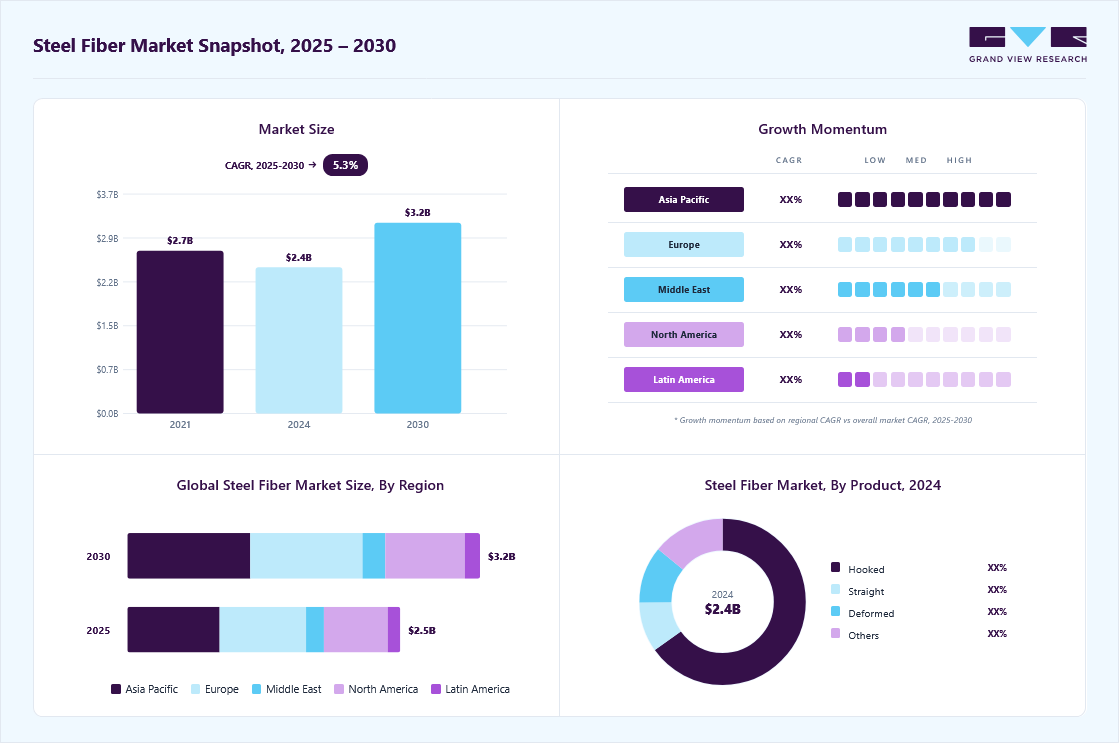
The global steel fiber market size was valued at USD 2.8 billion in 2025 and is projected to grow from USD 3.1 billion in 2026 to USD 4.2 billion by 2033, at a CAGR of 4.6% from 2026 to 2033. The market in Asia Pacific dominated with a revenue share of 33.7% in 2025. This growth is attributed to the increasing demand for high-performance construction materials, infrastructure development, and sustainable building solutions.
 Source: Grand View Research, IR Documents, Primary Interviews, Paid DatabasesTo learn more about this report,
 Download Free Sample Report
Key Market Trends & Insights
- By product: Hooked steel fiber segment held the largest market share of 65.8% in 2025.
- By application: Slabs & flooring segment held the largest market share of 46.8% in 2025.
Regional Highlights
- Largest regional market: Asia Pacific (33.7% revenue share, 2025)
- By country: China held the largest market share in 2025
Market Size & Forecast
- Market size in 2025: USD 2.8 Billion
- Estimated market size in 2026: USD 3.1 Billion
- Projected market size by 2033: USD 4.2 Billion
- CAGR (2026-2033): 4.6%
Three ways to get this report
Buy it, customize it, or ask a question.Ask an Analyst
Analyst response in 1 business day
- AccessReport author, directly
- Reply timeWithin 1 working day
- No sales callDirect answer only
- FormatEmail reply
- CostFree, no cost
Get the Full Report
What the study covers
- FormatsPDF · Excel · Dashboard
- Timeline2026–2033 annual, 2025 base
- Coverage20+ countries, 5 regions
- Companies10+ key players profiled
Customize the Report
20% free customization
- IncludeCountries, segments, points
- TailorTo your product definition
- ExtendDeeper competitor detail
- OrA fully bespoke study
- Turnaround5–10 working days
In addition, the need for durable, crack-resistant materials in construction, rising infrastructure investments in emerging economies such as China and India, and the superior mechanical properties of steel fibers such as high tensile strength, drives the market growth. Furthermore, the construction sector's shift towards eco-friendly and resilient building techniques is further propelling market expansion. To learn more about this report, Download Free Sample Report
Steel fibers are engineered metallic strands manufactured from pure metals or alloys, designed to enhance material performance across various industrial applications. These versatile fibers have emerged as transformative components in multiple sectors, offering unprecedented technological solutions. In the aerospace industry, metal fiber technologies are revolutionizing sound attenuation and filtration systems. Aircraft manufacturers are increasingly adopting sophisticated fiber composites to address growing noise pollution concerns near urban airports. These advanced materials effectively dampen cabin acoustic emissions, creating more comfortable flying experiences. Unlike traditional glass fiber media, metal fibers provide superior structural integrity through specialized sintering techniques, enabling more robust and reliable filtration mechanisms.
In addition, the textile sector has dramatically transformed by integrating metal fibers into functional materials. Conductive and antistatic textiles incorporating these innovative strands are gaining prominence across specialized domains such as pharmaceuticals, electronics, and medical technologies. These intelligent fabrics prevent electrostatic discharge, provide electromagnetic interference shielding, and enable sophisticated monitoring capabilities for complex physiological parameters. Furthermore, automotive industries are strategically leveraging metal fiber technologies to address increasingly stringent emission regulations. Crankcase airflow filters utilizing stainless steel non-woven media efficiently capture microscopic oil vapors from engine exhaust systems. Such advanced filtration solutions help manufacturers comply with rigorous environmental guidelines by reducing atmospheric contamination and improving overall engine performance.
Moreover, the convergence of metal fiber technologies represents a remarkable intersection of engineering innovation, environmental consciousness, and functional performance. Their extraordinary ability to enhance material properties across diverse applications positions them as critical components in modern industrial design. By offering sophisticated solutions that balance technological advancement with sustainability objectives, metal fibers are reshaping manufacturing paradigms and driving transformative changes across multiple industrial sectors.
Market Dynamics
The steel fiber market is experiencing robust growth, driven by increasing adoption of fiber-reinforced concrete (FRC) in infrastructure, commercial construction, industrial flooring, mining, and tunneling projects. Steel fibers are incorporated into concrete to improve tensile strength, crack resistance, impact resistance, fatigue performance, and durability while reducing the need for conventional reinforcement in many applications. Rapid urbanization, rising investments in transportation infrastructure, and growing demand for durable, low-maintenance concrete structures are key factors supporting market expansion.
The growing use of steel fiber-reinforced concrete in roads, bridges, tunnels, airports, ports, industrial floors, warehouses, and precast concrete elements is a major driver of the steel fiber market. Steel fibers enhance structural performance by improving load-bearing capacity, controlling shrinkage cracking, increasing abrasion resistance, and extending the service life of concrete structures. Governments worldwide are increasing investments in transportation, urban infrastructure, logistics facilities, and smart city developments, creating strong demand for high-performance construction materials.
Additionally, mining operations, underground construction, and tunnel projects are increasingly utilizing steel fiber-reinforced shotcrete due to its superior energy absorption, reduced rebound, and faster installation compared with conventional mesh reinforcement. The growing emphasis on sustainable and durable construction solutions is further accelerating the adoption of steel fibers.
Volatility in raw material prices, particularly carbon steel and stainless steel, remains a significant challenge for steel fiber manufacturers. Changes in steel prices, energy costs, and transportation expenses directly impact production costs and profit margins. Compared with conventional reinforcement methods, steel fibers often involve higher upfront material costs, which may discourage adoption in price-sensitive construction projects.
Growing investments in sustainable infrastructure, industrial facilities, renewable energy projects, and modern transportation networks present significant growth opportunities for the steel fiber market. Increasing adoption of precast concrete components, modular construction techniques, and high-performance concrete is driving demand for advanced reinforcement solutions that improve productivity while reducing maintenance requirements.
Analyst Perspective
The steel fiber market is poised for steady growth, supported by rising investments in infrastructure, industrial construction, tunneling, and precast concrete applications. Increasing adoption of fiber-reinforced concrete, coupled with the demand for durable, high-performance construction materials and ongoing product innovations, is expected to drive long-term market expansion.
Product Insights
The hooked steel fiber led the market with the largest revenue share of 65.8% in 2025. This growth is attributed to their exceptional ability to provide superior anchorage within concrete matrices, offering excellent crack control and enhanced tensile strength. In addition, their widespread adoption in industrial flooring, tunnel linings, and shotcrete applications stems from their proven performance in improving structural integrity, durability, and mechanical properties of construction materials.
The deformed steel fiber segment is expected to grow at a CAGR of 4.7% over the forecast period, owing to its remarkable performance in concrete applications, particularly in preventing cracking and water damage. Furthermore, these fibers are distinguished by superior abrasion and impact resistance, delivering better post-crack strength and meeting the increasing demand for high-performance construction materials that require enhanced structural resilience.
Application Insights
Based on application, the slabs & flooring segment led the market with the largest revenue share of 46.8% in 2025, primarily driven by increasing demand for non-structural and architectural building components, with concrete reinforcement playing a pivotal role. In addition, steel fibers help reduce slab thickness, improve placement efficiency, and save on concrete costs. Furthermore, their ability to minimize errors during fabric positioning and accelerate construction speed makes them attractive for modern building techniques, driving significant market expansion.
 To learn more about this report, Download Free Sample Report
The pavements & tunneling is expected to grow at a CAGR of 4.8% from 2026 to 2033 segment's growth is driven by infrastructure development projects and the need for durable transportation infrastructure. In addition, steel fibers enhance concrete pavements' performance, potentially decreasing fuel consumption and reducing greenhouse gas emissions. Furthermore, their superior mechanical properties, including improved tensile strength and crack resistance, make them ideal for constructing robust highways, tunnels, and transportation infrastructure.
Regional Insights
Asia Pacific dominated the steel fiber market with the largest revenue share of 33.7% in 2025. This growth is attributed to rapid urbanization, extensive infrastructure development, and significant construction projects. In addition, growing investments in green buildings, sustainable construction techniques, and technological advancements in manufacturing sectors are propelling market growth. Furthermore, emerging economies such as India and China are key contributors, with increasing demand for high-performance construction materials that offer superior durability, crack resistance, and enhanced mechanical properties.
 To learn more about this report, Download Free Sample Report
China Steel Fiber Market Trends
The steel fiber market in China held the largest share in the Asia Pacific region in 2025, driven by massive infrastructure expansion, urban development initiatives, and government-backed construction projects. In addition, the country's focus on sustainable infrastructure, transportation networks, and industrial facilities is creating substantial demand for steel fibers. Furthermore, technological innovations, increasing investments in infrastructure modernization, and the need for advanced construction materials with superior mechanical properties are driving market expansion.
Europe Steel Fiber Market Trends
Europe steel fiber market is expected to grow at a CAGR of 4.9% over the forecast period, owing to advanced manufacturing technologies, stringent sustainability regulations, and a strong focus on eco-friendly construction practices. Furthermore, increasing demand in industrial flooring, infrastructure rehabilitation, and specialized construction applications drives market growth. Moreover, the region's emphasis on energy-efficient buildings, infrastructure resilience, and innovative construction techniques contributes to the expanding steel fiber market.
The steel fiber market in Germany led the European market and accounted for the largest revenue share in 2025, primarily driven by technological innovation, precision engineering, and advanced manufacturing capabilities. The country's automotive, construction, and industrial sectors demand high-performance materials with superior mechanical properties. In addition, emphasis on sustainable infrastructure, energy-efficient buildings, and stringent quality standards contribute to the market's expansion. Furthermore, continuous research and development in material sciences further accelerate market growth.
North America Steel Fiber Market Trends
The North America steel fiber market is expected to grow significantly over the forecast period, owing to technological advancements, significant infrastructure reconstruction activities, and growing demand in mining and construction industries. In addition, increasing focus on sustainable infrastructure, infrastructure rehabilitation projects, and innovative construction techniques drive market expansion. Furthermore, the region's emphasis on high-performance materials, energy efficiency, and advanced engineering solutions contributes to the steel fiber market's robust growth.
The growth of steel fiber market in the U.S. is expected to be driven by extensive infrastructure development, reconstruction activities, and technological innovations. In addition, growing demand in construction, transportation, and industrial sectors, coupled with a focus on sustainable and resilient infrastructure, drives market expansion. Furthermore, increasing investments in smart city projects, advanced manufacturing techniques, and high-performance construction materials further accelerate the market's growth trajectory.
Key Steel Fiber Company Insights
Key companies in the global steel fiber industry include Bekaert, Fibrometals, Green Steel Group, and others. These companies are strategically focusing on product innovation, technological advancements, and strategic collaborations. In addition, they are actively pursuing mergers and acquisitions, developing specialized fiber products, expanding geographical presence, and investing in research and development to enhance their competitive positioning in the rapidly evolving construction materials sector.
-
ArcelorMittal offers a comprehensive range of steel fiber products including TABIX (undulated), HE (hooked-end), FE (flat-end), and HFE (hooked flat-end) variants. The company operates in concrete reinforcement segments such as infrastructure, industrial flooring, precast, and structural applications, providing innovative steel fiber solutions with enhanced mechanical properties.
-
Nippon Seisen Co., Ltd produces metal fibers with superior heat resistance, corrosion resistance, and versatile applications across multiple industries. The company operates in filtration, concrete reinforcement, heat-resistant materials, and advanced manufacturing sectors, offering innovative steel fiber solutions for diverse technical applications.
Key Steel Fiber Companies
The following key companies have been profiled for this study on the steel fiber market.
-
ArcelorMittal
-
Bekaert
-
Fibrometals
-
Green Steel Group
-
Kerakoll SpA
-
KOSTEEL CO, LTD.
-
Nippon Seisen Co., Ltd.
-
Severstal
-
SIKA AG
-
SPAJIC DOO
-
Zhejiang Boen Metal Products Co. Ltd
Competitive Benchmarking
Category
Operating Strategies
Competitive Edge
Weakness
Established Players (e.g., ArcelorMittal, Bekaert, Severstal, Nippon Seisen Co., Ltd.)
- Invest in advanced steel fiber designs with improved anchorage, durability, and corrosion resistance for demanding construction applications.
- Strengthening global distribution capabilities through regional manufacturing facilities and strategic partnerships with construction material suppliers.
- Expand participation in large-scale infrastructure, tunneling, and industrial flooring projects by offering application-specific reinforcement solutions.
- Extensive manufacturing expertise supported by integrated steel production and well-established global supply networks.
- Strong brand recognition and long-standing relationships with contractors, precast manufacturers, and infrastructure developers worldwide.
- Robust technical capabilities enabling the supply of high-quality steel fibers that meet international construction standards and project specifications.
- Business performance is influenced by fluctuations in construction spending and infrastructure investment cycles across major regions.
- Profitability is affected by changing steel prices, energy costs, and transportation expenses throughout the supply chain.
- Maintaining large-scale production facilities and meeting evolving environmental standards requires substantial ongoing capital expenditure.
Emerging & Regional Players (e.g., Fibrometals, KOSTEEL Co., Ltd., SPAJIC DOO, Stewols India Pvt. Ltd., Zhejiang Boen Metal Products Co., Ltd., Zhitai Steel Fiber Manufacturing Co., Ltd.)
- Expand domestic customer reach by strengthening partnerships with regional concrete producers, contractors, and precast manufacturers.
- Differentiate product offerings through customized fiber dimensions, packaging formats, and application-focused technical support.
- Improve manufacturing productivity by upgrading production equipment and optimizing operational processes to increase output efficiency.
- Strong understanding of regional construction practices and the ability to address local customer requirements effectively.
- Flexible manufacturing operations allow faster response to customized orders and changing project specifications.
- Competitive cost structures support growth in developing markets with increasing infrastructure and industrial construction activities.
- Limited international brand recognition restricts participation in large multinational infrastructure and engineering projects.
- Smaller production capacities reduce the ability to serve high-volume contracts across multiple geographic markets simultaneously.
- Financial and technological resources for product innovation and global expansion remain comparatively constrained.
Recent Developments
-
In January 2024, Bekaert’s innovative steel fiber solution, Dramix, was awarded the prestigious Pioneer Award by the Solar Impulse Foundation, recognizing its role in promoting ecological sustainability in construction. Collaborating with Société du Grand Paris and Eiffage, the use of Dramix steel fibers in the Grand Paris Express project has significantly reduced 10,000 tons of CO2 emissions per 10 kilometers of tunnels compared to traditional rebar methods. This award highlights the environmental benefits of steel fiber-reinforced concrete in large-scale infrastructure projects.
-
In September 2023, SIKA AG announced a significant investment in the production of macro fibers in the U.S., aiming to enhance its portfolio of concrete reinforcement solutions. This investment focuses on manufacturing synthetic macro fibers designed to improve the performance and durability of concrete, similar to steel fibers. The initiative underscores SIKA's commitment to delivering innovative construction materials that meet the growing demand for sustainable and high-performance solutions in the construction industry, particularly in infrastructure and commercial projects.
Steel Fibers Market Report Scope
Report Attribute
Details
Market definition
The market size represents the apparent consumption of steel fiber across key applications, including slabs & flooring, precast, pavements & tunneling, and other applications.
Market size in 2025
USD 2.8 billion
Estimated market size in 2026
USD 3.1 billion
Projected market size by 2033
USD 4.2 billion
Growth rate
CAGR of 4.6% from 2026 to 2033
Base year for estimation
2025
Historical data
2021 - 2024
Forecast period
2026 - 2033
Quantitative units
Revenue in USD million, volume in kilotons, and CAGR from 2026 to 2033
Report coverage
Revenue forecast, volume forecast, company ranking, competitive landscape, growth factors, and trends
Segments covered
Product, application, region
Regional scope
North America; Europe; Asia Pacific; Latin America; Middle East & Africa
Country scope
U.S., Canada, Mexico, China, India, Japan, Malaysia, Germany, UK, Russia, Brazil, Saudi Arabia
Key companies profiled
ArcelorMittal; Bekaert; Fibrometals; KOSTEEL Co., Ltd.; Nippon Seisen Co., Ltd.; Severstal; SPAJIC DOO; Stewols India Pvt. Ltd.; Zhejiang Boen Metal Products Co., Ltd.; Zhitai Steel Fiber Manufacturing Co., Ltd.
Customization scope
Free report customization (equivalent up to 8 analysts' working days) with purchase—addition or alteration to country, regional & segment scope.
Pricing and purchase options
Avail customized purchase options to meet your exact research needs. Explore purchase options
Global Steel Fibers Market Report Segmentation
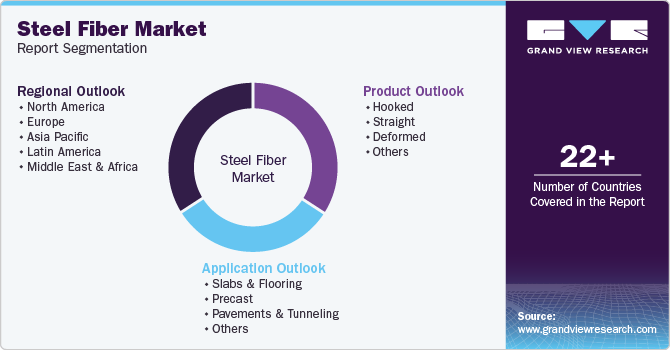
This report forecasts revenue growth at global, regional, and country levels and analyzes the latest industry trends in each sub-segment from 2021 to 2033. For this study, Grand View Research has segmented the global steel fibers market report based on product, application, and region:
 To learn more about this report, Download Free Sample Report
-
Product Outlook (Volume, Kilotons; Revenue, USD Million, 2021 - 2033)
-
Hooked
-
Straight
-
Deformed
-
Others
-
-
Application Outlook (Volume, Kilotons; Revenue, USD Million, 2021 - 2033)
-
Slabs & Flooring
-
Precast
-
Pavements & Tunneling
-
Others
-
-
Regional Outlook (Volume, Kilotons; Revenue, USD Million, 2021 - 2033)
-
North America
-
U.S.
-
Canada
-
Mexico
-
-
Europe
-
Germany
-
UK
-
Russia
-
-
Asia Pacific
-
China
-
India
-
Japan
-
Malaysia
-
-
Latin America
-
Brazil
-
-
Middle East and Africa
-
Saudi Arabia
-
-
Research Methodology
The steel fiber market figures in this report are based on a proven research process that combines executive interviews with secondary research from proprietary databases, company filings, and recognized regulatory and institutional sources. Market size is built through value-chain sizing - reconciling supply-side and demand-side estimates - and triangulated with bottom-up and top-down approaches. Every estimate passes multiple levels of expert validation before publication, with each steel fiber segment quantified using the revenue-capture definitions in the table below.
Segment Definition
Product
Revenue Capture Definition
Hooked
Revenue is attributed to hooked-end steel fibers designed to provide strong mechanical anchorage within concrete. Their ability to enhance structural integrity and resist crack propagation drives widespread use in industrial slabs, heavy-duty pavements, tunnel linings, and infrastructure projects.
Straight
This segment captures revenue from straight steel fibers incorporated into cementitious materials to improve tensile performance, minimize shrinkage cracking, and increase wear resistance. They are commonly utilized in precast elements, overlays, repair systems, and specialized concrete mixes.
Deformed
Revenue is generated from deformed steel fibers engineered with enhanced surface geometry to maximize bond strength with concrete. These fibers are preferred in demanding structural applications, including airport runways, bridge decks, shotcrete, and high-load industrial flooring.
Others
This category comprises revenue from specialty steel fibers such as crimped, wave-shaped, flat, stainless steel, and hybrid variants. These products serve niche applications, including refractory concrete, marine construction, hydraulic structures, defense infrastructure, and corrosion-sensitive environments.
Application
Revenue Capture Definition
Slabs & Flooring
Revenue is earned from steel fibers supplied for concrete flooring systems in factories, warehouses, logistics hubs, distribution centers, and commercial buildings, where they improve load distribution, reduce cracking, and increase abrasion resistance.
Precast
This segment includes revenue from steel fibers integrated into precast concrete products such as tunnel segments, pipes, utility chambers, sleepers, retaining panels, and modular structural components to enhance strength, durability, and manufacturing efficiency.
Pavements & Tunneling
Revenue is derived from steel fibers used in transportation and underground construction projects, including highways, airport pavements, metro tunnels, mining tunnels, and shotcrete applications, where superior toughness, impact resistance, and fatigue performance are essential.
Others
This segment covers revenue from steel fibers utilized in specialized concrete applications such as hydraulic structures, dams, marine facilities, refractory linings, concrete rehabilitation, mining infrastructure, and energy projects requiring long-term structural durability and crack control.
Estimation Model
Layer No.
Layer Name
Key Question
Description
01
Construction Demand Assessment Layer
Which sectors are driving steel fiber consumption?
Analyze demand generated from major construction activities, including industrial flooring, transportation infrastructure, precast concrete, tunneling, mining, and commercial buildings. Evaluate consumption across residential, commercial, industrial, and public infrastructure projects to determine the overall demand potential for steel fibers.
02
Production & Distribution Layer
How do steel fibers move from manufacturing to end users?
Assess global manufacturing capabilities by evaluating steel fiber production facilities, raw material procurement, product processing technologies, and regional production centers. Examine supply chain efficiency, distribution channels, import-export movements, and the availability of steel fibers across key geographical markets.
03
Application Adoption Layer
Where are steel fibers being incorporated in construction?
Evaluate the penetration of steel fibers across major concrete applications, including slabs, industrial floors, pavements, tunnel shotcrete, precast elements, and repair systems. Analyze adoption trends based on construction activity, infrastructure investments, project specifications, and the increasing preference for fiber-reinforced concrete over conventional reinforcement methods.
04
Market Value & Commercialization Layer
What factors determine market revenue?
Quantify market value by assessing sales across different steel fiber types, grades, dimensions, and end-use applications. Analyze the influence of construction spending, infrastructure development, raw material costs, product pricing, technological advancements, and regional demand patterns on overall market revenue generation.
Delivered Customizations
This report has been delivered with the following In-depth customizations
Client Request
Customization Delivered
Value Adds
Import Dependency & Domestic Production Analysis
Evaluated country-level dependence on imported steel fibers versus domestic manufacturing capacity, including supply adequacy and future production outlook.
Supported sourcing strategies, localization decisions, and supply chain resilience planning.
Market Opportunity & White Space Analysis
Identified underserved regions, emerging applications, and high-growth customer segments through demand gap analysis and competitive mapping.
Assisted in expansion planning, investment prioritization, and revenue opportunity identification.
Regional Demand & Project Pipeline Assessment
Delivered a detailed evaluation of steel fiber demand across key regions by analyzing infrastructure spending, industrial construction, tunneling, mining, and precast project pipelines. Included country-level demand outlook and regional growth potential.
Assisted in identifying high-growth markets, prioritizing regional expansion strategies, and aligning business development efforts with future construction activity.
Frequently Asked Questions About This Report
The global steel fiber market size was valued at USD 2.8 billion in 2025 and is estimated at USD 3.1 billion for 2026.
The global steel fiber market is expected to grow at a CAGR of 4.6% from 2026 to 2033, reaching USD 4.2 billion by 2033.
Hooked steel fiber led the market with the largest revenue share of 65.8% in 2025.
Asia Pacific dominated the steel fiber market with the largest revenue share of 33.7% in 2025.
The steel fiber market in China held the largest share in the Asia Pacific region in 2025.
The Asia Pacific region is expected to register the fastest CAGR of 5.1% during the forecast period
Based on applications, the slabs & flooring segment led the market with the largest revenue share of 46.8% in 2025.
The key players operating in the steel fiber market are ArcelorMittal, Bekaert, Fibrometals, KOSTEEL Co., Ltd., Nippon Seisen Co., Ltd., Severstal, SPAJIC DOO, Stewols India Pvt. Ltd.; Zhejiang Boen Metal Products Co., Ltd.; Zhitai Steel Fiber Manufacturing Co., Ltd., among others.
The key factor driving the growth of the global steel fiber market is the increasing adoption of steel fiber-reinforced concrete in infrastructure, industrial flooring, tunneling, mining, and precast construction applications due to its superior strength, durability, and crack resistance.
About the Author(s)
Advanced Interior Materials Research Team
Advanced Materials · Advanced Interior MaterialsThis report was authored by the advanced interior materials research team at Grand View Research - comprising two research analysts, one senior research analyst, and one industry expert - with specialized expertise in the advanced interior materials segment of the advanced materials industry. All findings are based on proprietary advanced materials databases, executive interviews, and regulatory analysis, subject to internal peer review prior to publication.
Last Updated:
Speak to Analyst

Customize this report to your needs - add regions, segments, or data points, with 20% free customization.
Or view our licence options:


ISO 9001:2015 & 27001:2022 Certified
We are GDPR and CCPA compliant! Your transaction & personal information is safe and secure. For more details, please read our privacy policy.


